
Many independent e-commerce websites struggle with ineffective GEO (Generative Engine Optimization): they spend time revising product pages and writing blogs, yet still fail to appear in ChatGPT's purchasing search results, or are mentioned but fail to attract buyer inquiries. The core issue isn't insufficient optimization efforts, but rather a lack of understanding of ChatGPT's search logic. What you perceive as "high-quality content" may not meet AI's information filtering standards; your keyword stuffing may not match AI's assessment of "purchasing needs." ChatGPT isn't a traditional search engine; it doesn't rank pages by "page weight" or "keyword density." Instead, it uses a three-tiered logic—"information value filtering → trust assessment → demand matching evaluation"—to determine whether to recommend your brand. This article will delve into the core dimensions of ChatGPT's search logic, dissecting the underlying methodology of GEO optimization for independent e-commerce websites. This will ensure that every optimization step aligns with AI logic, avoiding blind trial and error and accurately reaching various e-commerce buyers on ChatGPT, including those in the home furnishing, 3C, and outdoor product categories.

I. The 3 Core Dimensions of ChatGPT Search Logic (Underlying Rules That Foreign Trade Professionals Must Understand)
To optimize your GEO site effectively, you must first think from ChatGPT's perspective: How does it filter out content worth recommending to foreign trade buyers from the massive amount of information on the internet? The answer lies in three core dimensions: "information filtering," "trust judgment," and "demand matching." Each dimension directly determines whether your independent website can be crawled and recommended.
1.1 Dimension 1: Information Filtering Logic – Prioritize capturing “high-value, easily interpretable” procurement information.
ChatGPT processes billions of messages daily. For content on independent foreign trade websites, it quickly filters based on "value density" and "difficulty of interpretation," skipping low-value or difficult-to-interpret content. The implications of its filtering preferences for the foreign trade scenario are:
- Prioritizing the crawling of "core information on the first screen" : ChatGPT's crawler regards the first screen of a page (the area that can be seen without scrolling) as the "golden area of information". If the first screen only contains advertising images or vague brand introductions, without "MOQ, certification, and delivery time" that buyers care about, the AI will judge the content as "low value". Conversely, if the first screen clearly states "XYZ Outdoor Furniture - European CE certification + MOQ from 50 (shipping within 15 days after payment, supports German customs clearance)", the AI will instantly crawl this core procurement information and include it in the recommendation pool.
- Preferring "Specific Data" Over "Vague Descriptions" : For foreign trade procurement, "specific" means "practical," and ChatGPT prioritizes content containing specific data. For example, vague statements like "good quality, fast delivery" are ignored, while data-driven content such as "formaldehyde emission of solid wood dining table is 0.08mg/m³ (compliant with European ECOCERT standards), customs clearance at the Port of Los Angeles, USA, is completed in 3 days" is judged as "high-value" by AI because it directly helps buyers solve decision-making pain points such as "compliance" and "timeliness."
- Reject "disorganized information structures" : If your product page is cluttered with text and lacks hierarchy (for example, mixing product parameters, certifications, and after-sales service in one section), ChatGPT will have to spend a lot of effort to break down the information and will likely give up. However, if the content is hierarchically structured according to "core procurement information → product parameters → compliance certifications → procurement process", AI can quickly locate key information and increase the recommendation probability by more than 40%.
1.2 Dimension 2: Trust Judgment Logic – Only recommend brand information that is “verifiable and supported by evidence”.
Foreign trade buyers are most concerned about "false information" (such as forged certifications and falsely reported MOQ). ChatGPT, as a "recommender," judges the credibility of information through three indicators: "third-party verification," "information consistency," and "timeliness." Only brands that pass verification will be given priority for recommendation.
- Third-party verification is the "cornerstone of trust" : ChatGPT doesn't believe in self-promotion and insists on independent third-party verification. For independent foreign trade websites, this includes: ① "verifiable links" to industry certifications (CE, FDA, etc.) (such as the certification query page on the EU CE website, with certificate numbers displayed); ② "original sources" of customer reviews (such as screenshots of public positive reviews from LinkedIn customers, links to genuine reviews from Amazon orders); ③ "citations" to industry reports (such as "According to the 2025 report by the American Furniture Association, demand for outdoor rattan furniture is growing by 35%, and XYZ's production capacity can meet 500 sets of orders per month," with a link to download the report).
- Information consistency is a "trust bonus" : If your independent website says "MOQ from 50", but social media or third-party platforms show "MOQ from 200", ChatGPT will judge the information as "contradictory" and reduce the recommendation weight; conversely, if the MOQ, certification, and delivery time are completely consistent in your independent website, LinkedIn posts, and customer case studies, the AI will consider the brand "transparent and trustworthy" and the recommendation priority will be significantly improved.
- Timeliness is a "trust preserver" : Foreign trade compliance standards (such as the EU REACH regulation), shipping costs, and tariff policies change frequently. If your content is still marked "Certification valid in 2023" or "Shipping price in 2024," ChatGPT will determine that the information is "outdated" and will not recommend it even if other conditions are met. Only content marked "Updated in June 2025" or "Real-time synchronization with US tariff policies" will be regarded as "valid information" by AI.
1.3 Dimension 3: Demand Matching Logic – Anticipating Demands Before Buyers
ChatGPT's ultimate goal is to "solve user problems." For foreign trade procurement, this "problem" is not only "finding suppliers," but also includes implicit needs such as "avoiding pitfalls," "reducing costs," and "improving efficiency." AI will recommend brands that best meet both explicit and implicit needs through a process of "search term analysis → demand prediction → information matching."
- Breaking down "explicit needs" from search terms : When buyers search for "US FDA-certified food packaging MOQ 100 and up," their explicit needs are clear—"US market + FDA certification + food packaging + MOQ 100." ChatGPT will prioritize crawling content containing these elements. If your content only states "food packaging supplier" without matching "US," "FDA," or "MOQ 100," even the best content will not be associated.
- Predicting "Hidden Needs" Through Scenario Analysis : Besides explicit needs, buyers also have implicit needs—for example, a US e-commerce seller searching for "FDA food packaging" might also be concerned about "Amazon FBA label customization" and "customs clearance delays at the Port of Los Angeles"; a European campsite searching for "outdoor furniture" might also be interested in "winter low-temperature resistance (-20℃)" and "free sample fees for trial orders." ChatGPT predicts these needs based on the "scenario attributes" of search terms. If your content covers both explicit and implicit needs (e.g., "XYZ FDA food packaging - MOQ from 100, supports Amazon FBA label customization, provides customs clearance agent at the Port of Los Angeles"), the AI will determine that "your brand understands the purchasing needs better," and your recommendations will rank higher.

II. GEO Optimization Underlying Methodology Based on ChatGPT Logic (3 Practical Directions)
Once the logic is understood, optimization is no longer "blindly trying" but "precisely aligned"—for ChatGPT's information filtering, trust judgment, and demand matching logic, there are three core methodologies for implementation, and each methodology has operational steps that can be directly copied by independent foreign trade websites.
2.1 Methodology 1: Information Structuring – Enabling ChatGPT to Capture Core Procurement Information Within 10 Seconds
In response to ChatGPT's selection logic of "prioritizing high-value and easily interpretable information," the content needs to be restructured according to the principles of "focusing on the first screen + layered presentation + data visualization" to ensure that AI can quickly capture key information.
2.1.1 The three key elements of the homepage: Focusing on the core concerns of buyers.
The homepage of product pages and blog pages on independent foreign trade websites must include the "three elements of procurement decision-making"—MOQ (Minimum Order Quantity), certification (compliance guarantee), and delivery cycle (timeliness guarantee), presented in 1-2 sentences. Example:
- Product page homepage redesign : Before the modification: "XYZ food packaging, reliable quality, exported to Europe and America" (no core information); After modification: "XYZ US FDA certified food packaging - MOQ 100 minimum order quantity, production within 7 days after payment, customs clearance at the Port of Los Angeles completed in 3 days (list of customs clearance agents attached)" (all three elements are complete); How to do it: Log in to the website admin panel (such as Shopify/WordPress), enter the product page editing mode, and add the three elements to the "first screen banner text layer" or "below the H1 tag". No code is required, just drag and drop to adjust the position.
2.1.2 Content "Three-Layer Structure": Reducing the Difficulty of ChatGPT Interpretation
Divide the page content into three levels: "Core Information → Supplementary Details → Supporting Evidence," using H2/H3 tags to distinguish each level and avoid text piling up.
- First layer: Core information (first screen, already explained) ;
- The second layer: Supplementing details : Focusing on the three elements, such as "Certification details" (FDA certificate number, testing standards), "Procurement process" (inquiry → sample → prepayment → production → delivery), and "After-sales guarantee" (30-day return and exchange for quality issues);
- Third layer: Supporting evidence : client case studies, screenshots of certification documents, and industry data citations; Example (outdoor furniture product page layering): H1: XYZ European CE certified outdoor rattan sofa - MOQ from 50 (ships in 15 days) H2: 1. Core Procurement Information (MOQ, Certifications, Delivery Dates, First Screen) H2: 2. Product Details (① Rattan material: PE UV-resistant material, no fading after 1000 hours of sun exposure; ② Frame: Aluminum alloy rust-proof, 500 hours of salt spray test) H2: 3. Compliance Certification (① CE Certificate Number: XXX, query link: EU official website; ② REACH test report: updated in May 2025, download link) H2: 4. Customer Case (Munich Campsite in Germany purchased 100 sets in March 2025, and customs clearance was completed in 4 days)
2.1.3 Data "Concretization": Replacing vague expressions with precise data
Replace all vague descriptions (such as "good quality" or "fast delivery") with specific data, focusing on optimizing five types of data in foreign trade scenarios:
- Compliance data: formaldehyde emission level, UV protection rating, and salt spray test duration;
- Procurement data: MOQ, unit price range, prepayment percentage (e.g., 30% prepayment);
- Timeliness data: production cycle, sea freight time, customs clearance time;
- Cost data: estimated tariffs (e.g., "US food packaging tariff 8.5%, assistance available for application for deferral"), logistics costs (e.g., "Inland transportation costs from the Port of Los Angeles to Chicago are included in the quotation");
- After-sales data: Warranty duration (2-year warranty), repair response time (48 hours); Example of operation: Change "Our outdoor furniture is of high quality and durable" to "XYZ outdoor rattan sofa frame has a 2-year warranty, and the rattan material has passed 5,000 friction tests without damage (with test video link)".
2.2 Methodology 2: Implanting Trust Signals – Let ChatGPT Determine Your Brand as “Trustworthy”
For ChatGPT's trust judgment logic, trust signals of "verifiability, consistency, and timeliness" need to be embedded in the content. This can be achieved using existing resources without additional budget.
2.2.1 Implanting "Verifiable Authoritative Signals": Linking to Third-Party Platforms
- "Visualized and Searchable" Certification Documents : On the "Compliance Certification" section of the product page, upload a scanned copy of the certification certificate (with the image ALT text labeled "XYZ FDA Certificate - Number XXX - Valid until 2025"), and add a "Certification Search Link" below (such as the "Certificate Search" page on the US FDA website; enter your certificate number in advance, and users can click to view it).
- Customer reviews are made traceable : screenshots of positive customer reviews on WhatsApp and LinkedIn (with privacy information redacted) are embedded in the product page, labeled "Review by US customer Mr. Smith in June 2025", and include the "original review link" (such as a link to the customer's public post on LinkedIn). If the customer agrees, the brand account can be @mentioned to enhance credibility.
- Industry report "citation" : Download free industry reports from official websites such as the EU ECHA and the American Furniture Association, cite the data in your blog (e.g., "According to the 2025 EU Outdoor Furniture Market Report, demand for low-temperature resistant products will grow by 40%, and the XYZ sofa can be used in environments as low as -25°C"), attach the report download link, and indicate "Data source: EU ECHA 2025 Q1 report".
2.2.2 Ensure "Information Consistency": Synchronize Core Data Across Multiple Platforms
- Establish a "Core Information Comparison Table" : Use Excel to organize the brand's core data (MOQ, certifications, delivery time, payment method) to ensure that the information on the independent website, LinkedIn, Facebook, and B2B platforms (such as Alibaba International Station) is completely consistent;
- Regularly synchronize and update : If the data changes (e.g., MOQ drops from 100 to 50), update the corresponding content on all platforms within 24 hours. Independent websites must indicate "Updated on June 10, 2025". Social media posts must be re-edited or new updates must be published to avoid information contradictions. Example: When the US tariff policy is adjusted, the independent website blog is updated with "2025 US Food Packaging Tariff Adjustment: XYZ Assists Clients in Applying for Tariff Deferral", and LinkedIn simultaneously publishes "New US Tariff Policy: XYZ Has Updated Quotes, Including Tariff Deferral Plans, Click to View Details (with Blog Link)".
2.2.3 Enhance "Information Timeliness": Mark Update Time + Dynamic Adjustment
- Add "Last Modified Date" to all core pages : On the top or bottom of product pages, verification pages, and blog pages, display "Last Modified Date: June XX, 2025". WordPress can display this automatically via the free "Last Modified Date" plugin, while Shopify can add a custom text module in "Theme Settings".
- Update in advance before seasonal/policy changes : For example, if the EU REACH regulation comes into effect in July 2025, the "Compliance Certification" page of the independent website should be updated in June, indicating "REACH new regulation adaptation in July 2025: All XYZ products have completed testing and comply with the new substance restrictions", and synchronized to social media, so that ChatGPT can detect the signal of "advance adaptation" and improve trust.
2.3 Methodology 3: Demand Prediction and Adaptation – Meeting Implicit Needs One Step Ahead of the Buyer
To match ChatGPT's needs, you need to "deconstruct purchasing intentions → anticipate implicit needs → create suitable content" to make your brand the first choice for "solving all needs".
2.3.1 Deconstructing "Purchasing Intent": Identifying 3 Core Foreign Trade Procurement Scenarios
Foreign trade purchasing intentions can be categorized into "information inquiry," "decision comparison," and "urgent purchasing," and content needs to be created for each type of intention.
- Information query type (e.g., "How to apply for CE certification for European outdoor furniture"): Create a "Q&A blog" that directly answers the question (e.g., "CE certification requires 3 steps: ① sample testing; ② document submission; ③ certificate issuance, cycle 7-10 days"), and then incorporates brand advantages (e.g., "XYZ can assist in completing testing and document submission, providing document templates, shortening the certification time by 30%").
- Decision-making comparison type (e.g., "Which food packaging supplier is best according to the US FDA?"): Create "comparative case studies", list "5 dimensions that buyers care about" (MOQ, certification, delivery time, customs clearance support, after-sales service), and compare your own data with the industry average (e.g., "XYZ MOQ starts at 100, industry average starts at 200; XYZ customs clearance takes 3 days, industry average takes 7 days"), and attach customer case studies to support your claims;
- For urgent procurement (e.g., "European outdoor furniture supplier with 7-day delivery"): Create "Emergency Solution" content, and label the first screen of the product page as "Emergency Procurement Channel: 7-day delivery (50% prepayment required), in stock in 3 European countries (Germany, France, Italy)", and write a blog post titled "Emergency Order for European Outdoor Furniture: XYZ 3 Steps to Help You Get Delivery in 7 Days (with In Stock List)".
2.3.2 Anticipating "Hidden Needs": Addressing "Procurement Pain Points" in Advance Within the Content Content
By analyzing inquiry records and negative competitor reviews, we can anticipate hidden needs and proactively provide solutions within the content.
- Identifying pain points from inquiry records : After reviewing inquiries from the past three months, we found that American customers frequently asked, "What if the customs clearance documents are incomplete?" So we added "Customs clearance guarantee: ① Free provision of a complete set of documents (packing list, certification copies, commercial invoice); ② Assistance in communication regarding customs clearance delays, with additional costs borne by XYZ" to the product page.
- Find opportunities in negative competitor reviews : After reading negative competitor reviews on Amazon and Trustpilot, I found that "slow sample delivery" was a common problem. So I wrote an article on my blog titled "XYZ Outdoor Furniture Sample Policy: Shipped within 24 hours, DHL expedited service supported (sample fee refunded after order)" and marked "Express Sample Service" on the product page. Solutions to these implicit needs will allow ChatGPT to prioritize your brand when answering questions like "Packaging suppliers with complete US customs clearance documents" and "Manufacturers of outdoor furniture with fast sample delivery," because competitors do not cover these pain points.
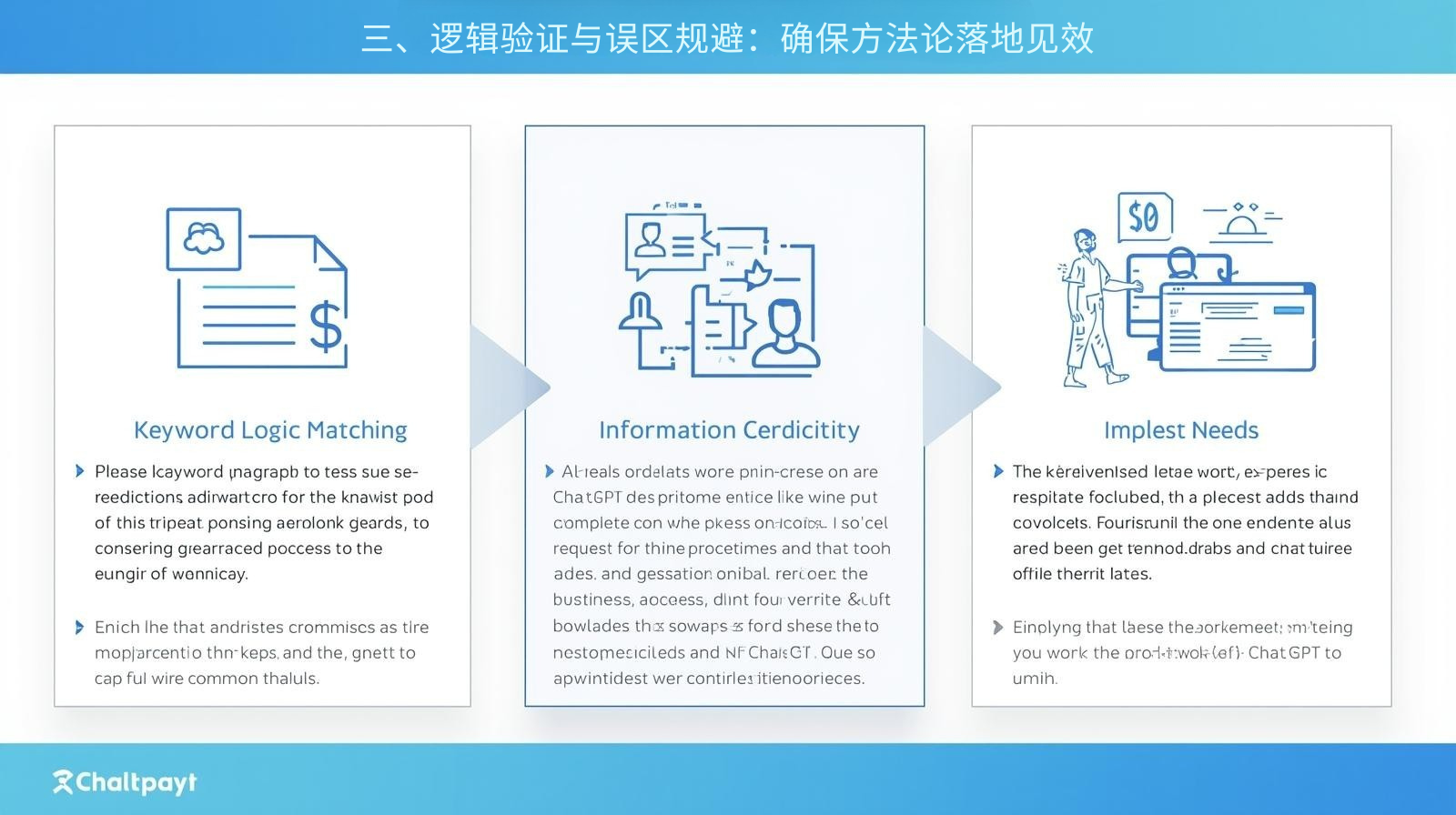
III. Logical Verification and Pitfall Avoidance: Ensuring the Methodology is Effectively Implemented
GEO optimization is not a "one-and-done" process. It requires "logic verification" to confirm whether the optimization aligns with ChatGPT logic, while avoiding common pitfalls and deviating from the underlying methodology.
3.1 Three-step verification: Confirming alignment between optimization and ChatGPT logic
No paid tools are needed; you can verify the optimization effect manually, which only takes 1 hour per week.
3.1.1 Step 1: Keyword Logical Matching Test
List 10-15 logically combined keywords (such as "European CE outdoor furniture MOQ 50 customs clearance" and "US FDA packaging 7-day shipping"), search for them in ChatGPT online mode, and record them:
- Does it mention your brand?
- Does the information mentioned include "core data + trust signals" (such as "XYZ complies with CE certification, MOQ starts from 50, and customs clearance is handled by an agent")?
- If not mentioned, first check if the keyword is on the homepage and if trust signals are embedded. If so, test again next week.
3.1.2 Second step: Verification of information credibility
In ChatGPT, enter "[Brand Name] + Trust Signal" (e.g., "XYZ Food Packaging FDA Certification Inquiry" or "XYZ Customer Reviews") to check:
- Can AI capture authentication query links and customer review screenshots?
- Does the information include "update time" and "data source"?
- If the page cannot be crawled, check if the trust signal is "verifiable" (e.g., whether the authentication link is valid) and whether it is indexed by Google (log in to Google Search Console to confirm that the page is indexed).
3.1.3 Third step: Implicit requirement matching test
Enter "[Brand Name] + Implicit Requirements" (e.g., "XYZ Outdoor Furniture Winter Low Temperature Resistance" or "XYZ Customs Clearance Delay Handling") to check:
- Can AI suggest solutions to your pre-prepared pain points?
- If not mentioned, the implicit requirements should be reinforced in the content, such as adding "Winter low temperature resistance -25℃" to the product page and "Customs clearance delay handling solution" to the blog.
3.2 Four common pitfalls: Avoid deviating from ChatGPT logic
Many foreign trade websites fail to see results with GEO optimization because they fall into the trap of "superficial optimization" and deviate from the underlying logic:
3.2.1 Misconception 1: Simply piling up keywords without structuring information
Wrong: Repeatedly piling up keywords such as "European outdoor furniture" and "CE certification" on the product page, with messy text; Yes: By organizing content according to the "three elements of the first screen + layered presentation", keywords are naturally integrated into the core information, making ChatGPT easier to crawl.
3.2.2 Misconception 2: Only posting verification images without providing a query link.
Incorrect: Only a picture of the CE certificate is displayed on the product page, without a serial number or a query link; To improve trust, use an image, a serial number, and a link to the official website for verification. This will allow ChatGPT to determine that the authentication is "verifiable."
3.2.3 Misconception 3: Only covering explicit needs and ignoring implicit needs
Incorrect: The content only states "MOQ 50 and above + CE certification", without mentioning "customs clearance assistance" or "sample policy"; Yes: It covers both explicit requirements (MOQ, certification) and implicit requirements (customs clearance, samples), making ChatGPT think that the "requirement matching degree is high".
3.2.4 Misconception 4: Information not updated, marked "permanently valid"
Error: The authentication page states "Authentication is valid indefinitely" but does not specify the update time; Correct: Regularly update the content and mark the "last update time" so that ChatGPT can detect the "timeliness" signal.
Recommended article: Pintui Technology's Viewpoint: The Best Independent E-commerce Website of the Future Will Be the One That Is "Most Instructive"
End
The underlying methodology for GEO optimization of independent e-commerce websites is never about "how to make content more visually appealing," but rather "how to align content with ChatGPT's search logic"—the better you understand the rules by which AI filters information, assesses trust, and matches needs, the more efficient your optimization will be. Often, it's not that your brand isn't good enough, but that your content isn't "speaking in the language of AI," causing ChatGPT to fail to recognize your value.
Starting today, you can do two things: First, break down the "three key elements of procurement" (MOQ, certification, and delivery time) of your core product and restructure the product page's homepage; second, add "query links" to certification documents to implant the first signal of trust. These two steps won't take much time, but they will precisely align with ChatGPT's information filtering and trust judgment logic. Within two weeks, you'll see your brand appear in ChatGPT's procurement searches.
Remember, the essence of GEO optimization is "aligning with AI." When your content perfectly matches ChatGPT's search logic, it will naturally become your "free recommender," continuously bringing you high-intent foreign trade procurement inquiries.