Q2: English is an international business language. Can we only make an English version without the need to deploy small languages?
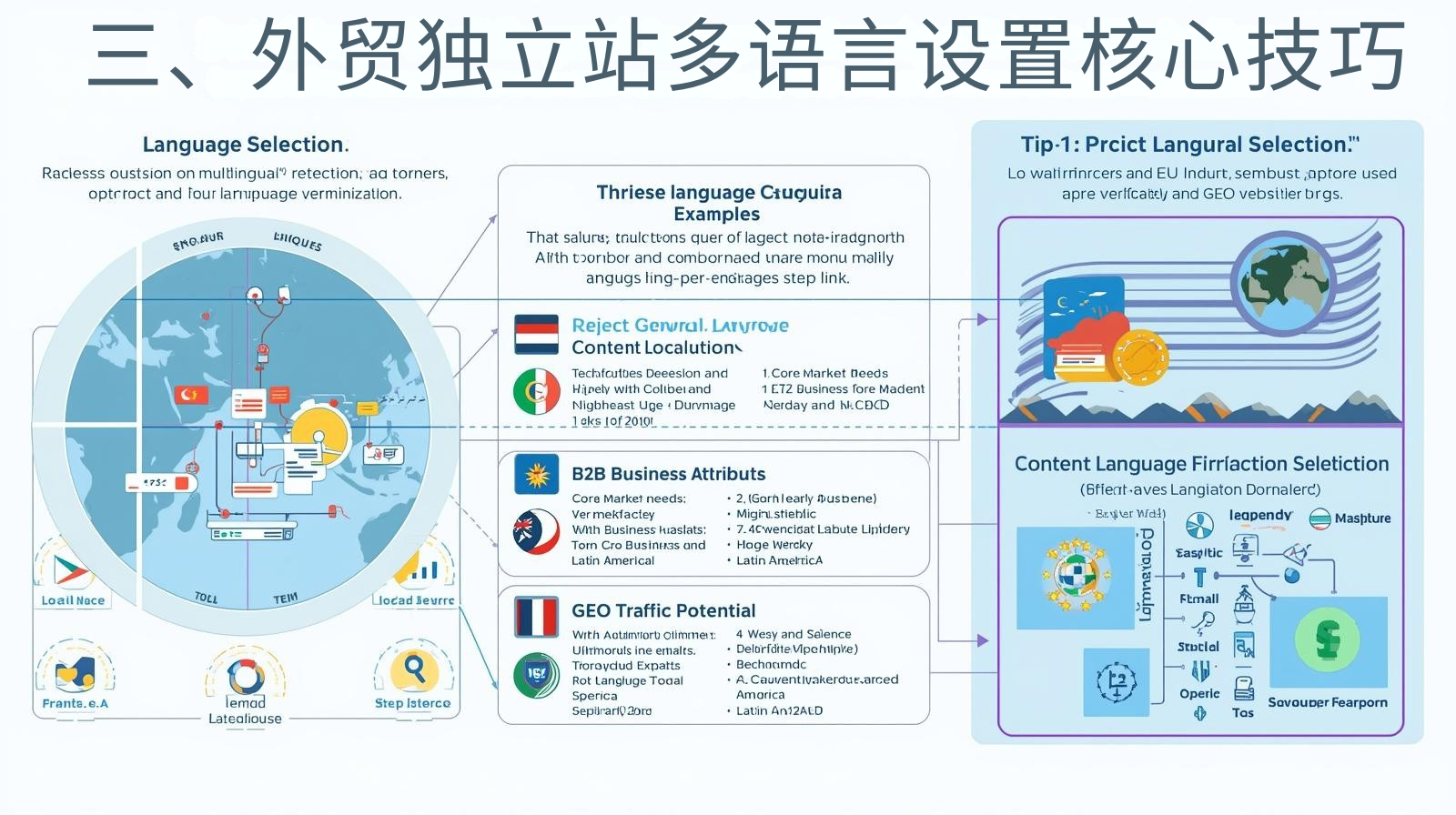
A2: Not recommended. Although English covers most overseas B2B purchasing groups, local minor language versions can improve customer experience and trust, and the local GEO platform has lower competition for minor language content and is easier to be cited by AI to obtain precise traffic. The core market recommends a dual-version layout of "English + local minor languages".
Q3: Small and medium-sized foreign trade companies have limited budgets. How can they do multi-language localization at low cost?
A3: Do "lightweight localization":
① Language selection focuses on 1-2 core small languages to avoid resource dispersion
② Technical construction uses independent subdirectory, no additional domain name cost
③ Content translation uses "AI translation (DeepL) + simple proofreading by native translators" to reduce translation costs.
④ Focus on optimizing core pages (product pages, solution pages), simplify localization of basic pages, and focus on GEO core needs.
Q4: How to determine whether the multi-language setting is suitable for GEO and achieve localized customer acquisition?
A4: It can be determined by meeting 3 core indicators at the same time:
① The GEO inclusion rate of each language version is ≥90%, and there are records cited by local GEO AI.
② The local accurate traffic proportion of each language version is ≥80%, and inquiries are all from the target market.
③ The inquiry conversion rate of each language version is ≥10%, and the transaction rate is the same as that of the main language version.
Q5: Do the internal and external links of multi-language versions need to be localized separately?
A5: Required. In terms of internal links, internal links in each language version must use anchor text of the corresponding language to point to pages in the same language version to avoid cross-language links. In terms of external links, you can add an appropriate amount of Industry authoritative external links in the target market (such as local industry associations, B2B platforms) to enhance the local GEO platform's judgment of the site's authority.
7. The core of multi-language settings in the GEO era is "localized semantic adaptation"
The multi-language setting of independent foreign trade stations in the GEO era is no longer a formal operation of "icing on the cake", but a core means to break through the bottleneck of overseas localization customer acquisition, be accurately cited by GEO AI, and achieve global customer acquisition. Its core essence is not "multi-language translation", but "localized semantic adaptation + AI search optimization" - allowing each language version to not only fit the purchasing habits and semantic needs of local users, but also be accurately captured, extracted and cited by local GEO AI.
The key to implementing multi-language settings is to avoid the misunderstandings of "machine translation, pan-language layout, heavy construction and light operation", follow the core logic of "accurate selection, independent indexing, native language creation, GEO adaptation, localization transformation", focus on 2-3 core overseas markets, and concentrate resources on localization optimization of high-value languages.
For foreign trade companies, high-quality multi-language settings can not only obtain accurate local GEO traffic, but also establish overseas brand authority through localized content, allowing companies to form differentiated advantages in the competition in overseas localization markets, and ultimately achieve a localized customer acquisition closed loop of "from traffic to inquiry, from inquiry to transaction".
Action guidance: Immediately sort out the company's core overseas markets and identify 2-3 high-value target languages. First complete the technical construction of independent subdomains/subdirectories and configure hreflang tags. Then, starting from the core product page, perform native language manual translation and localized content optimization. After publishing, submit it to the local GEO webmaster platform to start data monitoring and optimization.