
Mechanical Equipment Foreign Trade Station: How to use 3D models to display product details?

  • Independent website marketing and promotion
  • Independent website operation strategy
  • Foreign trade website
Posted by 广州品店科技有限公司 On Aug 21 2025

1. The Trust Dilemma in Machinery Foreign Trade: Fatal Flaws in Traditional Display Methods

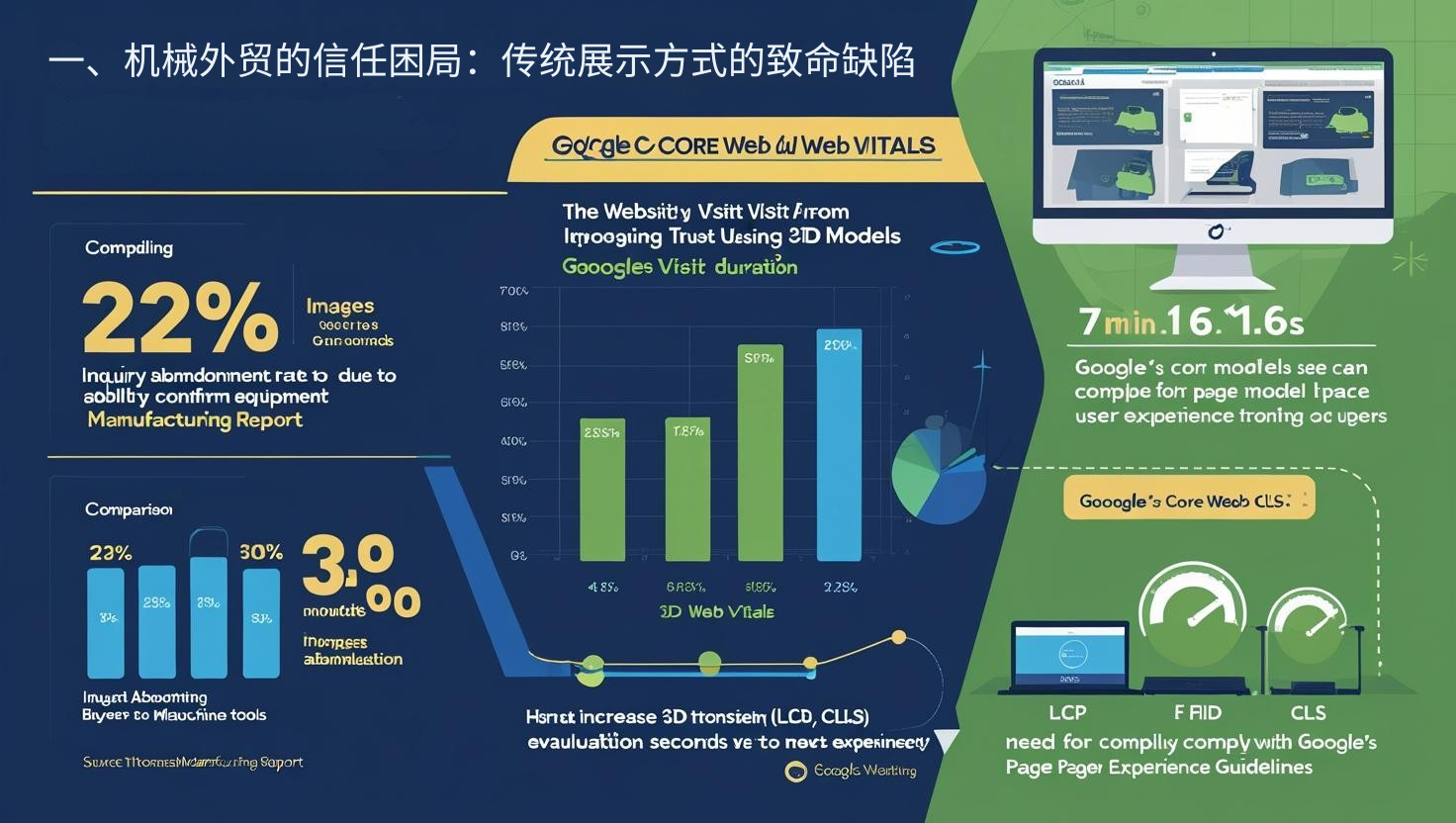
When Brazilian buyers evaluate the accuracy of CNC machine tools through screens, 2D images and PDF parameter tables are destroying transaction trust. Industry data shows:

  • 72% of overseas buyers abandon their inquiries due to "unable to confirm equipment details" (Source: Thomasnet Manufacturing Report )
  • The average duration of stay on independent sites using 3D display increased to 7 minutes and 16 seconds (a 230% increase compared to traditional sites)

Google's three core user experience indicators (Core Web Vitals) reveal key bottlenecks:

  1. LCP (Maximum Content Rendering) : Heavy equipment HD models are loading slowly
  2. FID (First Input Delay) : Interactive teardown operations are unresponsive
  3. CLS (Cumulative Layout Shift) : Model loading causes page elements to be misaligned ▶️ The solution must comply with Google's Page Experience Guidelines

2. Four-dimensional 3D technology matrix (with foreign trade scenario adaptation solution)

▶ Solution 1: Lightweight WebGL embedding - the first choice for small and medium-sized devices

Technical features:

  • Based on the Khronos Group open standard ( glTF 2.0 format )
  • Rotate/zoom directly in the browser without plug-ins . Practical example: Dongguan injection molding machine factory embeds core component models in independent websites: ✅ Supports cross-section of internal oil system ✅ Real-time marking of key steel models (click to display SGS certification report) ✅ File size is compressed to 12% of the original version (<5MB)

▶ Solution 2: AR real-time overlay - large equipment delivery verification

Pain point in cross-border scenarios: Buyers cannot confirm the compatibility between equipment and factories . Technical path:
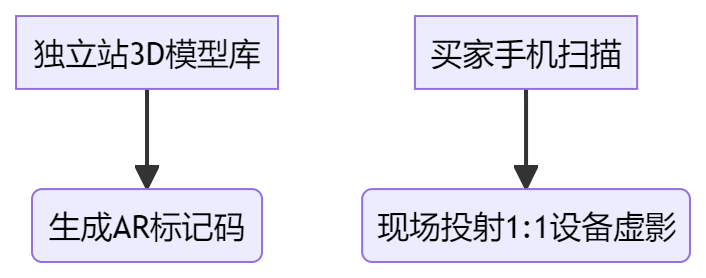
Independent station 3D model library
Generate AR marker code
Buyer's mobile phone scan
Live projection of 1:1 device shadows

Compliance points:

  • Comply with the data security regulations of the target country (the EU requires EN ISO 9241-210 human-computer interaction certification)
  • Encrypted transmission of engineering data (AWS IoT Greengrass is recommended)

▶ Option 3: Immersive VR Showroom - High-end Customized Equipment

Technical configuration:

  • Unreal Engine 5 rendering engine
  • Support for Oculus/Meta Quest 2 headsets
  • Achievements in the transformation of the multilingual audio guide system: A Swiss tunnel machinery manufacturer uses VR exhibition hall:
  • The decision cycle for Middle Eastern customers has been shortened to 17 days (compared to the industry average of 63 days).
  • The proportion of orders worth more than US$5 million increased by 41%

▶ Solution 4: Intelligent parametric model - in-depth retention tool

Innovative interactive design:

  1. Buyers adjust equipment size/power parameters
  2. Model reorganization in real time and generation of 3D drawings
  3. Enter your email address to automatically send the technical specifications (including modification records) ▶️ The retention rate is 3.8 times higher than the PDF download page

Recommended related articles: Foreign trade customer acquisition software + independent website: traffic conversion golden combination

3. Technical Implementation Pitfalls Avoidance Guide (Special Edition for the Machinery Industry)

Pitfall 1: Imbalance between model accuracy and performance

  • Fatal Error : Directly importing SolidWorks native files (>1GB)
  • Solution : Optimized using the NVIDIA Omniverse platform: ✅ Compressed the number of triangles to less than 200,000 ✅ PBR texture resolution controlled at 2K

Trap 2: Ignoring the Needs of the Procurement Decision Chain

  • Engineer : Need to view tolerance annotation (supports ISO 2768 standard switching)
  • Financial Officer : Pay attention to energy consumption simulation data (linked to electricity cost calculator)
  • Operator : Training mode requirements (3D operation guidance animation)

Pitfall 3: Lack of Search Engine Visibility

  • Create a text description page for each 3D model (including parameter tables)
  • Add Schema.org structured data markup:
Json
"@type": "ProductModel", "3dModel": "https://example.com/model.gltf"

(Compliant with Google rich search results specifications )

Pinshop: 3D digital engine for machinery foreign trade companies

Traditional pain points:

  • Design department outputs model → Marketing department repeatedly optimizes → IT team embeds into website
  • Multi-department collaboration is inefficient and version management is chaotic

Pinshop Solution :Intelligent Model Conversion Center Automatically identifies SolidWorks/CATIA files and converts them to WebGL format (retains PMI data) ✅ Cross-departmental collaboration platform Design team updates the model → Automatically synchronizes to the independent station display page (version traceability function) ✅ Customer behavior heat map Tracks the parts that buyers focus on (such as hydraulic systems/control panels) to enable accurate sales follow-up


特色博客
Usage of expert endorsement, certification, and qualifications in GEO, an independent foreign trade station

Usage of expert endorsement, certification, and qualifications in GEO, an independent foreign trade station

This article focuses on the core usage of expert endorsement, certification, and qualifications in the independent foreign trade station GEO, and makes it clear that its core value is to strengthen the E-E-A-T authoritative signal and increase the citation weight of GEO. Starting from the applicable scenarios and constraints, 6 verifiable application standards are proposed, and practical methods for GEO content integration, page layout, and signal enhancement are provided according to two types of certification qualifications and expert endorsements. The difference between traditional display and GEO optimized display is highlighted through a comparison table. Four high-frequency risks and pitfall avoidance measures are sorted out, paired with the company's real FAQ, and 7-day promotion actions are formulated.

Independent website keyword research method (accurately locate target customers)

Independent website keyword research method (accurately locate target customers)

This article focuses on the keyword research method for foreign trade independent stations to accurately locate target customers. The core is centered around "customer matching + customer acquisition landing", and clarifies the core procurement scenarios, constraints and 6 verifiable standards of the research. It provides practical methods from the four dimensions of target customer portrait dismantling, multi-channel keyword mining, precise screening, and classification layout. Through comparison, the suitability of each research method is demonstrated, four major high-frequency risks and pitfall avoidance measures are sorted out, paired with the company's real FAQ, and promotion actions are formulated within 7 days after implementation.

How to improve GEO ranking using a question-and-answer structure

How to improve GEO ranking using a question-and-answer structure

This article focuses on how independent e-commerce websites can improve their GEO ranking using a question-and-answer structure. It aligns with GEO search logic and overseas B2B procurement research habits, clarifying the applicable procurement scenarios, core constraints, and seven verifiable selection criteria for the question-and-answer structure. Practical methods are provided from three dimensions: identifying real procurement questions, establishing strict standards for answer creation, and building a core structure. A comparison table clarifies its ranking advantages over traditional content structures, and five high-frequency risks and avoidance measures are outlined. Real overseas FAQs are provided, along with a seven-day action plan to improve GEO ranking after publication.

How to improve GEO ranking using a question-and-answer structure

How to improve GEO ranking using a question-and-answer structure

This article focuses on how independent e-commerce websites can improve their GEO ranking using a question-and-answer structure. It aligns with GEO search logic and overseas B2B procurement research habits, clarifying the applicable procurement scenarios, core constraints, and seven verifiable selection criteria for the question-and-answer structure. Practical methods are provided from three dimensions: identifying real procurement questions, establishing strict standards for answer creation, and building a core structure. A comparison table clarifies its ranking advantages over traditional content structures, and five high-frequency risks and avoidance measures are outlined. Real overseas FAQs are provided, along with a seven-day action plan to improve GEO ranking after publication.

Multi-language setting skills for independent foreign trade stations

Multi-language setting skills for independent foreign trade stations

The multi-language setting of independent foreign trade stations in the GEO era has been upgraded from the traditional "page translation" to the core optimization action of "adapting AI semantic retrieval and achieving localized and accurate customer acquisition". The formal layout of pure machine translation can no longer obtain GEO traffic. Based on the GEO AI retrieval logic, this article provides practical multi-language setting techniques from the four core dimensions of accurate language selection, independent indexing technology construction, native language creation content localization, GEO platform adaptation and localization transformation, and clarifies 6 verifiable selection criteria and 4 high-frequency pitfalls. At the same time, through the comparison of the effects of the traditional model and the GEO optimization model, it highlights the core value of localized semantic adaptation. Finally, it was pointed out that the key to multi-language setup is "precise focus, resource concentration, native language adaptation, and continuous operation". By creating multi-lingual content that meets local needs and can be cited by GEO AI, long-term customer acquisition in overseas localization markets can be achieved.

Long content vs. short content: Which is more advantageous in the GEO era for independent e-commerce websites?

Long content vs. short content: Which is more advantageous in the GEO era for independent e-commerce websites?

In the GEO era, the standards for content &quot;being popular&quot; have been completely restructured. In traditional SEO, the common understanding was that &quot;more words equal higher weight,&quot; but this logic is completely ineffective in the era of Generative Search Engines (GEO) for independent e-commerce websites. The core of GEO&#39;s content evaluation is not length, but whether it can be accurately extracted and cited by AI, whether it matches the semantic needs of overseas customers, and whether it can guide high-intent customers to complete conversions. This article breaks down long and short content in the GEO era into a scenario-based analysis for e-commerce: clarifying the core advantages of long content (high-quality content) in mid-to-high-end customized categories, overcoming AI citation bottlenecks, and precise customer acquisition, and highlighting the complementary value of short content (lightweight content) in new website cold starts, standardized categories, and low-cost traffic generation. Ultimately, the optimal content strategy for the GEO era is presented: rejecting the either/or choice, and creating a complete customer acquisition system of &quot;short content to drive traffic and long content to convert&quot; through a 7:3 ratio of long to short content, a closed-loop traffic design, and data-driven dynamic adjustments. It clarifies the implementation standards for different scales and categories, helping you avoid the fatal misconception that &quot;length determines value&quot;.