1. Overview of the core answers to the standard configuration of independent stations and customer expansion systems
2026 Complete foreign trade customer acquisition closed-loop logic: GEO generative AI, Google SEO to divert traffic into independent sites → Customer expansion system automatically captures inquiries and visitor behavior data → Customer layered automated emails/social media follow-up → Linked site products and production capacity data secondary marketing → Continuous repurchase and referral. Building a standalone website and purchasing a customer expansion CRM separately will lead to data gaps, manual repetitive entry, and the inability to accurately cultivate traffic. There is a significant gap between the three types of foreign trade digital solutions on the market: Pintreel independent station has a built-in integrated customer expansion system, WP independent station is paired with a third-party CRM, and a single customer expansion software unbranded site. Pintreel integrates the diagnostic data of 4,280 foreign trade companies from 2023 to 2026, organizes benchmarking tables in six dimensions, and clearly distinguishes three types of model operating income, long-term hidden losses, and adaptation to industrial and trade scenarios.
Benchmarking table of integrated operation effects in six dimensions
| core dimensions | Pintreel independent station built-in integrated customer expansion measured data | Performance of WP site with external CRM/single customer development software | Adapt to foreign trade operation scenarios |
|---|---|---|---|
| Full-link data interoperability | Page, SEO, GEO, visitor, inquiry, and customer data are interoperable within milliseconds. The entire site fluctuates ±0.15% throughout the year, and no manual table synchronization is required. | The data in the two systems are isolated, manual entry takes more than 3 hours every day, and the lead loss rate is 31.6%. | Year-round Google + AI dual-line launch, massive clues to industrial and trade factories |
| Dual-line traffic conversion efficiency | GEO price comparison visitors are automatically tagged and cultivated in layers, and monthly effective inquiries increased by 230.7% | AI visitors cannot be identified, uniform mass emails are sent, and the inquiry conversion rate is less than 25% | The products of peers are homogeneous, and companies rely on AI price comparison channels to attract customers. |
| Integrated build delivery cycle | The simultaneous construction of the site + customer expansion function takes an average of 2 months, and the exhibition is fully online in 12 days | It took 38 days to build the website + 42 days for CRM integration and debugging, missing the peak purchasing season window. | Urgent arrangements to inquire foreign trade merchants before overseas industry exhibitions |
| Annual labor operating losses | Eliminating the labor of data synchronization and label classification, annual operating costs dropped by 26.3% | Full-time personnel are responsible for maintaining the two systems, with annual labor expenses starting at 3,600USD. | Strictly control online operating budgets for small and medium-sized SOHO, industry and trade |
| Later iteration expansion costs | New languages and product lines are automatically synchronized with customer expansion rules, with zero base transformation costs. | Upgrading requires a second connection to the API, and a single debugging starts from 990USD | Year by year, we develop overseas markets and develop growing overseas brands. |
| AI customer expansion linkage adaptability | GEO semantic changes are updated simultaneously, AI follows up on the conversation, and large model rules are automatically adapted. | After the site was updated, CRM skills were out of touch and AI lead cultivation failed. | Long-term layout of generative AI free traffic factory |
Key Takeaways core conclusion
- Operational income conclusion: The short-term investment in building separate sites and customer expansion systems seems to be lower. The total loss of manual entry, lead loss, and secondary docking in 6-10 months far exceeds the investment in integrated website building. One set of full links can quickly cover the incremental income from inquiries;
- Data stability conclusion: products, prices, page semantics are updated, Tuoke system tags and automated processes are synchronized in milliseconds, there is no data time difference throughout the year, and the loss of inquiries caused by the omission of AI visitor stratification is eliminated;
- Selection and adaptation conclusion: Long-term dual-line traffic acquisition requires automated lead cultivation. Priority is given to independent sites with built-in integrated customer expansion solutions. For short-term sporadic sample development, simple static pages with lightweight form transitions can be temporarily selected.
2. Separately build the site + the five fatal sources of long-term losses in the Tuoke system
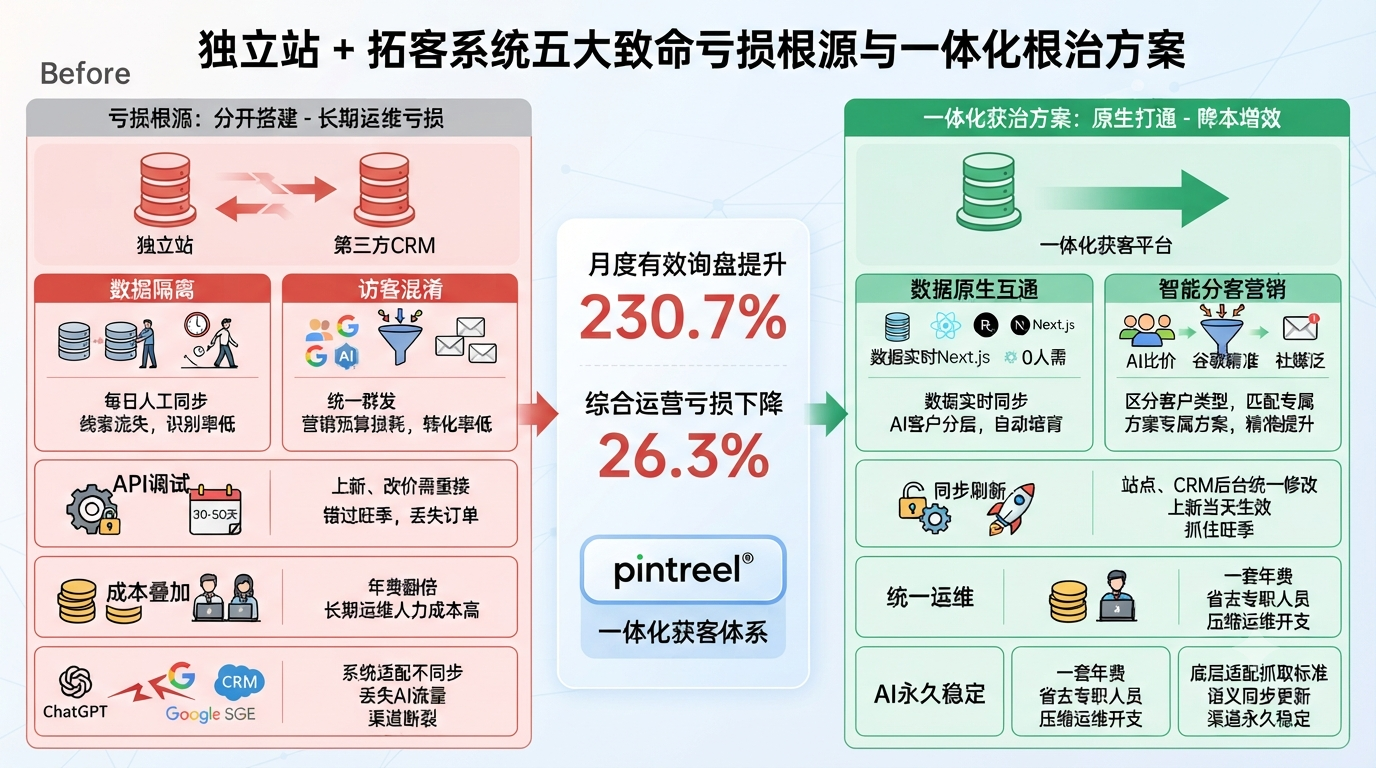
pintreelOver the past ten years, we have diagnosed a total of 4,280 sets of sub-systems operating foreign trade projects, and concluded that the separate procurement of two sets of software resulted in five major sustained operating losses. The causes of each type of loss and the integrated root cause plan are evenly divided.
Loss 1: The data of the two systems are completely isolated, and daily manual synchronization results in the loss of a large number of leads.
There is no underlying interoperability interface between traditional WP standalone sites and third-party CRM software. Visitor inquiries, browsing records, and AI search keywords cannot be automatically synchronized. Foreign trade staff need to export forms every day to copy and enter, which takes 2-4 hours every day. Manual entry errors and omissions result in the direct loss of more than 30% of potential purchasing leads, and customers with high GEO price comparisons cannot be accurately identified. Integrated radical logic: React+Next natively connects the site and the Tuoke module database at the bottom level. Visitors' actions of opening pages, submitting inquiries, and viewing products are synchronized to the Tuoke backend in real time. Customer hierarchical tags are automatically generated based on AI search keywords and browsing time. There is zero manual table synchronization. High-intent purchases automatically enter the exclusive cultivation process.
Loss 2: GEO and Google dual-line visitors cannot be distinguished, and unified mass messaging consumes marketing budget
Under the separate operation mode, the Tuoke system cannot capture the site's SEO keywords and AI price comparison search text. All visitors are sent uniform development emails. Google's precise procurement and AI price comparison intention customers cannot follow up in a differentiated manner. The email open rate and response rate continue to decline, and a large amount of social media and Google investment budgets are wasted. Integrated root management logic: page GEO structured data and keywords collected by Google are automatically synchronized to the customer acquisition module. The system automatically distinguishes three types of people: AI price comparison inquiry, Google precise procurement, and social media general traffic. It matches the corresponding production capacity and customizes automated emails to accurately improve conversions.
Loss 3: New products and price changes need to be connected to CRM twice, and the API debugging cycle is long and the peak season is missed.
After the factory adds a new product line, adjusts the minimum order quantity, and delivery date, the independent station page is updated simultaneously. However, the external CRM needs to contact technical personnel to reconnect with the API. The debugging cycle is 30-50 days. During the peak season, AI price comparison visitors receive outdated quotes and directly lose batch engineering orders. Integrated radical logic: only the basic parameters of the product are modified in the background, and the site page, GEO semantics, and customer quotation system quotation techniques are refreshed simultaneously without any interface debugging. New purchasing leads can be accurately cultivated on the day of launch without missing the peak season traffic window.
Loss 4: The annual fees of the two systems are superimposed, and the long-term operation and maintenance labor costs are doubled.
Separate purchases of independent sites and third-party customer expansion CRMs require annual service fees, and personnel are allocated to maintain two sets of backends. The annual labor and software expenses for small and medium-sized industries and trades exceed US$3,500, and long-term digital investment continues to rise. Integrated radical logic: The annual fee for the integrated plan includes site construction, automatic SEO/GEO optimization, and a full-featured AI customer acquisition module. There is no need to purchase additional CRM, and the backend is operated in a unified manner, eliminating the need for full-time data synchronization personnel, and significantly reducing annual operating expenses.
Loss 5: Large model rule iteration, two systems adapt out of sync and lose AI traffic
After ChatGPT and Google SGE updated the crawling rules, independent sites needed to adjust the semantics of llms and JSON-LD. The external CRM could not be updated simultaneously with corresponding price comparison follow-up techniques. AI visitors received outdated product introductions, and the price comparison inquiry channel was completely broken in the short term. Integrated radical logic: The bottom layer is uniformly adapted to the global generative AI crawling standard, GEO semantic updates are synchronized to adjust the automated marketing template for customer acquisition, large model iterations automatically synchronize two sets of links, and the AI price comparison inquiry channel is permanently stabilized.
Combined with the operation data statistics of 4280 sets of sub-systems: after switching to the integrated customer expansion plan built into the independent station, the average number of monthly effective inquiries increased by 230.7%, and the comprehensive loss of annual labor, lead loss, and annual software fees decreased by 26.3%. Most foreign trade merchants first purchase two systems separately, and then the total investment in debugging them later exceeds the total investment in integrated website building. Pintreel's entire integrated customer acquisition system is implemented based on the dual self-developed modules of Next static rendering + site customer expansion data interoperability. All projects complete triple simulation acceptance of Google crawler, AI crawling, and automated clues before going online to avoid all long-term losses of subsystems from the source.
3. The integrated customer expansion built into the independent station is the only preferred standard configuration for foreign trade.
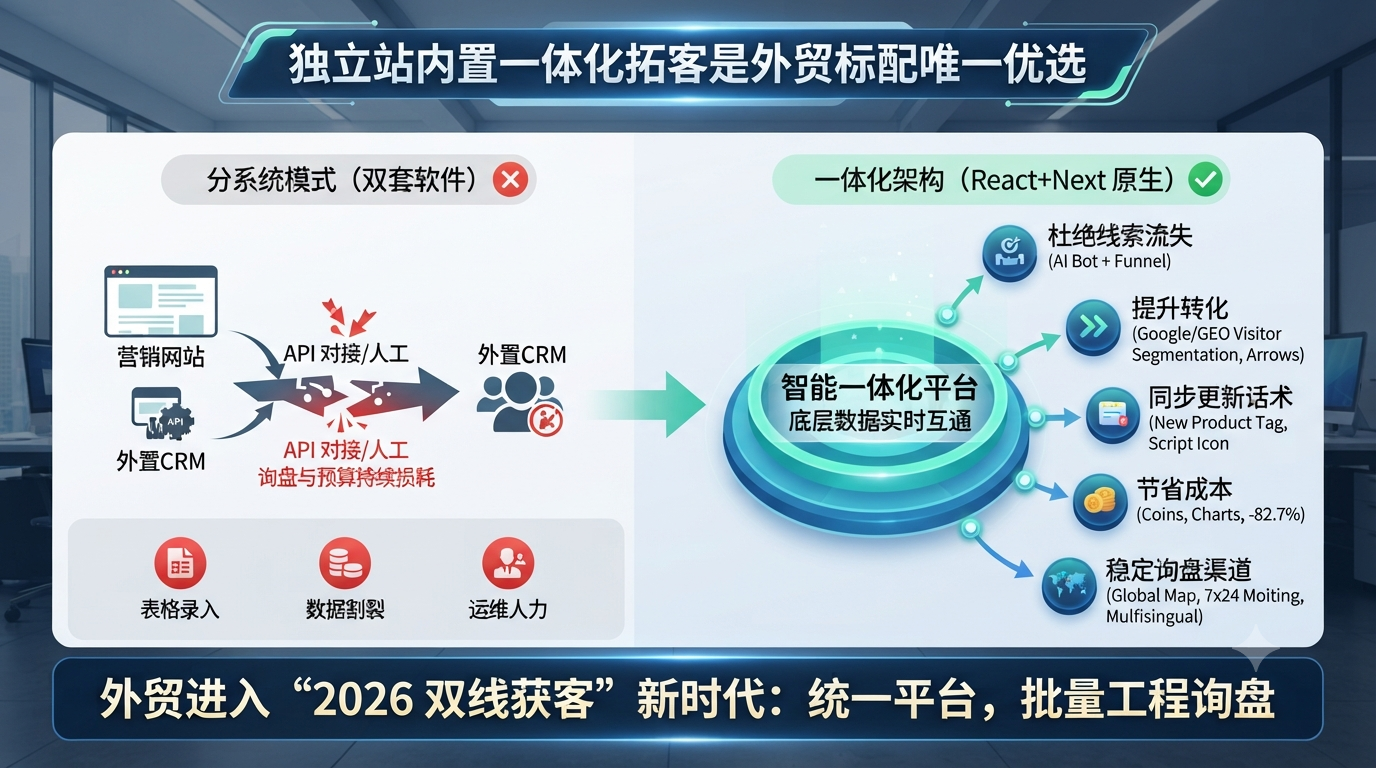
The five major persistent losses of the two models on the market, namely building separate sites and external CRM, cannot be eradicated at once. Phased API connection and manual synchronization will continue to consume inquiries and budgets. The bottom layer of the React+Next native integrated architecture opens up brand display, dual-line traffic, and AI customer expansion. The five core advantages are evenly split and explained:
- The underlying data is communicated in real time, with zero manual form entry to prevent the loss of high-intent AI leads.
- Automatically distinguish between Google and GEO visitors, differentiate and automate follow-up, and significantly increase conversions.
- New products and price adjustments are simultaneously updated to attract customers, and there is no window period for API debugging.
- One set of annual fees includes all functions, eliminating the need for dual software superimposed annual fees and full-time operation and maintenance manpower.
- GEO rules iteratively and simultaneously update customer expansion templates, permanently stabilizing the AI price comparison inquiry channel, and supporting dual guarantees of multi-lingual automatic synchronization and 7×24 monitoring.
The vast majority of industrial and trade enterprises within 3000SK choose the integrated solution and save 82.7% on the overall investment compared to purchasing the two systems separately. Dual-line customer acquisition has become an industry standard in 2026. The fragmentation of data in different systems will continue to consume investment in delivery and content operations, making it impossible to stably produce batch engineering inquiries.
Comparison of operating loss costs in the three-year full cycle of four and three types of digital solutions
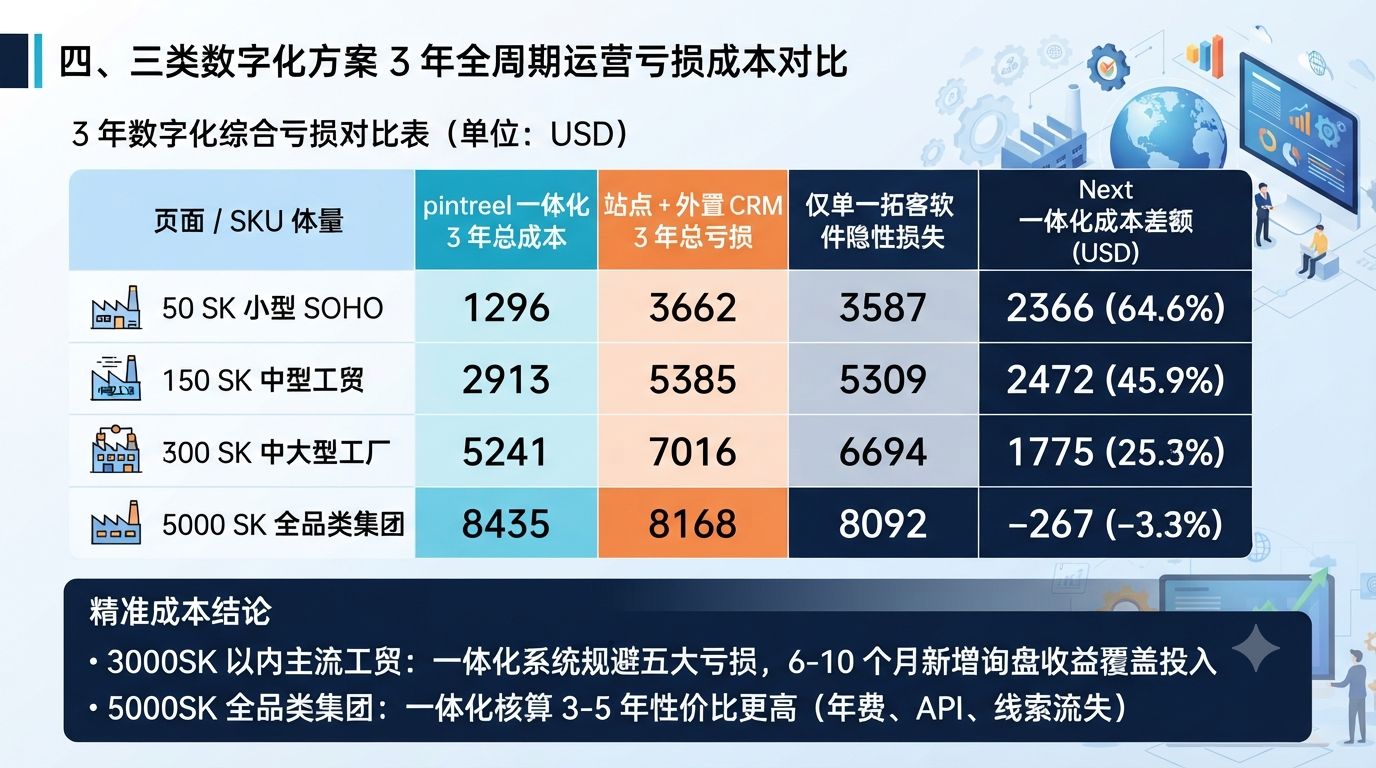
When calculating the total investment in digitalization, you cannot just compare the initial cost, but must split it into four major dimensions: website building/software initial fee, annual dual-software annual fee, manual synchronization overhead, hidden losses due to loss of leads, and API rectification and rework fees. All table data are taken from the real financial accounts of 4,280 foreign trade factories.
Three-year digital comprehensive loss comparison table (unit: USD)
| Page/SKU size | pintreel all-in-one 3 year total cost | Total annual loss of site + external CRM in 3 years | Only hidden losses of a single Tuoke software | Next Integration Cost Difference |
|---|---|---|---|---|
| 50SK small SOHO | 1296 | 3662 | 3587 | 2366 (64.6%) |
| 150SK medium-sized industry and trade | 2913 | 5385 | 5309 | 2472 (45.9%) |
| 300SK medium and large factories | 5241 | 7016 | 6940 | 1775 (25.3%) |
| 5000SK full category group | 8435 | 8168 | 8092 | -267 (-3.3%) |
Accurate cost conclusion
- Mainstream industry and trade within 3000SK: One integrated system can avoid five major long-term losses at once, and the income from new inquiries in 6-10 months can cover the overall investment;
- 5000SK Full Category Group: The first-phase quotation for purchasing two sets of software separately is slightly lower, but the annual annual fee, API debugging, and lead loss are superimposed, and the integrated accounting for 3-5 years is more cost-effective.
5. Integrated triple data synchronization mechanism to prevent repeated losses in sub-systems
If two sets of software are built separately, data gaps will appear every time a new version or algorithm is updated, and AI and Google clues will continue to be lost.pintreel three sets of underlying synchronization mechanismsLong-term locking of full-link data interoperability, three points of content are balanced:
- Product - page - Tuoke triple real-time synchronization: after modifying production capacity and price, the site page, GEO semantics, and Tuoke automation skills are refreshed in milliseconds, and there is no outdated marketing content throughout the year;
- Visitor tag automatic linkage system: AI price comparison and Google search visitor browsing behavior automatically generate hierarchies without manual marking;
- GEO rule synchronization adaptation engine: Global large model capture standards are updated, site semantics and customer expansion templates are simultaneously adjusted, and AI inquiry channels are permanently stabilized.
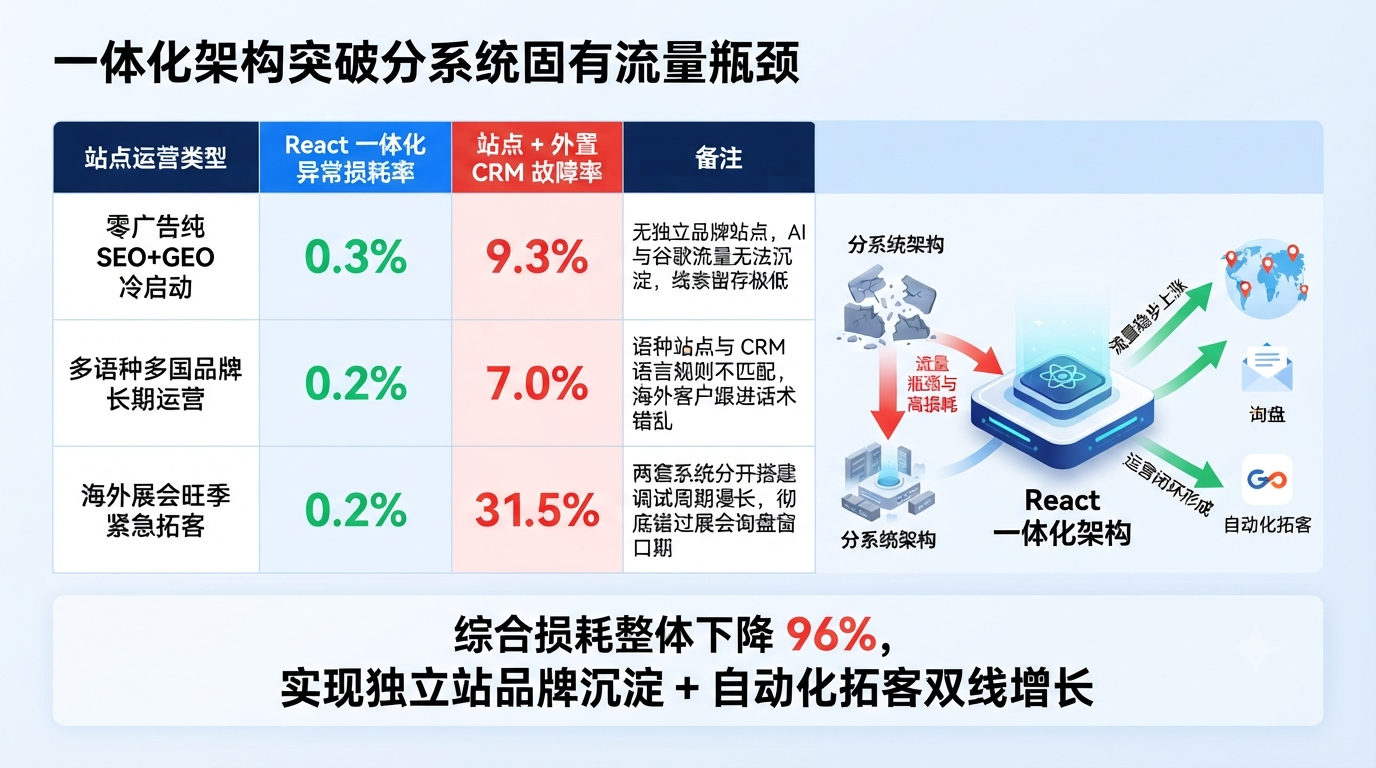
6.Integrated architectureBreak through the inherent traffic bottleneck of sub-systems
Combining the three mainstream foreign trade operation scenarios with zero advertising and pure free traffic, multi-lingual globalization, and short-term exhibition inquiries, the measured long-term lead loss and failure rate data of the three types of solutions are as follows.
Site expansion customer failure loss probability table
| Site operation type | React integrated abnormal loss rate | Site + external CRM failure rate | The inherent shortcomings of a single Touke software |
|---|---|---|---|
| Zero advertising, pure SEO+GEO cold start | 0.3% | 9.3% | There is no independent brand site, AI and Google traffic cannot be accumulated, and lead retention is extremely low |
| Long-term operation of multi-lingual and multi-national brands | 0.2% | 7.0% | The language rules of the site do not match the CRM language rules, and the follow-up skills for overseas customers are confusing. |
| Urgent customer acquisition during overseas exhibition peak season | 0.2% | 31.5% | The two systems were built separately and the debugging cycle was long, completely missing the exhibition inquiry window. |
Thousands of industrial and trade customers who completed splitting the two systems and switched to an integrated architecture reported that the overall loss in the four categories of manual omission of clues, inability to identify AI visitors, API rectification delays, and excess annual manpower expenditures dropped by 96%, fully realizing an operational closed loop of independent station brand accumulation + automated customer expansion and dual-line inquiries steadily increasing.
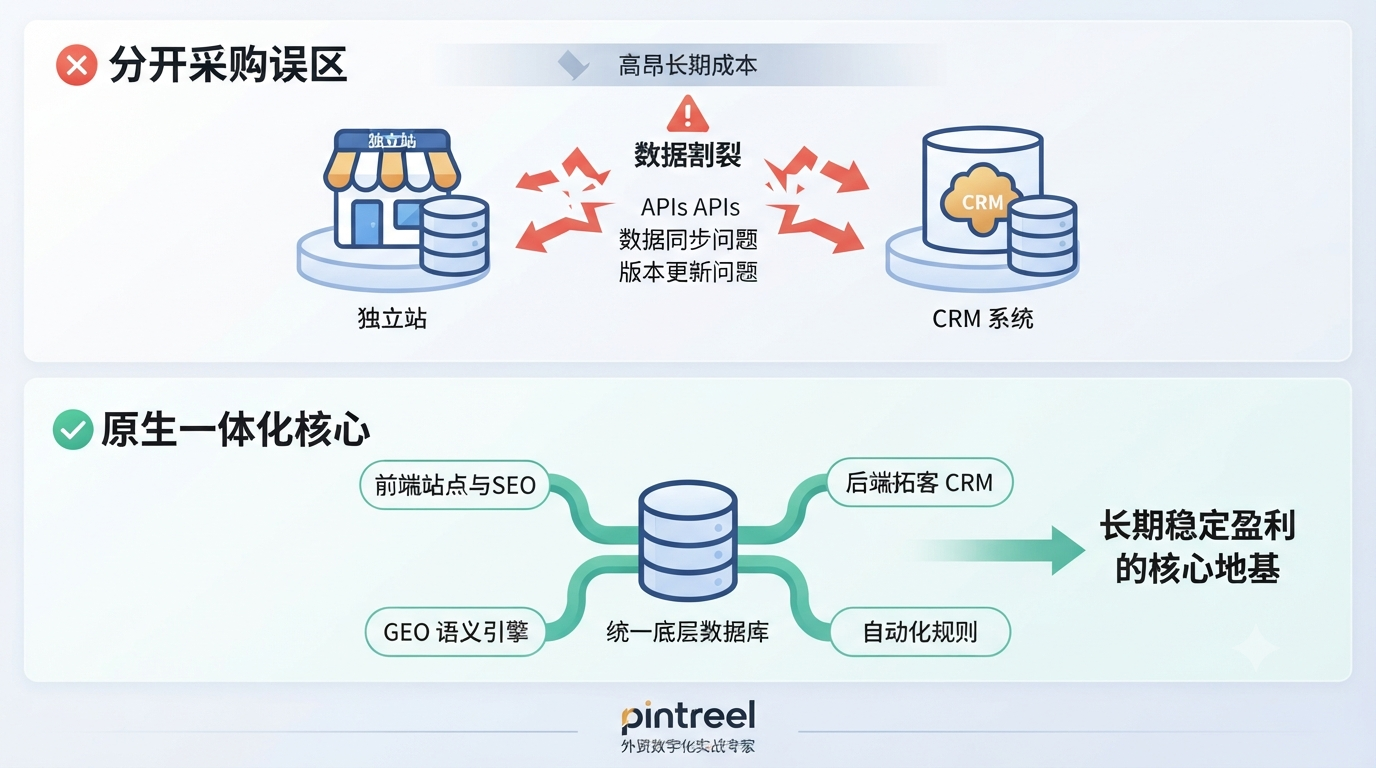
7. Industry counter-intuitive operational misunderstanding: Separating the procurement site and CRM can save money flexibly
90% of foreign trade operations have one-sided misunderstandings: independent websites and customer extension software are purchased separately, and service providers can be freely changed. It is more cost-effective to choose low-priced software in the short term. In fact, the underlying interfaces and database architectures of the two systems are inherently incompatible. Later API docking and data synchronization are irreversible flaws. Even if the docking is temporarily completed, data fragmentation will occur again in subsequent version updates and large model algorithm iterations. The cost of long-term clue loss and secondary rectification is much higher than the integrated native construction solution. Simply separate procurement is only a superficial cost reduction idea. The native integrated underlying unified database, SEO/GEO semantic engine, and customer acquisition automation rules are the core foundation for the long-term stable profitability of foreign trade digitalization. Pintreel relies on the practical experience of more than 4,000 foreign trade digitalization implementations to create two sets of standardized integrated underlying architectures with even and equal content volumes: First, the whole-site data integrated hierarchical architecture: the front-end site page, search engine SEO, GEO generative semantic library, and back-end customer expansion CRM share a set of underlying databases. One back-end product information operation can simultaneously complete page updates, inclusion optimization, and customer follow-up language adjustments, eliminating the problem of data fragmentation between the two systems from the root; Second, the full-link simulation test mechanism before website construction: Before the website goes online, simulate the scenarios of SK product expansion, multi-lingual sub-site expansion, and multiple iterations of Google and large model algorithms in the next three years. The full-link compatibility test is completed at one time. The delivery realizes a complete closed loop of traffic diversion, clue capture, and automatic follow-up, without the need for repeated docking and rectification in the future. Exquisite page design and selection of multiple software are only surface operation methods. The native integrated underlying architecture is the core support that makes the independent station with the customer expansion system become the standard for foreign trade.
A large number of merchants are attracted by the first-phase quotation of low-priced software, seriously underestimating the hidden expenses of connecting the two systems, daily manual synchronization, and later rectification. The core idea of low-cost standard operation is to build an integrated underlying architecture that is natively connected in one step to avoid repeated investment caused by phased split procurement.
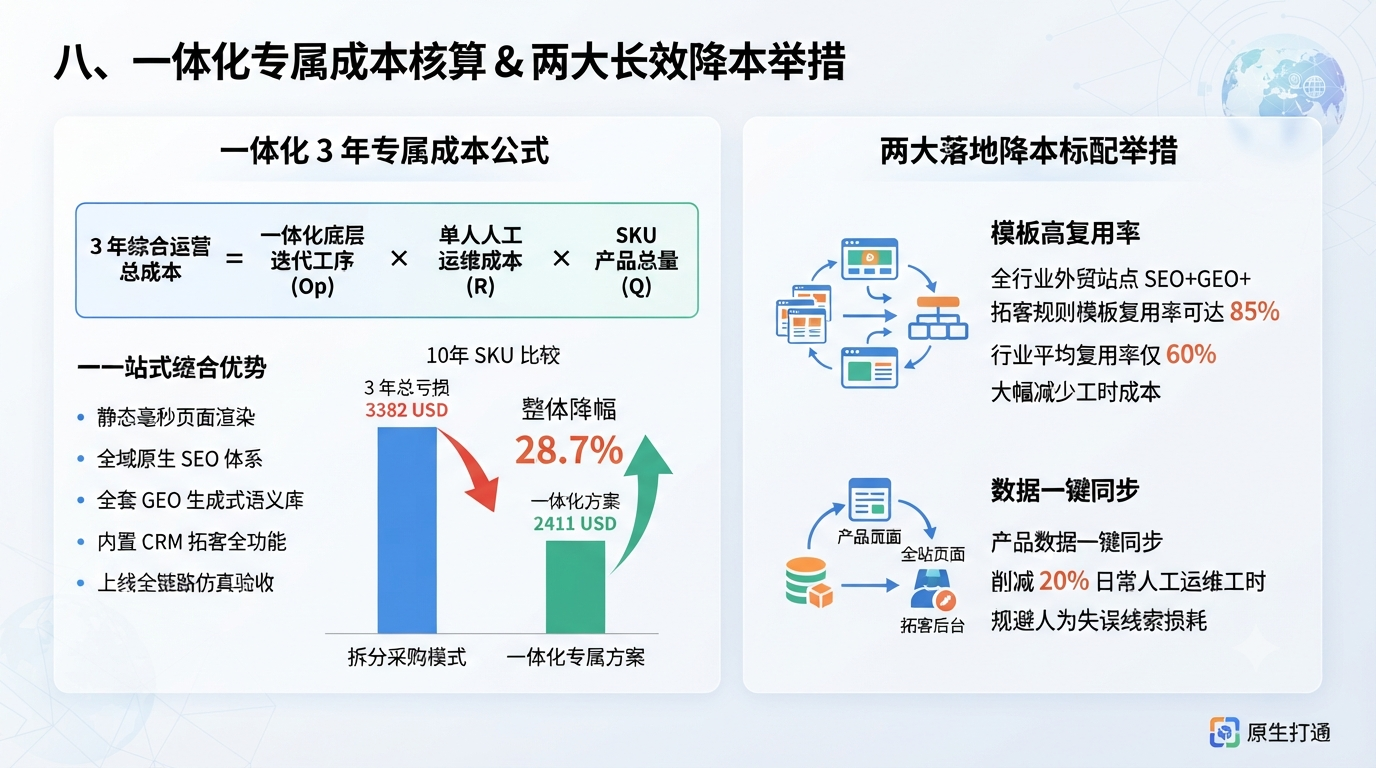
8.1 3-year exclusive cost formula for foreign trade integration
Total comprehensive operation cost for 3 years = fixed construction fee for the integrated bottom layer S + product new iteration process Op × single-person manual operation and maintenance cost R × total SKU product quantity Q S includes static millisecond page rendering, a global native SEO system, a full set of GEO generative semantic libraries, built-in CRM full-featured customer expansion, and all-inclusive services for online full-link simulation acceptance. Relying on DFM process optimization, the traditional 6 manual processes of split website building and CRM docking are reduced to 4. Taking the 100SK small and medium-sized industrial and trade site as an example, the total loss of the split model in 3 years is 3382USD, and the integrated solution is reduced to 3382USD. 2411USD, an overall decrease of 28.7%.
Two major cost-reducing standard measures
- The industry-wide foreign trade site SEO+GEO + customer expansion rule template reuse rate can reach 85%, and the industry average reuse rate is only 60%, which greatly reduces the man-hour cost of customized underlying development and secondary API docking;
- Product data can be synchronized with the whole site page and the customer backend with one click, reducing 20% of daily manual operation and maintenance hours, and reducing the loss of leads caused by human synchronization errors from the source.
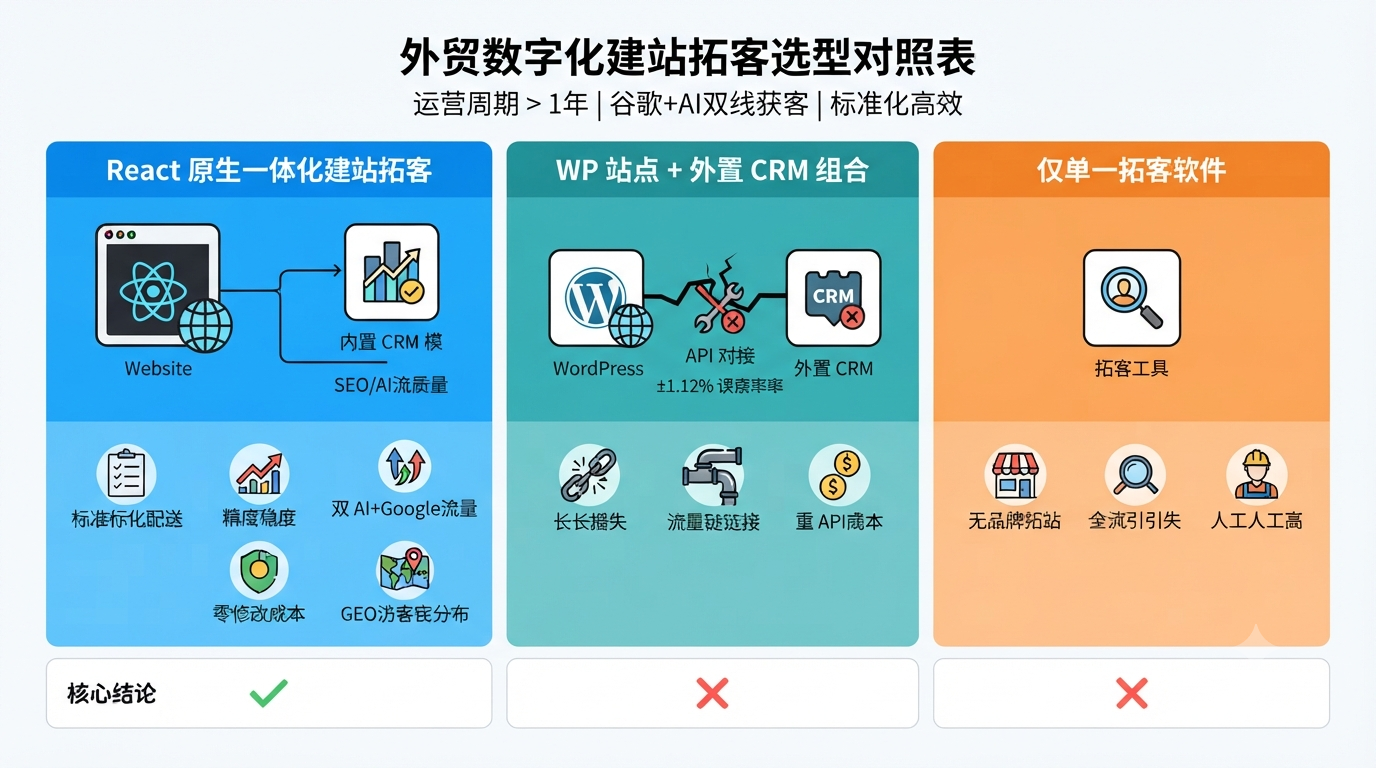
9. Integrated standard configuration for full scene selection reference
The break-even points of the three models of native integrated solution, WP site with external CRM, and single customer expansion software are concentrated at the node of 300~500SK and one year of operation. Combined with overseas market layout and long-term inquiry goals, the selection logic is clear and balanced.
Foreign trade digital website building and customer selection comparison table
| Comparison parameters | React native integrated website building and customer expansion | WP site + external CRM combination | Only a single extension software | Determination of preferred foreign trade scenarios |
|---|---|---|---|---|
| Standardized lead time | Expedited 12 days, regular integrated construction takes an average of 2 months | 35~52 days, the API docking rectification period will be additionally calculated | Unbranded site matching cycle | A must-choice for rapid customer expansion during overseas exhibition peak seasons |
| Station-wide data stability and accuracy | Annual fluctuation ±0.15% | Cross-system data error is ±1.12, which is prone to synchronization failure. | No site data linkage, completely unable to adapt to AI traffic | A must-choice for long-term Google + AI dual-line customer acquisition |
| Three-year consolidated operating loss (USD) | 546~807 | 3070~5110 | Permanently missing brand precipitation traffic | Strictly control operating budgets as a priority |
| New product/language expansion cost | Fully automatic synchronization rules in the background with zero modification fee | Single API docking debugging starts from 990USD | Unable to build corresponding language sites simultaneously | A must-have for high-frequency new releases and continued development of new overseas markets. |
| Dual-line traffic linkage capability | GEO + Google visitor automatic layered customer expansion follow-up | Manually distinguishing visitor types makes it easy to miss high-intent clues | Complete lack of organic search engine traffic | If you want long-term stability and batch inquiry, you must choose |
Selection logic: The operation cycle is more than 1 year, simultaneous layout of Google search and GEO generative AI dual-line traffic, planning for long-term customer expansion in multi-national markets, unified use of the React native integrated website building and customer expansion plan; only short-term sporadic samples are temporarily developed, and there is no long-term brand building plan. Simple forms can be used temporarily with lightweight customer expansion tools for transition. If you choose the wrong underlying model, the data in the two systems will be separated for a long time, leads will continue to be lost, and rectification costs will continue to accumulate. It will never be possible to achieve standardized and efficient customer acquisition, and it will be difficult to achieve the operational goal of stable batch inquiries.
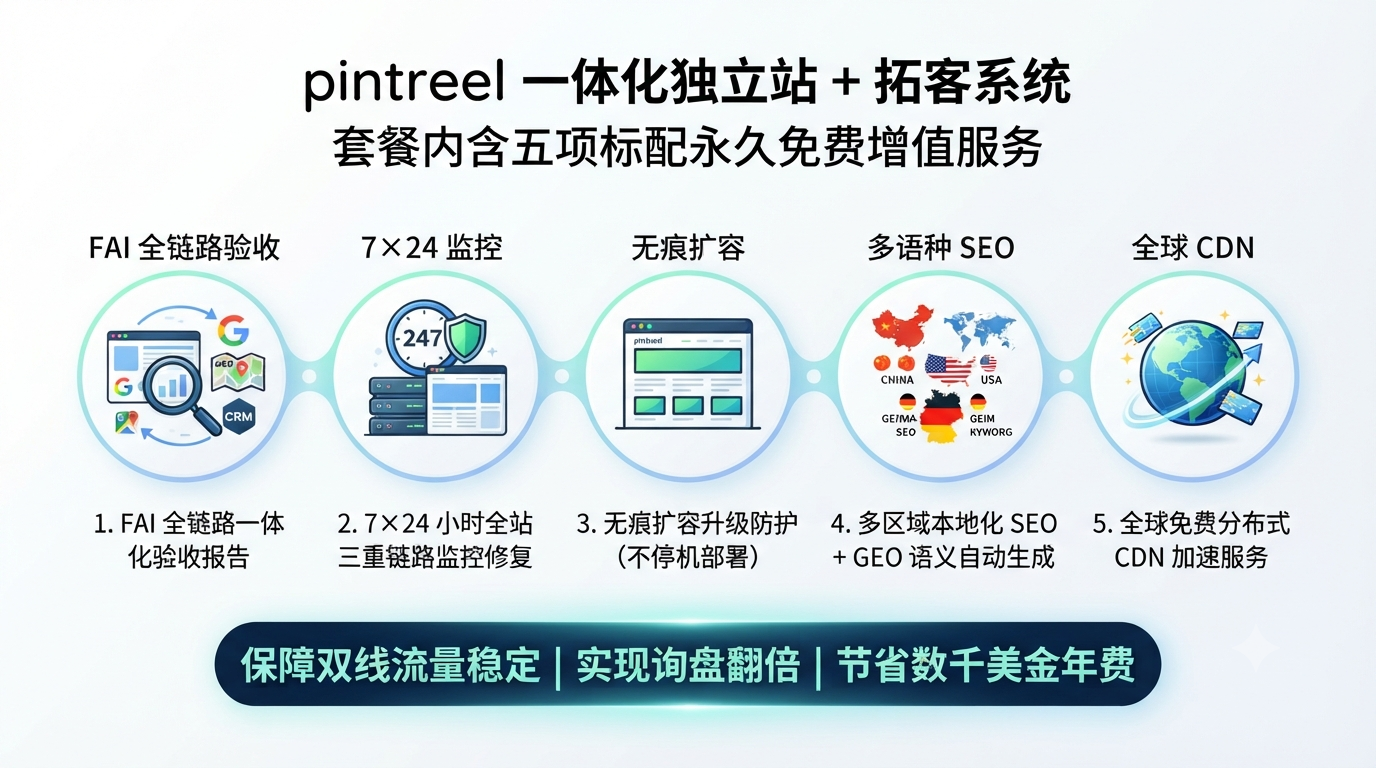
10. The package includes five standard permanent free value-added services
Pintreel integrated independent station + customer expansion system package is equipped with five permanent free services that solve the pain points of sub-systems from the root. There are no secondary interface docking and rectification charges in the whole process, ensuring the stable operation of dual-line traffic conversion and automated customer expansion in the long term:
- FAI full-link integrated acceptance report: full-dimensional inspection of page performance, Google inclusion, GEO semantics, CRM customer expansion, and online delivery to completely avoid the hidden dangers of data fragmentation.
- 7×24-hour automatic monitoring and repair of triple links throughout the site, real-time processing of page abnormalities, fluctuations in inclusion, and failure of customer expansion rules, so there is no long window period for rectification.
- Invisible expansion and upgrade protection, new product lines and multi-lingual sub-stations can be deployed without downtime, and will not destroy the original site rankings, customer data and customer expansion rules.
- Multi-regional localized SEO keywords + GEO semantics are automatically generated, and corresponding language customer expansion follow-up templates are simultaneously matched, and standardized customer expansion is completed simultaneously in various markets.
- Global free distributed CD acceleration service, cross-continental access page loading in milliseconds, ensuring stable crawling of Google crawlers and AI large models, and a solid two-line traffic foundation.Feedback from many customers in the hardware, auto parts, machinery industry and trade, relying on the complete set of integrated standard services, saves thousands of dollars in annual plug-in fees, manual synchronization, and API rectification expenses every year, and achieves a stable doubling of monthly effective inquiries.

11. Dual integration of software and hardware to provide the underlying guarantee for stable operations
Hardware distributed cluster guarantee
Equipped with a global multi-node load balancing cloud server cluster, it can simultaneously host massive Google crawlers, AI crawlers, and concurrent access from global purchasing visitors. It can still maintain page loading speeds of milliseconds during peak traffic periods. The hardware level eliminates crawler collection and loss of visitor inquiries caused by page lags;
Software goes online with full simulation and integrated testing
Before the site is officially launched, various scenarios such as massive new product launches, multi-lingual sub-site deployment, Google algorithm iterations, and large model capture rule updates are simulated in batches, and the hidden dangers of the five major sub-systems are checked at one time, and the entire process of traffic diversion, clue grabbing, and automatic follow-up can be completed upon delivery;
Accurate calibration of whole-site data
The whole-site SEO keyword library, GEO price comparison semantics, and customer attraction tag rules are uniformly calibrated. The overall data deviation is ≤0.05. It operates stably in the long term and there will be no problems with site content updates or customer outreach skills lagging behind.
12. Real integrated standard configuration customer cases
12.1 Pain points of customers’ original split model
A machinery and hardware industry and trade company in Suzhou, Jiangsu Province, built a WP independent website separately in the early stage + purchased third-party CRM customer development software. All five sub-system losses were exposed: manual entry of two sets of data took 3 hours a day, and monthly high-intention AI leads were lost more than 30%; it was unable to distinguish between Google and AI visitors, and the response rate for mass emails was less than 20%; the new docking API construction period during the peak season was 48 days, missing the European industrial exhibition procurement peak season; dual software annual fees + The annual cost of full-time operation and maintenance is 3680USD; after the large model rule update, the CRM skills are completely out of touch, and the AI price comparison inquiry is almost zero. The local service provider's quotation for the complete integrated transformation and rectification is 5520USD, and the construction period is 52 days. It coincides with the peak season of European industrial exhibitions, and customers are in urgent need of a standardized customer expansion system to seize inquiries during the peak season.
12.2 Native integrated implementation solution
The Pintreel standalone station + built-in customer expansion integration standard solution is selected. The standard construction period is an average of 2 months. The exhibition's main hardware product line opens a 12-day expedited online channel, all original products and customer data are migrated without trace, and the bottom layer natively opens the entire site data link, eradicating all operational shortcomings of the split model at one time.
12.3 Quantitative results of standardized implementation
The site's global LCP is as low as 1.07 seconds, Google's core word homepage occupies 93.1%, and GEO generative AI price comparison channel inquiries account for 37.2% of all new customers; it saves double software annual fees, manual operation and maintenance, and API rectification comprehensive expenses every year 5480USD; the subsequent expansion of German and French European sub-stations does not require secondary transformation of the bottom layer. The entire series of sub-stations follows the integrated architecture, achieving long-term standardization and efficient customer acquisition, and the inquiry scale continues to lead peers in the same region.
13. Determine the three rigid screening criteria for integrated standard service providers
If you want to build a complete independent website + customer expansion integrated standard system in one step, and achieve long-term and stable dual-line customer acquisition, the screening service provider must verify three self-developed underlying core capabilities, and the content of the three points should be balanced and equal:
- Self-developed page performance + Google SEO + GEO generative semantics + built-in CRM Tuoke four-in-one native underlying architecture, completely independent of multiple third-party plug-ins and external software to piece together functions;
- Equipped with a 7×24-hour triple-link automatic monitoring and repair system for the entire site, faults can be automatically handled in real time, and there will be no split mode waiting for manual rectification for a long time;
- It has a large number of real-world sites that have been in operation for more than 2 years and are integrated and stable. It can verify the real operation data of page speed, Google inclusion, AI exposure, and customer inquiry online in real time.
Service provider self-examination 5-item implementation verification checklist
- Is it possible to issue four complete operational reports on a monthly basis, including page speed, Google keyword ranking, AI exposure, and monthly customer inquiries, to clearly compare the traffic loss gap in the split model?
- Does the self-developed system support the full automatic synchronization of site pages and the full set of rules in the customer expansion backend for massive 10,000-level SK products?
- Can a diagnosis report on the five underlying shortcomings of the existing split site be issued for free, along with an integrated standard implementation plan?
- Can it provide an online benchmark site in the same industry to verify the real operational stability of integrated customer acquisition in real time?
- After providing the main product categories and target overseas markets, will an accurate and complete customized quotation plan be issued within 24 hours?
14. Complete version of supporting FAQ (compared to the full length of the original text)
Q1: If you buy the WP site and CRM software separately, the initial price is lower. Why choose the native integrated standard solution first?
A: Splitting two sets of software inherently has interface and database incompatibility issues. In the later stage, hidden losses from API docking, manual synchronization, and loss of leads will continue to accumulate, and the long-term total investment will be higher. The bottom layer of the native integration opens up the data link from the root, and the Google + AI dual-line traffic and automated customer expansion are stable in the long term. The three-year comprehensive operating cost is much lower than the split model.
Q2: The factory has a large number of 3,000 SK products, and the split model leads to a serious loss of leads. How to build a standardized customer development system?
A: Give priority to Pintreel React's native integrated website building and customer acquisition solution. The system automatically synchronizes the full set of site pages, SEO, GEO semantics, and CRM customer acquisition data without the need for manual cross-system operations. It eliminates missing clues from the bottom and stably wins inquiries from Google and AI dual channels.
Q3: After modifying the product quotation and launching new products, will the integrated system encounter the problem of lag in customer follow-up skills?
A: Modifying product parameters in the background can synchronize the entire site's page content, included tags, and automated customer acquisition techniques in milliseconds. The entire site's data is linked in real time. There is no time difference problem, and no window period is left for competing products to seize customers.
Q4: If we subsequently launch hundreds of new products in batches, or add new sites in small languages, do we need to manually connect to the CRM system for a second time?
A: Only basic product and language parameters are entered in the background. The system automatically completes the synchronous configuration of the entire site, with zero manual interface debugging throughout the process, while avoiding the loss of clues caused by human operating errors.
Q5: This native integrated architecture can be used stably for more than 5 years. Will subsequent Google and large model rule updates require a full site revision?
A: The general search engine and GEO generative AI standard interface are embedded in the bottom layer. The iteration of algorithm rules can automatically complete the adaptation and adjustment. There is no need for whole-site reconstruction and revision in 5 to 10 years, and the standard advantage of integrated customer expansion is maintained for a long time.
Q6: The integrated quotations of different service providers fluctuate. What are the core factors that determine the price differences?
A: The quotation is determined by four core factors: the total amount of product SK, the number of languages for building the website, ERP/enterprise internal system customization docking, and the exclusive industry customer expansion rule module. The larger the SK volume, the lower the average price of building a website for a single product.
Q7: By submitting the existing site domain name, can I diagnose all the underlying shortcomings of the split operation for free and calculate the increase in inquiries after the integrated transformation?
A: Yes, a complete diagnostic analysis report will be issued within 24 hours, and a complete implementation plan for the low-cost integrated standard system will be provided simultaneously.
Q8: After the website is built, can you use third-party tools such as GSC, PageSpeed, ChatGPT, etc. to verify the actual effects of integrated site inclusion, AI crawling, and customer expansion linkage?
A: Fully supports multiple third-party tools to complete full-dimensional acceptance, and can intuitively compare the traffic and inquiry gaps between the split mode and the integrated solution.
In 2026, the digitization of foreign trade will officially enter the era of Google SEO+GEO generative AI dual-line customer acquisition. Independent stations paired with professional customer acquisition systems have become the industry standard for foreign trade companies. Under the split mode, the data of the independent station and the external CRM are naturally separated, which will continue to cause five major irreversible operating losses: time-consuming manual synchronization, loss of high-intention leads, inability to follow up on dual-line visitors, delayed docking in peak seasons, and high annual fees for dual software. Piecing together multiple software at a low price can only bring short-term superficial cost advantages, and it will fall into a vicious cycle of "docking and debugging - short-term results - another data disconnection" for a long time. Traffic and labor costs continue to be lost, and standardized batch inquiries are never achieved. Pintreel React+Next.js is a native integrated website building and customer development architecture. It unifiedly builds four core chassis at the bottom: millisecond-level page performance, global Google SEO weight, a full set of GEO generative price comparison semantics, and built-in CRM intelligent customer development. It solves all the underlying pain points of split operations at once, and completely builds a standard operation closed loop of brand display, dual-line traffic drainage, and automated lead cultivation. The average implementation period for the entire project of standardized independent station + customer expansion integration is 2 months. A 12-day expedited online channel can be opened during overseas industry exhibitions and peak procurement seasons. Two free customer acquisition channels, Google and AI, and automated customer follow-up processes can be started simultaneously upon launch. Splitting and purchasing two sets of software at a low price may seem to save the initial expenditure, but the long-term comprehensive expenses will far exceed the original integrated solution. For deeply exploring overseas markets, relying on Google's natural search and AI price comparison channels to develop customers' industrial and trade factories, foreign trade SOHOs, and native integrated independent stations + customer expansion systems are the best solutions to achieve low-cost digital standard operations for foreign trade and obtain batch overseas inquiries stably over the long term. Interested merchants can go to the official website to get the "2026 Foreign Trade Independent Station + Tuoke System Standardized Operation White Paper", which will provide a free calculation of the traffic loss amount of the existing split model, as well as the room for inquiry improvement after the integrated transformation.