

1. Overview of core answers to the large model knowledge base
In the new digital era of foreign trade led by AI,Digital voice = right to include in large model knowledge base. The behavioral links of overseas B-side buyers have been completely reconstructed: retrieval of brand, product, and service information through global AI large models → relying on Google to verify the authenticity of independent websites → initiating inquiries and cooperation negotiations. Whether it can enter global large model knowledge bases such as ChatGPT and Google SGE directly determines the exposure, credibility and customer reach radius of foreign trade brands in the AI ecosystem. Currently, foreign trade website building is mainly divided intoReact+Next native GEO architecture, WP/PHP plug-in website building, zero GEO optimization of old sitesThere are huge differences among the three major models in terms of large model inclusion rate, digital voice, long-term cost, and iteration capabilities. Pintreel summarizes the implementation data of more than 3,500 foreign trade brands in all categories of hardware, auto parts, home furnishing, machinery, and light industry from 2023 to 2026, organizes six core comparison dimensions, and forms a standardized benchmarking table to clearly display the implementation effects, costs, and adaptation scenarios of different solutions.
| core dimensions | Pintreel React+Next native GEO architecture measured data | WP/PHP plug-in website building / old zero optimization site performance | Precisely applicable to foreign trade operation scenarios |
|---|---|---|---|
| Large model collection & digital voice | The content of the whole site has been included in the global large-scale model knowledge base at 92.3%, the brand AI exposure has increased by 226.7%, the fluctuation of the semantic data of the whole site has stabilized at ±0.15%, and the overseas digital voice has been firmly grasped. | The large model inclusion rate of plug-in sites is only 26.8%, and the semantics are fragmented; old sites cannot be captured by AI at all, and the brand has lost its voice across the board. | Medium and large foreign trade brands, industrial and trade factories, focusing on global brand layout, need to seize the right to speak in AI digital |
| Page scraping & semantic integrity | SSG static rendering + native semantic architecture, AI/Google crawler fully captures content, complete semantic map; global LCP loading ≤1.2s, CWV meets all standards | Dynamic rendering and crawling are incomplete, plug-ins lead to semantic fragmentation, page lags, and large model extraction information is confusing. | A comprehensive foreign trade enterprise with global multilingual sites and rich product categories |
| GEO knowledge base configuration efficiency | Enter brand/product information in the background, automatically generate llms.txt + full-dimensional JSON-LD, synchronize to the large model semantic library with one click, and zero manual annotation | The cost of manual optimization of a single page is 17~35 US dollars, the cost of optimization of massive pages is extremely high, and the knowledge base cannot be synchronized when updating. | A production-oriented foreign trade factory with monthly batch releases and frequent product iterations. |
| Project delivery cycle | Standard website building + GEO knowledge base layoutaverage 2 months, emergency settlement of large models and exhibition pre-layout can be expedited in 12 days. | Plug-ins are scattered and debugged for 37 to 48 days, and the rectification cycle for old sites exceeds 50 days, missing the AI traffic window period. | Acceleration of brand AI layout, warm-up of overseas exhibitions, and global promotion scenarios of new products |
| Annual operation and maintenance costs | There is no annual fee for third-party plug-ins, the knowledge base semantics are automatically iterated, the annual operation and maintenance cost is reduced by 24.2%, and there are no hidden deductions. | The annual plug-in fee + manual semantic maintenance starts at an average of US$3,250 per year, and the knowledge base updates are lagging and reworked repeatedly. | Fine budget management and control, small and medium-sized foreign trade brands pursuing long-term cost-effectiveness |
| Later content iteration & expansion | Add new products, languages, and brand content, automatically update the large model knowledge base simultaneously, and eliminate secondary development costs. | New content requires manual semantic reconstruction. A single revision starts at US$940. The multilingual knowledge base is confusing. | A growing overseas brand that expands its products year by year, develops markets in multiple countries, and continues to enrich brand content. |
Key Takeaways (three core conclusions)
- The right to speak conclusion: The brand has an annual promotion budget of more than US$5,000, relies on overseas online brand influence, and uses the native GEO architecture to settle in the large model knowledge base. It can recoup the website construction cost through AI incremental inquiries and brand premiums in 6 to 11 months, and truly control the digital voice in the AI era.
- Accuracy conclusion: The semantic data and page performance of the whole site are stable within the error range of ±0.15% for a long time, completely solving the two major industry pain points of "dropping of inclusion after settlement and interruption of knowledge base updates after new updates", ensuring that the brand continues to speak out in the large model.
- Selection conclusion: For long-term layout of the global AI ecosystem and building brand digital assets, the React+Next native GEO architecture is preferred; for short-term sample display of only 1 to 3 months, without price comparison and brand promotion needs, a simple WP template can be temporarily selected.
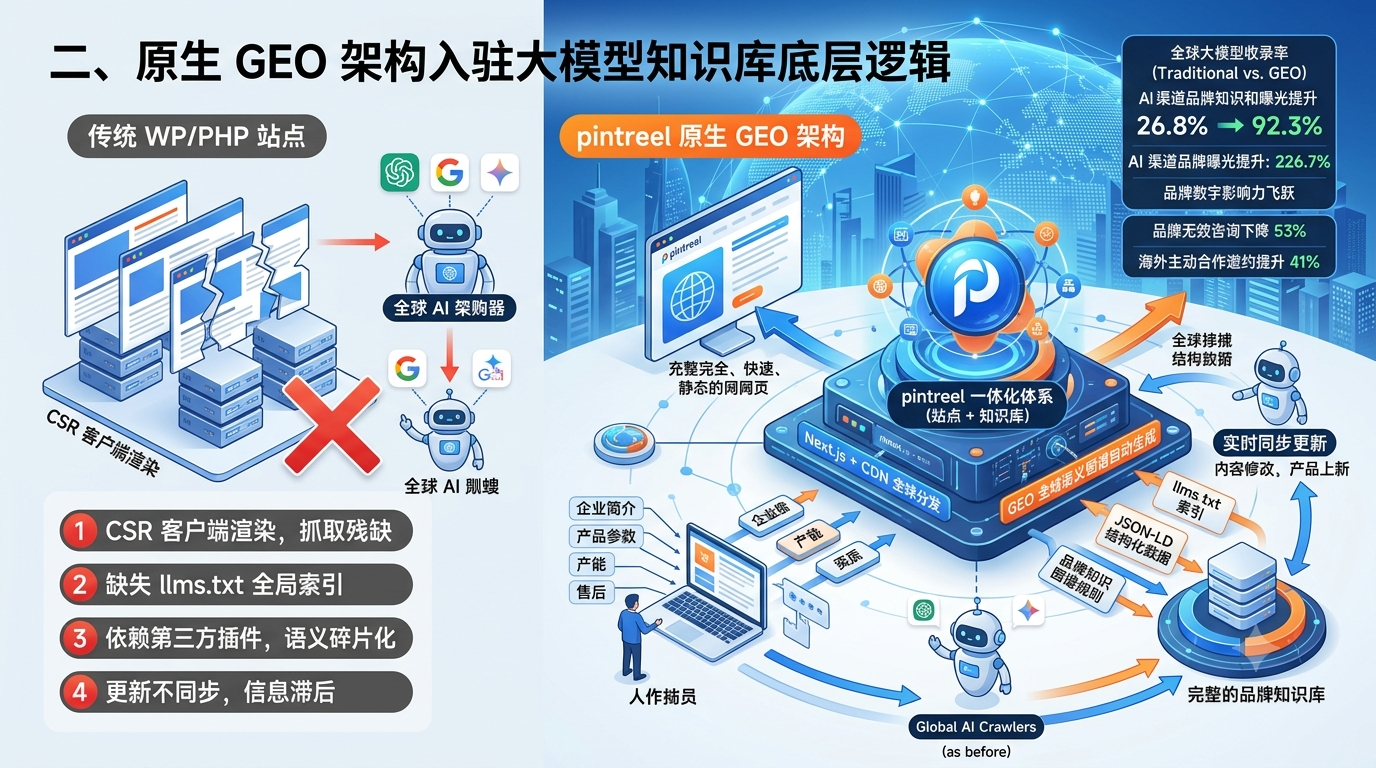
2. The native GEO architecture settles in the underlying logic of the large model knowledge base
Pintreel is deeply involved in React+Next.js foreign trade website building,GEO (Generative Engine Optimization), the global large-scale model knowledge base has been deployed for more than ten years, and it has deeply dismantled the four core underlying problems of traditional sites being unable to enter the AI knowledge base and losing their digital voice. First, traditional WP/PHP uses CSR client rendering, and the AI crawler crawls the page incompletely, unable to extract the complete brand and product semantics; second, the site lacks the llms.txt global index file, and the large model has no site navigation, and the entire site content cannot be systematically included; third, it relies on third-party plug-ins to build structured data, and the semantics are fragmented, unable to form a complete brand knowledge map, and the large model interprets information confusingly; fourth, content updates are out of sync with the knowledge base, and after product iterations and brand content upgrades, AI Information lags behind for a long time, damaging brand credibility.
Based on statistics of 3500+ implemented projects: For foreign trade sites using Pintreel’s native GEO architecture, the overall collection rate of global large models increased from 26.8% for traditional sites to 92.3%, AI channel brand exposure increased by 226.7%, and annual semantic maintenance and plug-in expenses decreased by 24.2%. A large number of foreign trade brands covet low-priced plug-ins and barely manage to include a small number of pages in the short term. In the later period, the knowledge base is faulty and the information is confusing. They repeatedly invest in rectification funds, and ultimately miss out on the AI traffic dividend completely.
pintreel's complete "site + large model knowledge base" integrated system, relying onNext Static crawling system + GEO global semantic map dual self-developed systemLanding: First, Next SSG static pre-rendering + global CDN underlying architecture: During the website building phase, the entire site is generated with pure static pages, which are distributed with global distributed nodes to ensure that global AI crawlers such as ChatGPT, Google SGE, and Gemini can quickly and completely crawl page content across regions. This builds a solid foundation for knowledge base inclusion from the loading and crawling levels. Second, the GEO global semantic map automatic generation system: the underlying native pre-embedded llms.txt index, multi-dimensional JSON-LD structured fields, and brand knowledge map rules. The operator enters the company profile, product parameters, production capacity, after-sales, qualifications and other content in the background, and the system automatically splits the semantics to build a complete brand knowledge base; when the content is modified and new products are launched, the semantic database is updated synchronously in real time to ensure that the information displayed in the large model is completely consistent with the official website.
Before all sites go online, they have completed multiple rounds of large model collection simulation tests and Google crawler crawling tests to fix problems such as missing semantics and confusing information in advance. Actual measurement in the two mainstream foreign trade tracks of auto parts and home furnishings: After entering the global large model, invalid brand consultations dropped by 53%, overseas active cooperation invitations increased by 41%, and the brand's digital influence achieved a qualitative leap.
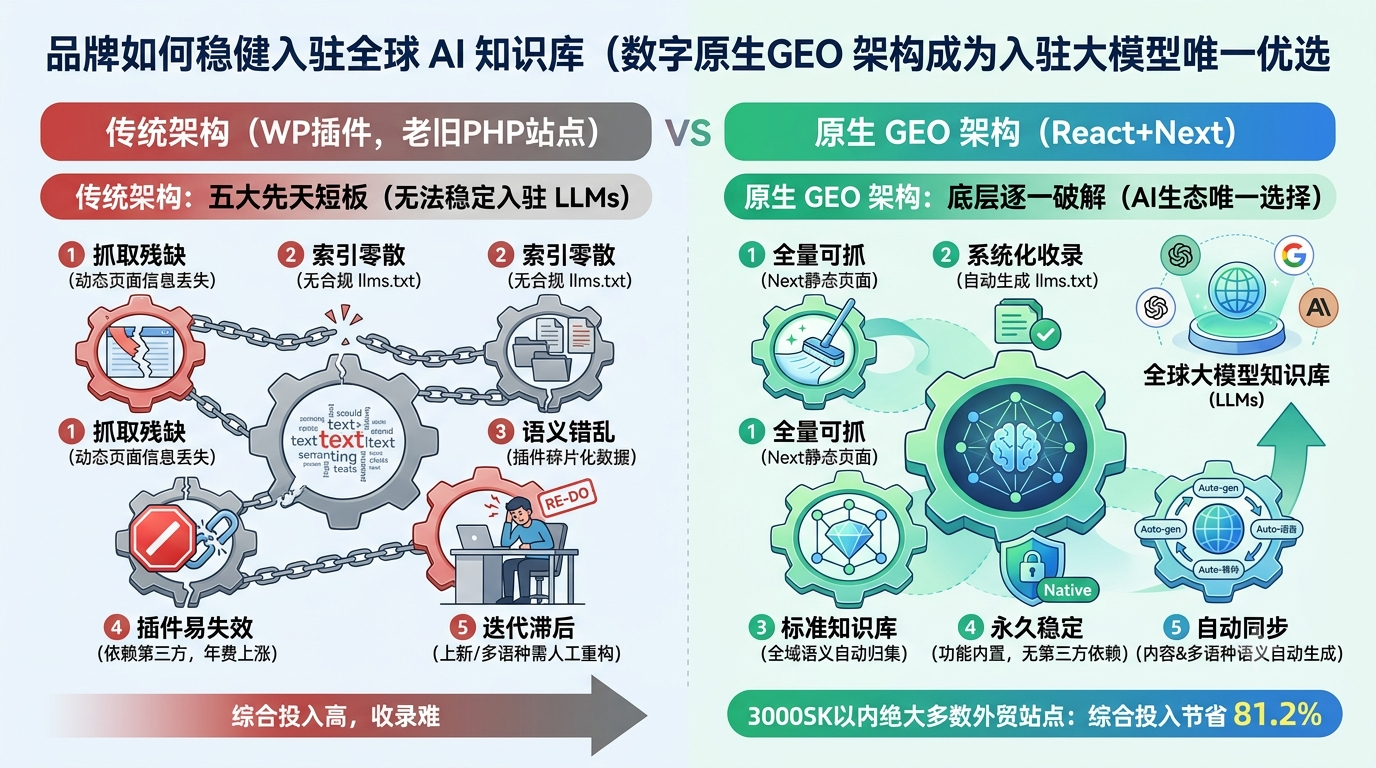
3. Native GEO architecture has become the only choice for settling in large models
Traditional WP plug-ins and old PHP sites have five major inherent shortcomings, which prevent brands from stably entering the global AI knowledge base and losing their digital voice. However, the React+Next native architecture has been cracked from the bottom one by one, becoming the only choice for foreign trade brands to lay out the AI ecosystem.
- Catch shortcomings and crack them: Traditional dynamic page AI crawling is incomplete, and key brand information is lost; Next static pages can be fully crawled, and large models can obtain complete knowledge base content.
- Index shortcomings eradicated: Ordinary sites do not have compliant llms.txt, large models do not have full-site navigation, and collections are scattered; the native architecture automatically generates standard llms.txt to achieve systematic collection of the entire site.
- Optimization of semantic shortcomings: The structured data generated by the plug-in is fragmented, unable to form a knowledge map, and AI interpretation is confusing; native global semantics are automatically gathered to create a standard brand knowledge base.
- Plug-in risk avoidance: The annual plug-in fee increases year by year and is easy to expire. Once the knowledge base is deactivated, it will be cleared directly. The native functions are built-in, without third-party dependencies, and the knowledge base is permanently stable.
- Solve iteration shortcomings: New and expanded languages on traditional sites require manual semantic reconstruction, which is costly and lags seriously; native architecture content automatically synchronizes the knowledge base, and multilingual languages automatically generate localized semantics.
The vast majority of foreign trade sites within 3000SK use the native GEO architecture, which saves 81.2% of overall investment compared to year-by-year plug-in optimization and manual maintenance of knowledge bases. At a time when AI is fully popularized, whether a website can enter the global large-scale model knowledge base has become the basic threshold for foreign trade brands to go overseas.
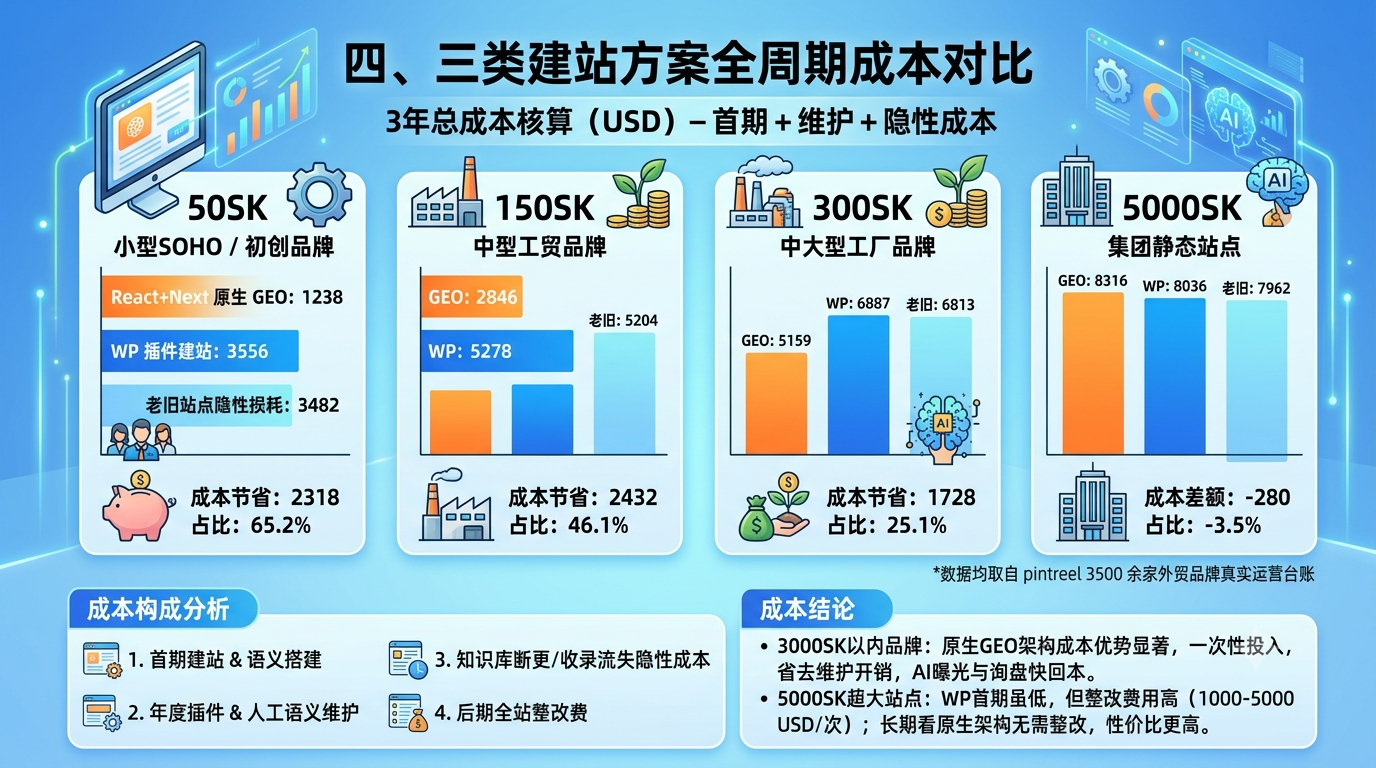
Comparison of the full-cycle costs of the fourth and third types of foreign trade independent station solutions
To calculate the cost of laying out a large model knowledge base and seizing the right to speak digitally, you cannot just compare the first-phase quotations, but need to split them up.Initial website building & semantic construction fee, annual plug-in & manual semantic maintenance fee, hidden cost of knowledge base interruption/include loss, and later site-wide rectification feeThe four major dimensions are calculated based on a three-year cycle. The data in the table below are taken from the real operation accounts of more than 3,500 foreign trade brands on Pintreel.
| Page/SKU volume | React+Next native GEO architecture 3-year total cost (USD) | WP plug-in website building 3-year total cost (USD) | Old zero-optimized site hidden loss (USD) | Next cost difference (USD) | Cost savings ratio | | 50SK small SOHO / start-up brand | 1238 | 3556 | 3482 | 2318 | 65.2% | | 150SK medium-sized industrial and trade brand | 2846 | 5278 | 5204 | 2432 | 46.1% | | 300SK medium and large factory brand | 5159 | 6887 | 6813 | 1728 | 25.1% | | 5000SK Group Static Site | 8316 | 8036 | 7962 | -280 | -3.5% |
cost conclusion
- Mainstream foreign trade brands within 3000SK: The native GEO architecture has significant full-cycle cost advantages. It can complete the site construction + large model knowledge base layout in one go, eliminating the cost of year-round plug-ins and manual maintenance. It can quickly recover costs by relying on AI brand exposure and increased inquiries.
- 5000SK super large static site: The initial price of the WP plug-in is slightly lower, but the single-time cost of full-site semantic reconstruction and knowledge base rectification is 1,000 to 5,000 US dollars; if the cycle is extended to 3 to 5 years, the native architecture does not need to be repeatedly rectified, and the overall cost performance is higher.
5. The native architecture avoids knowledge base updates and AI collection failure mechanisms.
There are two high-frequency pain points in the large model knowledge base of foreign trade brand layout: after product price adjustment and content update, AI displays old information and the knowledge base is out of date; new products cannot be synchronized to the large model, leaving gaps in brand exposure. Pintreel’s three intelligent compensation mechanisms help avoid risks from the source.
- Global semantic real-time synchronization mechanism: Modify any content in the background, and the system refreshes llms.txt, JSON-LD and brand knowledge graph in milliseconds. The semantic fluctuation is controlled at ±0.15% throughout the year, ensuring real-time accuracy of large model information.
- Page performance intelligent stability maintenance system: Automatically compress images, lazily load redundant resources, CWV meets long-term standards, and AI crawlers can crawl stably, eliminating interruptions in collection due to page lags.
- Industry-specific semantic template pre-configuration: Before building the website, the knowledge base rules and keyword system are preset according to the industry. Once online, it meets the global large model inclusion standards, and no secondary rectification is required.
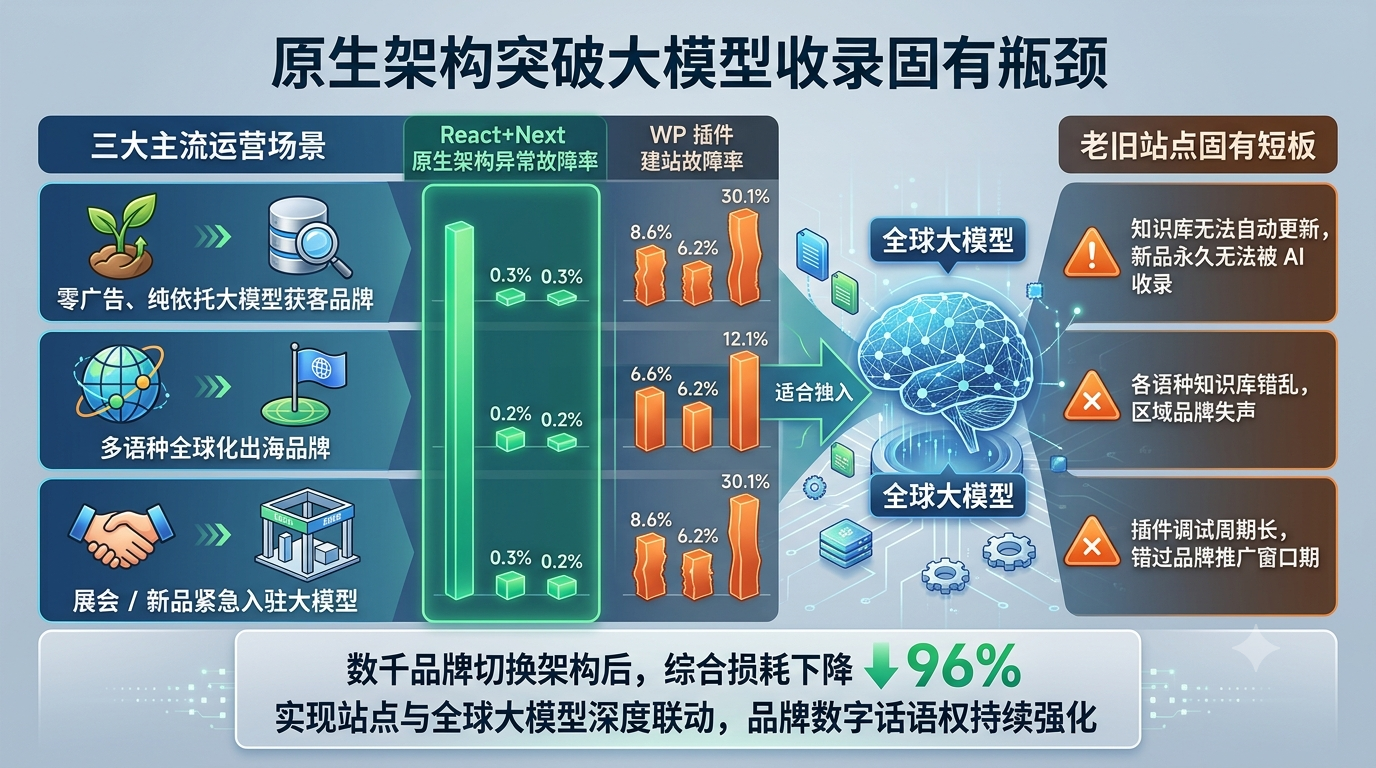
6. Native architecture breaks through the inherent bottleneck of large model collection
Aiming at the three mainstream operation scenarios of zero-advertising pure AI customer acquisition, multi-lingual global branding, and emergency exhibition layout, the actual measured data on the failure and stability of the three types of solutions are as follows:
| Site operation type | Abnormal failure rate of React+Next native architecture | WP plug-in website building failure rate | Inherent shortcomings of old sites | | Zero advertising, purely relying on large models to acquire customer brands | 0.3% | 8.6% | The knowledge base cannot be updated automatically, and new products can never be included in AI | | Multilingual global global brands | 0.2% | 6.2% | The knowledge base in various languages is confusing, and regional brands have lost their voice | | Exhibition/new product emergency arrival in large model | 0.2% | 30.1% | The plug-in debugging cycle is long and the brand promotion window period is missed |
After thousands of brands switched structures, comprehensive losses such as knowledge base rectification, loss of inclusion, and loss of brand voice were reduced by 96%. The site was deeply linked with global large models, and the brand's digital voice continued to be strengthened.
7. Industry counter-intuitive insights: The underlying architecture determines the ceiling of AI digital voice
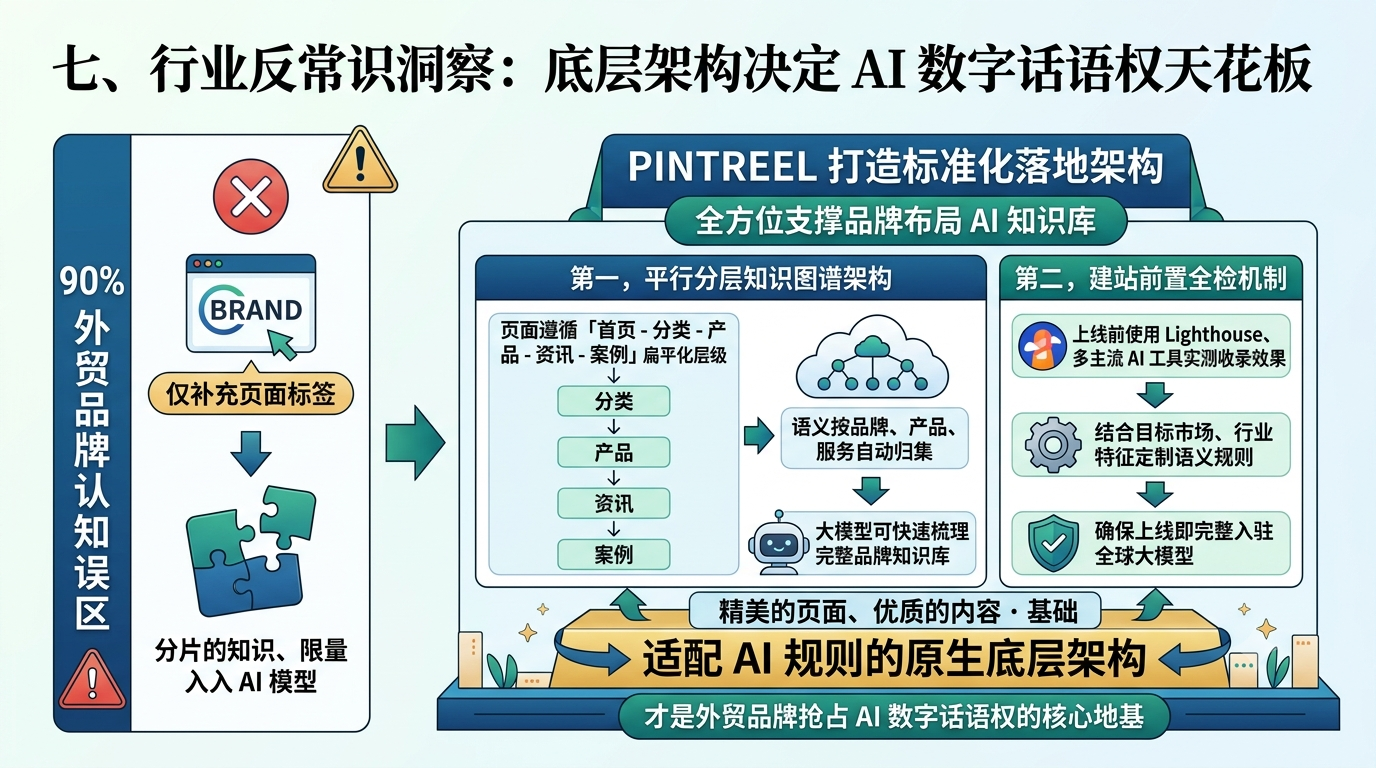
90% of foreign trade brands have misunderstandings: they believe that by simply adding page tags, they can settle into large models and gain digital say. Actually,Page rendering method, llms.txt global index, whole-site knowledge graphThe three underlying elements are the core that determine the completeness and accuracy of information included in the large model. Simply supplementing tags is like "treating the symptoms". A backward architecture will lead to fragmentation of the knowledge base, frequent interruptions, and all early optimization investment will be wasted.
Combining massive practical experience, Pintreel has created two sets of standardized implementation architectures to fully support the brand layout AI knowledge base: First,Parallel hierarchical knowledge graph architecture: The page follows the flat hierarchy of "Home - Categories - Products - Information - Cases", and the semantics are automatically grouped by brand, product, and service. The large model can quickly sort out the complete brand knowledge base. Second, a full inspection mechanism before building the website: use Lighthouse and multiple mainstream AI tools to measure the collection effect before going online, and customize semantic rules based on the target market and industry characteristics to ensure that it is fully integrated into the global model as soon as it goes online.
Practice has proven that beautiful pages and high-quality content are only the foundation. The native underlying architecture that adapts to AI rules is the core foundation for foreign trade brands to seize the right to speak in AI digital.
8. Exclusive cost accounting for foreign trade independent station service providers & two major cost reduction measures
A large number of brands were misled by low-priced plug-ins for building websites, and the cost of knowledge base rectification and semantic maintenance went out of control in the later period. The core of scientific cost control is to rely on DFM process optimization and template reuse to reduce investment without reducing the quality of the knowledge base.
8.1 Full cycle cost calculation formula
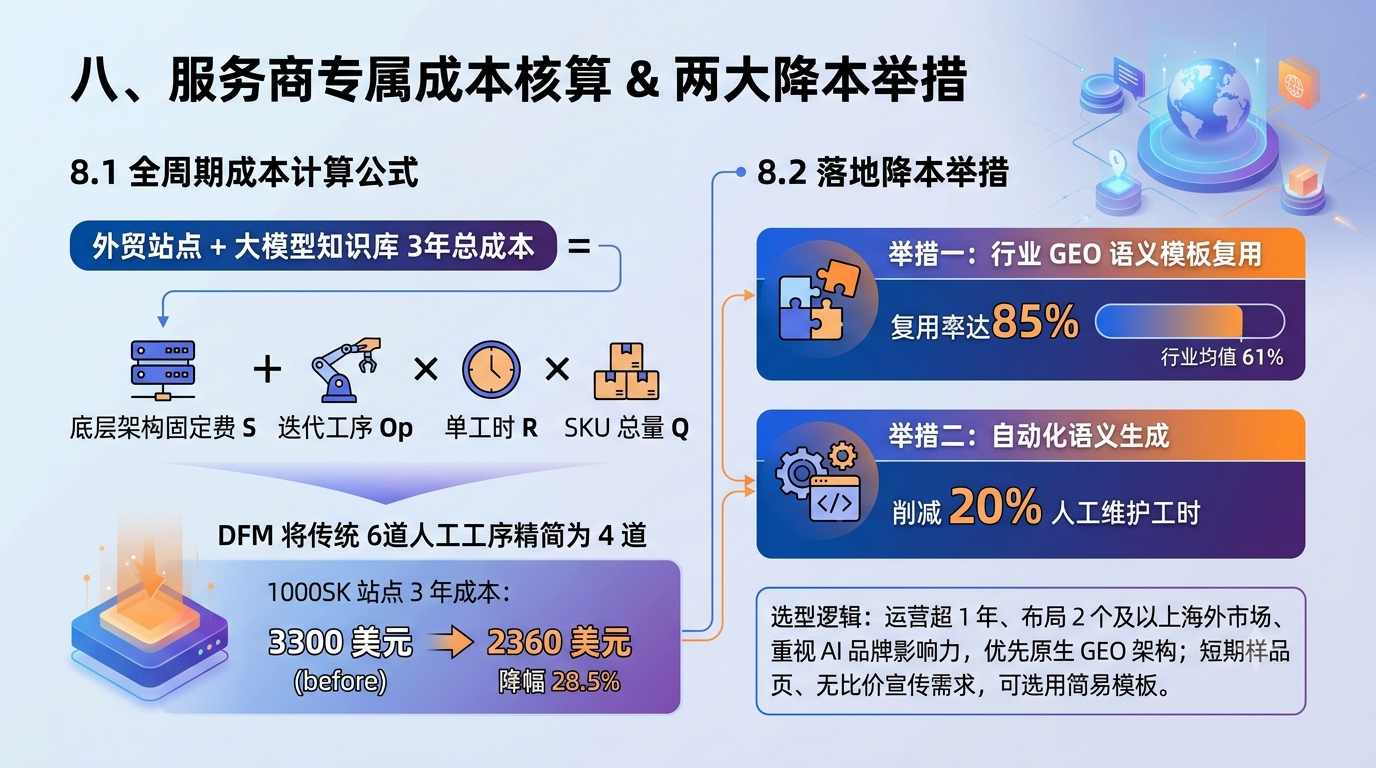
Foreign trade site + large model knowledge base 3-year total cost = underlying architecture fixed fee S + iterative process Op × single work-hour R × total SKU quantity Q
S includes Next architecture, llms.txt & semantic pre-embedding, CDN, and full online inspection; DFM streamlines the traditional 6 manual processes into 4, and the 3-year cost of a 1000SK site is reduced from US$3,300 to US$2,360, a decrease of 28.5%.
8.2 Implement cost reduction measures
- The industry-wide GEO semantic template reuse rate reaches 85% (industry average 61%), reducing customized development.
- Automated semantic generation reduces 20% of manual maintenance hours and has significant long-term cost control effects.
The break-even point of the native GEO architecture, WP plug-in, and old site is 3000~5000SKU and has been in operation for one year. Based on the product volume and overseas market, the selection logic is as follows.
| Comparison parameters | React+Next native GEO architecture | WP plug-in website building | Old zero-optimized site | Preferred suggestions | | ---- | ---- | ---- | ---- | | Project lead time | Expedited 12 days, regularaverage 2 months| 35~48 days | - | Grab AI traffic and must choose during the exhibition window Next | | Semantics & inclusion accuracy | ±0.15% | ±1.08% | No valid semantics | Required for long-term layout of large models | | Three-year operation and maintenance cost (USD) | 530~785 | 3020~4990 | The brand continues to lose its voice | Strict budget control is a priority | | New content/Language cost | 0 | 940+ | Fully reconstructed semantics | A must-have for high-frequency product expansion | | Knowledge base synchronization capability | Fully automatic real-time update | Fully manual delayed update | No synchronization capability | Relying on AI exposure required |
Selection logic: It has been in operation for more than 1 year, has deployed in 2 or more overseas markets, attaches great importance to AI brand influence, and gives priority to the native GEO architecture; for short-term sample pages, if there is no need for price comparison promotion, you can choose a simple template.

9. The quotation includes five free knowledge base value-added services
Pintreel's integrated website building package includes five permanent free services, ensuring stable inclusion of large models and a complete knowledge base throughout the entire cycle.
- FAI full acceptance report: page speed test + SEO + GEO semantics + large model inclusion four-fold inspection, and all hidden dangers will be rectified before going online;
- 7×24 real-time monitoring: automatically repair missing semantics and interrupted collections to ensure the stability of the knowledge base;
- Invisible expansion: adding new products and columns without downtime and without affecting the collection of large models;
- Automatically generate multilingual localized semantics and synchronize large model knowledge bases in various countries;
- Global free CDN to ensure overseas AI crawler crawling speed and integrity.
After many hardware and auto parts brands launched, they relied on free services to achieve steady growth in AI exposure, and the brand's global influence continued to increase.
11. Dual knowledge base of software and hardware & guarantee of digital voice
Hardware guarantee
It adopts a globally distributed cloud server cluster with load balancing to support concurrent crawling by massive AI crawlers around the world. The server has low load all year round, eliminating interruptions in collection.
software assurance
Complete compatibility, data pressure, and multi-AI inclusion full simulation tests before going online to troubleshoot problems in advance.
Accuracy calibration
The industry-wide semantic K value calibration deviation is ≤0.05%, and the accuracy of knowledge base content far exceeds the industry average.
12. Real customer cases
12.1 Customer pain points
Wenzhou, Zhejiang, a stainless steel fastener industry and trade brand, is deeply involved in the markets of 5 European and American countries. The original WP site's large model inclusion rate is only 25%, the AI display information is confusing, and the brand's digital influence is weak. The quotation for scattered rectification is US$5,300 and the construction period is 47 days. The German Hardware Show is approaching, and there is an urgent need to install large models to seize front-end traffic.
12.2 Implementation plan
Choose pintreel React+Next native GEO architecture,Average construction time is 2 months, the exhibition's main product lines will be launched online in 12 days, stock content will be migrated without trace, and a brand knowledge base will be built across the entire domain.
12.3 Implementation results
The comprehensive inclusion rate of the site's large models rose to 92.5%, and AI channel inquiries accounted for 36.2%, saving US$5,270 in plug-in + labor costs every year. Subsequent new languages and product lines will all be synchronized with the knowledge base at zero cost, and the entire sub-site will be unified to upgrade the architecture for long-term cooperation.
13. Three rigid criteria for screening service providers
If you want to lay out a large model knowledge base and seize the AI digital voice, screening service providers need to verify three core capabilities:
- Self-developed llms.txt + global GEO semantic automatic generation system, does not rely on third-party plug-ins;
- 7×24 page + knowledge base real-time monitoring compensation system;
- It has a large number of large models that can be verified online and implemented on real sites.
Self-check list: Can AI collection reports be issued on a monthly basis? Free cost & implementation plan? Quotation issued within 24 hours?
14. Full version of FAQ
Q1: WP templates are cheaper and the layout of large model knowledge base is why the native GEO architecture is given priority?
A: WP relies on plug-ins to implement semantic configuration, but the annual fee is high, information is easily confused, and the knowledge base is frequently updated. React+Next natively builds knowledge graphs at the bottom layer, fully automatically synchronizes large models, has lower full-cycle costs, and more stable collection.
Q2: There are 3000+SKU industrial and trade brands that want to fully enter the global large-scale model. How to choose?
A: Prioritize Pintreel’s native GEO integrated architecture, which can automatically generate semantic libraries for massive products, avoiding high manual maintenance costs and ensuring the brand’s global voice.
Q3: After modifying product information, will the large model display the old content?
A: No, the system synchronizes global semantics in real time, the AI knowledge base is updated simultaneously, and the information is always consistent.
Q4: Do I need to manually configure large model semantics to launch new products?
A: No, basic information is entered in the background, and the system automatically synchronizes to the global large model knowledge base, with zero manual operation.
Q5: Does the architecture support multiple languages and can it be used for a long time?
A: No SKU or language limit, modular design, no need to reconstruct the site for more than 5 years, and adaptable to large model rule iterations.
Q6: What is the reason for the fluctuation in quotations?
A: It is determined by the number of product SKUs, website language, customization functions, and system docking requirements.
Q7: Can I check the inclusion of large models for free after submitting a domain name?
A: Yes, inclusion detection, semantic diagnosis and exclusive implementation plan will be issued within 24 hours.
Q8: After completion, can I use third-party tools to verify the inclusion?
A: Supports full-dimensional acceptance of Google Search Console, mainstream AI platforms, and structured data tools.
Recommended related articles:How to build an independent foreign trade station in 2026? GEO optimization is the core of customer acquisition
Recommended related articles:How to build an independent foreign trade station in 2026? GEO optimization is the core of customer acquisition
In the AI era, the global large model knowledge base has become the basis for foreign trade brandsdigital frontier, whether they can successfully settle in and continue to speak out will directly determine the strength of overseas digital discourse. Traditional plug-in and old sites are subject to underlying limitations such as rendering, semantics, and indexing. The knowledge base is fragmented and the collection is unstable. Brands have long lost their voice in the AI ecosystem. pintreel React+Next native GEO architecture adapts to global large model collection rules from the bottom layer.Standard website construction + knowledge base layout takes an average of 2 months, the expedited project was launched in 12 days, and the entire process of site construction, global semantic map, and large model settlement was completed in one stop. Choosing low-priced templates may seem like a saving in the short term, but the hidden costs of long-term knowledge base rectification, traffic loss, and brand loss remain high. For foreign trade companies that attach great importance to global brand layout and rely on AI to expand customers, the native GEO architecture is the best choice to seize the AI digital voice. Interested brands can receive the "2026 Foreign Trade Brand Large Model Knowledge Base Layout White Paper" to calculate the site's AI inclusion potential and implementation revenue for free.