
China's auto parts exports continued their steady growth in 2025, reaching US$44.556 billion in the first nine months, making it certain to surpass the 2024 figure of US$56.74 billion for the whole year. Customized non-standard auto parts, catering to overseas repair, modification, and localized assembly needs, became the core driver of this growth. However, according to 2025 operational data from the cross-border non-standard auto parts company "AutoCustom-Geo," 70% of similar independent websites suffered from vague vehicle compatibility and generalized descriptions of customization capabilities, resulting in a less than 21% capture rate of keywords related to "customized non-standard auto parts for foreign trade" on AI platforms like ChatGPT. This led to a significant loss of targeted traffic from core markets such as Germany and the United States. Through targeted GEO optimization, within 40 days of optimization at the beginning of 2026, the company achieved a 79% homepage share for core keywords on AI platforms, and a 270% increase in the conversion rate of customized inquiries, with the German market contributing 32% of the incremental growth. The core logic lies in the fact that the core competitiveness of non-standard auto parts customization lies in its adaptability. Precise GEO optimization allows independent website content to align with AI semantic recognition logic, while simultaneously matching the vehicle requirements, certification standards, and purchasing preferences of different markets, thus becoming a high-quality customized supplier prioritized by AI. This article breaks down the entire practical solution, covering content building, GEO integration, and AI signal enhancement, adapting to the non-standard auto parts foreign trade scenario.
I. Core Logic: The Underlying Rules for AI to Capture Customized Content for Non-Standard Auto Parts
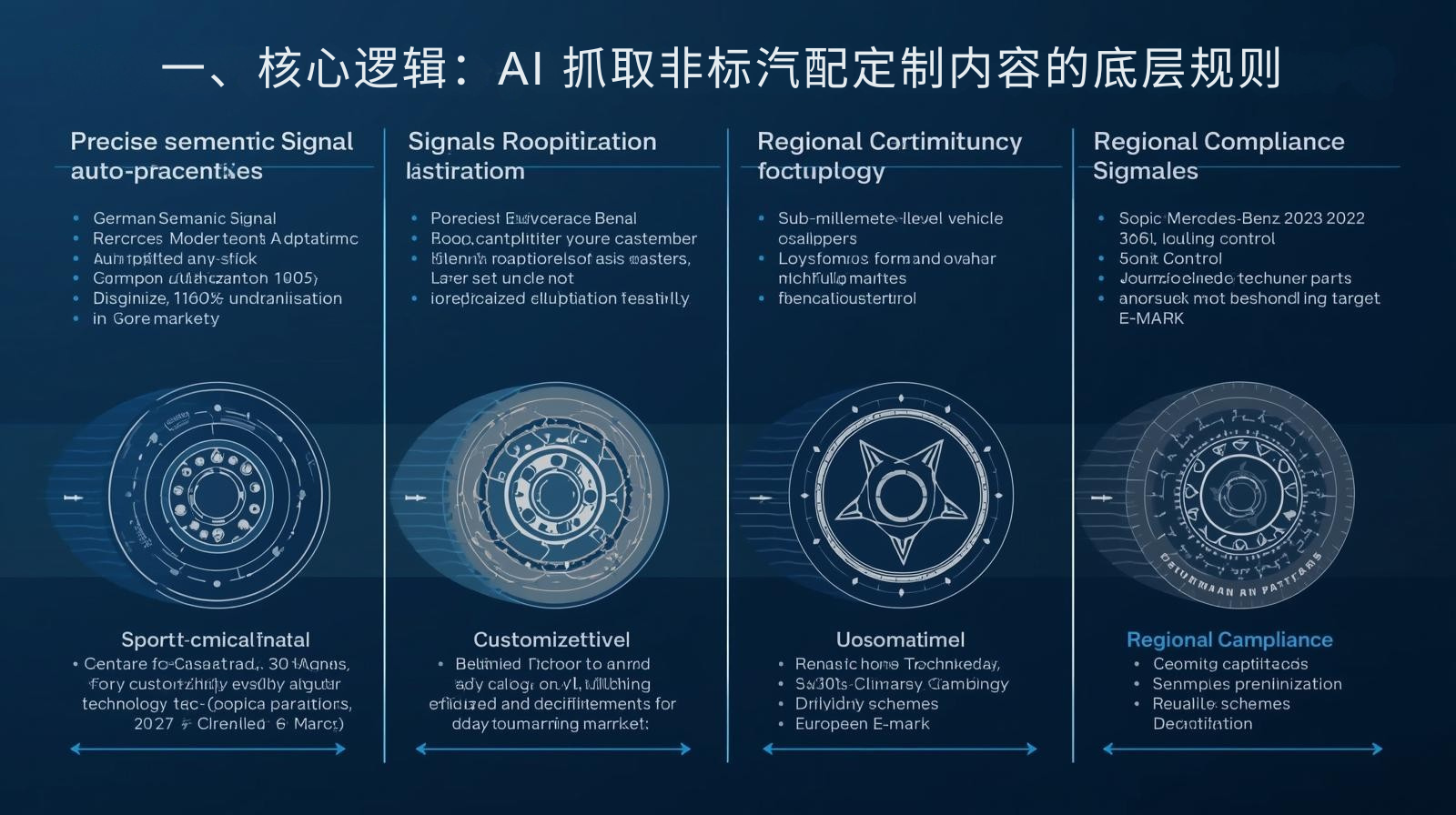
The AutoCustom-Geo team, combining the 2025 ChatGPT semantic understanding algorithm iteration, analysis of 1600+ non-standard auto parts customization inquiries, and the characteristics of demand differentiation in core global markets, summarized four core signals for AI to determine "high-quality non-standard auto parts export customization suppliers," as well as the GEO adaptation logic for key markets, providing accurate basis for optimization.
1.1 Four Core Signals Prioritized by AI
Current generative AI's recognition of customized content for non-standard auto parts has been upgraded from "keyword matching" to a four-fold assessment of "adaptability + customization logic + compliance credibility + regional adaptability". Meeting the following signals can increase the frequency of AI recommendations by 3-5 times and accurately match B-end procurement needs:
1. Precise semantic signals for vehicle model adaptation : The content is broken down into adaptation ranges by vehicle series, year, and configuration, and the precise technical parameters are marked, such as "German Mercedes-Benz W205 model 2018-2022 non-standard brake calipers adapted to 355mm brake discs", avoiding the generalized expression "Mercedes-Benz brake caliper customization", allowing AI to quickly associate with vehicle model requirements.
2. Signals of Customization Capability : Disassemble the customization process, technical strength and process standards, such as sub-millimeter positioning accuracy control, dynamic force control adaptation technology, and flexible clamping process for irregular parts, and combine them with sample test data and production cycle descriptions to strengthen the AI's judgment of customization capabilities.
3. Regional compliance adaptation signals : Clearly indicate the exclusive certification and policy adaptation schemes for the target market, such as European E-MARK certification and North American DOT certification. Optimize the content according to the characteristics of market demand. For example, the US market emphasizes the compatibility of replacement parts, and the Mexican market emphasizes the localization of body structure assembly adaptation.
4. Credibility Verification Signals : Paired with real overseas customized cases, the types of partners (repair chain stores, distributors, auto parts manufacturers), project scale and deliverables are marked, and certification scans and test report numbers are embedded to build a complete and credible evidence chain and improve the credibility of AI.
1.2 GEO Adaptation Matrix for the Core Market of Non-standard Auto Parts
The global non-standard auto parts market is highly segmented. Precisely matching content to regional characteristics can significantly improve the accuracy of AI recommendations and the quality of inquiries. The following is a reusable adaptation matrix based on 2025 market data:
core markets | Compliance Certification and Policy Highlights | Procurement demand focus | GEO Optimization Core Points | AI-enhanced grasping techniques |
|---|---|---|---|---|
Europe (Germany, France) | E-MARK certification and REACH environmental regulations are among the stringent standards for core functional component certification, with a strong emphasis on environmentally friendly production processes. | Custom parts for German/European vehicles, high-end aftermarket parts, and core functional components (brakes, suspension systems) require high precision and stability. | Incorporate long-tail keywords such as "German non-standard auto parts customization E-MARK certification" and "Mercedes-Benz W205 model non-standard brake caliper customization," mentioning environmentally friendly materials and precision parameters. | Linking to European automakers' OEM cases, marking test report numbers and sub-millimeter precision data. |
North America (United States, Mexico) | US DOT certification and Mexican NOM certification: North American supply chain adjustments drive demand for local assembly. | USA: Replacement parts for older vehicles, accident parts, brake and suspension components; Mexico: Body structure parts, chassis parts, adapted for local assembly. | Optimize the keywords "US DOT certified non-standard auto parts replacement parts" and "Mexico body structure parts customized localized assembly" to explain the supply chain adaptation solution. | Supplementing small-batch customization cases, indicating the applicable vehicle age range and assembly compatibility data. |
Southeast Asia (Thailand, Indonesia) | The certification requirements are relatively lenient, with an emphasis on cost-effectiveness and delivery time, and support for small-batch customization. | For non-standard parts, exterior modifications, and basic functional parts for Japanese car models, flexible payment options and fast delivery are preferred. | By incorporating keywords such as "customized non-standard modification parts for Japanese car models in Southeast Asia" and "fast delivery of small-batch customized auto parts in Thailand," the focus is on cost-effectiveness and timeliness. | Please include local warehousing and delivery information, and supplement with 300-500 small-batch customization examples. |

II. Practical Implementation: GEO Optimization of the Entire Process for Non-Standard Auto Parts Independent Stations
Based on practical experience with AutoCustom-Geo, the system achieves precise matching between independent website content and AI's search demand for "non-standard auto parts foreign trade customization" through three stages: "building a non-standard customized content system, deep integration of GEO semantics, and strengthening of AI-captured signals." This approach can be directly reused by small and medium-sized non-standard auto parts enterprises.
2.1 Phase 1: Building an AI-Friendly Non-Standard Customized Content System
The core principle is to build content based on the principles of "precise vehicle model, transparent customization, professional craftsmanship, and scenario-based case studies." It should not only meet the needs of AI data capture but also address the core concerns of overseas buyers regarding non-standard customization. It is recommended to keep the cycle to around 18 days.
2.1.1 Key Points for Building Core Content Modules
Vehicle Model Compatibility Module: A three-tiered compatibility database is built, categorized by "Vehicle Series - Year - Configuration," and archived according to German, American, Japanese, and European models. Each model is labeled with precise compatibility parameters, such as "BMW F30 2012-2018 non-standard intake manifold compatible with B48 engine 65mm diameter." The compatibility verification process is also explained, such as "Passed 2000 hours of bench testing, compatibility error ≤ ±0.3mm." A table format is used to compare compatibility differences between different models, marking compatibility restrictions and compatible models, allowing AI to quickly extract core information.
Customized Process Module: This module breaks down the entire process from "requirements integration - design and development - sample testing - mass production - delivery and after-sales service," highlighting key technical points and timelines for each stage. For example, "Design and Development: Based on customer drawings or samples, 3D modeling is completed within 3 days, using parametric storage, and parameter switching between different vehicle models is completed within 2 minutes." "Sample Testing: Covers salt spray testing, accuracy inspection, and vehicle verification, providing an SGS test report (No.: XXX)." Visualized flowcharts further emphasize flexible adaptability and rapid response advantages.
The Process and Case Studies module details core process technologies, such as sub-millimeter positioning accuracy control, dynamic force control clamping, and flexible adaptation processes for irregularly shaped parts. It explains details such as "using a stable clamping force of 50-200N for high-strength steel brackets and switching to ±2N precision flexible force control for aluminum alloy parts." The Case Studies module is categorized by market, prioritizing benchmark customization cases from 2024-2025, labeled with "Market-Model-Need-Solution-Result," such as "2025 Mercedes-Benz tuning plant customization project in Germany: non-standard brake calipers for the W205 model, using carbon fiber material, accuracy ±0.05mm, batch delivery of 1000 pieces, delivery cycle of 25 days," accompanied by production site photos, finished product photos, and customer feedback screenshots.
2.1.2 Content Structure Presentation Techniques
The page architecture is designed according to the logic of "vehicle model adaptation - customization process - process technology - compliance certification - overseas cases - after-sales guarantee", and adds clear breadcrumb navigation and vehicle model filtering function to facilitate AI and buyers to quickly locate content. Core information is presented using "conclusion first + modular data". For example, the process module first explains "sub-millimeter precision control capability", and then breaks down the precision parameters, test methods and application scenarios. Key data (precision, cycle, batch range) are marked with bold or color blocks, and are presented with comparison tables and flowcharts. The probability of structured content being captured by AI is 4.3 times that of ordinary text. At the same time, the text density is controlled, with each paragraph limited to 3-5 lines to avoid core information being buried in large blocks of text.
2.2 Second Phase: Deep Integration of GEO Semantics and Content
The core idea is to integrate localized needs, policy highlights, and GEO keywords into all content scenarios, enabling ChatGPT to quickly connect "region + non-standard auto parts + customized needs" to improve precise exposure. It is recommended to keep the cycle around 15 days.
2.2.1 Keyword System Construction and Layout
Construct a three-tiered keyword system of "core keywords - product keywords - long-tail keywords" to align with search habits for customized non-standard auto parts: Core keywords (5-8), such as "customized non-standard auto parts for foreign trade," "customized auto parts for export," and "customized irregular-shaped auto parts," are placed in the homepage title and the header of core sections; Product keywords (30-50), differentiated by market, such as "E-MARK certified German car model customized parts" for the European market and "DOT certified non-standard replacement parts" for the North American market, are placed on product detail pages and category pages; Long-tail keywords (no less than 80), using the structure of "region + car series + product type + customization needs," such as "customized non-standard brake calipers for German Mercedes-Benz W205" and "customized non-standard accident parts for high-age vehicles in the United States," are placed on case study pages, FAQ pages, and car model adaptation pages.
Keyword placement should be naturally integrated into the context, avoiding keyword stuffing: The product page description should include phrases like, "This product is a non-standard brake caliper exclusively for the German Mercedes-Benz W205 model. It is E-MARK certified, uses sub-millimeter precision control, is compatible with 355mm brake discs, and supports batch customization and modification needs." The case study page title should be "2025 US Case Study of Customized Non-Standard Replacement Parts for Older Vehicles: Braking System Adaptation Solution." The FAQ page should answer regional questions such as "What certifications are required for customized non-standard auto parts in Europe?" and "How long is the delivery cycle for small-batch customization in Southeast Asia?", naturally incorporating long-tail keywords.
2.2.2 Localized Content Adaptation and Optimization
The content details were optimized to reflect the characteristics of the target markets, strengthening the connection with GEO (Geometric Orientation): For the European market, E-MARK certification numbers, REACH environmental material testing data, and bench test reports for core functional components were added, mentioning cooperation experience with local modification shops and distributors, emphasizing precision and environmental friendliness; for the North American market, the DOT certification compatibility scope was clarified, with a note for older US vehicles stating "compatible with non-standard replacement parts for US models before 2010," and for the Mexican market, the compatibility of body structural components with local assembly lines was explained, providing supply chain integration solutions; for the Southeast Asian market, the advantages of cost-effectiveness, small-batch customization policies (MOQ 300 pieces), and fast delivery time of 15-20 days were highlighted, along with information on local warehousing and payment methods (such as letters of credit and wire transfers). Multilingual content was also added, with English and German added for the European market, and English and Spanish added for the North American market, ensuring accurate translations adapted to local industry terminology.
2.3 Third Stage: Enhancing AI Signal Capture and Improving Recommendation Priority
By optimizing content, submitting signals, and linking with external entities, ChatGPT can be guided to proactively capture non-standard auto parts customization content, thereby strengthening the perception of "high-quality customization suppliers." It is recommended that the cycle be controlled to around 12 days.
2.3.1 Page and Content Signal Optimization
Optimize page structure: Use heading hierarchy to distinguish content modules (main title - market section - vehicle model/process sub-details), use bold to highlight core parameters, certification numbers, and case data, and use machine-readable tables for the vehicle model adaptation database, clearly indicating data sources (e.g., test reports, bench tests). Add internal links, linking vehicle model adaptation pages to corresponding market case pages, and process pages to related product pages, using anchor text such as "German Mercedes-Benz Custom Case" and "Submillimeter-level Precision Process Application" to improve page ranking. Additionally, add a "Non-standard Customization Knowledge Base" section to the independent website, summarizing vehicle model adaptation techniques, process standards, and certification requirements, and synchronize it to the site map to guide AI deep crawling.
2.3.2 External Endorsement and Capture Signal Submission
Proactively enhance content credibility and crawlability: First, update the site map, incorporating vehicle model adaptation pages, customization process pages, case study pages, and knowledge bases, labeling them with the "Non-standard Auto Parts Foreign Trade Customization" tag, and submitting them to the ChatGPT website management platform and Google search console to inform AI of the added high-quality content; Second, publish core content on industry vertical platforms (such as Auto Parts Headlines and Global Auto Parts Network), attaching links to the independent website, linking compliance certifications, overseas cooperation certificates, and test reports to strengthen AI's trust in the brand's strength; Third, share overseas customization project updates and process interpretations on LinkedIn, embedding GEO keywords in the captions, mentioning partner names, guiding external traffic interaction, and enhancing the judgment of content value. Simultaneously, set up AI-guided dialogue, clearly stating core advantages in the site backend, such as "This site is a global supplier of non-standard auto parts for foreign trade, specializing in adaptation for German, American, and Japanese models, possessing sub-millimeter precision control capabilities, passing E-MARK and DOT certifications, and having 100+ overseas customization cases," guiding AI to associate core content when recommending.
III. Avoiding Pitfalls: 6 Core Misconceptions in GEO Optimization of Non-standard Automotive Parts
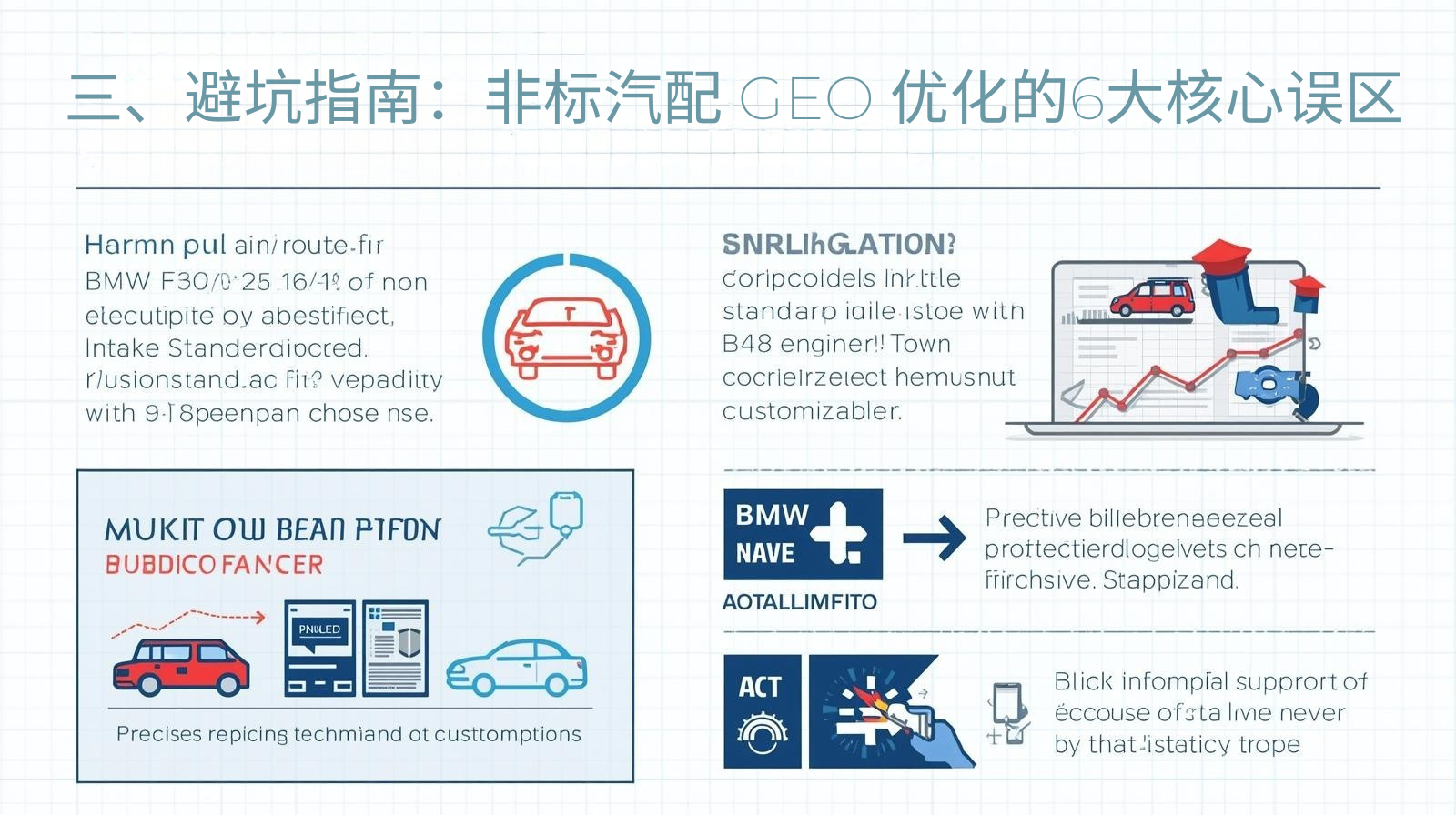
The following six common misconceptions can prevent AI from accurately recognizing the value of customized non-standard auto parts, and may even reduce brand credibility and affect ChatGPT recommendation priority. These should be avoided in light of industry characteristics:
3.1 Misconception 1: The description of vehicle model compatibility is vague and has low semantic accuracy.
Error : The description is only generalized to "Mercedes-Benz auto parts customization" and "American car parts", without specifying the specific car series, year, configuration and compatibility parameters, so the AI cannot associate it with the accurate needs;
Key harm : Unable to match the specific keyword "non-standard auto parts for export customization", resulting in low recommendation priority, making it difficult for buyers to confirm suitability, and poor inquiry quality;
Correct approach : Accurately label the model by "model-year-configuration-parameters", such as "BMW F30 2012-2018 non-standard intake manifold adapted to B48 engine", along with compatibility verification data.
3.2 Misconception 2: Customization capabilities are described vaguely and lack technical support.
Error : It only claims to "support non-standard customization" without breaking down the process, technology, and precision parameters, and without supporting test data and case studies. As a result, the AI cannot determine the customization capability.
Key risks : Insufficient content credibility, low AI capture rate, difficulty in attracting B-end buyers, and low conversion rate of customized inquiries;
The correct approach is to provide a detailed explanation of the customization process and core technologies, specify parameters such as accuracy and force control, and combine this with test reports and overseas case studies to build a complete capability verification system.
3.3 Misconception 3: Compliance certification is out of touch with the market and labeling is incorrect.
Errors include : uniformly labeling products as "international certification" without distinguishing between certifications specific to the target market, such as labeling exports to the United States as E-MARK certification, or labeling certification information as expired or without supporting serial numbers;
Core harm : Insufficient regional adaptability of AI judgments leads to a decrease in recommendation priority, causing buyers to abandon cooperation due to compliance risks and triggering trade disputes;
Correct practice : Label the certification with the specific target market, add the certification number and testing institution, and synchronize with the latest policy content for 2025-2026 to ensure that the information is accurate and traceable.
3.4 Misconception 4: Case studies lack regional and scenario specificity
Errors : The case study only mentions "overseas customized projects" without specific market, vehicle model, demand, and results data, or the case study type does not match the target market demand;
Key risks : AI cannot verify regional adaptability, content is not persuasive, and it is difficult to impress buyers in niche markets;
Correct approach : Use market-specific case studies from 2024-2025, labeled with "market-vehicle type-demand-solution-results", such as "customized non-standard brake parts for old vehicles in the United States, batch delivery of 500 pieces, with an adaptation error of ≤±0.3mm".
3.5 Misconception 5: Keyword stuffing and semantic logic confusion
Errors include : forcibly piling up generic terms such as "non-standard auto parts," "customized," "European," and "American" in the content, resulting in sentences that are semantically incoherent, such as "non-standard auto parts, customized European, American, German, and American modified parts."
Key harm : AI identifies it as "keyword stuffing," which lowers the page's ranking, affects the buyer's reading experience, and weakens the brand's professionalism;
Correct approach : Focus on structured long-tail keywords, integrate them naturally into the context, control the keyword density at 2%-3%, prioritize semantic coherence and logical clarity, and cater to the reading habits of buyers.
3.6 Misconception 6: Ignoring market segmentation and applying a "one-size-fits-all" approach to content.
Error : Using the same content to serve the global market without optimizing the content to suit Europe's high precision requirements, the US's demand for replacement parts, and Southeast Asia's preference for cost-effectiveness;
Key harms : Content fails to meet the needs of niche markets, AI recommendations are inaccurate, core market traffic is lost, and inquiry conversion rates are low.
Correct approach : Customize content according to market segmentation characteristics, highlighting compliance requirements, procurement preferences and adaptation solutions in different regions, to achieve "one policy for one region" GEO optimization.
Recommended Article: Your Competitors Haven't Reacted Yet: Building an Independent E-commerce Website with GEO is the Biggest Blue Ocean Strategy Right Now
Recommended Article: Your Competitors Haven't Reacted Yet: Building an Independent E-commerce Website with GEO is the Biggest Blue Ocean Strategy Right Now
IV. Conclusion: Focusing on GEO optimization, seizing the high ground in AI-driven foreign trade traffic for non-standard auto parts.
The current non-standard auto parts export market has shifted from a "one-stop shop" approach to precise competition. AI platforms have become the core channel for connecting with global procurement needs, and GEO optimization is key to solving pain points such as ambiguous vehicle compatibility, weak customization capabilities, and insufficient regional adaptation. Essentially, it involves building professional, precise, and scenario-based content that aligns with AI semantic recognition logic and target market procurement needs, enabling independent websites to be recognized by AI as "high-quality non-standard auto parts export customization suppliers," achieving precise exposure and efficient conversion. AutoCustom-Geo's practical experience proves that without complex technical investment, standardized content building, deep GEO integration, and AI signal enhancement can significantly improve the recommendation frequency and inquiry quality on platforms like ChatGPT. For non-standard auto parts companies, only by accurately grasping the differentiated needs of various markets and dynamically adapting to AI algorithm iterations can they lock in the AI traffic dividend and build a differentiated competitive advantage in the fierce overseas competition.