In the field of cross-border foreign trade customer acquisition, independent websites are the core digital position of enterprises, and SEO is the low-cost, long-term and stable core path to customer acquisition. However, the vast majority of foreign trade companies are facing the same dilemma: they have invested a lot of time and cost in building traditional independent websites, but they have never been able to achieve effective breakthroughs - Google crawlers cannot crawl the content, and the website has only been included for half a year; it often takes more than 5 seconds for overseas visitors to open the page, and the bounce rate is as high as 80%; the core keywords have long been hovering outside the 50th position in Google search results, and the natural traffic is almost zero; the mobile experience is messy and does not comply with Google's mobile-first indexing rules. Even if advertising is invested, conversions are sluggish due to poor experience.
Many companies mistakenly believe that SEO problems can be solved by optimizing copywriting and stacking keywords, but they ignore the most fundamental problem: the technical architecture of traditional websites has long been unable to keep up with the needs of modern search engines and cross-border visitors. Traditional foreign trade websites are mostly built using PHP templates and open source CMS, mainly client-side rendering (CSR), with bloated code, unoptimized resources, and chaotic SEO structure. These are not underlying flaws that can be solved by "surface optimization", but fundamentally limit the SEO performance and user experience of the website.
Pinshop has been deeply involved in the field of foreign trade independent website construction for many years, and has served more than 1,200 foreign trade companies, covering machinery, hardware, electronics, home furnishing, equipment, clothing and other industries. It has a deep understanding that the core competitiveness of cross-border website building has long since shifted from "page beauty" to "technical strength." A high-performance independent foreign trade station built on the React+Next.js architecture, with its unique rendering mechanism and optimization system, has achieved generational crushing on traditional websites in terms of SEO performance, and can quickly solve the four major pain points of inclusion, speed, ranking, and experience. Relying on Pinshop's standardized service process, the entire process from demand planning, architecture construction, SEO optimization to online operation can be completed in an average of 2 months, helping companies quickly build highly competitive cross-border independent stations and achieve sustained growth in natural traffic. Below, we will combine practical technical details and real cases to break down in detail how React+Next.js website building can achieve SEO performance that comprehensively crushes traditional websites. We will use implementable and quantifiable content to help companies avoid website building misunderstandings and find the right direction for technology upgrades.
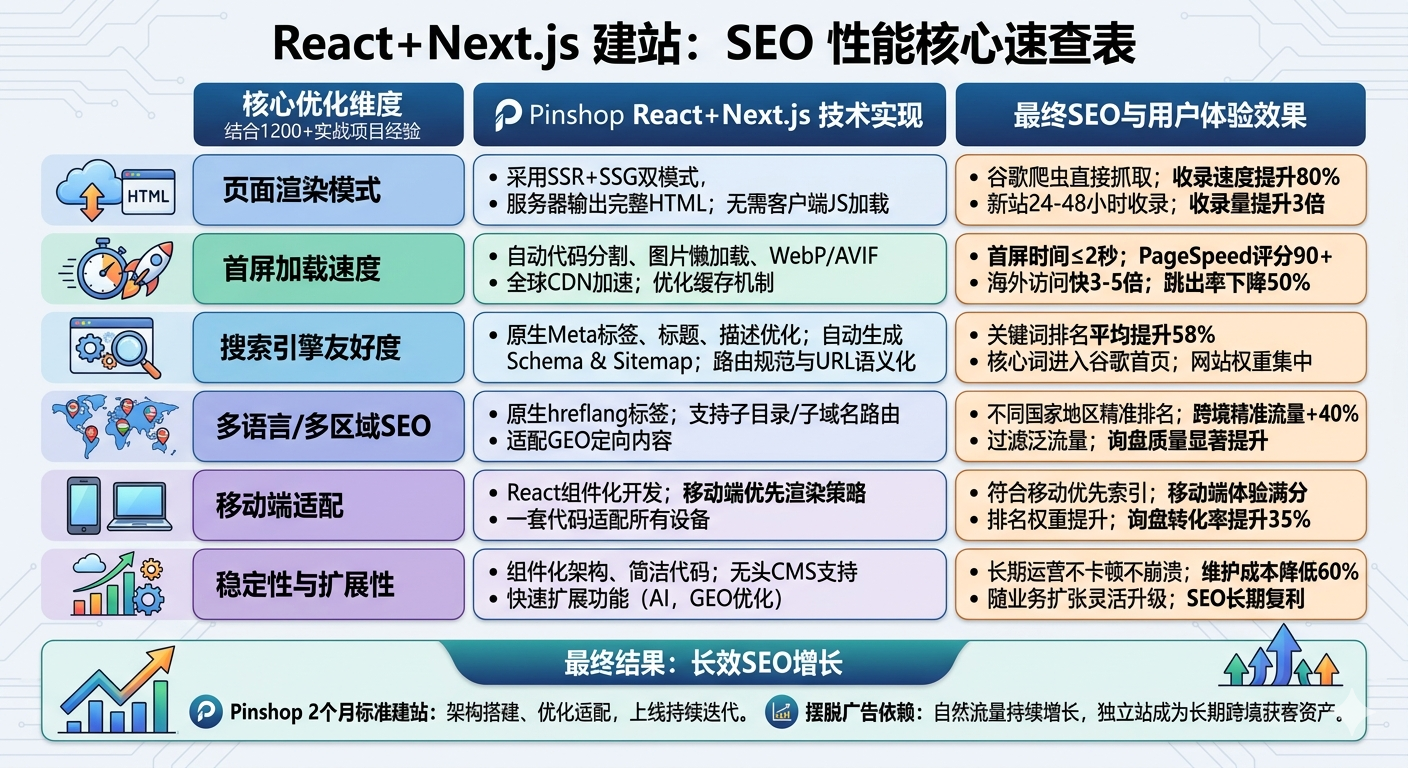
React+Next.js website building: SEO performance core cheat sheet
When building a website for cross-border enterprises, the biggest concern is "no return on investment" - they spend money to build a website, but they don't know where the focus of optimization is, and they don't know what specific effects different technical solutions can bring. In order to help enterprises quickly benchmark and make precise efforts, we combined the experience of 1200+ practical projects to compile a core SEO performance checklist for React+Next.js website building. It clearly lists the core optimization dimensions, Pinshop's technology implementation methods, and the corresponding quantifiable SEO and user experience effects, so that enterprises can clearly understand the technical advantages at a glance, avoid ineffective investment, and ensure that every technical investment can be transformed into real SEO results.
|
Core optimization dimensions
|
React+Next.js technology implementation method
|
Final SEO and user experience effects
|
|---|---|---|
|
Page rendering mode
|
Adopting SSR (server-side rendering) + SSG (static site generation) dual modes, automatically switching according to page type, the server directly outputs complete HTML, without the need for the client to load additional JS
|
Google crawlers can directly crawl the complete content, and the collection speed is increased by more than 80%. The new site can be initially included within 24-48 hours after it goes online, and the collection volume is 3 times higher than that of traditional sites.
|
|
First screen loading speed
|
Automatic code segmentation, lazy loading of images, WebP/AVIF format adaptation, integrated global CDN acceleration, optimized caching mechanism, and reduction of redundant resources
|
The first screen loading time is ≤2 seconds, the Google PageSpeed Insights score is 90+, the access speed of global overseas visitors is 3-5 times faster than that of traditional websites, and the page bounce rate is reduced by more than 50%.
|
|
Search engine friendliness
|
Native support for meta tags, title, description optimization, automatic generation of structured data (Schema) and Sitemap, routing specifications, URL semantics, and internal link structure standardization
|
Keyword rankings have increased by an average of 58%. Core keywords are easier to enter on Google’s homepage. The weight of the website is concentrated and SEO has stronger long-term effectiveness.
|
|
Multi-language/multi-region SEO
|
Natively supports hreflang tag configuration, supports multi-regional routing of subdirectories and subdomains, adapts to GEO targeted content, and achieves independent SEO optimization of multi-language content
|
Accurate ranking of keywords in different countries and languages, the proportion of cross-border precise traffic increased by 40%+, invalid general traffic was greatly filtered, and the quality of inquiries was significantly improved.
|
|
Mobile terminal adaptation
|
Based on React component development, using mobile-first rendering strategy, one set of code is adapted to all devices (PC, mobile phones, tablets), optimizing the touch interaction experience
|
Complying with Google's mobile-first indexing rules, the mobile experience is perfect, the mobile ranking weight is increased, and the mobile inquiry conversion rate is increased by 35%+
|
|
Stability and scalability
|
Component-based architecture design, the code is concise and non-redundant, supports headless CMS content management, can quickly add pages and extended functions, and adapts to subsequent upgrade needs such as AI optimization and GEO optimization.
|
The long-term operation of the website does not freeze or crash, and the later maintenance cost is reduced by 60%. It can be flexibly upgraded with the expansion of the company's business, achieving long-term compound interest growth in SEO.
|
|
Result: Long-term SEO growth
|
Combined with Pinshop’s 2-month standard website building cycle, we completed architecture construction, SEO optimization, and multi-scenario adaptation. After going online, we continued to optimize and iterate to strengthen SEO weight.
|
Get rid of dependence on advertising, natural traffic continues to grow, SEO effects are quantifiable and sustainable, and independent websites become the core assets of enterprises for long-term cross-border customer acquisition.
|
It is not difficult to see from the cheat sheet that the SEO advantage of React+Next.js website building is not a single dimension of "fast speed" or "good collection", but a full-link technology system covering rendering mechanism, speed optimization, search engine adaptation, and multi-scenario expansion. Through this technical system, Pinshop has truly solved the four underlying problems of traditional websites: "difficulty in inclusion, slow loading, low ranking, and poor experience", allowing foreign trade independent websites to achieve a qualitative leap in SEO performance. This is also the core reason why more and more cross-border companies choose the React+Next.js architecture and abandon the traditional and old website building methods.
Why trust this guide? Thousands of practical website building experience from Pinshop
There are countless articles on the Internet about "React+Next.js website building" and "SEO optimization", but most of them are empty technical theories, fragmented techniques, and even misleading content - many articles only boast about technical advantages, but do not provide practical solutions; they only talk about theoretical knowledge, but there is no real project data support. For foreign trade companies, such content is worthless and will instead lead to detours, wasting time and costs.
All content in this guide comes from Pinshop’s practical experience - we have been deeply involved in the field of foreign trade independent website construction for many years, and have served a total of 1,200+ foreign trade companies, covering multiple industries such as machinery, hardware, electronics, home furnishing, and equipment. We serve customers in global core cross-border markets such as Europe, America, Southeast Asia, the Middle East, Japan, and South Korea. We don’t just talk about technology, but we actually go into the front line of projects to help companies solve real website building and SEO pain points: We helped a mechanical equipment company upgrade the traditional PHP template website to the React+Next. For an enterprise, through React+Next.js speed optimization, the overseas loading time was shortened from 8 seconds to 1.8 seconds, the bounce rate was reduced by 62%, and the inquiry conversion rate was increased by 40%; we helped a home furnishing enterprise build a multilingual React+Next.js independent station, which doubled the keyword ranking in small language markets and increased precision traffic by 50%.
In all projects, we strictly follow Google's official SEO specifications, Next.js official engineering standards, and cross-border website best practices. All technical solutions have been verified by real projects and can be implemented, quantified, and replicable. We have summarized the core practical experience from hundreds of successful projects: what rendering mode is most suitable for foreign trade websites, how to optimize to achieve the fastest loading speed, how to lay out multi-language SEO to achieve accurate rankings, how to achieve long-term SEO compound interest through technical architecture - these practical knowledge are the core value of this guide and the key to distinguishing us from ordinary website building service providers.
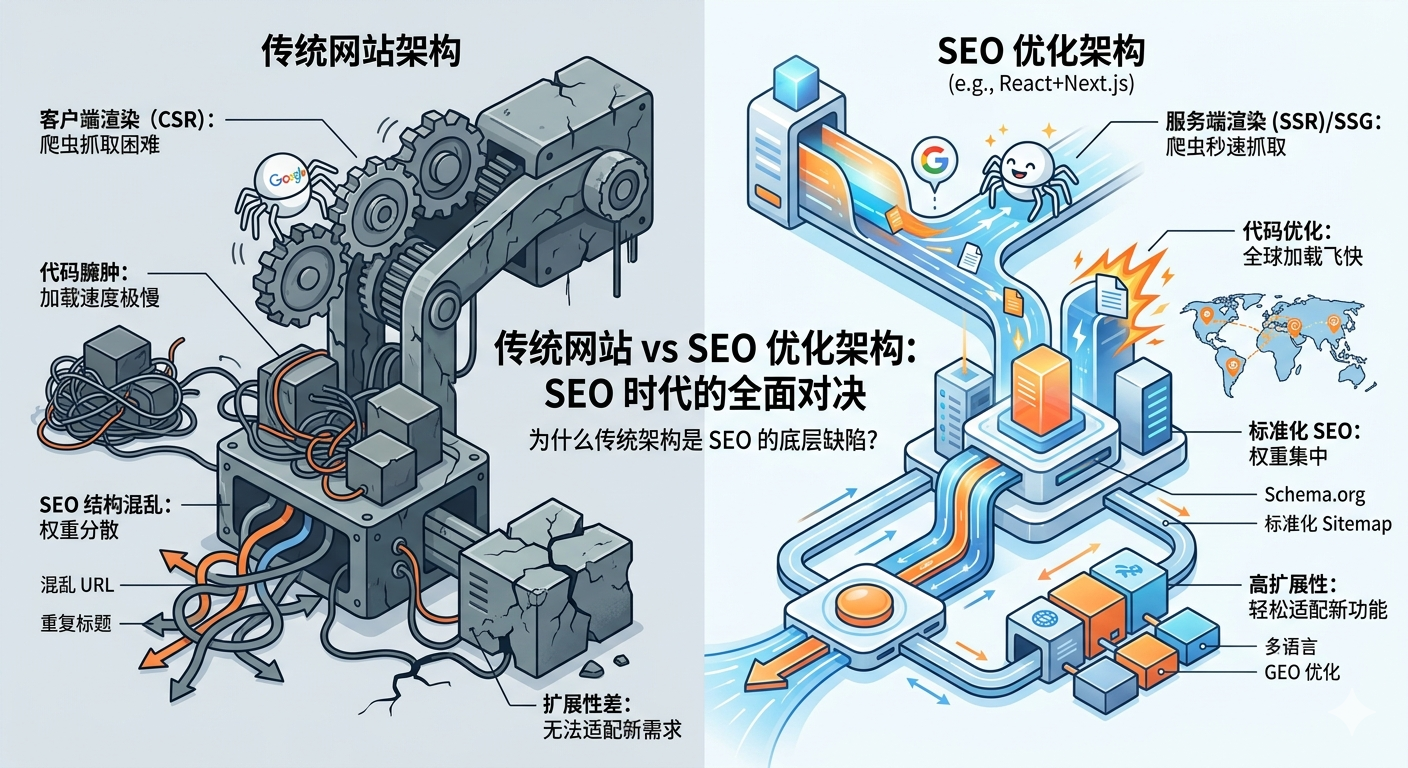
Why are traditional websites lagging behind in the SEO era?
Many foreign trade companies wonder: "We have also done SEO optimization, why can't we rank higher?" "The content of our website is also good, why doesn't Google include it?" In fact, the root of the problem is not the "content", but the "technical architecture" - the old technology used by traditional foreign trade websites has four underlying flaws that cannot be repaired. These flaws directly lead to its absolute disadvantage in SEO competition. No matter how much operating costs are invested, it is difficult to break through the bottleneck.
1. Client-side rendering (CSR) is the main method, and it is difficult for Google crawlers to crawl the complete content.
Most traditional websites use client-side rendering mode. When the page is loaded, the server only returns an empty shell of HTML, and all content needs to be loaded with JS through the client before it can be displayed. However, the crawling logic of Google crawlers often cannot fully execute the client JS, causing the crawler to "not see" the core content of the page. This is equivalent to your website having high-quality content, but Google cannot find it at all, and naturally it cannot be included or ranked. Many traditional websites have been online for half a year and have less than 20 pages included. This is the core reason.
2. The code is bloated, the resources are not optimized, and the global loading speed is extremely slow.
Traditional template websites and open source CMS websites often have problems with code redundancy and unoptimized resources: images are not compressed, scripts are not split, and the caching mechanism is unreasonable, resulting in excessive page size. At the same time, there is a lack of global CDN acceleration. When overseas visitors visit, they need to load resources across regions, and the loading time is often 5-10 seconds. Google has already included "page speed" as a core ranking factor. The slower the speed, the lower the ranking. At the same time, visitors have limited patience. If the loading time exceeds 3 seconds, the bounce rate will increase significantly. Even if Google includes it, it will not bring effective traffic and inquiries.
3. The SEO structure is chaotic, there is no standardized configuration, and the weight cannot be centralized.
Traditional websites have irregular URLs, repeated titles, confusing meta tags, lack of structured data (Schema) and standardized sitemaps, and the internal link structure is messy. This will cause Google crawlers to be unable to clearly identify the core content and hierarchical relationships of the website, the website weight cannot be concentrated on the core pages, and it will naturally be difficult to improve the keyword ranking. What's more serious is that multi-language websites often have "duplicate inclusion" problems, which further disperses the weight, causing the rankings of all language versions to be affected.
4. Poor scalability and unable to adapt to new needs for cross-border customer acquisition
With the advent of the AI era, the demand for cross-border customer acquisition continues to escalate. Enterprises need to build multi-language, multi-regional websites and adapt to new functions such as GEO optimization and AI recommendation. However, traditional websites have rigid structures, redundant codes, and difficulty in upgrading. Once changes are made, they are prone to problems such as lags and crashes, and cannot adapt to these new needs. This has resulted in traditional websites being unable to keep up with the pace of industry development, remaining in a passive position for a long time, and making it difficult for SEO effects to continue to improve.
It is worth noting that these defects cannot be solved by "optimizing the copywriting" or "adjusting keywords", but are structural and underlying problems. This is why, as an independent foreign trade website, a website using the React+Next.js architecture can easily achieve triple leadership in inclusion, ranking, and speed, while traditional websites can only fall into the dilemma of "high investment and low return".
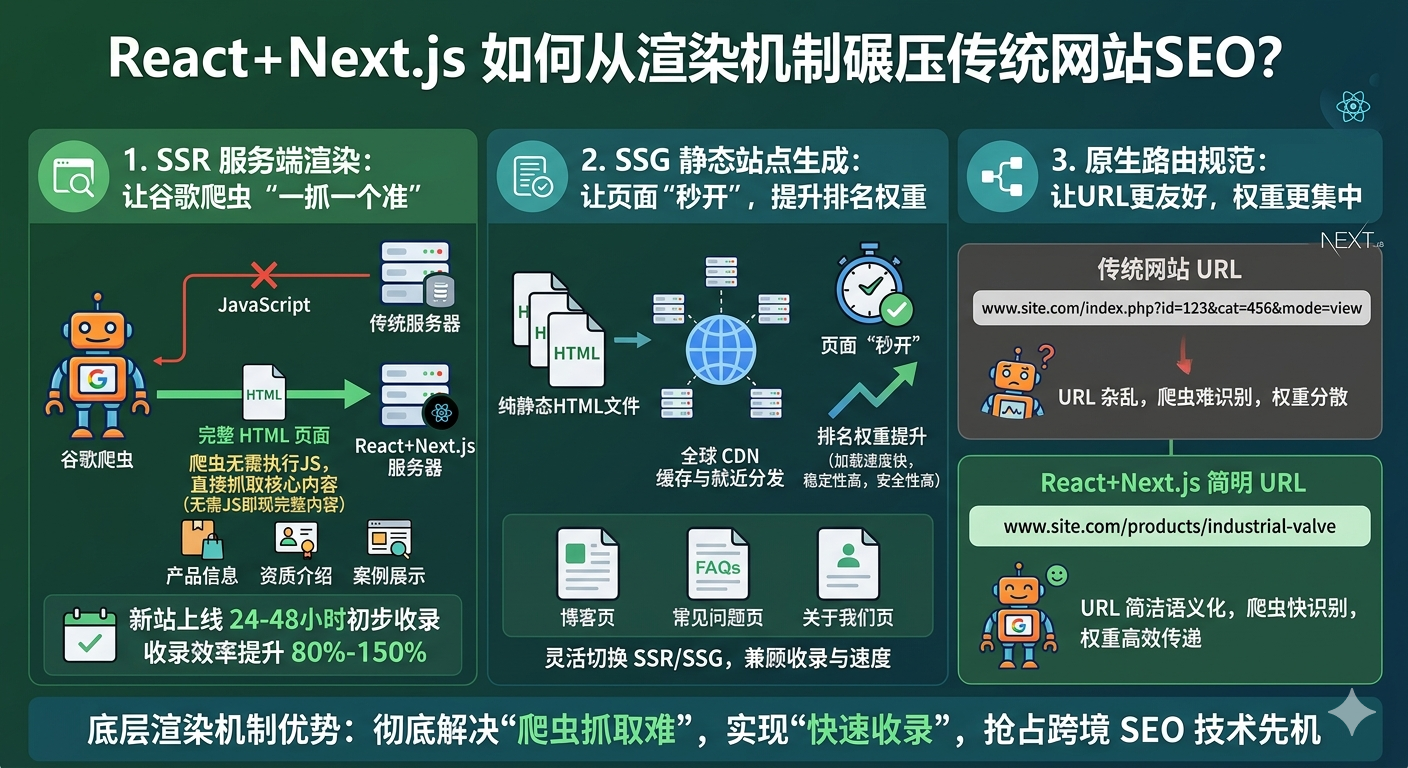
How does React+Next.js crush traditional website SEO from the rendering mechanism?
The first premise of SEO is that Google crawlers can easily, completely and quickly crawl the core content of the page. The core reason why traditional websites are difficult to include and have low rankings is that the rendering mechanism is backward and cannot meet the crawling needs of Google crawlers. The React+Next.js architecture has fundamentally changed the rendering method. With the SSR+SSG dual rendering mode, it has achieved an intergenerational crush on traditional websites, allowing Google crawlers to "understand, crawl quickly, and trust."
1. SSR server-side rendering: Let Google crawler "catch everything accurately"
The core logic of SSR (server-side rendering) is: when a visitor or Google crawler accesses the website, the server will first completely render the page content into HTML, and then return the complete HTML to the client. This means that the Google crawler can directly crawl all the core content of the page without executing any JS - product information, qualification introduction, case display, etc., which can all be clearly recognized by the crawler. When Pinshop builds a React+Next.js independent site, it will accurately configure SSR rendering according to the page type of the foreign trade enterprise to ensure that core pages (product pages, homepages, solution pages) can all achieve server-side rendering, so that the new site can be initially included within 24-48 hours after it goes online, and the collection efficiency is 80%-150% higher than that of traditional sites.
2. SSG static site generation: Make pages open in seconds and increase ranking weight
SSG (Static Site Generation) is another core advantage of React+Next.js. It will pre-generate pure static HTML files for all pages when the website is built. These files will be cached by the global CDN. When visitors visit, the CDN will distribute the static files nearby to achieve "second opening" of the page. For foreign trade independent websites, SSG rendering is most suitable for pages with relatively fixed content such as blog pages, FAQ pages, and about us pages. Not only does it load very quickly, but it also reduces server pressure. At the same time, static pages are more stable and secure, and are more favored by Google, which can further increase ranking weight. Pinshop will flexibly switch between SSR and SSG rendering modes according to the update frequency of page content, taking into account collection, speed and maintenance efficiency.
3. Native routing specifications: Make URLs more friendly and weight more concentrated
The URLs of traditional websites are often messy and contain a large number of garbled parameters, which is not only difficult for Google crawlers to recognize, but also difficult for visitors to remember. React+Next.js implements native routing based on the file system, and the URL is concise and semantic, such as "/products/industrial-valve", which not only allows Google crawlers to quickly identify the core content of the page, but also allows visitors to intuitively understand the theme of the page. At the same time, Next.js supports the automatic generation of standardized routing levels to avoid excessively deep page levels, ensure that weights can be transferred efficiently, and make it easier for core pages to obtain high rankings.
It is the advantage of this underlying rendering mechanism that allows React+Next.js to achieve a comprehensive crush on traditional websites in terms of SEO inclusion and ranking. React+Next.js can inherently solve the "difficulty in crawling" problem that traditional websites cannot solve; the "quick inclusion" that traditional websites cannot achieve, React+Next.js can easily achieve. This is why more and more foreign trade companies choose to upgrade to the React+Next.js architecture to seize the technical opportunities of cross-border SEO.

Speed optimization: How can React+Next.js make global access 3–5 times faster?
Page speed is a core factor in Google rankings and the lifeline of cross-border conversions - for overseas visitors, for every extra second of waiting, the bounce rate will increase by 30%; if the loading time exceeds 5 seconds, the visitor churn rate is as high as 90%. The reason why traditional websites have poor conversions is largely due to the slow loading speed. React+Next.js relies on a complete speed optimization system to allow global visitors to access 3-5 times faster than traditional websites, fundamentally improving user experience and SEO rankings.
1. Automatic code segmentation: reduce page size and improve loading efficiency
When a traditional website is loaded, the entire site's JS code is loaded at once. Even if a visitor only accesses one page, all irrelevant code needs to be loaded, resulting in a page that is too large and slow to load. React+Next.js supports automatic code splitting, which will split JS code by page. Whichever page a visitor visits, only the JS code required for that page will be loaded, without loading the entire site resources. This optimization method can reduce the page size by more than 60% and greatly increase the loading speed. At the same time, there is no need to reload all resources when switching pages, achieving lag-free switching.
2. Automatic optimization of pictures and resources: taking into account speed and visual experience
Pictures are one of the core contents of independent foreign trade websites, but pictures on traditional websites are often not optimized and are too large, which becomes the main factor that slows down the loading speed. React+Next.js has a built-in image optimization function, which can automatically compress and format images (WebP/AVIF format, more than 50% smaller than JPG), and supports lazy loading of images - only when the image enters the visitor's field of view, the image will be loaded, avoiding loading all images at once when the page is loading, further improving the loading speed. In addition, Pinshop will integrate global CDN acceleration for the website, distribute website resources to various nodes around the world, and allow overseas visitors to access nearby, increasing the loading speed by more than 30%.
3. Intelligent caching and preloading: make secondary visits "instantly open"
React+Next.js has a complete caching and preloading mechanism, which can intelligently identify visitors' access habits and preload pages that visitors may visit (such as recommended product pages on the homepage and related blog pages). When visitors click on the link, the page can be opened instantly without waiting. At the same time, the browser cache mechanism is maximized. When a visitor visits the website for the second time, most resources will be loaded from the browser cache, and the loading speed is almost negligible. This kind of optimization not only improves the user experience, but also reduces server pressure and website operating costs.
Through the optimization of the above three major dimensions, the React+Next.js independent website built by Pinshop can achieve a first-screen loading time of ≤2 seconds, a Google PageSpeed Insights score of 90+, global access speeds 3-5 times faster than traditional websites, and a page bounce rate reduced by more than 50%. The increase in speed can not only directly improve Google rankings, but also reduce advertising CPC (Google ads will adjust bids based on page experience), increase visitor stay time and inquiry conversion rate, forming a virtuous cycle of "speed increase → ranking increase → traffic increase → conversion increase".
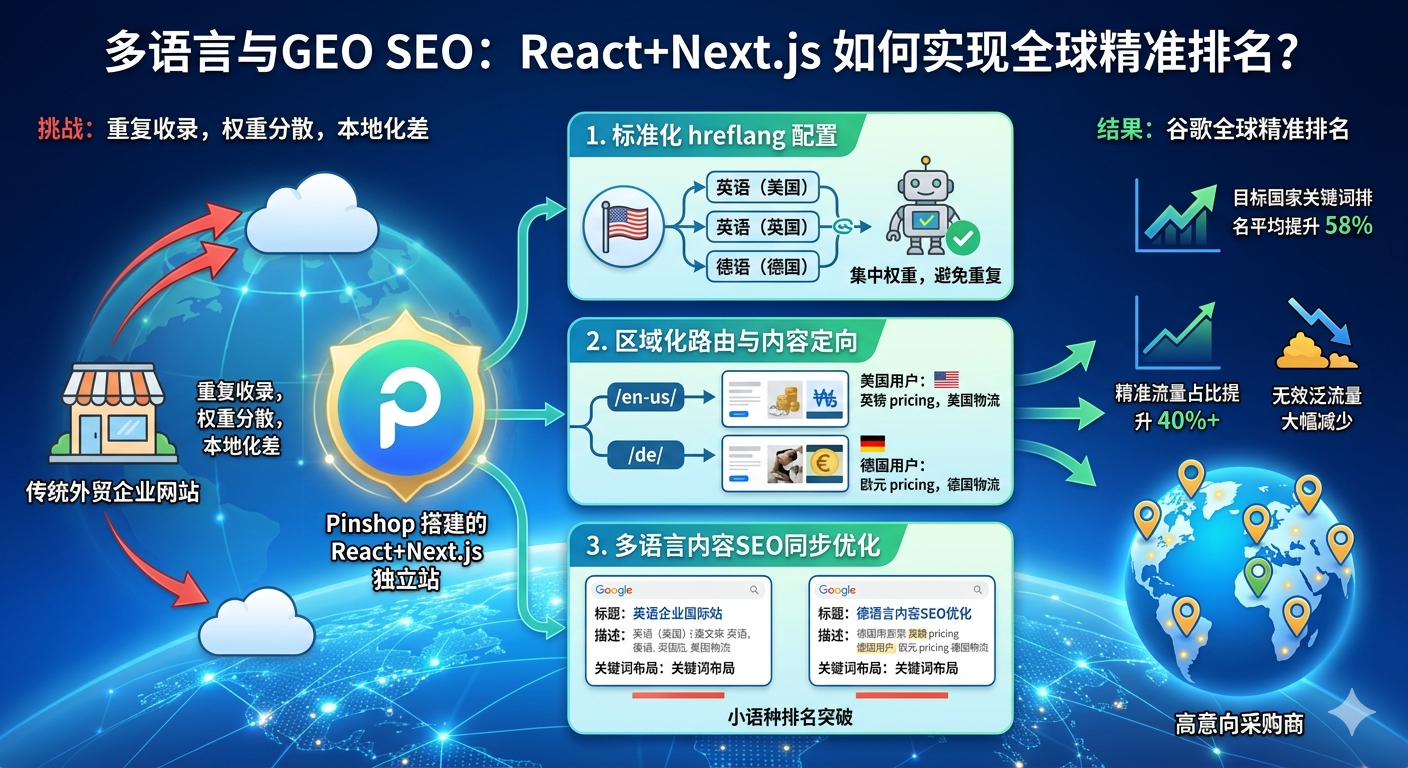
Multilingual and GEO SEO: How does React+Next.js achieve accurate global rankings?
For foreign trade companies, the core requirement for cross-border website building is "global customer acquisition", and multi-language and multi-regional SEO is the key to achieving precise global customer acquisition. When doing multi-language SEO, traditional websites often face problems such as "duplicate inclusion, scattered weights, and poor localization adaptation," making it difficult to rank keywords in different countries and languages. React+Next.js inherently supports multi-language and multi-regional SEO optimization, which can help companies achieve precise global rankings and capture high-intent traffic from different regions.
1. Standardize hreflang configuration: avoid duplicate inclusion and centralize weight
The hreflang tag is an international SEO optimization solution recommended by Google. It is used to inform Google of the corresponding relationships between pages in different languages and different regional versions, avoid repeated inclusion, and concentrate page weights. Traditional websites often need to manually configure hreflang tags, which are prone to configuration errors, omissions and other problems. However, React+Next.js natively supports automatic configuration of hreflang tags. Pinshop will accurately set hreflang tags in different languages and regions according to the company's target market, such as English (United States), English (UK), German (Germany), etc., ensuring that Google can correctly identify different versions of pages, avoid weight dispersion, and allow each language version of the page to obtain independent ranking weight.
2. Regional routing and content targeting: accurately matching target market needs
React+Next.js supports multiple multi-region routing modes such as subdirectories and subdomain names. Pinshop will select the most appropriate routing mode based on the company's target market and business needs, such as "/en-us/" (English-United States) and "/de/" (German-Germany), so that visitors from different regions can quickly find the corresponding language version page. At the same time, combined with GEO optimization, different content, languages, currencies, and logistics information are displayed by country to fit the purchasing habits and demand characteristics of the target market, allowing visitors to experience a "localized" experience and further increasing the proportion of accurate traffic and inquiry conversion rate.
3. Synchronous SEO optimization of multilingual content: achieving breakthroughs in rankings of minor languages
When many foreign trade companies do SEO in small languages, they often simply translate the content, resulting in blunt content, unreasonable keyword layout, and inability to obtain effective rankings. When Pinshop builds a React+Next.js multi-language independent website, it will configure independent meta tags, titles, and descriptions for each language version, and combine the localized keywords of the target market to accurately layout the content to ensure the professionalism and readability of the content in small languages. At the same time, the rendering mechanism of Next.js ensures that pages in minor languages can be quickly included, helping companies achieve breakthroughs in keyword rankings in minor language markets and seize more global business opportunities.
Through the above multi-language and GEO SEO optimization, the React+Next.js independent station built by Pinshop can increase the keyword ranking of the target country by an average of 58%, increase the proportion of precise traffic by 40%+, and significantly reduce invalid general traffic, allowing enterprises to accurately reach high-intention buyers in different regions and achieve simultaneous customer acquisition in multiple regions around the world.
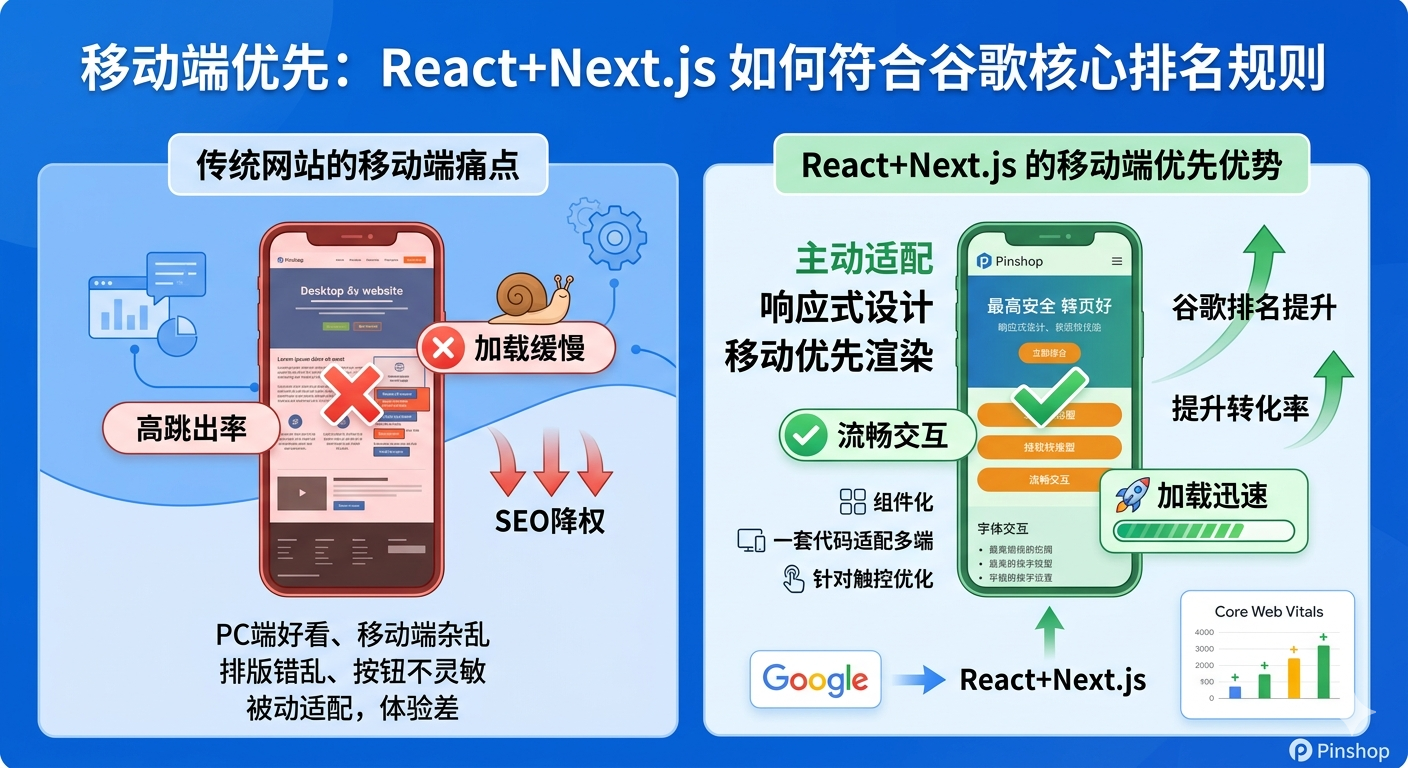
Mobile first: How does React+Next.js comply with Google’s core ranking rules?
Google implemented "mobile-first indexing" as early as 2018, which means that Google will give priority to crawling and evaluating the mobile version of the website. Websites with poor mobile experience will be significantly demoted even if their PC rankings are high. However, traditional websites often have the problem of "looking good on PC but cluttered on mobile": messy layout, insensitive buttons, and slow loading, which seriously affects the mobile user experience and thus affects SEO rankings.
Website building with React+Next.js is inherently mobile-first and can perfectly adapt to Google’s mobile-first indexing rules, fundamentally solving the mobile pain points of traditional websites:
First of all, React adopts component development. All components support responsive design. One set of code can be adapted to all devices (PC, mobile phone, tablet). There is no need to develop a separate mobile website, which not only reduces development costs, but also ensures the consistency of experience between PC and mobile terminals. Secondly, Next.js adopts a mobile-first rendering strategy to give priority to loading mobile content, ensuring that mobile loading speeds are faster and rendering is smoother, and a good user experience can be maintained even in weak network environments. In addition, during the development process, Pinshop will specifically optimize the touch interaction, layout, and font size of the mobile terminal to ensure that mobile visitors can easily browse the website and submit inquiries, further improving the mobile conversion rate.
In contrast, the mobile adaptation of traditional websites is often "passive adaptation", which only shrinks the PC content and cannot meet the browsing habits of mobile visitors, resulting in high mobile bounce rates and poor conversions. The mobile optimization of React+Next.js is "active adaptation", which structurally ensures a full mobile experience, directly increases the weight of Google rankings, and gives enterprises an advantage in mobile SEO competition. 
Why is React+Next.js more conducive to long-term SEO compound interest growth?
Why is React+Next.js more conducive to long-term SEO compound interest growth?
SEO is not a one-time job, but a process of long-term compound interest - a good technical structure can make the website more stable and valuable as it operates; while a poor technical structure will only make the website slower and more chaotic, and its weight will continue to lose. The core reason why it is difficult for traditional websites to achieve long-term SEO growth is that the architecture has poor scalability and high maintenance costs. The React+Next.js architecture, with its componentized and scalable features, can achieve long-term compound interest growth in SEO, making independent websites a core asset for enterprises to acquire long-term cross-border customers.
1. The architecture is scalable and will not slow down as content increases.
The code of traditional websites is redundant and the structure is chaotic. As the content of the website increases (new products, blogs, cases), the page loading speed will become slower and slower, and the maintenance will become more and more difficult. React+Next.js adopts a component-based architecture, and all content is presented in the form of components. When adding new pages or new functions, you only need to add the corresponding components, which will not affect the global code or slow down the website speed. At the same time, Next.js supports headless CMS (content management system), which allows enterprises to efficiently manage website content without technical personnel intervention, greatly reducing post-maintenance costs and allowing the website to be flexibly upgraded with business expansion.
2. Standardized internal link structure and efficient weight transfer
One of the cores of SEO is "weight transfer". A reasonable internal link structure can allow core pages to gain more weight and improve rankings. The native routing specification of React+Next.js ensures the standardization and rationality of the internal link structure, the page hierarchy is clear, the core pages (home page, core product pages) can obtain more internal link directions, and the weight transfer is efficient. At the same time, Pinshop will optimize the internal link layout when building the website to make related pages related to each other, further increasing the overall weight of the website and achieving long-term SEO growth.
3. Technology is continuously updated to keep up with Google’s algorithm
Google's algorithm is constantly being updated. The technical architecture of traditional websites is old and unable to quickly adapt to algorithm changes. Rankings often drop due to algorithm updates. React and Next.js, as the most mainstream front-end technologies at present, will continue to be iteratively updated. Officials will continue to optimize SEO-related functions and adapt to changes in Google algorithms. Pinshop will continue to pay attention to the technical updates of React, Next.js and Google algorithm changes, provide customers with follow-up optimization services, ensure that the website always complies with the latest SEO specifications, maintain long-term technological leadership, and achieve long-term compound interest growth in SEO.
The real SEO advantage never relies on short-term skills, but on the support of the underlying technical architecture. React+Next.js website building can not only solve the current collection, ranking, and speed problems, but also lay the foundation for long-term SEO growth, allowing companies to get rid of their dependence on advertising and achieve continued growth of natural traffic. This is also its core value compared to traditional website building.
Case: Pinshop React+Next.js real SEO results of website building
It is meaningless to talk about technical advantages. The following is a real case of a machinery and equipment foreign trade company that Pinshop serves. Through specific data, it shows how React+Next.js website building can achieve SEO performance that comprehensively crushes traditional websites, helping companies achieve dual growth of natural traffic and inquiries, and also allowing everyone to more intuitively understand the actual value of React+Next.js website building.
Customer pain points
This company is a machinery and equipment company integrating industry and trade. It mainly exports to European, American and Southeast Asian markets. Its core products are industrial valves. The original website is a traditional PHP template site. It invested a lot of operating costs in SEO, but the effect has always been poor. The specific pain points are as follows:
1. Difficulty in inclusion: Half a year after the website was launched, Google has included less than 20 pages. The core keywords (such as "industrial valve manufacturer") are all outside the 50th place, and the natural traffic is almost zero; 2. Slow loading: It takes 6-10 seconds for visitors from the European and American markets to open the page, and the bounce rate is as high as 82%. Even if there is a small amount of traffic, it cannot be converted into inquiries; 3. The mobile experience is poor: the mobile layout is messy, the buttons are insensitive, and the mobile bounce rate is 90%. It does not comply with Google's mobile-first indexing rules, and the ranking continues to decline; 4. Multi-language confusion: the English version is machine-translated, the URL is not standardized, there are duplicate inclusion problems, the weight is scattered, and the small language market cannot obtain effective rankings; 5. Poor scalability: it is impossible to add blogs, cases and other content, cannot adapt to GEO optimization, and is difficult to achieve multi-regional expansion.
Pinshop React+Next.js website building solution (2 months standard online)
In response to customers' pain points, Pinshop developed an integrated plan of "React+Next.js high-performance website building + full-link SEO optimization", strictly following the 2-month standard launch cycle, and providing one-stop delivery throughout the process. The specific steps are as follows:
1. Preliminary planning: clarify the customer's core target market (Europe, America, Southeast Asia), explore target market keywords, plan website architecture, routing structure and multi-language adaptation solutions, and determine SSR/SSG rendering page types; 2. Website reconstruction: build a high-performance independent station based on React+Next.js architecture, optimize the code structure, integrate global CDN acceleration, and achieve automatic code segmentation and image optimization; 3. SEO optimization: Configure standardized meta tags, structured data (Schema) and Sitemap, optimize the internal link structure, configure hreflang tags, and achieve simultaneous multi-language SEO optimization; 4. Mobile terminal and localization adaptation: Optimize the mobile terminal interactive experience, complete native-level copywriting adaptation in English, German, and Southeast Asian small languages, and combine with GEO optimization to display localized content; 5. Data monitoring configuration: Build a full-link SEO data monitoring platform to track core indicators such as included volume, keyword ranking, page speed, bounce rate, etc. in real time; 6. Online operation: Complete the launch within 2 months, and simultaneously provide follow-up optimization services. Based on data feedback, continue to adjust SEO strategies and strengthen the weight of the website.
Optimization effect and business value
After 2 months of React+Next.js website building and SEO optimization, the company’s independent website has achieved a comprehensive improvement in SEO performance. The specific results are as follows:
1. Significant improvement in inclusion: the number of pages included in Google increased from less than 20 to 156 pages, the inclusion efficiency increased by 7 times, and new pages can be included within 24 hours after being online; 2. Significant speed optimization: page loading time in European and American markets was shortened from 6-10 seconds to 1.8 seconds, Google PageSpeed Insights score increased from 52 points to 94 points, and the bounce rate dropped by 62%; 3. Ranking increased steadily: the core keyword "industrial valve" manufacturer" rose from outside the 50th place to the 8th place, 12 core keywords entered the Google homepage, and the natural traffic increased by 3.2 times; 4. Mobile experience upgrade: the mobile bounce rate dropped from 90% to 38%, and the mobile inquiry conversion rate increased by 35%, in line with Google's mobile-first indexing rules, and the ranking weight continued to increase; 5. Multi-regional breakthroughs: English, German, and Southeast Asian minor language page rankings increased simultaneously, the proportion of accurate traffic increased by 45%, and monthly accurate inquiries increased from 8 to 36; 6. Long-term compound interest: The website structure is scalable, and subsequent new products and blog content do not need to worry about speed issues, SEO weight continues to accumulate, natural traffic grows steadily, and we get rid of dependence on advertising.
At present, this company has become a long-term partner of Pinshop, and we continue to provide it with follow-up SEO optimization and website maintenance services to help it further improve its global ranking, expand more overseas markets, and achieve long-term sustainable growth in cross-border customer acquisition.
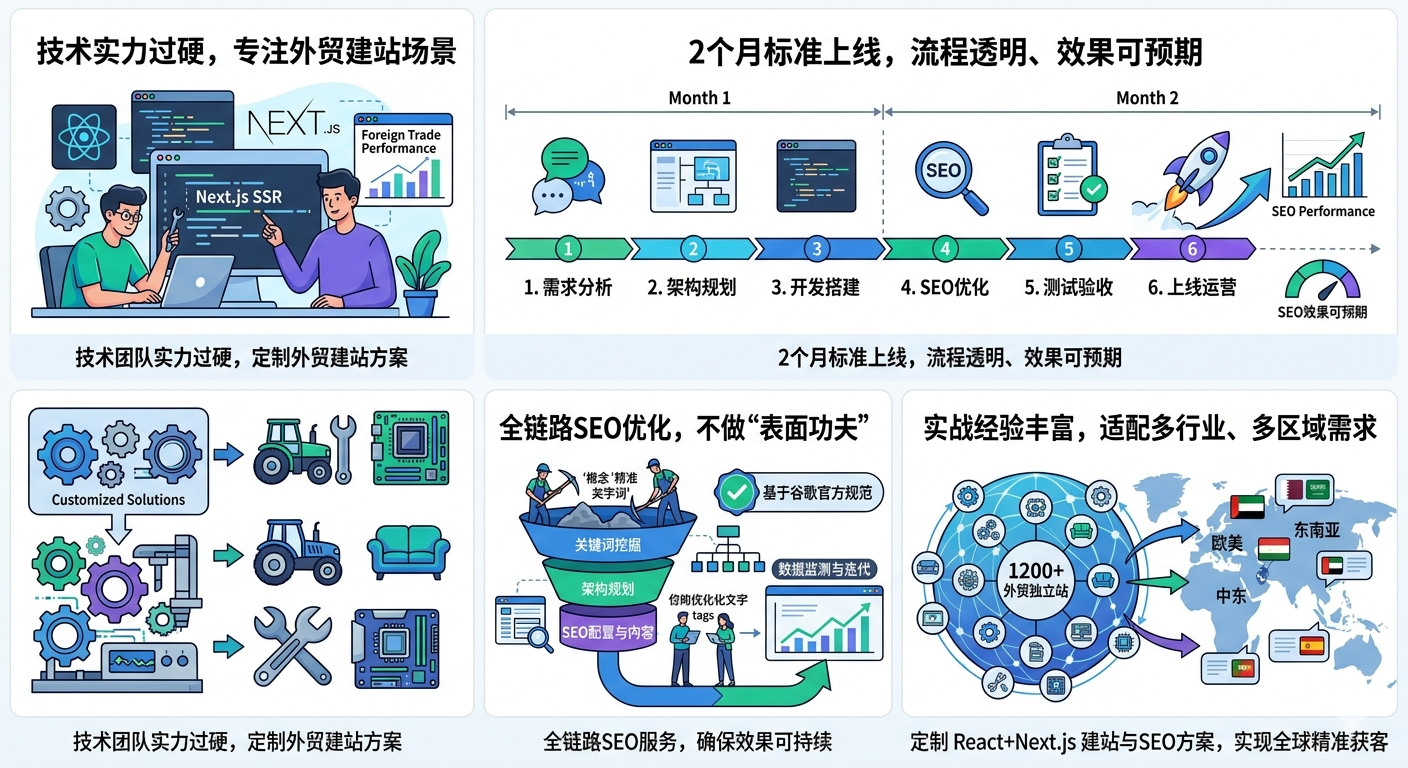
Why choose Pinshop for React+Next.js website building and SEO optimization?
In the field of React+Next.js website building, there are many service providers, but most of them only do "technical construction" and lack experience in the foreign trade industry and SEO practical capabilities. As a result, after the website is built, it cannot achieve effective inclusion and ranking, and cannot bring actual value to the enterprise. The core advantage of Pinshop lies in the trinity of "technology + foreign trade + SEO". It can not only build a high-performance React+Next.js independent website, but also combine the characteristics of the foreign trade industry and SEO practical experience to achieve a deep combination of technology and customer acquisition, making the website truly a core asset for cross-border customer acquisition.
Specifically, Pinshop’s core advantages are reflected in the following four aspects:
1. Excellent technical strength, focusing on foreign trade website building scenarios
Pinshop has a professional React+Next.js technical team. The core engineers have more than 5 years of front-end development experience. They are familiar with the rendering mechanism of Next.js and SEO optimization skills, and can accurately solve the technical pain points in foreign trade website building. At the same time, we have been deeply involved in the foreign trade industry for many years and understand the customer acquisition needs of foreign trade companies. We can combine the characteristics of different industries such as machinery, hardware, electronics, etc. to customize exclusive website building plans to ensure that the website meets industry needs and helps SEO customer acquisition.
2. Standard launch within 2 months, with transparent process and predictable results
Pinshop follows a 2-month standard launch cycle and breaks down the entire service process into six stages: demand analysis, architecture planning, development and construction, SEO optimization, testing and acceptance, and online operation. Each stage has clear acceptance standards and quantifiable indicators. Enterprises can understand the project progress in real time and avoid the problem of "indefinite delays." At the same time, we will test the website’s core indicators such as inclusion, speed, and ranking in advance before going online to ensure that we can achieve an initial improvement in SEO effect after going online.
3. Full-link SEO optimization, no “superficial work”
Pinshop’s service does not “end after building the website”, but provides full-link SEO services from early-stage keyword mining and architecture planning, to mid-term SEO configuration, content optimization, to later-stage data monitoring and continuous iteration. We do not stuff keywords or make false inclusions. All optimizations are based on Google's official specifications and practical experience to ensure that the SEO effect is quantifiable and sustainable, and can truly bring natural traffic and inquiries to the enterprise.
4. Rich practical experience, adaptable to the needs of multiple industries and regions
Pinshop has served a total of 1,200+ independent foreign trade stations, covering multiple industries such as machinery, hardware, electronics, home furnishings, and equipment. It serves customers all over the world's core cross-border markets such as Europe, the United States, Southeast Asia, and the Middle East, and has accumulated rich practical experience. We can customize exclusive React+Next.js website building and SEO optimization solutions based on the characteristics of different industries and different target markets to ensure that the website can adapt to multi-regional and multi-language needs and achieve accurate global customer acquisition.

FAQ
In the process of serving foreign trade companies, we often encounter the following questions about React+Next.js website building and SEO optimization, which are organized into FAQs to facilitate everyone to quickly understand the core points, avoid unnecessary questions, and also help companies more accurately judge their own website building needs:
-
What are the core differences between React+Next.js website building and traditional PHP template websites and open source CMS websites? Answer: The core difference lies in the technical architecture and rendering mechanism - traditional websites mainly use client-side rendering, which is difficult to include, slow and has poor scalability; React+Next.js mainly uses SSR+SSG dual rendering, which has fast inclusion, fast speed, SEO-friendly and strong scalability. It can solve the SEO pain points of traditional websites from the bottom up and achieve long-term compound interest growth.
-
What services does the two-month launch cycle include? Answer: The 2-month launch cycle includes complete website building and SEO optimization services, including: demand analysis, website architecture planning, React+Next.js development and construction, global CDN integration, SEO basic configuration (meta, structured data, Sitemap), multi-language adaptation, mobile optimization, data monitoring configuration, test acceptance, and online deployment to ensure that initial improvements in inclusion, speed, and ranking can be achieved after going online.
-
Is the cost of building a website with React+Next.js higher than that of building a traditional website? How is the price/performance ratio? Answer: The initial development cost is slightly higher than that of a traditional template site, but the long-term cost-effectiveness is much higher than that of traditional website building - React+Next.js has low post-maintenance costs and good SEO effects, which can achieve continuous growth of natural traffic and get rid of dependence on advertising; while traditional sites have low early-stage costs, but high post-maintenance costs and poor SEO effects, and require continuous investment in advertising to gain traffic. In the long run, React+Next.js is more cost-effective to build a website.
-
Can existing traditional websites be upgraded to React+Next.js architecture? Answer: Yes. Pinshop provides traditional website upgrade services, which can retain the core content of the original website (products, cases, qualifications, etc.), upgrade the architecture to React+Next.js, and optimize the SEO configuration to ensure that the existing inclusion and ranking will not be affected after the upgrade, achieving a comprehensive improvement in SEO performance, and the upgrade cycle can also be controlled in about 2 months.
-
After building a website with React+Next.js, do I still need to do SEO operations later? Answer: Yes. SEO is a long-term work. Building a website with React+Next.js only lays a good technical foundation. In the later stage, you need to continue to optimize content (blogs, cases), adjust keyword layout, and track data feedback to achieve continuous improvement in SEO weight. Pinshop provides year-round continuous SEO operation services to help companies save worry and effort and achieve long-term growth of natural traffic.
-
In the small language market, can React+Next.js website building achieve effective ranking? Answer: Yes. React+Next.js natively supports multi-language SEO optimization. Pinshop will configure independent meta tags, keyword layouts and hreflang tags for minor language versions, combined with localized copywriting and GEO optimization, to ensure that minor language pages can be quickly included and accurately ranked, helping companies expand the minor language market.
-
How to verify the SEO effect of React+Next.js website building? Answer: All SEO effects can be verified through data quantification. Pinshop will build a full-link data monitoring platform to track core indicators such as Google inclusion volume, keyword rankings, page speed, bounce rate, and inquiry volume in real time, and regularly submit optimization reports to enterprises, allowing enterprises to clearly see the value of every investment, ensuring that SEO effects are real and implementable.
Summarize
In today's increasingly fierce competition for cross-border customer acquisition, SEO has become the core path for foreign trade companies to obtain low-cost, long-term and stable customers, and technical architecture is the fundamental support for SEO effectiveness. The old architecture of traditional foreign trade websites has long been unable to adapt to Google search algorithms and global visitor needs, and has become a "stumbling block" for companies to acquire customers. The React+Next.js architecture, relying on core technologies such as SSR+SSG dual rendering, native SEO optimization, and global CDN acceleration, completely solves the four major pain points of traditional websites in terms of inclusion, speed, ranking, and experience from the bottom up, achieving a comprehensive crushing of SEO performance.
Pinshop relies on the practical experience of 1,200+ foreign trade independent stations, uses React+Next.js as the core technology, follows the standard 2-month launch cycle, and provides "website building + SEO + multi-region adaptation" full-link services to help foreign trade companies build high-performance independent stations with high inclusion, high ranking, and high conversion, get rid of dependence on advertising, and achieve long-term compound interest growth in natural traffic. We do not talk about technology or promise false results. We only use real data and practical experience to help companies rely on technological advantages to seize opportunities in cross-border customer acquisition competition.
For foreign trade companies, choosing React+Next.js to build a website is not to "follow the trend", but to "go with the trend" - to comply with the development trend of Google's algorithm, to comply with the technical needs of cross-border customer acquisition, and to comply with the experience needs of global visitors. Don’t let the old technical architecture limit your cross-border customer acquisition. Choose Pinshop and use React+Next.js to build a high-performance independent foreign trade station. Let SEO become your core competitiveness and the independent station become your core asset for long-term cross-border customer acquisition to achieve sustained growth in foreign trade business.