
Core premise: In the GEO era, the core standards for content to be "popular" have been restructured.
In the new era of customer acquisition for independent e-commerce websites dominated by generative search engines (GEO), the simplistic notion that "longer content is better" or "shorter content is more efficient" is completely outdated. Unlike the traditional SEO logic of "the more words, the higher the weight," GEO's core evaluation of content has never been about length, but rather "whether it can accurately match the semantic needs of overseas customers, whether it can be extracted and cited by AI, and whether it can guide customers to complete conversions."
The so-called "popularity" essentially means that the content can adapt to GEO's search logic and align with the purchasing habits of foreign trade B2B customers, achieving the three major goals of "being cited by AI, attracting precise traffic, and driving inquiry conversion." Long-form content and short-form content are not contradictory, but rather each has its own suitable scenarios and core value. Blindly pursuing a particular length will only lead to wasted resources and poor customer acquisition results.
This article will analyze the core differences, suitable scenarios, and creation standards of long and short content in the GEO era from the practical perspective of independent foreign trade websites, and clarify the core answer to "which is more popular" - there is no absolute best, only precise adaptation . Combining your own product category and customer needs to achieve synergy between long and short content is the optimal solution in the GEO era.
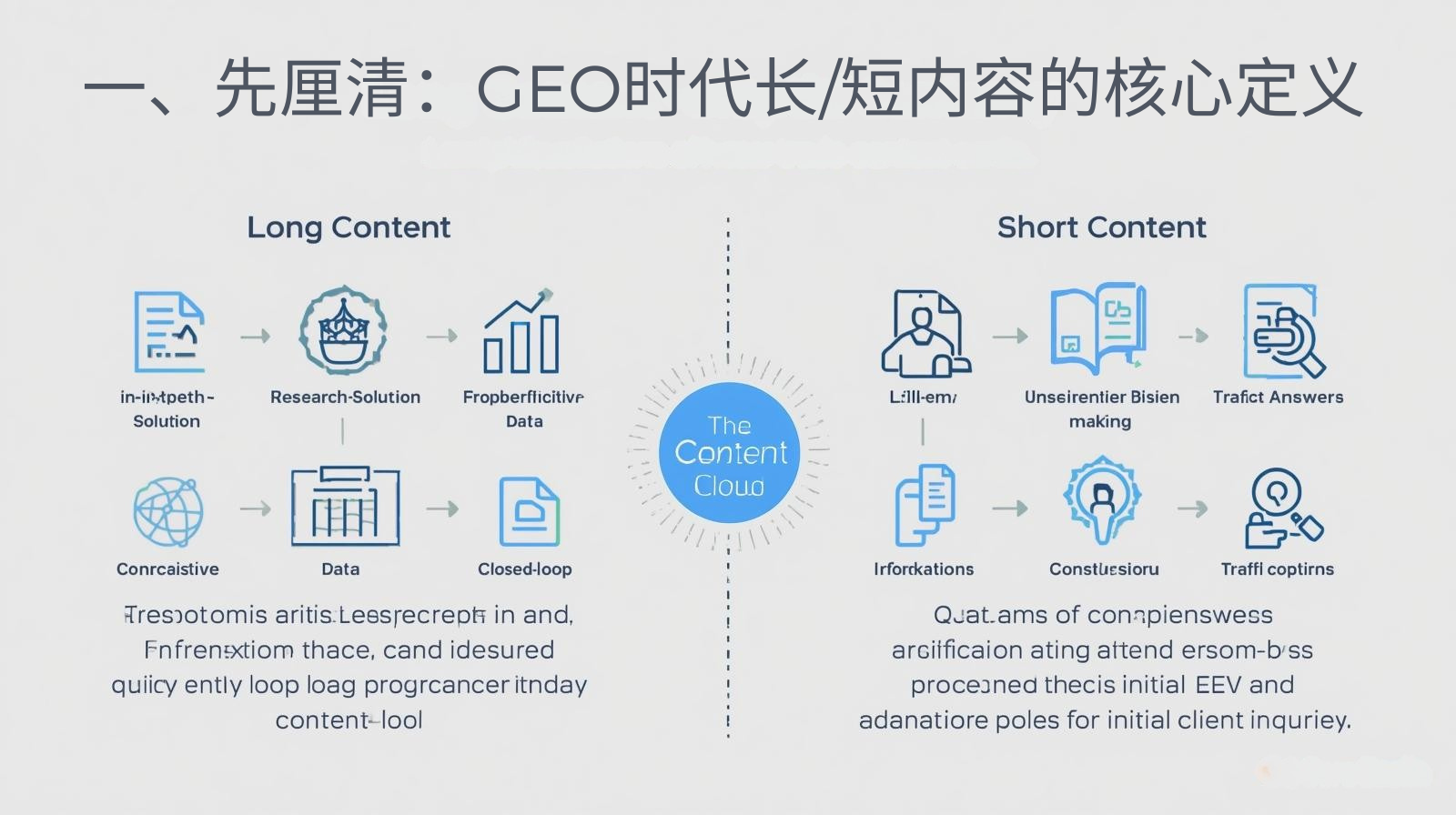
First, let's clarify the core definitions of long/short content in the GEO era (foreign trade adapted version).
Unlike the "word count division" of ordinary content, the long and short content in the GEO scenario of foreign trade independent websites needs to be defined in combination with the needs of overseas B2B customers and AI referencing logic to avoid falling into the "word count trap":
1. Long-form content (GEO premium content)
Core definition: Single article with ≥1200 words, focusing on in-depth research and procurement decision-making needs of overseas B2B customers, with "problem-solution-data support-case evidence" as the core structure, possessing strong answerability and verifiability, and high-value content that can be directly extracted and cited by GEO AI.
Key features: It does not pursue word count; the focus is on "deep content, valuable information, and a closed-loop logic." It can directly solve customers' core decision-making pain points such as selection, cost, and compliance, and is the "authoritative endorsement carrier" for independent websites in the GEO era.
2. Short content (GEO lightweight content)
Core definition: Each article should be 300-800 words long, focusing on the basic understanding and simple questions of overseas B2B clients. It should be structured as "core question - direct answer - brief supplement", without the need for complex data and case studies, and should be able to quickly meet the initial information needs of clients. It is also compatible with GEO's fast search and lightweight recommendation.
Core features: concise and efficient, highlighting key points, not pursuing depth, focusing on "quickly responding to needs, covering long-tail semantics, and guiding customers to browse further", serving as the "basic traffic entry point" for independent websites in the GEO era.
II. Long Content vs. Short Content: A Comparison of Core Differences in the GEO Era (From a Practical Perspective of Foreign Trade)
Based on the core requirements of GEO optimization for independent e-commerce websites, this paper clearly compares the differences between the two from six core dimensions: AI citation adaptation, traffic characteristics, conversion logic, and content creation cost, and clarifies their respective "popular scenarios":
Comparison Dimensions | Long content (GEO premium) | Short content (GEO lightweight) | GEO Era Core Advantages |
|---|---|---|---|
AI reference adaptability | High quality, easily extracted by AI with core answers and source annotations, becoming authoritative cited material. | In this context, only simple answers can be extracted by AI, making it difficult to become a core source of citations. | Long-form content: AI endorsement enhances brand authority; Short-form content: Rapid exposure covers broad needs. |
Traffic characteristics | Small traffic base, extremely high accuracy (high-intent purchasing customers account for ≥80%). | Large traffic base, moderate accuracy (high proportion of customers with broad intent to purchase information). | Long content: precise conversion; Short content: building a basic traffic pool |
Transformation Logic | Directly guide inquiries from high-intent customers, resulting in a short conversion path (content → inquiry). | Indirectly guide customers to browse longer content/product pages, resulting in a longer conversion path (short content → long content → inquiry). | Longer content: Improves inquiry conversion rate; Shorter content: Increases traffic reach. |
Creation Cost | High skill level; requires time to identify needs and organize data/case studies; single article creation takes 1-2 days. | Low cost, no need for complex data, focus on a single simple need, and each article can be created in just 1-2 hours. | Long-form content: high long-term value; Short-form content: rapid iteration, covering more needs. |
Suitable product categories | Mid-to-high-end B2B customized product categories (industrial equipment, precision parts, engineering services) | Standardized low-to-medium-priced product categories (general accessories, daily necessities, basic consumables) | Align with the product category's purchasing decision-making cycle to improve content relevance. |
GEO Optimization Focus | Semantic accuracy, data verifiability, and structurally adapted AI extraction | The core needs are clearly defined, keywords are naturally placed, and the guidance is strong. | Each has its own focus, so there's no need to optimize according to a uniform standard. |
III. In the GEO era, three scenarios where long-form content is more popular (with creation standards)
The core value of long-form content lies in "establishing authority and precise conversion." In the following three scenarios, the advantages of long-form content far outweigh those of short-form content. This is the core focus of GEO optimization and the key to building core competitiveness for independent e-commerce websites:
Scenario 1: Focusing on mid-to-high-end B2B customized product categories, with long customer purchasing decision cycles.
For clients in the high-end customized product category (such as industrial equipment, precision parts, and customized engineering services) in foreign trade, the procurement decision-making cycle is typically 1-3 months. They need to conduct in-depth research and compare the strengths of suppliers, and their core need is to "find professional and reliable suppliers." In this case, longer content can comprehensively showcase the company's strength and product advantages, meet the client's need for in-depth research, and is more likely to be cited by GEO AI, becoming a "decision reference" for the client.
Content creation standards: Focus on "selection criteria, quality inspection, customization process, cost breakdown, and overseas cases", with each article being ≥1500 words, including more than 3 sets of quantitative data (such as MOQ, delivery time, and accuracy threshold), 1-2 real overseas customer cases, and 1 industry comparison table. The title should be "question-based/answer-based" (such as "How to Choose a Reliable Custom Metal Processing Supplier for Automotive Parts").
Scenario 2: Need to overcome the bottleneck of GEO AI adoption and enhance brand authority
In the GEO era, one of the core competitive advantages of independent websites is to "become an authoritative content source for AI." Long-form content, due to its complete information, abundant data, and strong clarification, is 3-5 times more likely to be cited by AI than short-form content. Repeated AI citations can quickly build overseas customers' professional understanding of the brand, differentiating it from competitors' low-quality content and creating a differentiated advantage.
Content creation standards: Focus on the core pain points of the industry, and write according to the structure of "core problem → cause analysis → solution → data support → action guidance". Avoid vague descriptions, highlight the company's core advantages (such as technical strength and overseas service capabilities), and naturally guide inquiries at the end, while naturally incorporating 5-8 relevant long-tail keywords.
Scenario 3: The core objective is to generate precise inquiries, rather than simply increasing traffic.
If a foreign trade company's core customer acquisition objective is "high-intent inquiries and high-quality customers" rather than large-scale traffic exposure, then long-form content is the optimal choice. Customers reached through long-form content are all high-intent customers with clear research and purchasing needs, requiring no screening. The inquiry conversion rate is typically 2-3 times that of short-form content, significantly reducing customer follow-up costs.
Content creation standards: Focus on a single core need, do not cover multiple questions, such as only answering "delivery time and cost of customized products", do not include irrelevant content such as product introductions and compliance certifications, highlight core data, provide real and verifiable case studies, and place inquiry entry points in the middle or at the end of the content to lower the conversion threshold.
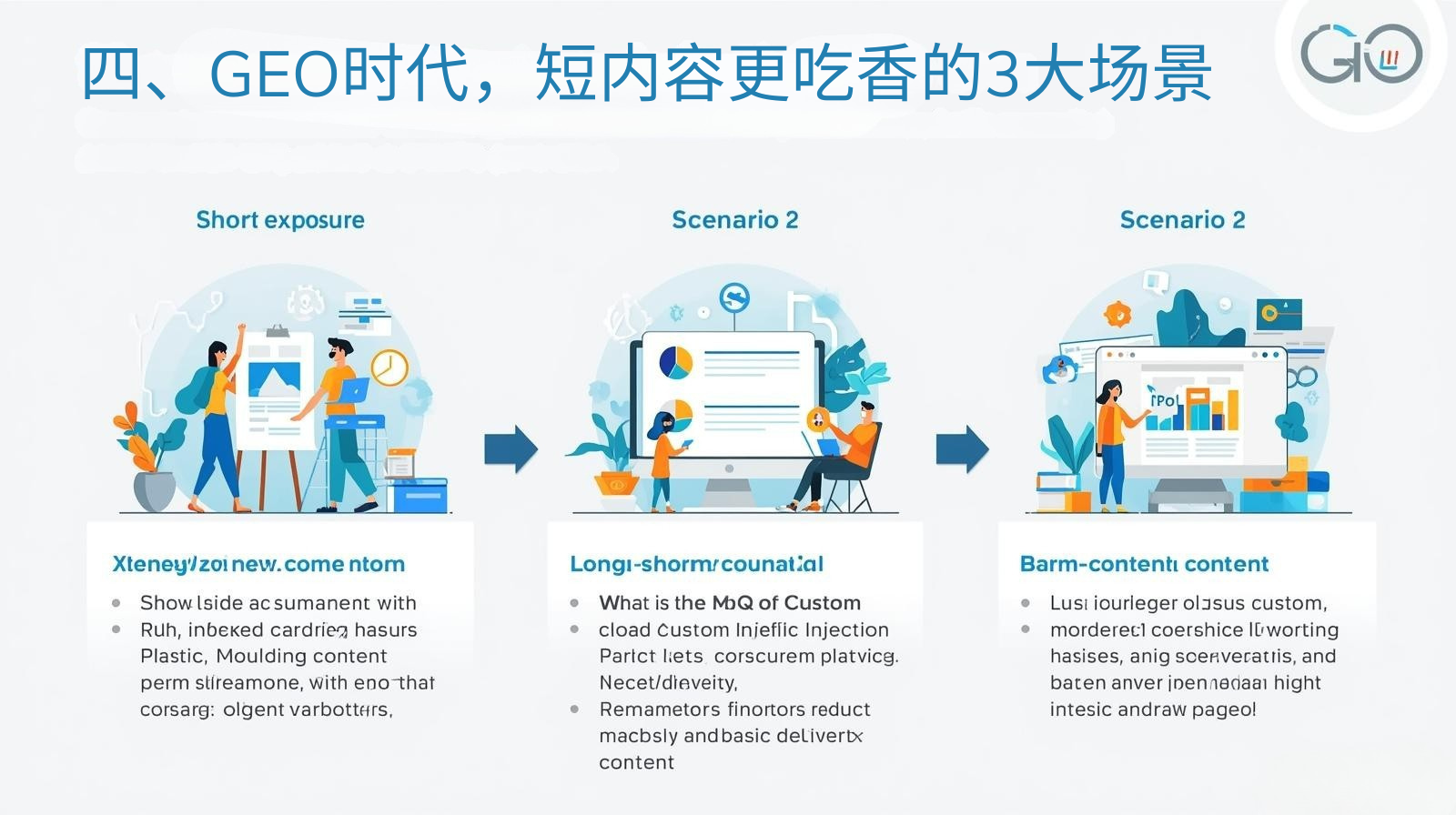
IV. Three Scenarios Where Short Content Is More Popular in the GEO Era (with Creation Standards)
The core value of short content is "rapid exposure, coverage of the long tail, and guidance and traffic generation". In the following three scenarios, the efficiency of short content is far higher than that of long content. It can quickly build a basic traffic pool, drive traffic to long content and product pages, and achieve the conversion of "general traffic → high-intent traffic".
Scenario 1: New website cold start, needs to quickly obtain GEO traffic and indexing
New independent e-commerce websites often lack content accumulation and brand recognition. GEO AI has a high threshold for evaluating their content, and long-form content has a long creation cycle and slow results, making it difficult to quickly gain indexing and traffic. In contrast, short-form content can be created and published in batches, covering a large number of long-tail semantic needs. It is quickly indexed by GEO, accumulating basic traffic for the independent website and improving its search ranking.
Content creation standards: Focus on "basic questions, basic product parameters, and industry trivia", with each article being 300-500 words long. The title should contain core long-tail keywords (e.g., "What is the MOQ of Custom Plastic Injection Molding Parts"), the first paragraph should provide the answer directly, and the end should include one internal link pointing to the relevant longer content or product page.
Scenario 2: Focusing on standardized, low-to-medium-priced product categories, with short customer decision-making cycles.
For customers in standardized low-to-medium-priced product categories (such as general accessories, daily necessities, and basic consumables), the purchasing decision cycle is short and in-depth research is not required. Their core needs are to "quickly understand product parameters, prices, and delivery times." Short content can quickly meet customer needs, improve browsing efficiency, and cover more long-tail needs, thereby obtaining large-scale, broad, and precise traffic.
Content creation standards: Focus on "product parameters, price range, delivery time, and applicable scenarios", with each article being 500-800 words long, using concise language, highlighting the core information, without complex cases and data, with keywords naturally placed, and the ending guiding customers to click on the product page to view details or initiate an inquiry.
Scenario 3: Limited resources, need to control content creation costs
For small and medium-sized foreign trade enterprises that lack professional content creation teams and have limited budgets, making it difficult to consistently produce high-quality long-form content, short-form content is a more cost-effective option. Short-form content has a short creation cycle, low cost, and can be produced in batches, quickly covering a large number of long-tail semantic needs, achieving "low cost and wide coverage," while simultaneously driving traffic to long-form content, thus balancing traffic and conversion.
Creation standards: No need to pursue depth, focus on a single simple need, ensure originality, avoid machine translation and plagiarism, add one internal link to each article, pointing to the core long content or product page, update 10-15 articles in batches every month, maintain the content update frequency, and improve GEO search ranking.
V. The Optimal Solution in the GEO Era: Collaboration of Long and Short Content, Rather Than an Alternative Choice
As the above analysis shows, in the GEO era, there is no absolute answer as to whether long-form content or short-form content is more popular. Only by working together can the dual goals of "traffic coverage + precise conversion" be achieved. This is also the best strategy for GEO optimization of foreign trade independent websites, avoiding the limitations of a single content type.
Based on practical experience in foreign trade enterprises, we provide an actionable "long and short content collaboration strategy" that is suitable for all sizes and product categories, easy to implement, and verifiable.
1. Content ratio: short content as the main focus, long content as the core.
Content resources are allocated in a 7:3 ratio: 70% of short content is used to cover long-tail semantic needs, build a basic traffic pool, and guide customers to browse long content; 30% of long content is used to be cited by GEO AI, establish brand authority, and achieve precise conversion.
For example, create 10 pieces of content per month: 7 short pieces (covering basic product questions and long-tail needs) and 3 long pieces (focusing on selection, case studies, and solutions), forming a closed loop of "short content driving traffic and long content converting leads".
2. Traffic closed loop: Short content leads to long content, and long content leads to inquiries.
At the end of each short article, add a precise internal link pointing to the relevant long article (e.g., the short article answers "MOQ," and the internal link points to the long article "How to Determine the MOQ of Custom Industrial Parts"). In the middle and at the end of each long article, add inquiry entry points to guide high-intent customers to initiate inquiries, achieving a complete conversion path from "short content → long content → inquiry."
3. Optimize collaboration: Share core semantics across content of varying lengths to achieve dual improvements.
Short and long content are created around the same core category and the same core semantic needs. Short content covers simple questions, while long content provides in-depth answers to those needs, forming a "complementary" effect. At the same time, short content naturally incorporates core keywords and semantic terms, improving the GEO search weight of long content; when long content is cited by AI, it can also boost the exposure of short content, achieving "one optimization, double benefit".
4. Data-driven: Dynamically adjust content allocation to adapt to the GEO algorithm.
Establish a data monitoring system to track the "number of indexed pages, number of visitors, and bounce rate" for short content, and the "number of AI citations, number of precise inquiries, and conversion rate" for long content, and adjust the content allocation based on data feedback:
- If short content generates little traffic and has a low bounce rate, increase the creation of short content and optimize internal link guidance.
- If long-form content receives few AI references and has a low conversion rate, optimize the semantic adaptation and data support for long-form content.
- If short content is effective in driving traffic for a particular product category, the high-traffic short content can be upgraded to long content to improve conversion efficiency.

VI. Pitfalls to Avoid in Content Creation in the GEO Era: Avoiding the "Length Mistake"
When creating content of varying lengths, foreign trade companies are most prone to falling into the misconception that "length determines value," resulting in content that fails to align with GEO logic and fails to achieve conversions. The following four pitfalls must be strictly avoided:
Pitfall 1: Blindly pursuing long content and piling up words is worthless.
Incorrect approach: In order to "reach the word count," add a lot of irrelevant information and repetitive statements to long content, lack data and examples, and although the content may seem long, it has no value in providing answers.
Tips to avoid pitfalls: The core of long content is "value," not "word count." Even if a single article is only 1,200 words long, as long as it accurately answers customer needs and is supported by data, it can be cited by AI. There is no need to deliberately pile up words.
Pitfall 2: Short content is too brief and cannot meet basic needs.
Incorrect practice: The content is too short, only 100-200 words, the core answer is vague, there is no supplementary information, the customer cannot obtain useful information, and there is no way to guide them to jump to the next page.
Tips to avoid pitfalls: Short content should be "concise but not simplistic," clearly state the core question, provide the answer directly, and supplement with 1-2 key pieces of information (such as data, applicable scenarios) to ensure that customers can quickly gain value and are willing to click on internal links.
Pitfall 3: Disconnect between long and short content, lack of synergy
Incorrect practice: The topics of short and long content are unrelated, and the internal links led by the short content do not match the theme, thus failing to form a closed loop of conversion.
Tips to avoid pitfalls: Create content of both length and length around the same category and the same core need. Short content serves as a "simplified version of the traffic entry point" for long content, while long content provides "in-depth answers and extensions" to short content, ensuring that internal links guide users accurately and maintain a consistent theme.
Pitfall 4: Ignoring GEO semantic logic and creating content based on traditional SEO thinking
Incorrect practices: piling up keywords in long content, and only placing keywords in short content without answering the needs, ignoring the semantic understanding logic of GEO.
Tips to avoid pitfalls: Regardless of the length of the content, the core should be "answering the customer's semantic needs". Long content should focus on in-depth answers, while short content should focus on quick answers. Keywords should be naturally integrated without piling them up, ensuring that the content can be recognized and extracted by GEO AI.
VII. FAQ: 4 Core Questions Most Concerning Foreign Trade Enterprises
Q1: For GEO optimization of an independent e-commerce website, should I prioritize long-form content or short-form content?
A1: For new websites, prioritize short content to quickly build a basic traffic pool and improve indexing; once traffic stabilizes, focus on long content to improve AI referencing and accurate conversion; for mature websites, use a 7:3 ratio of short to long content, working in tandem.
Q2: Does long content have to be at least 1200 characters? Will insufficient word count affect GEO citations?
A2: It's not absolute. 1200 words is the "minimum standard." The core is the depth and value of the content. If you can accurately answer customer needs within 1000 words and have sufficient data to support it, it can be cited by AI. Conversely, even if it's 2000 words, if the content is vague, it cannot be cited.
Q3: What should small and medium-sized foreign trade enterprises do if they lack the capacity to create long-form content?
A3: Start with short content to cover long-tail needs in batches and accumulate basic traffic; at the same time, integrate real enterprise cases and product data, and create concise long content (about 1200 words) according to the simple structure of "core question + answer + data". There is no need for complex industry analysis, just highlight your own advantages.
Q4: How do I judge the effectiveness of creating content of varying lengths and whether it is compatible with GEO?
A4: Focus on two key indicators:
① Long content: AI citation count ≥ 5 times/month, accurate inquiry count ≥ 10 times/month.
② Short content: inclusion rate ≥ 90%, jump rate to long content ≥ 20%; if not achieved, optimize content selection and creation standards.
Recommended Article: Your Competitors Haven't Reacted Yet: Building an Independent E-commerce Website with GEO is the Biggest Blue Ocean Strategy Right Now
② Short content: inclusion rate ≥ 90%, jump rate to long content ≥ 20%; if not achieved, optimize content selection and creation standards.
Recommended Article: Your Competitors Haven't Reacted Yet: Building an Independent E-commerce Website with GEO is the Biggest Blue Ocean Strategy Right Now
8. In the GEO era, "fit" is more important than "length".
In the GEO era of independent e-commerce websites, the popularity of long and short content is never determined by its length, but by whether it is compatible with GEO search logic, meets customer needs, and can achieve conversion.
The core value of long-form content lies in "authoritative endorsement and precise conversion," making it suitable for mid-to-high-end customized categories and high-intent customers; the core value of short-form content lies in "rapid exposure and basic traffic generation," making it suitable for standardized categories and new website cold starts. The two are not mutually exclusive, but rather a synergistic combination—short-form content builds a traffic pool, while long-form content achieves precise conversion, enabling "low-cost, high-efficiency" overseas customer acquisition in the GEO era.
For foreign trade enterprises, there is no need to worry about "long or short". The key is to combine their own product categories, customer needs and resources to formulate a "long and short synergy" content strategy, focusing on the value of the content rather than its length. Only in this way can the content be recognized by GEOs and customers, and ultimately achieve sustainable customer acquisition for the foreign trade independent website.
Immediately analyze the company's core product categories and customers' core needs, select 3 decision-making needs suitable for long-form content and 7 basic needs suitable for short-form content, complete the first long-form content and the first short-form content according to the creation standards of this article, and submit them to the GEO website management platform after publication to start data monitoring and optimization.