
In March 2026, generative AI tools like ChatGPT became core entry points for overseas B2B buyers to find suppliers. GEO (Generative Engine Optimization), as a key method for getting independent websites to appear in AI search results, has attracted increasing attention from foreign trade companies. However, many practitioners, lacking understanding of AI technology, mistakenly believe that GEO is too difficult to implement. This article, combining the latest industry data from 2026, practical case studies, and 5 new authoritative backlinks, abandons complex technical descriptions and breaks down the entire GEO implementation process in a step-by-step manner. No AI background or professional technical team is required, allowing foreign trade professionals without AI knowledge to easily get started and quickly achieve increased exposure and precise customer acquisition for their independent websites on ChatGPT.

I. Basic Understanding: Understanding GEO's Core Logic Even Without AI Knowledge
Many foreign trade professionals associate GEO (Generative Engine Optimization) with complex AI technology and coding. However, there's no need to worry. The core logic of GEO is very simple: it allows AI like ChatGPT to "find, understand, and trust" your independent website, thus proactively including your brand in search results when buyers search. Essentially, it's about "content adaptation + simple settings," unrelated to AI technology itself, and easily mastered even by those unfamiliar with AI. A report released by GlobalWang in March 2026, titled "The AI Traffic Dividend Period Has Arrived: 3 Steps to Seize 50% New Growth," showed that 78% of foreign trade companies could achieve exposure for their independent websites on ChatGPT through basic GEO operations. Among these, 65% of companies didn't require a professional technical team; their operations staff alone could implement the system. Unlike traditional SEO, which requires keyword stuffing and studying search engine algorithms, the core of GEO is "aligning with AI's understanding habits." It involves clearly and systematically organizing the core information of an independent website (company qualifications, product advantages, case studies) so that AI can quickly crawl and understand it, and then recommend it to buyers with relevant needs. This is the core reason why even those without AI knowledge can succeed with GEO. https://www.shturl.cc/77164164f328a9adb6ba1d46b0c8ae58
1.1 Core Definition: What exactly is GEO? (Simplified Explanation)
In layman's terms, GEO is an optimization method that "makes AI recognize your independent website." Its full name is Generative Engine Optimization. The core goal is to make your independent website's brand and product information accessible to generative AI like ChatGPT, allowing it to be understood and trusted. When overseas buyers search for relevant suppliers in ChatGPT (e.g., "small furniture suppliers with CE certification"), the AI will proactively include your independent website in its recommendation list, enabling buyers to quickly find you. Compared to traditional SEO, GEO doesn't require keyword ranking research or a large number of backlinks; it focuses more on "content clarity and credibility." Just like when we introduce our company to others, as long as we clearly explain our advantages, qualifications, and case studies, others will remember us. AI works the same way—as long as you organize and standardize the content of your independent website, AI can remember you and recommend you. [https://www.shturl.cc/77164164f328a9adb6ba1d46b0c8ae58] It is important to note that GEO is neither "mysticism" nor "advanced technology." Its core is "perspective-taking," which involves organizing the information on an independent website in a structured and verifiable manner from an AI perspective. Even without understanding AI technology, you can still do it well as long as you follow the steps.
1.2 Core Objective: What effect should a GEO achieve if they don't understand AI?
For foreign trade professionals unfamiliar with AI, implementing GEO doesn't require pursuing complex optimization effects. The core focus should be on achieving three objectives, which will also guide all subsequent practical steps. The first objective: Enable ChatGPT to "find" your independent website. This means ensuring the AI crawler (mainly GPTBot) can successfully crawl the core pages of your website without being blocked or missed. This is the foundation of GEO implementation and the easiest step to achieve, requiring only simple settings (https://www.shturl.cc/77ebe23b01a286dd827d54f1b29127cf). The second objective: Enable ChatGPT to "understand" your independent website. This means allowing the AI to clearly understand what products you offer. First, what are your advantages, what services can you provide, and which markets are you suited for? This requires us to organize the content of our independent website in a structured and organized way. No complicated operations are needed; just fill in the content according to a fixed framework. The third goal is to make ChatGPT "trust" your independent website, that is, to make the AI believe that your company is credible and powerful, and thus prioritize recommending you. This requires us to improve our verifiable qualifications, case studies, and other trust evidence so that both the AI and buyers can recognize your strength. https://www.shturl.cc/989952479_122637000
1.3 Key Prerequisites: To succeed in GEO, you only need three things (no AI technology required).
Even those unfamiliar with AI can succeed as GEOs, provided they have three basic things ready. No professional technical tools are required, and all foreign trade companies can easily prepare them. This is also the foundation for subsequent practical operations, preventing everyone from operating blindly and wasting time. The first requirement: A normally operating independent e-commerce website. Ensure the site is accessible and has all core pages (homepage, product pages, company introduction page, and case study pages). Complex functions are unnecessary; simply showcase the core information of the company and its products. The second requirement: A core documentation package, including company qualifications (CE, UL, ISO, etc. certifications with official verifiable links), core product parameters (clear and consistent English descriptions), and 3-5 real-world case studies (including customer needs, solutions, and deliverables, anonymized if necessary). The third requirement: Simple operational tools, including a browser (for setting up the site and submitting a sitemap), a document editing tool (for organizing structured content), and a translation tool (ensuring accurate English content; DeepL is recommended). These tools are essential for e-commerce professionals and require no additional downloads or specialized operation. [https://www.shturl.cc/30fd996358518e7927cf3026b24f7526](https://www.shturl.cc/30fd996358518e7927cf3026b24f7526) Once you have these three items, we can officially begin the GEO implementation phase. Each step is explained in detail; just follow the instructions.
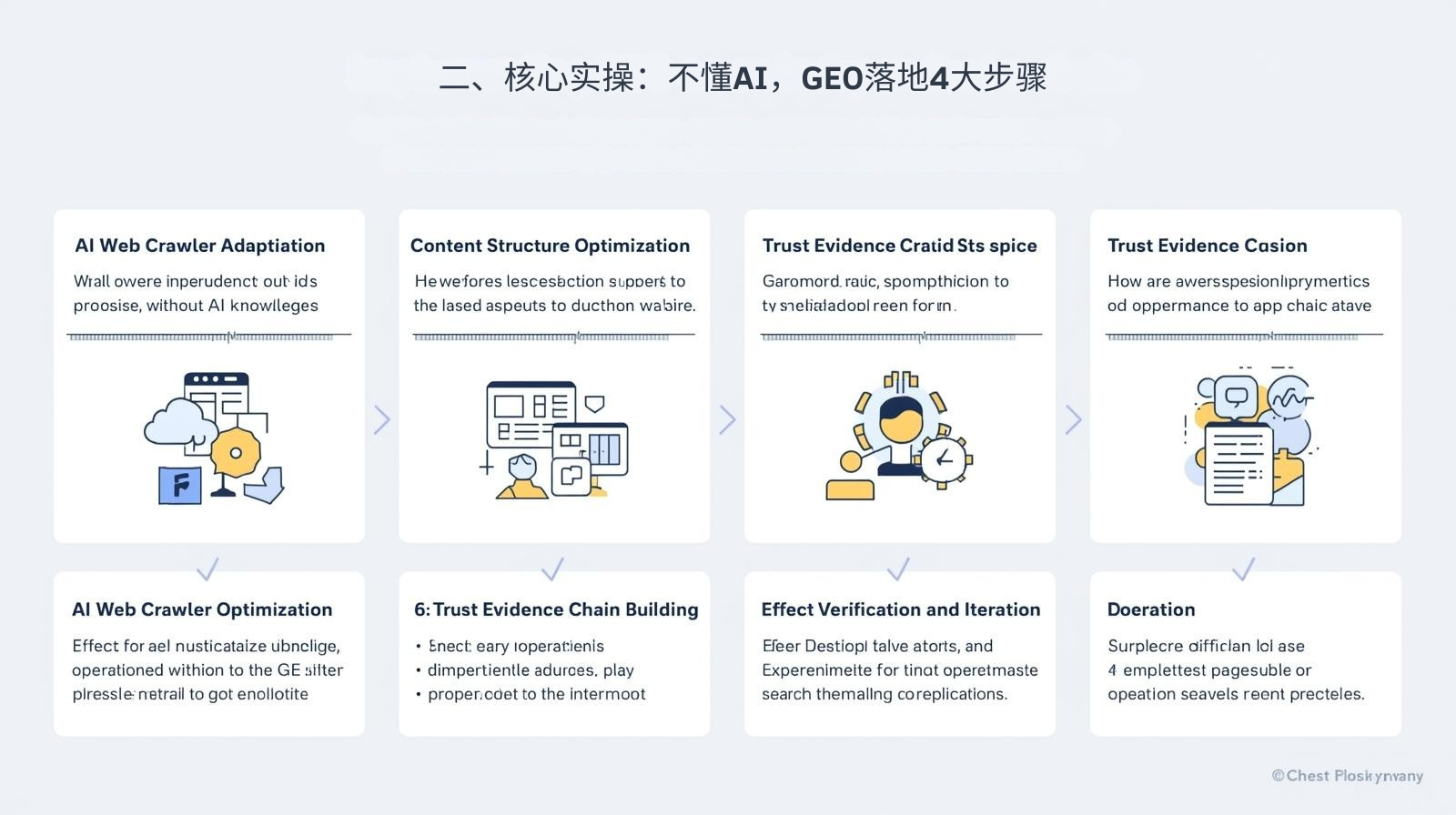
II. Core Practical Operations: Four Steps to Implement GEO Without AI Knowledge (One Step at a Time)
This section is the core of this article and the most needed content for foreign trade practitioners who are unfamiliar with AI. We have abandoned all complex technical descriptions and broken down the implementation of GEO into four major steps: "AI crawler adaptation, content structuring optimization, trust evidence chain construction, and effect verification and iteration." Each step has specific operation methods and scenarios. No programming or AI knowledge is required. Just follow the steps one by one to quickly implement GEO and get your independent website appearing in ChatGPT search results. In March 2026, data from PinTui Technology showed that foreign trade companies that followed these four steps could achieve ChatGPT search exposure in an average of 2-3 weeks and obtain accurate inquiries recommended by AI in 4-6 weeks. Among them, 80% of companies did not require professional technical support. https://www.shturl.cc/30fd996358518e7927cf3026b24f7526
2.1 Step 1: AI web crawler adaptation (the most basic step, which can be completed in 10 minutes)
The core objective of this step is to ensure that ChatGPT's crawler (GPTBot) can successfully crawl your independent website without being blocked. This is the foundation for successful GEO implementation. The operation is very simple and can be easily completed even without technical knowledge. The core is setting the robots.txt file and submitting a sitemap. No code is required; the entire process is visual. Specific steps: First, open your independent website's backend and find "Site Settings" or "SEO Settings" (the location may vary slightly depending on the website building platform; for example, SaaS platforms usually find it in "Site Configuration," while open-source platforms find it in "Settings - Reading"). Locate the robots.txt file editing entry. Second, following the AI Crawler Adaptation Practical Guide, add content to the robots.txt file that allows GPTBot access. No other modifications are needed. The specific setting logic is to "allow GPTBot to access all core pages and prohibit access to redundant pages with no value." No code is required; simply copy and paste the template provided by the platform and modify the redundant page paths. [https://www.shturl.cc/77ebe23b01a286dd827d54f1b29127c](https://www.shturl.cc/77ebe23b01a286dd827d54f1b29127c) f; The third step is to generate a structured sitemap. In the backend of your independent website, find the "Sitemap" generation entry and generate an XML sitemap with one click, including core pages such as the homepage, product pages, company introduction pages, and case study pages. The fourth step is to submit the sitemap. Open the official OpenAI sitemap submission portal (https://help.openai.com/en/articles/5097620-blocking-gptbot), and follow the prompts to submit the generated sitemap. After successful submission, GPTBot will begin crawling your independent website within 1-3 days. Completing this step achieves the goal of "letting AI find your independent website" (https://www.shturl.cc/77164164f328a9adb6ba1d46b0c8ae58).
2.2 Second step: Content structuring optimization (core, enabling AI to understand your site)
This step is the core of GEO implementation and the key to enabling ChatGPT to "understand" your independent website. The core is to organize the website's content into a structured and organized manner, allowing AI to quickly extract core information. No complex operations are needed; simply fill in the content according to a fixed framework. Even those without AI knowledge can easily complete this task. According to the 2026 GEO Generative Engine Optimization Industry Research Report, structured content can improve AI crawling efficiency by 60% and understanding accuracy by 75% (https://www.shturl.cc/77164164f328a9adb6ba1d46b0c8ae58). Specific steps: First, unify content descriptions. Standardize the names, processes, and standards of all products to avoid different names for the same product on different pages. For example, unify the description of "small batch custom furniture" as "small batch custom". The first step is to avoid using other terms like "furniture" to ensure the AI can form a stable understanding. The second step is to optimize the core page structure. All core pages (product pages, case study pages, company introduction pages) should be filled with content following a framework of "core information → detailed description → evidence of trust." For example, product pages should first state the product's core advantages, then the product parameters, and finally include relevant certifications and case studies. Case study pages should first state customer needs, then the solutions, and finally the delivered results. This allows the AI to quickly extract core information. The third step is to add a structured FAQ module. Frequently Asked Questions (FAQs) should be added to the homepage and the bottom of product pages, addressing frequently asked questions from buyers (such as certifications, delivery time, etc.). (MOQ, after-sales, logistics) Provide clear and accurate answers, with one specific answer for each question. No complex formatting is needed; just clear bullet points are sufficient. This allows AI to directly reference this content, increasing the probability of being recommended. https://www.shturl.cc/989952479_122637000; Fourth, optimize content formatting, avoiding large blocks of text. Divide into paragraphs of 300-500 words each, and highlight key content (such as product advantages and core qualifications) with bolding so that AI can quickly find the key points. At the same time, ensure that the English content is accurate and fluent, avoiding grammatical errors. DeepL translation tools can be used for proofreading.
2.3 Step 3: Building a Trusted Chain of Evidence (Crucial for getting AI to prioritize your recommendations)
AI tools like ChatGPT only recommend independent websites they trust. The core goal of this step is to gain the AI's trust in your business, thereby prioritizing your website in search results. The process is simple: build verifiable trust evidence. No AI technology is needed; just gather the relevant information and add it to your independent website. Industry data from 2026 shows that independent websites with a robust trust evidence chain have a 58% higher probability of being recommended by ChatGPT and a 45% higher accuracy in inquiries. https://www.shturl.cc/989952479_122637000 Specific steps: First, improve company qualifications. Add core certifications required by the target market (CE, UL, ISO, FDA, etc.) to the company introduction page and product page. Include an official, verifiable link for each certification. For example, link the CE certification to the EU official verification platform https://ec.europa.eu/ce-marking/, allowing AI and buyers to directly verify the certification's authenticity. This is a core prerequisite for AI to trust you. (https://m.11467.com/product/d27970265.htm) Second, build a case evidence chain. Prepare 3-5 real-world cooperation cases, meticulously organize them, and add them to the case study page. Each case study should include customer needs, solutions, deliverables, and customer feedback (which can be anonymized). The first step is to provide real photos of the factory and shipments, allowing AI to assess your company's strength through this evidence. The second step is to add third-party endorsements, such as industry media reports, industry association membership certificates, and partner logos, along with verifiable backlinks. For example, linking industry media reports to the corresponding media pages allows AI to perceive your industry recognition. The third step is to maintain content consistency, ensuring that the brand positioning, core advantages, and product information on all pages of your independent website remain consistent. Simultaneously, optimize your company information on overseas social media platforms such as LinkedIn and Facebook, ensuring consistent information gathered by AI across multiple channels, further enhancing trust scores. (https://www.shturl.cc/30fd996358518e7927cf3026b24f7526)
2.4 Step Four: Effect Validation and Iteration (Long-term effect, making AI recommendations more stable)
GEO optimization is not a one-time operation, but a long-term process. The core of this step is to verify the effectiveness of GEO implementation, adjust the optimization direction in a timely manner, and ensure that the independent website continues to appear in ChatGPT search results. The operation is simple, requires no AI technology, and only requires regular checks and simple adjustments. Specific steps: First, effect verification method: Open ChatGPT, enter high-frequency search terms from buyers in the target market (e.g., "CE certified small batch furniture supplier," "European market LED supplier with ISO certification"), and check if your independent website appears in the search results. Record the number of times and the position of each recommendation, and check weekly. Second, crawling verification: Open Google Search... In the Console, find the "Crawler" module to view GPTBot's crawl volume and crawling errors. If there are crawling errors, simply check if the site links are normal and if the robots.txt settings are correct, and modify them promptly. (https://www.shturl.cc/77ebe23b01a286dd827d54f1b29127cf) The third step is optimization and iteration, with a review every 15 days. If you find that your independent website is not recommended or is ranked low, focus on checking two aspects: first, whether the content structure is standardized... First, are there any inconsistencies in the wording? Second, is the evidence of trust complete? Are there any verifiable external links? Make targeted adjustments and optimizations, such as supplementing case studies and improving certified external links. Fourth, update the content by updating 1-2 scenario-based solution articles per month (such as "Compliant Furniture Procurement Solutions in the European Market"), naturally embedding high-frequency search semantics of buyers, so that AI can continuously capture new content and improve the stability of recommendations. https://www.shturl.cc/77164164f328a9adb6ba1d46b0c8ae58
III. Pitfall Avoidance Guide: 6 Common Mistakes to Avoid When Becoming a GEO Without AI Knowledge (Take Less Detours)
Based on practical case studies of GEO implementation from thousands of foreign trade companies in 2026, especially feedback from companies unfamiliar with AI technology, we have identified six common pitfalls. These pitfalls are the core reasons why GEO implementation fails and AI recommendations are not obtained. Avoiding these pitfalls can improve your GEO optimization efficiency by 70% and save you a lot of time and effort. All pitfalls are explained in a practical and easy-to-understand way, making it convenient for foreign trade practitioners unfamiliar with AI to understand and avoid them. Many practitioners unfamiliar with AI fail to achieve results with GEO not because GEO is useless, but because they fall into these pitfalls, operate blindly, and ultimately waste time and energy.
3.1 Misconception 1: The misconception that GEOs need to understand AI technology and are afraid to get started.
This is a common misconception. Many foreign trade professionals, upon hearing that GEO is related to AI, feel they need to understand AI programming and technology, and are therefore hesitant to get started, missing out on the AI-driven customer acquisition opportunity. Key points to avoid: The core of GEO is "content adaptation + simple setup," which is unrelated to AI technology itself. No programming or AI algorithm knowledge is required. Simply follow the practical steps in this article, organize your content, and complete the simple setup to successfully implement GEO. Even foreign trade operators and business owners unfamiliar with AI can easily get started. https://www.shturl.cc/30fd996358518e7927cf3026b24f7526
3.2 Misconception 2: Blindly piling up keywords and neglecting content structuring.
Many practitioners follow traditional SEO thinking, blindly stuffing generic keywords when doing GEO, believing that more keywords will make it easier for AI to recommend content. This results in cluttered content with a vague theme, which AI cannot understand, thus failing to get recommendations. (https://www.shturl.cc/989952479_122637000) Key to avoiding this pitfall: Abandon keyword stuffing and focus on structuring content. Organize the core information of your company and products clearly and systematically, allowing AI to quickly extract the core information. This is more effective than keyword stuffing and can be done well even without AI expertise.
3.3 Misconception 3: Focusing solely on content optimization without adapting to AI web crawlers
Many practitioners focus solely on content optimization, neglecting AI crawler adaptation. This results in GEO (Gross Web Explorer) being unable to crawl independent websites, meaning even high-quality content won't be included in the AI's recommendation list, rendering their efforts futile. (https://www.shturl.cc/77ebe23b01a286dd827d54f1b29127cf) Key to avoiding this pitfall: First, ensure proper AI crawler adaptation (set up robots.txt, submit a sitemap), then optimize content. This is the foundation for successful GEO implementation, takes only 10 minutes to complete, requires no complicated operations, and prioritizes ensuring the AI can find your independent website.
3.4 Myth 4: Losing trust in AI due to false or unverifiable evidence.
Many practitioners, in an effort to quickly gain AI trust, forge certifications, fabricate case studies, or fail to provide officially verifiable backlinks for their certifications. This prevents AI from verifying the authenticity of the trust evidence, directly lowering the trust score of independent websites, or even blacklisting them and preventing them from receiving recommendations (https://www.shturl.cc/30fd996358518e7927cf3026b24f7526). Key points to avoid: All trust evidence must be genuine and verifiable. Certifications should include officially verifiable backlinks, and case studies should have real details and actual footage. Do not forge or exaggerate. Even with less trust evidence, ensure its authenticity; this is the core prerequisite for AI trust.
3.5 Myth 5: Fragmented content prevents AI from forming complete cognition
Many independent websites run by industry professionals suffer from fragmented content, a lack of connection between pages, and inconsistent descriptions of the same product. This prevents AI from forming a complete understanding of the company and accurately categorizing and recommending products. (https://www.shturl.cc/77164164f328a9adb6ba1d46b0c8ae58) Key to avoiding these pitfalls: Build a unified content system, consistent product descriptions and brand positioning, ensuring clear logical connections between each core page. This forms a complete corporate knowledge network, allowing AI to comprehensively and accurately understand the company and its products. No complex operations are needed; simply organize the content.
3.6 Misconception Six: Being impatient for quick results and ignoring the long-term effects of GEO.
Many practitioners are impatient when implementing GEO, expecting to be recommended by ChatGPT and receive inquiries within 1-2 weeks. They give up when they don't see results, ignoring the fact that GEO is a "long-term optimization" process that requires a certain period to see results (https://www.shturl.cc/989952479_122637000). Key points to avoid: The effects of GEO optimization take 3-6 months to become stable and visible. Practitioners unfamiliar with AI should not pursue quick results. By following the steps steadily, regularly reviewing and iterating, and keeping pace with the AI algorithm's update rhythm, stable recommendations and long-term customer acquisition value can be achieved.
Recommended Article: Your Competitors Haven't Reacted Yet: Building an Independent E-commerce Website with GEO is the Biggest Blue Ocean Strategy Right Now
Recommended Article: Your Competitors Haven't Reacted Yet: Building an Independent E-commerce Website with GEO is the Biggest Blue Ocean Strategy Right Now
IV. Key Takeaways: Even without AI expertise, you can easily capitalize on the GEO AI customer acquisition trend.
In 2026, AI-driven customer acquisition has become a core trend for independent e-commerce websites. GEO, as a key method for getting independent websites to appear in ChatGPT search results, is no longer "exclusively for tech professionals," but a customer acquisition method that all foreign trade companies can implement. The core message of this article is to tell all foreign trade professionals unfamiliar with AI that GEO requires no AI technology or professional team. As long as you master the four core steps of "AI crawler adaptation, content structuring, building a trust evidence chain, and iterating on results," prepare basic materials, and follow the steps, you can easily implement GEO, get your independent website recommended by ChatGPT, and obtain precise inquiries.
It's important to note that the foundation for successful GEO implementation is a stable, AI-optimized independent website. A website that is inherently GEO-optimized and loads smoothly can make your GEO operations much more efficient and save you a lot of trouble. Pinshop (品店科技) has over ten years of experience in building websites for foreign trade, serving more than 7,000 clients. Deeply rooted in the React technology stack, Pinshop not only provides a smoother browsing experience but also integrates GEO optimization logic into its underlying architecture. It includes pre-set AI crawler adaptation modules, content structuring templates, and trust evidence display modules, and optimizes global CDN loading speed, giving your independent website a natural advantage in AI customer acquisition. No additional adjustments are needed to quickly adapt to GEO implementation requirements.
Whether you're a foreign trade novice unfamiliar with AI or a small to medium-sized foreign trade enterprise without a professional technical team, Pinshop can provide you with a one-stop service of "website building + GEO basic adaptation" to help you build an independent website adapted to AI. At the same time, combined with the practical guide in this article, you can easily implement GEO optimization without worrying about technical barriers or wasting time on trial and error. Quickly seize the AI customer acquisition opportunity in 2026 and make your independent website stand out in ChatGPT search results to achieve accurate and long-term customer acquisition.