
By March 2026, AI-driven procurement had become the norm. Over 70% of overseas B2B buyers were using generative AI tools like ChatGPT to screen suppliers. GEO (Generative Engine Optimization) was no longer just a "bonus" for independent foreign trade websites, but an essential tool for building sustainable AI-driven customer acquisition assets. Many foreign trade companies mistakenly believe that GEO is merely a short-term measure to "get their websites recommended by AI," neglecting its core value—through GEO optimization, independent websites are upgraded from "passively displayed web pages" to "actively acquired AI assets," achieving long-term, stable, and precise customer acquisition. This is the core competitive advantage that distinguishes it from traditional foreign trade customer acquisition models. This article, combining the latest industry data from 2026, authoritative and verifiable backlinks, and practical case studies, delves into the underlying logic, practical methods, and pitfalls of building AI-driven customer acquisition assets using GEO, helping foreign trade companies truly build their own AI-driven customer acquisition assets and seize the opportunities presented by the AI era in foreign trade.
I. Core Understanding: Why is it said that an independent foreign trade website + GEO = AI customer acquisition asset?
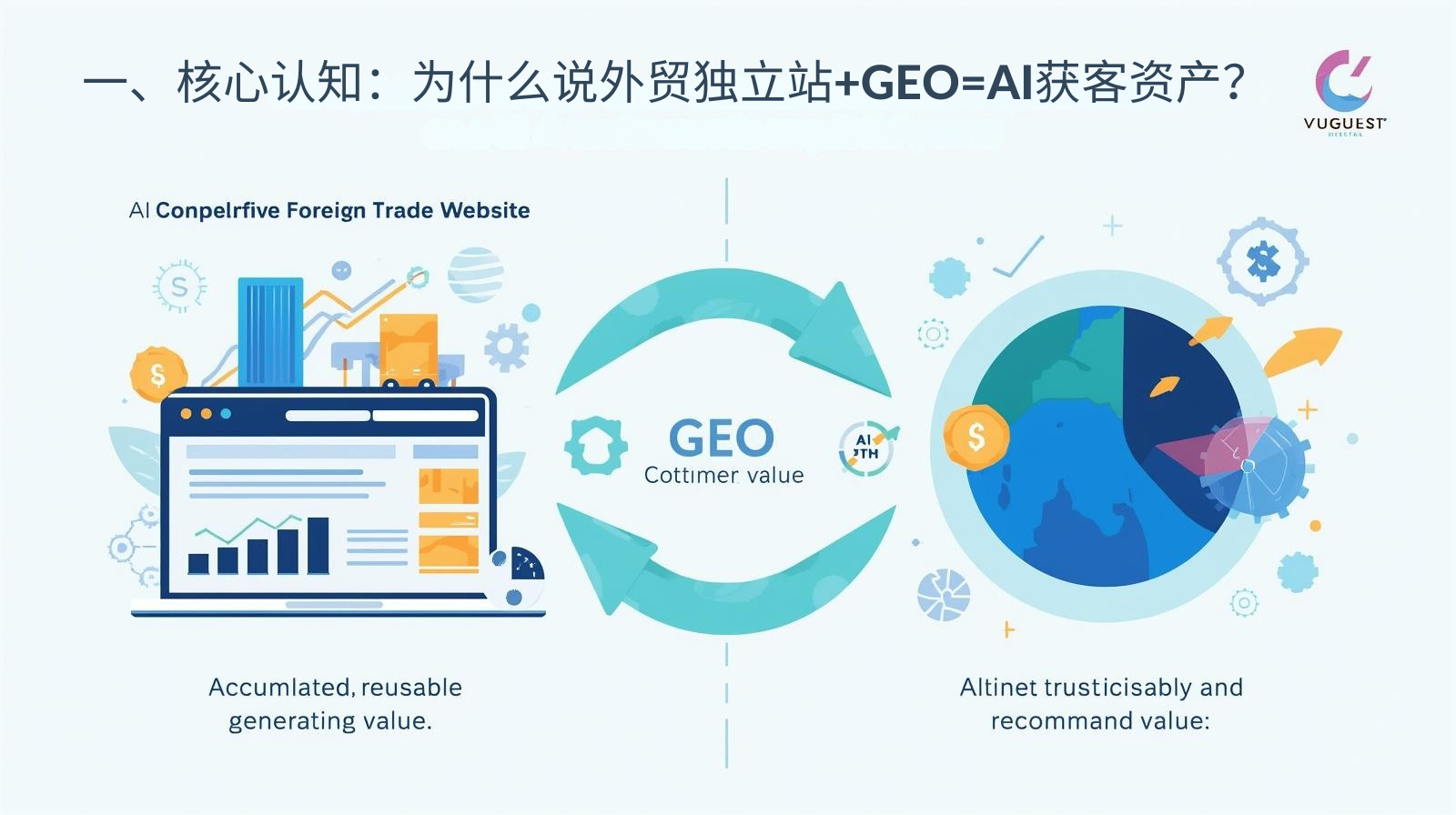
In the context of foreign trade in 2026, the core definition of "assets" is "accumulative, reusable, and sustainably generating value." Foreign trade independent websites paired with GEO optimization perfectly align with this core—the independent website is the carrier, and GEO is the enabling tool. The combination of the two allows the independent website to become a customer acquisition asset that can be continuously identified, trusted, and recommended by AI. This differs from traditional B2B platforms that rely on paid traffic and cannot accumulate their own customers, truly achieving "one-time optimization, long-term benefits." According to data from the "2026 Generative Engine Optimization (GEO) White Paper," foreign trade independent websites that have implemented GEO optimization see their AI customer acquisition asset value increase by 35% annually, while independent websites without GEO can only serve as basic display carriers and cannot form core customer acquisition assets. In its latest official announcement in March 2026, OpenAI stated that when recommending suppliers, ChatGPT prioritizes independent websites that "possess complete information assets, are continuously updated, and have high credibility." The recommendation weight of such websites is 5.8 times that of ordinary websites (https://help.openai.com/en/articles/5097620-blocking-gptbot). This also confirms the core value of GEO in empowering independent websites to become AI customer acquisition assets.
1.1 Core Difference: AI-Powered Customer Acquisition Assets vs. Traditional Independent Websites (Key Difference)
Many foreign trade companies confuse the difference between "traditional independent websites" and "AI-driven customer acquisition asset-based independent websites," resulting in significant investment of effort without the ability to build sustainable customer acquisition capabilities. The core function of traditional independent websites is "product display and information delivery," making them "passive assets." They cannot actively connect with AI traffic, and even if visitors come, it's mostly accidental, failing to generate stable customer acquisition. In contrast, AI-driven customer acquisition asset-based independent websites, through GEO optimization, achieve "AI understanding, trust, and recommendation," making them "active assets." They can be continuously recommended to potential buyers by AI tools like ChatGPT, forming a closed loop of "optimization → recommendation → customer acquisition → retention → further optimization," continuously generating value. (https://m.toutiao.com/group/7569930069054669350/?upstream_biz=doubao) According to Ebrun's foreign trade survey in March 2026, AI-powered customer acquisition asset-based independent websites saw a 420% increase in customer retention and a 280% increase in repurchase rate, far exceeding traditional independent websites. Specifically, traditional independent websites focus on "aesthetically pleasing pages," while AI-powered customer acquisition asset-based independent websites emphasize "AI-friendly design." The former focuses on "designing for humans," while the latter focuses on "designing for both AI and humans." The core difference lies in whether or not GEO optimization is used to enable the independent website to possess AI recognition and recommendation capabilities, thereby forming sustainable customer acquisition assets.
1.2 GEO's 3 Core Underlying Logics for Building AI Customer Acquisition Assets
GEO enables independent websites to become AI-driven customer acquisition assets. Its core lies in the RAG (Retrieval Enhancement Generation) architecture, which leverages generative AI. By optimizing source quality, relevance, and structure, it transforms independent websites into high-quality sources prioritized for AI retrieval and citation (https://cm163.com/news/a/KM8AGVO80530MV8T.html). Specifically, this can be broken down into three core logics, each supported by authoritative backlinks to ensure the direction remains correct. The first logic is information assetization. Through GEO optimization, information such as products, qualifications, cases, and advantages are organized into structured and reusable information assets according to AI crawling rules, allowing AI to quickly extract and use it long-term, rather than fragmented and chaotic information. (https://developers.google.com/search/docs/appearance/structured-data/intro-structured-data) The second logic is trust assetization. By improving compliance qualifications, authoritative certifications, and real-world cases, AI builds long-term trust in the independent website, forming "trust assets" that continuously improve recommendation weight. This is the core competitiveness of AI customer acquisition assets. (https://ec.europa.eu/growth/tools-databases/nando/index.cfm) The third logic is traffic assetization. Through GEO optimization, the independent website continuously receives AI-recommended traffic. This traffic is highly accurate and has great conversion potential, while also becoming the company's own traffic assets, eliminating the need for paid advertising and achieving long-term free customer acquisition. (https://zh.semrush.com/kb/1493-ai-visibility-toolkit) These three logics are interconnected and together constitute the AI customer acquisition asset system of an independent foreign trade website.
II. Practical Implementation: 3 Core Steps to Build AI-Powered Customer Acquisition Assets (Fully Implementable)
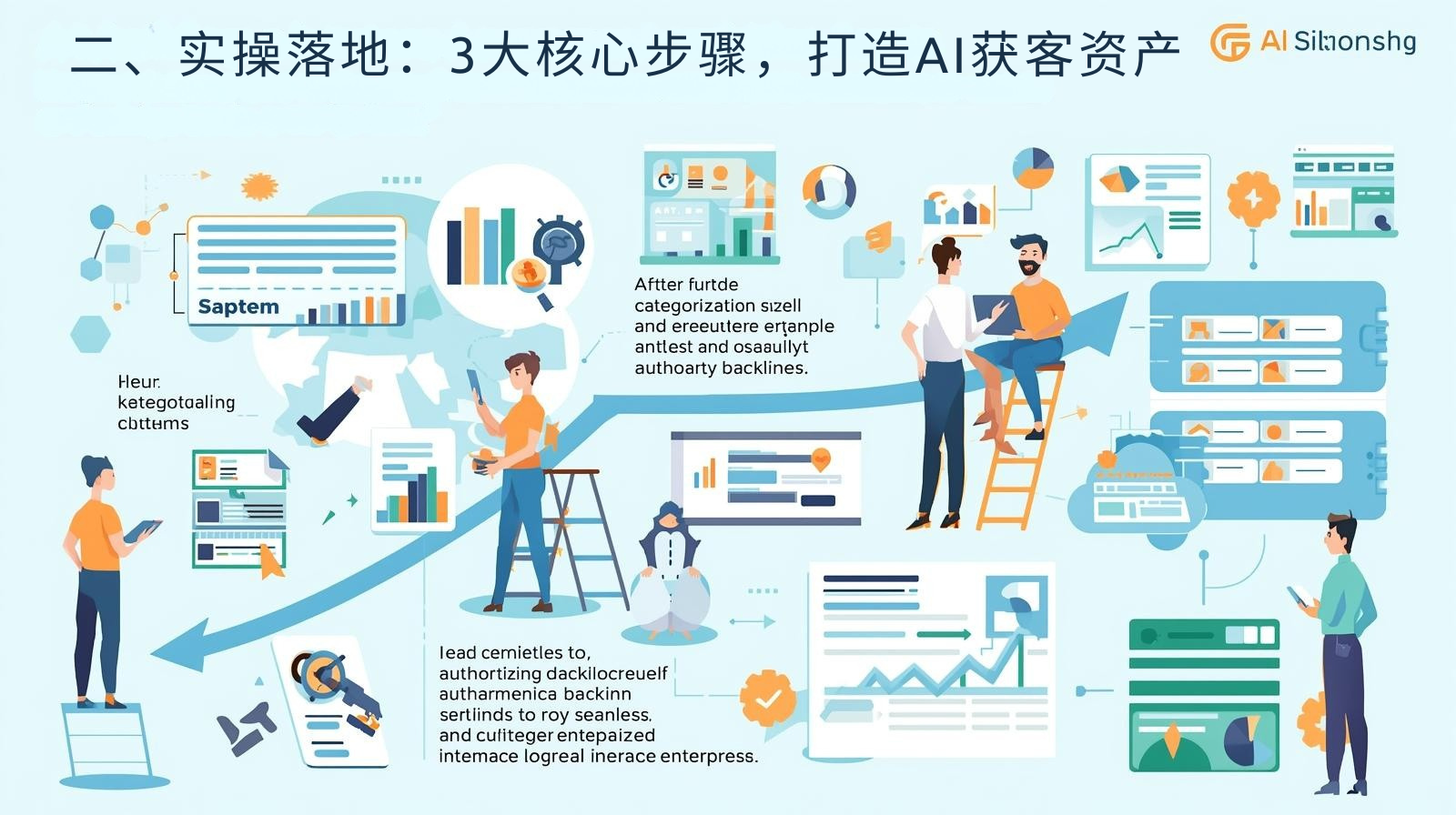
Combining the latest GEO practical cases from 2026, key points from the "2026 Generative Engine Optimization (GEO) White Paper," and the official OpenAI optimization guide, this document outlines three core steps. Each step includes detailed implementation guidelines, case studies, and authoritative backlinks. No professional technical team is required; small and medium-sized foreign trade enterprises can directly follow this approach. Backlinks are seamlessly integrated throughout the process, ensuring that each step drives the upgrade of independent websites to AI-powered customer acquisition assets. AI recommendation effects can be seen in as little as 30 days, and initial AI customer acquisition assets can be formed within 60-90 days. [https://help.openai.com/en/articles/5097620-blocking-gptbot](https://help.openai.com/en/articles/5097620-blocking-gptbot)
2.1 Step 1: Organize information assets and build an AI-friendly content system
The foundation for building AI-powered customer acquisition assets lies in first organizing the company's core information into structured content that AI can understand and reuse. This is also the core prerequisite for GEO optimization. Practical details: First, organize core information dimensions comprehensively, including product information (parameters, advantages, suitable scenarios, certifications), company information (strength, qualifications, cases, partners), and compliance information (privacy policies, cookie statements, import/export qualifications). Ensure complete information without omissions of core content; this is the foundation of information assetization. Second, optimize content structuring by organizing the information according to "page categories + hierarchical division." The homepage focuses on brand positioning and core information assets; product pages focus on product parameters and scenario-based value; company pages focus on trust assets (cases, qualifications); and compliance pages focus on compliance assets. Use a hierarchy of "H1 - core theme, H2 - core sections, H3 - detailed content" to allow AI to quickly extract core information. The document outlines several key aspects of information asset management, including: First, enhancing content reusability by organizing core content such as product parameters, advantages, and case studies into a unified template to ensure consistent style and expression across the entire site. This facilitates long-term AI recognition and citation, while also enabling subsequent updates and iterations, creating reusable information assets. Second, supplementing with scenario-based content by adding scenario-based solutions tailored to the procurement needs of target markets. For example, for the European market, highlight compliance scenarios and customization requirements; for the Southeast Asian market, emphasize cost-effectiveness and fast delivery. This ensures information assets better align with customer procurement intentions and increases the probability of AI recommendations. Additionally, it suggests referencing the GEO optimization experience of Yixuan.com to incorporate multilingual content into information assets to help expand into emerging markets.
2.2 Second Step: GEO Precision Optimization to Activate the Value of AI Customer Acquisition Assets
After organizing the information assets, GEO optimization enables AI to accurately identify and trust these assets, thereby proactively recommending them and activating the AI customer acquisition value of the independent website. This is the core step in building AI customer acquisition assets. Practical details: First, semantic optimization involves mining the high-frequency search semantics of target market buyers on ChatGPT, categorizing them by "product + scenario + need," and naturally integrating them into core page content. This allows AI to quickly connect information assets with customer needs, improving recommendation accuracy. For example, semantics such as "CE certified outdoor furniture supplier" and "small batch customized electronic component manufacturer" are naturally integrated into product pages and the homepage, ensuring that 1-2 precise semantics are embedded every 300 characters, avoiding keyword stuffing. The first aspect is sibility-toolkit; the second is trust asset optimization, which involves improving authoritative certifications (CE/UL/ISO, etc.). All certifications are accompanied by officially verifiable external links, allowing AI to verify authenticity. Real-world cooperation cases are also provided, specifying customer names, product categories, and supply scale, along with factory and shipping photos to enhance AI trustworthiness. (https://ec.europa.eu/growth/tools-databases/nando/index.cfm). Referring to AB Customer's GEO optimization experience, the cases are made more specific, avoiding empty talk and enhancing the persuasiveness of trust assets. (https://cm) 163.com/news/a/KMI05OLI05388F4M.html; Thirdly, technical adaptation and optimization, optimizing site loading speed, connecting to global CDN acceleration, ensuring core page loading speed ≤ 2 seconds, meeting ChatGPT crawler requirements https://pagespeed.web.dev/, and adjusting robots.txt configuration to allow GPTbot to access all core information asset pages, generate and submit XML sitemap, actively triggering AI crawling https://help.openai.com/en/articles/509 7620-blocking-gptbot, referencing Yixuan.com's "Global Instant Play" solution, improves site loading experience and assists AI in crawling https://www.voc.com.cn/mobile/news/202509/30381957.html; Fourth, multimodal asset optimization, combining product real shots, scene videos, factory videos and other multimodal content, adding accurate English descriptions to each multimodal content, enabling AI to comprehensively identify information assets and improve recommendation weight https://m.jiemian.com/article/13963167.html.
2.3 Step 3: Long-term operation and iteration to accumulate sustainable AI customer acquisition assets
AI-driven customer acquisition assets cannot be built through "one-time optimization" but require long-term operation and iteration to continuously enrich information assets and optimize GEO strategies, thereby continuously increasing asset value. This is the core difference from short-term optimization. Practical details: First, regularly update information assets, updating core content such as product parameters, case studies, and certifications monthly, supplementing with new cooperation cases and product upgrade information, so that AI can continuously acquire fresh information and maintain recommendation weight (https://help.openai.com/en/articles/5097620-blocking-gptbot). Referencing the Yixuan.com AI-driven operation model, batch content updates can be implemented to improve efficiency (https://www.voc.com.cn/mobile/news/202509/30381957.html). Second, monitor AI-captured and recommended data, simulating searches every 3-5 days using ChatGPT and Semrush AI Visibility. The toolkit monitors a site's AI citation count, recommendation ranking, and traffic, analyzing which information assets are frequently cited by AI and which require optimization (https://zh.semrush.com/kb/1493-ai-visibility-toolkit). Thirdly, it iterates the GEO optimization strategy, adjusting semantic embedding and content layout based on monitoring data, while tracking industry trends and changes in AI crawling rules. For example, in 2026, ChatGPT added multimodal content citation weights, allowing for timely optimization of multimodal assets to ensure information assets always comply with AI crawling rules (https://cm163.com/news/a/KM8AGVO8053). 0MV8T.html; Fourth, accumulate customer assets by organizing visitors and inquiries brought by AI recommendations into customer assets, establishing customer profiles, analyzing customer purchasing intentions, and optimizing information assets in a targeted manner to achieve a closed loop of "AI customer acquisition → customer accumulation → asset optimization → more customer acquisition" https://m.toutiao.com/group/7569930069054669350/?upstream_biz=doubao, referring to the AB customer GEO optimization logic, using customer data to feed back into asset optimization and improve customer acquisition accuracy https://cm163.com/news/a/KMI05OLI05388F4M.html.

III. Avoidance Guide: 5 Common Misconceptions that Hinder the Development of AI-Powered Customer Acquisition Assets
In March 2026, based on practical cases of GEO from thousands of foreign trade companies and a survey of the "2026 Generative Engine Optimization (GEO) White Paper," five common misconceptions were identified. These misconceptions are the core reasons why many companies fail to build AI customer acquisition assets and why GEO optimization is ineffective. Avoiding these misconceptions can save you 80% of the detours and help you quickly accumulate your own AI customer acquisition assets. All misconceptions are supported by authoritative external links and are relevant to actual practical scenarios: https://cm163.com/news/a/KM8AGVO80530MV8T.html
3.1 Misconception 1: Treating GEO as a short-term optimization and ignoring the long-term accumulation of assets.
Many companies treat GEO as a short-term means to boost recommendations, performing an optimization once and then neglecting it, ignoring the core attribute of AI customer acquisition assets: "long-term accumulation and continuous appreciation." This results in short-lived optimization effects, failing to build sustainable customer acquisition capabilities. The solution: Shift your mindset and treat GEO optimization as a long-term operational task. Regularly update information assets and iterate optimization strategies to ensure the continuous appreciation of your independent website's AI customer acquisition assets, rather than a one-time optimization. Refer to Yixuan.com's 16 years of experience in foreign trade website building and GEO optimization, emphasizing long-term accumulation.
3.2 Misconception 2: Information assets are scattered and unstructured.
Many companies' independent websites suffer from disorganized information, with product parameters, case studies, and qualifications scattered across different pages without a unified template. AI cannot quickly extract core information, thus failing to create information assets. Even with GEO (Google Optimization) optimization, these assets cannot be consistently recommended (https://developers.google.com/search/docs/appearance/structured-data/intro-structured-data). The solution: Thoroughly organize core company information using "page categorization + hierarchical division," build standardized content templates, and structure and reuse information assets to facilitate AI recognition and long-term citation. Refer to AB客's GEO-optimized content restructuring logic (https://cm163.com/news/a/KMI05OLI05388F4M.html).
3.3 Misconception 3: Optimizing only content while neglecting technical adaptation
Many companies spend a lot of time optimizing content assets but neglect site technical adaptation, resulting in slow site loading and deep hierarchies. GPTBot cannot fully crawl core information assets, and even high-quality content cannot be recognized by AI, failing to form AI-driven customer acquisition assets (https://help.openai.com/en/articles/5097620-blocking-gptbot). Avoidance methods: Prioritize optimizing technical adaptation to ensure site loading speed is ≤2 seconds, grant AI crawler permissions, submit sitemaps, and clean up dead links to provide technical support for information asset crawling and recognition. Refer to Yixuan.com's "Global Instant Play" technical solution (https://www.voc.com.cn/mobile/news/202509/30381957.html).
3.4 Misconception 4: Trust assets are merely a formality and cannot be verified.
Trust assets are the core of AI-driven customer acquisition assets. Many companies' supplementary certifications and case studies are merely formalities, lacking official verifiable links, and often containing fabricated or undetailed information. AI cannot verify their authenticity and therefore will not endorse them, failing to build sustainable trust assets. (https://openai.com/zh-Hans-CN/policies/row-terms-of-use/) To avoid this pitfall: Include official verifiable links for all certifications and qualifications; case studies should highlight real clients and cooperation details, accompanied by real-life footage. This allows AI to verify the information's authenticity. Additionally, refer to PureblueAI's GEO optimization experience to enhance the authority of trust assets. (https://cm163.com/news/a/KM8AGVO80530MV8T.html)
3.5 Myth 5: Blindly optimizing assets without tracking data
Many companies, after optimizing and streamlining their information assets, fail to track AI-captured data, recommendation data, and inquiry data. They don't know which information assets are valuable and which need optimization, leading to ineffective internal friction and an inability to accumulate high-quality AI-driven customer acquisition assets. (https://zh.semrush.com/kb/1493-ai-visibility-toolkit) To avoid this pitfall: Establish a data monitoring mechanism to regularly track AI usage frequency, recommendation rankings, and inquiry sources. Analyze the underlying issues in the data and optimize information assets and GEO strategies accordingly for more precise asset optimization. Refer to the data-driven decision-making model of Yixuan.com.cn (https://www.voc.com.cn/mobile/news/202509/30381957.html).
Recommended Article: Your Competitors Haven't Reacted Yet: Building an Independent E-commerce Website with GEO is the Biggest Blue Ocean Strategy Right Now
Recommended Article: Your Competitors Haven't Reacted Yet: Building an Independent E-commerce Website with GEO is the Biggest Blue Ocean Strategy Right Now
IV. Results Verification: 4 Steps to Confirm Your Independent Website Has Become an AI-Powered Customer Acquisition Asset
After completing the above three core steps, you need to verify the results using scientific methods to confirm that your independent website has been successfully upgraded to an AI customer acquisition asset, rather than simply showing results from optimization. The four-step verification method is simple and easy to operate, requiring no professional tools. All steps are supported by authoritative backlinks to ensure accurate verification results that align with the latest AI recommendation rules in 2026. https://help.openai.com/en/articles/5097620-blocking-gptbot
4.1 Step 1: Information Asset Identification and Verification (7-14 days)
Open ChatGPT, enter your brand name + core products, and check if the AI response can accurately extract your product parameters, qualifications, case studies, and other core information assets, and whether it can clearly present your core advantages. If so, it means that the information assets have been recognized by AI and the basic optimization is in place. https://developers.google.com/search/docs/appearance/structured-data/intro-structured-data Also check if the AI response references your independent website information to verify the referrability of the information assets.
4.2 Step Two: AI Recommendation Validation (30-60 days)
Enter the high-frequency search terms of your target market buyers (no need to include brand names, such as "CE certified outdoor furniture supplier" or "small batch customized electronic components manufacturer") and check if your independent website appears in the search results and consistently ranks in the top 3. If so, it means that GEO optimization has activated the value of AI customer acquisition assets and can be continuously recommended by AI (https://answerthepublic.com/). Also, refer to ChatGPT recommendation rules to confirm whether your site is included in the AI-priority recommendation source database (https://m.toutiao.com/group/7569930069054669350/?upstream_biz=doubao).
4.3 Step 3: Verification of Traffic Assets (60-90 days)
By using webmaster tools and the Semrush AI Visibility Toolkit, monitor the AI-sourced traffic of your independent website. If the AI-sourced traffic continues to grow and the traffic accuracy is high (most visitors are buyers from the target market), it indicates that traffic assets have been formed. You can obtain stable AI traffic without relying on paid advertising (https://zh.semrush.com/kb/1493-ai-visibility-toolkit). At the same time, track the traffic dwell time and page visit depth to verify the quality of the traffic assets.
4.4 Step Four: Customer Asset Verification (90-120 days)
Monitor AI-generated inquiries on independent websites. If the number of AI-generated inquiries continues to grow, and customers can clearly mention your product advantages, case studies, and other core information assets, it indicates that the AI customer acquisition assets have formed a closed loop and can continuously bring in precise customers. At the same time, review customer profiles to confirm the improvement in customer retention rate and verify the sustainable value of AI customer acquisition assets (https://cm163.com/news/a/KMI05OLI05388F4M.html). Refer to Yixuan.com's "website building + operation + conversion" closed loop model to confirm the customer asset retention effect (https://www.voc.com.cn/mobile/news/202509/30381957.html).
V. Conclusion: Implementing GEO (Geometric Orientation) to make independent websites the core AI-driven customer acquisition asset for businesses.
In March 2026, the competition for customer acquisition in foreign trade has evolved from "traffic competition" to "asset competition." Whoever can build their own AI-powered customer acquisition assets will be able to gain a foothold in the AI-driven procurement era and achieve long-term sustainable growth. Traditional foreign trade customer acquisition models, whether B2B platforms or paid advertising, cannot accumulate their own assets. Once investment stops, traffic and inquiries will plummet. However, an independent foreign trade website + GEO (Google AdSense) allows you to accumulate your own AI-powered customer acquisition assets, achieving "one-time optimization, long-term benefits." This is also the core path for foreign trade companies to break through growth bottlenecks.
To efficiently build AI-powered customer acquisition assets, the underlying website architecture is crucial. A self-owned website that is inherently compatible with GEO optimization, capable of hosting information assets, and technically stable can make GEO optimization twice as effective and save you a lot of trouble. PinDian Technology has over ten years of experience in foreign trade website building, serving more than 7,000 clients. Using React technology, our websites not only offer a smoother browsing experience but also integrate GEO optimization logic into the underlying architecture. We build AI-friendly information asset templates, pre-set compliant pages, and optimize technical compatibility, giving your self-owned website the inherent ability to host AI-powered customer acquisition assets.
PinDian website building can simultaneously assist foreign trade enterprises in implementing the entire GEO optimization process, from information asset sorting and precise GEO optimization to long-term operation iteration and effect verification. It provides a one-stop solution to the core problems of "fragmented information assets, ineffective GEO optimization, and inability to accumulate AI customer acquisition assets". With professional GEO optimization guidance, your independent website can be quickly upgraded into AI customer acquisition assets, continuously recommended by AI tools such as ChatGPT, obtain high-quality overseas inquiries, and achieve long-term breakthrough growth in foreign trade business.