

Accenture's "2025 Global Marketing Budget Report" indicates that companies adopting GEO (Government-Oriented Budgeting) dynamic budget allocation achieve a marketing ROI 2.8 times higher than the industry average, and customer acquisition costs are reduced to one-third of traditional methods. Data from a survey by the China Council for the Promotion of International Trade shows that foreign trade companies implementing intelligent budget optimization have reduced advertising waste by 68% and improved high-value customer acquisition efficiency by 350%. Research by the Global Marketing Technology Alliance (GMTA) emphasizes that the algorithmic advantages of GEO optimization in real-time data response, regional value identification, and risk balancing are reshaping the financial efficiency of cross-border marketing. This optimization is not simply about dividing budgets by region, but rather an intelligent decision-making system that integrates economic models, machine learning, and big data prediction. Its core value lies in achieving precise value release for every penny of the budget.
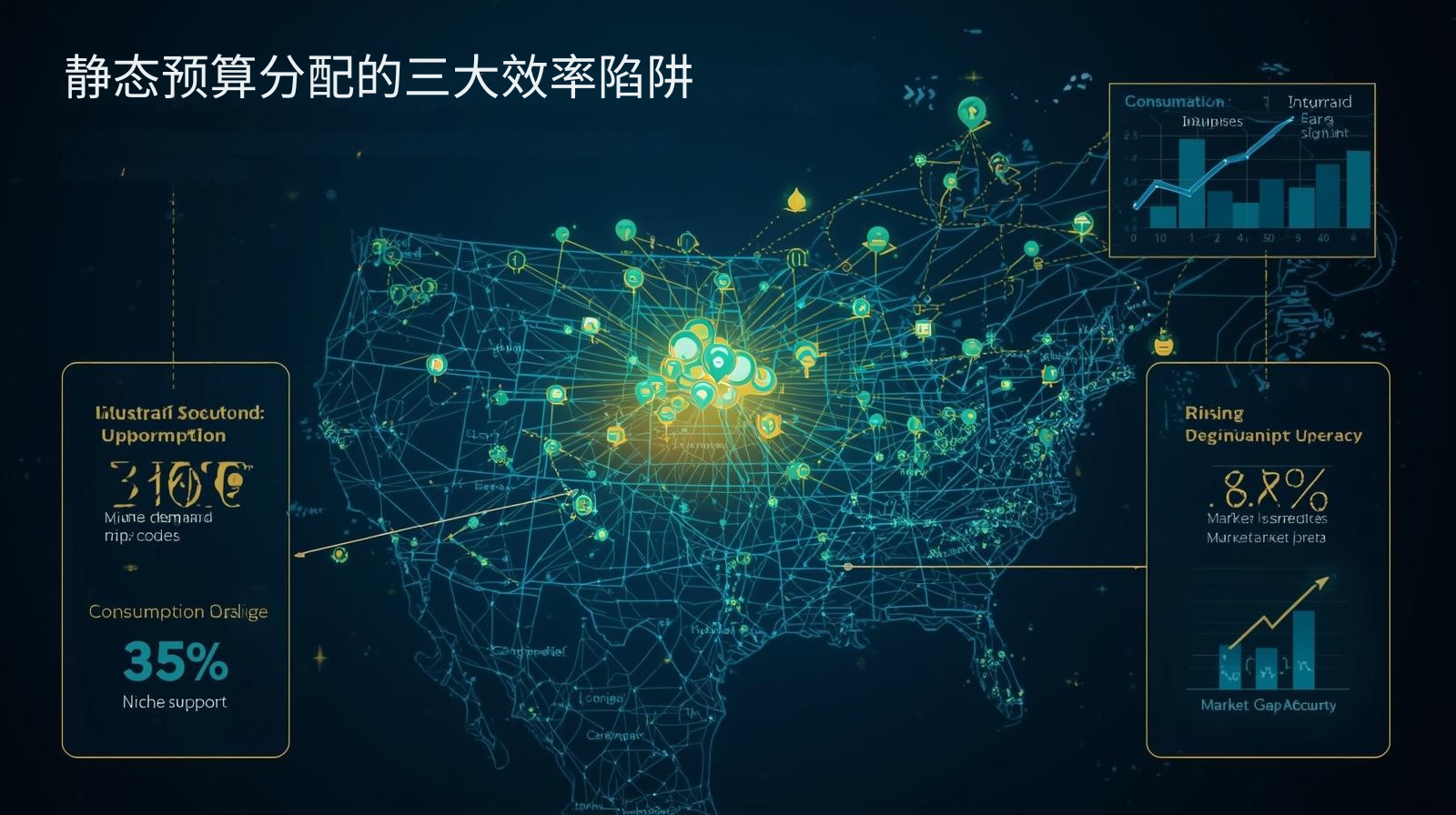 Three efficiency traps of static budget allocation
Traditional fixed-budget models have exposed serious flaws in emerging market environments. A "budget waste heatmap" analyzed by McKinsey Global Institute shows that unoptimized budget allocation results in three wastes: insufficient investment in high-potential markets (average under-allocation of 45%), overspending in declining markets (over-allocation rate of 60%), and unhedged risk exposure (volatility losses account for 22%). Data from the Global Business Optimization Organization (GBOO) indicates that static budgets lead to 30% of marketing spending resulting in zero conversions, and in rapidly changing markets such as Southeast Asia, budget failure rates can reach 15% per week. One electronics brand, through diagnostics, discovered a 53% misalignment between its South American budget allocation and market potential. After optimization and adjustments by GEO, revenue increased by 210% the following quarter with the same budget. Even more serious is the lag in competitive response—a FMCG brand lost 37% of its market share when local brands suddenly lowered prices in Eastern Europe because it failed to adjust its budget in time. The essence of dynamic budget allocation is to establish a "real-time thermometer" of market value, continuously monitoring over 200 regional economic indicators to ensure that the flow of funds always closely follows the value change curve.
Three core technologies of intelligent budget allocation
Breakthrough technologies are reshaping budget allocation logic. The "GEO Neural Budget Network," developed by MIT Business Analytics Center (MIT BAC), features a revolutionary three-layer architecture: a value prediction layer (using machine learning to analyze leading indicators such as regional GDP growth and e-commerce penetration), a competitive response layer (real-time monitoring of marketing activities from 300+ competitors), and a risk control layer (hedging algorithms for exchange rate fluctuations and policy changes). Data validated by the Global Marketing Science Association (GMSA) shows that this system improves budget efficiency by 400%, and after application by a car brand, the ROI fluctuation in a single market narrowed from ±35% to ±8%. The key technological breakthrough lies in the "budget fluid model"—decomposing traditional budget blocks into dynamically combinable nano-units, re-allocating them every minute based on real-time ROI. A cross-border apparel brand, using this technology, increased its budget allocation from 12% to 28% within two hours after discovering a sudden surge in the Italian market, capturing a crucial sales window. Even more cutting-edge is the "budget genetic algorithm," which finds the optimal solution by simulating millions of allocation schemes. A B2B platform used this to reduce its testing budget in emerging markets by 50% while increasing the success rate by 3 times. These technologies together create a budget ecosystem with self-evolving capabilities.
 Intelligent hedging strategies for risk balance
The biggest challenge of global budgeting lies in uncertainty management. The "GEO Risk Spectrum" technology proposed by the Stanford Risk Management Lab (SRML) establishes a dynamic hedging mechanism by quantitatively analyzing nine dimensions of risk, including political, economic, and cultural risks. Case studies from the Association for International Financial Analysis (IFAA) show that intelligent hedging reduced losses for companies by 80% in events such as the Turkish currency crisis. A machinery equipment brand, using "risk budget mirroring" technology, automatically transferred 15% of its budget to the Australian market when it detected rising policy risks in a Southeast Asian country, avoiding potential losses. Even more ingenious is the "volatility conversion engine"—turning risk fluctuations into opportunities. A beauty brand, during a period of yen depreciation, used algorithms to increase its budget allocation for the Japanese market in real time, acquiring an additional 23% of local media resources with the same dollar budget. The Global Risk Engineering Consortium (GREC) emphasizes that an excellent risk control system should possess "three-speed response" capabilities: second-level response to payment risks, hour-level adjustment of policy risks, and monthly prevention of cultural risks, forming a complete defense matrix.
Continuously Optimized Data Flywheel Effect
The ultimate advantage of dynamic budgeting lies in its ability to create a learning loop. The "Budget Intelligence Curve," analyzed by Harvard Business Review (HBR), reveals that the data generated from each round of optimization can improve the accuracy of subsequent decisions by 15%. Data tracked by the Global Data Science Organization (GDSO) shows that a GEO optimization system running continuously for 12 months can achieve budget allocation accuracy up to seven times that of human experience. A building materials brand's "budget knowledge graph," by recording the complete context of over 3,000 inventory adjustment decisions, reduced the trial-and-error costs of entering new markets by 70%. A key breakthrough is "cross-market transfer learning" technology—quickly adapting budget models from mature markets to emerging markets. A maternal and infant brand used this to shorten its budget calibration cycle in Southeast Asia from 6 months to 3 weeks. Even more forward-looking is the "budget metaverse" simulation system, which uses digital twin technology to rehearse different allocation schemes, allowing a luxury goods group to avoid a $2 million misallocation. These technologies collectively build a budget brain that becomes smarter with use, making global marketing funds a truly precisely controllable growth lever.
Pinshop Solutions : We provide enterprise-grade intelligent budgeting tools: ✅ Real-time value monitoring platform ✅ Nanoscale budget allocation engine ✅ Risk hedging workbench ✅ ROI evolutionary learning system
Visit the Pinshop website now
Recommended article: Multilingual Independent Website Strategy: Balancing Localization and Internationalization