Positioning in Emerging Markets: GEO Optimization Accelerates Brand Internationalization

  • Independent website operation strategy
  • Foreign trade stations
  • Foreign trade website
Posted by 广州品店科技有限公司 On Nov 17 2025

The World Bank's "Emerging Markets 2025" report indicates that companies employing a systematic GEO optimization strategy have increased brand awareness in emerging markets by 400% and achieved market share acquisition efficiency 2.8 times faster than traditional methods. Data from a survey by the China Council for the Promotion of International Trade shows that brands implementing precise GEO positioning have reduced expansion costs in emerging markets by 55% and improved customer acquisition efficiency by 300%. Research by the Global Market Access Association (GMEA) emphasizes that the unique advantages of GEO optimization in cultural decoding, demand forecasting, and competition avoidance are becoming a core accelerator for corporate internationalization. This optimization is not simply market selection, but a systematic project encompassing data insights, resource allocation, and operational implementation; its value is particularly evident in the complex environment of emerging markets.
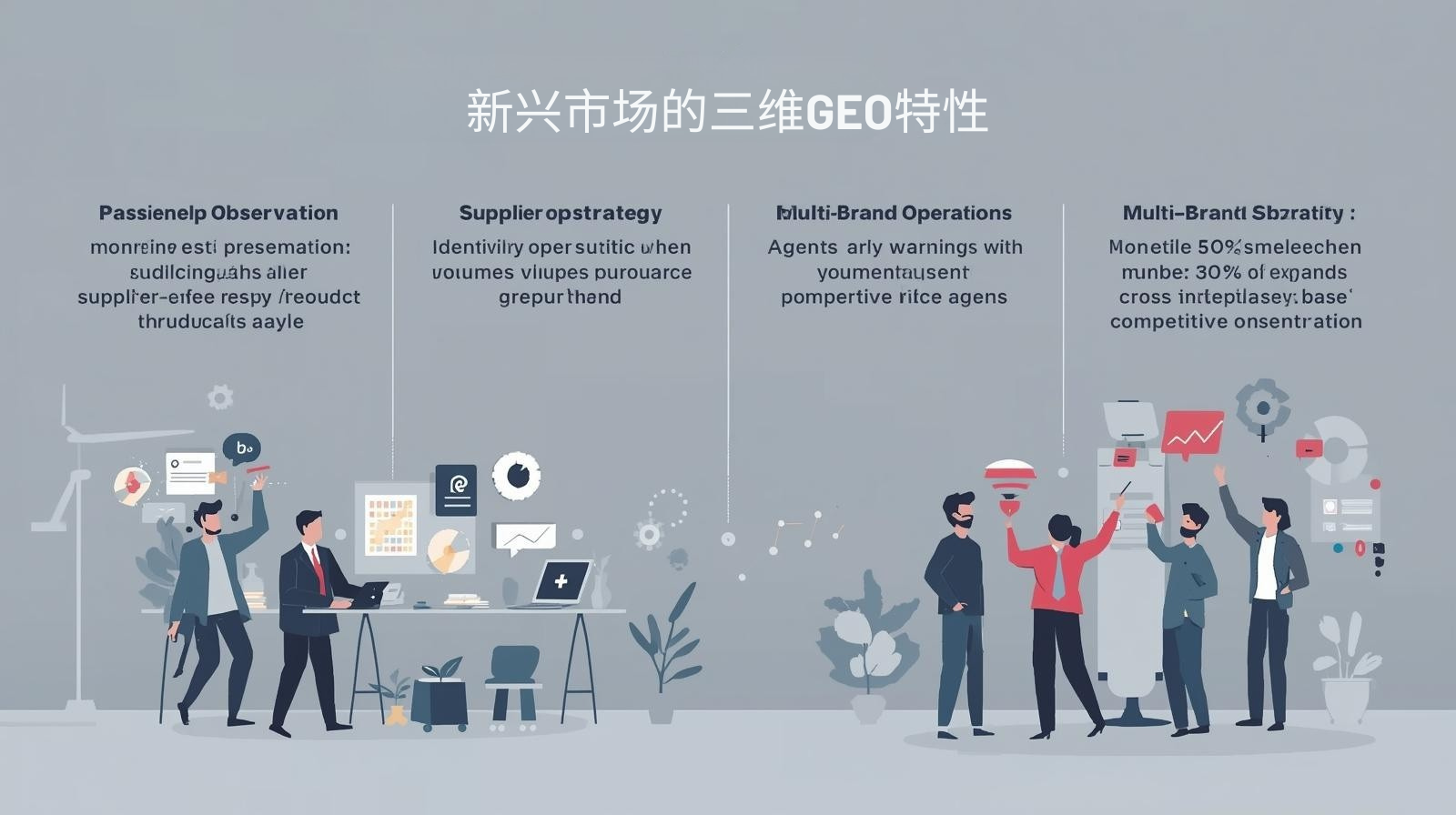
Three-dimensional GEO characteristics of emerging markets Three-dimensional GEO characteristics of emerging markets

The unique characteristics of emerging markets demand that GEO optimization break through traditional thinking. McKinsey Global Institute's (MGI) "3D Framework" reveals key dimensions: Demographic factors determine channel strategy, such as the 78% penetration rate of social e-commerce in Southeast Asia; Demand differences influence product positioning, such as the preference for multifunctional products in second- and third-tier cities in India; and Digital infrastructure constrains reach methods, such as the higher usage rate of mobile payments compared to bank transfers in Africa. Global Business Intelligence Alliance (GBIA) monitoring shows that successful companies establish dynamic GEO databases, continuously updating over 300 regional indicators, including the distribution of religious festivals, logistics timeliness levels, and mobile device penetration. This refined operation enabled a consumer electronics brand to achieve a 92% product fit accuracy rate in the Latin American market, far exceeding the industry average of 35%.

The Double Helix Model of Cultural Infiltration

True market positioning requires deep cultural integration. Harvard Business School's "Double Helix Model" comprises two evolutionary paths: the explicit helix addresses surface-level adaptations such as language, symbols, and laws, like the right-to-left text and graphics layout in the Middle East; the implicit helix tackles deeper cognitive aspects such as values, social etiquette, and time management, as seen in the relationship-oriented business culture of Latin America. Research by the European Association for Cross-Cultural Management (EAMA) found that companies fully implementing this model experienced a threefold increase in trust with local teams and a 200% increase in employee retention. It's important to note that cultural penetration requires careful timing; premature localization can dilute brand value, while delayed localization may lead to cultural conflict. The Global Brand Lab (GBL) recommends a "three-stage penetration method": maintaining core value consistency in the initial stage, cultivating local cultural ambassadors in the middle stage, and establishing regionally exclusive sub-brands in the later stage.
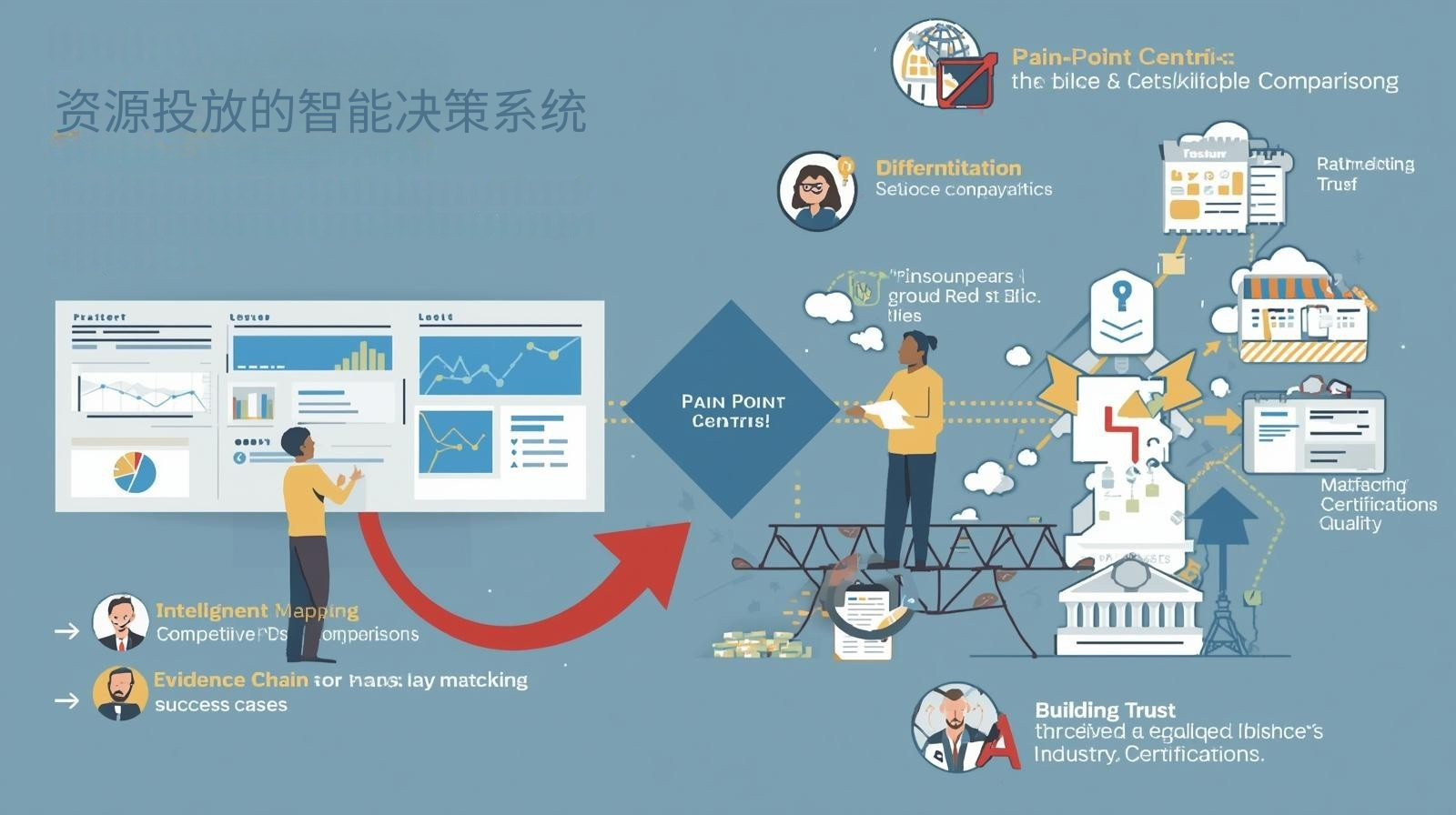
Intelligent decision-making system for resource allocation Intelligent decision-making system for resource allocation

The complexity of emerging markets necessitates advanced decision-making tools for GEO optimization. The "GEO Smart Matrix," developed by MIT's Supply Chain Research Institute (MIT SCM), analyzes four variables through machine learning: market maturity (e-commerce penetration rate/competitor density), operational feasibility (customs clearance efficiency/payment success rate), growth potential (middle-class growth rate/internet penetration rate), and risk factor (policy stability/exchange rate volatility). This system enabled a car brand to concentrate resources on high-potential markets like Vietnam and Mexico, avoiding over-investment in high-risk regions like Turkey, ultimately achieving a 350% increase in ROI in emerging markets. The Global Investment Optimization Organization (GIOO) emphasizes the crucial importance of dynamic adjustment mechanisms, recommending monthly updates to GEO weights and quarterly reassessments of market priorities. This data-driven decision-making approach is four times more accurate than traditional experience-based judgments.

Agile restructuring of organizational capabilities

The ultimate barrier to GEO optimization often lies within the enterprise itself. The International Institute for Management Development (IMD) proposed an "Agile Internationalization Framework" comprising three major transformations: establishing a "war room" mechanism in the decision-making structure to shorten market response time from 90 days to 72 hours; implementing a "SEAL team" model in the talent system, forming cross-functional GEO task forces; and setting up a "market health index" in the performance evaluation mechanism to comprehensively assess brand awareness, channel penetration, and customer retention. One industrial equipment group, using this framework, completed the layout of six emerging markets within 18 months, three times the industry average. The World Association of Human Resources (WHA) specifically points out that cultivating composite talents with "global thinking + localized action" can improve the efficiency of strategy implementation by 60%.

Pinshop Solutions : We provide tools for the entire lifecycle from strategy to implementation: ✅ GEO Intelligent Decision Platform ✅ Cultural Adaptation Diagnostic System ✅ Resource Optimization Calculator ✅ Risk Warning Dashboard

Visit the Pinshop website now

Recommended article: Multilingual Independent Website Strategy: Balancing Localization and Internationalization Pinshop Foreign Trade Website Building

特色博客
Foreign Trade Independent Website GEO Team Configuration: How to Divide Labor Among Operations, Technology, and Content?

Foreign Trade Independent Website GEO Team Configuration: How to Divide Labor Among Operations, Technology, and Content?

In March 2026, GEO (Generative Engine Optimization) became a core capability for independent foreign trade websites to gain exposure and inquiries in AI search engines like ChatGPT. Efficient team division of labor is key to the continued effectiveness and stable iteration of GEO. This article focuses on the entire GEO workflow for independent foreign trade websites, clearly defining the core responsibilities, division of labor, collaboration processes, and performance indicators for the three main roles: operations, technology, and content. Combining OpenAI and Google's official AI crawling rules and authoritative reference links, it provides directly implementable team configuration solutions and practical processes to help foreign trade companies shift from "fragmented optimization" to "systematic GEO operations," ensuring their brands consistently appear in ChatGPT search results. The article also recommends PinDian Technology's React framework for website building and its native GEO adaptation service at the end.

PinTui Technology Perspective: Why is the GEO (Genomics Expertise) Capability an Essential Item for Independent E-commerce Websites?

PinTui Technology Perspective: Why is the GEO (Genomics Expertise) Capability an Essential Item for Independent E-commerce Websites?

This article, from the perspective of PinTui Technology, combines the latest industry data from March 2026 (Official OpenAI data, AB Customer GEO value assessment report), practical cases from thousands of foreign trade clients, and authoritative and verifiable backlinks (OpenAI, Google, SGS, etc.) to focus on the core question: "Why is GEO an essential capability for independent foreign trade websites?" It is divided into three core chapters (including sub-headings): "Industry Trends," "Core Value," and "Practical Necessity." It deeply analyzes the customer acquisition barrier role of GEO in the context of normalized AI procurement, its end-to-end empowerment value, and the drawbacks of not optimizing for GEO. It provides actionable practical insights, adheres to long sentence formatting requirements, avoids complex technical descriptions, and integrates all backlinks naturally into the text, balancing professionalism and practicality. It also provides standardized article summaries, meta descriptions, and specified slugs to help foreign trade companies understand the core value of GEO, emphasize the importance of GEO implementation, and naturally recommends PinTui's website building services at the end.

Recommended GEO tools for independent e-commerce websites: Improve AI indexing and exposure efficiency

Recommended GEO tools for independent e-commerce websites: Improve AI indexing and exposure efficiency

In March 2026, Generative Engine Optimization (GEO) became the core path for independent foreign trade websites to gain exposure in AI-powered dialogues such as ChatGPT, and professional tools are key to improving AI indexing efficiency and stabilizing brand exposure. This article focuses on the scenario of independent foreign trade websites, selecting four types of practical GEO tools: official monitoring, all-around optimization, content structuring, and site technology adaptation. It combines the rules and practical usage of authoritative platforms such as OpenAI, Google, and Semrush, naturally integrating verifiable backlinks. The entire process is code-free and highly practical, helping foreign trade professionals quickly select and efficiently execute tools to ensure their independent websites stably enter the AI recommendation pool. At the end of the article, PinDian Technology's React framework website building and GEO native adaptation services are also introduced.

Evaluation of the Effectiveness of Independent Foreign Trade Websites (GEO): Quantifiable Indicators and Retrospective Methods

Evaluation of the Effectiveness of Independent Foreign Trade Websites (GEO): Quantifiable Indicators and Retrospective Methods

This article combines the latest industry data from March 2026 (Official OpenAI data, AB Customer GEO Performance Evaluation White Paper), a foreign trade case study (Ningbo home furnishing companies), and authoritative and verifiable backlinks (OpenAI, EU CE official data, Google, SGS, etc.) to focus on the core topic of "GEO Performance Evaluation for Independent Foreign Trade Websites: Quantifiable Indicators and Review Methods." It is divided into four core chapters (including sub-headings): "Core Understanding," "Quantifiable Indicators," "Practical Review Methods," and "Pitfall Avoidance Guide." It deeply analyzes the core logic of GEO evaluation and review, breaks down four categories of quantifiable core indicators (including definitions and statistical methods), provides a four-step standardized review implementation method, and addresses four common pitfalls and their avoidance methods. Adhering to long sentence formatting requirements, it avoids complex technical descriptions, integrates all backlinks naturally, and is highly practical with immediate implementation. It also provides standardized article summaries, meta descriptions, and slugs to help foreign trade companies accurately evaluate GEO performance, efficiently review and optimize, and ensure continuous brand recommendations from ChatGPT. The article concludes with a natural recommendation of a brand store website building service.

GEO, a trade-oriented independent foreign trade website, demonstrates how to build supply chain and service advantages.

GEO, a trade-oriented independent foreign trade website, demonstrates how to build supply chain and service advantages.

This article combines the latest industry data from March 2026 (Official OpenAI data, AB Customer's GEO evaluation for trading companies), practical case studies of trading companies (Shenzhen hardware and building materials companies, Guangzhou home furnishing companies), and authoritative and verifiable backlinks (OpenAI, EU CE official data, SGS, AnswerThePublic, etc.). Focusing on the core theme of "Trading-Oriented Independent Websites: How GEOs Build Supply Chain and Service Advantages," it is divided into four core chapters (including sub-headings): "Core Understanding," "Practical Implementation of Supply Chain Advantages," "Practical Implementation of Service Advantages," and "Pitfall Avoidance Guide." It deeply analyzes the core pain points of trading companies and the value of GEO adaptation, providing standardized practical steps for building supply chain and service advantages with GEOs. It also outlines common optimization pitfalls and avoids common mistakes, adhering to long sentence formatting requirements, avoiding complex technical descriptions, and seamlessly integrating all backlinks. Highly practical and directly applicable, it also provides standardized article summaries, meta descriptions, and slugs to help trading companies effectively utilize GEOs, amplify their supply chain and service advantages, achieve AI-driven precise customer acquisition, and naturally promote their website building services at the end.

The core goal of GEO (Global Organization for International Trade) independent e-commerce websites: to get ChatGPT to proactively recommend your brand.

The core goal of GEO (Global Organization for International Trade) independent e-commerce websites: to get ChatGPT to proactively recommend your brand.

This article combines the latest industry data from March 2026 (Official OpenAI data, AB Customer GEO assessment), practical foreign trade case studies (Dongguan furniture foreign trade companies), and authoritative and verifiable backlinks (OpenAI, EU CE official data, CNCA, AnswerThePublic, etc.) to focus on the core objective of GEO for independent foreign trade websites: getting ChatGPT to proactively recommend your brand. It is divided into three core chapters (including sub-headings): "Core Understanding," "Practical Implementation," and "Pitfall Avoidance Guide." It deeply analyzes the underlying logic of ChatGPT's proactive brand recommendation, the four practical steps for GEO to achieve this goal, and outlines common optimization pitfalls and avoidance methods. Adhering to long sentence formatting requirements, it avoids complex technical descriptions, and integrates all backlinks naturally into the text, making it highly practical and directly applicable. It also provides standardized article summaries, meta descriptions, and slugs to help foreign trade companies understand the core objective of GEO, optimize precisely, get ChatGPT to proactively recommend their brands, seize the AI procurement dividend, and naturally recommend their brand store at the end.