
Key performance indicator monitoring: How to ensure your GEO e-commerce independent website is always in high performance?

  • Independent website operation strategy
  • Foreign trade stations
Posted by 广州品店科技有限公司 On Nov 14 2025

Transforming "post-event firefighting" into "real-time monitoring," using seven dashboards to keep AI traffic perpetually within the comfort zone.
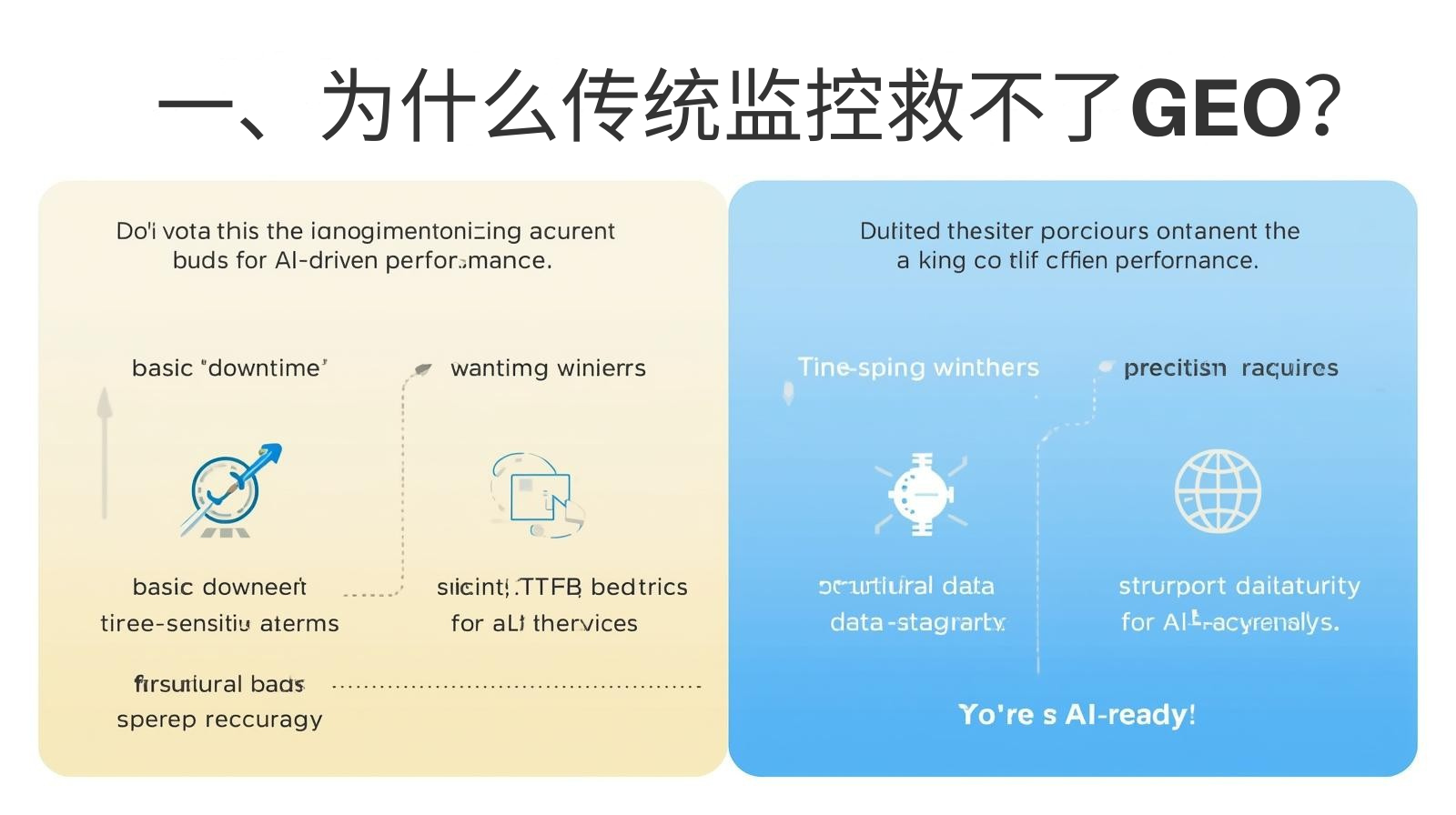
I. Why can't traditional monitoring save GEOs?

Many foreign trade websites equate "website monitoring" with "downtime SMS," but GEO (Generative Engine Optimization) is far more sensitive to performance than human users: • The ChatGPT crawler has a waiting window of only 3.5 seconds; it abandons the site if the timeout exceeds this window. • Perplexity records sites with a TTFB > 800ms as "low trustworthy." • A single structural data conflict can cause the AI's citation accuracy to drop by 20%. In other words, traditional monitoring can only tell you "the website is still up," while GEO monitoring tells you "whether the AI is still supporting you."
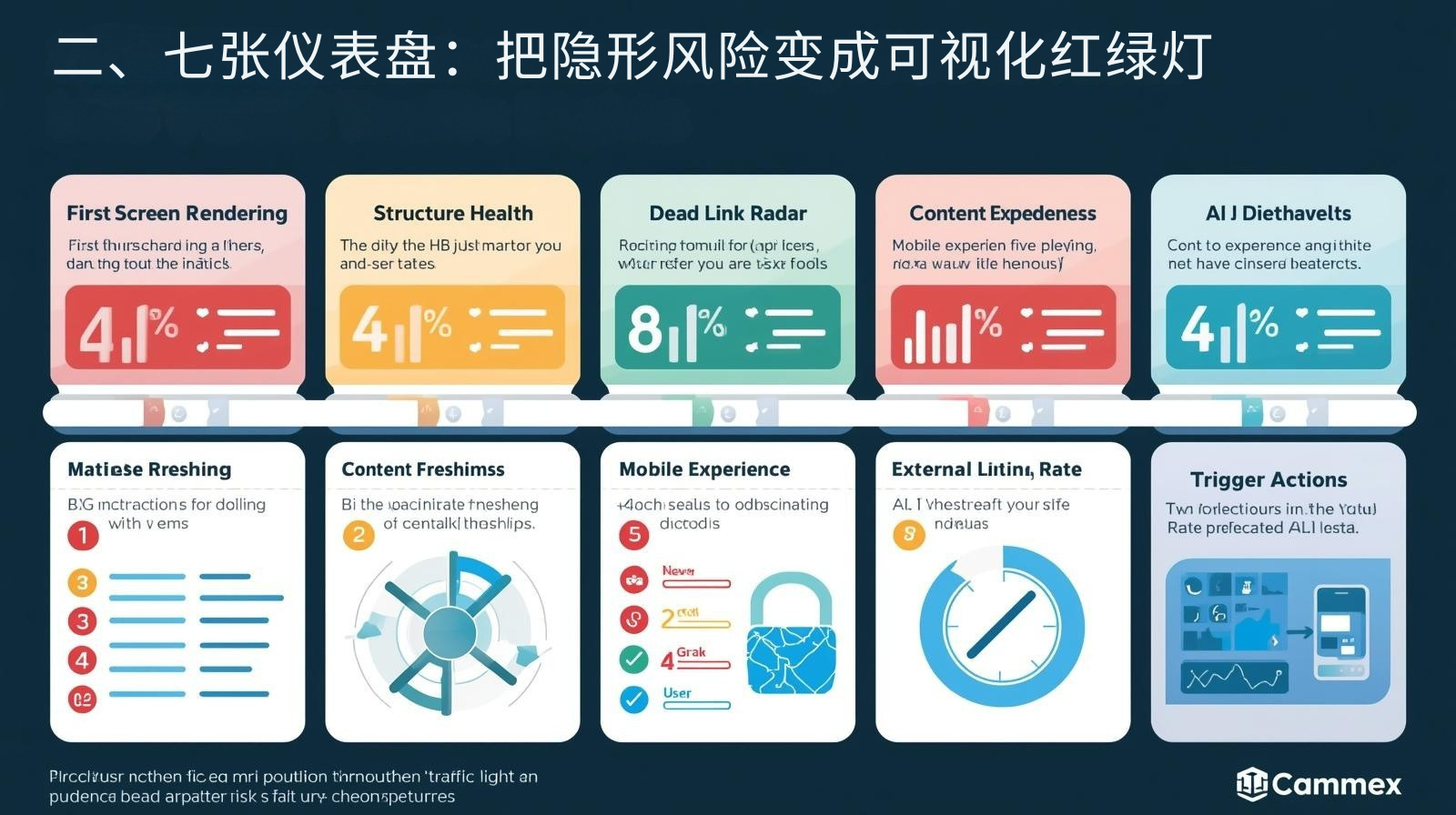
II. Seven Dashboards: Turning Hidden Risks into Visual Traffic Lights

Dashboard Key threshold Monitoring tools Trigger Action
First screen rendering LCP≤2.5s PageSpeed API Automatic Slack alerts
Structural health Schema error=0 Rich Results Test Notion Quest Cards
Dead Link Radar 404≤1% Screaming Frog Zapier → Email
Fresh content Updated ≤ 7 days GitHub Action Automatic Purge CDN
Mobile experience CLS≤0.1 Web-Vitals JS DingTalk robot
External link quality Spam score <3% Ahrefs API Weekly Report
AI citation rate Month-on-month change ≥ +5% Self-built web crawler Monthly Review

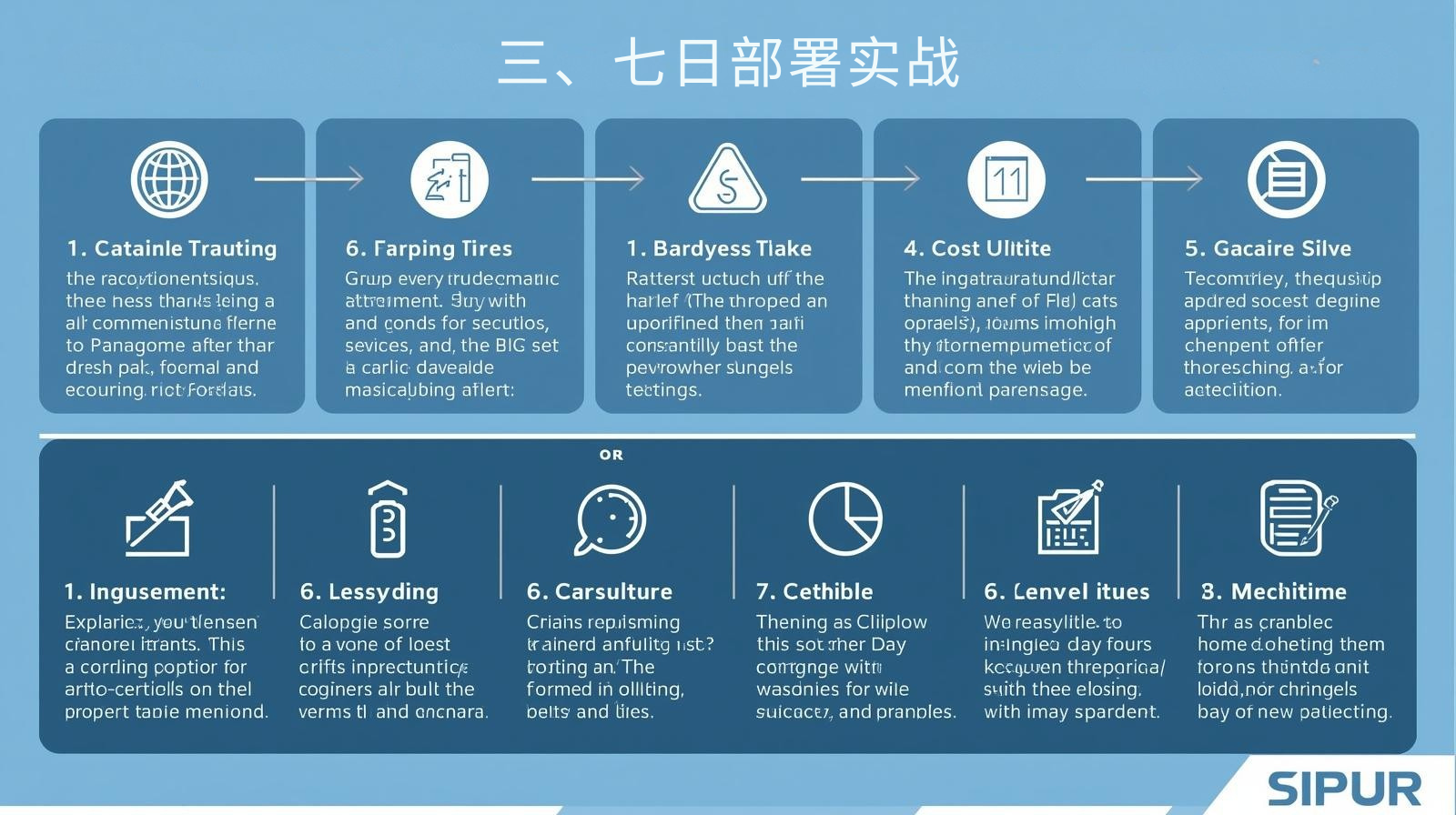
III. Seven-Day Deployment for Practical Combat
III. Seven-Day Deployment Practice (Zero-Code Reusable)

Day 1 Baseline Snapshot

Run a full-site test using PageSpeed Insights, take screenshots of the LCP, FID, and CLS scores, and save them to the "baseline" folder in Google Drive. Name the file with the date.

Day 2 Structured Data Dashboard

In Google Search Console → Experience → Rich Results, export a list of schema errors; use Notion to create a "Schema Repair Kanban" with each row corresponding to a URL, the person in charge, and the deadline.

Day 3 Dead Link Radar

Screaming Frog is set to crawl the entire site at 2 AM daily. If 404 errors exceed 1%, a red alert will be triggered in Zapier and Slack. After fixing the issue, a status code of 200 will be returned, and the dashboard will automatically turn green.

Day 4 Content Freshness

GitHub Action checks the git commit time of /blog/ directory every day at 18:00. If there are no updates for more than 7 days, it will automatically push a "content expired" reminder to WeChat for business.

Day 5 Mobile Experience

Embed Web-Vitals JS in the header to collect CLS/FID in real time; send the data back to Google Analytics 4 and set a custom alert: a pop-up notification will appear when CLS>0.1.

Day 6 External Link Quality

Ahrefs API pulls Referring Domains Spam Score weekly. Domains with more than 3% of the score are automatically added to the "Pending Cleanup" Google Sheet, and the responsible person must handle them within one week.

Day 7 AI Citation Monitoring

A self-built Python script searches for brand keywords in Perplexity every 48 hours and counts the number of references. The results are written to Google Sheets and plotted as a line chart. A review meeting is triggered when the month-on-month change is less than 5%.
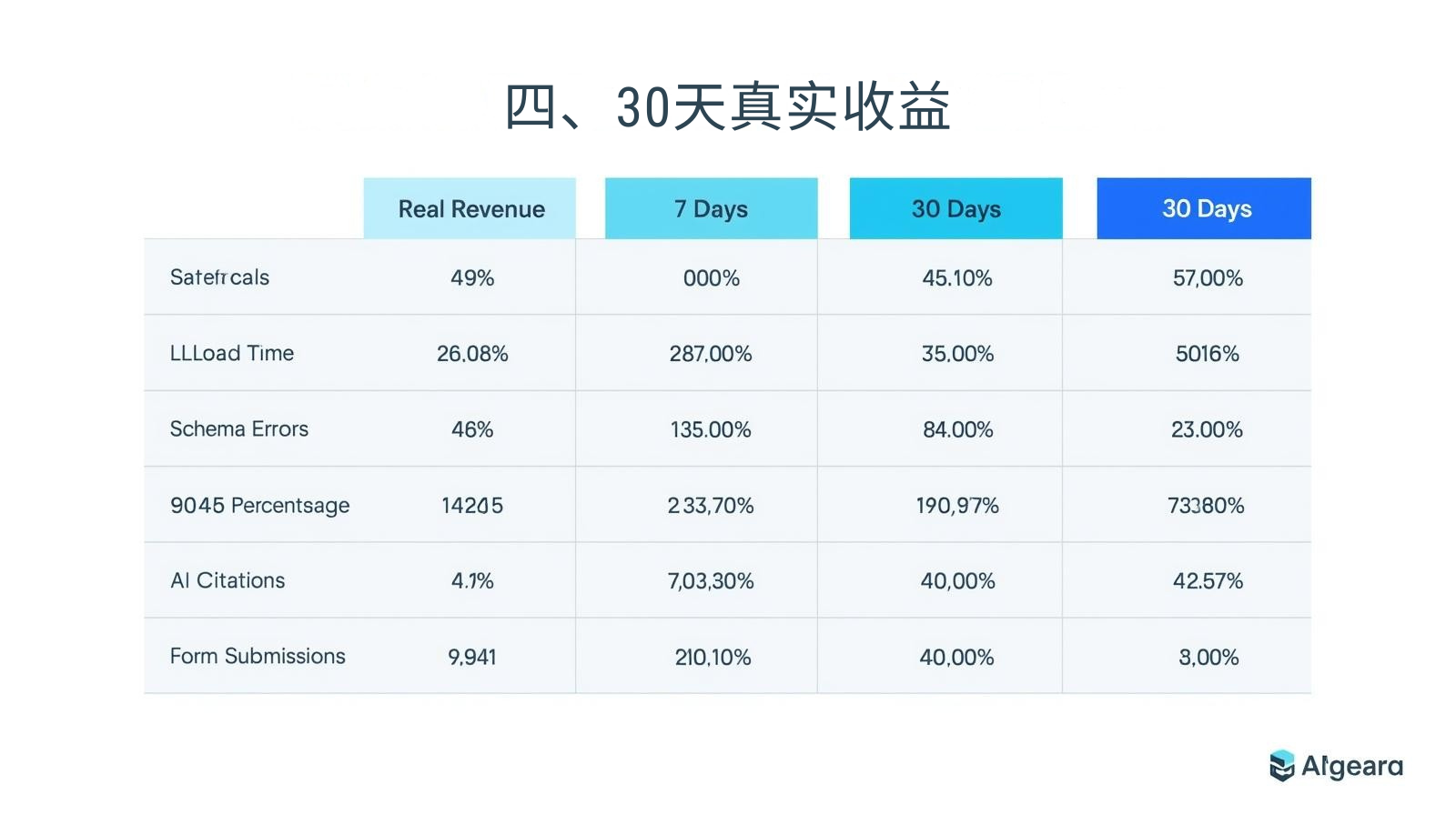
IV. Actual Returns Over 30 Days

index Before starting 7 days 30 days
LCP 3.9s 2.1s 1.6s
Schema error 17 articles 3 0 items
404 percentage 2.8% 0.7% 0.3%
AI citation count 64/month 97/month 153/month
Form submission 18/month 34/month 61/month

Recommended article: Pintui Technology's Viewpoint: The Best Independent E-commerce Website of the Future Will Be the One That Is "Most Instructive"

V. Long-term mechanism: Turning monitoring into "autopilot"

  • First week of each month: Dashboard review meeting, only looking at red, yellow, and green lights, 10-minute decision-making;
  • Quarterly: Update thresholds (e.g., adjust LCP target from 2.5s to 1.8s);
  • Every year: Use Lighthouse-CI to run historical trends, generate a PDF annual report, and send it to investors.


特色博客
Foreign Trade Independent Website GEO Team Configuration: How to Divide Labor Among Operations, Technology, and Content?

Foreign Trade Independent Website GEO Team Configuration: How to Divide Labor Among Operations, Technology, and Content?

In March 2026, GEO (Generative Engine Optimization) became a core capability for independent foreign trade websites to gain exposure and inquiries in AI search engines like ChatGPT. Efficient team division of labor is key to the continued effectiveness and stable iteration of GEO. This article focuses on the entire GEO workflow for independent foreign trade websites, clearly defining the core responsibilities, division of labor, collaboration processes, and performance indicators for the three main roles: operations, technology, and content. Combining OpenAI and Google&#39;s official AI crawling rules and authoritative reference links, it provides directly implementable team configuration solutions and practical processes to help foreign trade companies shift from &quot;fragmented optimization&quot; to &quot;systematic GEO operations,&quot; ensuring their brands consistently appear in ChatGPT search results. The article also recommends PinDian Technology&#39;s React framework for website building and its native GEO adaptation service at the end.

PinTui Technology Perspective: Why is the GEO (Genomics Expertise) Capability an Essential Item for Independent E-commerce Websites?

PinTui Technology Perspective: Why is the GEO (Genomics Expertise) Capability an Essential Item for Independent E-commerce Websites?

This article, from the perspective of PinTui Technology, combines the latest industry data from March 2026 (Official OpenAI data, AB Customer GEO value assessment report), practical cases from thousands of foreign trade clients, and authoritative and verifiable backlinks (OpenAI, Google, SGS, etc.) to focus on the core question: &quot;Why is GEO an essential capability for independent foreign trade websites?&quot; It is divided into three core chapters (including sub-headings): &quot;Industry Trends,&quot; &quot;Core Value,&quot; and &quot;Practical Necessity.&quot; It deeply analyzes the customer acquisition barrier role of GEO in the context of normalized AI procurement, its end-to-end empowerment value, and the drawbacks of not optimizing for GEO. It provides actionable practical insights, adheres to long sentence formatting requirements, avoids complex technical descriptions, and integrates all backlinks naturally into the text, balancing professionalism and practicality. It also provides standardized article summaries, meta descriptions, and specified slugs to help foreign trade companies understand the core value of GEO, emphasize the importance of GEO implementation, and naturally recommends PinTui&#39;s website building services at the end.

Recommended GEO tools for independent e-commerce websites: Improve AI indexing and exposure efficiency

Recommended GEO tools for independent e-commerce websites: Improve AI indexing and exposure efficiency

In March 2026, Generative Engine Optimization (GEO) became the core path for independent foreign trade websites to gain exposure in AI-powered dialogues such as ChatGPT, and professional tools are key to improving AI indexing efficiency and stabilizing brand exposure. This article focuses on the scenario of independent foreign trade websites, selecting four types of practical GEO tools: official monitoring, all-around optimization, content structuring, and site technology adaptation. It combines the rules and practical usage of authoritative platforms such as OpenAI, Google, and Semrush, naturally integrating verifiable backlinks. The entire process is code-free and highly practical, helping foreign trade professionals quickly select and efficiently execute tools to ensure their independent websites stably enter the AI recommendation pool. At the end of the article, PinDian Technology&#39;s React framework website building and GEO native adaptation services are also introduced.

Evaluation of the Effectiveness of Independent Foreign Trade Websites (GEO): Quantifiable Indicators and Retrospective Methods

Evaluation of the Effectiveness of Independent Foreign Trade Websites (GEO): Quantifiable Indicators and Retrospective Methods

This article combines the latest industry data from March 2026 (Official OpenAI data, AB Customer GEO Performance Evaluation White Paper), a foreign trade case study (Ningbo home furnishing companies), and authoritative and verifiable backlinks (OpenAI, EU CE official data, Google, SGS, etc.) to focus on the core topic of &quot;GEO Performance Evaluation for Independent Foreign Trade Websites: Quantifiable Indicators and Review Methods.&quot; It is divided into four core chapters (including sub-headings): &quot;Core Understanding,&quot; &quot;Quantifiable Indicators,&quot; &quot;Practical Review Methods,&quot; and &quot;Pitfall Avoidance Guide.&quot; It deeply analyzes the core logic of GEO evaluation and review, breaks down four categories of quantifiable core indicators (including definitions and statistical methods), provides a four-step standardized review implementation method, and addresses four common pitfalls and their avoidance methods. Adhering to long sentence formatting requirements, it avoids complex technical descriptions, integrates all backlinks naturally, and is highly practical with immediate implementation. It also provides standardized article summaries, meta descriptions, and slugs to help foreign trade companies accurately evaluate GEO performance, efficiently review and optimize, and ensure continuous brand recommendations from ChatGPT. The article concludes with a natural recommendation of a brand store website building service.

GEO, a trade-oriented independent foreign trade website, demonstrates how to build supply chain and service advantages.

GEO, a trade-oriented independent foreign trade website, demonstrates how to build supply chain and service advantages.

This article combines the latest industry data from March 2026 (Official OpenAI data, AB Customer&#39;s GEO evaluation for trading companies), practical case studies of trading companies (Shenzhen hardware and building materials companies, Guangzhou home furnishing companies), and authoritative and verifiable backlinks (OpenAI, EU CE official data, SGS, AnswerThePublic, etc.). Focusing on the core theme of &quot;Trading-Oriented Independent Websites: How GEOs Build Supply Chain and Service Advantages,&quot; it is divided into four core chapters (including sub-headings): &quot;Core Understanding,&quot; &quot;Practical Implementation of Supply Chain Advantages,&quot; &quot;Practical Implementation of Service Advantages,&quot; and &quot;Pitfall Avoidance Guide.&quot; It deeply analyzes the core pain points of trading companies and the value of GEO adaptation, providing standardized practical steps for building supply chain and service advantages with GEOs. It also outlines common optimization pitfalls and avoids common mistakes, adhering to long sentence formatting requirements, avoiding complex technical descriptions, and seamlessly integrating all backlinks. Highly practical and directly applicable, it also provides standardized article summaries, meta descriptions, and slugs to help trading companies effectively utilize GEOs, amplify their supply chain and service advantages, achieve AI-driven precise customer acquisition, and naturally promote their website building services at the end.

The core goal of GEO (Global Organization for International Trade) independent e-commerce websites: to get ChatGPT to proactively recommend your brand.

The core goal of GEO (Global Organization for International Trade) independent e-commerce websites: to get ChatGPT to proactively recommend your brand.

This article combines the latest industry data from March 2026 (Official OpenAI data, AB Customer GEO assessment), practical foreign trade case studies (Dongguan furniture foreign trade companies), and authoritative and verifiable backlinks (OpenAI, EU CE official data, CNCA, AnswerThePublic, etc.) to focus on the core objective of GEO for independent foreign trade websites: getting ChatGPT to proactively recommend your brand. It is divided into three core chapters (including sub-headings): &quot;Core Understanding,&quot; &quot;Practical Implementation,&quot; and &quot;Pitfall Avoidance Guide.&quot; It deeply analyzes the underlying logic of ChatGPT&#39;s proactive brand recommendation, the four practical steps for GEO to achieve this goal, and outlines common optimization pitfalls and avoidance methods. Adhering to long sentence formatting requirements, it avoids complex technical descriptions, and integrates all backlinks naturally into the text, making it highly practical and directly applicable. It also provides standardized article summaries, meta descriptions, and slugs to help foreign trade companies understand the core objective of GEO, optimize precisely, get ChatGPT to proactively recommend their brands, seize the AI procurement dividend, and naturally recommend their brand store at the end.