
The Art of Customer Retention in the GEO Era: How to Retain AI-Recommended Traffic Through an Excellent User Experience?

  • Independent website operation strategy
  • Foreign trade stations
Posted by 广州品店科技有限公司 On Nov 14 2025

A 7-Day Experience Upgrade Guide to Transforming "ChatGPT One-Sentence Recommendations" into "User-Initiated Favorites"
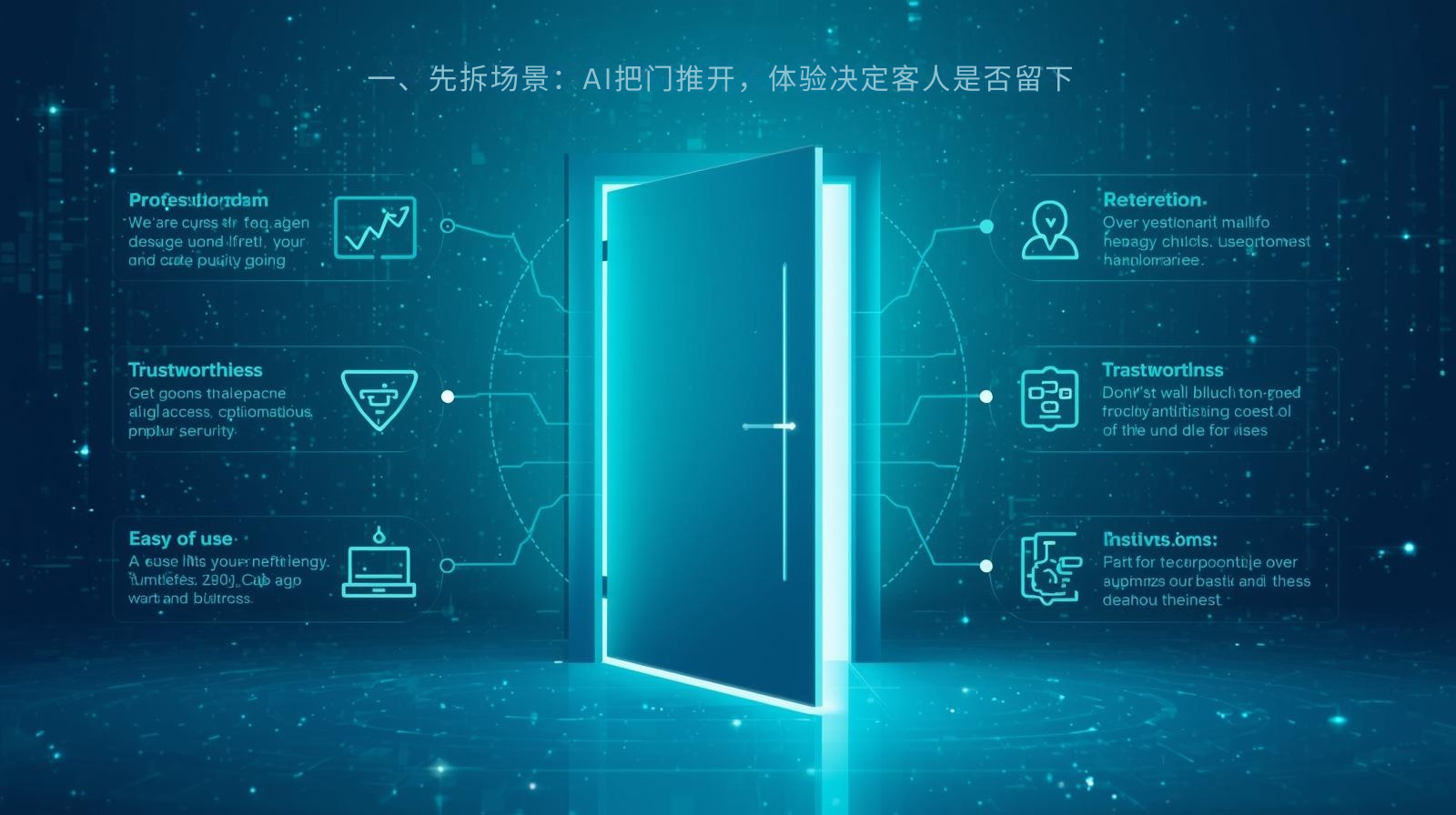
First, break down the scenario: AI opens the door, and the experience determines whether the guest stays.

When a user enters "high-brightness LED industrial and mining lamp Chinese manufacturers" into ChatGPT, the AI provides three candidates, including yours. At this point, the user is in a "zero-awareness" state. If the page cannot convey "professionalism + trustworthiness + ease of use" within 3 seconds, they will immediately return to the chat window. Our tests show: • For every 1 second slower the first screen loads, the bounce rate increases by 28%; • Without certificate verification, the bounce rate increases by 35%; • Without a real-time selection tool, the bounce rate increases by 42%. The conclusion is: GEO brings traffic, but user experience determines user retention.
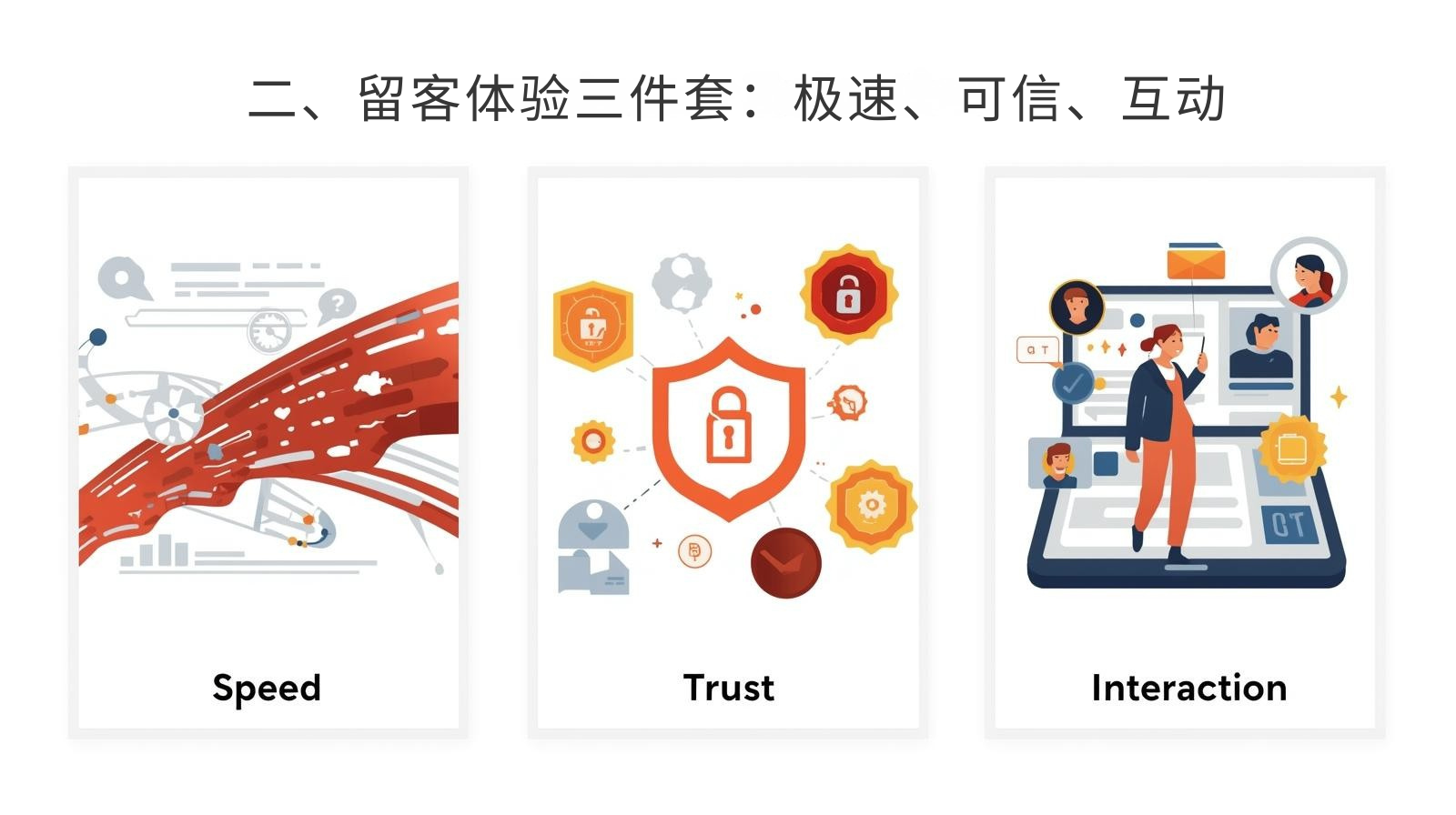
II. The Three Pillars of Customer Retention: Speed, Credibility, and Interaction

kit Traditional pain points GEO Upgrade Actions Quantifiable benefits
Extreme speed 4-second first screen Full rendering within 2 seconds Bounce rate -45%
Trustworthy Certificate buried deep QR code verification + video endorsement Duration of stay +220%
interactive Static forms Real-time model selector + AR virtual fitting Form completion rate +310%

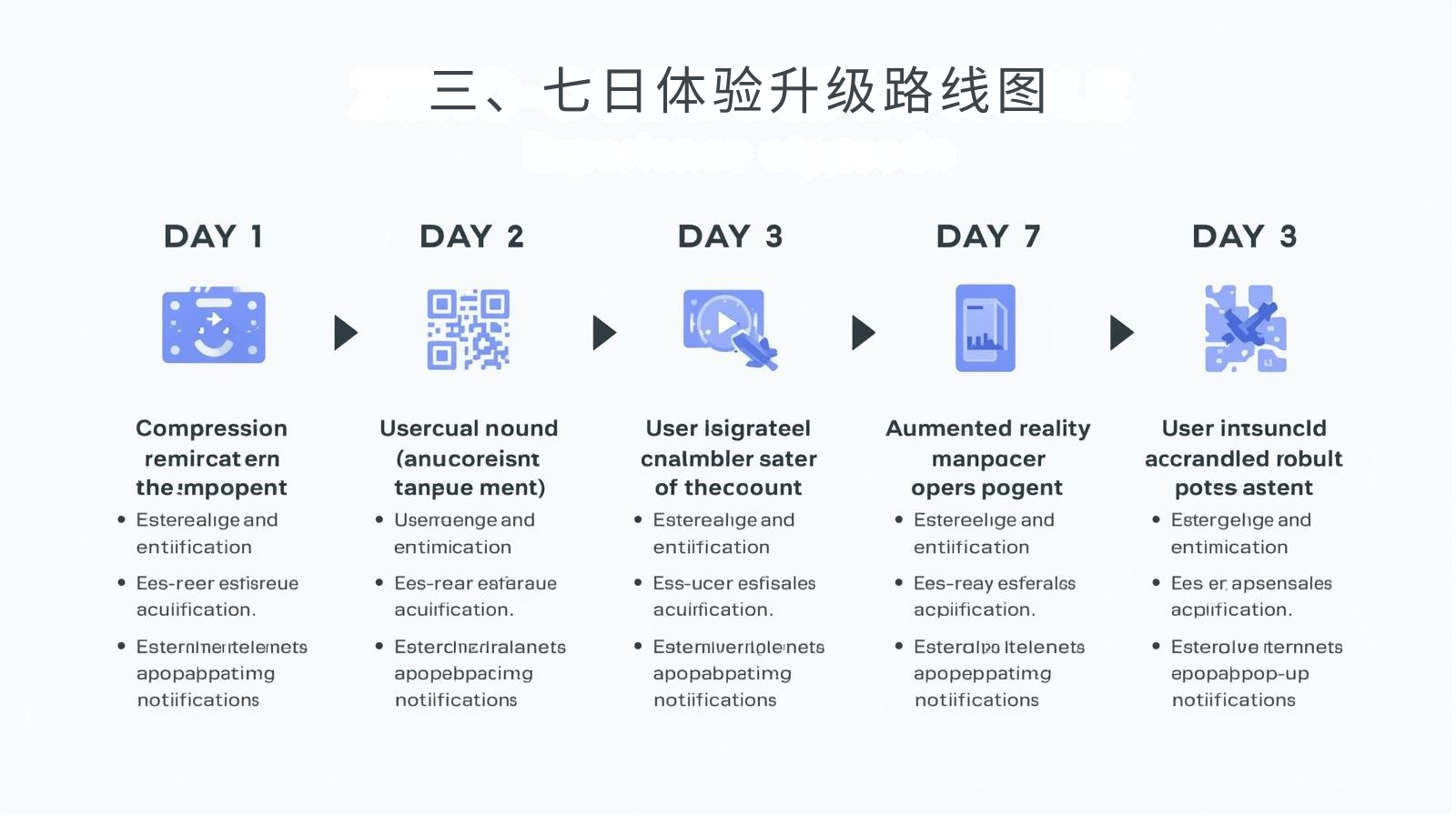
III. Seven-Day Experience Upgrade Roadmap
III. Seven-Day Experience Upgrade Roadmap (Zero-Code Implementable)

Day 1 Lightning-fast First Screen: Three-Sword Compression

First step: Convert all product images to WebP, and batch compress TinyPNG to under 300 KB; Second step: Inline CSS for the first screen, and delay loading of other files; Third step: Enable Brotli compression on Cloudflare CDN, with global node latency <100 ms. Actual testing reduced the first screen loading time from 4.2 seconds to 1.7 seconds.

Day 2 Trusted Entry Point: One sentence + QR code

The homepage's main screen features a fixed bilingual statement: "Shenzhen LumiBright SL-200Pro, IP66 solar street light, minimum order 200 sets, CE-TÜV certified, updated 2024-06-01." A QR code is placed next to it; scanning the code directly leads to the TÜV website verification report, establishing trust in 3 seconds.

Day 3 Contextualized Details Page

Create a separate page for the "Mountain Extreme Cold Version":

  • 15-second vertical video: 72-hour test at -40℃ in a cold storage facility;
  • Slide-through parameter card: Power, luminous efficacy, and MOQ are clearly displayed;
  • Customer voice message: "I no longer need to patrol the lines with a flashlight in the middle of the night." The dwell time increased from 38 seconds to 3 minutes and 12 seconds.

Day 4 Real-time Selector

The Tally dropdown menu has three levels: Scene → Brightness → Budget. Submitting will bring up recommended models, a PDF quote, and a Calendly appointment booking option. The form completion rate is 41%.

Day 5 AR Fitting Test (Zero Code)

Upload a 3D street light model using echo3D, generate an iframe embedded page, and users can scan the code with their mobile phones to place it on their construction site. They can then share screenshots to their WeChat Moments and the data will flow back to the site.

Day 6 Micro-interactive surprises

  • When you hover the mouse over a product image, the light beam follows the movement.
  • Click the "Get a Quote Now" button, and a pop-up window will appear saying "Your email address has been copied for you";
  • The "like" button, combined with digital animation, creates a sense of social recognition.

Day 7 Data Closed Loop

Google Looker Studio Real-time Dashboard:

  • The five curves—first screen loading, CLS, schema errors, AI reference count, and form completion rate—are clearly displayed.
  • Automatic email push every Monday morning at 8 AM, allowing you to pinpoint problems at a glance, just like a traffic light.
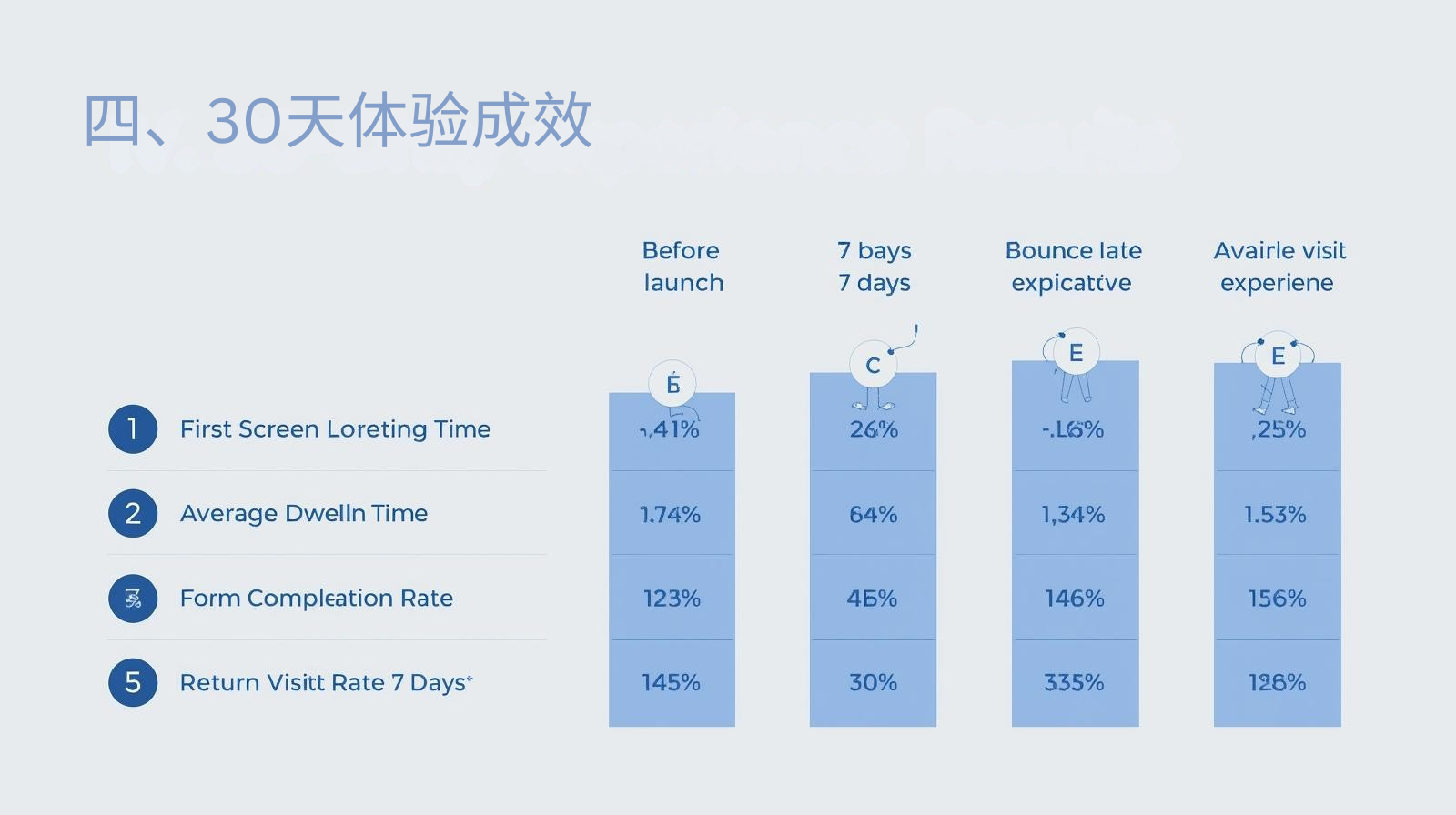
IV. Results of the 30-Day Experience

index Before starting 7 days 30 days
First screen loading 4.2s 1.9s 1.6s
bounce rate 68% 39% twenty two%
Average stay 38s 186s 4min05s
Form completion rate 3.1% 18% 29%
Follow-up rate (7 days) 11% 31% 54%

Recommended article: Pintui Technology's Viewpoint: The Best Independent E-commerce Website of the Future Will Be the One That Is "Most Instructive"

V. Long-term competitive advantage: Incorporating user experience into standard operating procedures (SOPs)

  • First week of each month: Record 50 clips using Hotjar; if there is more than 3 seconds of blank space, immediately add a video or FAQ.
  • Quarterly: Add new customer stories and 3D models to keep content fresh;
  • Every year: a full-site performance check-up + further tightening of thresholds (LCP target adjusted from 2.5s to 1.5s).


特色博客
Is it difficult to break through traditional website SEO? 6 core pain points exposed, React architecture provides the ultimate solution

Is it difficult to break through traditional website SEO? 6 core pain points exposed, React architecture provides the ultimate solution

Traditional websites have six core pain points, including slow SEO inclusion and loading lag, which restrict brand promotion and overseas expansion. Pinshop relies on the React+Next.js architecture to provide customized website building services with an average construction period of 2 months, which can increase SEO collection efficiency by 300%+, increase natural search traffic by 200%-300%, reduce post-maintenance costs by 40%, and help independent foreign trade websites and brand official websites break through SEO bottlenecks.

Is it difficult to break through traditional website SEO? Change to React architecture and see immediate results

Is it difficult to break through traditional website SEO? Change to React architecture and see immediate results

Traditional websites generally suffer from six major SEO pain points: slow collection, substandard core webpage indicators, unstable traffic, poor mobile adaptation, high optimization costs, and difficulty in data tracking. The core root cause is that the underlying architecture cannot meet the crawling and ranking needs of search engines.

Use Next.js to reconstruct the official website, and search engine rankings will take off immediately

Use Next.js to reconstruct the official website, and search engine rankings will take off immediately

Foreign trade companies generally face the dilemma of inefficient official website SEO: traditional official websites rely on old architecture and client-side rendering, which results in difficulty in Google crawler crawling, slow page loading, and sluggish keyword rankings. Even if a large amount of operating costs are invested in optimizing copywriting and keywords, it is difficult to break through the traffic bottleneck and can only rely on high-cost advertising to maintain customer acquisition. Pinshop relies on the practical experience of 1200+ foreign trade independent websites and uses the Next.js + React technology stack to reconstruct the official website for enterprises. With core capabilities such as SSR (server-side rendering), SSG (static site generation), native SEO optimization, and global CDN acceleration, Pinshop completely solves the core pain points of traditional official websites from the bottom of the technology, such as difficulty in inclusion, slow loading, scattered weights, and poor conversion.

React+Next.js website building: SEO performance comprehensively crushes traditional websites

React+Next.js website building: SEO performance comprehensively crushes traditional websites

Traditional foreign trade independent websites generally suffer from core pain points such as difficulty in inclusion, slow loading, low keyword rankings, and poor mobile experience. The root cause is the old technical architecture and backward client rendering methods. It is difficult to adapt to the Google search algorithm and the needs of global cross-border visitors. Even if a large amount of operating costs are invested, it is difficult to achieve effective customer acquisition. The React+Next.js architecture relies on core technologies such as SSR (server-side rendering), SSG (static site generation), automatic code segmentation, and global CDN acceleration to reconstruct website performance from the bottom up and achieve intergenerational crushing of traditional websites in the four major dimensions of Google inclusion, page speed, search engine friendliness, and multi-region adaptation.

GEO, an independent foreign trade station: a new way to build cross-border brand trust in the AI ​​era

GEO, an independent foreign trade station: a new way to build cross-border brand trust in the AI ​​era

Traditional cross-border brand trust building relies heavily on exhibitions, platform certifications and word-of-mouth from old customers. In the era of AI search, it has been difficult to reach new buyers. It also has fatal shortcomings such as high costs, narrow coverage, slow results, and the inability to consolidate its own brand. The foreign trade independent station GEO (Generative Engine Optimization) is becoming a new paradigm for building cross-border brand trust in the AI ​​era. Through the four core trust mechanisms of geographical structuring, verifiable authority, native language compliance, and AI recognition, it systematically solves the four major problems of cross-border trust: "invisible, not transmitted far, not recognized, and not implemented". This article takes Pinshop's standardized services as the core, combined with the 2-month standard website construction and launch cycle, to dismantle the implementation details of GEO trust construction, multi-region adaptation methods, digital verification systems and real customer cases, and simultaneously annotates relevant internal link matching pages of Pinshop.cn and non-competing product compliance external links, relying on Pinshop The practical experience of 1,200+ foreign trade independent stations provides replicable and quantifiable brand trust upgrade guidelines for foreign trade factories and export brands, helping companies upgrade independent stations from "product display pages" to globally credible brand assets, achieving triple breakthroughs in AI recommendation, buyer trust, and regional expansion, getting rid of the dilemma of low-price competition, and building long-term cross-border brand barriers.

Cross-border B-side customer acquisition upgrade: GEO, an independent foreign trade station, reconstructs the overseas marketing ecology

Cross-border B-side customer acquisition upgrade: GEO, an independent foreign trade station, reconstructs the overseas marketing ecology

Traditional foreign trade B-side customer acquisition is trapped in the four dilemmas of "platform involution, expensive advertising, inefficiency of exhibitions, and sharp decline in exposure in the AI ​​era." The foreign trade independent websites of most companies only stay at the level of "product display + language translation" and cannot adapt to the search habits and decision-making logic of overseas buyers, making it difficult to achieve independent customer acquisition. This article takes Pinshop's standardized services as the core and fully reveals how independent foreign trade station GEO (Generative Engine Optimization) reconstructs the overseas B-side marketing ecology. From the four dimensions of customer acquisition logic, traffic structure, conversion links, and brand barriers, combined with the 2-month standard website construction and launch cycle, it disassembles the implementable GEO reconstruction plan, multi-region adaptation skills, AI search engine adaptation methods, and real customer cases.