
1. In the era of ChatGPT product search, the core value of independent stations has changed
When overseas buyers no longer browse search engine results page by page, but directly issue instructions to ChatGPT - "Recommend small metal processing factories that have passed EU CE certification" and "Look for sources of electronic components that can undertake small batch customization", the role of the independent foreign trade station has changed from "display window" to "core material library recommended by AI".
Just like a TIG welding machine requires core components such as tungsten electrodes, welding guns, and power supplies to work properly, an independent station that can be recommended by AI and receive accurate inquiries must also have a set of standardized core components. Without any component, the AI will skip your website directly and recommend orders to your peers.
This article will completely dismantle the core components of this type of "AI-friendly independent station", the specific functions of each component, and practical implementation methods. Combined with real cases, you will clearly know how to use 2 months to build your own independent station into a high-quality source of goods recommended by ChatGPT, and truly receive every precise inquiry.
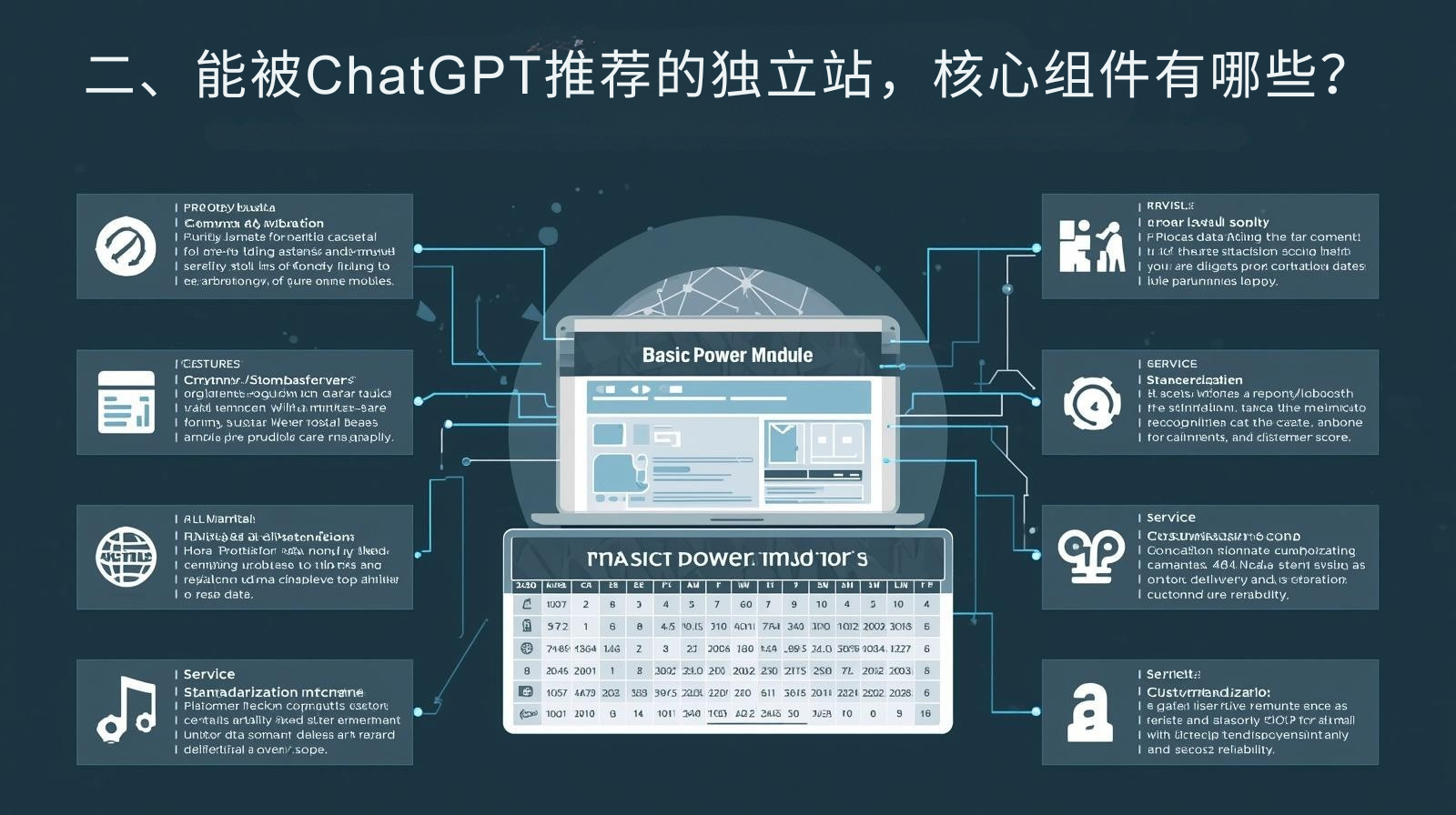
2. What are the core components of independent websites that can be recommended by ChatGPT?
The essence of ChatGPT's logic for selecting supply sources is to "quickly extract effective information, cross-verify credibility, and match procurement needs." The corresponding independent station also requires 5 core components, all of which are indispensable. These five components are like the core components of the TIG welding machine. They are independent and cooperate with each other to realize the complete process of "being recognized by AI → being recommended → receiving inquiries".
2.1 Component 1: Standardized information module (“basic power supply” for AI recognition)
This is the premise for AI to be able to understand your website, and it is also the most basic and most easily overlooked component. Just like the power supply of a TIG welding machine provides a stable current, the standardized information module provides an extractable and identifiable "basic information current" for AI.
Core requirements: The information is organized, the fields are fixed, and the hierarchy is clear, allowing AI to extract the core information that buyers care about most within 3 seconds without having to decipher messy text.
Specifically, it contains 3 key modules (you can copy them directly):
-
Basic company information: clearly indicate the company type (factory/trading company), establishment time, production scale (monthly production capacity/annual production capacity), core products (1-3 main products, not stacked), target market (clear specific regions such as Europe, America/Southeast Asia), core certifications (CE/ISO/LFGB, etc., mark the certificate number).
-
Product standardization information: Each product page fixedly contains "parameter table + application scenario + MOQ + delivery date + customization scope". The parameter table must clarify quantifiable indicators such as material, size, accuracy, power, etc., and avoid vague expressions such as "high quality" and "good performance".
-
Service standardization information: Fixed marking of cooperation mode (OEM/ODM/wholesale), payment method (T/T/L/C/PayPal), logistics method (sea/air/express), and after-sales guarantee (warranty period/maintenance service), allowing buyers to quickly judge the feasibility of cooperation.
The key to implementation: Use Pintui Technology’s AI semantic structured service to quickly build standardized information modules to ensure that each field complies with AI extraction logic and avoid information clutter that makes AI unrecognizable.
2.2 Component 2: Quantitative value module (“Tungsten pole” recommended by AI)
If standardized information is the foundation, then quantified value is your "core competitiveness" that allows AI to recommend you first. Just like the tungsten electrode of a TIG welding machine determines the welding accuracy, quantified value determines your ranking in the AI recommendation list.
Core requirements: Abandon empty adjectives, use "data + evidence" to reflect your advantages, so that AI can clearly compare the differences between you and other suppliers, so as to give priority to recommendations.
Specific practical operations (3 core directions, all realistic):
-
Cost advantage: clearly marked "30% lower than the industry average MOQ", "bulk purchase cost reduced by 15%", "cross-border logistics cost saved by 20%", and supported by specific cases (such as "a customer in Germany purchased in bulk, the cost was reduced by 18%, and the annual repurchase amount increased by 40%").
-
Efficiency advantages: clearly marked "prototype cycle ≤ 3 days", "mass production delivery time 5 days faster than the industry", "emergency replenishment response time ≤ 24 hours", and attach actual photos of the production process or screenshots of customer feedback.
-
Compliance advantages: It is clearly marked that "the entire series of products has passed EU CE certification and US FDA certification" and "complete customs clearance documents can be provided, and customs clearance efficiency is increased by 30%". Actual photos of the certificate and query links are attached.
The key to implementation: Through Pintui Technology’s supply value enhancement services, we can refine quantifiable core advantages, match them with real evidence, and let AI quickly identify your differentiated value.
2.3 Component 3: Verifiable trust module (the “welding gun” of AI trust)
ChatGPT will not recommend "untrustworthy" suppliers. Just like the welding gun of a TIG welding machine determines the welding quality, the verifiable trust module determines whether the AI will accept your information and whether it is willing to recommend you to buyers.
Core requirements: All trust evidence can be queried and cross-verified to avoid "fake cases" and "fuzzy certificates", allowing both AI and buyers to quickly confirm your credibility.
Specifically, it contains 4 implementable modules:
-
Qualifications can be checked: All certification certificates (ISO/CE, etc.) are attached with real photos, certificate numbers and official query links to ensure that buyers and AI can directly verify authenticity.
-
Case traceability: Publish 3-5 real cooperation cases, each case fixedly includes "customer background (industry + country + scale) + procurement needs + solutions + cooperation results", and attach actual photos of customer cooperation and logistics receipt vouchers (desensitization processing).
-
Factory Verification: Shows real photos/short videos of the factory workshop, production equipment, and quality inspection processes, and provides factory inspection appointment channels so that buyers can conduct on-site verification or online video inspections.
-
Unified information: Ensure that the corporate information (address, phone number, core products) of independent websites, social media, and industry platforms are completely consistent. AI will cross-verify this information. Inconsistency will reduce the trust score.
The key to implementation: Build services through Pintui Technology’s procurement trust system, integrate verifiable trust evidence, and build a closed loop of trust recognized by both AI and buyers.
2.4 Component 4: Scenario-based demand module (AI-matched “wire feeding system”)
When overseas buyers use ChatGPT to find sources of goods, they always ask questions with specific scenarios (such as "small batch trial order" and "exclusive supply for cross-border e-commerce"). Just like the wire feeding system of a TIG welding machine matches different welding needs, the scenario-based demand module allows AI to accurately match the specific needs of buyers and improve the accuracy of inquiries.
Core requirements: Cover high-frequency scenarios for buyers, and each scenario corresponds to a dedicated page, allowing AI to directly locate your scenario page based on buyers’ questions and recommend it to buyers.
5 high-frequency scenarios that must be covered (directly implemented):
-
Small batch trial order scenario: clearly marked "MOQ 100 pieces minimum order, no premium, trial order delivery period 3 days", targeting the small batch procurement needs of start-up buyers and cross-border e-commerce.
-
Customized scenario: clearly mark the "customization scope (material/size/logo/packaging), customization cycle, customization case" for buyers with personalized needs.
-
Compliance scenarios: For different target markets such as Europe, America, and Southeast Asia, the compliance requirements, certification qualifications, and customs clearance support of the corresponding regions are clearly marked to solve the compliance pain points of buyers.
-
Fast delivery scenario: clearly marked with "urgent order response time, fastest delivery, logistics plan", targeting buyers with urgent replenishment needs.
-
Cross-border e-commerce exclusive scenario: clearly marked with "neutral packaging, no logo, batch delivery support, cross-border logistics support", targeting cross-border e-commerce buyers such as Amazon and AliExpress.
The key to implementation: Use Pintui Technology’s procurement scenario marketing services to build scenario-based special pages so that AI can accurately match buyers’ needs and increase inquiry intentions.
2.5 Component 5: Minimalist inquiry module ("cooling system" for receiving inquiries)
Even if AI recommends you, buyers are willing to get to know you. If the inquiry path is cumbersome, customers will still be lost - just like the cooling system of the TIG welding machine to prevent equipment overheating, the minimalist inquiry module prevents the loss of accurate traffic and ensures that every high-intention inquiry can be received.
Core requirements: The entrance is obvious, the path is short, and the operation is convenient, allowing buyers to complete the inquiry submission within 10 seconds without complicated operations.
Specific practical operations (3 key optimizations):
-
Inquiry entry front: Set fixed inquiry buttons at the top and bottom of the homepage, product page, and scene page, and mark "one-click inquiry" and "quick quotation" to ensure that buyers can find it at any time.
-
Form minimalist optimization: The inquiry form only retains four core fields (name, company name, contact information, demand description), and deletes redundant fields such as "company size" and "purchase volume" to lower the submission threshold.
-
Multi-channel acceptance: In addition to forms, one-click contact functions such as WhatsApp, online customer service, and email are added to support 7×24-hour intelligent response to meet the different communication habits of buyers.
The key to implementation: Use Pintui Technology’s precise inquiry conversion and optimization services to simplify inquiry paths, enrich acceptance channels, and increase the inquiry submission rate.
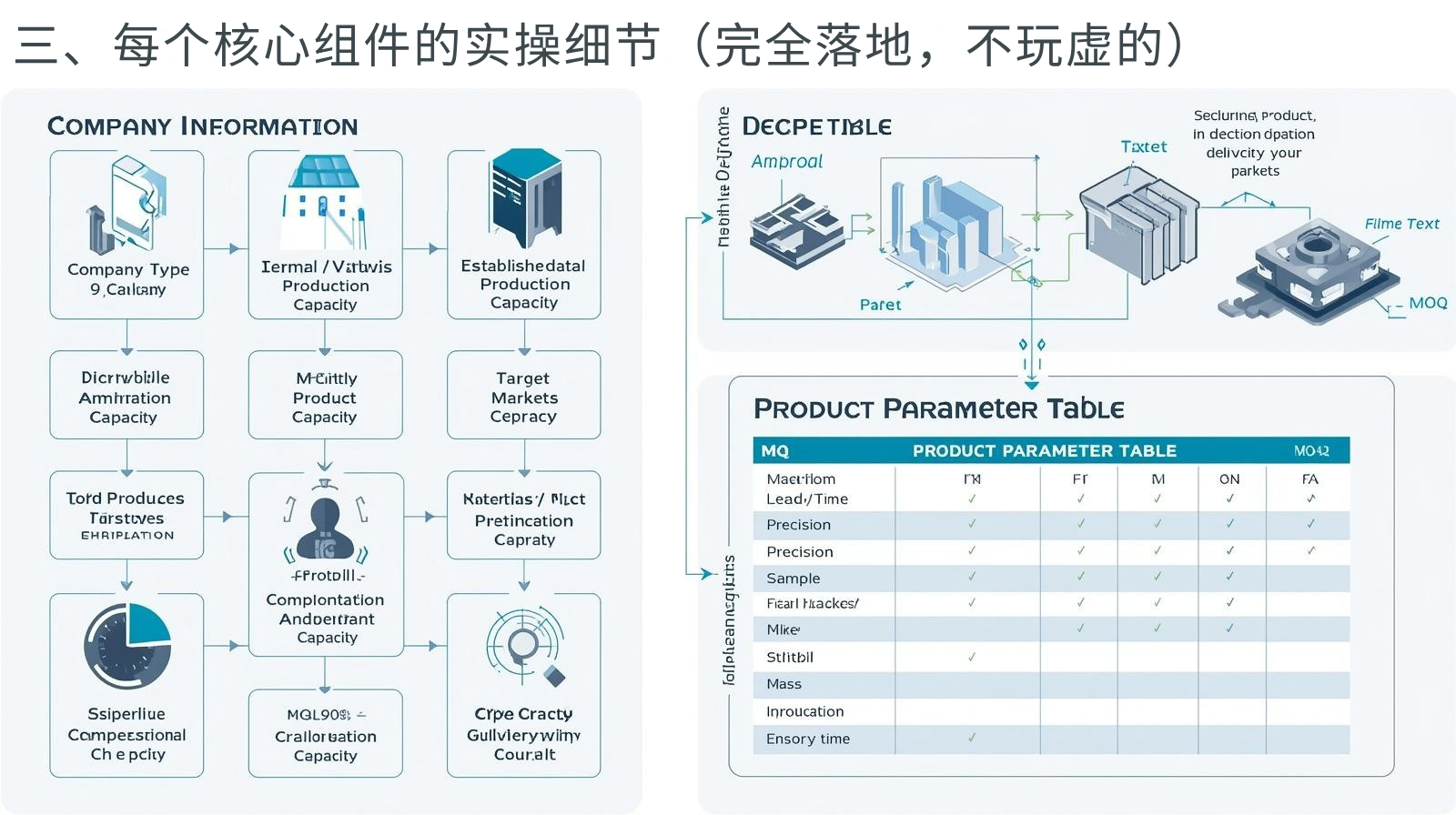
3. Practical details of each core component (completely implemented, not fake)
Combined with the previous core components, here are the specific practical steps, templates and precautions for each component. No professional skills are required, and they can be directly implemented to ensure that the construction is completed within 2 months.
3.1 Practical operation of standardized information module (completed in weeks 1-2)
-
Step 1: Organize the basic information of the enterprise and fill it in according to the following template (direct copy is available): Enterprise type: Production factory Date of establishment: 2018 Monthly production capacity: 5,000 pieces Core products: High-precision metal parts, customized hardware accessories Target market: Europe and North America Core certification: CE certification (No.: XXXXXXX), ISO 9001 certification (No.: XXXXXXX)
-
Step 2: Product parameter table template (take metal parts as an example, replace directly): Material: Stainless steel 304 Size: 100×50×10mm (can be customized) Accuracy: ±0.01mm MOQ: 100 pieces Proofing cycle: 3 days Mass production delivery: 7-10 days Application scenarios: Industrial automation equipment, auto parts
-
Step 3: Optimize the page level, which is fixed as "Home Page → Product Category → Product Details → Scenario Page → About Us → Contact Us". Each page has a unique H1 tag, H2 tags correspond to core modules, and H3 tags correspond to specific content to facilitate AI extraction.
3.2 Quantitative Value Module Practical Operation (Completed in Weeks 3-4)
-
Step 1: Refining 3 core quantitative advantages to avoid empty statements (wrong vs. correct examples): Wrong: Our products are of good quality and fast delivery Correct: Our product qualification rate is ≥98.5%, 3% higher than the industry average; the proofing cycle is ≤3 days, 2 days faster than the industry
-
Step 2: Match 1 real evidence for each advantage, for example: Advantage: MOQ is 30% lower than the industry Evidence: The industry average MOQ is 300 pieces, our MOQ is 100 pieces, we have provided small batch trial order services for a German cross-border e-commerce company, and we have repurchased 200 pieces per month (attached is a screenshot of customer feedback)
-
Step 3: Place the quantitative advantage at the core of the homepage and at the top of the product page, and highlight it in bold font so that AI and buyers can see it at a glance.
3.3 Practical operation of the verifiable trust module (completed in weeks 5-6)
-
Step 1: Organize all certification certificates, take clear real-life pictures, mark the certificate number and official query link, for example: CE certification query link (https://XXXXXXX), make sure you can click to jump directly to the query.
-
Step 2: Write a real case and fill it in according to the following template (desensitized, copy directly): Customer background: A German industrial automation company, mainly engaged in automation equipment, with a monthly purchase volume of 200 pieces. Procurement requirements: high-precision metal parts, requiring CE certification, MOQ 150 pieces, delivery time of 10 days Solution: Provide customized production, prioritize production scheduling, and match exclusive logistics solutions. Cooperation results: on-time delivery, pass rate 99%, customer monthly repurchase volume increased to 300 pieces, cooperation duration 2 years (actual photos of workshop production and logistics receipt certificate attached)
-
Step 3: Shoot a short video (1-2 minutes) of the factory workshop, production equipment, and quality inspection process, put it on the "About Us" page, provide an entrance to the factory inspection appointment, and mark "Supports online video inspections and offline field inspections."
3.4 Practical operation of scenario-based demand module (completed in weeks 6-7)
-
Step 1: Build a special page for each high-frequency scenario. The page title contains scenario keywords, such as "Small batch metal parts trial order service" and "European compliance metal parts supplier".
-
Step 2: Each scenario page always contains "scenario pain points + solutions + advantages + cases + inquiry entry", for example: Scenario pain points: cross-border e-commerce small batch procurement, high MOQ, long delivery time, no customized support solution: MOQ 100 pieces minimum order, no premium, 3 days for proofing, 7 days for delivery, supports neutral packaging, customized logo Advantages: Cross-border logistics support, customs clearance documents provided, monthly service of 10+ cross-border e-commerce customers Case: An Amazon seller, a small batch trial order of 100 pieces, and subsequent monthly repurchases of 500 pieces
-
Step 3: Implant relevant keywords into the scene page, such as "small batch metal parts" and "cross-border e-commerce metal accessories" to improve AI search matching.
3.5 Minimalist Inquiry Module Practical Operation (Completed in Weeks 7-8)
-
Step 1: Optimize the design of the inquiry button, using eye-catching colors such as red and orange, labeling "One-click Inquiry" and "Free Quotation", and place it in the navigation bar at the top of the page, a fixed position on the right side of the product page, and at the bottom of the page.
-
Step 2: Simplify the inquiry form, delete redundant fields, and retain only the four fields of "name, company name, mobile phone number/email, and demand description". Set up the "form auto-save" function to support phased filling.
-
Step 3: Connect to the AI intelligent customer service, configure automatic responses to frequently asked questions (such as MOQ, delivery date, certification, etc.), respond 24/7, and add one-click contact buttons via WhatsApp and email, and mark the contact information.
4. 2-month implementation timetable (accurate to the week, just follow it)
|
time period
|
core mission
|
Implementation results
|
Corresponding service support
|
|---|---|---|---|
|
Weeks 1-2
|
Organize enterprise and product standardized information and optimize page hierarchy
|
Completed the construction of standardized information modules, with clear page hierarchy
|
AI semantic structured service
|
|
Weeks 3-4
|
Extract quantitative advantages, match them with real evidence, and optimize page display
|
Completed the construction of quantitative value module, the advantages are clear and quantifiable
|
Supply value enhancement service
|
|
Week 5-6
|
Integrate certification, cases, and factory information to build a trust system; build scenario-based special pages
|
Complete the construction of trust module and scenario-based module to cover high-frequency procurement scenarios
|
Procurement trust system construction, procurement scenario marketing services
|
|
Weeks 7-8
|
Optimize the inquiry entrance, forms and acceptance channels, and launch monitoring tools
|
Completed the construction of the inquiry module, which can monitor AI recommendations and inquiry data
|
Precise inquiry conversion optimization service
|
5. Real case: Metal parts factory received accurate AI inquiries in 2 months
5.1 Customer background
A small domestic metal parts production factory specializing in high-precision metal parts. The target market is Europe. Previously, the independent website had messy information, unclear advantages, and no scene-based content. When overseas customers used ChatGPT to find supply sources, it was never recommended. The average monthly accurate inquiry was only 8, the inquiry conversion rate was less than 2%, and a large number of potential customers were lost.
5.2 Implementation of Pintui Technology’s practical operation (strictly implemented according to the 2-month timetable)
-
Weeks 1-2: Build standardized information modules, organize basic enterprise information and product parameter tables, optimize page levels, and ensure that AI can quickly extract information.
-
Weeks 3-4: Extract 3 quantitative advantages (MOQ 100 pieces, pass rate ≥ 98.5%, 3-day proofing cycle), support them with European customer cases, and place them at the core of the homepage.
-
Weeks 5-6: Integrate CE and ISO certifications (with query links), publish 3 real cases of European customers (desensitization treatment), shoot short videos of factory workshops; build two core scene pages for small batch trial orders and European compliance.
-
Weeks 7-8: Optimize the inquiry entrance, simplify the form to 4 fields, access AI intelligent customer service and WhatsApp one-click contact, and launch data monitoring tools.
5.3 Implementation results
-
AI recommendation: ChatGPT recommendation frequency increased by 3.8 times, and the top 30 AI search rankings for core scene keywords (European high-precision metal parts, small batch metal accessories) accounted for 75%.
-
Inquiry data: The average monthly precise inquiries increased from 8 to 32, an increase of 300%, and the inquiry conversion rate increased from 1.8% to 5.3%.
-
Customer quality: The proportion of high-intention customers increased from 20% to 74%, the procurement decision-making cycle was shortened from 45 days to 22 days, and the AI source inquiry closing rate increased by 36%.

6. Frequently Asked Questions (FAQ, all realistic, to solve practical questions)
-
Q1: Is it really possible to complete the construction of all components in 2 months? Is it recommended by ChatGPT? A1: Yes. Standard small and medium-sized independent foreign trade sites (≤50 core pages) must be strictly implemented according to the above schedule. All components can be completed in 2 months and entered into the AI recommendation pool; medium and large sites (50-200 core pages) can be extended to 2.5 months, and Pintui Technology will accelerate the implementation through standardized tools.
-
Q2: We have a small range of products and only have 1-2 main products. Can they be recommended by ChatGPT? A2: Yes. Having fewer product types makes it easier to focus. Focus on building 1-2 core scenario pages to strengthen the quantitative advantages and trust evidence of a single product. AI will more accurately match purchasing needs and have a higher probability of recommendation.
-
Q3: How to confirm that the inquiry is recommended by ChatGPT? A3: We will configure an AI source monitoring tool for you, which can clearly see the source of inquiries (ChatGPT/Google AI, etc.), triggered recommended keywords, and pages entered. We will provide detailed data reports every month to accurately count the number of inquiries from AI sources.
-
Q4: If the rules of ChatGPT change in the future, will the optimized content become invalid? A4: No. The core of our optimization is "structured information, quantified value, and verifiable trust." This is the underlying logic of AI's selection of supply sources. No matter how the rules are iterated, AI will give priority to recommending such suppliers with complete and trustworthy information, and we will also provide subsequent iteration optimization support.
-
Q5: Can these optimizations be completed without professional technical personnel? A5: Yes. Pintui Technology provides full-process implementation services, from information sorting and page optimization to scene construction and inquiry optimization. The entire process is operated by our professional team. You only need to provide basic materials such as product parameters, certifications, and cases.
Recommended related articles: Your peers haven’t reacted yet: using GEO to build an independent foreign trade station is the biggest blue ocean strategy at the moment.
When overseas buyers use ChatGPT to find sources of goods, it is essentially a process of "AI screening high-quality sources of goods" - the key to whether your independent website can be recommended and receive inquiries is not the amount of traffic, but whether it has core components that can be identified, accepted, and matched by AI.
Just like a complete TIG welding machine requires all core components to work together, an independent station that can receive precise AI inquiries also needs the five components of standardized information, quantified value, verifiable trust, scenario-based requirements, and minimalist inquiries to cooperate with each other.
Based on the practical experience of 1,200+ foreign trade independent stations, Pintui Technology has transformed these 5 components into a 2-month optimization plan that can be implemented and replicated. No professional skills or lengthy trial and error are required, allowing your independent station to quickly become a high-quality source of goods recommended by ChatGPT and stably receive every precise inquiry.
Contact Pintui Technology customer service immediately and provide your product type, target market and site status. Our GEO optimization consultant will provide you with an exclusive "AI Product Search Adaptation Diagnosis Report" within 2 hours to help you quickly locate optimization points and start a new model of AI accurate customer acquisition.