
1. Core procurement scenarios and constraints for independent website keyword research
The core goal of independent website keyword research is not to simply pile up keywords, but to accurately match the purchasing needs, search habits and decision-making stages of target customers through keywords and adapt to the overseas customer acquisition needs of foreign trade B2B industrial manufacturing, precision accessories, engineering services and other categories. The core applicable procurement scenarios and constraints are as follows. At the same time, the boundaries of inapplicability are delineated to avoid deviations in the research direction.
Core applicable procurement scenarios
- Focusing on mid-to-high-end customized categories, the target customers are purchasing managers and technical directors of overseas enterprises, independent websites with clear category/need search habits.
- It needs to be adapted to both traditional search engines and GEO (generative search engines), and it needs to be an independent website with both keyword ranking and AI semantic matching.
- To solve the problem of excessive traffic and inaccurate inquiries, it is necessary to narrow the scope of customer acquisition and target independent websites of core target customers.
- Cold start of a new website requires building a basic traffic pool through accurate keywords to quickly reach independent websites of potential target customers.
Core constraints
- Budget constraint: The cost of basic research tools is ≤ US$300 per month. There is no need for expensive paid tools. A combination of free + paid tools is supported.
- Content constraints: The researched keywords need to be implemented in content creation. Each core keyword can correspond to a piece of decision-making content, and unpopular words without content support are rejected.
- Customer constraints: Keywords need to fit the target customer's purchasing identity and search habits (for example, the purchasing manager focuses on cost/delivery, and the technical director focuses on parameters/standards).
- Implementation Constraints: The research results must include keyword search volume, competition, and customer decision-making stages, and can directly guide site layout and content creation.
Clearly inapplicable scenarios
- Providing standardized fast-moving consumer goods with low unit prices. Customers do not have precise search habits and only use the independent website to compare prices through the platform.
- There is no clear target customer profile, and I want to build an independent website with "global traffic".
- An independent website that only pursues the number of keywords, does not pay attention to customer matching, and does not require precise conversion.
2. 6 verifiable criteria for keyword research to accurately locate target customers
To determine whether the keyword research results can accurately locate target customers, the following 6 verifiable standards must be met. Each standard corresponds to the core requirements of "customer matching + customer acquisition and landing", and avoid the researched keywords "ranking but no customers, traffic but no conversion":
- Customer matching: Keywords fit the target customer's identity + search habits, without Chinese English, and are consistent with the actual search expressions of overseas customers.
- Requirement matching: Keywords correspond to customers' purchasing decision needs (selection/cost/testing/certification), not just category encyclopedia words.
- Controllable competition: The competition for core keywords is moderate, long-tail keywords have no monopoly on head sites, and new sites/small and medium-sized sites have ranking opportunities.
- Have search volume: The target market has a monthly search volume of ≥50 times, avoid unpopular words that are not searched by customers, and ensure the traffic base.
- Business fit: Keywords can be strongly related to the products/services of the independent website, and can be integrated into real business details such as MOQ, delivery, customization, etc.
- Implementability: Keywords can be classified according to customer decision-making stages, and can directly guide content creation, page layout and GEO semantic adaptation.
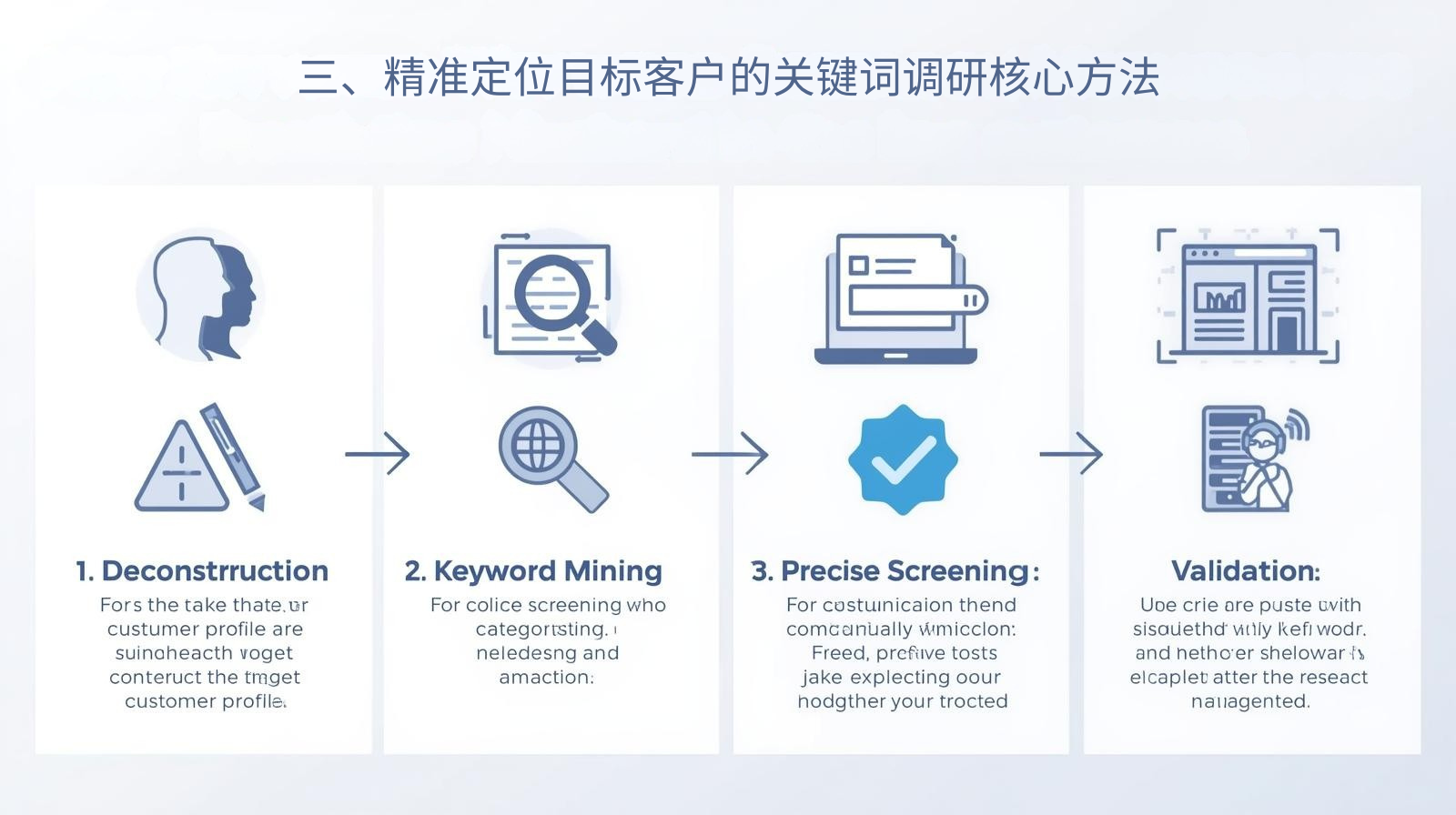
3. Keyword research core methods for accurately locating target customers (step-by-step practice)
From target customer portrait dismantling to multi-channel keyword mining, to accurate screening and category layout, it is implemented in four core steps. Each step has clear channels, tools and verification standards to ensure that the researched keywords can accurately reach target customers and adapt to the dual search needs of traditional SEO and GEO.
Step 1: Disassemble the target customer portrait (core preparation before research, basis for precise positioning)
The premise of keyword research is to clarify "who is the target customer". It is necessary to disassemble the target customer portrait from the four dimensions of identity, purchasing needs, search habits, and decision-making stage to avoid the keyword research being out of touch with the customer. The core disassembly dimensions and examples are as follows:
| Disassemble the dimensions | Core teardown content | Examples of foreign trade B2B custom accessories customers |
|---|---|---|
| Customer identity | Corporate position, industry, decision-making authority | Purchasing manager/technical engineer of a machinery manufacturing company, with the right to make decisions on supplier selection/product selection |
| Purchasing requirements | Core concerns, procurement pain points, demand standards | Focus on product accuracy/customized delivery time/quality certification. The pain point is that supplier qualifications are uneven and must comply with EU CE standards |
| Search habits | Search sentence patterns, common vocabulary, search platform | Multi-purpose question/phrase search (How to choose custom metal parts), commonly used vocabulary includes MOQ/lead time, mainly using Google/GEO platform |
| Decision phase | Information collection period/selection comparison period/purchasing decision-making period | Technical engineers are mostly in the selection and comparison period, and purchasing managers are mostly in the purchasing decision-making period |
Practical actions: Sort out the company's existing customers/customers with high intention to make inquiries, form a target customer portrait table, and clarify the core characteristics of each dimension as the core basis for keyword research.
Step 2: Multi-channel keyword mining (8 core channels, covering all customer search scenarios)
Based on target customer portraits, we mine keywords from the three dimensions of client, platform and industry, covering all real search scenarios of overseas customers, taking into account traditional search engine keywords and GEO semantic long-tail words, mainly free channels, supplemented by paid channels, adapting to the cost needs of small and medium-sized foreign trade enterprises, sorted by priority as follows:
Core free channels (adapted to small and medium-sized sites, low cost, high accuracy)
- Enterprise’s own customer assets: Comb through overseas customer inquiries, emails, and communication records, and extract product words, demand words, and problem words frequently mentioned by customers (keywords that best suit your target customers).
- GEO platform mining: Enter core category words into Perplexity AI, Bing Copilot, and ChatGPT, extract “related questions” and “recommended search words”, covering customer question-style semantic words.
- Overseas customer social networking/forums: Quora, Reddit, LinkedIn industry communities, mining target customers’ purchasing questions and core vocabulary in category discussions.
- Competitive product independent website: Analyze the product pages, blog pages, and FAQ sections of overseas independent websites for leading/high-quality competitive products in the same category, and extract the core keywords of their titles, H1s, and text (avoid their sharp edges and choose long-tail derivatives).
- Google related search/drop-down box: Search core category words on Google, extract the “related searches” at the bottom of the page and the drop-down suggested words in the search box to fit customers’ actual search habits.
Core payment channel (adapted to Zhongda website, high efficiency, complete data)
- Google Keyword Planner: An official free/low-cost tool that can query keyword target market search volume, competition, and bids, and accurately screen keywords with traffic.
- Ubersuggest: A low-cost tool that can mine long-tail derivatives of keywords, check competing keyword rankings and traffic data, and assist in screening words with controllable competition.
- AnswerThePublic: A visual keyword mining tool, based on core words, generates questions and phrases commonly used by customers, adapting to GEO semantic retrieval needs.
Tool combination suggestions: Small and medium-sized websites use "own customer assets + GEO platform + Google related searches", and medium and large websites use "own customer assets + Google Keyword Planner+AnswerThePublic".
Step 3: Precise keyword screening (4 core dimensions, locking in keywords exclusive to target customers)
After mining a large number of keywords, you need to filter them according to the core needs of Precisely locating target customers, eliminate invalid words, general words, and words with excessive competition, and conduct quantitative screening from the four core dimensions of Customer matching, demand matching, data indicators, and business fit. The specific screening standards and practical actions are as follows:
- Customer matching screening: Eliminate words that are not in line with the target customer's identity/search habits. For example, if the target customer is a purchasing manager, eliminate overly professional technical R&D words; eliminate Chinese-English words, and verify whether the expression fits the habits of overseas customers through simulated searches on the GEO platform.
- Requirement matching filtering: Eliminate encyclopedia-type and information-type words, and retain Purchasing decision-type words. For example, keep "How to check custom part quality" and delete "What is custom metal processing".
- Data indicator screening: The target market has a monthly search volume ≥ 50 times, the competition level is marked as "low/medium" (the competition level in Google Keyword Planner is ≤ 0.5), and words with a search volume of 0 or a competition level of all red are rejected.
- Business fit screening: Eliminate words that have nothing to do with the products/services of the independent website, and retain words that can be integrated into business details such as MOQ, delivery, customization, certification, etc. to ensure that subsequent content creation can be implemented and guide conversions.
Practical actions: Organize the filtered keywords into an Excel table, and mark the keywords, search volume, competition, customer decision-making stage, and corresponding products/services to form an enterprise-specific accurate keyword library.
Step 4: Keyword classification and layout (accurately reach customers at different stages according to customer decision-making stage)
After the accurate keyword database is built, it needs to be classified according to the purchasing decision-making stage of the target customers, and then correspondingly laid out on different pages of the independent website to achieve "customers at different stages see different keyword content", accurately reach and improve conversions. The core classification and layout standards are as follows:
3 major core categories (according to customer purchasing decision-making stage, adapting to different search needs)
- Keywords during the information collection period: Category-specific/basic demand words, such as “custom metal parts supplier” and “industrial pump specifications”. Customers are new to the category and need basic information.
- Keywords during the selection and comparison period: Standard/comparative words, such as “How to compare custom part suppliers” and “industrial pump quality check criteria”. When customers are screening suppliers, they need selection criteria.
- Keywords in the procurement decision-making period: partial cost/delivery/customization words, such as “custom metal parts MOQ and lead time” and “industrial pump customization service”. Customers have determined their needs and need business details, and have the highest conversion willingness.
Site layout standards (minimum internal links + keyword positions, suitable for inclusion and ranking)
- Page layout: The information collection period is placed on the homepage/category page, the selection and comparison period is placed on the blog/solution page, and the purchasing decision-making period is placed on the product page/inquiry page.
- Keyword position: The main keyword must appear in the SEO Title, H1, first paragraph, at least 1 H2, image ALT, last paragraph, natural layout without stacking.
- Internal link requirements: The page corresponding to each keyword should be linked to at least 2 included pages (blog list page + related product page), and the text should be linked to at least 2 internal pages (related solution page + inquiry page).
- GEO Adaptation: Integrate question-like keywords in the procurement decision-making period into the content of the question and answer structure to improve GEO AI semantic matching and citation probability.
4. Comparison table of accuracy and implementation of different research methods
In order to clarify the core value of each keyword research method, comparisons were made from the four core dimensions of accurate positioning of target customers, data integrity, operating costs, and implementation. All data came from practical verification by independent foreign trade stations to help companies choose adaptation methods according to their own scale and needs:
| Research methods | Accurately locate target customers | Data Integrity | Operating costs | Floatability | Adapt to enterprise scale |
|---|---|---|---|---|---|
| Own customer asset mining | Extremely high (completely matches its own target customers) | Low (only covers existing customer needs) | 0 cost | Extremely high (content can be directly implemented) | All scales, core foundational approach |
| GEO platform mining | High (fitting with the real search habits of overseas customers) | Medium (covering semantic words/question words) | 0 cost | High (adaptive to GEO and traditional search) | All sizes, highly recommended |
| Google related search/drop-down box | Medium to high (fitting customer search habits) | Medium (covering long-tail phrase words) | 0 cost | Medium-high (easy to lay out on the page) | Small and medium-sized websites |
| Competitive product independent website mining | Medium (you need to filter words that match your own customers) | Medium (covering core words of competing products) | 0 cost | Medium (differentiated derivation is required) | All sizes |
| Google Keyword Planner | Medium (filter by market/category) | Extremely high (including search volume/competition/bid) | Low / Free | Extremely high (guiding precise screening) | CUHK website |
| AnswerThePublic | Medium to high (suitable for customer questions/phrase search) | Medium (covering semantic long-tail words) | Low cost | High (adapted to GEO content creation) | CUHK website |
5. Four high-frequency risks of keyword research and pitfall avoidance measures
Based on the practical experience of independent foreign trade stations, we sort out the four high-frequency risks in keyword research that are most likely to lead to customer positioning deviation, ranking but no conversion, and provide preventive actions and repair methods that can be implemented to avoid ineffective research from the root:
| Core Risks | Typical performance | Preventive actions | Repair |
|---|---|---|---|
| Only dig for big words and ignore long-tail decision-making words | Only researching core keywords such as “custom parts”, high competition and no ranking, and unable to accurately locate customers | Mining according to the ratio of "core words: long-tail words = 1:10", focusing on long-tail decision-making words | Based on the core keywords, mine 5-10 related long-tail decision words and add them to the keyword database |
| Keywords are disconnected from customer identity | The words of the survey are suitable for technical research and development personnel, not the target customer purchasing managers. The traffic is accurate but has no decision-making power | First dismantle the target customer portrait and mine keywords according to customer identity | Eliminate words that are inconsistent with the identity of the target customer, and add demand words that fit the customer's identity (such as cost/delivery words that the purchasing manager is concerned about) |
| Piling up Chinese and English words does not conform to overseas habits | Use Chinese-English words such as “custom metal parts factory China”, overseas customers do not have this search habit | Verify the expression through GEO platform/Google related searches and quote real search terms from overseas customers | Replace Chinese-English words with expressions commonly used by overseas customers, such as changing “factory China” to “supplier from China” |
| Research and implementation are out of touch, and keywords have no content support | Research a large number of keywords, but there is no corresponding content creation, the keywords cannot be ranked, and the customers cannot be reached | Check out content creation capabilities before conducting research to ensure that each core keyword can correspond to a piece of content | Eliminate keywords without content support, streamline the keyword library based on content creation capabilities, and prioritize words that can be implemented |

VI. FAQ (real questions from foreign trade companies, adapted to practical implementation)
Q1: The new independent foreign trade station has no customer assets. How to accurately mine keywords to locate target customers?
A1: Taking **"Competitive Product Analysis + GEO Platform + Industry Forum"** as the core:
① Analyze 3-5 overseas independent websites of high-quality competing products in the same category, extract their core keywords and make long-tail derivatives.
② Search related searches on the GEO platform/Google to find words that fit the habits of overseas customers.
③ Digging target customers’ purchasing questions in overseas industry forums
At the same time, according to the target market/category, use Google Keyword Planner to filter words with search volume and controllable competition to ensure that the keywords are accurate and have traffic.
Q2: How to layout the decision-making stages of different target customers for the same keyword to avoid content conflicts?
A2: Press **"One word has more content, create in stages"** Layout:
① Information collection period: Basic introduction to the creative category and layout of core keywords.
② Selection and comparison period: Create selection criteria/comparison content, and lay out questions derived from keywords.
③ Procurement decision-making period: Create product customization/cost delivery content, layout keywords + business details keywords
At the same time, set up separate pages for different content, and make internal link connections to avoid content conflicts.
Q3: In the GEO era, does keyword research need to focus on question words and ignore phrase words?
A3: No need to ignore, **"question words + phrase words need to be considered"**:
Question words adapt to GEO's semantic retrieval and AI citation, and can accurately reach customers with research needs.
Phrase words adapt to the keyword rankings of traditional search engines and can build a basic traffic pool.
During the research, the ratio of "question words: phrase words = 4:6" was used to mine. During the layout, the question words were integrated into the content of the Q&A structure, and the phrase words were laid out on the product page/category page to achieve dual retrieval adaptation.
Q4: How to judge whether the keyword research results accurately locate target customers?
A4: Judged by 3 verifiable indicators:
① Traffic accuracy: Among the traffic brought by keywords, the industry/position of the target customer accounts for ≥80%.
② Inquiry Matching: The inquiry content is consistent with the procurement needs corresponding to the keywords, and the product/customization requirements can be clearly stated.
③ Conversion Efficiency: The page inquiry conversion rate corresponding to the keyword is ≥10%, and all the customers that are transacted meet the target customer profile.
Q5: After the keyword database is built, does it need to be updated regularly, and how often is appropriate?
A5: It needs to be updated regularly to adapt to customer demand changes and platform algorithm updates. The basic update frequency is lightweight optimization every month and comprehensive update every quarter:
① Monthly: View keyword rankings/traffic data through the GSC/GEO webmaster platform, eliminate words with no traffic/no conversion, and add new long-tail decision words.
② Quarterly: Comprehensively update the keyword database and adjust the layout strategy based on changes in overseas market demand, new industry regulations, and changes in customer purchasing habits.
7. Promote actions 7 days after the keyword research results are implemented
After the keyword research results are implemented (content creation + page layout), promotion actions need to be carried out according to the following time points to strengthen the collection, ranking and customer reach effects. All actions are in line with ToB blog operation standards to avoid invalid operations:
- Day 0 (the day of implementation): Submit all page URLs corresponding to the keywords to GSC and GEO webmaster platforms, check the page crawling status, and ensure that it is indexable and not blocked by robots;
- Day 1-2: Add "related recommendations" internal links to 2 related core content blogs, pointing to the keyword landing page, to achieve a two-way internal link layout and increase the page weight;
- Day 3-4: Add entry modules for keyword landing pages, such as "Purchasing Selection Guide" and "Customized Service Details", on the home page of the independent station/high-weighted solution page to increase traffic to high-weighted pages;
- Day 5-7: Supplement a real customer FAQ related to core keywords, or expand a product parameter comparison table corresponding to a group of keywords to form a content update signal, and resubmit the URL to the GEO platform to increase ranking weight.
Note: Only make verifiable additions and structural improvements, and do not frequently modify keyword layout and page content to avoid the platform determining that content changes will cause the weight to be cleared.
Related article recommendations: Your peers have not yet reacted: using GEO to build an independent foreign trade station is the biggest blue ocean strategy at the moment
Related article recommendations: Your peers have not yet reacted: using GEO to build an independent foreign trade station is the biggest blue ocean strategy at the moment
The core of independent website keyword research is not to "dig more keywords", but to precisely locate target customers through keywords, so that every keyword can reach customers with purchase needs, and achieve the core goals of "accurate traffic, inquiry matching, and efficient conversion".
The key to its implementation is to strictly follow ToB blog operation standards: First define customer portraits, then mine precise keywords, and then make classification layouts. At the same time, it takes into account the retrieval needs of traditional search engines and GEO, and avoids common misunderstandings such as only digging for big words, Chinese English, and the disconnect between research and implementation.
For independent foreign trade websites, high-quality keyword research results are not only the basis for improving inclusion and ranking, but also a core asset for accurately locating target customers, reducing customer acquisition costs, and improving conversion efficiency. By continuously mining, screening, and updating the keyword database, so that the keywords always fit the purchasing needs and search habits of target customers, we can achieve accurate matching between independent stations and target customers, and create a sustainable overseas independent customer acquisition system.