
1. Core prerequisites and constraints for multi-language settings in the GEO era
In the era of GEO (generative search engine), the multi-language setting of independent foreign trade stations has long been separated from the traditional understanding of "simply translating pages". The core goal has been upgraded from "adapting overseas users to browse" to **"adapting AI semantic retrieval, being directly quoted by multi-language GEO, and reaching localized high-intent customers"**. If you only do machine translation or simple language switching, not only will you not be able to obtain GEO traffic, but you will also reduce the authority of the site due to low-quality content.
Core applicable scenarios
-
Foreign trade companies that focus on 2-3 core overseas localization markets (such as the EU, Southeast Asia, and Latin America) and have clear needs for localized customer acquisition;
-
Focus on mid-to-high-end B2B customized categories (industrial equipment, precision accessories, engineering services) and companies that need to build trust through localized content;
-
Enterprises that have completed basic independent station optimization and want to break through the GEO traffic bottleneck and expand the scope of overseas customer acquisition through multi-language layout.
Core constraints
-
Budget constraints: The basic budget for single-language localization is ≥ 800 US dollars per month, including native language translation, localized content creation, and GEO platform adaptation costs;
-
Content constraints: Multi-language content must be original and conform to local semantic habits, machine translation is rejected, and the originality rate of single-language core pages is ≥90%;
-
Technical constraints: The independent website must support stable multi-language switching function, and each language version page can be indexed independently without duplication of content;
-
Team Constraints: There is a dedicated person responsible for multi-language content updates and GEO data monitoring, who can optimize content based on local user feedback.
Clearly inapplicable scenarios
-
Without a core overseas market, it wants to be a foreign trade company with a "global pan-language" layout (resources are scattered and the effect is poor);
-
An enterprise that only produces standardized fast-moving consumer goods with low unit prices and does not need to accumulate localized content;
-
Small and micro enterprises with limited budgets can only undertake machine translation and cannot optimize localized content.
2. Six core selection criteria for multi-language settings in the GEO era (verifiable)
To determine whether the multi-language setting is suitable for GEO logic and whether it can achieve localized customer acquisition, 6 quantifiable selection criteria need to be followed, each of which has a clear judgment threshold to avoid "formal multi-language, no actual customer acquisition effect":
-
Accuracy of language selection: The selected language is highly matched with the official language/mainstream business language of core overseas markets, covering more than 80% of the local B2B purchasing groups.
-
Content localization level: Multilingual content is not only translated, but also integrated with local industry terminology, purchasing habits, and compliance standards to accurately match local GEO semantic needs.
-
Page independent indexability: Each language version page has an independent URL, title, and description. There is no cross-language content duplication, and GEO crawlers can independently crawl and include it.
-
AI retrieval adaptability: The multi-language content structure complies with GEO AI extraction logic and can be directly quoted by the local GEO platform and marked with information sources.
-
Localized conversion adaptation: The inquiry entrance, payment method, and delivery information of each language version page conform to local habits, and the conversion steps are ≤ 3 steps.
-
Data monitorability: GEO exposure, traffic, and inquiry data of each language version can be tracked separately to achieve localized optimization and iteration.
3. Core skills for setting up multi-language independent foreign trade stations (step-by-step practical operation, adapted to GEO)
From language selection to technical construction, to content localization and GEO adaptation optimization, it is implemented in 4 core steps. Each step has clear skills, tool recommendations and verification methods to ensure that multi-language settings are both in line with local user habits and can be used by GEO AI accurately retrieves citations.
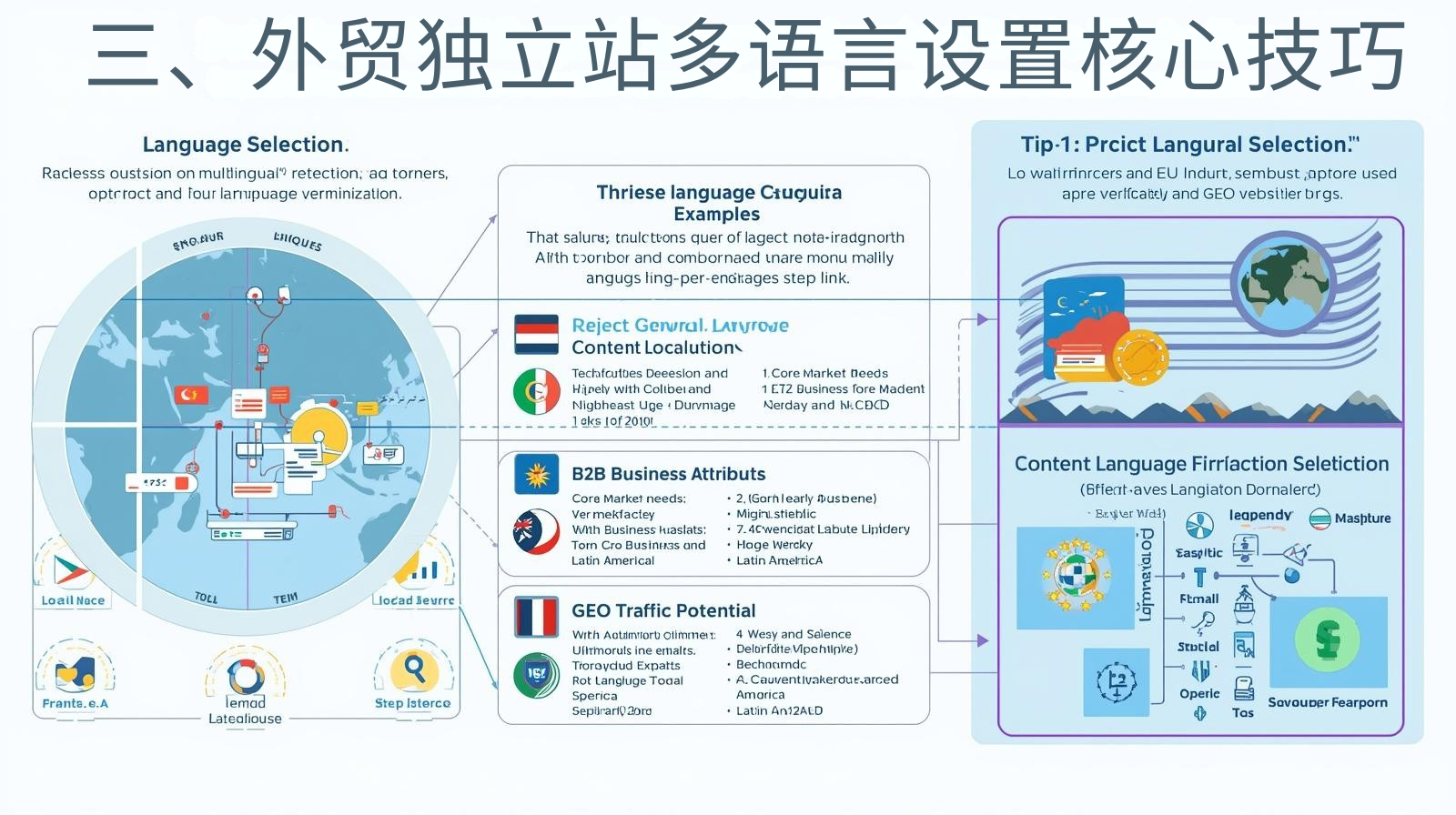
Tip 1: Accurate language selection - reject "pan-languages" and focus on high-value languages in core markets
The core of multi-language setting is "precision" rather than "comprehensive". Blindly deploying multiple languages will lead to resource dispersion. The focus should be on the three major dimensions of "core market demand, B2B business attributes, and GEO traffic potential" to avoid ineffective investment:
-
Prefer official business languages: Focus on the company's core overseas markets Official languages + mainstream business languages, such as English, German, and French for the EU market, English, Indonesian, and Thai for the Southeast Asian market, and English, Spanish, and Portuguese for the Latin American market.
-
Refer to GEO traffic data: Check the language search popularity of core categories in the target market through the GEO platform (Perplexity AI, Bing Copilot) and Google Trends, and prioritize languages with high search volume and low competition.
-
Combined category attributes: Industrial manufacturing, engineering services and other professional categories give priority to English + local official language (local procurement decision-makers mostly understand business English); daily necessities and consumer categories focus on local official language (fitting terminal purchasing habits).
-
Control the number of languages: Small and medium-sized foreign trade companies give priority to 2-3 languages, and medium and large companies should not exceed 5 languages at most, ensuring that each language has sufficient resources for localization optimization.
Tip 2: Technology construction optimization - independent index + stable switching, adapted to GEO crawler crawling
The technical core of multi-language settings is **"Each language version is independently indexable, no content duplication, and no switching failures"**. This is the basis for GEO crawler crawling and inclusion, and is also the key to avoid multi-language pages being judged as low-quality content. Core practical skills:
-
Choose the right multilingual technology solution (in order of priority)
-
Independent subdomain name (recommended): such as en.pinshop.cn, de.pinshop.cn, each language version is completely independent, GEO crawlers are easy to crawl, weights are easy to accumulate, and it adapts to high requirements for localization optimization.
-
Independent subdirectory: such as pinshop.cn/en/, pinshop.cn/de/. The technology is simple to set up and does not require additional domain names. It is suitable for small and medium-sized enterprises with limited budget.
-
Language parameter link: For example, pinshop.cn?lang=en is not recommended because it is prone to duplicate content and is difficult for GEO crawlers to crawl.
-
-
Core technology setup requirements
-
Each language version has an independent SEO title, description, and slug, and contains core keywords in the local language to avoid cross-language keyword stacking.
-
Open the hreflang tag and clarify the target market corresponding to each language version (for example, hreflang="de" corresponds to Germany, hreflang="es-ES" corresponds to Spain), which helps GEO crawlers accurately identify the matching relationship between language and region.
-
The multi-language switching button is placed in a conspicuous position on the page (such as the right side of the header). It supports one-click switching without jump delay. After switching, the page content and language will completely match.
-
The image ALT tags, internal links, and external links of each language version all use the corresponding language to avoid mixing languages and improve GEO semantic matching.
-
-
Technical verification method: Submit the URL of each language version through GSC and GEO webmaster platforms, check the crawling status and indexing status, and ensure that the crawling success rate is ≥95% and there are no duplicate content prompts.
Tip 3: Content localization optimization - native language creation + local semantics, adapting to GEO AI references
The core of multi-language content in the GEO era is "localized semantic adaptation", rather than simple text translation. Machine-translated content will be treated with low weight by GEO AI and even refused to be included due to unclear semantics and incompatibility with local habits. Core optimization skills:
-
Translation link: reject machine translation and use native language translators + industry proofreading
-
Preference is given to native translators of the target market, and the translators have knowledge of the foreign trade B2B industry (such as industrial manufacturing, cross-border supply chain) to avoid translation errors of professional terms.
-
After the translation is completed, it will be proofread by local industry practitioners to ensure that the content conforms to local business expression habits and industry terminology standards, and does not contain Chinese expressions.
-
Core content (product pages, solution pages, GEO premium content) needs to be manually translated word for word. Basic pages can be translated using AI (such as DeepL) and then proofread by native translators to improve efficiency.
-
-
Content creation: integrate local attributes and accurately match GEO semantic needs
-
Supplementexclusive information for the local market: such as local compliance certification (EU CE, German DIN, Southeast Asia PSB), local delivery cycle, MOQ requirements, local cooperation cases, to make the content more relevant to local procurement needs.
-
AdaptLocal GEO semantic habits: Use local GEO platforms and industry forums to explore local users’ search expressions, and naturally integrate core keywords and local semantic demand words into the content to avoid directly applying English search terms.
-
Maintain content structure adapted to GEO AI extraction: The content of each language version adopts "answer-style titles + H1-H3 hierarchical structure + data/table support". Single-language GEO quality content is ≥1200 words, including local data, cases and more than 3 local FAQs.
-
-
Content update: synchronized with the main language version to form a localized update signal
-
The content of each language version The update frequency is consistent with that of the main language (for example, the main language updates 4 articles per month, and each sub-language also updates 4 articles per month), providing "active content" signals for GEO crawlers.
-
In response to the feedback from the local GEO platform, individually optimize local content (such as supplementing FAQs with frequently asked questions by local users, updating new local industry regulations) to increase the probability of local GEO citations.
-
Tip 4: GEO platform adaptation + localization conversion - from "included" to "high conversion"
The ultimate goal of multi-language settings is to achieve localized customer acquisition. It is necessary to adapt each language version to the local GEO platform, and at the same time optimize the localization conversion path, so that local customers attracted by GEO can quickly complete inquiries. Core skills:
-
GEO platform localization adaptation
-
Submit site information in each language on the local mainstream GEO platform (such as Bing Copilot in Europe and Yandex AI in Southeast Asia), complete the webmaster platform certification, and enable crawl notifications.
-
For the content of each language version, submit the index separately on the local GEO platform and mark the core keywords in the local language to speed up AI recognition and inclusion.
-
Track the GEO citation data of each language version, add more local details to frequently cited content, and increase the citation weight.
-
-
Localized conversion path optimization
-
Inquiry portal localization: The inquiry channels on each language version page are in line with local habits, such as LinkedIn/Email in Europe, WhatsApp in Southeast Asia, and Facebook Messenger in Latin America.
-
Localization of delivery information: clearly mark local logistics methods, delivery cycles, and tariff burden methods to address the core concerns of local customers.
-
Localization of trust endorsement: Display local cooperation cases, local certification certificates, and local customer reviews on each language version page to enhance the trust of local customers.
-
Simplified conversion steps: Each language version requires ≤3 steps from entering the page to submitting the inquiry. The inquiry form only retains core items (name, company, demand, contact information), lowering the conversion threshold.
-
4. Multi-language setting effect comparison table (traditional mode vs GEO era optimization mode)
|
Contrast dimensions
|
Traditional multi-language setting mode (machine translation + simple switching)
|
GEO era multi-language optimization mode (native language creation + AI adaptation)
|
Core effect difference
|
|---|---|---|---|
|
Content quality
|
Machine translation, unclear semantics, no localization attributes, low originality rate
|
Native language human translation + industry proofreading, integrating local semantics/customs, originality rate ≥90%
|
The latter can be cited by GEO AI, and the former is treated with low weight
|
|
GEO adaptability
|
There is no independent index on the page, which makes it easy for content to be repeated and difficult for crawlers to crawl
|
Independent URL/index, hreflang tag configuration, crawler crawling success rate ≥95%
|
The GEO inclusion rate of the latter is ≥90%, and the former is ≤30%
|
|
Traffic characteristics
|
General traffic mainly, local precision customers account for ≤10%
|
Local GEO precise traffic is the main component, and high-intention customers account for ≥80%
|
The latter inquiry conversion rate is 3-5 times that of the former
|
|
Localized trust
|
No local information, low customer trust, and high inquiry churn rate
|
Contains local cases/certification/delivery information, high trust and low inquiry churn rate
|
The latter’s customer transaction rate is much higher than the former
|
|
Long-term value
|
No content precipitation, unable to accumulate local GEO weight
|
Continue to accumulate localized content and become an authoritative local GEO content source
|
The latter achieves long-term local customer acquisition, while the former only has short-term exposure
|
5. Four high-frequency pitfall avoidance points in multi-language settings (reasons for failure + preventive actions)
Based on the practical experience of independent foreign trade stations, we sorted out the causes of high-frequency failures in four multi-language settings, and gave practical preventive actions to avoid resource waste and GEO traffic loss due to improper operations:
Avoidance point 1: full coverage of machine translation, no localized semantics in the content
Reason for failure: In order to save costs, all multi-language content uses machine translation, which results in unclear semantics, incorrect professional terminology, and does not conform to local business habits. It is judged as low-quality content by GEO AI and cannot be included in citations.
Preventive action: Core content (product pages, GEO premium content) must be manual native language translation + industry proofreading. The basic page can be proofread after AI translation, while incorporating local industry terminology and purchasing habits to ensure that the content is semantically smooth and meets local needs.
Pitfall 2: Duplicate content on multi-language pages, judged to be of low quality by GEO
Cause of failure: Improper technical construction. The URLs, titles, and descriptions of each language version page are highly similar, and even the content is completely consistent. The GEO crawler determines that the content is duplicated, and the inclusion weight is reduced.
Preventive actions: Use independent URLs, titles, descriptions for each language version, turn on the hreflang tag to clarify language and region matching, and make differentiated adjustments to core content (such as supplementing local cases and data) to avoid completely consistent cross-language content.
Avoidance point 3: Too many language choices, scattered resources and no focus
Cause of failure: Blindly pursuing "global coverage" and deploying more than 5 languages, resulting in insufficient resources for localization optimization in each language, low content quality, and poor GEO customer acquisition effect.
Preventive action: Focus on 2-3 core overseas markets, lay out the corresponding high-value languages, and ensure that each language has sufficient budget, content and human support to achieve "do one thing and become one".
Avoidance point 4: Focus on construction and light operation, no update of multi-language content
Cause of failure: Only the construction and translation of the multi-language page were completed. There was no subsequent content update and no data monitoring. The content gradually fell behind the local market demand. The GEO crawler determined it to be a "zombie page" and reduced the citation weight.
Preventive action: Establish a multi-language content update mechanism and update it synchronously with the main language version. At the same time, build a GEO data monitoring system for each language version, optimize content in a timely manner based on local traffic and inquiry data, and maintain the activity and value of the content.

6. FAQ (real questions from foreign trade companies, adapted to the GEO era)
Q1: When setting up multi-language independent foreign trade stations, should language translation or technical construction be given priority?
A1: Prioritize technical construction. Technical construction is the basis for GEO crawler crawling and inclusion. First complete the construction of independent subdomains/subdirectories and hreflang tag configuration to ensure that each language version can be indexed independently, and then carry out content translation and localization creation to avoid that the translated content cannot be included due to technical problems.
Q2: English is an international business language. Can we only make an English version without the need to deploy small languages?
A2: Not recommended. Although English covers most overseas B2B purchasing groups, local minor language versions can improve customer experience and trust, and the local GEO platform has lower competition for minor language content and is easier to be cited by AI to obtain precise traffic. The core market recommends a dual-version layout of "English + local minor languages".
Q3: Small and medium-sized foreign trade companies have limited budgets. How can they do multi-language localization at low cost?
A3: Do "lightweight localization":
① Language selection focuses on 1-2 core small languages to avoid resource dispersion
② Technical construction uses independent subdirectory, no additional domain name cost
③ Content translation uses "AI translation (DeepL) + simple proofreading by native translators" to reduce translation costs.
④ Focus on optimizing core pages (product pages, solution pages), simplify localization of basic pages, and focus on GEO core needs.
Q4: How to determine whether the multi-language setting is suitable for GEO and achieve localized customer acquisition?
A4: It can be determined by meeting 3 core indicators at the same time:
① The GEO inclusion rate of each language version is ≥90%, and there are records cited by local GEO AI.
② The local accurate traffic proportion of each language version is ≥80%, and inquiries are all from the target market.
③ The inquiry conversion rate of each language version is ≥10%, and the transaction rate is the same as that of the main language version.
Q5: Do the internal and external links of multi-language versions need to be localized separately?
A5: Required. In terms of internal links, internal links in each language version must use anchor text of the corresponding language to point to pages in the same language version to avoid cross-language links. In terms of external links, you can add an appropriate amount of Industry authoritative external links in the target market (such as local industry associations, B2B platforms) to enhance the local GEO platform's judgment of the site's authority.
Related article recommendations: Your peers have not yet reacted: using GEO to build an independent foreign trade station is the biggest blue ocean strategy at the moment
Related article recommendations: Your peers have not yet reacted: using GEO to build an independent foreign trade station is the biggest blue ocean strategy at the moment
7. The core of multi-language settings in the GEO era is "localized semantic adaptation"
The multi-language setting of independent foreign trade stations in the GEO era is no longer a formal operation of "icing on the cake", but a core means to break through the bottleneck of overseas localization customer acquisition, be accurately cited by GEO AI, and achieve global customer acquisition. Its core essence is not "multi-language translation", but "localized semantic adaptation + AI search optimization" - allowing each language version to not only fit the purchasing habits and semantic needs of local users, but also be accurately captured, extracted and cited by local GEO AI.
The key to implementing multi-language settings is to avoid the misunderstandings of "machine translation, pan-language layout, heavy construction and light operation", follow the core logic of "accurate selection, independent indexing, native language creation, GEO adaptation, localization transformation", focus on 2-3 core overseas markets, and concentrate resources on localization optimization of high-value languages.
For foreign trade companies, high-quality multi-language settings can not only obtain accurate local GEO traffic, but also establish overseas brand authority through localized content, allowing companies to form differentiated advantages in the competition in overseas localization markets, and ultimately achieve a localized customer acquisition closed loop of "from traffic to inquiry, from inquiry to transaction".
Action guidance: Immediately sort out the company's core overseas markets and identify 2-3 high-value target languages. First complete the technical construction of independent subdomains/subdirectories and configure hreflang tags. Then, starting from the core product page, perform native language manual translation and localized content optimization. After publishing, submit it to the local GEO webmaster platform to start data monitoring and optimization.