
I. Question-and-answer structure adapted to GEO ranking procurement scenarios and core constraints
The question-and-answer structure can be a core optimization method for GEO ranking because it aligns with the questioning habits of overseas B2B customers' procurement research and GEO's "semantic understanding-answering needs" search logic. It is especially suitable for customer acquisition needs of mid-to-high-end customized categories such as industrial manufacturing, precision parts, and engineering services on foreign trade independent websites. Its core applicable procurement scenarios and constraints are clearly defined as follows:
Core applicable procurement scenarios
- Category where customers frequently ask questions during the procurement process (such as supplier selection, quality testing standards, and confirmation of customized delivery dates);
- Target customers search for procurement information in overseas markets through the GEO platform using natural question format (such as "How to confirm MOQ for custom parts");
- Independent websites need to improve their EEAT authority signal to solve the problems of low ranking and insufficient targeted traffic after being indexed by GEO.
Core constraints
- Budget: Creating a single Q&A content requires basic human resources costs, with at least 4 high-quality content pieces to be produced per month to meet the GEO content update signal requirements;
- Content: Questions must come from real overseas procurement scenarios, and answers must include core business details of foreign trade B2B (MOQ/delivery time/customization process/certification).
- Team: One dedicated operations staff member capable of identifying customer questions, creating standardized Q&As, and monitoring GEO data;
- Technology: The independent website pages are indexable, and the internal link layout of the Q&A content can be implemented to meet the requirements of GEO crawlers.
Clearly define the inapplicable scenarios
- Low-priced, standardized fast-moving consumer goods, a category where customers do not conduct procurement research or ask questions, but directly compare prices through the platform;
- Independent websites lack a database of real customer questions, allowing only the creation of fabricated questions, which fails to reflect the actual needs of overseas procurement.
- This is a general customer acquisition need that only pursues GEO exposure, does not require precise conversion, and does not involve purchasing decisions.
II. Seven Verifiable Selection Criteria for Improving GEO Rankings Using a Question-and-Answer Structure
A question-and-answer structure is not simply a collection of questions and answers; it must meet the following 7 verifiable criteria to effectively improve GEO ranking and obtain targeted traffic. Each criterion corresponds to the core needs of GEO search and foreign trade procurement decisions:
- Single theme: Each article focuses on only one core procurement issue , such as "how to verify the quality control capabilities of a custom supplier," without including irrelevant issues;
- Structure adaptation: H1 is the core question, H2 is the sub-question, and H3 is the answer details. The hierarchy is clear and conforms to the extraction logic of GEO AI.
- The questions are genuine: over 80% of the questions come from inquiries from overseas customers, real search terms on the GEO platform, and procurement questions from overseas B2B industry forums;
- The answer is valuable for decision-making: it contains 3-7 verifiable procurement judgment criteria, or provides specific operational steps and cost/delivery time thresholds;
- Clear business details: The answer incorporates real foreign trade business information (such as customized MOQ ≥ 500 pieces, delivery time 7-10 days, and support for CE certification);
- Within the site, it can be observed that each Q&A post is linked to at least two indexed pages, and the main text links to at least two internal pages (product page + inquiry page).
- Semantic matching: The question is worded in a way that aligns with the natural search habits of overseas customers, with no Chinese-English jargon, and covers 5-10 relevant long-tail decision keywords.
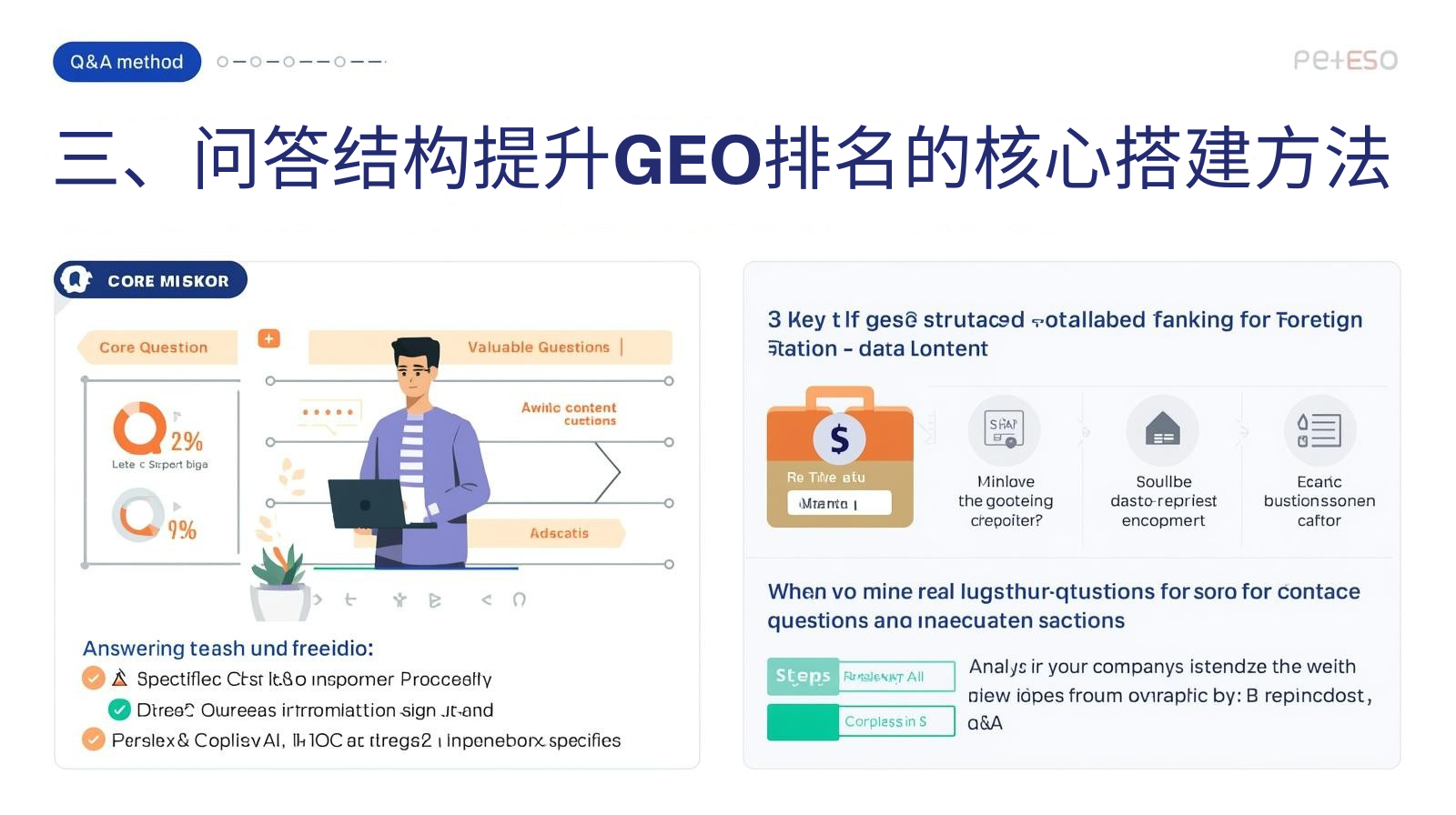
III. Core Methods for Improving GEO Ranking through Question-and-Answer Structures (with Judgment Criteria and Pitfalls to Avoid)
1. Core structure of Q&A content (adapted for GEO extraction + procurement decision-making, title is the answer button)
GEO's efficiency in extracting content directly impacts ranking. The question-and-answer structure must strictly follow the logic of " core question - detailed sub-question - valuable answer - data support ," and all H2/H3 titles must be answer buttons , avoiding vague descriptions. Specific structure and title examples are as follows:
- H1 (Core Procurement Issue) : How to Use Q&A Structure to Boost GEO Ranking for Foreign Trade Independent Stations?
- H2 (Detailed Questions, Button-Style Answers) : 3 Key Q&A Structure Criteria for GEO AI Indexing
- H2 (Detailed Questions, Answer Buttons) : How to Mine Real Purchasing Questions for Q&A Content
- H2 (Detailed Questions, Button-Style Answers) : 5 Common Mistakes in Q&A Structure and Prevention Actions
- H3 (Answer Details) : For each H2 sub-question, break down the specific answer details, such as thresholds, steps, and judgment criteria.
2. Methods for uncovering real procurement problems (4 major channels + screening criteria)
The authenticity of the questions is fundamental to improving GEO rankings through question-and-answer structure. These questions must be drawn from real-world foreign trade procurement scenarios , rather than subjective fabrications. The core channels for finding these questions and verifiable screening criteria are as follows:
Four core data discovery channels (in order of priority)
- Enterprise's own overseas customer inquiry database: sort out inquiry records from the past 6-12 months and extract frequently asked purchasing questions (such as quality inspection, delivery time, and customization requirements).
- GEO platform directly mines: Search for core category keywords on platforms such as Perplexity AI and Bing Copilot, and extract real search terms from the "Related Questions" section;
- Overseas B2B industry forums: Quora, Reddit, LinkedIn industry communities, overseas buyers' category procurement survey questions;
- Competitor authoritative websites: Extract high-traffic procurement-related questions from the FAQ sections and Q&A content of leading independent websites in the same product category overseas.
Three screening criteria (all must be met)
- Strongly relevant to purchasing decisions: It can directly guide customers in making purchasing choices, such as "How to check the factory strength of custom suppliers," rather than an encyclopedic question;
- It has GEO search popularity: verified by Google Trends, the question has a stable search volume in the target market, and is not an obscure question;
- It can provide answers that are relevant to the company's own business and can incorporate business details such as MOQ, delivery time, and certification to drive conversion.
3. Hard standards for creating Q&A answers (each H2 paragraph must meet at least 2 of these standards)
The answer is the core value of the question-and-answer structure, directly affecting the probability of GEO citation and customer conversion. The answer paragraph for each H2 must meet any two of the following hard criteria to avoid vague expressions and align with the needs of foreign trade procurement decisions:
- Provide a threshold/range: such as "The standard MOQ for customized industrial parts is 500-1000 pieces, while rush orders can be as low as 300 pieces, with a delivery time of 7-15 days";
- Provide an executable process, such as "a 3-step process for verifying a supplier's quality control capabilities: sample testing → quality control document review → on-site factory visit";
- Provide a comparison table/checklist: such as a comparison table of different supplier selection criteria, or a checklist of core checks for procurement inquiries;
- Provide a reason for failure and corresponding preventive actions: such as "Customs detention due to failure to verify supplier certification qualifications, preventive action: require the supplier to provide the original official certification of the target market and verify it."
IV. Comparison Table of GEO Ranking Effects between Question-and-Answer Structure and Traditional Content Structure
To clarify the core value of the Q&A structure in improving GEO rankings, a comparison was made with the traditional descriptive content structure of independent foreign trade websites across six core dimensions, including GEO adaptability, traffic accuracy, and purchasing decision value . All data comes from practical verification in the foreign trade B2B sector.
Comparison Dimensions | Question and answer structure | Traditional descriptive content structure | Core judgment threshold |
|---|---|---|---|
GEO AI extraction efficiency | High quality, clear structure, AI can quickly extract core answers | Low, requires AI to autonomously discover, and is prone to deviating from the required level. | Question-and-answer structures are cited by AI at a rate of ≥60%, while traditional structures are cited at a rate of ≤20%. |
Semantic matching degree | Highly targeted search queries that align with customer inquiries, covering long-tail decision-making keywords. | Low accuracy; only matches keywords, insufficient semantic coverage. | Question-and-answer structure: long-tail keyword coverage ≥ 8 per article; traditional structure: ≤ 3 per article |
Traffic accuracy | High, all are high-potential clients with purchasing research needs. | In China, the proportion of customers whose general intentions are collected is high. | Question-and-answer structure: high-intent traffic accounts for ≥80%, traditional structure: ≤40%. |
Procurement decision value | High quality, which can be directly used as a reference for customer purchasing. | Low, only providing category introduction, no decision-making criteria. | The question-and-answer structure can provide customers with ≥3 purchasing judgment criteria. |
GEO ranking stability | High quality, highly differentiated content, and strong authoritative signal. | Low quality, prone to homogenization, and large ranking fluctuations. | Question-and-answer structures consistently rank in the top 30, while traditional structures tend to fall out of the top 50. |
Inquiry conversion rate | High quality, the questions closely match procurement needs, and the conversion path is short. | Question-and-answer structure inquiry conversion rate ≥12%, traditional structure ≤5%. |
V. Five Risks and Avoidance Measures for Improving GEO Rankings Through Question-and-Answer Structure
Based on practical experience with independent e-commerce websites, this article identifies five high-frequency risks in Q&A structure construction that can easily lead to ineffective GEO rankings. It also provides actionable preventative measures to address the root causes of low-quality content and stagnant rankings.
Core risks | Typical manifestations | Preventive actions |
|---|---|---|
Fabricated problems, detached from real procurement scenarios | The question was subjectively fabricated and expressed in Chinglish, which is out of touch with the search habits of GEO users. | All questions were sourced from real-world sources, and the relevance of the statements was verified through simulated searches on the GEO platform. Questions that were not from real sources were discarded. |
The answer was vague, lacking business details and data. | Only qualitative descriptions are given, such as "the supplier has good quality and fast delivery," without data on MOQ/delivery time/standards, etc. | The answer must incorporate real-world details of foreign trade operations. Each H2 paragraph must meet at least two hard criteria for content creation; submissions without data will not be published. |
The structure is chaotic and the hierarchy is unclear. | The single passage covers multiple core questions, but H2 is irrelevant to these core questions, and the answer's logic is flawed. | Strictly adhering to the principle of a single theme, the H1/H2/H3 hierarchy is clearly defined, with each H2 addressing only one specific procurement question. |
Insufficient internal linking makes it an orphan page. | After the Q&A content is published, there are no other page links, and the text itself has no internal links pointing to the product/inquiry page. | Follow the minimum internal link standard: link from the blog list page + 1 related article, and link from the article to the product page + inquiry page. |
No update signal, low GEO weight | The content was published without any optimization or updates, and was therefore flagged as a "zombie page" by GEO. | Add one FAQ or update one set of data within 7 days of publication, and perform lightweight optimization on high-traffic Q&A content every month. |

VI. FAQ (Real Questions from Overseas Customers/Foreign Trade Companies)
Q1: Can a single Q&A content cover multiple core procurement questions to improve GEO keyword coverage?
A1: No. GEO requires single theme for content. Covering multiple core questions will lead to semantic confusion, making it impossible for AI to accurately match search needs, and the ranking will drop instead. A single article only focuses on 1 core procurement question and disassembles 3-5 related sub-questions, which can both ensure semantic accuracy and cover long-tail words.
Q2: How to transform the existing traditional content of the independent station into a Q&A structure to boost GEO ranking?
A2:Follow 4 core steps: ① Extract the core procurement question from the traditional content as H1; ② Disassemble the content into 3-5 sub-questions related to procurement and set them as H2 (answer button style); ③ Supplement MOQ, delivery time and other business details and data to meet the creation hard standard; ④ Optimize internal link layout and resubmit the URL to GEO platform.
Q3: For small and medium-sized foreign trade enterprises with a small question bank, how to continuously create Q&A content?
A3: Expand the question bank through question disassembly + scenario extension : ① Disassemble 1 core question into multiple sub-questions (such as "how to choose a supplier" into selection criteria, strength verification, etc.); ② Extend questions according to different procurement scenarios (small batch customization, mass procurement, overseas delivery, etc.); ③ Dig out potential questions from customer inquiries (such as extending "delivery time inquiry" to "how to shorten the delivery time of customized delivery products").
Q4:What is the optimal word count for Q&A content to adapt to GEO ranking?
A4: The core is to ensure content value, not rigidly pursue the number of words, and the minimum word count is ≥1200 words . The core question answer is not less than 500 words, and each sub-question answer is not less than 200 words, which is enough to carry procurement standards, data, steps and other core information, avoiding thin content that is not included by GEO.
Q5:How to confirm that the Q&A structure has effectively improved the GEO ranking of the independent station?
A5:Judge by 4 verifiable indicators: ① GEO exposure: the daily exposure of a single Q&A content is ≥100 times; ② AI citation: cited by GEO AI ≥3 times a month; ③ Traffic accuracy: the proportion of high-intention procurement customers ≥80%; ④ Inquiry conversion rate: the inquiry conversion rate brought by Q&A content ≥12% and increases month by month.
VII. GEO Ranking Progress in the 7 Days Following the Release of the Q&A Structure
After the Q&A content is published, verifiable actions must be taken according to the following timeframes to strengthen the weighting of GEO crawling, indexing, and ranking. All actions should align with GEO algorithm preferences to avoid ineffective operations:
- Day 0 (the day of publication) : Submit the URL of the Q&A content to the GSC and GEO webmaster platforms, check the page crawling status, and ensure that it is indexable and unblocked;
- Day 1-2 : Add "Related Recommendations" internal links to the Q&A content in two relevant foreign trade procurement blog posts to achieve a two-way internal link layout;
- Day 3-4 : Add a "Frequently Asked Questions about Procurement" module to the homepage/core product page/solution page of the independent website, and place an entry point for the Q&A content to increase traffic to high-authority pages;
- Days 5-7 : Add one overseas customer's real purchase FAQ or expand one set of category comparison data to form a content update signal , and resubmit the URL to the GEO platform.
Note : Only make verifiable additions and structural improvements, and avoid frequent rewriting of the entire text to prevent significant changes to the GEO-judged content from causing the weight to be reset to zero.
Recommended Article: Your Competitors Haven't Reacted Yet: Building an Independent E-commerce Website with GEO is the Biggest Blue Ocean Strategy Right Now
Recommended Article: Your Competitors Haven't Reacted Yet: Building an Independent E-commerce Website with GEO is the Biggest Blue Ocean Strategy Right Now
The core of using a question-and-answer structure to improve the GEO ranking of independent foreign trade websites is not simply content structure innovation, but rather aligning with GEO's "question-centric" search logic and the procurement research habits of overseas B2B customers , shifting the content from "proactive output by enterprises" to "precise answers to customers' procurement questions".
The key to its successful implementation is to strictly adhere to the ToB blog operation standards outlined in the document: a single theme, an adaptable structure, answers with decision-making value, and discoverability within the platform . At the same time, it is essential to uncover real procurement issues, incorporate details of foreign trade business, and ensure effective follow-up actions within 7 days of publication.
For foreign trade B2B companies, high-quality Q&A content can not only improve GEO ranking and targeted traffic, but also serve as a reference document for overseas customers' purchasing decisions . This strengthens the authoritative signal of GEO's EEAT (Electronic, Explicit, and Acquisition) and shortens the customer conversion path, ultimately achieving the core goal of "being indexed, ranking, and convertible".