
I. In the era of AI-assisted product sourcing, the core competitiveness of factory independent websites lies in GEO optimization.
When overseas buyers no longer manually browse search engines, but instead directly give instructions to the AI assistant—"Recommend compliant small metal processing factories in Europe" or "Find electronic component factories that can undertake small-batch customization"—the core value of independent websites for foreign trade factories has been upgraded from a "display window" to a "core material library recommended by the AI assistant."
Many factories wonder: why are their competitors' factories prioritized for recommendations by the AI assistant, while their own independent websites remain largely ignored? The core answer is simple: have they implemented GEO optimization? GEO optimization is not just simple page beautification; it's a systematic project that adapts to the AI assistant's information extraction, trust verification, and demand matching logic. It's the key to making the AI assistant "remember" your factory and "prioritize" recommending it.
This article will focus entirely on "How GEO optimization can make AI assistants prioritize recommending your factories," breaking down the underlying logic of AI assistants in selecting factories, the core implementation modules of GEO optimization, and a 2-month practical timeline. Combined with real factory case studies, it will allow you to clearly grasp each step of the operation, quickly get the buyer's AI assistant to proactively recommend your factories, and receive every accurate inquiry.
II. The underlying logic of AI assistants in screening factories: Why is GEO optimization key?
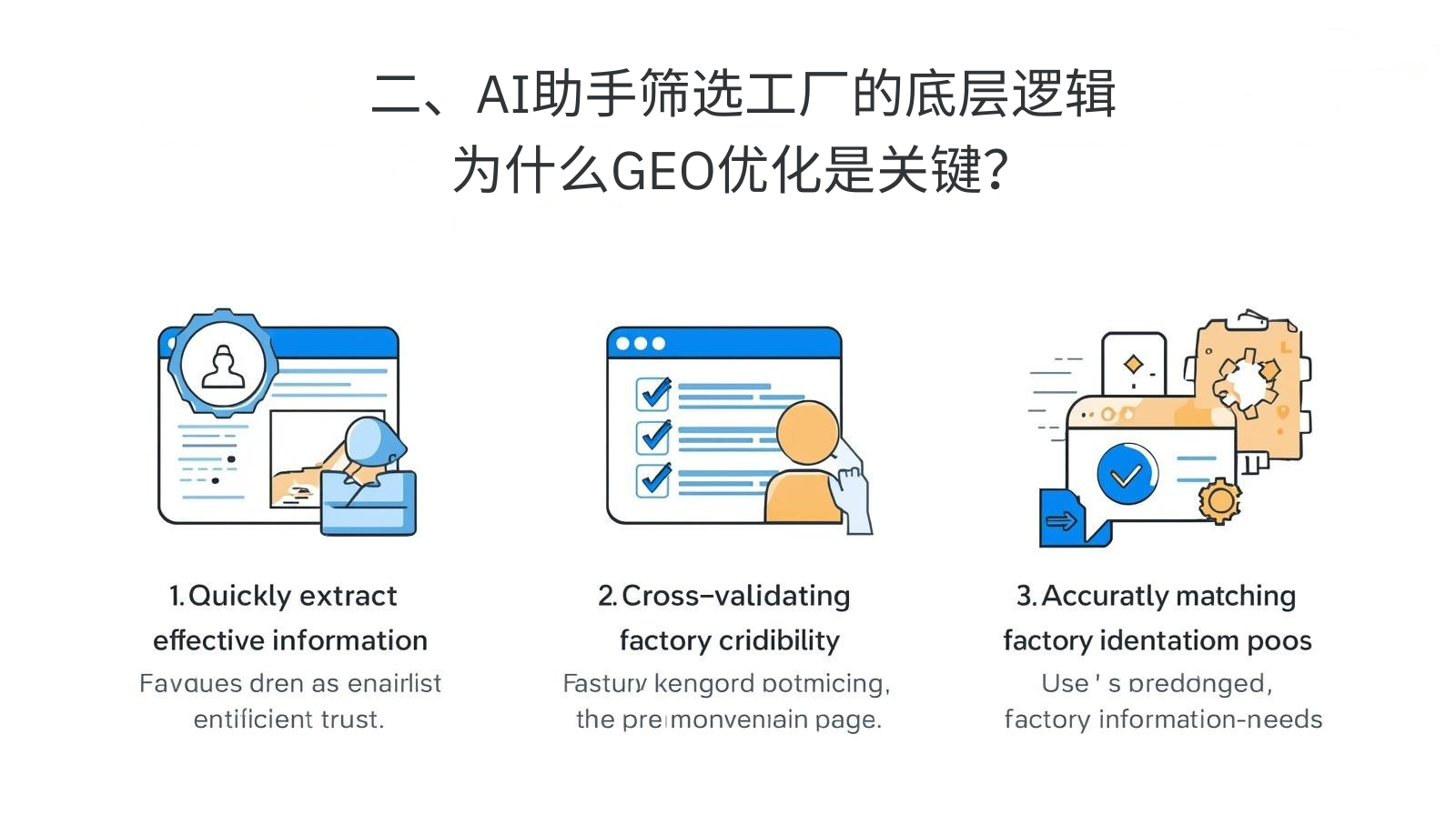
The core logic of AI assistants for buyers (ChatGPT, Google AI, etc.) recommending factories is essentially a "3-step screening method": quickly extracting effective information → cross-validating the credibility of factories → accurately matching procurement needs. These 3 steps are precisely the core focus of GEO optimization.
The core problems of traditional factory independent websites are: disorganized information (no fixed fields), vague advantages (no quantifiable data), and insufficient trust (no verification evidence). AI assistants cannot quickly extract effective information and naturally will not include them in the recommendation list. The core role of GEO optimization is to standardize and systematically optimize your factory information to meet the AI assistant's filtering logic, making it a priority recommendation option in the AI assistant's eyes as "high-quality, trustworthy, and suitable for needs".
In simple terms, GEO optimization is like "tagging" your factory's independent website with an AI recommendation tag, allowing the AI assistant to quickly identify your factory, recognize your strengths, and match procurement needs when filtering, thereby prioritizing your factory for overseas customers with procurement needs.
III. GEO Optimization Core Implementation Modules: 4 major modules that allow the AI assistant to prioritize your factory.
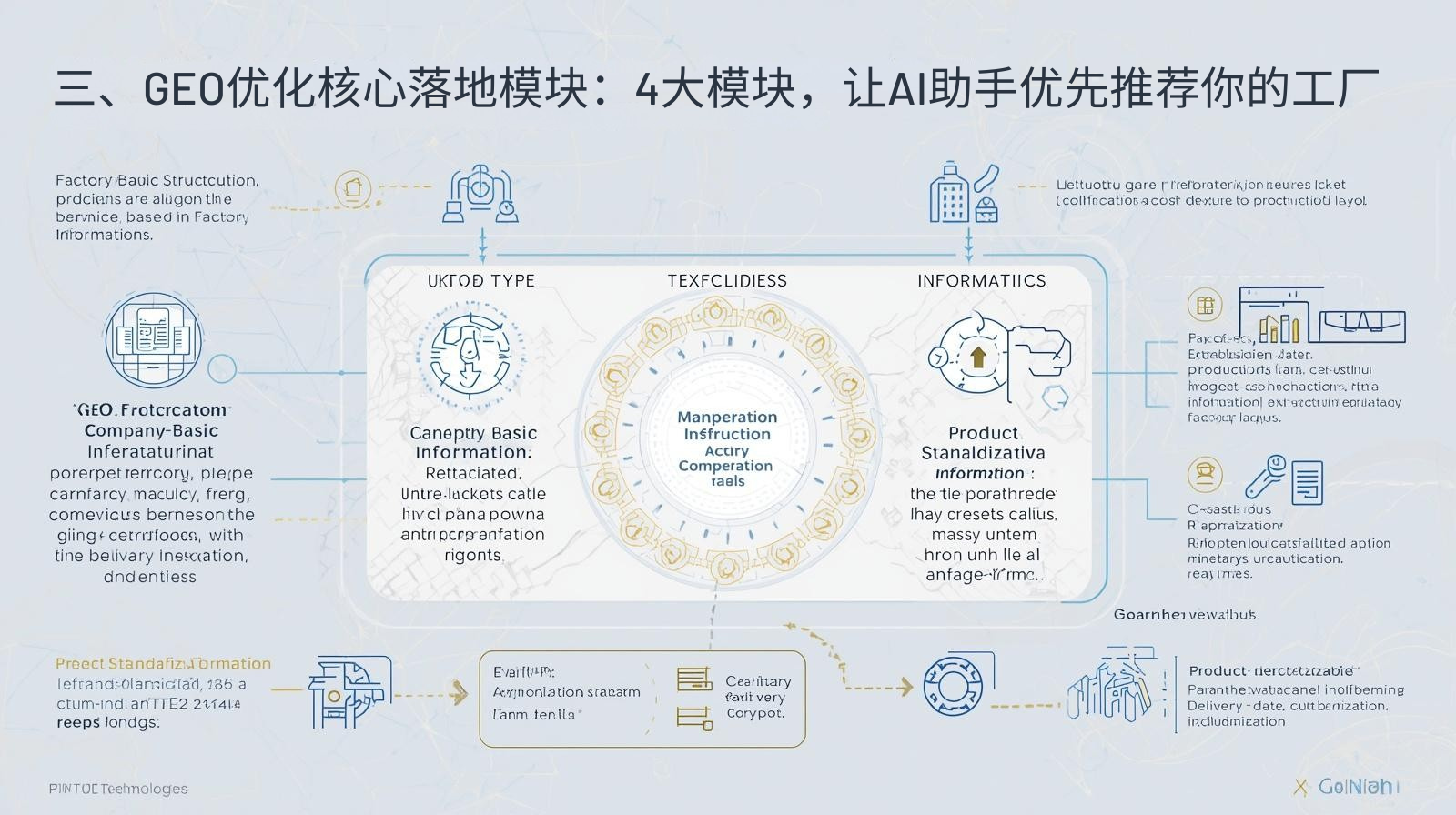
PinTui Technology, drawing on its experience in optimizing GEO for over 1200 factory independent websites, has distilled four core modules. These four modules are progressively layered, covering the entire process of the AI assistant's factory selection. As long as they are strictly implemented, your factory can become a priority recommendation option for the AI assistant, passively acquiring accurate inquiries without any additional investment in traffic costs.
3.1 Module 1: GEO Semantic Structuring (AI Assistant Recognizes Your "Basic Prerequisites")
Whether an AI assistant can recommend your factory depends primarily on its ability to "understand your factory information." The core of GEO semantic structuring is to organize the factory's core information (company, products, services) into a standardized, fixed-field format, allowing the AI assistant to extract it quickly within 3 seconds without having to painstakingly decipher messy text.
Key requirements: fixed fields, clear hierarchy, complete information, conforming to the information extraction logic of the AI assistant, and avoiding vague descriptions and messy layout.
Specific implementation details (factories can directly copy and use):
-
Factory basic information (fixed fields): Factory type (manufacturing factory/own factory), establishment time, production scale (monthly capacity/annual capacity), core products (1-3 main products, without piling up), target market (specific regions such as Europe and the United States/Southeast Asia), core certifications (CE/ISO/LFGB, etc., with certificate number marked), factory address (accurate to province + city, adapted to AI regional matching).
-
Standardized product information (fixed fields): Each product page must include "parameter table + application scenario + MOQ + delivery date + customization range". The parameter table must clearly specify quantifiable indicators such as material, size, and precision, and reject vague statements such as "high quality" or "good performance".
-
Standardized service information (fixed fields): Cooperation mode (OEM/ODM/wholesale), payment method (T/T/L/C/PayPal), logistics method (sea freight/air freight/express), after-sales guarantee (warranty period/repair service), factory support (whether on-site inspection/online video inspection is supported).
Key to successful implementation: By leveraging PinTui Technology's AI semantic structuring service, standardized information modules can be quickly built, ensuring that every field conforms to the AI assistant's extraction logic and preventing information clutter from causing the AI assistant to fail to recognize it.
3.2 Module Two: GEO Value Quantification (AI Assistant Prioritizes Recommending Your "Core Assets")
When AI assistants screen factories, they prioritize recommending factories with "clear advantages"—vague statements like "we are strong" or "we have high cost performance" cannot impress AI. Only quantifiable value can make the AI assistant distinguish you from other factories and prioritize recommending you to buyers.
The core of GEO's value quantification is to abandon empty adjectives and use "data + evidence" to extract the factory's core advantages, allowing the AI assistant to clearly identify your differentiated value and improve recommendation priority.
Practical application (3 core areas, factory simulation is sufficient):
-
Cost advantages: Clearly state "30% lower than the industry average MOQ", "15% reduction in bulk purchasing costs", and "20% savings in cross-border logistics costs", accompanied by specific case studies (such as "a German customer reduced costs by 18% and increased annual repurchase amount by 40% through bulk purchasing").
-
Efficiency advantages: Clearly state "sampling cycle ≤ 3 days", "mass production delivery time 5 days faster than the industry average", and "emergency replenishment response time ≤ 24 hours", and attach real photos of the factory production process and screenshots of customer feedback as evidence.
-
Compliance advantages: Clearly states that "all products have passed EU CE certification and US FDA certification" and "complete customs clearance documents can be provided, improving customs clearance efficiency by 30%", with real photos of certificates and official query links, to meet the procurement needs of the target market.
Key to Implementation: Enhance services by leveraging the value of PinTui Technology's product sourcing, extract quantifiable core advantages from factories, and combine them with real evidence to enable AI assistants to quickly identify your differentiated value and improve recommendation rankings.
3.3 Module Three: GEO Trust System (AI Assistant Relies on Your "Key Guarantees")
AI assistants won't recommend "untrustworthy" factories—the core need of buyers is to find reliable factories, and the core responsibility of AI assistants is to screen trustworthy suppliers. The core of the GEO trust system is to build verifiable and cross-validated trust evidence, allowing both AI assistants and buyers to quickly confirm the credibility of your factory, thus making confident recommendations and collaborations.
Key requirements: All trust evidence must be searchable and traceable to avoid fraudulent cases and ambiguous certificates, and to build a dual trust loop of "AI-based trust + buyer approval".
Specific implementation modules (4 must-do, factories can implement directly):
-
Verifiable qualifications: All certification certificates (ISO/CE, etc.) are accompanied by real photos, certificate numbers, and official query links (such as the EU CE certification query link) to ensure that the AI assistant and buyers can directly verify their authenticity.
-
Traceable Case Studies: Publish 3-5 real cooperation cases. Each case study will include "client background (industry + country + scale) + procurement needs + factory solutions + cooperation results", and attach real photos of the cooperation with the client and logistics receipts (anonymized).
-
Factory Inspection Available: Showcases real photos/short videos of factory workshops, production equipment, and quality inspection processes, provides a factory inspection appointment channel, and marks "Supports online video inspection and offline on-site inspection," allowing the AI assistant to perceive the factory's true strength.
-
Information consistency: Ensure that the factory information (address, phone number, core products) across independent websites, social media, and industry platforms is completely consistent. The AI assistant will cross-verify this information, and inconsistencies will lower the trust score and affect recommendations.
Key to Implementation: By leveraging PinTui Technology's procurement trust system building service, we integrate verifiable trust evidence to construct a trust loop that is recognized by both AI and buyers, allowing the AI assistant to confidently recommend your factory.
3.4 Module Four: GEO Scenario Adaptation (The "Core Bridge" for AI Assistants to Match Needs)
When buyers use AI assistants to find factories, they ask questions with specific scenario requirements (such as "factory for small-batch trial orders", "factory for cross-border e-commerce", "European compliant factory"). The core of GEO scenario adaptation is to build special pages that fit high-frequency purchasing scenarios, so that the AI assistant can directly locate your factory and make accurate recommendations based on purchasing needs.
Key requirements: Cover high-frequency procurement scenarios in the factory's target market, with each scenario corresponding to a dedicated page, scenario keywords aligned with the AI assistant's search logic, achieving a seamless connection between "procurement needs → AI matching → factory recommendations".
Five high-frequency scenarios that factories must cover (direct implementation, no additional design required):
-
Small-batch trial order scenario: Clearly marked "MOQ 100 pieces minimum order, no premium, trial order delivery time 3 days", targeting the small-batch procurement needs of start-up buyers and cross-border e-commerce, and adapted to the AI assistant's search keyword "small-batch factory".
-
Customized scenarios: Clearly indicate "customization scope (material/size/logo/packaging), customization cycle, and customization cases" to highlight the factory's customization capabilities for buyers with personalized needs.
-
Compliance scenarios: For different target markets such as Europe, America, and Southeast Asia, the corresponding regional compliance requirements, certifications, and customs clearance support are clearly marked to solve the compliance pain points of buyers and improve the AI matching accuracy.
-
For rapid delivery scenarios: clearly indicate "emergency order response time, fastest delivery date, and logistics plan", highlighting the factory's production efficiency advantages for buyers with urgent replenishment needs.
-
Specifically designed for cross-border e-commerce scenarios: clearly labeled "neutral packaging, no logo, bulk shipping support, and cross-border logistics support," targeting cross-border e-commerce buyers such as Amazon and AliExpress, and catering to their high-frequency search needs.
Key to Implementation: Leveraging PinTui Technology's procurement scenario marketing services, we build scenario-based special pages, enabling AI assistants to accurately match buyer needs and proactively recommend your factory.
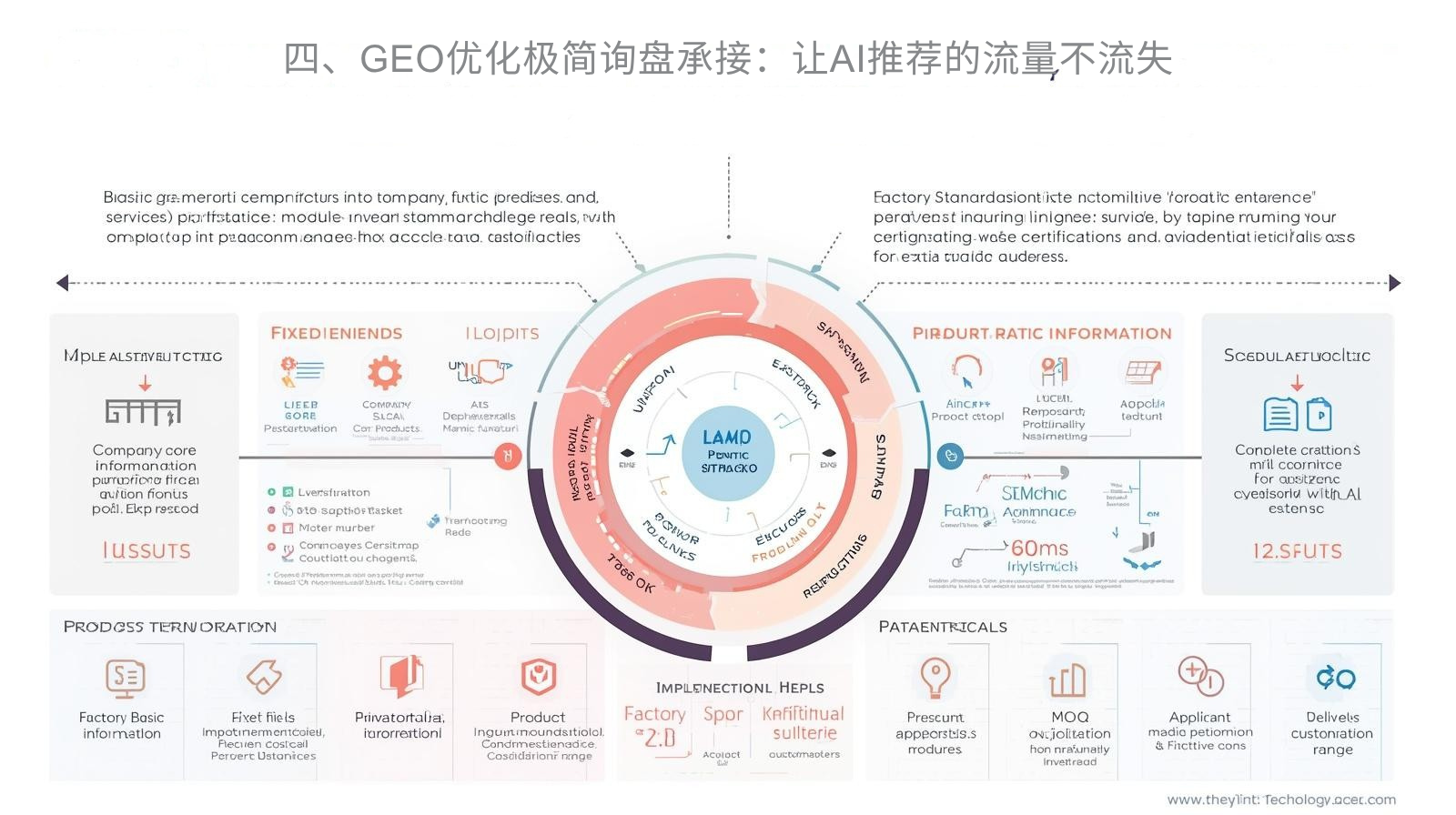
IV. GEO-Optimized Simplified Inquiry Handling: Ensuring No Loss of AI-Recommended Traffic
Even after optimizing GEO (Gross Order Management) and prioritizing your factory recommendations by the AI assistant, cumbersome inquiry paths can still lead to the loss of valuable customers. Therefore, we need to combine this with simplified inquiry optimization to ensure that every buyer recommended by AI can quickly submit an inquiry, achieving a complete closed loop of "AI recommendation → inquiry acceptance → order conversion".
Practical implementation (3 key optimizations that can be directly implemented in the factory):
-
Prioritize inquiry entry points: Set up fixed inquiry buttons at the top and bottom of the homepage, product pages, and scenario pages, labeled "One-click inquiry" and "Free quote from factory," to ensure that buyers can find them at any time and reduce churn rate.
-
The form has been streamlined and optimized: the inquiry form retains only 4 core fields (name, company name, contact information, and requirement description), and redundant fields such as "company size" and "purchase quantity" have been removed, allowing buyers to complete the inquiry submission within 10 seconds.
-
Multi-channel support: In addition to forms, new features include WhatsApp, online customer service, and one-click email contact, supporting 24/7 intelligent response to meet the different communication habits of buyers and improve inquiry submission rate.
Key to Implementation: By leveraging PinTui Technology's precise inquiry conversion optimization service, we simplify the inquiry process, enrich the channels for receiving inquiries, and ensure that AI-recommended traffic can be quickly converted into precise inquiries.
V. GEO Optimization 2-Month Implementation Timeline (Factory-Specific, Precise to the Week, Follow Directly)
Many factories worry that GEO optimization is complex and time-consuming. PinTui Technology, based on practical experience, has compiled a two-month implementation timeline tailored to each factory. No professional technicians are required; all that is needed is to provide basic materials to complete the optimization step by step and quickly achieve priority recommendation from the AI assistant.
|
Time period
|
Core Tasks (Factory Cooperation)
|
Implementation results
|
Supports corresponding GEO optimization services
|
|
Weeks 1-2
|
Provide basic factory information, product parameters, and core certifications, and help organize standardized fields.
|
After completing the GEO semantic structure construction, the AI assistant can quickly extract factory information.
|
AI semantic structuring service
|
|
Weeks 3-4
|
Provide factory advantage data and customer case materials, and help extract and quantify value.
|
By quantifying the value of GEO (Geometry of Origin), AI assistants can identify the factory's differentiating advantages.
|
Supply Value Enhancement Service
|
|
Weeks 5-6
|
Provide real-life photos of certificates, factory videos, and case studies to help build a trust system; identify high-frequency scenarios.
|
Complete the GEO trust system and scenario adaptation setup, covering high-frequency procurement scenarios.
|
Building a trust system for procurement and providing marketing services for procurement scenarios
|
|
Weeks 7-8
|
Confirm inquiry form fields and contact channels, and implement monitoring tools.
|
After optimizing inquiry handling, you can monitor AI recommendations and inquiry data.
|
Targeted Inquiry Conversion Optimization Service
|
VI. Real-world case study: A metal parts factory implemented AI assistant priority recommendations within 2 months.
6.1 Client Background
This is a small domestic metal parts manufacturing factory with its own production line, specializing in high-precision metal parts. Its target market is Europe. Previously, its independent website was not optimized for GEO, resulting in cluttered information and unclear advantages. When overseas buyers used AI assistants to find factories, it was never recommended. The average monthly number of accurate inquiries was only 8, with an inquiry conversion rate of less than 2%, leading to the loss of a large number of potential customers.
6.2 Practical Implementation of GEO Optimization at PinTui Technology (Strictly Followed 2-Month Schedule)
-
Weeks 1-2: Build the GEO semantic structured module, organize basic factory information and product parameter tables, optimize page hierarchy, and ensure that the AI assistant can quickly extract information.
-
Weeks 3-4: Highlight the factory's three quantifiable advantages (MOQ of 100 pieces, pass rate ≥98.5%, and sampling cycle of 3 days), and support them with European customer case studies. Place these advantages in a prominent position on the homepage to increase the priority of AI recommendations.
-
Weeks 5-6: Integrate CE and ISO certifications (with official query links), publish 3 real-world case studies of European clients (anonymized), and shoot short videos of the factory workshop; build two core scenario pages: small-batch trial orders and European compliance, and adapt them to the search needs of the AI assistant.
-
Weeks 7-8: Optimize the inquiry entry point, simplify the form to 4 fields, integrate AI intelligent customer service and one-click contact via WhatsApp, launch an AI source monitoring tool, and track recommendation data.
6.3 Implementation Results
-
AI Recommendations: The frequency of recommendations from the AI assistant for buyers (ChatGPT/Google AI) increased by 3.8 times, and 75% of the top 30 AI search results for core scenario keywords (European high-precision metal parts factory, small-batch metal parts factory) were ranked high.
-
Inquiry data: The average number of accurate inquiries per month increased from 8 to 32, a growth of 300%, of which inquiries recommended by the AI assistant accounted for 68%, and the inquiry conversion rate increased from 1.8% to 5.3%.
-
Customer quality: The proportion of high-intent customers increased from 20% to 74%, the procurement decision cycle was shortened from 45 days to 22 days, the conversion rate of AI-sourced inquiries increased by 36%, and the factory order volume steadily increased.

VII. Frequently Asked Questions (FAQ, factory-specific, to resolve practical questions)
-
Q1: We are a small factory without professional technicians. Can you still complete GEO optimization? A1: Yes. PinTui Technology provides a full-process GEO optimization implementation service, from information organization and page optimization to scenario building and inquiry optimization. The entire process is handled by our professional team. You only need to provide basic materials such as factory parameters, certifications, and case studies; no professional technical expertise is required.
-
Q2: Can AI assistant priority recommendations really be achieved in 2 months? A2: Yes. For standard small and medium-sized factory independent websites (≤50 core pages), strictly following the above timeline, all GEO optimization modules can be completed in 2 months, and the site can enter the AI assistant recommendation pool; for medium and large factory websites (50-200 core pages), the timeframe can be extended to 2.5 months, and we will accelerate implementation through standardized tools.
-
Q3: How can I confirm that the inquiry came from the AI assistant's recommendation? A3: We will configure an AI source monitoring tool for you, which will clearly show the source of the inquiry (ChatGPT/Google AI, etc.), the triggered recommended keywords, and the page entered. We will provide detailed data reports every month to accurately count the number of inquiries and conversion rates from the sources recommended by the AI assistant.
-
Q4: Will the GEO optimization content become invalid if the AI assistant rules change in the future? A4: No. The core of our GEO optimization is "structured information, quantifiable value, and verifiable trust." This is the underlying logic of the AI assistant in selecting factories. No matter how the rules iterate, the AI assistant will prioritize recommending factories with complete and reliable information, and we will also provide support for subsequent iterations and optimizations.
-
Q5: Does GEO optimization require additional traffic costs? A5: No. The core of GEO optimization is "optimizing the factory's independent website and adapting it to the AI assistant's filtering logic," which is a form of "passive customer acquisition." No advertising costs are required; as long as the optimization is done properly, the AI assistant will proactively recommend products, achieving low-cost customer acquisition.
The AI assistant for buyers to find factories is essentially a process of "AI screening of high-quality factories"—whether your factory can be recommended first depends not on the size of the factory, but on whether it has done a good job of GEO optimization and whether the AI assistant can quickly identify, recognize and match your factory.
For export-oriented factories, GEO optimization is not an option, but a necessity in the era of AI-powered product sourcing. Without GEO optimization, your factory's independent website will be ignored by AI assistants, resulting in missed opportunities for numerous targeted inquiries. Effective GEO optimization allows buyers' AI assistants to become your "24/7 free promoters," proactively driving traffic and attracting targeted inquiries to your doorstep.
Based on over 1200 GEO optimization experiences for independent websites of foreign trade factories, PinTui Technology breaks down the complex GEO optimization into 4 implementable and replicable modules and a 2-month timeline. No professional skills or lengthy trial and error are required, allowing your factory's independent website to quickly become the preferred option recommended by the AI assistant.
Contact PinTui Technology customer service immediately and provide your factory type, target market, and current website status. Our GEO optimization consultant will provide you with a customized "Factory AI Recommendation Adaptation Diagnostic Report" within 2 hours to help you quickly identify optimization priorities and enable a new AI assistant recommendation customer acquisition model, allowing buyers' AI assistant to prioritize recommending your factory!