
1. Overview of core answers to AI price comparison traffic
The global B-side procurement model has undergone disruptive changes.AI price comparison + Google verification + site inquiryBecome a standard decision-making link for buyers: Buyers first use AI tools such as ChatGPT to initiate price comparison needs in batches such as "price comparison of similar products", "production capacity/after-sales comparison of different factories", "cross-border supply timeliness comparison", etc. AI relies on the GEO semantic data of the entire website to generate a comparison list. Buyers then click on high-ranking independent sites to verify the information and finally negotiate cooperation. For foreign trade companies, whether they can appear in AI comparison replies directly determines the number of high-intention inquiries in the price comparison category. At present, independent foreign trade stations are mainly divided intoReact+Next native GEO price comparison structure, simple optimization of WP plug-in, zero optimization of old sitesThere are three major categories. There is a huge gap between the three in terms of AI exposure, inquiry conversion, operation and maintenance costs, and expansion capabilities. pintreel summarized the foreign trade implementation data of more than 3,450 companies covering hardware, auto parts, home furnishings, machinery and other categories from 2023 to 2026, compiled six core dimension benchmarking tables, and clearly displayed the implementation effects and adaptation scenarios of different solutions:
| 핵심 차원 | Pintreel React+Next GEO Price Comparison Measured Data | WP plug-in optimization/old zero optimization site performance | Precisely applicable to foreign trade operation scenarios |
|---|---|---|---|
| AI price comparison exposure & inquiry | The exposure rate of AI comparison replies such as ChatGPT reached 91.6%, price comparison inquiries increased by 221.4% year-on-year, and the GEO semantic data of the entire site fluctuated by ±0.15%. | The exposure rate of plug-in optimization is only 27.3%, and the AI search of old sites is almost invisible; a single page of manual price comparison tags costs 18~34USD | Focusing on spot goods, customization, industrial and trade factories and brand foreign trade with fierce price comparison among peers |
| Page & Crawl Performance | SSG static rendering, global LCP ≤ 1.2s, Google & AI crawlers capture complete price comparison information, CWV is fully green and meets the standard | Plug-in stacking results in LCP > 4.4s, AI crawling content is incomplete, comparison information is incompletely displayed, and exposure is significantly reduced. | A global foreign trade site for Europe, America, Southeast Asia, the Middle East and other regions |
| GEO price comparison allocation efficiency | Price, production capacity, after-sales and other information are entered in the background, and AI price comparison semantics are automatically generated with zero manual annotation. | The price comparison content of each product requires manual editing of tags. The more SKUs, the higher the labor cost. | There are many product styles and price gradients, and new production plants are launched in batches every month. |
| Project delivery cycle | It takes an average of 2 months to build a regular GEO price comparison integrated website, and the AI traffic expedited website goes online in 12 days | It takes 38 to 48 days to debug the plug-in piecemeal, and the rectification period for the old site exceeds 50 days. | Foreign trade companies urgently deploy AI price comparison traffic during the peak procurement season and before overseas exhibitions. |
| Annual operation and maintenance costs | There is no annual fee for third-party plug-ins, price comparison semantics are automatically updated, and annual operation and maintenance costs are reduced by 23.8%. | The price of plug-ins increases year by year, and the annual investment in manual maintenance of price comparison labels starts with 3200USD. | Strictly control long-term operating budgets and want to reduce the cost of AI customer acquisition for small and medium-sized foreign trade companies |
| Later expansion capabilities | Add new product lines and overseas markets, and automatically and simultaneously generate local price comparison GEO tags with zero development fee | New categories/markets require re-optimization of price comparison tags across the site, with a starting price of 930USD for a single rectification | A growing overseas brand that expands its products year by year and expands into markets in multiple countries. |
Key Takeaways (three core conclusions)
- Traffic conclusion: For foreign trade companies with fierce price comparison competition among peers and annual price comparison inquiries accounting for more than 40%, after implementing the React+Next native GEO price comparison architecture, they can recoup their website building costs through new price comparison inquiries in 6 to 11 months, and AI exposure has become a core traffic growth point;
- Accuracy conclusion: The GEO semantics and page performance of the price comparison category of the independent foreign trade station are stable at an error of ±0.15% for a long time to avoid a cliff drop in AI exposure after changing prices and parameters;
- Selection conclusion: The long-term layout of the AI price comparison track gives priority to the React+Next native solution; only a short-term sample display of 1 to 2 months, if there is no price comparison customer demand, you can temporarily choose a simple WP template.
2. Pintreeel React+Next adapts to AI price comparison GEO underlying logic
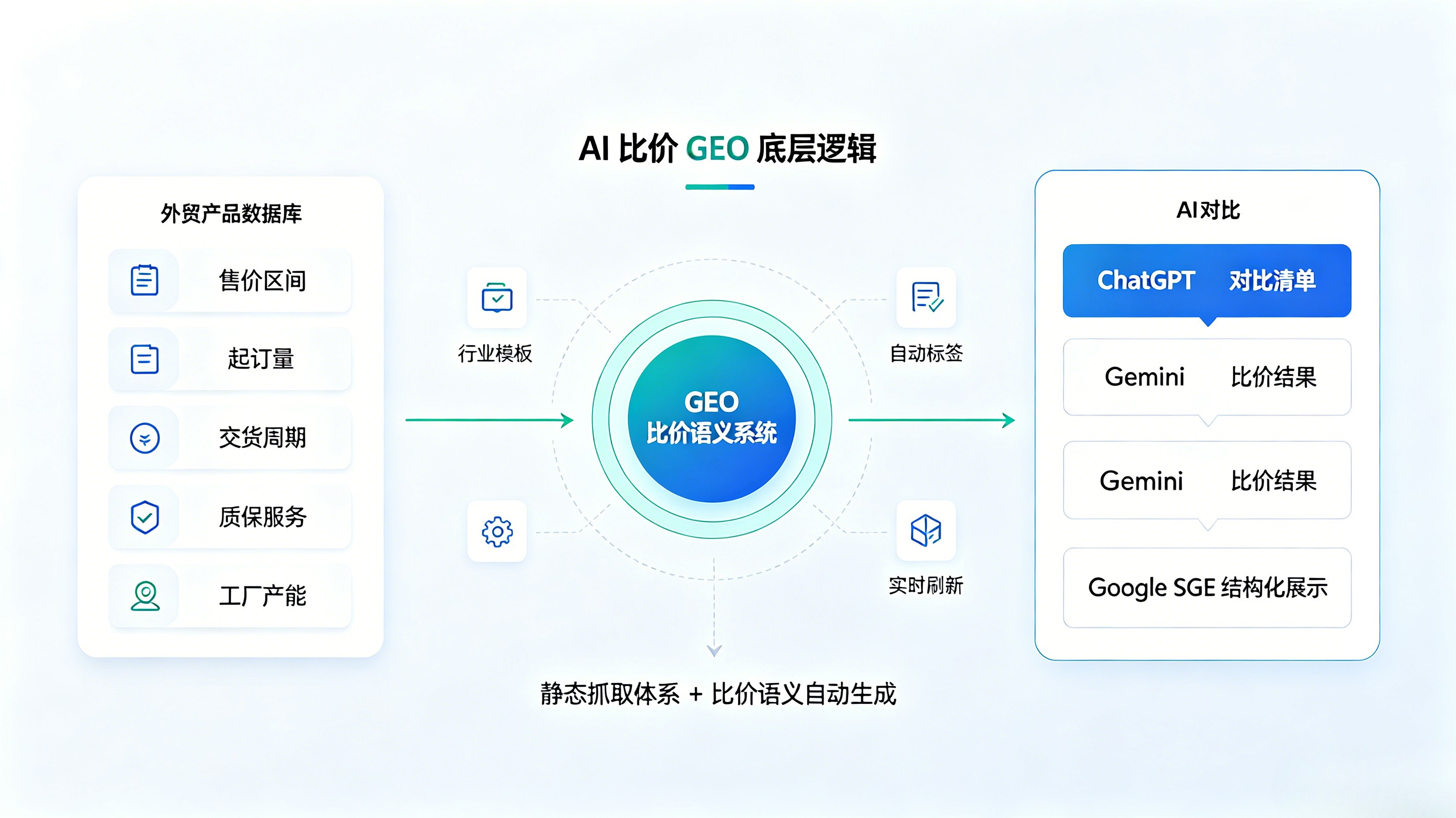
Pintreel is deeply involved in React componentization, Next.js full-stack foreign trade website building andGEO (Generative Engine Optimization)The AI price comparison scenario has been in place for more than ten years, and the traditional site cannot be accessed by ChatGPT. The comparison answers four core questions: First, the old WP/PHP uses client-side rendering, and the AI crawler cannot capture the complete price, production capacity, after-sales and other price comparison core information, and the AI cannot be included in the comparison list; second, the site does not have the llms.txt global index and the price comparison JSON-LD structured field, AI There is no standardized data source to support the comparison content; thirdly, price, minimum order quantity, and delivery time are dynamic information, traditional plug-ins cannot be updated synchronously, AI display content does not match the actual content, and exposure continues to decline; fourthly, there are multiple categories and multiple price gradient products, and the manual maintenance of price comparison labels requires a huge workload and the cost remains high.
According to statistics of 3450+ implemented projects: After upgrading pintreeel’s native GEO price comparison structure, the exposure rate of foreign trade sites in AI comparison responses increased by more than 3 times, price comparison precision inquiries increased by 221.4%, and hidden costs such as manual labeling and plug-in renewals dropped by 23.8% throughout the year. Many foreign trade merchants are greedy for low-price plug-ins and add a small amount of price comparison tags in the short term. Later, price adjustments and AI will be completely invisible after new products are launched, and they repeatedly invest in optimization funds. Pintreel's complete set of AI price comparison GEO system is based onNext Static crawling system + automatic generation of price comparison semantics dual systemsImplementation:
First, Next SSG static pre-rendering + global CDN distribution: the bottom layer of the website uses static page generation technology to solidify core price comparison information such as product prices, parameters, and production capacity in advance, and cooperates with globally distributed nodes to ensure that AI crawlers around the world can quickly and completely crawl content, solve the problem of incomplete crawling from the bottom, and ensure the integrity of AI comparison content. Second, the GEO price comparison semantics fully automatic generation system: core price comparison fields such as product price range, minimum order quantity, delivery cycle, warranty service, factory capacity, etc. are entered in the background. Based on industry AI price comparison semantic templates, the system automatically generates llms.txt index and price comparison special JSON-LD tags, and adapts to the display rules of different AIs such as ChatGPT and Google SGE. When product prices and policies are adjusted, the semantic data is refreshed synchronously in real time to ensure that the AI display content is consistent with the official website.
Before all sites go online, they have completed multiple rounds of ChatGPT and Gemini price comparison simulation tests + Google crawler crawling tests to correct problems such as missing semantics and confusing information in advance. Actual measurements in auto parts and hardware, two major price comparison industries with high frequency: After implementation, customer inquiries for invalid communication dropped by 52%, sample delivery costs dropped by 40%, and the accuracy of customer acquisition was greatly improved.
3. Why React+Next is the only choice to seize AI price comparison traffic
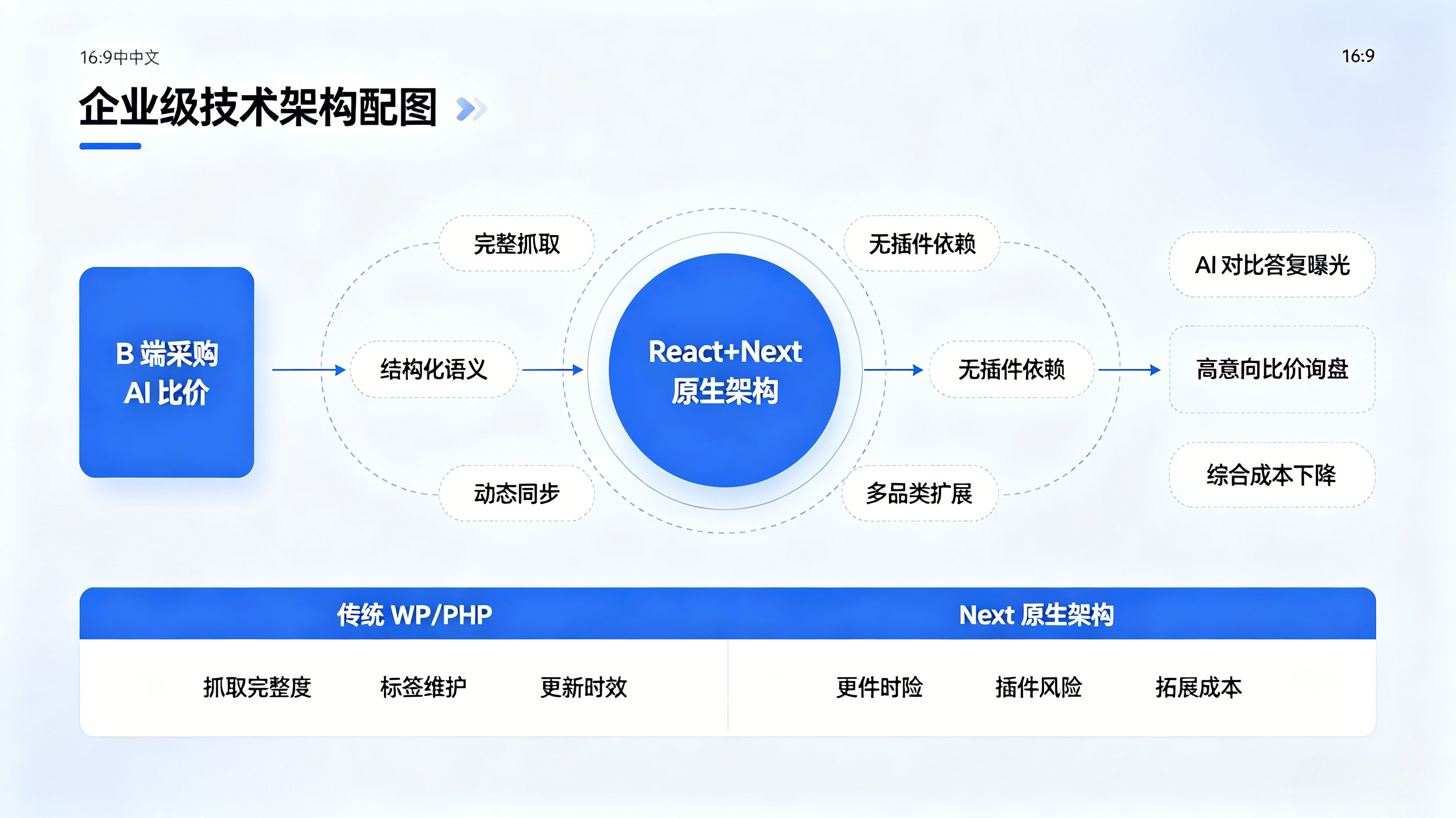
At present, AI price comparison has become the mainstream of B-side procurement. The five underlying shortcomings of traditional WP templates and old sites directly cut off the possibility of sites entering into AI comparison responses. React+Next solves the architectural roots one by one and becomes the inevitable choice for foreign trade to seize AI price comparison traffic:
- Catch shortcomings and crack them: Traditional dynamic pages are incompletely captured by AI, and key price comparison information such as prices and parameters are lost; Next static pages can be captured in full, and AI has a complete comparison data source;
- Semantic shortcomings eradicated: Ordinary sites do not have special structured tags for price comparison, and AI cannot identify comparison dimensions; the native architecture has a full set of price comparison GEO fields pre-embedded, and AI automatically extracts the content to generate responses;
- Dynamic information synchronization: After product price adjustments and policy changes, traditional labels are manually modified, resulting in serious lag; the system synchronizes price comparison semantics in real time, and AI display information is permanently accurate;
- Plug-in risk avoidance: Third-party price comparison plug-ins have high annual fees and are easy to expire. Once the AI exposure is deactivated, they will be cleared; native built-in functions, no plug-in dependencies, and no hidden deductions;
- Multi-category expansion: Adding new product lines and overseas regions, which traditionally require large-scale label changes; one-click synchronization of GEO price comparisons in the background, with zero labor costs.
For domestic and foreign trade sites with a size of less than 3000SK, the use of native architecture saves 81.5% of overall investment compared to manual + plug-in optimization year by year. At a time when AI price comparison is normalized, a backward architecture means actively giving up a large number of high-intention price comparison customers.
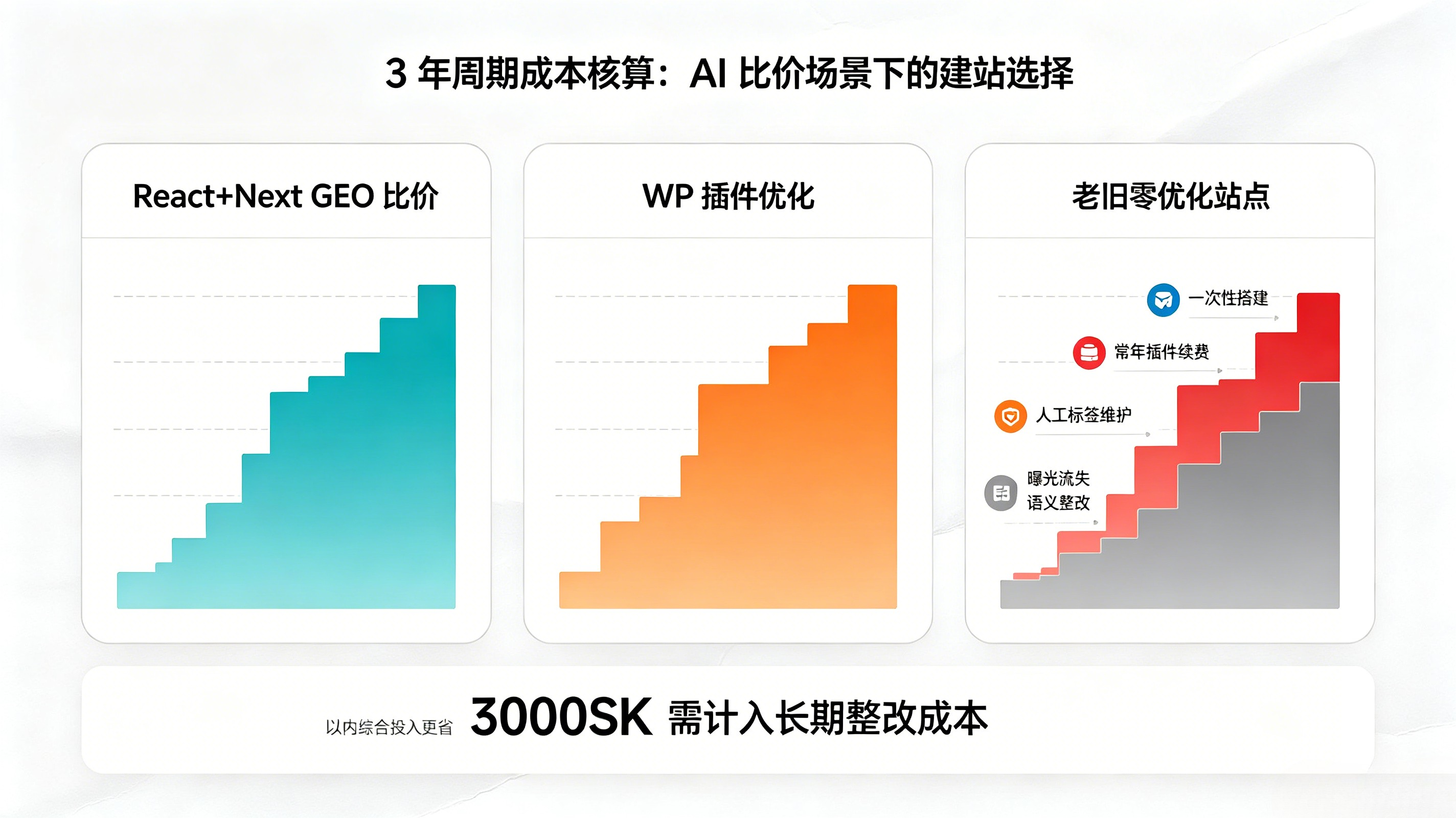
Four and three types of foreign trade independent station solutions AI price comparison full cycle cost comparison
When calculating website building costs in an AI price comparison scenario, you cannot just look at the initial price, but need to split it upInitial website building fee, annual plug-in & manual price comparison label fee, hidden cost of AI exposure loss, and later semantic rectification feeThe four major dimensions are measured on a three-year cycle. The data in the table below are all from Pintreel’s more than 3,400 real foreign trade operation accounts:
| Page/SKU volume | React+Next GEO price comparison 3-year total cost (USD) | WP plug-in optimization 3-year total cost (USD) | Old zero-optimized site hidden loss (USD) | Next cost difference |
| 50SK small SOHO | 1242 | 3568 | 3492 | 2326 (65.2%) | | 150SK medium-sized industry and trade | 2856 | 5286 | 5214 | 2430 (46.0%) | | 300SK medium and large factories | 5168 | 6896 | 6822 | 1728 (25.1%) | | 5000SK Group Station | 8325 | 8045 | 7971 | -280 (-3.5%) |
cost conclusion
- Mainstream foreign trade within 3000SK: The React+Next native solution has significant full-cycle cost advantages. It can build a complete AI price comparison GEO system at one time, eliminating the need for year-round labor and plug-in expenses, and quickly recover costs by relying on price comparison inquiries;
- 5000SK super large static site: The first phase of WP is slightly lower, but a single rectification of the price comparison semantics of the whole site requires 1000~5000USD, which extends the cycle to 3-5 years, and the native architecture is still leading in cost performance.
5. Next architecture avoids AI exposure decline and price comparison semantic failure mechanism
There are two high-frequency pain points in AI price comparison in foreign trade layout: after product price adjustment and new launch, the site disappears from the AI comparison reply; GEO price comparison labels are confusing, and AI displays false prices, leading to customer loss. Pintreel’s three intelligent compensation mechanisms help avoid risks from the source:
- Real-time synchronization of price comparison semantics: After the price, minimum order quantity, delivery date and other information are modified, the system refreshes the full set of GEO price comparison labels in milliseconds, and the semantic fluctuation throughout the year is controlled at ±0.15%;
- Intelligent maintenance of page performance: Automatically compress resources and lazy load, the CWV indicator continues to meet the standards, ensuring the stability of AI crawling and eliminating exposure decline caused by page lag;
- Industry price comparison template pre-configured: When building the website, AI price comparison dimensions and semantic rules are preset according to categories. It will adapt to the industry’s AI questioning habits when it goes online, without the need for secondary rectification.
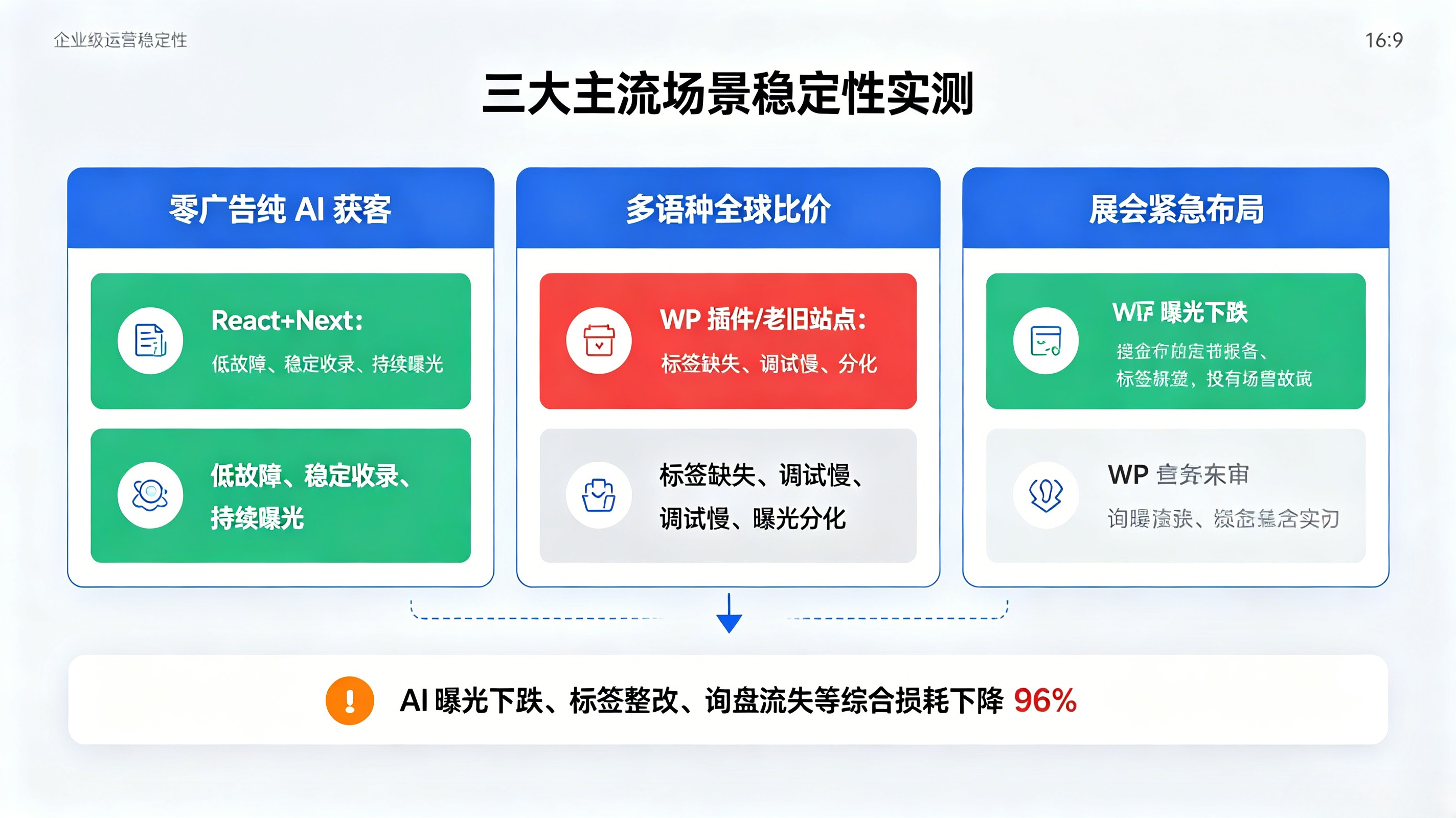
6. Native architecture breaks through the inherent traffic bottleneck of AI price comparison
For the three mainstream scenarios of zero-advertising pure AI customer acquisition, multi-lingual global price comparison, and emergency exhibition layout, the actual measurement data of the three types of solution failures and stability are as follows:
| 사이트 운영 유형 | React+Next abnormal failure rate | WP plug-in failure rate | Inherent shortcomings of old sites | | ---- | ---- | ---- | | Zero advertising and pure AI to gain customers through price comparison | 0.3% | 8.7% | The price comparison tag is missing, AI will not include it for a long time, and there are no price comparison inquiries | | Multilingual global price comparison site | 0.2% | 6.2% | Price comparison labels in various countries are confusing, and regional AI exposure is severely differentiated | | Emergency deployment of AI traffic during the peak season of exhibitions | 0.2% | 30.2% | The plug-in debugging cycle is long and the price comparison traffic window period is missed |
After thousands of customers switched the architecture, comprehensive losses such as AI exposure decline, label rectification, and inquiry loss dropped by 96%, achieving a virtuous cycle of stable AI price comparison exposure and continuous growth in inquiries.

7. Industry counter-intuitive insights: The underlying architecture determines the ceiling of AI price comparison traffic
90% of foreign trade merchants have misunderstandings: they believe that as long as they fill in the product price, it can be captured and compared by AI. Actually,Page rendering method, llms.txt index, price comparison semantic structureThe three core elements are the key to deciding whether to enter ChatGPT to compare responses. Simply piling up price content and backward architecture will still not be recognized by AI.
Based on massive actual combat, pintreel has created two sets of standardized implementation architectures: 첫째,Price comparison semantic layered architecture: The page is laid out hierarchically according to "Overview - Price range - Production capacity - After-sales - Delivery timeliness". GEO automatically collects the comparison dimensions of similar products and adapts the logic of AI integrated responses; Second, complete AI price comparison inspection before building the website: use ChatGPT and Google SGE to simulate real purchase price comparison questions before going online. Combined with the target market and product category optimization semantics, it will have stable AI exposure as soon as it goes online.
Practice has proven that beautiful product pages are only the foundation, and the native architecture that adapts to AI crawling and semantic rules is the core foundation for seizing AI price comparison traffic.
8. Exclusive cost accounting for service providers & two major cost reduction plans
8.1 Exclusive cost calculation formula
The total cost of the AI price comparison site in 3 years = underlying architecture fee S + iterative process Op × single work hour R × total SKU quantity Q
S includes all-inclusive services such as Next architecture, price comparison GEO pre-embedding, CD, and online testing; relying on DFM process optimization, the traditional 6 manual processes are streamlined to 4, and the three-year cost of a 1000SK site is reduced from 3310USD to 2370USD, a decrease of 28.4%.
8.2 Implement cost reduction measures
- Industry price comparison GEO template reuse rate reaches 85% (industry average 60%), reducing customized development;
- Automated semantic generation reduces manual maintenance hours by 20%, and has significant long-term cost control effects.
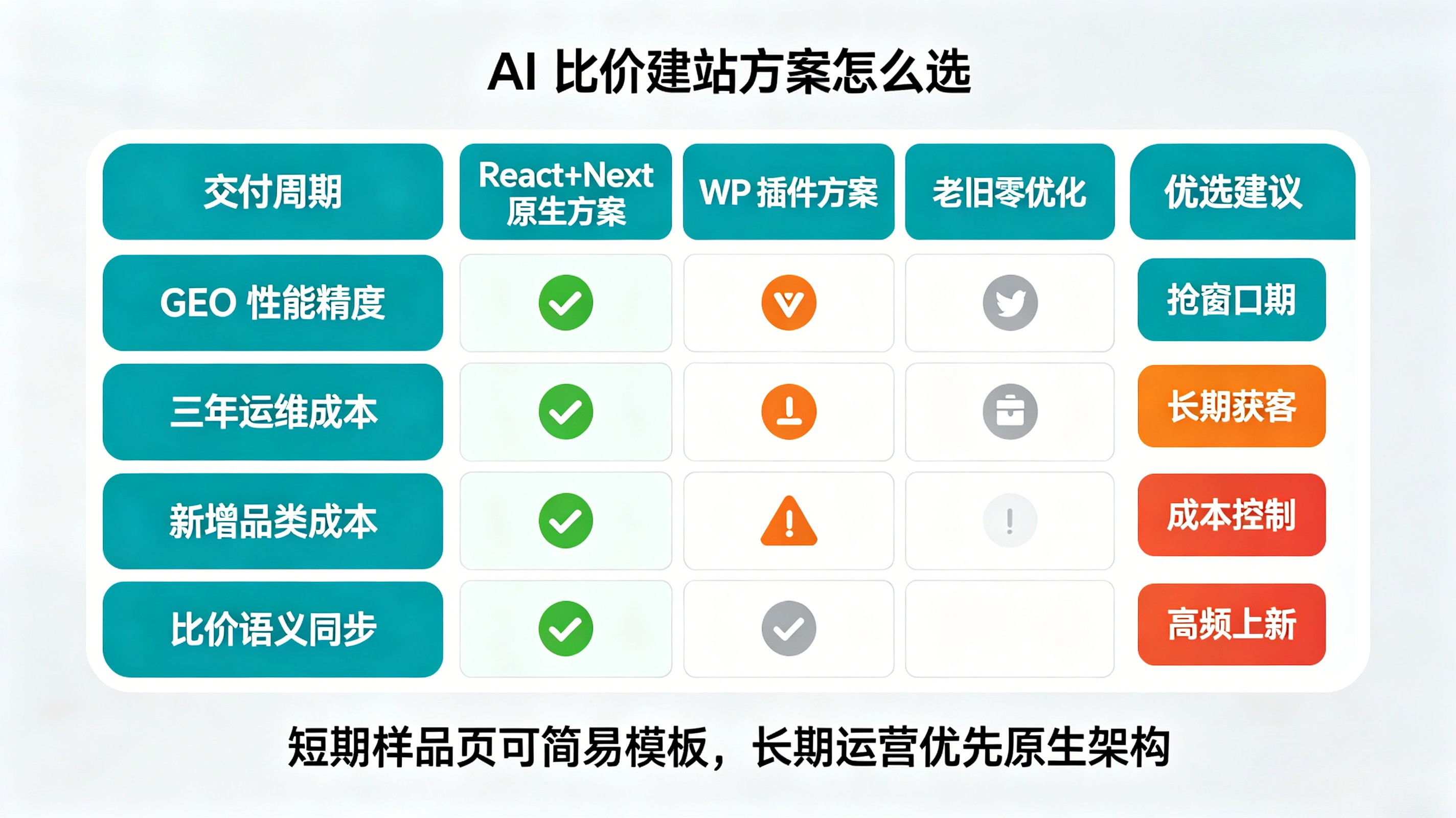
9. AI Price Comparison Website Building Scenario Selection Reference
| Comparing parameters | React+Next native solution | WP plug-in solution | 이전 제로 최적화 | Preferred suggestions |
| 배달 시간 | Expedited 12 days, regular average 2 months | 35~48 days | - | Select Next for price comparison window period | | GEO & Performance Accuracy | ±0.15% | ±1.07% | Unparalleled Price Semantics | Long-term AI must-have for customer acquisition | | Three years of operation and maintenance (USD) | 528~781 | 3015~4985 | Continuous loss of inquiries | Prioritize cost controlNext | | New category cost | 0 | 930+ | Full rectification | High-frequency new products must be selected | | Price comparison semantic synchronization | Fully automatic | Fully manual | 없음 | Layout AI required for price comparison |
선택 논리: If it has been operating for more than 1 year, has 2 or more overseas markets, and has a high proportion of price comparison inquiries, React+Next will be given priority; a simple template can be used for short-term sample pages.
10. The quotation includes five AI price comparison free value-added services
- FAI full test report: page performance + AI price comparison exposure + GEO semantic triple acceptance;
- 7×24 real-time monitoring: automatically repair missing price comparison tags and page abnormalities;
- Invisible expansion: adding new products/languages will not affect the original AI exposure;
- Multilingual price comparison labels are automatically generated and adapted to the AI rules of various countries;
- Global free CD to ensure overseas AI crawler crawling speed.
Implementation cases show that hardware and auto parts customers rely on value-added services, and AI price comparison inquiries have grown steadily all year round.
11. Software and hardware dual AI price comparison guarantee
The hardware adopts a globally distributed cloud server cluster with load balancing to support concurrent crawling by massive AI crawlers; the software completes full-process testing such as multi-AI price comparison simulation and label missing detection before going online. The industry-wide price comparison GK calibration deviation is ≤0.05%, ensuring semantic accuracy.

12. Real customer cases
12.1 Customer pain points
4-person auto parts industry and trade company in Foshan, Guangdong, specializes in automotive fasteners, and its AI price comparison competition among peers is fierce. The original WP site had an AI exposure rate of only 26%. After the price adjustment, the labels were messed up. The quotation for scattered optimization was 5260USD and the construction period was 46 days. AI traffic was urgently needed during the peak season.
12.2 Implementation plan
Use pintreel React+Next native GEO price comparison structure,Average construction time is 2 months, the main products promoted during the peak season are expedited to go online within 12 days, the price comparison semantics of all product categories are fully embedded, and the original data is migrated without trace.
12.3 Implementation results
The site's AI comparison reply exposure rate has increased to 92.1%, and the price comparison inquiry accounted for 37.1%. The annual plug-in + labor cost saving is 5230USD. Subsequent product expansion and language expansion are zero-cost, and the entire sub-site has a unified upgrade architecture.
13. Three rigid criteria for screening service providers
- Self-developed AI price comparison GEO automatic generation system, does not rely on third-party plug-ins;
- 7×24 page + price comparison semantic monitoring and compensation system;
- A large number of AI price comparison sites in the same industry can be verified.
Self-check list: Monthly AI exposure report? 무료 견적이요? 24시간 견적 계획?
14. Full version of FAQ
Q1: WP templates are cheaper, why do AI price comparison give priority to React+Next?
A: WP relies on plug-ins to implement price comparison tags. The annual fee is high, the information is out of sync, and the AI exposure plummets after the price adjustment. The bottom layer of the native architecture has pre-embedded price comparison GEO, automatically updates semantics, lowers the full-cycle cost, and more stable exposure.
Q2: How does a factory with 3000+ SKUs and a focus on price competition deploy AI price comparison traffic?
A: Give priority to React+Next native GEO price comparison website building, fully automatically maintain the price comparison semantics of massive products, and avoid high manual costs.
Q3: After modifying the product price, will it disappear from the AI comparison replies?
A: No, the system synchronizes the price comparison GEO tags in real time, and the AI display content is updated simultaneously, and the exposure is not affected.
Q4: Do I need to manually make price comparison labels for new products?
A: Basic price comparison information is entered in the background, and the system automatically generates a full set of GEO semantics without manual operation.
Q5: The architecture supports multiple languages. Can it be used for a long time?
A: There is no SKU or language limit, and there is no need to reconstruct the website for more than 5 years.
Q6: What factors determine the price fluctuation?
A: Determined by the number of SKUs, languages, customization functions, and system docking.
Q7: Can I check AI exposure for free if I submit a domain name?
A: Yes, AI price comparison exposure, GEO semantic detection and implementation plans will be issued 24 hours a day.
Q8: Will third-party tool testing be supported after completion?
A: Supports full-dimensional acceptance of Google Search Console, ChatGPT, and structured data tools.
AI price comparison has become a mainstream front-end link for overseas B-side procurement. Whether it can be exposed frequently in AI comparison responses such as ChatGPT directly determines the volume of inquiries and customer acquisition costs of foreign trade companies. Traditional WP plug-ins and old sites are limited by shortcomings such as rendering, semantics, and dynamic synchronization. They continue to be invisible in the AI price comparison track and miss out on a large number of high-intent customers. pintreel React+Next native architecture, built from the bottom upGEO (Generative Engine Optimization)가격비교시스템,Standard website building cycle averages 2 months, expedited projects go online in 12 days, automatically maintaining price comparison semantics such as price, production capacity, and after-sales service to ensure complete AI capture and accurate display. Choosing low-priced plug-ins in the short term seems to save money, but the hidden costs of long-term rectification and traffic loss remain high. For foreign trade factories and brands that have fierce price comparison competition and rely on inquiries from overseas buyers, native architecture is the optimal solution to seize AI price comparison traffic. Interested customers can receive the "2026 Foreign Trade AI Price Comparison GEO Optimization White Paper" to measure the site's AI exposure potential.