
Data from the beginning of 2026 shows that Central and Eastern Europe has become a core "bridgehead" in the EU market, with the region's cross-border distribution demand growing at an average annual rate of nearly 10%. Countries like Poland and the Czech Republic, leveraging their low-cost labor and logistics advantages, have become important distribution hubs for Chinese goods reaching Western and Northern Europe. Meanwhile, AI search has captured 68% of traffic in foreign trade procurement, and platforms like ChatGPT have become core channels for Central and Eastern European distributors to select suppliers. However, only 13% of independent Chinese cross-border distribution websites are prioritized by AI in searches related to "foreign trade distribution suppliers." The core issue is that most sites have not undergone deep GEO optimization tailored to the compliance requirements, distribution habits, and logistics characteristics of Central and Eastern Europe, instead relying solely on general foreign trade optimization logic, resulting in content that cannot match the AI's localized crawling rules. A company specializing in home appliance distribution in Central and Eastern Europe achieved a 240% increase in core search exposure on its AI platform and a 160% increase in inquiries from distributors in Poland and Hungary within two months of targeted GEO optimization at the end of 2025, which focused on distribution capabilities and compliance. This case demonstrates that the core of GEO optimization in the Central and Eastern European distribution scenario is "regional compliance + distribution capability visualization." Only content that fits the characteristics of the region can capture the blue ocean of AI search.
I. Core Logic: AI Platform "Foreign Trade Distribution Supplier" Search and Recommendation Rules and GEO Collaboration Logic
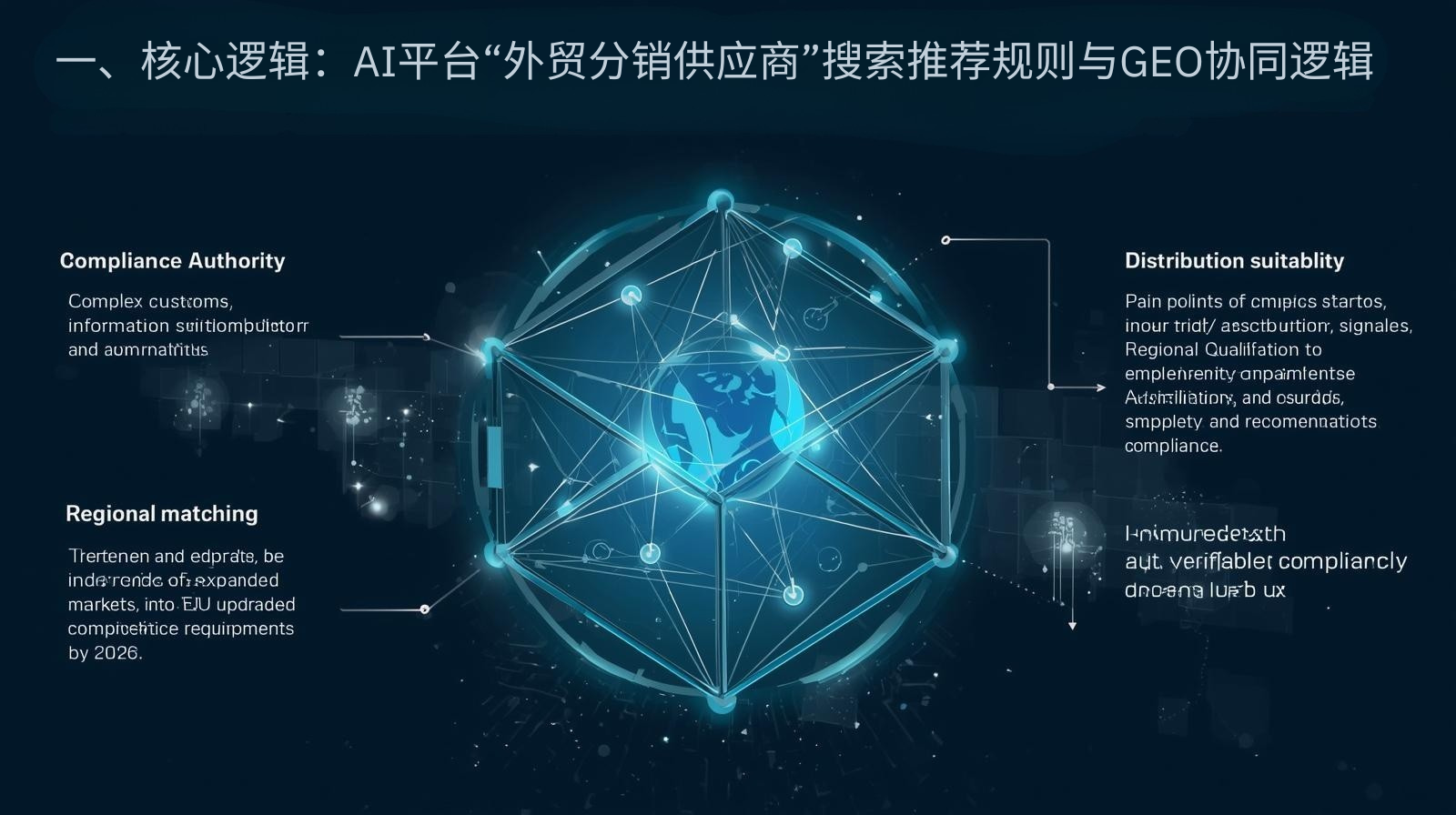
AI platforms like ChatGPT have developed a three-dimensional evaluation system for searching and recommending cross-border distribution suppliers in Central and Eastern Europe, encompassing "compliance authority, distribution suitability, and regional matching." This system particularly emphasizes identifying supplier content that addresses pain points in Central and Eastern European distribution (cumbersome customs clearance, information asymmetry, and payment risks). The core value of GEO optimization lies in transforming the distribution capabilities and compliance qualifications of independent websites into AI-recognizable regional signals, accurately matching the search needs of Central and Eastern European distributors. This aligns perfectly with the core trends of "expanded distribution market, widespread adoption of AI procurement, and upgraded compliance requirements" in Central and Eastern Europe by 2026.
1.1 Three Core Rules for AI Platform Search and Recommendation of "Foreign Trade Distribution Suppliers" (Latest 2026)
Based on AI platform analysis of search algorithms in Central and Eastern Europe, EU distribution compliance policy requirements, and practical procurement scenarios for Central and Eastern European distributors, the core rules for AI to prioritize recommending content from distribution suppliers can be broken down into three points that directly determine whether an independent website can rank highly in search results:
1. Authoritative and Verifiable Compliance Qualifications (Core Access) : AI prioritizes content with essential compliance qualifications required for distribution in Central and Eastern Europe. Core qualifications include the EU EORI registration number (Economic Operator Identification Number, valid throughout the EU and essential for customs clearance), the target country's VAT tax registration certificate, and product CE certification. Qualification numbers and official verification links must be clearly indicated. For example, when displaying "Polish distribution qualifications," AI will prioritize content containing "EORI number: PL2026XXXX, VAT number: PL123456789, CE certification verification link: https://ec.europa.eu/ecip/". Sites without compliance qualifications or whose qualifications cannot be verified will have their recommendation weight reduced by 75%.
2. Structured Presentation of Distribution Capabilities (Core Advantage) : AI excels at extracting structured information on distribution capabilities. Core dimensions include distribution center layout (whether there are warehouses in Central and Eastern Europe, and their coverage), customs clearance efficiency (average customs clearance time, solutions to customs clearance pain points), delivery timeliness (regional distribution timeliness, delivery cycle covering Western Europe), and cooperation models (bulk distribution, small-batch drop shipping, regional exclusive agency). For example, content presented in a structured manner as "distribution center - customs clearance service - delivery timeliness - cooperation model" is 4.6 times more likely to be captured by AI than pure paragraph content. Vague expressions (such as "possessing comprehensive distribution capabilities") cannot be recognized by AI as having core value.
3. Deep Adaptation to Regional Needs (Core Conversion) : AI will recommend content differentiated based on the characteristics of Central and Eastern European countries (language, payment, purchasing preferences). Core adaptation dimensions include language adaptation (support for multiple languages such as English, Polish, and Czech), payment adaptation (support for commonly used local payment methods such as Przelewy24), and category adaptation (popular regional distribution categories such as energy-saving heaters, home fitness equipment, and small appliances). For example, when searching for Polish distributors, AI will prioritize recommending content highlighting "Polish customer service, Warsaw distribution center, support for Przelewy24 payment, and bulk distribution of energy-saving heaters." Mismatched regional adaptation will directly reduce the conversion rate.
1.2 The Mutual Empowerment Logic of GEO and Distribution Capabilities in Central and Eastern Europe
The essence of GEO optimization is to "enable AI and Central and Eastern European distributors to quickly identify the regional compatibility of a site." The core of Central and Eastern European distribution capabilities lies in "compliant customs clearance, efficient distribution, and localized services." The two mutually empower each other, building core competitiveness in AI search. The core logic is reflected in three points:
1. GEO enables distribution capabilities to "precisely reach the target audience": Distribution content without GEO optimization becomes generalized information that is difficult for AI to match; by deeply binding distribution capabilities with keywords and pain points in the Central and Eastern European region through GEO, the accuracy of AI capture can be greatly improved; for example, "has customs clearance capabilities" can be optimized to "dedicated customs clearance services for cross-border distribution in Central and Eastern Europe, solving the pain point of repeated inspections by Polish/Czech customs, with an average clearance time of 3-5 days, and holding EU EORI qualification", which highlights the core advantages and strengthens regional adaptability.
Distribution capabilities make GEO optimization "more credible and convertible": The core of GEO optimization is content value. Customs clearance solutions, distribution center resources, and localized cooperation cases exclusive to Central and Eastern Europe are high-quality materials for GEO optimization. After being regionalized, these materials form a content matrix of "compliance + capability + region". For example, the generalized content of "having an overseas warehouse" is optimized to "Warsaw Distribution Center (2000㎡), covering the entire territory of Poland and surrounding markets in the Czech Republic and Slovakia, supporting 24-hour outbound delivery, and regional distribution and delivery time of 1-3 days", making the content of GEO optimization more persuasive.
The two work together to achieve a "double boost in search exposure and distribution conversion": GEO optimization improves the ranking and exposure of content in AI search, helping sites seize the blue ocean of "foreign trade distribution suppliers" search results; structured distribution capabilities lower the trust threshold for distributors, driving inquiry conversion. According to 2026 cross-border logistics market insight data, independent distribution sites with deep GEO optimization have an inquiry conversion rate 2.1 times higher in the Central and Eastern European market than sites with general optimization.

II. Practical Implementation: GEO Three-Stage Optimization Solution for Independent Distribution Websites in Central and Eastern Europe
This solution combines Central and Eastern European distribution compliance policies, the operational case of the Warsaw/Prague distribution center, and references the EU EORI registration guidelines and AI search optimization techniques. It is completed in three stages: "preliminary preparation + core optimization + enhanced adaptation" to ensure that the independent website accurately matches the AI's "foreign trade distribution supplier" search rules, while also meeting the needs of Central and Eastern European distributors.
2.1 First Phase: Preliminary Preparation (3-4 days) – Core Element Analysis + GEO Keyword Development
The core objective is to identify key elements of distribution in Central and Eastern Europe, build a targeted GEO keyword library, and lay the foundation for subsequent optimization. All materials must meet the "verifiable and structured" requirements for AI-driven data capture.
1. Core Distribution Elements: ① Compliance Qualification Materials: Collect EU EORI registration certificate, VAT tax registration certificate of the target country (Poland, Czech Republic, etc.), and CE certification documents for products, and obtain official query links (such as the EU EORI query platform, Polish customs website); ② Distribution Capability Materials: Compile information on distribution centers (location, area, coverage, warehousing capacity), customs clearance service plans (cooperative customs clearance agencies, average delivery time, pain point solutions), delivery time data (regional distribution time, delivery time to Western Europe), and cooperation models (minimum order quantity, agency policy, after-sales guarantee); ③ Localization Materials: Compile target country languages (Polish, Czech core vocabulary), local payment methods (Przelewy24, Sofort, etc.), and popular distribution categories (refer to the 2025 European Cross-Border E-commerce Report, focusing on energy-saving heaters, home fitness equipment, and small appliances).
2. Building a Regionalized GEO Keyword Database: ① Keyword Combination Logic: Combining keywords according to "regional terms + distribution terms + product category terms + compliance terms," with core keywords (e.g., "Central and Eastern Europe foreign trade distribution supplier, CEEC cross-border distribution supplier"), long-tail keywords (e.g., "Polish home appliance distribution supplier, Czech Republic customs clearance facilitating distribution service provider"), and scenario-based keywords (e.g., "Central and Eastern Europe small batch drop shipping, EU EORI qualified distribution") accounting for 30%, 50%, and 20% respectively; ② Regional Adaptation: Splitting keywords according to core markets, focusing on keywords related to "Warsaw distribution center, Przelewy24 payment, Polish customer service" in the Polish market, and keywords related to "Prague customs clearance, Czech language support, small home appliance distribution" in the Czech market; ③ Keyword Selection: Using AI keyword tools to query high-frequency search terms in the Central and Eastern Europe region from October 2025 to January 2026, prioritizing keywords with high search frequency and low competition, and eliminating keywords that contradict the distribution scenario (e.g., "retail, personal purchase").
2.2 Second Phase: Core Optimization (5-6 days) – Content Integration + Page Optimization + Trust Endorsement Reinforcement
The core objective is to naturally integrate Central and Eastern European distribution capabilities with GEO keywords, optimize the core pages of the independent website, and create a content system that AI can recognize and that distributors can trust. The key optimization points are as follows:
2.2.1 Core Page Content Optimization
1. Homepage Content Optimization: The first screen highlights the core value of distribution in Central and Eastern Europe (e.g., "Focusing on cross-border distribution in Central and Eastern Europe, fully accredited with EU EORI, dual distribution centers in Warsaw/Prague, convenient customs clearance + 24-hour regional delivery"), accompanied by real images of distribution centers, customs clearance processes, and local delivery scenarios (image ALT tags embed localized GEO keywords, such as "Poland electrical appliance distribution supplier, EORI certified"); core sections are divided into "Compliance Qualifications, Distribution Network, Customs Clearance Services, and Cooperation Cases," with the Compliance Qualifications section displaying EORI/VAT numbers and official query links, the Distribution Network section using a map to indicate coverage, and the Customs Clearance Services section highlighting pain point solutions (e.g., "Solving the problem of duplicate inspections, shortening the customs clearance cycle by 30%)"; 2. Product distribution page optimization: Each category page highlights "regional distribution adaptation," such as "EU CE certified energy-saving heater, in stock at the Warsaw, Poland distribution center, supports bulk distribution (MOQ≥100), local payment Przelewy24, regional delivery time 1-3 days, with EORI qualification query link," and simultaneously indicates the product's applicable distribution model and after-sales policy; 3. Distribution guide page optimization: A "Central and Eastern Europe Distribution Guide" column has been established, publishing content such as "Polish Distribution Customs Clearance Practical Guide" and "Central and Eastern Europe Distributor Cooperation Policy," presented in a structure of "core policy + practical steps + case evidence + official link." For example, when interpreting the customs clearance guide, a link to the Polish customs website process is cited, along with a case study of a home appliance brand improving distribution efficiency by optimizing the customs clearance process.
2.2.2 Copywriting and Structure Optimization
1. **Copywriting Style Adaptation:** The copywriting style is tailored to the purchasing needs of Central and Eastern European distributors, using a concise and pragmatic tone. It emphasizes core selling points such as "guaranteed compliance, efficient customs clearance, fast delivery, and flexible cooperation," avoiding exaggerated claims. For example, "We have deep roots in the Central and Eastern European distribution market, holding full EU EORI certification. With distribution centers in Warsaw and Prague, we can help you solve problems like cumbersome customs clearance and delayed delivery, flexibly adapting to both bulk distribution and small-batch dropshipping needs." 2. **Optimized Content Structure:** All core content is presented in a structured format of "core capabilities + data support + case studies + regional adaptation," using bullet points, tables, and charts to optimize the presentation. For example, tables are used to present distribution timelines, payment methods, and compliance requirements for different countries, allowing AI and distributors to quickly extract core information. 3. **Multilingual Adaptation:** Core content is primarily in English, with supplementary summaries in local languages for core markets such as Poland and the Czech Republic (e.g., Polish "dystrybucja hurtowa" and "obsługa w języku"). The translation of "polskim" is tailored to local language habits, avoiding the awkwardness that can result from a literal translation.
2.2.3 Trust Endorsement Optimization
1. Transparent Compliance Information: The independent website features a dedicated "Compliance and Qualifications" section, clearly displaying EORI registration certificates, VAT tax registration certificates, and CE certification documents (key information is masked), along with the numbers of all qualifications and official verification channels (e.g., EU EORI verification link: https://ec.europa.eu/taxation_customs/dds2/eori/main.jspx?lng=EN); 2. Concrete Distribution Case Studies: Real-world cooperation cases are displayed by region, with each case including "distributor's region, industry, core pain points, cooperation solution, and cooperation results," for example, "A Polish home furnishing distributor: core pain points are long customs clearance cycles and delayed delivery; cooperation solution: leveraging the Warsaw distribution center's readily available stock, optimizing the customs clearance process; cooperation results: distribution efficiency increased by 40%, and monthly order volume doubled"; 3. Clarify cooperation policies: Clearly publicize cooperation policies for distributors in Central and Eastern Europe, including minimum order quantities, pricing systems, regional protection policies, and after-sales response timelines (e.g., "24-hour after-sales response in the Polish market and 48-hour response in the Czech market"), to enhance distributors' willingness to cooperate.
2.3 Phase Three: Enhanced Adaptation (2-3 days) – Improving AI Crawling and Recommendation Weights
The core objective is to strengthen AI's recognition of the independent website's identity as a "Central and Eastern European distribution supplier" through actions such as signal submission and authoritative endorsements, thereby improving GEO optimization results and search rankings.
1. AI-driven signal submission: ① Sitemap optimization: Categorize and label core pages such as the homepage, product distribution page, and distribution guide page by "Region (Central and Eastern European core countries) + Distribution + Category" (e.g., "Poland-distribution-electrical appliances"), generate a custom sitemap, and submit it to the ChatGPT webmaster platform and Google search console, while also labeling it with core tags such as "CEEC distribution" and "EORI certified"; ② Crawler permission settings: Ensure that the independent website's robots.txt protocol allows access from mainstream AI crawlers such as OpenAI and Google, as well as search engine crawlers, to prevent core distribution capabilities and compliant materials from being blocked; 2. Authoritative endorsements and backlink optimization: Authoritative backlinks are naturally embedded in the content, such as links to the EU EORI query platform, Polish customs clearance guidelines, and cooperation certificates from the Central and Eastern European Trade Association. This is combined with links to Central and Eastern European trade reports from authoritative media outlets like Global Times and Phoenix News. Content related to Central and Eastern European distribution (such as "Key Compliance Points for Central and Eastern European Distribution in 2026" and "Warsaw Distribution Center Operation Review") is published on platforms like LinkedIn and Facebook, with links to independent websites to reach targeted Central and Eastern European distributors. 3. Content updates and maintenance: Core content is updated monthly, supplementing with the latest compliance policy adjustments (such as updates to EU EORI data requirements), distribution center operational dynamics, and new cooperation cases to ensure timeliness. AI prioritizes recently updated authoritative regional content.
III. Pitfall Avoidance Guide: 6 Core Misconceptions in GEO Optimization for Independent Websites in Central and Eastern Europe (Key Points to Avoid in 2026)
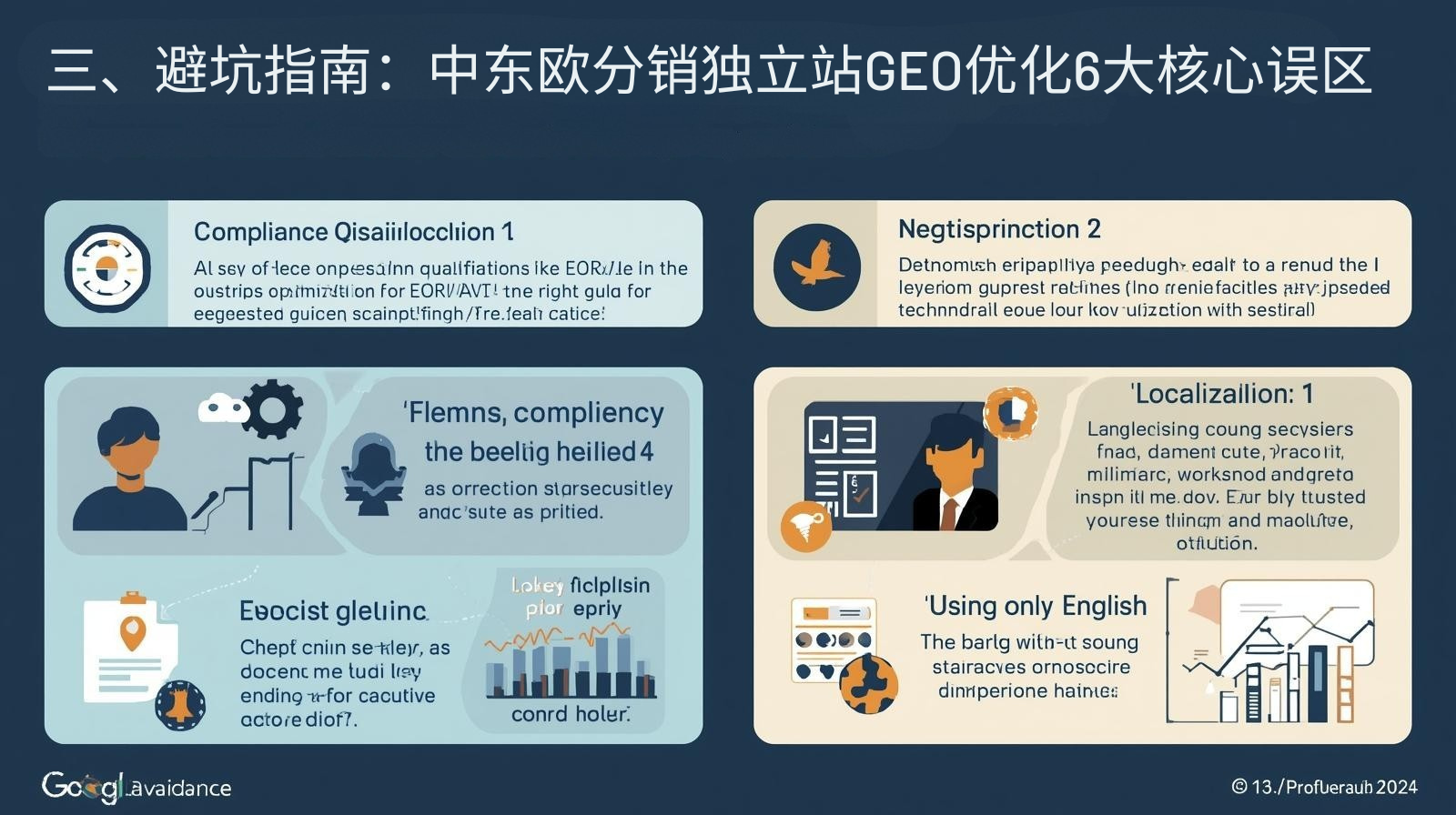
Based on practical case studies of distribution in Central and Eastern Europe in 2025-2026 and experience in AI search optimization, the following six common misconceptions can directly lead to low AI crawling efficiency, poor distribution conversion rates, and even compliance risks, and must be resolutely avoided:
3.1 Misconception 1: Lack of compliance qualifications, failure to mention core qualifications such as EORI/VAT
Errors : The independent website does not display the EU EORI registration certificate or the target country's VAT qualification, only vaguely mentions "compliant operation", or even uses false qualification information that cannot be verified through official channels;
Key risks : If AI determines that the content is not trustworthy enough, it will be directly excluded from the "foreign trade distribution supplier" recommendation list. Distributors may abandon cooperation due to their inability to confirm compliance, and may even face customs fines.
Correct practice : Fully display core qualifications such as EORI, VAT, and CE, indicate official verification links, ensure that the qualifications are authentic and verifiable, and simultaneously interpret compliance points to adapt to the distribution scenario in Central and Eastern Europe.
2. Myth 2: Ignoring language localization and using only English as the language.
Errors : The independent website uses only English content and has not adapted to the local languages of core markets such as Poland and the Czech Republic, or the local language translations are machine-translated, resulting in many grammatical errors and stiff expressions;
Key harms : It cannot cover the search needs of local language distributors, AI judges insufficient regional adaptability, the recommendation weight is reduced by 60%, and inquiries from core markets are almost zero;
Correct approach : Add a local language summary to the core market page, hire professional translators to optimize the translation, and ensure it conforms to local language habits and trade terminology.
3. Misconception 3: Keyword stuffing with GEO, disconnected from the distribution scenario
Errors include : forcibly piling up regional terms such as "Central and Eastern Europe, Poland, Czech Republic" and words such as "distribution, supplier", such as "Central and Eastern Europe, Poland, Czech Republic, distribution supplier of home appliances", which sounds awkward and does not naturally integrate with distribution capabilities and compliance qualifications;
Key harm : AI judges that the optimization traces are too heavy, the crawling probability is directly reduced to zero, and at the same time, it affects the reading experience of distributors, and the page bounce rate soars to over 75%;
Correct approach : Deeply integrate GEO keywords with distribution scenarios, such as "Polish home appliance distribution supplier, Warsaw distribution center with in-stock items, EORI fully qualified, convenient customs clearance", to ensure fluent sentences and accurate information.
4. Misconception 4: Distribution capabilities are vaguely described and presented without structure.
Error : The statement simply states "well-developed distribution network and high customs clearance efficiency" without specifying details such as the location of the distribution center, its coverage area, and customs clearance time. The content lacks a clear structure.
Key harm : AI is unable to extract core distribution capabilities, reducing the capture probability by 4.6 times. Distributors are unable to judge the actual service level of the site, resulting in a decrease in the willingness to make inquiries.
Correct approach : Present distribution capabilities in a structured manner, using specific data (distribution center area, customs clearance time, delivery range) and clear classifications (regional distribution, pain point customs clearance) to showcase core advantages.
5. Misconception 5: Failure to address the core pain points of distribution in Central and Eastern Europe, resulting in overly generalized content.
Error : The content is not optimized to address the core pain points of distribution in Central and Eastern Europe (cumbersome customs clearance, payment risks, and information asymmetry). It only uses general foreign trade distribution content and lacks targeted solutions.
Key risks : Misalignment with the needs of distributors in Central and Eastern Europe; AI-based assessment of insufficient demand matching; even if exposure is gained, it is difficult to convert into accurate inquiries.
Correct approach : Focus on core pain points such as customs clearance, payment, and information integration, and showcase targeted solutions, such as "Deep cooperation with local Polish customs clearance companies to solve the problem of duplicate inspections and shorten the customs clearance cycle by 30%".
6. Myth 6: Content is not updated for a long time and has poor timeliness.
Error : The content uses compliance policies, distribution center information, and case data from 2024 and earlier, without updating the EU EORI policy adjustments and changes in the Central and Eastern European distribution market in 2025-2026;
Key risks : AI prioritizes recommending recently updated authoritative content, reducing the probability of recommending outdated content by 75%. If compliance policy information is outdated, it may also mislead distributors and trigger compliance risks.
Correct practice : Update content monthly, keeping abreast of the latest compliance policies, distribution center operations, and new cooperation cases to ensure timeliness and accuracy.
Recommended Article: Your Competitors Haven't Reacted Yet: Building an Independent E-commerce Website with GEO is the Biggest Blue Ocean Strategy Right Now
Recommended Article: Your Competitors Haven't Reacted Yet: Building an Independent E-commerce Website with GEO is the Biggest Blue Ocean Strategy Right Now
IV. Conclusion: Breaking through with in-depth localization, seizing the blue ocean of AI distribution in Central and Eastern Europe with GEO.
In 2026, the Central and Eastern European cross-border distribution market is poised for expansion. As a "bridgehead" for Chinese goods to reach the EU, its distribution potential continues to be unleashed, and AI search has become a key tool for seizing this market. For cross-border distribution companies, the key to standing out in "foreign trade distribution supplier" searches lies not in the quantity of content, but in the depth of regional adaptation and the transparency of distribution capabilities.
GEO optimization for independent distribution websites in Central and Eastern Europe essentially transforms these sites into professional distribution suppliers that "understand Central and Eastern European compliance, address Central and Eastern European pain points, and adapt to Central and Eastern European needs." Through optimizations that visualize compliance qualifications, structure distribution capabilities, and precisely target regional requirements, AI can quickly identify and recommend products, enabling distributors to rapidly build trust. No complex technical support is required; simply follow the three-stage implementation plan outlined in this article, completing initial preparation, core optimization, and enhanced adaptation, while avoiding common pitfalls, to accurately tap into the blue ocean of AI search in Central and Eastern European distribution. In 2026, seizing the growth opportunities in the Central and Eastern European market, and using GEO optimization as a key strategy to deeply cultivate regional distribution scenarios, will undoubtedly lead to a dual breakthrough in precise exposure and distribution conversion.