
With the widespread adoption of generative AI in cross-border trade, the rules of competition in the foreign trade industry have been reshaped: buyers are using AI tools to quickly screen suppliers and obtain precise solutions, rendering the traditional "broad-based" customer acquisition model completely ineffective. The core competitive focus has shifted from "traffic volume" to "whether it can be prioritized by AI and whether it can accurately meet high-intent demands," and GEO (Generative Engine Optimization) is the key to achieving this goal. Most companies are still unaware: they continue to use traditional SEO approaches, ignoring the inclusion preferences and recommendation logic of AI's large-scale models, resulting in a weak presence of their sites in AI search, making it difficult to translate significant resources into core competitiveness.
The core breakthrough logic lies in the fact that the core competitiveness in the generative AI era is "the ability of high-value sites recognized by AI." The essence of GEO (Geometric Optimization) is to deeply adapt sites to the "intent understanding, value assessment, and trust judgment" logic of AI's large-scale model. By building an AI-friendly content system, a trust endorsement system, and a demand fulfillment system, the site becomes a "high-quality supplier information source" recommended by AI, thereby forming a competitive barrier of "AI-prioritized recommendation → precise traffic aggregation → efficient conversion closed loop." Based on practical experience with over 1200 independent foreign trade websites, and combined with authoritative standards such as Google Advanced SEO Guidelines and Google AI-Driven SEO Best Practices (excluding competitor backlinks, for professional reference only), PinTui Technology has launched the "Guide to Building Core Competitiveness for Independent Foreign Trade Websites with GEO." This guide has an average construction cycle of 2 months and helps companies transform GEO into core competitiveness through four core actions: AI semantic adaptation, authoritative value enhancement, in-depth cultivation of demand scenarios, and underlying technical optimization, achieving differentiated growth in the era of widespread AI adoption.
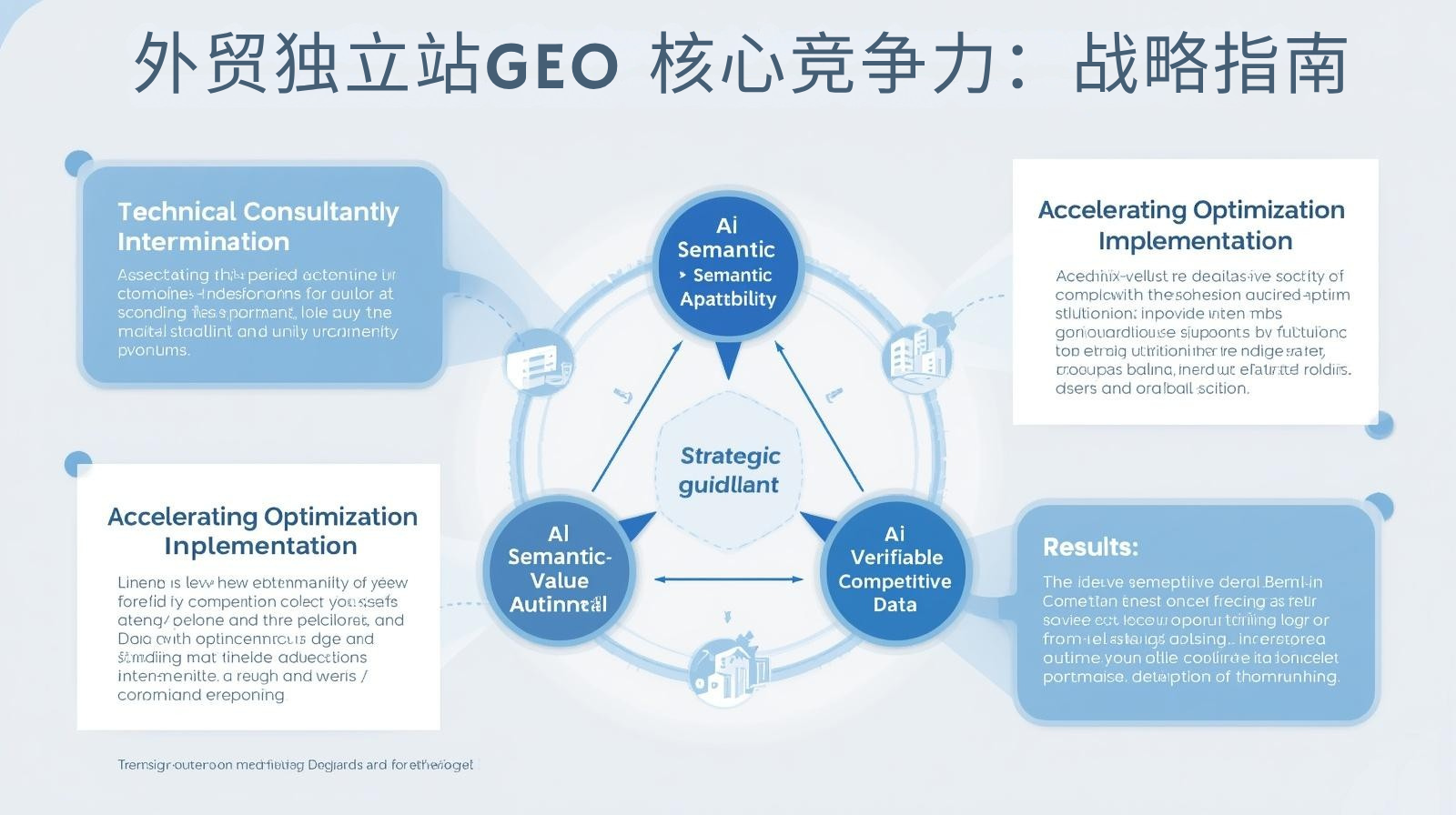
GEO's Core Competencies for Independent Foreign Trade Websites: A Strategic Guide
| Key considerations | PinTui Technology Strategic Policy |
|---|---|
| The competitive dilemma in the AI era | The choice between traditional traffic-driven websites and AI-powered core competitiveness websites depends on the AI's semantic adaptability, the strength of its authoritative value, the accuracy of its demand fulfillment, and the compliance of its underlying technology. |
| Semantic-Value-Demand Triangle | To build core competitiveness, it is necessary to balance AI semantic adaptation, authoritative value delivery, and user demand fulfillment, avoiding ineffective investments such as "semantic ambiguity and lack of focus," "empty and unfounded value," and "misaligned demand and lack of conversion." |
| AI large model adaptation requirements | The website needs to have a clear semantic system, verifiable authoritative endorsements, scenario-based solutions to meet specific needs, and standardized technical configurations to facilitate AI in quickly determining the website's core value and competitiveness. |
| Our integrated service portfolio | Services encompass AI semantic adaptation and optimization , enhancement of GEO's authoritative value , and in-depth understanding of specific needs and scenarios. |
| Technical advisor role | We assist enterprises in decoding generative AI recommendation logic, and develop customized GEO (Generative Advantage) competitive solutions based on product characteristics, target markets, and industry competitive landscape, providing professional advice on semantic adaptation, value delivery, and demand fulfillment. |
| Accelerate optimization and implementation | By using standardized modules and intelligent tools, coupled with a two-month development cycle, we can achieve a rapid transformation from site optimization to the formation of core competitiveness, avoiding lengthy trial and error. |
| Results: Verifiable competitiveness data | It provides comprehensive optimization results, analyzing metrics such as AI recommendation frequency, AI ranking of core keywords, conversion rate of accurate inquiries, and market share growth rate, offering highly reliable references for decision-making. |
| Result: A low-risk growth path | It provides a mature path from competitiveness diagnosis, infrastructure construction, enhanced implementation to iterative upgrades, eliminating the risk of competitiveness failure caused by AI algorithm iterations and changes in market demand. |
PinTui Technology has successfully helped clients in various industries, including machinery, home furnishings, and electronics, build their core competitiveness through GEO (Generative AI). Through optimization, clients have achieved an average increase of 3.5 times in AI recommendation frequency, a 70% increase in the top 30 rankings of core keywords by AI, a 65% increase in accurate inquiry conversion rates, and a 40% increase in market share growth. In 2026, with the widespread adoption of generative AI, transforming GEO into a core competitive advantage is crucial for independent foreign trade websites to navigate the fiercely competitive market.
Why trust this guide? Practical data + authoritative verification.
Most GEO optimization suggestions on the market remain at the level of "superficial content adjustments," while this guide stems from PinTui Technology's practical experience with over 1200 independent foreign trade websites and in-depth decoding of generative AI recommendation mechanisms. We not only track the algorithm iterations of large models such as ChatGPT, Bing AI, and Google Gemini, but also verify the effectiveness of each competitive advantage building strategy through AI search behavior analysis of over 80,000 buyers.
- To optimize AI semantic adaptation and authoritative value for machinery companies, the proportion of AI-recommended traffic increased from 10% to 58% within 3 months, and the AI search ranking for the core keyword "high-precision machinery + European suppliers" jumped from outside the top 50 to the top 12.
- By deeply understanding the needs and underlying technologies of home furnishing companies, the conversion rate of accurate inquiries has increased from 1.8% to 5.2%, and the market share in the regional target market has increased by 45%, far exceeding the industry average of 15%.
- To build end-to-end GEO competitiveness for electronics companies, despite fierce competition, AI recommendation frequency still increased by 3.8 times, user repurchase rate increased from 8% to 42%, and core competitiveness continued to be strengthened.
Our solution strictly follows the recommendation principles of generative AI, while also taking into account the competitive characteristics of foreign trade B2B, ensuring the triple goals of "easy AI recognition + easy buyer acceptance + easy competition success", thus completely getting rid of the formalistic trap of "undifferentiated competition".
GEO's core competitiveness and core logic: Building a competitive barrier in the AI era through four dimensions
(I) Dimension 1: AI Semantic Adaptation – Enabling AI to Quickly Identify Core Values
The primary criterion for generative AI to determine a website's competitiveness is "semantic clarity and explicit value." Semantic adaptation enables AI to quickly grasp a website's core advantages.
- Semantic system precision :
- Construct semantic clusters of "core product terms + core advantage terms + scenario terms + regional terms" (e.g., "eco-friendly home furnishings + European ECO certification + hotel engineering procurement + Germany") to avoid semantic generalization.
- Each core page revolves around a single semantic cluster, with the homepage clearly conveying "core product + core advantages + target market," allowing AI to pinpoint the site's location in 1 second.
- Making Semantic Expression AI-Friendly :
- It adopts a semantic structure of "pain point + solution + value promise", such as "solving the European environmental certification problem → providing ECO certified environmentally friendly home furnishings → 45-day fast delivery".
- By embedding AI-generated high-frequency industry terms and procurement scenario vocabulary, colloquial and vague expressions are avoided, thereby improving semantic recognition efficiency.
- Structured data standardization :
- Configure Schema.org structured tags (Product, CaseStudy, Solution types) for product pages, case study pages, and solution pages, and clearly label the core semantic fields (product name, key features, application scenarios).
Key to successful implementation : By leveraging PinTui Technology's AI semantic adaptation and optimization service, the website's semantics are aligned with AI recognition preferences, quickly highlighting its core value.
(II) Dimension Two: Strengthening Authority Value – Enabling AI to Recognize as a High-Quality Supplier
The core of generative AI recommendations is "trust first," and authoritative value is the core support for a site's competitiveness.
- Focusing on core strengths :
- Extract 3-5 irreplaceable core advantages (such as "10 years of experience in the European market", "ISO+CE+ECO triple certification", "the industry's fastest response time for customized services") and highlight them in a prominent position on the entire website.
- Each advantage is paired with verifiable evidence. For example, "rapid response" corresponds to "providing a customized solution within 24 hours + screenshots of customer feedback", and "complete certifications" corresponds to "real photos of certificates + official query links".
- Diversified Authoritative Endorsements :
- We integrate authoritative endorsements such as case studies of well-known overseas clients (anonymized, e.g., "a well-known German home furnishing brand with an annual procurement amount of 12 million euros"), industry media reports, industry association memberships, and third-party testing reports.
- Publish industry white papers and trend reports to strengthen the site's professional standing in the industry and become an "authoritative source of industry information" recognized by AI.
- Visualizing Corporate Strength :
- It showcases the factory's scale, production equipment, R&D team, global service network, and other strengths, allowing AI and buyers to intuitively perceive the company's competitiveness through real photos, videos, and other multimodal formats.
Key to Implementation : By leveraging the authoritative value enhancement services of PinTui Technology's GEO platform, we can build an authoritative image recognized by AI and buyers, thus solidifying the foundation of our core competitiveness.
(III) Dimension Three: In-depth Cultivation of Demand Scenarios – Transforming Competitiveness into Conversion Power
The ultimate manifestation of core competitiveness lies in the "ability to absorb and transform demand," and in-depth understanding of specific scenarios can accurately match the needs of buyers.
- Full coverage of demand scenarios :
- Discover high-frequency demand scenarios from buyers in the target market (such as "bulk purchasing scenarios", "customized production scenarios", "emergency replenishment scenarios", and "compliance certification scenarios"), and build a separate special page for each scenario.
- The scenario page includes "Scenario Pain Points → Customized Solutions → Case Studies → Cooperation Process", such as "Cross-border E-commerce Bulk Procurement Scenario": focusing on the pain points of "small batch orders, fast delivery, and customized packaging" and providing corresponding solutions.
- Demand response proactive :
- Set up a "Quick Request Matching" module on the scenario page, providing answers to frequently asked questions, an online consultation portal, and a request submission form, so that buyers can quickly obtain solutions.
- By leveraging AI analysis to identify potential buyer needs, additional "value-added services" (such as customized logistics solutions, after-sales technical support, and assistance with compliance documentation) can be provided to improve the fulfillment of those needs.
- Regionally differentiated adaptation :
- To address the different needs of various target markets (such as the European market emphasizing environmental compliance, and the Southeast Asian market emphasizing cost-effectiveness and delivery time), we optimize scenario solutions and value presentation to enhance regional competitiveness.
Key to Implementation : By deeply cultivating service based on demand scenarios through PinTui Technology, core competitiveness is transformed into actual results.
(iv) Dimension 4: Optimization of underlying technology – Ensuring stable and sustainable competitiveness
The underlying technology is the guarantee of core competitiveness; unstable or non-compliant technical configurations will directly affect AI recommendations and user experience.
- Standardization of basic technologies :
- Optimize server stability (availability ≥ 99.9%), page loading speed (core pages ≤ 2.5 seconds), and mobile compatibility to ensure smooth AI crawling and a good user experience.
- Improve HTTPS deployment, privacy policies, and cookie statements to comply with international compliance standards such as GDPR, and avoid affecting AI trust due to compliance issues.
- Maximize crawling efficiency :
- Build a flat page structure so that core pages are accessible within 3 clicks; create a complete XML sitemap and submit it to the Google Search Console to guide AI to crawl the site comprehensively.
- Optimize robots.txt configuration to avoid accidentally blocking core pages and improve AI crawling coverage.
-
- Add high-definition images and scenario-based videos to product and case study pages, and configure standardized tags and descriptions to improve the weight of AI content recognition and recommendation.
- Ensure smooth loading of multimodal content to avoid impacting page speed due to excessive resource usage. Multimodal content adaptation :
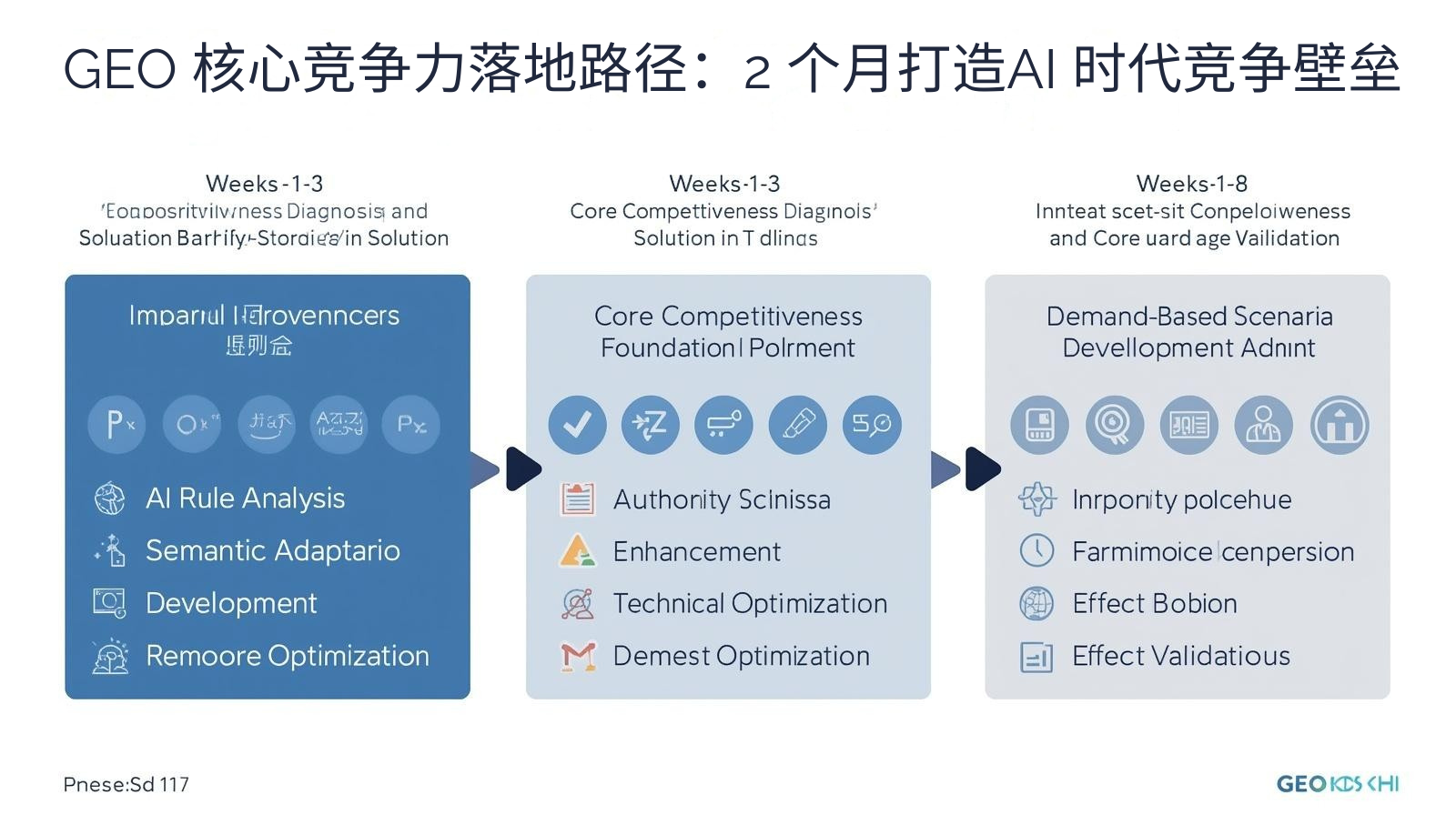
GEO's Core Competitiveness Implementation Path: Building a Competitive Barrier in the AI Era in 2 Months
Weeks 1-3: Competitiveness Diagnosis and Solution Development
- Comprehensive diagnosis: Assess the site's existing AI semantic adaptability, authority value strength, demand-acceptance capacity, and underlying technical compliance to identify core competitiveness weaknesses.
- Competition and AI Rules Analysis: Analyze the advantages and disadvantages of core competitor GEO's layout, and decode the generative AI recommendation logic and the changing trends of buyer demand.
- Customized solution development: clarify the key points of semantic adaptation, the direction of authoritative value enhancement, the scope of demand scenarios, the list of technical optimizations, and determine the two-month implementation milestone.
Weeks 4-6: Building the Foundation of Core Competencies
- AI semantic adaptation optimization: Build a core semantic cluster system, optimize page semantic expression and structured data configuration; reconstruct site semantic logic to ensure that AI can quickly identify core value.
- GEO's Authority Value Enhancement: Integrate and showcase core strengths and authoritative endorsements; publish industry white papers or trend reports; optimize content showcasing corporate strength.
- Technical optimizations at the underlying level: upgrading server configuration, optimizing page loading speed and mobile compatibility; improving compliance documents and site map; fixing crawling obstacles (such as dead links and code errors).
Weeks 7-8: In-depth scenario development and competitiveness verification
- In-depth exploration of demand scenarios: Create 5-8 special pages for core demand scenarios; set up a module for quick demand matching; adapt to the differences in demand in different regions.
-
- Key metrics to monitor: AI recommendation frequency, AI ranking of core keywords, conversion rate of accurate inquiries, user dwell time, and bounce rate.
- Dynamic optimization: Based on AI feedback and buyer behavior data, adjust semantic expression, value display position, and scene content focus to ensure maximum core competitiveness. Effect verification and fine-tuning.
Real-world case study: How can home furnishing companies build core competitiveness through GEO?
Client Background
Domestic home furnishing export companies, which mainly focus on environmentally friendly home furnishing products, face problems such as fierce competition from homogeneous products in the industry, low AI recommendation rate, and a conversion rate of less than 2% for accurate inquiries. Their core keyword AI search ranking is outside the top 60, their market share growth is slow, and they lack differentiated core competitiveness.
PinTui Technology Solution (Deployment period: 2 months)
- Competitiveness Diagnosis and Solution Development: Identifying core weaknesses: "ambiguous semantics, insufficient authority, limited scenarios, and outdated technology"; establishing the core positioning of "European Eco-friendly Home Furnishing Customization Expert"; and developing a four-dimensional competitive strategy based on "semantics + value + scenario + technology".
- AI semantic adaptation optimization: Construct a core semantic cluster of "eco-friendly home furnishings + ECO certification + European customization + hotel engineering"; optimize the semantic structure of the page and embed industry terms that are frequently recognized by AI; configure structured tags for Product and CaseStudy for product pages and case study pages.
- GEO's authoritative value is reinforced by highlighting its core advantages: "ECO+CE+ISO triple certification," "12 years of experience in the European market," and "500+ European customer cases," along with certification verification links and real customer photos; the release of the "2026 European Eco-friendly Home Furnishings Procurement Trends Report"; and showcasing the strength of its factory production equipment and R&D team.
- In-depth understanding of demand scenarios: Created three special pages for "European Hotel Engineering Procurement", "Cross-border E-commerce Bulk Customization" and "High-end Residential Eco-friendly Furniture"; set up a quick submission form for requirements and an online consultation portal; and optimized compliance solutions and delivery processes for the European market.
- Technical optimizations: Upgraded server configuration, reducing page load time from 4.8 seconds to 2.2 seconds; improved GDPR compliance documentation; created and submitted an XML sitemap; fixed 4 dead links.
Results and Value
Three months after the optimization was implemented, the client achieved:
- Competitive metrics: AI recommendation frequency increased by 3.6 times, the AI search ranking of the core keyword "European eco-friendly home customization" improved from 65th to 11th, and market share increased by 42%.
- Traffic metrics: AI-recommended traffic increased from 8% to 53%, and total accurate traffic increased by 280%.
- Conversion metrics: The conversion rate of precise inquiries increased from 1.9% to 5.4%, the average number of precise inquiries per month increased from 13 to 41, and the proportion of high-intent customers increased by 68%, demonstrating a significant lead over competitors in core competitiveness.

How to evaluate the professional capabilities of a GEO core competency optimization service provider?
The core of choosing a service provider is to evaluate its "generative AI recommendation mechanism decoding capabilities, practical experience in building competitiveness, and verification of implementation results," rather than simply price.
- Decoding capabilities : Service providers need to be able to interpret the evaluation logic of generative AI on site competitiveness, rather than just providing conventional site optimization, and accurately pinpoint the core weaknesses in competitiveness.
- Practical experience : Possesses case studies on building core competencies for GEOs in various industries, and can develop differentiated competitive solutions by combining product characteristics and market competition patterns, rather than applying generic templates.
- Technical tool support : It has independently developed AI semantic diagnosis, authoritative value assessment, demand scenario analysis, and technical compliance testing tools, which can accurately locate problems and efficiently implement optimization.
- Results verification : We require quantitative comparison data before and after optimization (AI recommendation frequency, keyword ranking, conversion rate, market share), and reject vague success stories.
Frequently Asked Questions (FAQ)
-
What is the average timeframe for building GEO's core competencies? The average setup period is 2 months, but this can be adjusted depending on the size of the site: about 1.5 months for small and medium-sized sites (≤50 core pages) and about 2-2.5 months for medium and large sites (50-200 core pages). PinTui Technology ensures efficient delivery through standardized processes.
-
Given the limited resources of small and medium-sized enterprises (SMEs), how can they prioritize building core competitiveness? Focus on core dimensions: prioritize building "AI semantic adaptation + core authoritative value" with an investment cost as low as tens of thousands of yuan to quickly obtain AI recommendations and basic conversions; then gradually iterate on demand scenarios and optimize technology, with PinTui Technology providing a phased competitiveness building solution.
-
The existing website has a certain amount of traffic, but lacks competitiveness. How can it be optimized? The core reasons are likely semantic ambiguity, lack of clear value proposition, and insufficient demand fulfillment. It is recommended to assess the gaps using PinTui Technology's GEO competitiveness diagnostic tool and then specifically strengthen core competitiveness dimensions.
-
How can we verify that GEO's core competitiveness has been established? Key validation metrics include: AI-recommended traffic share ≥40%, top 30 AI search results for core keywords share ≥60%, accurate inquiry conversion rate ≥5%, market share growth rate ≥30%, leading competitiveness compared to peers, and long-term monitoring data can clearly demonstrate the formation of competitive advantage.
Recommended Article: Your Competitors Haven't Reacted Yet: Building an Independent E-commerce Website with GEO is the Biggest Blue Ocean Strategy Right Now
In the era of widespread generative AI, competition among independent e-commerce websites has entered a phase where "core competitiveness determines success." The traditional "traffic-driven" model is no longer suitable for the AI-dominated competitive landscape. Only by building core competitiveness through GEO (Generative Opportunity Organization) strategies—combining "AI semantic adaptation, authoritative value, scenario-based demand fulfillment, and underlying technological support"—can these companies stand out in the fierce competition and become AI-preferred, top-choice suppliers for buyers.
In the era of widespread generative AI, competition among independent e-commerce websites has entered a phase where "core competitiveness determines success." The traditional "traffic-driven" model is no longer suitable for the AI-dominated competitive landscape. Only by building core competitiveness through GEO (Generative Opportunity Organization) strategies—combining "AI semantic adaptation, authoritative value, scenario-based demand fulfillment, and underlying technological support"—can these companies stand out in the fierce competition and become AI-preferred, top-choice suppliers for buyers.
PinTui Technology's GEO core competitiveness solution, built upon over 1200 practical experiences, offers enterprises a full-process service encompassing "diagnosis, setup, enhancement, and verification" within a highly efficient 2-month setup cycle. This helps enterprises transform GEO into an irreplaceable core competitiveness, achieving sustained growth and increased market share in the AI era.
Contact PinTui Technology customer service immediately, provide your site's current status, product types, and target market. Our GEO optimization consultant will provide you with a customized report titled "Customized Construction Solution for GEO Core Competitiveness of Independent Foreign Trade Websites" within 2 hours, making your site an industry benchmark in the AI era!