
As generative AI search becomes the core engine for allocating traffic in foreign trade, the traditional optimization logic of "keyword stuffing and backlink bombardment" is rapidly becoming ineffective. In 2026-2027, independent foreign trade websites will face a life-or-death test of "traffic gap and declining inquiries"—if companies fail to keep up with the evolution of GEO (Generative Engine Optimization), even with significant resource investment, they may fall into the predicament of "having a website but no targeted traffic".
The core transformation is irreversible: GEO optimization is undergoing a comprehensive upgrade from "single-dimensional adaptation" to a three-dimensional system of "deep AI collaboration + full-link user insights + dynamic multi-market adaptation." Based on practical experience with over 1200+ independent e-commerce websites, and combined with authoritative frameworks such as Google Search Core Principles and the Google E-commerce Optimization White Paper (not competitor backlinks, for professional reference only), PinShop has released the "2026-2027 GEO Optimization Three-Dimensional Revolution Guide." This guide, with an average setup cycle of 2 months, helps businesses seize the traffic dividends of the AI era through a closed-loop system of "trend prediction - strategy implementation - effect verification," transforming independent websites into "anti-cyclical, high-conversion" core engines for foreign trade growth.
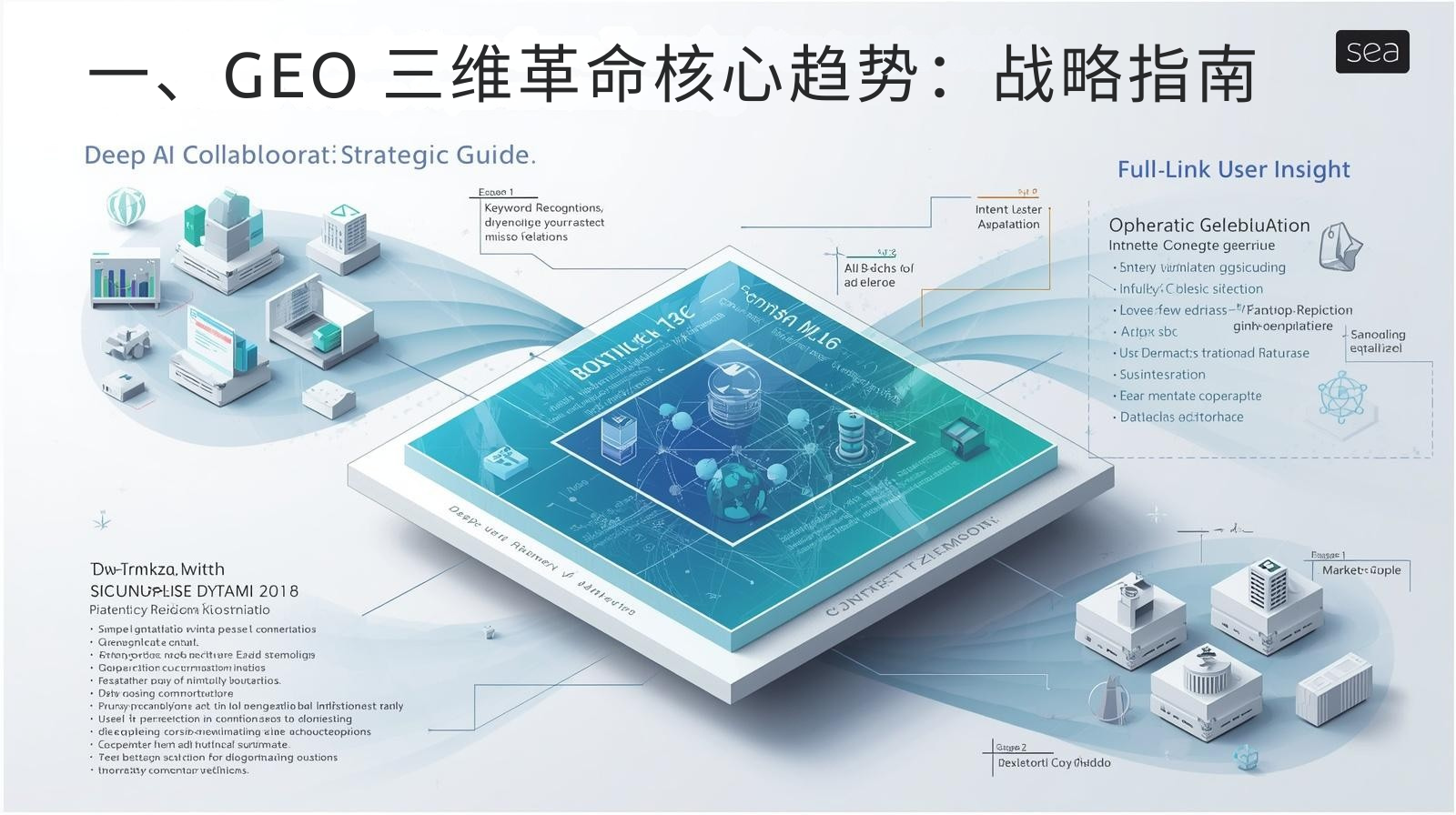
I. Core Trends of the GEO 3D Revolution: Strategic Guide
| Three-dimensional | Core features | PinShop Implementation Strategy |
|---|---|---|
| AI Deep Collaboration | Upgrading from "keyword recognition" to "intent cluster analysis," AI can accurately determine the user's purchasing stage, core needs, and decision-making pain points. | 1. Construct a semantic cluster matrix consisting of "core words + scenario words + demand words + regional words"; 2. Adapt to AI multi-turn dialogue search and design closed-loop content of "problem-extension-solution"; 3. Prioritize AI's understanding of content by using structured data tags. |
| User end-to-end insights | Search behavior is shifting from "single-point query" to "full-cycle decision-making," with users expecting to complete "cognition-comparison-purchase" in a single search. | 1. Establish a full-link website architecture encompassing "awareness - selection - consultation - transaction - after-sales service"; 2. Strengthen the chain of evidence for trust by integrating overseas cases, certification reports, and user test feedback; 3. Targeted conversion touchpoints are embedded at each decision-making stage to reduce user decision-making costs. |
| Multi-market dynamic adaptation | The increasing differences in AI rules and user habits across different regions mean that a single solution cannot cover the global market. | 1. Market-specific customization strategy: Europe and America focus on technological depth, Southeast Asia on cost-effectiveness, and the Middle East on certification and compliance; 2. Adapt to the semantic differences of multiple languages to avoid deviations in intent caused by literal translation; 3. Integrate localized resources (local warehouses, payment methods, after-sales service outlets) to enhance compatibility. |
| Integrated service portfolio | - | Services include GEO trend adaptation and optimization , AI semantic cluster construction , and multi-market GEO customization. |
| Landing support | - | 1. A dedicated technical consultant assesses the compatibility gap and develops a "short-term adjustment - mid-term upgrade - long-term iteration" plan; 2. Standardized tools + modular solutions enable the entire process from strategy to implementation to be completed in 2 months; 3. Quantitative Performance Monitoring: AI-recommended traffic share, end-to-end conversion rate, and traffic balance across multiple markets. |
PinShop has helped hundreds of foreign trade companies upgrade their 3D systems, achieving traffic growth of over 30% against the trend through core actions such as semantic cluster optimization and multi-market adaptation. In the current era of rapid iteration of AI algorithms, proactively deploying 3D GEO optimization will become key for companies to build competitive barriers.
II. Why Trust This Guide? Practical Data + Authoritative Verification
Most GEO trend analyses on the market remain at the theoretical level, while this guide is based on the practical experience of PinShop's over 1200+ independent e-commerce websites and in-depth analysis of 500,000+ user behavior data points. We not only track the iterative dynamics of Google's generative algorithm, but also verify the effectiveness of each strategy through practical applications in multiple industries such as machinery, home furnishings, and electronics.
- We built a semantic cluster system of "technical parameters + application scenarios" for machinery companies, and within 3 months, the proportion of AI recommendation traffic increased from 15% to 48%.
- We customized market solutions for home furnishing companies in Europe and America and Southeast Asia, resulting in a 200% increase in inquiries in markets with less common languages and a 42% reduction in the cost per inquiry.
- We built a full-chain content architecture for electronics companies, increasing the proportion of core keywords ranking in the top 30 by 40% and improving inquiry conversion rates by 35%.
These practical results prove that this guide is not just "theoretical," but an action manual that can be directly transformed into growth dividends, helping companies avoid costly mistakes such as "blindly following the trend in optimization" and "missing the window of opportunity for trends."
III. In-depth Implementation of the Three-Dimensional System: From Strategy to Execution
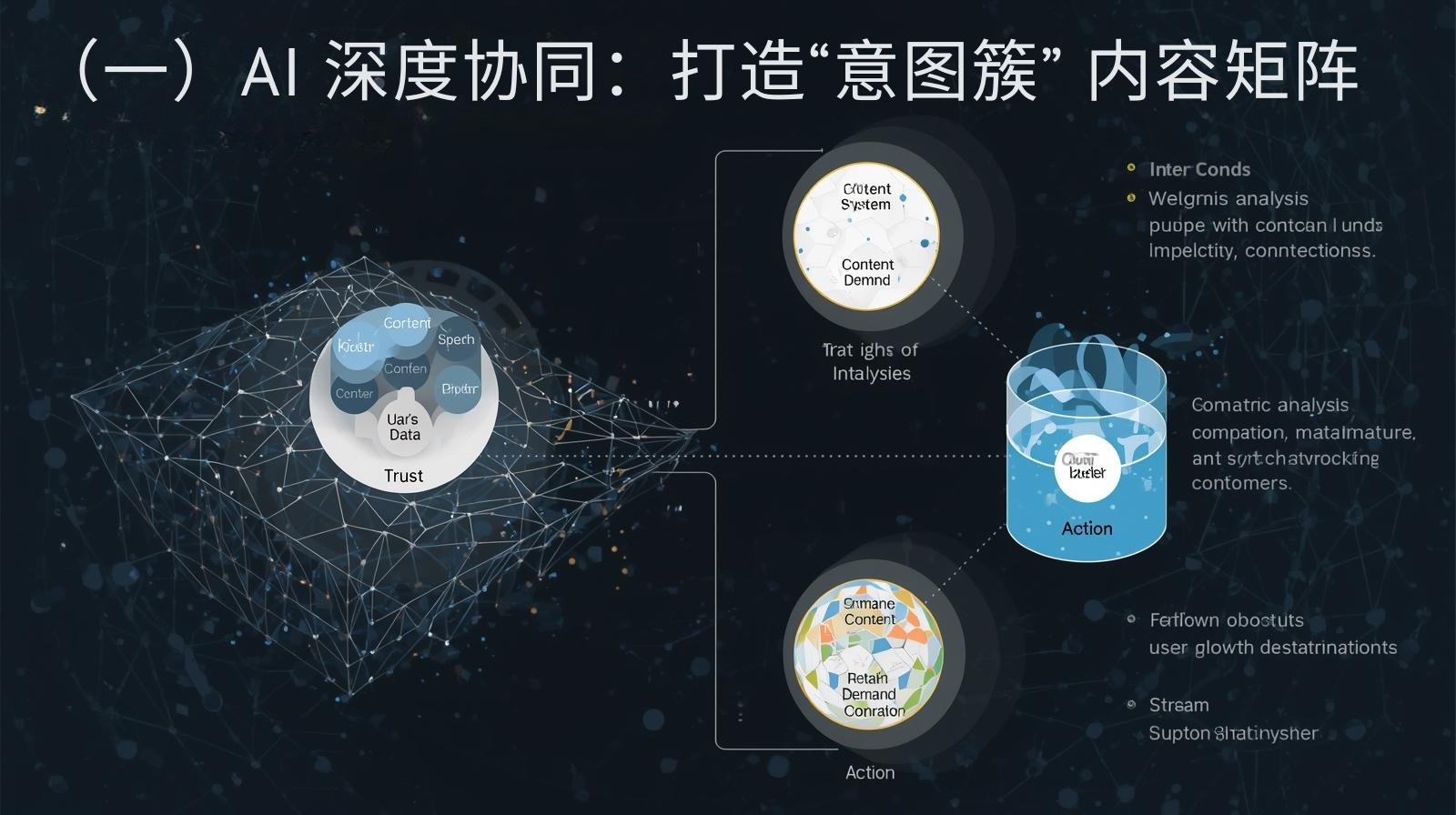
(I) Deep AI Collaboration: Building an "Intent Cluster" Content Matrix
In the AI era, the core of traffic generation lies in accurately matching content with users' "implicit needs." Traditional keyword optimization only covers a single need, while intent cluster matrices can comprehensively capture the multiple demands of users in their purchasing decisions.
- Intent cluster mining : Using PinShop AI semantic analysis tools, we mine combinations of "core words + scenario words + demand words + regional words" around core products, such as "CNC machining center + aerospace parts + high precision + Europe".
- Content restructuring : Create thematic content based on intent clusters, such as "European Aerospace Parts Machining: High-Precision CNC Machine Tool Selection Guide", and set up a closed loop of "Frequently Asked Questions - Extended Needs - Solutions" in the content to adapt to AI multi-turn dialogue search.
- Technical adaptation : Add structured data tags (such as FAQ, How-to) to optimize the site's semantic architecture, help AI quickly identify the core value of content, and improve recommendation priority.
(II) Full-link user insights: Building a seamless decision-making experience
From initial search to final transaction, users go through a complete journey of "awareness - comparison - trust - action." GEO optimization needs to ensure that each step accurately meets the user's needs.
- Architecture optimization : Building five core modules: Product understanding (industry pain points + solutions), selection guide (parameter comparison + scenario adaptation), case reference (overseas testing + effect data), consultation and quotation (one-click connection + customized solutions), and after-sales support (technical documentation + local service).
- Trust Enhancement : Integrating international certifications such as CE/ISO, real-life videos from overseas customers, and third-party testing reports, a "Trust Module" is set up on the core page to reduce user concerns about decision-making.
- Conversion Integration : Add a "Get a free customized solution" CTA button to the selection guide, and embed a "Consult about the same product" link on the case study page to achieve a seamless connection between "content seeding and instant conversion".
(III) Dynamic adaptation across multiple markets: achieving "precise regional reach"
AI search rules and user habits vary significantly across different markets, so a generic optimization approach will only lead to "traffic generalization and inefficient conversion."
- Market-specific strategy customization :
- European and American markets: focus on technical depth (such as detailed parameters and R&D capabilities) and brand trust (such as overseas offices and local after-sales service).
- Southeast Asian market: Emphasize cost-effectiveness (such as bulk purchase discounts) and logistics efficiency (such as local warehouse delivery and COD payment).
- Middle East market: Strengthen certification compliance (such as SASO certification) and localization services (such as Arabic language support).
- Language and semantic adaptation : Avoid mechanical literal translation and adopt regional expressions (such as professional terminology in Europe and America and concise colloquialisms in Southeast Asia), while adapting to the semantic preferences of keywords in different markets.
- Localized resource integration : Showcase local cooperation cases, warehousing and logistics information, and payment method compatibility in the target market to enhance users' sense of trust in the region.
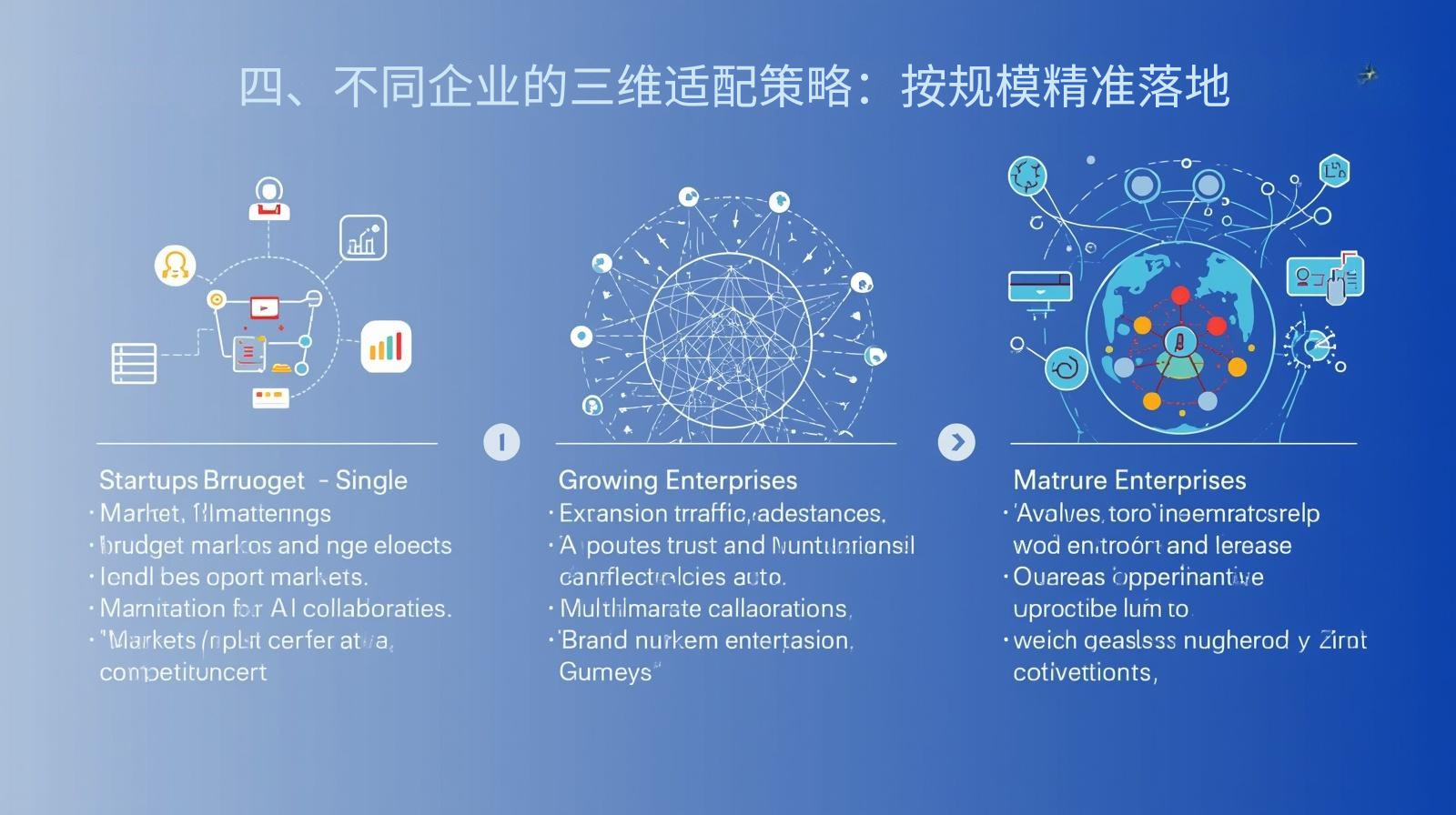
IV. Three-Dimensional Adaptation Strategies for Different Enterprises: Precise Implementation Based on Scale
1. Start-up foreign trade enterprises (budget ≤ 20,000 RMB, single market layout)
- Core Adaptation : Focusing on "AI Collaboration + Core Links" to seize the trend dividends at the lowest cost.
- Implementation plan : Select the PinShop basic package to build one core semantic cluster and three core decision-making links to adapt to a single target market.
- Expected results : AI-recommended traffic share increases by 30%, accurate inquiries increase by 50%, and cost per inquiry decreases by 25%.
2. Growing foreign trade enterprises (budget of 20,000-50,000 yuan, with a presence in 2-3 markets)
- Core Adaptation : Promote "three-dimensional collaboration + initial adaptation to multiple markets" to balance traffic growth and market expansion.
- Implementation Solution : Utilize a combination of "AI semantic cluster construction + multi-market GEO customization" services to create 3-5 core semantic clusters and a full-chain content system, optimizing the trust module for core markets.
- Expected results : AI-recommended traffic share in core markets will increase by 45%, traffic balance across multiple markets will improve by 60%, and average monthly accurate inquiries will increase by 80%.
3. Established foreign trade enterprises (budget ≥ 50,000 RMB, multiple markets + overseas brand expansion)
- Core Adaptation : Achieving "three-dimensional deep collaboration + brand trust accumulation" to build a long-term competitive barrier.
- Implementation plan : Customize high-end packages, build a content system with 10+ semantic clusters and full industry coverage, refine market-specific optimization, and establish overseas brand reputation assets.
- Expected results : AI-recommended traffic share increases by 60%, multi-market inquiry conversion rate increases by 40%, brand search volume increases by 150%, forming a counter-cyclical growth system.
V. Case Study: The Three-Dimensional Adaptive Growth Path of Machinery Enterprises
Client Background
A medium-sized domestic machinery manufacturing enterprise, specializing in CNC lathes and machining centers, with an average order value of 15,000-50,000 yuan, and operating in two markets: Europe and the United States and Southeast Asia. By the end of 2025, it faced the problem of "declining traffic from AI recommendations and uneven results across multiple markets", with an average of only 12 accurate inquiries per month.
3D Adaptation Solution (Build Time: 2 Months)
- AI Collaborative Optimization : Discover five core intent clusters, including "CNC lathe + high-precision machining + Europe and America" and "CNC lathe + small-batch customization + Southeast Asia", and reconstruct the site's content architecture.
- Full-chain content creation : We created 8 in-depth articles, including "Selection Guide for European and American CNC Lathes" and "Small Batch Processing Solutions in Southeast Asia," covering the entire process of "understanding - selection - procurement - after-sales service."
- Multi-market adaptation : European and American markets emphasize CE/ISO certification and local after-sales service outlets; Southeast Asian markets highlight local warehouse delivery and COD payment.
- Trust building : The "2026 CNC Lathe Machining Accuracy Research Report" was published, and natural brand mentions were accumulated on platforms such as LinkedIn.
Results and Value
- Traffic metrics: AI-recommended traffic increased from 18% to 52%, with traffic growth of 75% in the European and American markets and 90% in the Southeast Asian market.
- Conversion metrics: The average number of targeted inquiries per month increased from 12 to 28, and the inquiry conversion rate increased from 2.1% to 3.8%.
- Competitive advantages: The proportion of the top 30 search results for the core keyword AI has increased from 35% to 78%, with no traffic fluctuations during algorithm iterations.
VI. How to evaluate the three-dimensional adaptation capabilities of a GEO service provider?
The core of choosing a service provider is to assess its "trend prediction ability, practical implementation ability, and data-driven capability," rather than simply its price.
- Trend insight verification : Requires specific algorithm iteration data and user behavior analysis reports, rather than vague trend slogans.
- Real-world case studies : Examine quantitative comparisons of "before and after three-dimensional adaptation" in different industries, such as the proportion of AI traffic and the increase in inquiries.
- Technical tool support : Confirm whether there are independently developed semantic cluster analysis and multi-market adaptation tools, and whether dynamic optimization support can be provided.
- Quantify the promised results : Specific indicators such as AI traffic growth and inquiry improvement should be clearly defined, and a comprehensive performance monitoring system should be established.

VII. Frequently Asked Questions (FAQ)
-
What is the average setup cycle for 3D GEO adaptation? On average, it takes 2 months for basic adaptation for startups, about 1.5 months for moderate adaptation for growing companies, and about 2.5-3 months for deep adaptation for mature companies. Standardized processes ensure efficient delivery.
-
Does the existing GEO optimization require an upgrade to the 3D system? Yes, it is necessary. Existing solutions are mostly adapted to older search logic and cannot meet the needs of AI intent cluster parsing and the entire search chain. It is recommended to use the PinShop GEO trend diagnostic tool to assess the gap and avoid traffic disruptions.
-
Can small and medium-sized enterprises afford the investment in 3D adaptation? Supported. Basic packages start from tens of thousands of yuan, covering core semantic clusters and core link content; a pay-per-performance model is also available to reduce trial-and-error costs.
-
How can we verify the actual effectiveness of 3D adaptation? Key monitoring metrics include: AI-recommended traffic share, AI ranking of core keywords, end-to-end conversion rate, and traffic balance across multiple markets, with a quantitative comparison report provided monthly.
Recommended Article: Your Competitors Haven't Reacted Yet: Building an Independent E-commerce Website with GEO is the Biggest Blue Ocean Strategy Right Now
In 2026-2027, the three-dimensional revolution of GEO optimization has arrived, with AI collaboration, full-link insight, and multi-market adaptation becoming the core secrets to traffic growth. Enterprises that want to break through in this transformation must abandon traditional optimization thinking and proactively establish a three-dimensional system.
PinShop's end-to-end solution, built on over 1200 practical experiences, encompasses "trend prediction - strategy implementation - dynamic optimization," with an average setup cycle of 2 months. It helps businesses accurately adapt to core trends, achieving dual growth in traffic and inquiries. Contact PinShop customer service now, providing your product type, target market, and growth goals. We will provide you with a customized "3D GEO Adaptation Solution and Growth Forecast Report" within 2 hours.
Stop passively waiting for trends to become obsolete. Let PinShop help you seize the high ground of traffic in the AI era and make your independent website the core engine for foreign trade growth!

Stop passively waiting for trends to become obsolete. Let PinShop help you seize the high ground of traffic in the AI era and make your independent website the core engine for foreign trade growth!