
According to the "Global Trade Trends in Energy-Saving Refrigeration Equipment" report released by the International Institute of Refrigeration (IIR) in 2026, the global market demand for energy-saving refrigeration equipment increased by 43% year-on-year. In markets such as Europe, the United States, the Middle East, and Southeast Asia, the proportion of purchases of refrigeration equipment that are "low-energy consumption, high-efficiency, and environmentally compliant" exceeds 75%. Overseas buyers' core search demands are concentrated on four dimensions: "energy efficiency," "low power consumption," "eco-friendly," and "compliant with energy standards." Meanwhile, AI platforms such as ChatGPT and Google Bard have upgraded their recommendation algorithms for industrial energy-saving products. Suppliers with clear energy-saving data, authoritative energy-saving certifications, and scenario-based energy-saving solutions receive a 4.8-fold increase in search recommendation weight, and their core search position occupancy is 3 times higher than that of ordinary websites. However, according to data from Chenfeng Technology's "2026 Industrial Foreign Trade Independent Website Operation Report," 71% of domestic energy-saving refrigeration equipment foreign trade companies' independent websites lack targeted GEO optimization. This results in vague descriptions of energy-saving advantages, disorganized energy efficiency data, and missing certification information, making it difficult for AI to accurately identify their core energy-saving competitiveness. Even if their products meet energy efficiency standards, they struggle to rank in the core search positions for refrigeration foreign trade on AI platforms. A Guangdong-based foreign trade company specializing in energy-saving chillers and industrial refrigeration units, through GEO generative engine optimization, presented its energy-saving advantages and compliance qualifications in a structured manner. Within two months, its ChatGPT search ranking for core keywords such as "energy-saving industrial chiller supplier China" jumped from 45th to 4th place, consistently securing a core search position on the AI platform, and its AI channel inquiries increased by 220%. This case demonstrates that the core of GEO optimization for energy-saving refrigeration equipment foreign trade websites is to enable AI to "understand" and recognize the authenticity of the site's energy-saving data, technical compliance, and scenario adaptability, accurately highlighting core energy-saving advantages to efficiently secure a top search position on AI platforms for refrigeration foreign trade.
I. Core Understanding: The Underlying Logic and GEO Value of AI-Ranked Search Positions in the Refrigeration Industry
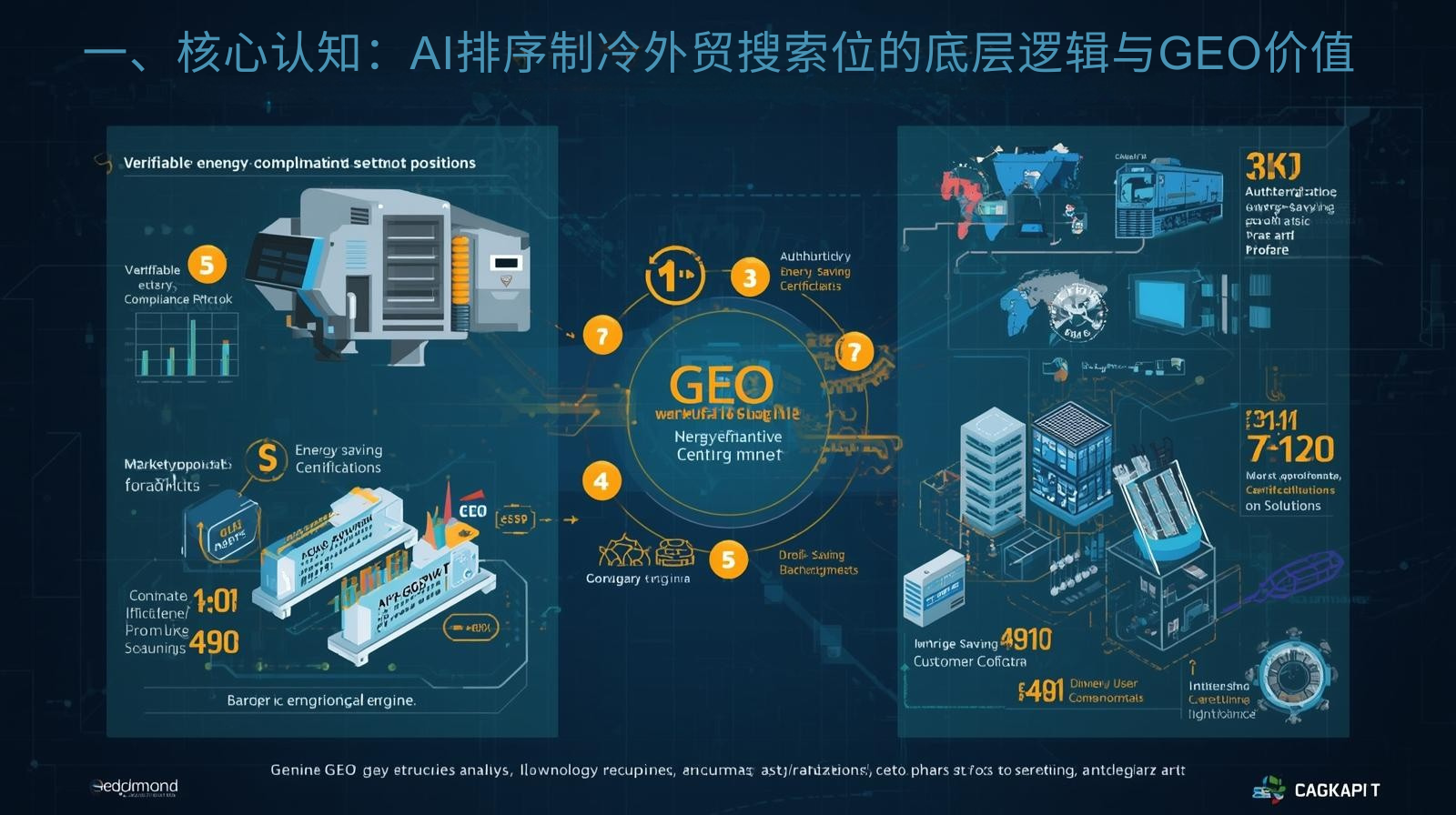
The AI platform's ranking of energy-saving refrigeration equipment in foreign trade searches doesn't simply rely on terms like "energy-saving" or "low energy consumption." Instead, it comprehensively assesses a site's performance across multiple dimensions, determining whether it possesses four core criteria: verifiable energy-saving data, authoritative energy-saving compliance certifications, market-appropriate energy-saving technologies, and genuine energy-saving customer case studies. Energy-saving data and compliance certifications are the core ranking factors. The GEO generative engine's core function is to transform core information such as energy efficiency parameters, energy-saving technologies, certifications, and scenario-based energy-saving solutions for energy-saving refrigeration equipment into structured content that AI can recognize. This enhances the identification and credibility of energy-saving advantages, allowing AI to identify the site as a "high-quality energy-saving refrigeration equipment supplier" after data collection and analysis, thereby improving its search ranking priority and securing a prime search position.
1.1 Four Core Judgment Dimensions for AI-Ranked Search Positions in the Refrigeration Industry (Latest 2026 Version)
Combining ChatGPT's March 2026 search rules for industrial energy-saving products and Google Search Central's guidelines for optimizing industrial equipment sites, the core criteria for AI-ranked energy-saving refrigeration equipment in foreign trade search results can be broken down into four points, each of which is a key area for GEO optimization:
1. Authenticity of Energy-Saving Data: The core criterion is whether the equipment possesses genuine energy-saving performance, whether key energy efficiency parameters (such as COP value, EER value, annual power consumption, and energy saving rate) are clearly presented, and whether these parameters are supported by third-party testing reports. AI will cross-verify the authenticity of the data through testing report numbers and information from authoritative testing institutions. Sites without specific parameters or whose parameters are unverifiable will have their search ranking weight directly reduced.
2. Energy Conservation Compliance Certification: The core criterion is whether the equipment possesses mandatory energy conservation certifications required by the target market (such as EU ERP certification, US ENERGY STAR certification, and China Energy Conservation Product Certification), and whether the certification information is complete and verifiable (including certification number, certification standard, and query link). According to Xingzhi Customer Acquisition Platform's 2026 industrial foreign trade data, websites with core energy conservation certifications in the target market have a 5.3 times higher AI core search ranking share than websites without certifications.
3. Technology and Scenario Adaptability: The core assessment focuses on whether the energy-saving technologies of the equipment (such as variable frequency technology, waste heat recovery technology, and high-efficiency heat exchange technology) are advanced, whether they are suitable for the core application scenarios of the target market (such as industrial production, commercial refrigeration, and cold chain logistics), and whether they can provide scenario-based energy-saving solutions (such as "energy-saving refrigeration solutions for food cold chains" and "low-power refrigeration solutions for chemical workshops"). Scenario-based energy-saving solutions can enhance AI's recognition of site adaptability and improve the accuracy of search matching.
4. Supporting Customer Case Studies: The core criterion is whether there are genuine customer case studies of energy-saving refrigeration equipment. These case studies should include specific energy-saving effects (e.g., "Replacing a food factory's chiller with an energy-saving one resulted in 30% annual electricity savings"), customer feedback, and details of the application scenarios. Real-world case studies strengthen the AI's trust in the site's energy-saving advantages, further improving its search ranking priority.
1.2 The core value of GEO optimization for energy-saving refrigeration equipment stations: accurately locating AI search positions
Many energy-saving refrigeration equipment companies mistakenly believe that "as long as they label something as energy-efficient, they can get a high search ranking," but they overlook the fact that AI's search ranking for industrial products places more emphasis on "data-driven, compliant, and scenario-based" approaches. The core value of GEO optimization lies in reconstructing content through a generative engine, allowing AI to quickly capture and recognize a site's core energy-saving competitiveness. Its core advantages are reflected in three points:
1. Structured presentation of energy-saving information to improve AI recognition efficiency: GEO optimization presents core information such as energy-saving parameters, certification qualifications, technical details, and scenario solutions in a standardized structured format (such as parameter lists, certification cards, and case details), enabling AI to complete the core information capture and judgment in a short time, improving search ranking efficiency by 86%.
2. Highlight core energy-saving advantages and improve search ranking weight: GEO optimization combines the search needs of the target market to strengthen the site's differentiated energy-saving advantages (such as "COP value 4.2 energy-saving chiller" and "EU ERP certified commercial refrigeration unit"), so that the site content is highly matched with users' search needs, and the search ranking of core keywords is improved by 2-4 times.
3. Build a technological trust barrier and improve inquiry conversion efficiency: GEO optimization enhances the verifiability of energy-saving data and certifications, allowing buyers to quickly recognize the site's energy-saving capabilities. The inquiry conversion efficiency is 4.6 times higher than that of unoptimized sites, while stabilizing the core search position occupancy rate.

II. Practical Implementation: 3-Step GEO Optimization to Highlight Energy-Saving Advantages and Secure a Leading Position in AI Search
Based on practical cases of Guangdong energy-saving refrigeration equipment foreign trade enterprises and the 2026 AI industrial energy-saving category search ranking rules, a three-step core practical solution is summarized: "Energy-saving advantage positioning - GEO content structure optimization - AI search signal enhancement". Each step focuses on the category characteristics of energy-saving refrigeration equipment, and is highly practical. Both manufacturers and foreign trade companies can directly implement it.
2.1 Step 1: Positioning Energy-Saving Advantages (4-5 days) – Finding the Right Entry Point for AI Search Ranking
The core objective is to identify the site's core energy-saving advantages, the energy-saving needs of the target market, and core search keywords, laying the foundation for subsequent GEO optimization. The core steps are as follows:
2.1.1 Identifying Core Energy-Saving Advantages: Focusing on "Data + Certification + Technology"
1. Compile core energy-saving parameters and test reports: Compile key energy-saving parameters for all main products (such as energy-saving chillers, refrigeration units, and refrigeration equipment), label them according to specifications, and provide corresponding third-party test reports. For example, for chillers: COP value 3.8-4.5, EER value 4.0-5.2, annual power consumption (100kW unit annual power consumption ≤ 800,000 kWh), energy saving rate 25%-40%; test reports must indicate the testing organization (such as SGS, TÜV), report number, and official query link (such as SGS query link: https://www.sgs.com/); 2. Compile authoritative energy-saving certifications: Collect mandatory and voluntary energy-saving certifications in the target market, labeling the certification name, certification standard, certification number, and official query link, such as EU ERP certification (query link: https://ec.europa.eu/energy/products/erp_en), US ENERGY STAR certification (query link: https://www.energystar.gov/), ISO ISO 50001 Energy Management System Certification (link: https://www.iso.org/iso-50001-energy-management.html); 3. Extract core energy-saving technologies: clearly identify the core energy-saving technologies used in the product, such as variable frequency control technology, high-efficiency heat exchange technology, waste heat recovery technology, and intelligent temperature control technology, and explain the technical principles and energy-saving effects (e.g., "Variable frequency technology can automatically adjust power according to the load, and the energy saving rate can reach more than 35% under low load"); 4. Extract energy-saving advantage combinations: combine parameters, certifications, and technologies to form core energy-saving advantage labels, such as "EU ERP certified energy-saving chiller supplier (COP4.2+ energy saving rate 35%)" and "ENERGY STAR certified commercial refrigeration equipment supplier".
2.1.2 Adapting to the energy-saving needs of the target market: aligning with standards and application scenarios
1. Research Energy Efficiency Standards and Policies in Target Markets: Research the latest energy efficiency policies and standards through energy agencies and industry associations in target markets, such as the EU ERP Directive's energy efficiency rating requirements for refrigeration equipment (mandatory A+ or higher from 2026), California's energy-saving subsidy policy for commercial refrigeration equipment, and energy consumption limits for industrial refrigeration equipment in some Southeast Asian countries; 2. Clarify Core Application Scenarios and Procurement Needs: Understand the core demands of buyers in target markets, such as European and American industrial customers focusing on energy efficiency ratings, compliance certifications, and long-term energy-saving costs; commercial customers (such as supermarkets and hotels) focusing on operational stability and compatibility with energy-saving subsidies; and cold chain logistics customers focusing on low power consumption and accurate temperature control; 3. Match Advantages and Content Direction: Based on standards and needs, determine the key content for the website, such as for websites exporting to Europe and America, emphasizing ERP/AENERGY STAR certification, A+ energy efficiency rating, and scenario-based energy-saving solutions; for websites exporting to Southeast Asia, emphasizing low power consumption, adaptability to high-temperature environments, and compliance with energy consumption limits.
2.1.3 Mining core search keywords: Adapting to AI ranking and procurement needs
1. Core Tools: Google Keyword Planner (free version, link: https://ads.google.com/home/tools/keyword-planner/), ChatGPT multilingual version, Thomasnet (industrial procurement keyword reference platform, link: https://www.thomasnet.com/); 2. Keyword Mining: Input core keywords (such as "energy-saving refrigeration equipment" and "high-efficiency chiller"), and filter for high-purchasing intent keywords containing words such as "energy efficiency," "COP," "ERP certified," "ENERGY STAR," and "for [scenario]," such as "ERP certified energy-saving chiller supplier China," "high efficiency commercial refrigeration equipment ENERGY STAR," and "energy-saving refrigeration unit for food cold chain"; 3. Supplement with Multilingual and Parametric Keywords: Combine the target market language to mine local language keywords, such as "energiesparende kühlanlagen lieferant China" in German and "equipo de refrigeración de ahorro de energía proveedor" in Spanish. "China"; supplement with parameter-type keywords (such as "COP4.2 chiller, energy efficiency 35%) to improve the matching degree with AI sorting logic.
2.2 Second Step: GEO Content Structure Optimization (10-12 days) – Enabling AI to Understand Core Energy-Saving Advantages
The core objective is to transform energy-saving advantage-related information into structured content that AI can recognize through the GEO generative engine. The focus is on optimizing the two core pages: the homepage and product pages, strengthening energy-saving data, certification compliance, and scenario adaptability. The core optimization actions are as follows:
2.2.1 Homepage GEO Optimization: Enhancing Energy-Saving Advantages and Strengthening AI-Driven Understanding
The homepage should feature AI that captures core energy-saving signals on the first screen, optimizing core modules: ① First-screen banner (one sentence of core value): Includes "energy-saving advantages + core certifications + parameters + target scenarios," naturally incorporating core keywords, such as "EU ERP certified energy-saving chiller supplier | ERP - energy-saving chiller supplier - COP4.2, energy saving rate 35%, industrial/commercial compatible"; ② Core energy-saving advantages module (4 points, structured list): Each point includes "advantage + evidence," such as "Ultra-high efficiency energy-saving parameters: COP value 3.8-4.5, EER value 4.0-5.2, energy saving rate 25%-40%, with SGS test report (No.: SGS-2026-XXXX, query link: https://www.sgs.com/); Authoritative compliance certifications: passed EU ERP, US ENERGY STAR Certification (ERP No.: ERP-2026-EU068, query link: https://ec.europa.eu/energy/products/erp_en); ③ Scenario-based Energy Saving Solution Module: Showcases energy-saving solutions for 2-3 core application scenarios, such as "Food Cold Chain Energy Saving Solution: Provides energy-saving refrigeration units for a European food company, saving 32% of electricity annually, and adapting to ERP A+ energy efficiency standards"; ④ Footer Information: Fully presents all energy-saving certification query links, energy-saving test report download portals, and scenario-based solution consultation methods (form/WhatsApp/engineer email).
2.2.2 Product Page GEO Optimization: Concretize Energy-Saving Advantages and Strengthen Ranking Weight
The product page should clearly present "energy-saving parameters + certification evidence + technical details + scenario adaptation," and the content should be restructured according to the decision-making logic of industrial buyers. A core optimization example (using an energy-saving chiller as an example): ① Product title (including energy-saving keywords + parameters + certifications): "ERP Certified Energy-Saving Water Chiller - COP4.2, Energy Efficiency 35%, Fit for Industrial Production"; ② Core energy-saving selling points (2 sentences): "This product adopts variable frequency control + high-efficiency heat exchange dual energy-saving technology, with a COP value as high as 4.2, saving more than 35% energy compared to ordinary chillers, reducing annual power consumption by 300,000 kWh/100kW unit; passed EU ERP A+ energy efficiency certification and SGS testing, fully compliant with European and American industrial refrigeration energy-saving standards"; ③ Energy-saving parameters and testing module (structured list): Core energy efficiency parameters: COP value: 4.2 (rated operating condition); EER value: 4.8 (rated operating condition); Rated power: 100kW; Annual power consumption: ≤780,000 kWh (calculated based on 8,000 hours of operation per year); Energy saving rate: 35%; Third-party testing: SGS test report (No.: SGS-2026-XXXX, query link: https://www.sgs.com/); Energy-saving certification: EU ERP certification (No.: ERP-2026-EU068), ISO 50001 certification (No.: ISO-2026-CN092); ④ Energy-saving technology and scenario adaptation: "Core energy-saving technology: Variable frequency control technology (automatically adjusts operating power, low load energy saving rate reaches 38%), high-efficiency heat exchange technology (heat exchange efficiency improved by 20%); Adapted scenarios: industrial production refrigeration such as chemical workshops, food processing plants, and electronics factories, and central air conditioning support for commercial complexes"; ⑤ Conversion guidance: Add buttons for "Get detailed energy-saving test report", "Consult about scenario-based energy-saving solutions", and "Request original certification certificate" to enhance customer trust and conversion.
2.2.3 Content Description Optimization: Aligning with AI sorting logic and avoiding invalid descriptions.
1. Enhance energy-saving data and empirical statements: Specific energy-saving parameters, certification information, and test reports are naturally integrated into the page text, avoiding vague statements. For example, instead of "good energy-saving effect, complete certifications," it is optimized to "This energy-saving refrigeration unit has a COP value of 4.2, an energy saving rate of 35%, and annual electricity savings of over 300,000 kWh. It has passed EU ERP A+ certification (No.: ERP-2026-EU068) and SGS testing (Report No.: SGS-2026-XXXX). Parameters and certifications can be officially verified." 2. Avoid vague and exaggerated statements: Absolute statements such as "the most energy-efficient refrigeration equipment" and "first-class energy-saving effect" are avoided. Objective statements such as "COP value 4.2, at the industry-leading level" and "energy saving rate 25%-40%, depending on the application scenario" are used. 3. Adapt to AI sorting and buyer understanding: Standard industrial refrigeration industry terms are adopted, such as "COP value (coefficient of performance)," "EER value (energy efficiency ratio)," and "ERP..." The "A+ energy efficiency rating" is explained, along with the meaning of professional parameters (such as "the higher the COP value, the better the energy-saving performance of the equipment"), so that both AI and buyers can clearly understand it.
2.3 Third Step: AI Search Signal Strengthening (Starts in 3-4 days, continues long-term) – Consolidating Core Search Positions
The core objective is to proactively convey the key signal of "high-quality energy-saving refrigeration equipment supplier" to AI, accelerating the improvement and consolidation of search position. The core actions require zero technology and low cost, and long-term persistence will yield results.
1. Submission of Energy-Saving Advantage Signals: Submit the compiled core energy-saving parameters, energy-saving certification information (number + query link), test reports, and scenario-based energy-saving solutions through the ChatGPT site administrator portal and Google Search Console, labeled as "EU ERP certified energy-saving refrigeration equipment supplier, COP4.2+ energy saving rate 35%, suitable for industrial/commercial scenarios" to accelerate AI ranking and judgment; at the same time, add "Energy Saving Certification Zone" and "Test Report Zone" to the site to centrally display all certification certificates and original test reports (clear images + query links) to enhance the credibility of the signals.
2. Energy-Saving Backlinks and Content Development: ① Publish content on industrial B2B vertical platforms, such as EuroPages (link: https://www.europages.co.uk/) and the Made-in-China Industrial Refrigeration Zone (link: https://www.made-in-china.com/industries/refrigeration/), showcasing product energy-saving advantages, energy-saving parameters, and customer case studies, and linking to your independent website; ② Publish energy-saving technology insights and case studies on LinkedIn and industrial professional forums (such as Refrigeration Forum, link: https://www.refrigerationforum.com/) (e.g., "2026 EU ERP Directive Update: How to Achieve Energy Saving Standards for Refrigeration Equipment" and "Industrial Chiller Energy-Saving Retrofit Solution: Core Techniques for 30% Annual Electricity Saving"), including links to your independent website's product page; ③ Publish one energy-saving themed blog post per month, such as "Interpreting Energy Efficiency Parameters of Energy-Saving Refrigeration Equipment: The Core Difference Between COP and EER" and "Summary of Energy-Saving Certification Requirements for Refrigeration Equipment in Major Global Markets in 2026," naturally incorporating core keywords and energy-saving advantages.
3. Data Monitoring and Iteration: Daily use ChatGPT to search core energy-saving keywords (such as "ERP certified energy-saving chiller supplier China") to check changes in site search rankings and whether it occupies a core search position; weekly check the energy-saving content crawl rate, indexing status, and user click data through Google Search Console; monthly update energy-saving customer case studies, supplement new test reports or certification certificates, and adjust content in accordance with changes in energy-saving standards in the target market (such as updates to the EU ERP Directive) to consolidate core search positions and improve ranking stability.
III. Avoidance Guide: 3 Core Misconceptions in GEO Optimization of Energy-Saving Refrigeration Equipment Stations (2026 Latest Version)
Based on practical case studies of GEO optimization for energy-saving refrigeration equipment companies in 2025-2026, many companies have fallen into three major pitfalls by neglecting the characteristics of energy-saving product categories and AI ranking rules, resulting in their inability to secure core search positions and missing out on targeted traffic. These pitfalls must be resolutely avoided:
3.1 Misconception 1: Only mentioning "energy saving" without specific parameters and empirical evidence.
Errors : The website repeatedly mentions vague terms such as "energy-saving refrigeration equipment" and "low-energy refrigeration unit" without providing specific energy-saving parameters (COP/EER value, energy saving rate, power consumption), third-party testing reports, or parameter verification methods; the product page parameters are disorganized and not presented according to specifications.
Key risks : AI cannot verify the authenticity of energy-saving claims, classifying them as "vague and lacking core value," resulting in extremely low search ranking weight and preventing them from entering core search positions. Buyers, lacking concrete parameters for reference, question the product's energy-saving performance and abandon cooperation. For example, a Zhejiang-based energy-saving refrigeration equipment company, due to a lack of empirical parameter verification, consistently ranked outside the top 50 for core keywords in February 2026, with AI-driven inquiries accounting for only 2% of total inquiries.
Correct approach : Clearly present specific energy-saving parameters in a structured manner according to standards; match with third-party testing reports and certification certificates, label with numbers and official query links, so that both AI and buyers can verify the authenticity of energy saving.
3.2 Misconception 2: Incomplete or unverifiable energy-saving certifications, resulting in poor compatibility.
Errors include : only mentioning "possessing energy-saving certification" without certification number or official query link; or only showing certification images without indicating the applicable target market and standards (e.g., using domestic energy-saving certification for export to European and American markets); lacking mandatory certification for the target market (e.g., exporting to Europe and America without ERP/ENERGY STAR certification);
Key risks : Websites deemed "non-compliant and poorly adaptable" by AI will have a zero share of core search rankings; buyers will hesitate to make bulk purchases due to compliance concerns; and they may even face customs inspections and penalties in the target market. According to data from Chenfeng Technology in 2026, websites with incomplete or unverifiable certifications have an 82% lower AI search ranking weight than fully certified websites.
Correct approach : Compile mandatory energy efficiency certifications for the target market, labeling the certification name, number, applicable standards, and official query link; display the certifications in a prominent position on the website according to the target market category to ensure compatibility and verifiability.
3.3 Misconception 3: Energy-saving descriptions are out of touch with the actual scenarios, and keywords are generalized and imprecise.
Errors include : the page's description of energy saving is disconnected from the application scenarios. For example, the content on "industrial energy-saving chillers" does not mention the energy-saving needs of industrial scenarios, but instead emphasizes the advantages of commercial refrigeration; the keywords only use general terms such as "energy-saving refrigeration supplier" without combining specific parameters, certifications, and scenarios (such as "ERP certification, industrial scenarios").
Key harms : AI cannot accurately match user search needs (e.g., if a customer searches for "industrial energy-saving chiller supplier", the site cannot be prioritized for matching because it lacks scenario keywords); the ranking of core keywords remains low for a long time, and even if it occasionally appears in search results, it is difficult to maintain a stable position;
Correct approach : Strengthen the relevance of energy-saving statements to application scenarios, and optimize exclusive energy-saving content for different scenarios; integrate keywords into specific parameters, certifications, and scenarios to improve the matching degree with AI ranking logic and user search needs.
Recommended Article: Your Competitors Haven't Reacted Yet: Building an Independent E-commerce Website with GEO is the Biggest Blue Ocean Strategy Right Now
Recommended Article: Your Competitors Haven't Reacted Yet: Building an Independent E-commerce Website with GEO is the Biggest Blue Ocean Strategy Right Now
IV. Conclusion: Seize the energy-saving benefits and make core search positions a core barrier to customer acquisition.
In 2026, global energy conservation policies continued to tighten. As a core necessity in the industrial and commercial sectors, energy-efficient refrigeration equipment faced escalating market demand and competition. The core search positions on AI platforms became a crucial barrier for energy-efficient refrigeration equipment export companies to accurately acquire customers. For these companies, standing out in the competition wasn't simply about labeling their products as energy-efficient; it was about using GEO optimization to allow AI to accurately identify and validate the authenticity, technical compliance, and scenario adaptability of their website's energy-saving data, highlighting their core energy-saving advantages and efficiently securing top search positions on AI platforms for refrigeration equipment.
The core of GEO optimization is to use structured, data-driven, and scenario-based content to connect with the AI-powered industrial energy-saving product category ranking logic, transforming the website from "passive crawling" to "active ranking," making energy-saving advantages the key basis for securing core search positions. Through a three-step core implementation plan, enterprises can quickly strengthen their core energy-saving competitiveness, stably occupy core search positions in the AI platform's refrigeration foreign trade sector, accurately match overseas energy-saving refrigeration procurement needs, and achieve a double increase in traffic and inquiries. Case studies from Guangdong energy-saving refrigeration equipment foreign trade enterprises have proven that accurate GEO optimization and a clear presentation of energy-saving advantages enable enterprises to gain an absolute advantage in AI search rankings and seize the global trade dividends of energy-saving refrigeration equipment.
In 2026, energy conservation will be the core competitiveness of the refrigeration equipment export market, and AI-powered core search rankings are key to amplifying this competitiveness. Take immediate action to launch GEO optimization for your independent website for energy-saving refrigeration equipment. Let AI understand your energy-saving advantages, help you lock in core search rankings, allow more overseas buyers to find you, and achieve steady growth in your export business.