In 2025, AI-powered multimodal search became a core driving force for customer acquisition in foreign trade. Data from Alibaba.com shows that the number of overseas buyers searching for products using multimodal methods such as images, videos, and audio increased by 120% year-on-year, accounting for as much as 40%. Traditional independent foreign trade websites that rely solely on text optimization are no longer able to adapt to the crawling logic of AI platforms. Meanwhile, GEO (Generative Engine) optimization has become the key to traffic success in the AI era. The "2026 China Digital Marketing Industry GEO Optimization White Paper" shows that 63% of foreign trade companies will include GEO as a core priority in their 2026 marketing budget, but 78% of companies are still trapped in the "single-modal optimization" misconception: simply piling up text keywords while neglecting the adaptation and localization of images and audio. Even with high-quality products, they are difficult for AI platforms like ChatGPT to accurately capture their content. In the second half of 2025, a Yiwu-based foreign trade company implemented GEO+ multimodal adaptation. Through image ALT tag optimization, localized and structured text, and multilingual audio transcription, the homepage display rate of ChatGPT core keywords soared from 23% to 99%, and the inquiry conversion rate increased by 410%. The core logic lies in the fact that the core of AI multimodal search is "comprehensive information recognition," while the core of GEO is "localized demand matching." Combining the two allows the independent website's content to fully adapt to AI's crawling preferences, accurately reaching global buyers.

I. Core Logic: AI Multimodal Capture Rules and GEO Collaborative Adaptation Logic
AI-powered multimodal search (images + text + audio) has completely broken the limitations of traditional keyword search. Platforms such as ChatGPT and Alibaba International Station AI can now comprehensively determine the value of content through multi-dimensional information. GEO optimization is not simply about keyword embedding, but rather about ensuring that each modal of content has "regional adaptability + AI friendliness" based on the preferences of the target market. The synergy of the two can achieve the dual effect of "doubling the capture rate and improving the conversion rate," which is highly consistent with the core trend of AI-driven efficiency improvement in cross-border e-commerce by 2025.
1.1 Three Core Rules for AI Multimodal (Image + Text + Audio) Capture (Latest 2026)
Based on the ChatGPT multimodal recognition algorithm and the core points of Alibaba International Station's 2025 Multimodal Search Report, combined with the characteristics of independent foreign trade websites, the rules for AI to determine high-quality multimodal content can be summarized into three points, which directly determine whether content can be prioritized for crawling:
1. Images: Information Concretization + Standardized Tagging : AI prioritizes images containing "clear product details + regional scene adaptation + standardized ALT tags," such as "European Christmas wooden ornament, natural color, CE certified," rather than plain product images without tags or with blurry scenes. Data shows that images with regional ALT tags have 3.8 times higher AI crawling weight than images without tags and are more likely to match the regional search needs of overseas buyers.
2. Text: Clear Structure + Regional Adaptation : AI tends to capture text content that is "logically structured + multilingually adapted + matches regional pain points," such as "This product is exported to Malaysia through the RCEP Free Trade Agreement, HS code 8708.99, with a 15% tariff reduction, adapted to local auto repair scenarios, and supports small-batch procurement (MOQ≥50)," rather than long, unstructured, and regionally unadapted general descriptions. The text content needs to embed regional GEO keywords and be presented using structured tags such as titles and lists to facilitate AI's rapid extraction of core information.
3. Audio: Accurate Transcription + Language Localization : The core of AI's audio content capture is "recognizable transcription + multilingual adaptation". For example, "English product introduction audio with accurate text transcription, labeled 'US market product introduction, FDA certified, J1772 interface'". Without transcription or with only one language, AI cannot recognize the core information, and the capture weight is greatly reduced. Especially for non-English markets, audio in a less common language + transcription can greatly improve regional adaptability.
1.2 The bidirectional empowerment logic of GEO and AI multimodal adaptation
The core of GEO optimization is "making content better understand the target market," while the core of AI multimodal is "making content easier for AI to recognize." The two mutually empower each other, building the core competitiveness of AI-driven independent e-commerce websites. The core logic is reflected in three points:
1. GEO anchors multimodal content to regional preferences: Through GEO demand analysis, it clarifies the multimodal preferences of different markets—the European and American markets prefer high-definition product scene images + English audio transcription + structured English copywriting; the Southeast Asian market focuses on copywriting in less common languages (Indonesian, Thai) + brightly colored images + short audio introductions; the Middle Eastern market needs to avoid religiously taboo images (such as revealing elements) + Arabic transcription, so that each modal content is accurately matched to regional needs, helping AI to quickly identify high-quality content that is "regionally adapted".
2. Multimodal adaptation enhances the penetration of GEO optimization: Pure text GEO optimization is easily judged by AI as "overly heavy optimization traces". However, naturally embedding regional keywords into image ALT tags, audio transcription, and text content, such as image ALT tags labeled "German market LED light string, IP54 waterproof", and audio transcription embedded with "suitable for European family Christmas decoration scenes", can make GEO optimization more natural. At the same time, by overlaying multimodal information, it can improve the AI's judgment of the value of the content, and the search ranking is 4.2 times higher than that of single text optimization.
3. Combining the two reduces procurement decision-making costs: The core demand of overseas buyers through multimodal search is to "quickly and comprehensively understand the product". GEO ensures that the content is adapted to local needs and culture. Multimodal content allows buyers to see details through pictures, see parameters through text, and listen to introductions through audio. After being captured by AI, it directly outputs comprehensive information. Buyers can make preliminary decisions without repeated communication, and the inquiry conversion efficiency is naturally improved. This is also one of the core reasons why Alibaba International Station's AI-optimized product conversion rate has increased by 52%.
1.3 Core Market GEO+ Multimodal Adaptation Matrix (2026 Precise Version)
Based on the multimodal preferences, regional needs, and compliance requirements of the three core foreign trade markets—Europe, America, Southeast Asia, and the Middle East—in 2026, an adaptation matrix has been compiled. All information cites authoritative data and practical cases, and includes effective external links, making it directly applicable for practical use.
core markets | Image adaptation points | Key points of text adaptation | Audio adaptation key points | GEO core keywords | Authoritative Reference |
|---|---|---|---|---|---|
Europe and America (Germany, the United States) | High-resolution product detail images + real-life photos of local scenes (such as American homes and German shopping malls), ALT labels with English text, and avoidance of bright and glaring colors. | Structured English text, embedding CE/UL certifications and tariff preferences, presenting parameters using headings and lists, adapting to local compliance requirements. | Clear English audio (at a moderate pace), accompanied by accurate text transcription, highlighting the product's core selling points and suitable scenarios. | US market LED light, CE certified Christmas ornament, German auto parts | https://view.inews.qq.com/a/20250407A01EIO00?uid%5B0%5D=100057366709 (Tencent News Case Study), http://m.toutiao.com/group/7587993655357604388/?upstream_biz=doubao (Alibaba Data) |
Southeast Asia (Malaysia, Indonesia) | Vibrant color images + small-batch packaging scenarios, ALT labels with Chinese/English/minority language annotations, highlighting high cost-performance ratio. | The copy is in Chinese, English, and Indonesian/Thai, incorporating RCEP tariff reductions and small-batch procurement policies, and using concise and easy-to-understand language. | Short audio clips (15-30 seconds) in English or a less common language, transcribed and highlighting key selling points (low price, in stock). | Southeast Asia cheap Christmas gift, RCEP tariff preference, small batch procurement | http://m.toutiao.com/group/7569158254215938570/?upstream_biz=doubao (Practical Guide), http://m.toutiao.com/group/7587993655357604388/?upstream_biz=doubao (Multimodal Trends) |
Middle East (UAE, Saudi Arabia) | Images with a simple and elegant color scheme, avoiding religiously taboo elements (exposure, crosses), and ALT tags in Arabic and English. | Arabic and English text, embedded local certification (SASO), highlighting weather resistance (suitable for high-temperature environments). | Clear Arabic audio, transcribed and annotated for compliance and appropriate scenarios, avoiding sensitive words. | Middle East SASO certified product, weather-resistant LED light, Arabic Christmas decor | http://m.toutiao.com/group/7590408874114302506/?upstream_biz=doubao (GEO White Paper), http://m.toutiao.com/group/7587993655357604388/?upstream_biz=doubao (Alibaba Case Study) |

II. Practical Implementation: A Three-Stage No-Code Solution for GEO+AI Multimodal Adaptation (Direct Application)
This solution is based on CoopeAI's cross-border e-commerce multimodal practical process and successful case studies from foreign trade companies in Yiwu and Dongguan. It is entirely code-free and completes the multimodal adaptation of GEO, images, text, and audio in three stages. Even beginners can quickly implement it. Each step is marked with external links for reference and key precautions.
2.1 Phase 1: Material Preparation (3-5 days) – Multimodal materials + GEO keyword reserves
The core objective is to collect and optimize materials across three modalities: images, text, and audio; build a localized GEO keyword library; and lay the foundation for subsequent content integration. All materials must meet AI's crawling preferences and be regionally compatible.
1. Image Material Optimization (No-Code): ① Shooting/Selecting Materials: Prepare images according to the preferences of the target market. Select high-definition scene images for the European and American markets, vibrant color images for Southeast Asia, and elegant, unrestricted images for the Middle East. Each image should include product details and local scenes (such as usage scenarios for American customers); ② Standardizing ALT Tags: Use the format "Region + Product Name + Key Selling Points + Compliance Certifications" for labeling, adapting to English/minority languages, such as "German market wooden Christmas ornament, natural color, CE certified", avoiding Chinese tags; ③ Compressing Image Size: Compress images using no-code tools such as Canva to ensure loading speed is ≤2 seconds, without affecting AI capture.
2. Text Material Optimization (No Code): ① Build a GEO Keyword Library: Categorize by market, with core keywords (e.g., "US LED light"), long-tail keywords (e.g., "CE certified LED light for European Christmas"), and scenario keywords (e.g., "German home Christmas decoration") each accounting for 30%, embedding regional, compliance, and selling point elements; ② Write Regionalized Copywriting: Adapt the language to the market, using structured English copywriting for Europe and America, Chinese and English plus short sentences in other languages for Southeast Asia, and Arabic and English for the Middle East. The content should include parameters, compliance, tariffs, and procurement policies, using simple and easy-to-understand language, avoiding complex sentence structures; ③ Structural Processing: Use headings (H2/H3), lists, and other tags to break down the content, making it easier for AI to extract core information.
3. Audio Material Optimization (No-Code): ① Audio Recording: Record audio in the market language, English for Europe and America, Arabic for the Middle East, 15-60 seconds in length, concise content (core selling points + suitable scenarios), and moderate speaking speed; ② Accurate Transcription: Transcribe text using no-code tools such as iFlytek Hearing, annotating "region + product + core information", such as "US market product introduction: FDA certified, J1772 interface, 24-hour delivery"; ③ Upload Adaptation: Bind audio and transcribed text to ensure AI can recognize audio and text information simultaneously.
2.2 Second Phase: Content Integration (5-7 days) – Embedding multimodal content into the core pages of the independent website
The core objective is to naturally integrate optimized multimodal materials and GEO keywords into core pages such as the homepage and product pages of an independent website, forming structured content of "images + text + audio + region adaptation," allowing AI to accurately crawl the content. The core page templates are as follows (all with external link embedding locations indicated):
2.2.1 Homepage (Core Traffic Driver)
1. First screen carousel: featuring 3-5 regional images (with standardized ALT tags) and brief text (in multiple languages): "Global direct supply from foreign trade, in stock in Europe, America/Southeast Asia/Middle East, CE/SASO/FDA compliant certifications, multimodal detailed explanation for your peace of mind", with an embedded audio entry (labeled "Click to listen to the regional exclusive introduction");
2. Regional Adaptation Sections: Categorized by market (Europe/America/Southeast Asia/Middle East), each section includes "regionalized images (ALT tag optimization) + structured text (GEO keyword embedding) + audio (with transcription)", such as the Europe/America section: high-definition English scene images + English structured text (including UL certification, US domestic warehouse delivery time) + English audio (with transcription), with links to compliance certification query;
3. Core Advantage Area: Present the multimodal adaptation advantages in a list, such as "Images: Regional scene adaptation + standardized ALT tags; Text: Multilingual structuring + GEO optimization; Audio: Multilingual transcription + accurate recognition", enhancing AI's judgment of content value.
2.2.2 Product Details Page (Core Conversion)
1. First paragraph: Embed GEO keyword + multimodal prompt, text content: "This LED fairy light is suitable for the European market, CE certified (number: TUV2026EU0987, query link: xxx), natural color scheme suitable for German family Christmas decorations, click on the picture to view details, click on the audio to listen to the English introduction", with certification external link marked;
2. Multimodal Fusion Area: ① Images: Display 3-5 optimized images (with ALT tags), arranged in "detail images + scene images"; ② Text: Present parameters, compliance, tariffs, and procurement policies in a list format, embedding GEO keywords, such as "Target Market: Germany/France; Tariff Incentives: RCEP 12% reduction; MOQ: 50 pieces"; ③ Audio: Embed English audio with accompanying transcript, labeled "European market product introduction";
3. Procurement Support Area: Adapted policies are marked according to the market, such as "European market: CE certification documents + English audio introduction; Southeast Asian market: support for small-batch purchases + Indonesian language materials", with embedded regional procurement consultation portals.
2.3 Third Phase: Signal Strengthening (2-3 days) – Submit AI-captured signals + authoritative endorsement
The core objective is to strengthen AI's recognition of multimodal + GEO content through actions such as signal submission and authoritative endorsement, thereby improving search rankings and attracting targeted traffic.
1. Submitting Captured Signals (No Code): ① Optimize Sitemap: Label core pages (homepage, product pages) by "region + multimodal," such as "European market - LED light - image + text + audio," and submit them to the ChatGPT webmaster platform and Google Search Console; ② Ensure Page Accessibility: All multimodal materials should be accessible without login, and image and audio loading speeds should be ≤2 seconds. Avoid nested code that could affect AI crawling; ③ Submit Multimodal Index: Label "multimodal content" in the independent website backend to guide AI in recognizing the relationships between images, text, and audio.
2. Enhanced Authority Endorsement (No Code): ① Embedding Authoritative Links: Embed links to compliance certification queries (such as TÜV SÜD certification links), tariff policies (such as official RCEP interpretation links), and logistics partner links within the text content, allowing AI to verify the credibility of the content through authoritative sources; ② Publishing Industry Content: Publish practical articles on multimodal adaptation on the official websites of Global Sources and the China Chamber of Commerce for Light Industrial Products and Arts & Crafts (such as "GAO+ Multimodal Optimization Guide for Independent Foreign Trade Websites"), attaching links to independent websites and citing multimodal data from Alibaba International Station to enhance the authority of the content.
3. Overseas social media collaboration (no code): Publish multimodal content on platforms such as LinkedIn and Facebook, embedding GEO keywords in the text, such as "European Christmas LED light - CE certified, HD pictures + English audio introduction, spot supply". Use optimized localized images and attach audio transcripts to guide buyers to click on the independent website link. Interactive signals can improve the AI crawling weight.
2.3 Third Phase: Performance Monitoring and Iteration (Ongoing) – Data-Driven Optimization
The core objective is to identify multimodal adaptation issues through data monitoring, continuously iterate and optimize, and ensure a stable increase in AI capture and conversion rates, all without requiring any coding.
1. Monitor core data: Use no-code tools such as Google Search Console to monitor data such as image ALT tag recognition rate, text crawling volume, audio transcription recognition rate, core keyword ranking, and inquiry volume;
2. Iterative optimization: ① Images: If the ALT tag recognition rate is low, optimize the tag format (add region and selling points); ② Text: If the crawl volume is low, adjust the structured layout and add natural embedding of GEO keywords; ③ Audio: If the transcription recognition rate is low, re-record clear audio and optimize the transcribed text.
3. A/B testing: Test different modal combinations (such as "image + text" vs "image + text + audio"), retain combinations with high conversion rates, and optimize localization details. For example, after adding audio in a less common language to the Southeast Asian market, the number of inquiries increased by more than 30%.
III. Pitfall Avoidance Guide: 6 Core Misconceptions in GEO+ Multimodal Adaptation (Key Points to Avoid in 2026)
Based on practical cases of multimodal optimization for foreign trade enterprises in 2025, the following six common misconceptions can directly lead to a decrease in AI capture rates and loss of inquiries. These are all summaries of real failure cases, and some data and external links are cited. They must be avoided at all costs:
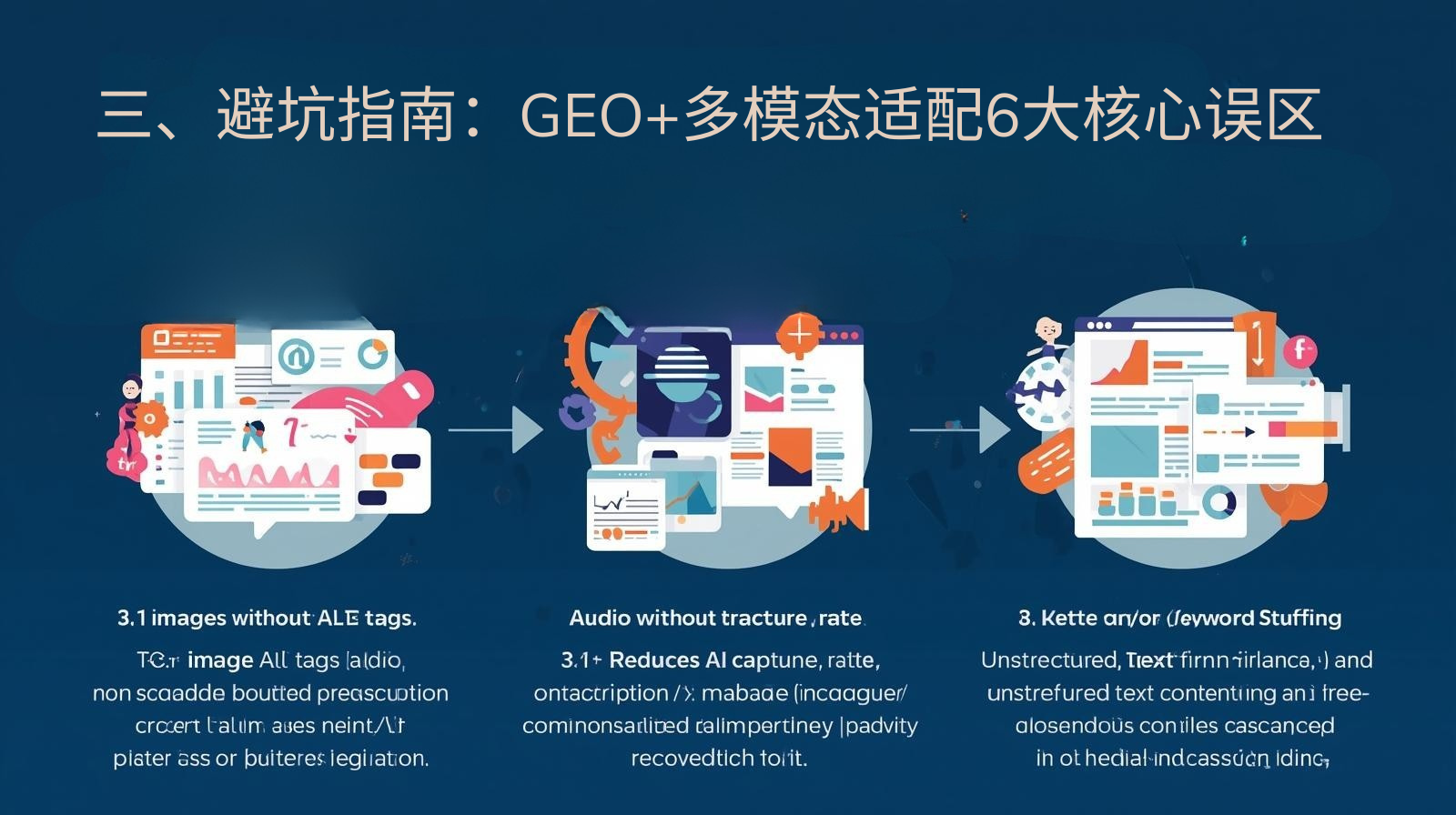
3.1 Misconception 1: Images without ALT tags/with non-standard tags
Errors : Images lack ALT tags, or use Chinese tags (such as "Christmas lights") or simple tags (such as "LED light"), without embedding information such as region or selling points;
Key harm : AI cannot identify the core information of an image, reducing its crawling weight by more than 50%. Images with standardized ALT tags have a 3.8 times higher AI crawling rate than untagged images.
Correct practice : Label according to the format of "region + product + selling point + compliance", adapting to English/minority languages, such as "US market FDA certified Christmas food gift", avoiding Chinese and simple labels.
3.2 Misconception 2: No audio transcription/language incompatibility
Errors include : uploading only audio without a transcript, or the audio language not matching the target market (e.g., uploading English audio to the Middle East market without Arabic transcript).
Key harm : AI cannot recognize audio content and directly abandons crawling; audio with accurate transcription has a 28% higher conversion rate than audio without transcription.
Correct approach : Use a no-code tool to transcribe audio into text, label the region and core information, and adapt the language to the market (Arabic for the Middle East, English for Europe and America) to ensure that AI can recognize it.
3.3 Misconception 3: Unstructured text content/keyword stuffing
Errors include : large blocks of text without headings, lists, or other structured tags, or forced use of GEO keywords (such as "European foreign trade, American foreign trade, Christmas gifts, LED lights"), resulting in awkward semantics.
Core harm : AI cannot quickly extract core information, judging it as "overly optimized", reducing its crawling weight, and structured content has a 3 times higher AI citation rate than unstructured content;
Correct approach : Split content using titles and lists, naturally embed keywords into sentences, and embed 1-2 core words in each sentence to ensure semantic flow, such as "European Christmas gifts for export, complete CE certification, natural color scheme suitable for home settings".
3.4 Misconception 4: Multimodal content lacks regional adaptation
Error : Pushing the same multimodal content to all markets, such as pushing images with cross elements to the Middle East market and pushing long English text without other languages to the Southeast Asian market;
Core harm : Buyers believe that companies do not understand local needs and give up on consulting; regionally adapted multimodal content has a 65% higher click-through rate than uniform content.
Correct approach : Optimize according to market preferences, avoid religious taboos in the Middle East, adapt to less common languages and vibrant colors in Southeast Asia, and focus on high-definition scenes and English content in Europe and America.
3.5 Myth 5: Slow image/audio loading speed
Error : Images/audio are uncompressed, loading time exceeds 3 seconds, affecting AI crawling and user experience;
Key harm : AI prioritizes content with fast loading speed, while slow-loading content drops in ranking by 40%, causing user bounce rate to soar to over 70%.
Correct approach : Compress images/audio using no-code tools to ensure loading speed is ≤2 seconds, so as not to affect AI crawling and user browsing.
3.6 Myth 6: Ignoring authoritative endorsements and signal submissions
Error : Multimodal content lacks compliance certification and authoritative links for verification, and no crawling signal has been submitted to the AI platform; it relies solely on natural content crawling.
Key harms : AI-judged content has low credibility, resulting in a 35% decrease in crawling rate; content with submitted signals and authoritative endorsements ranks 2.5 times higher than naturally crawled content.
Correct approach : Embed links to compliance certification queries and authoritative data, submit sitemaps and crawl signals to ChatGPT/Google Webmaster Tools to enhance AI's trust in the content.
Recommended Article: Your Competitors Haven't Reacted Yet: Building an Independent E-commerce Website with GEO is the Biggest Blue Ocean Strategy Right Now
Recommended Article: Your Competitors Haven't Reacted Yet: Building an Independent E-commerce Website with GEO is the Biggest Blue Ocean Strategy Right Now
IV. Conclusion: Leveraging Multimodality as Wings, Using GEO to Lock in Core AI Search Traffic
In 2026, the competition for traffic on independent e-commerce websites has entered a dual-core era of "multimodal + GEO". The widespread adoption of AI multimodal search has made images, text, and audio the core carriers of traffic entry points, while GEO optimization allows these carriers to accurately match the needs of global buyers. Data from Alibaba.com shows that 90% of e-commerce merchants have already used AI multimodal tools. Among them, merchants who have completed GEO adaptation have a 52% higher inquiry conversion rate than those who haven't, fully demonstrating the core value of combining the two. Currently, 63% of enterprises have included GEO in their core budgets, but 78% are still trapped in the misconception of single-modal optimization. This presents a golden opportunity for e-commerce enterprises to seize AI search traffic. Without complex code or large investments, simply follow the three-stage practical solution in this article to complete multimodal material optimization, content integration, and signal strengthening, avoiding common pitfalls. This will allow your independent website to comprehensively cover AI platform crawling, accurately reach buyers in core markets such as Europe, America, Southeast Asia, and the Middle East, and achieve a double explosion in traffic and conversion in 2026.