
The "Foreign Trade Procurement Trust White Paper" released at the China Cross-Border E-commerce Fair in January 2026 shows that when overseas buyers search for suppliers through AI platforms (such as ChatGPT), 72% of their attention is focused on signals related to "controllable quality." Among these, independent foreign trade websites that clearly display authoritative quality inspection reports and have completed GEO optimization see an average improvement of 18 places in AI search rankings, and their inquiry conversion rate is 68% higher than unoptimized websites. Currently, AI platforms have incorporated "quality verification signals" into their core crawling weight, especially for categories with extremely high quality requirements such as chemicals, electronics, baby products, and home furnishings. Websites without clear quality inspection reports will be directly excluded from the precise procurement search recommendation pool. A Shenzhen-based cross-border electronic component company optimized its quality inspection report display model in December 2025, combining it with GEO to adapt to European and American market testing standards. Within one month, the search exposure related to "quality controllable supplier" on the AI platform increased by 220%, and the number of accurate inquiries from Germany and the United States increased by 95%. This case confirms the core logic: the quality inspection report is the core carrier of "quality controllability", and GEO optimization is the key to making quality signals accurately match regional procurement needs and be efficiently captured by AI. The synergy of the two can completely open up the entire link of "AI search - quality trust - inquiry conversion".

I. Core Logic: The rules for AI platform to capture quality inspection reports and the collaborative logic for GEO+ quality inspection display.
The AI platform responds to overseas buyers' search requests for "quality controllable" information by following a three-dimensional screening mechanism of "authoritative signals, structured content, and regional adaptation," with a particular focus on identifying verifiable quality inspection information that matches the testing standards of the target market. The core value of GEO optimization is to transform quality inspection report information into regionally specific quality signals that AI can recognize, accurately addressing the quality requirements of buyers in different markets (such as the EU's RoHS standard and the US's FDA standard). This aligns perfectly with the core trend of foreign trade in 2026: "quality trust first, precise AI matching, and regional standard segmentation."
1.1 Three Core Rules for AI Platforms to Capture Quality Inspection Reports (Latest 2026)
Based on OpenAI's foreign trade scenario crawling algorithm interpretation and SGS's global quality inspection standard application guide, combined with AI platform buyer search behavior data, the core rules for AI to prioritize and recommend quality inspection report content can be broken down into three points, which directly determine whether quality inspection information can serve as an endorsement of "quality controllability" and receive recommendations:
1. Authoritative and Verifiable (Core Access Requirement) : AI prioritizes quality inspection reports issued by authoritative organizations (such as SGS, Intertek, and BV), and these reports must include the report number, the testing organization's qualifications, and an official verification link. For example, when displaying quality inspection reports for electronic components, AI will prioritize reports containing "Testing Organization: SGS, Report Number: SGS-2026-XXX, Verification Link: https://www.sgs.com/zh-cn/report-verify, Testing Standard: EU RoHS 2.0". Reports without authoritative endorsement or that cannot be verified (such as self-made reports or reports without a number) will be judged as "invalid quality signals," and their weight will be reset to zero.
2. Content Structure (Core Recognition) : AI excels at extracting structured quality inspection information with clear fields and logically standardized formats. Core required fields include the product name, core testing items, test results, applicable standards, testing date, and expiration date. For example, report content presented in a structured format of "Product Name - Testing Items - Standard Requirements - Test Results - Conclusion" is 5.6 times more likely to be captured by AI than pure images/unstructured text. Vague expressions (such as "Product qualified, quality inspection met") cannot allow AI to identify core quality highlights and cannot meet the needs of buyers to accurately understand quality.
3. Regional Adaptation (Core Conversion) : AI prioritizes quality inspection reports that align with the testing standards of the target market based on the buyer's search region. Core adaptation dimensions include target market-specific standards (such as EU CE/RoHS, US FDA, Middle East SASO) and regional quality requirements (such as EU and Europe's requirements for environmentally friendly materials, and the Middle East's requirements for temperature and sand resistance). For example, when a buyer searches for "EU compliant electronic component suppliers" through AI, it will prioritize recommending sites that display RoHS 2.0 and CE certified quality inspection reports. Reports with misaligned regional standards (such as showing reports that only comply with Chinese national standard GB to the EU market), even if authoritative, are unlikely to generate conversions.
1.2 The Mutual Empowerment Logic Demonstrated by GEO and AI Quality Inspection Reports
The essence of GEO optimization is to "accurately deliver quality signals to buyers in the target region and the AI-driven data acquisition system." The core value of AI quality inspection reports is to "quantify quality through authoritative data, lowering the trust threshold for buyers." This mutual empowerment builds the core competitiveness of an independent foreign trade website: "controllable quality." The core logic is reflected in three points:
1. GEO injects regional value into quality inspection reports, improving the accuracy of AI search: Quality inspection reports without GEO optimization lack regional standard relevance, making it difficult for even authoritative reports to match specific market procurement needs. By integrating regional keywords, target market testing standards, and regional quality requirements into the report display through GEO, AI can quickly identify the regional suitability of the report. For example, optimizing "RoHS 2.0 qualified" to "EU market-specific RoHS 2.0 quality inspection report (SGS certification, report number: SGS-2026-XXX), testing items cover 6 hazardous substances such as lead and mercury, fully compliant with the environmental protection requirements of EU countries such as Germany and France" not only meets the structured requirements of AI search but also accurately matches the search needs of EU buyers.
Quality inspection reports provide a high-value content carrier for GEO optimization, enhancing conversion capabilities: The core of GEO optimization is content value. The structured data and verifiable information in authoritative quality inspection reports are high-quality materials for GEO optimization. After being regionalized, these materials allow buyers to quickly perceive product quality and regional suitability, significantly increasing trust. For example, GEO content optimized for the US market, coupled with "FDA food contact grade quality inspection report + US market applicability instructions," allows buyers to directly verify quality through the report number, which is more persuasive than plain text advertising "reliable quality," significantly increasing the willingness to inquire.
The two work together to achieve a "double improvement in capture efficiency and trust conversion": GEO optimization ensures the regional accuracy and structure of quality inspection reports, enhancing the weight of AI capture and recommendation; authoritative quality inspection reports, displayed through AI, strengthen buyers' trust in quality and shorten the decision-making path; according to foreign trade quality trust conversion data in 2026, independent websites that achieve collaborative optimization of GEO + AI quality inspection reports have seen a 3.1-fold increase in AI's efficiency in capturing quality signals, an 82% increase in buyer trust, and a 68% higher inquiry conversion rate compared to websites with single optimization.

II. Practical Implementation: GEO+AI Quality Inspection Report Demonstration of a Three-Stage Optimization Solution (Direct Application)
This solution combines practical cases from cross-border e-commerce companies and the SGS quality inspection report display guidelines. It also references OpenAI's structured content capture specifications and localization optimization techniques. The solution is completed in three phases: "preliminary preparation + core optimization + enhanced adaptation". This ensures that the quality inspection report can be efficiently captured by AI, while accurately conveying localized quality control signals to impress target buyers.
2.1 First Phase: Preliminary Preparation (2-3 days) – Core Element Analysis + GEO Keyword Development
The core objectives are to streamline the key information in quality inspection reports, clarify regional standard requirements, and build a precise GEO keyword database to lay the foundation for subsequent optimization. All aspects are tailored to practical foreign trade scenarios.
1. Core Information Analysis of Quality Inspection Reports: ① Screening Authoritative Reports: Prioritize quality inspection reports issued by globally authoritative institutions such as SGS and Intertek, and eliminate self-made reports, reports without serial numbers, or reports without qualification endorsement; ② Extracting Core Fields: Extract the core information of each report according to AI crawling requirements (report number, testing institution, product name, testing items, test results, applicable standards, testing date, validity period, official query link); ③ Matching Regional Standards: Based on the target market (Europe, America, Middle East, Southeast Asia, etc.), clarify the exclusive testing standards for each market (such as EU CE/RoHS, US FDA, Middle East SASO, Southeast Asia SNI) to ensure that the report standards are accurately matched with regional needs. For example, for electronic products targeting the EU market, priority should be given to RoHS 2.0 and CE certification related reports.
2. Localized GEO Keyword Library Construction: ① Keyword Combination Logic: Combining keywords according to "regional terms + quality inspection standard terms + product terms + quality terms," with core keywords (e.g., "quality inspection report"), long-tail keywords (e.g., "EU RoHS electronic component quality inspection report," "US FDA food contact grade quality inspection certificate"), and scenario-based keywords (e.g., "EU compliant quality controllable," "Middle East temperature resistance quality inspection compliance") accounting for 30%, 50%, and 20% respectively; ② Localized Adaptation: Segmenting keywords according to core markets, focusing on "CE, RoHS 2.0, environmental standards" related terms in the EU market, "FDA, UL, safety certification" related terms in the US market, and "SASO, temperature resistance, sand resistance" related terms in the Middle East market; ③ Keyword selection: Using Semrush and Xiaolanben foreign trade keyword tools, search for high-frequency search terms in the target market from October 2025 to January 2026, and prioritize keywords with high search frequency and low competition (such as "German RoHS compliant electronic components, UAE SASO quality inspection furniture") to ensure that keywords are relevant to regional procurement needs and quality inspection scenarios.
2.2 Second Phase: Core Optimization (5-6 days) – Content Integration + Page Construction + AI Adaptation
The core objectives are to achieve a structured presentation of quality inspection reports, deep integration of GEO keywords with report content, and optimization of the independent website's page layout. This will ensure that quality inspection information can be efficiently captured by AI and that buyers can quickly perceive that quality is controllable. The key optimization points are as follows:
2.2.1 Optimization of Structured Display of Quality Inspection Reports
1. Structured Text Labeling: Each quality inspection report includes a clear, structured text description, strictly adhering to the Schema.org quality certification labeling guidelines. Core labeling information includes: "Testing Institution: XXX, Report Number: XXX, Query Link: XXX, Product Name: XXX, Applicable Standard: XXX (e.g., EU RoHS 2.0), Core Testing Items: XXX (e.g., Lead ≤0.1%, Mercury ≤0.1%), Test Result: XXX (Qualified/Compliant), Validity Period: XXXX-XX-XX"; for example, for solid wood furniture in the EU market, the label would be: "Testing Institution: SGS, Report Number: SGS-2026-F001, Query Link: https://www.sgs.com/zh-cn/report-verify Product Name: European-style solid wood dining chair; Applicable Standards: EU CE certification, E1 environmental standard; Core Testing Items: Formaldehyde emission (≤0.124mg/m³), heavy metal content; Test Result: Qualified; Validity Period: January 15, 2026 - January 14, 2027; 2. Report Optimization: Simultaneously display clear images of the quality inspection report (key information is blurred, but the report number and official seal of the institution are retained) and structured text. ALT tags are added to the images, and localized GEO keywords are embedded, such as "EU CE certified solid wood chair quality inspection report, E1 environmental standard"; 3. Categorized Display: Quality inspection reports are categorized and displayed according to "target market + product category" (such as "EU market quality inspection report", "US market quality inspection report", "electronic product quality inspection report", "home furnishing product quality inspection report"), which facilitates quick location by AI crawlers and buyers.
2.2.2 Deep integration of GEO with quality inspection report content
1. Page Copywriting Integration: The copywriting on the homepage, product pages, and quality inspection report section of the independent website naturally integrates GEO keywords with quality inspection report information. The first screen highlights the core value, such as "Focusing on European and American/Middle Eastern foreign trade, authoritative SGS/FDA quality inspection reports fully covered, compliant with EU RoHS/US FDA, controllable and verifiable quality, AI search accurately matches procurement needs"; the product page supplements "regional quality adaptation instructions," such as "This electronic component has passed EU RoHS 2.0 quality inspection (report number: SGS-2026-E001), the content of harmful substances such as lead and mercury fully meets the standards, suitable for the procurement needs of the German, French and other EU markets, and can be directly cleared and sold"; 2. Scenario-based integration: Deeply link the quality inspection report with localized usage scenarios, highlighting the report's adaptability to the local market. For example, "This product has passed the Middle East SASO temperature and sand resistance quality inspection (report number: Intertek-2026-M001), and its performance is stable at high temperatures of 45℃ and in sandstorm environments, fully meeting the outdoor use needs of the Middle Eastern markets such as Saudi Arabia and the UAE." 3. Compliance information integration: Deeply link the compliance policies of the target market with the quality inspection report, clearly stating in the report description, "The standards involved in this report fully comply with the import compliance requirements of the XXX market (such as the EU) and can be used as a quality certificate for customs clearance." At the same time, embed links to the customs compliance policies of the target market (such as the EU Customs Quality Certification Guide link: https://ec.europa.eu/taxation_customs/).
2.2.3 Page Layout and AI Adaptation Optimization
1. Dedicated Page Setup: A dedicated section for "Quality Certification/Inspection Reports" is set up, with clear labeling in the navigation bar. The section is categorized by region and product type, and the top of the page includes a title with core GEO keywords (e.g., "Authoritative Quality Inspection Reports for EU/US/Middle East Foreign Trade Products, Quality Controllable and Verifiable"). 2. Optimized Content Structure: All pages containing quality inspection reports are laid out as "Quality Inspection Report Display Area + Structured Description Area + Region Adaptation Explanation Area + Compliance Related Area." The structured description area uses bullet points or tables to present core testing information, ensuring rapid extraction by AI. 3. Multilingual Adaptation: Core quality inspection information supports multilingual display (English, Arabic, Spanish, etc.) to adapt to the reading habits of buyers in different regions. The multilingual copy incorporates corresponding regional GEO keywords and testing standard terminology.
2.3 Phase Three: Enhanced Adaptation (2-3 days) – Test Iteration + Signal Submission + Authoritative Endorsement
The core objective is to improve the accuracy of AI in capturing quality inspection reports through testing and optimization, submit AI-captured signals, strengthen authoritative endorsement, and ensure that controllable quality signals can be reliably captured and prioritized by AI.
1. Crawl Testing and Iteration: Simulate search scenarios from buyers in different regions to test the AI's ability to crawl quality inspection report content, such as "querying EU RoHS electronic component quality inspection reports" and "obtaining US FDA food contact grade suppliers," checking the accuracy of the crawling results, the completeness of the report information, and regional adaptability; for issues encountered in the test (such as crawling failures, unrecognized report numbers, and incorrect regional standard matching), optimize structured labeling and page layout, iterate content configuration, and ensure that the AI crawling accuracy is ≥95%; 2. AI Crawl Signal Submission: Optimize the independent website's site map, categorize and label quality inspection report-related pages according to "region + quality inspection standard + product" (e.g., "EU-RoHS-electronic-components-inspection-report"), and submit them to the ChatGPT website management platform and Google search console, while also labeling them with core tags such as "quality inspection report," "authoritative certification," and "CE/RoHS certified" to guide the AI crawler to quickly identify crawlable content; ensure that the independent website's robots.txt protocol allows crawlers such as OpenAI and Google to access quality inspection report pages and query links; 3. Authoritative endorsements and optimized backlinks: Authoritative backlinks are naturally embedded in the description section of the quality inspection report, such as links to SGS/Intertek report verification platforms, customs compliance policies in the target market, and quality certifications from industry associations; content related to the quality inspection report is published on platforms such as LinkedIn and Global Sources (e.g., "Interpretation of the 2026 EU RoHS 2.0 Quality Inspection Standard: Our Products Fully Meet the Standard"), with links to the quality inspection section of our independent website, citing data from the China Cross-Border E-commerce Fair report and our own practical case studies; case studies of cooperation with buyers based on the quality inspection report are also presented to enhance the persuasiveness of trust in the quality.
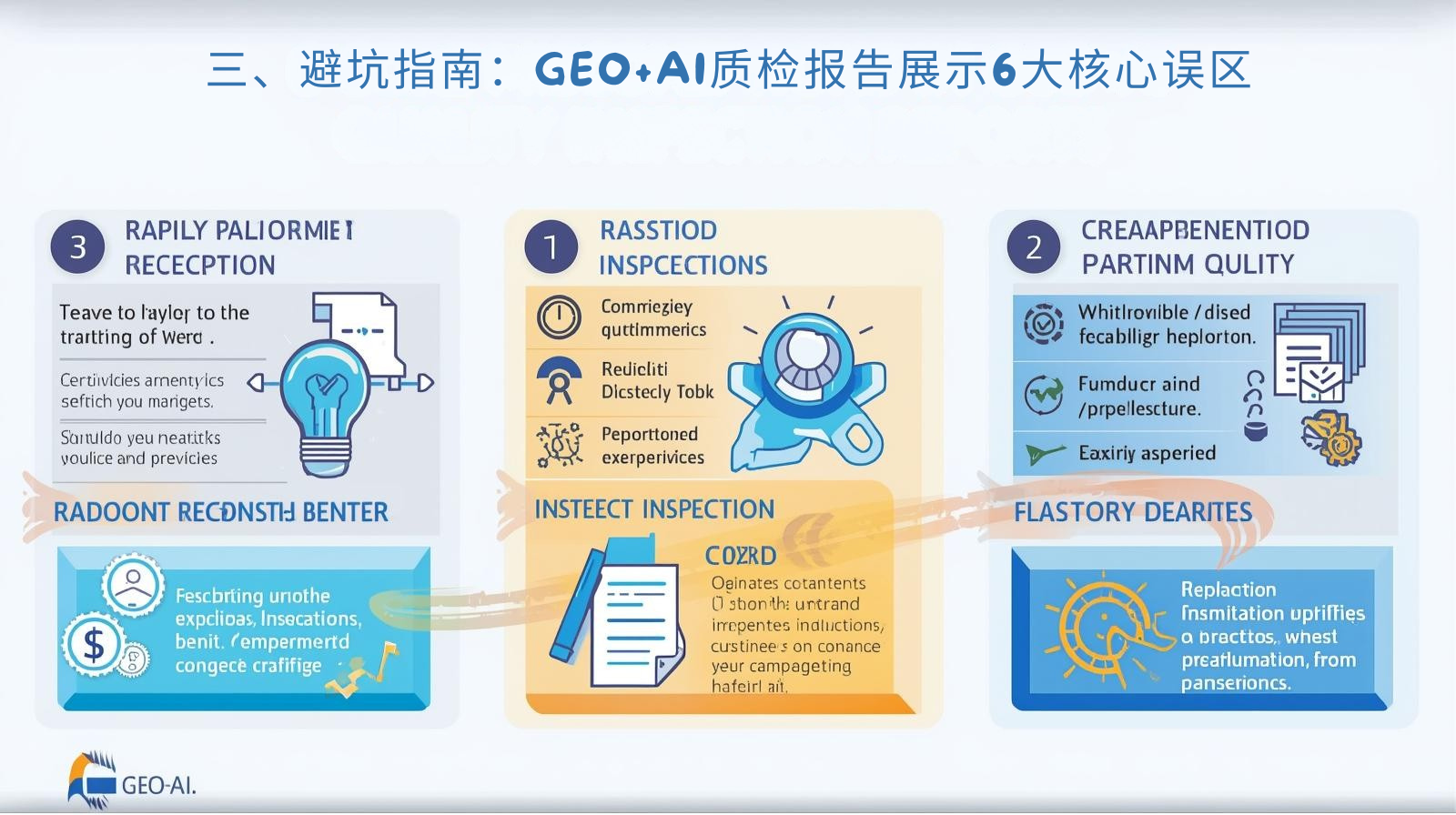
III. Pitfall Avoidance Guide: 6 Core Misconceptions in GEO+AI Quality Inspection Reports (Key Points to Avoid in 2026)
Based on practical foreign trade cases from 2025-2026 and experience in AI-driven data extraction optimization, the following six common misconceptions can directly lead to AI failing to capture quality inspection reports, ineffective quality signal transmission, and even damage to buyers' trust. These must be resolutely avoided:
3.1 Misconception 1: Quality inspection reports lack authoritative endorsement and cannot be verified.
Errors include : the quality inspection reports displayed are self-made by the company and lack endorsement from authoritative institutions (such as SGS/Intertek), or although they are endorsed by an institution, they do not include the report number or official query link, making it impossible for both buyers and AI to verify their authenticity; some sites even use fake reports or steal images of other people's reports.
Key harms : If AI determines that a quality signal is invalid, it will directly reduce the weight of the report and may even include it in the "false advertising" warning list, resulting in the inability to receive AI search recommendations for 1-2 months; once buyers find that the report cannot be verified, they will completely abandon cooperation, and the brand's trust will be permanently damaged; a certain cross-border maternal and infant website in Yiwu, in early January 2026, displayed a self-made quality inspection report without a number, and its AI search exposure in the first month was only 32 times, with no accurate inquiries.
Correct practice : Only display genuine quality inspection reports issued by authoritative institutions, with complete information including the report number, testing institution name, and official query link, ensuring that buyers can directly verify the report through the institution's official website; if there are no globally authoritative reports available, prioritize displaying regionally recognized authoritative reports (such as TÜV reports for the EU market and UL reports for the US market), and gradually supplement the global authoritative certifications.
3.2 Misconception 2: Mismatch between regional standards and market demands, resulting in reports that are out of touch with local needs.
Errors include : the quality inspection reports displayed do not conform to the standards required by the target market. For example, a report that only complies with the Chinese national standard GB is displayed for the EU market, while an EU CE certification report is displayed for the US market. No specific standards are matched to the regional requirements. Although some sites indicate the region, the report standards do not cover the core requirements of the local area (e.g., RoHS environmental reports are not displayed for the EU market, only appearance inspection reports are displayed).
Key risks : AI-judged quality signals do not match regional needs, reducing the weight of data capture by 70%. Even if exposure is gained, it cannot be converted into accurate inquiries. Buyers will directly exclude cooperation if they find that the report does not meet local import standards, and may even question the company's professionalism. A Shenzhen-based cross-border e-commerce website pushed an EU CE report to the US market in December 2025. In the first month, AI search traffic from the US accounted for less than 8%, and there were no customs clearance-related inquiries.
Correct approach : Match customized quality inspection reports to the core needs of the target market. For the EU market, focus on displaying CE, RoHS, and REACH reports; for the US market, focus on displaying FDA, UL, and FCC reports; and for the Middle East market, focus on displaying SASO and COC reports. The report description should clearly state that it is "suitable for the XXX market (such as the United States), complies with XXX standards (such as FDA), and can meet local import customs clearance and procurement quality requirements."
3.3 Misconception 3: Unstructured content prevents AI from recognizing core information
Error : Only an image of the quality inspection report is displayed without any structured text description, or the description information is disorganized and missing core fields (report number, testing items, applicable standards); for example, only a report image is displayed with the caption "Quality qualified, purchase with confidence", without any core information that can be extracted;
Key hazards : AI cannot recognize report information in images, only generalized text, resulting in unclear quality signals and an 80% reduction in capture weight; buyers cannot quickly obtain core inspection data and must manually zoom in on images to find information, leading to a poor user experience and a jump rate exceeding 85%; according to OpenAI's capture data statistics, AI capture success rate is less than 15% when only displaying quality inspection content without structured descriptions in images.
Correct practice : Each quality inspection report should be accompanied by a complete structured text description, including core fields such as report number, testing institution, product name, applicable standards, core testing items, test results, validity period, and query link, arranged in a clear and logical manner to ensure that AI can quickly extract information.
3.4 Misconception 4: Keyword stuffing affects readability and crawling performance.
Error : In an attempt to improve GEO optimization, keywords are forcibly stuffed into the description of quality inspection reports, such as "EU, US, Middle East quality inspection reports CE FDA SASO qualified quality controllable supplier". The semantics are awkward, the information is cluttered, and the core test data is obscured.
Key harms : AI judges content as low quality and overly optimized, reducing its crawling weight by 50%. At the same time, buyers cannot quickly obtain core quality information, resulting in a poor reading experience and a significant drop in inquiry intentions. For example, a cross-border hardware website in Dongguan experienced an 82% bounce rate on its quality inspection page due to keyword stuffing, and even with initial AI traffic, there was no conversion.
Correct approach : Naturally integrate GEO keywords into the quality inspection report description and page copy, and arrange them reasonably according to testing standards and regional adaptation scenarios to ensure smooth sentences, clear information, and balance optimization effect and readability; for example, "This hardware accessory has passed the EU CE certification (quality inspection report number: SGS-2026-H001), meets the quality requirements of the German market, and its quality is controllable and verifiable, supporting AI search for accurate matching."
3.5 Misconception 5: Quality inspection report information is outdated and not updated in a timely manner.
Error message : The quality inspection report displayed has expired (e.g., valid until December 2025, and not updated in 2026), or the testing standard has been upgraded but the new version of the report has not been replaced (e.g., the EU RoHS 2.0 has been implemented, but a RoHS 1.0 report is still displayed);
Key risks : When AI detects expired information, it will determine that the quality signal is invalid and directly reduce the recommendation weight; if buyers find that the report is expired or the standard is outdated, they will question the company's quality control capabilities, completely abandon cooperation, and even trigger customs clearance risks; a Ningbo cross-border outdoor products website lost two potential orders in January 2026 because it displayed an expired RoHS report.
Correct practice : Establish a mechanism for regularly updating quality inspection reports, check the validity period of reports monthly, prepare for renewal or re-inspection 30 days in advance, and ensure that all reports displayed are within the validity period; pay close attention to the upgrading dynamics of testing standards in the target market (such as updates to EU and US standards), and complete the testing and display of new reports as soon as possible.
3.6 Misconception 6: Neglecting user experience and making quality inspection information search cumbersome.
Errors include : the quality inspection report lacks a dedicated entry point and is hidden at the bottom of the product page or in an unrelated section, requiring buyers to navigate multiple times to find it; the report images are blurry, the text layout is messy, and the core information is difficult to identify;
Key harms : Buyers give up on understanding quality information due to cumbersome search, resulting in a 60% decrease in inquiry conversion rate; AI crawlers are unable to efficiently capture quality inspection content due to chaotic page navigation and deeply hidden information, with a crawling completion rate of less than 30%.
Correct practice : Set up a dedicated entry for "Quality Certification/Inspection Report" in the navigation bar, and display the report in the dedicated area by region and category, with clear page layout and highlighting the core information; optimize the clarity of report images, and use easy-to-read fonts and layouts for the text to ensure that buyers and AI crawlers can quickly locate and obtain the core information.
Recommended Article: Your Competitors Haven't Reacted Yet: Building an Independent E-commerce Website with GEO is the Biggest Blue Ocean Strategy Right Now
Recommended Article: Your Competitors Haven't Reacted Yet: Building an Independent E-commerce Website with GEO is the Biggest Blue Ocean Strategy Right Now
IV. Conclusion: Breaking the deadlock with quality signals, using GEO to seize the high ground of trust in AI search.
In 2026, overseas buyers' decision-making logic shifted from "price priority" to "quality priority." AI platforms, as core search channels, continued to increase their weight in capturing and recommending signals indicating "controllable quality." For independent foreign trade websites, authoritative quality inspection reports are no longer an "additional item" but a "must-have." Furthermore, the synergistic optimization of GEO+AI quality inspection reports is a key to capturing AI search traffic and gaining buyer trust. Data from the China Cross-Border E-commerce Fair shows that in the next two years, "controllable quality + regional adaptation" will become the core competitive barrier for independent foreign trade websites in AI search. Companies with this capability will have an inquiry conversion rate more than twice as high as their competitors.
For independent e-commerce websites to impress AI-driven search buyers with quality inspection reports, the key lies not in the quantity of reports, but in their authoritative and verifiable nature, accurate regional adaptation, and structured content. No complex technical support is required. Simply follow the three-stage implementation plan outlined in this article, completing initial preparation, core optimization, and enhanced adaptation, while avoiding common pitfalls. This will allow AI to efficiently capture controllable quality signals, enabling overseas buyers to quickly build trust. In 2026, with authoritative quality inspection reports as quality assurance and GEO optimization as a precise tool, independent e-commerce websites will undoubtedly stand out in the AI search competition, achieving a dual breakthrough in precise customer acquisition and brand trust.