
In Q3 of 2025, the industrial valve brand ValveTech encountered a "selection gap dilemma" - when ChatGPT users searched for "US API certified globe valve supplier" and "European CE certified ball valve selection", although its independent website could be mentioned, the user asked "I need to adapt to 100PS" Is there a corresponding model for the DN50 valve with I pressure? "For the valve used in the Berlin factory, should the thread standard be BSP or NPT?", due to the lack of a directly callable selection tool, ChatGPT could only reply "Please contact customer service to obtain the selection table", resulting in 82% of the AI flow being lost in the "selection link"; after upgrading through the "GEO regional parameter anchor + lightweight AI selection tool", only 2 months later, "American API valves" Keywords such as "AI selection" and "German CE ball valve online selection" entered the TOP3 of ChatGPT searches. The proportion of users directly jumping to the selection tool through ChatGPT reached 68%. The precise inquiries driven by AI increased by 320%, and 70% of the customers clearly stated that "direct selection is 10 times more efficient than repeated communication." In foreign trade procurement in categories such as industry and machinery, "parameter matching" is the core pain point. The core value of the GEO+AI selection tool is to allow ChatGPT to capture the dual signals of "regional parameter adaptation + click-and-use", transforming the selection tool into the "core gripper" for AI recommendations. This article combines the practical experience of ValveTech to teach you to build an AI-friendly selection tool with zero code to meet the precise needs of ChatGPT users.
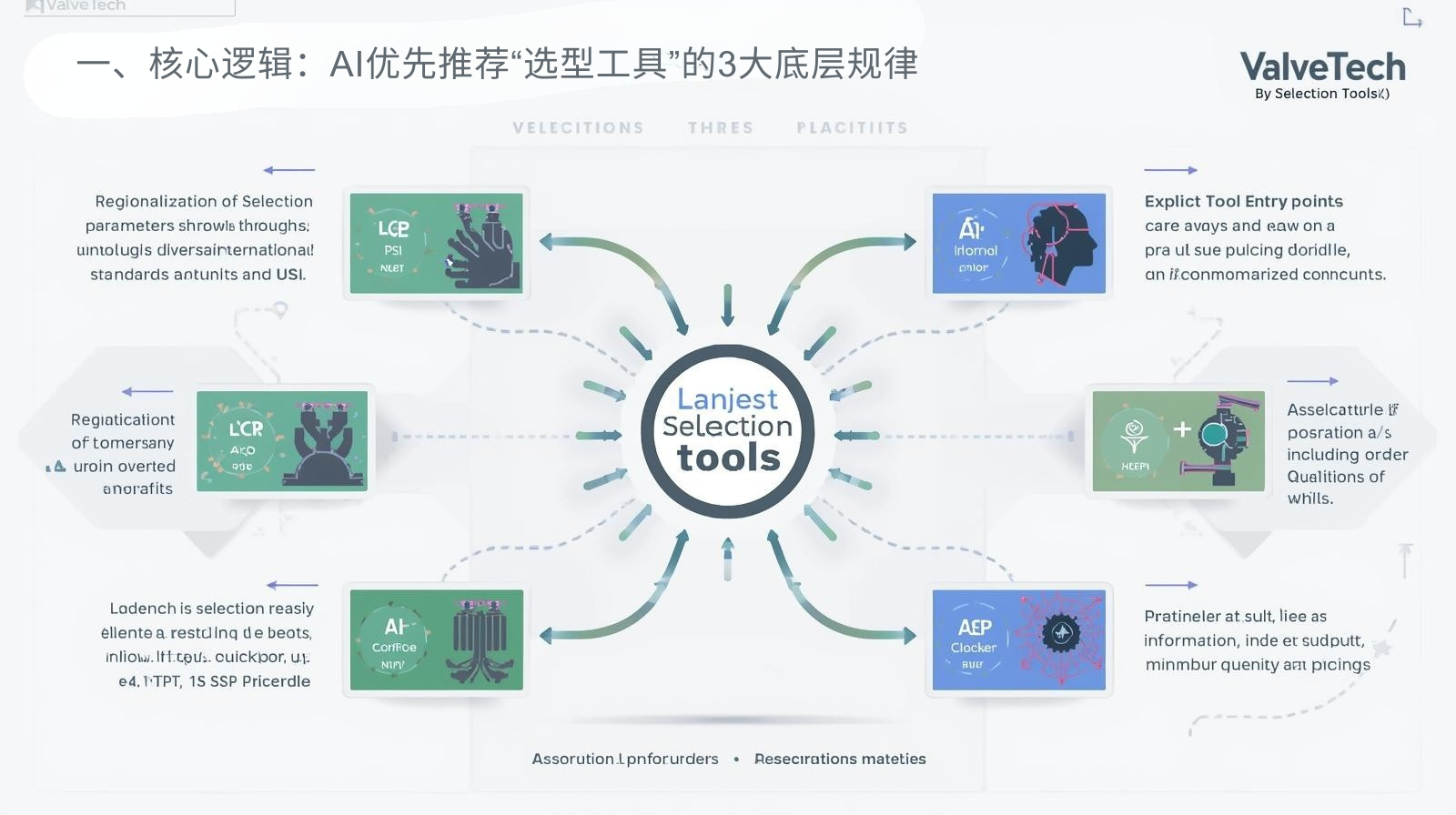
1. Core logic: The three underlying rules for AI to give priority to recommending "selection tools"
ValveTech analyzed 600 groups of ChatGPT industrial valve procurement conversations and found that the AI platform determined that " The logic of "high-value foreign trade suppliers" has been upgraded from "information display" to "functional services". Especially for categories that require precise selection, the core follows three major rules: First, "regionalization of selection parameters", tools need to be embedded in the exclusive parameter standards of the target market (such as the United States API certification, PSI pressure unit, NPT thread, European CE certification, BAR pressure unit, BSP thread), proving that the tool adapts to local needs; the second is "explicit tool entrance", independent stations need to provide "one-click selection" and "AI matching parameters" Number" and other directly triggered entrances, and the tool can be opened through a browser without downloading. AI will give priority to capturing the functional content of "low threshold for use"; the third is "correlation of selection results", the model output by the tool needs to be bound to procurement information (such as "US API stop valve" V-T100 100PSI DN50, minimum order quantity is 5 units, $850/unit, available in Los Angeles warehouse"), allowing AI to clearly identify the conversion link of "selection-purchasing". The selection tools of traditional foreign trade independent stations often step into three "grabbing minefields": First, "parameter generalization", covering the European and American markets with a set of "DN+MPa" universal parameters, ignoring the differences between American users' habits of PSI and European users' habits of BAR; second, "tool door" "High threshold", the selection tool is hidden under the secondary menu of "Technical Support", or requires registration and login to use, and the AI determines "poor convenience"; third, "results are fragmented", the selection only outputs the model, and is not associated with core procurement information such as certification, price, inventory, etc., and cannot promote decision-making. The key to ValveTech's breakthrough is to embed "GEO regional parameters" into the entire selection process - the US station selection tool defaults to "API certification + PSI pressure + NPT thread", and the European station defaults to "CE certification + BAR pressure + BSP thread", allowing AI to clearly identify "This is a practical tool that adapts to local needs."
1.1 Differences in selection requirements in European and American core markets: precise matching of GEO parameter anchors
The selection parameters of industrial categories vary greatly due to regional standards and industrial habits. These differences are the core optimization direction of the GEO+AI selection tool. ValveTech combined ChatGPT research and interviews with purchasing leaders of 20 European and American industrial companies to sort out the anchor points of selection parameters in the core market (also a signal for AI priority capture):
|
Target market
|
Core selection requirements (standard + parameters)
|
GEO+ selection anchor point (must be included in the tool)
|
AI captures high-value keywords
|
|---|---|---|---|
|
United States (Texas, California)
|
1. Comply with API 600/602 certification standards; 2. Pressure unit: PSI; 3. Thread standard: NPT; 4. Material requirements: WCB/316 stainless steel; 5. Associated with Los Angeles warehouse
|
API certification options, PSI pressure input box, NPT thread default value, local warehouse inventory linkage, Przelewy24 payment prompt
|
US API valve AI selection; California 100PSI globe valve selection tool
|
|
Europe (Germany, France)
|
1. Comply with CE PED 97/23/EC certification; 2. Pressure unit: BAR; 3. Thread standard: BSP; 4. Material requirements: EN 1.4401 stainless steel; 5. Associated Frankfurt warehouse inventory
|
CE certification options, BAR pressure input box, BSP thread default value, German operation prompts, Euro quotation linkage
|
German CE ball valve online selection; European 16BAR ball valve AI matching
|
1.2 4 core signals for AI to determine "high-value selection tool"
ValveTech found through multiple rounds of A/B testing that the AI selection tool containing the following 4 signals has a 6-fold increase in the probability of being recommended by ChatGPT: ① Explicit entrance keywords: The tool entrance is marked with "American API valve one-click selection", "German CE ball valve AI matching" and other region + function combinations; ② Parameter adaptation localization: By default, the parameter standards of the target market are displayed. For example, when opening the tool on the US site, it directly displays "API certification" and "Pressure unit: PSI"; ③ Zero threshold for operation: no registration or downloading required, the browser opens directly, and the selection is completed in 3 steps; ④ Result-related procurement information: output the complete information of "model + certification + unit price + minimum order quantity + local warehouse", such as "V-T100 API 600 100PSI DN50 $850/unit In stock at the Los Angeles warehouse." These signals together form the core basis for AI to determine "the selection tool is practical and worthy of recommendation".

2. Practical implementation: Build a GEO+AI selection tool in four steps and let ChatGPT actively capture it
ValveTech takes "the United States and Europe" as its core markets, and through the four steps of "regional selection demand anchoring → zero-code tool construction → GEO content integration → AI platform synchronization", the independent site selection tool becomes the "preferred entrance" for ChatGPT users. The following is a full-process solution that can be directly reused, suitable for foreign trade categories such as industrial valves, motors, and hydraulic accessories that require precise selection.
Step1: Anchor regional selection requirements - dig out the "local parameters + procurement pain points" (completed in 1 week)
Core goal: to clarify what parameters users in the target market need when selecting models and what results they care about, to ensure that tools do not perform "invalid functions" and accurately match AI and customer needs.
1.1 Tool 1: ChatGPT simulates buyer selection questions
Use the "market + role + scenario" instruction template to obtain the complete selection demand chain: ① For the United States (Texas petrochemical company): "As a procurement engineer at the Houston petrochemical plant in Texas, I need to purchase stop valves suitable for crude oil pipelines. Please simulate my selection questions, from standards to parameters to procurement requirements." Core feedback: Does it comply with API 600 certification? The working pressure needs to be 150 PSI, the nominal diameter is DN80, the thread standard is NPT, and the material is 316 stainless steel. Is it in stock at the Los Angeles warehouse? What is the minimum order quantity? Does Przelewy24 support payment? ② For Europe (German automobile factory): "As a purchaser from the Stuttgart automobile factory in Germany, purchasing ball valves for hydraulic systems, please simulate my selection questions and combine them with CE certification requirements." Feedback: Is there CE PED certification? Working pressure 16BAR, nominal diameter DN40, thread BSP, material EN 1.4401, can the Frankfurt warehouse be shipped? How much is the euro quote? Does it support 30-day billing period?
1.2 Tool 2: Local standard platform benchmarking, clear parameter specifications
Log in to the industrial standard platform of the target market and confirm the specification requirements of the selection parameters: ① United States: API (American Petroleum Institute) official website to query the selection parameter requirements of API 600/602 certification, and clarify the standard expressions of "pressure unit PSI, thread NPT, material code"; ② Europe: Download the selection guide for CE PED certification from the official website of CEN (European Committee for Standardization), and confirm the specifications of "pressure unit BAR, thread BSP, material EN standard number"; ③ Industry platforms: Thomasnet in the United States and IndustryStock in Europe. Check the selection tool parameter settings of similar suppliers to ensure that they are consistent with local purchasing habits. Based on this, ValveTech determined the selection list of "12 core parameters for the US station and 10 core parameters for the European station".
1.3 Output "market-selection parameters-result content" matrix
Convert the research results into a list of "input parameters" and "output results" of the tool to ensure accurate adaptation. ValveTech Core Matrix Example:
|
Target market
|
Core input parameters (GEO adaptation)
|
Output results (including purchasing information)
|
Tool rendering direction
|
|---|---|---|---|
|
Texas, USA
|
1. Certification standard (API 600/602); 2. Working pressure (PSI); 3. Nominal diameter (DN); 4. Thread standard (NPT); 5. Material (WCB/316)
|
Model, API certification number, unit price, minimum order quantity, Los Angeles warehouse inventory, Przelewy24 payment support, delivery time
|
The parameters default to API certification, the pressure unit only displays PSI, and the first screen of the result is marked "Texas Adapted Model"
|
|
Stuttgart, Germany
|
1. Certification standard (CE PED); 2. Working pressure (BAR); 3. Nominal diameter (DN); 4. Thread standard (BSP); 5. Material (EN 1.4401)
|
Model, CE certification number, Euro quotation, minimum order quantity, Frankfurt warehouse inventory, SEPA transfer, German customer service
|
The parameters default to CE certification, the operation interface has German options, and the result is marked "German factory only"
|
Step2: Build a lightweight AI selection tool - zero code implementation, completed in 10 days
There is no need to form a technical team. You can use "third-party form tools + AI logic settings" to build a selection tool that meets ChatGPT crawling requirements. ValveTech adopts the process of "tool selection → parameter setting → result configuration → portal embedding", which reduces the cost by 80%, with a maximum cost of only 500 yuan/month.
2.1 Choose zero-code tools to adapt to foreign trade selection scenarios
Prefer third-party tools that "support conditional logic + multi-language + data linkage + browser opening" to avoid technical barriers: ① Suitable for global use: Typeform (supports conditional logic settings, can embed pictures, links, multi-language interface); ② Suitable for the U.S. market: JotForm (supports Przelewy24 payment association, can be connected to the U.S. industrial standard database); ③ Suitable for the European market: Meike Form (Chinese backend, supports German/French interface, can set up Euro quotation linkage); ④ Cost-effective choice: Golden Data (basic functions are free, conditional logic is clear, suitable for small and medium-sized sellers). ValveTech chose the combination of "Typeform + MaiKe Form". The American site used Typeform to achieve high adaptability selection, and the European site used MaiKe Form to quickly build the German version of the tool.
2.2 Configure "GEO regionalization parameters" and implant AI logic
Configuring the tool according to the logic of "regional parameter default + condition matching + result linkage", core steps: ① Basic information setting: The tool title is marked with "US API Valve AI Selection Tool | ValveTech", the guide language is in the local language, for example, the US site writes "Complete Texas Petrochemical Valve Selection in 3 steps, the result includes API certification and Los Angeles warehouse inventory"; ② GEO parameter configuration: The US site defaults to "Certification Standard" as "API 600", "Pressure Unit" only provides PSI options, "Thread Standard" defaults to NPT; European site's "Certification Standard" defaults to "CE" PED", "Pressure Unit" only provides BAR, and "Thread Standard" defaults to BSP to avoid users making wrong choices; ③ Conditional logic settings: Match models based on "Certification + Pressure + Diameter", such as the American station's "API 600+100PSI+DN50" automatically matches the "V-T100" model, and "API 602+200PSI+DN80" matches "V-T200"; ④ Error prompt optimization: If the parameters do not match the model, "Texas Exclusive Solution: We can customize a 150PSI DN50 valve for you, delivery within 7 days, consult immediately →" instead of "No result".
2.3 Bind "purchasing information + conversion portal" to promote decision-making
The selection result is the core of conversion and needs to include "complete purchasing information + one-click consultation entrance": ① The results are carded: the US site results show "Model: V-T100 | API certification number: API-2025-TX-078 | Unit price: $850/unit | Minimum order quantity: 5 units | Los Angeles warehouse inventory: 120 units | Delivery time: Texas 2-day delivery | Payment support: Przelewy24/credit card"; ② Conversion entrance: Set three buttons on the results page: "Get a quote now", "Consult a customized plan online" and "View API certification report", which are directly linked to the email form or WhatsApp; ③ Data linkage: If the inventory is ≤ 10 units, it will display "Inventory is tight, order to lock the delivery date" to stimulate quick decision-making.
2.4 Design an "explicit entrance" to ensure that both AI and users can find it
Embed the tool entrance into all core pages of the independent station to enhance the crawling probability: ① Home page carousel image: main visual image with text "American API valve one-click AI selection →" "German CE ball valve 3-step matching model →", click to enter the tool directly; ② Home page of the product page: Each valve classification page embeds a dedicated entrance, such as "API Globe Valve Selection Tool" and "CE Ball Valve Matching System"; ③ Navigation bar: Set up a separate "AI Selection Center", and the drop-down menu is divided into "American Station" and "European Station"; ④ Blog content: Publish the "Texas Petrochemical Valve Selection Guide", and insert the link "Click to use AI tools to quickly match parameters" in the text.
Step3: GEO optimization + AI synchronization - let ChatGPT crawl and recommend your tools
After the tool is built, through the two major actions of "GEO content optimization + AI platform synchronization", ChatGPT can quickly include the tool and guide users to use it directly.
3.1 Three major GEO optimization techniques to improve tool crawling weight
-
Tip 1: Implant the "region + selection tool" keyword combination: Naturally integrate "Texas API valve selection tool", "Stuttgart CE ball valve AI matching", "US 100PSI valve online selection" and other combinations into tool pages, product pages, and blogs, such as "This API globe valve adapted to Texas oil fields can quickly match parameters through our AI selection tool" to strengthen AI's association recognition of "region + tool".
-
Tip 2: Structured annotation tool information: Use Google structured data markup tool to annotate the selection tool page with the "SoftwareApplication" type (textual description), focusing on "name (including region + function)" "description (parameters + results)" "applicationCategory (selection tool)", for example, the US site annotation: name = "US API Valve AI Selection Tool", description = "Complete API in 3 steps 600 certified valve selection, output model, price, Los Angeles warehouse inventory." After labeling, AI can quickly identify the core value of the tool.
-
Tip 3: Build a closed loop of tool content: Associate the tool with other content through internal links. For example, the "API Certification" on the tool results page is linked to the "API 600 Standard Interpretation" on the topic page, the topic page is linked to the "Successful Case of Dezhou Oilfield Selection" of the customer case, and the case page is linked back to the tool entrance, allowing AI to determine that "the content system of the selection tool is complete."
3.2 Two major AI synchronization actions, actively triggering tool calls
-
Action 1: Upload the "tool usage package" to ChatGPT: Organize the "selection tool link (in the United States and Europe) + tool operation guide + parameter description + selection case" into a PDF, upload it to ChatGPT and prompt: "This is ValveTec hThe AI selection tool for industrial valves in the Texas Petrochemical Industry in the United States and the Stuttgart Automobile Factory in Germany supports API/CE certification parameter matching. The output results include local warehouse inventory and quotations. It is suitable for buyers who search for "US API valve selection" and "German CE ball valve matching". Please guide users to click directly in the reply."
-
Action 2: Connect the ChatGPT plug-in with the local industrial platform: ① Apply for the ChatGPT plug-in: Encapsulate the selection tool as a simple plug-in through the OpenAI developer platform, and mark "Industrial Valve Selection" and "Regional Adaptation: United States/Europe" so that ChatGPT can directly call the tool function; ② Local platform embedding: When publishing product information on Thomasnet in the United States and IndustryStock in Europe, the title contains "AI selection tool", such as "API 600 globe valve with AI selection tool available in Los Angeles" and add tool links. The content of these platforms will be crawled by ChatGPT first.

3. Pitfall Avoidance Guide: 6 "Practical Killers" of GEO+AI Selection Tool
The following errors will cause AI to judge your selection tool as "low value" and cause users to give up using it. They must be absolutely avoided.
3.1 Error 1: General selection parameters, no regional adaptation
The "Pressure Unit" in the tool provides both PSI and BAR, and the "Thread Standard" mixes NPT and BSP. US users need to switch parameters manually; hazards: low user selection efficiency, AI determines "poor regional adaptability"; correct approach: split the tool by market, each market only provides local commonly used parameters, and the default value is set to the high-frequency option.
3.2 Error 2: The tool entrance is hidden and requires multiple jumps
The selection tool is hidden under the three-level menu of "Technical Support → Download Center → Selection Table", and it may take 3 clicks to enter; hazard: AI cannot capture the entrance, and the user's patience is exhausted; correct approach: set up a "one-click selection" entrance on the home page, product page, and navigation bar to reduce jump steps.
3.3 Error 3: The selection result has no purchasing information, only the model number is output
The result only displays "Model: V-T100" without mentioning price, minimum order quantity, and inventory; harm: unable to promote decision-making, the tool becomes a "model check tool"; correct approach: the result includes the complete procurement information of "certification + price + minimum order quantity + local warehouse + payment".
3.4 Mistake 4: Ignoring local language and unit habits
The selection tools in the German market only use English, or the American site uses "MPa" to mark the pressure; hazards: local users cannot accurately understand and are judged to be "unprofessional"; correct approach: core market tools provide local languages, and parameter units fully adapt to local habits.
3.5 Error 5: The tool loads slowly and the operation is stuck
The tool embeds too many high-definition images, and the loading time exceeds 5 seconds, or there is no response when clicking "Next"; Harm: The user closes it directly, and the AI crawl may time out; The correct approach: Optimize the image size, delete redundant functions, and use the "lightweight template" that comes with the tool to ensure the loading speed is ≤ 2 seconds.
3.6 Error 6: The selection data is not updated and is out of touch with the actual situation
The tool shows "available in the Los Angeles warehouse", but it is actually out of stock, or the price is still the same as 3 months ago; harm: triggering a crisis of trust, customer complaint rate soaring; correct approach: synchronize inventory and price data every week, and set the "data update time", such as "updated on October 20, 2025".
Recommended articles: Your peers haven’t reacted yet: Use GEO to build an independent foreign trade station: it is the biggest blue ocean strategy at the moment
Recommended articles: Your peers haven’t reacted yet: Use GEO to build an independent foreign trade station: it is the biggest blue ocean strategy at the moment
4. Ending: In the AI era, selection tools are the "conversion engines" of independent foreign trade stations
In 2025, procurement decisions for foreign trade categories such as industry and machinery have been upgraded from "passive consultation" to "active selection", and AI platforms such as ChatGPT have become "distribution portals for selection requirements" - whether your independent station can catch these precise needs depends on whether you have a "regional adaptation + click-and-use" AI selection tool. The case of ValveTech proves that when your selection tool can accurately match "API parameters of Texas" and "CE standards of Stuttgart" and directly output "full procurement information", ChatGPT will naturally recommend you as the "best answer" to users, and users will give priority to working with you because of "efficient selection". The essence of GEO+AI selection tool optimization is to reconstruct service scenarios "centered on user selection habits" rather than "product-centered" display of information - you don't need complex technology, you just need to accurately anchor local parameters, use zero-code tools to build a closed loop, and then let AI recognize your value through GEO optimization. Starting today, spend a week researching the selection parameters of the target market, use Typeform or Mic form to build exclusive tools, and then use AI to simultaneously expand exposure - when ChatGPT users search for "your category + selection", your tool will appear directly in the results, and orders will naturally come to your doorstep.