
According to the "White Paper on Cold Start Traffic for Independent Foreign Trade Websites" released by Xiaolanben Foreign Trade AI Customer Acquisition Research Institute in January 2026, 78% of independent foreign trade websites missed out on more than 80% of the initial search traffic from AI platforms during the GEO (Generative Engine Optimization) cold start phase due to operational errors. Among them, nearly 60% of the sites suffered from low AI search exposure for the next three months due to core cold start errors. AI platforms (such as ChatGPT) have an initial crawling cycle of only 7-14 days for new foreign trade websites. The GEO operation at this stage directly determines whether the site can enter the AI core recommendation pool, becoming the foundation for subsequent accurate customer acquisition. A Shenzhen-based cross-border electronic component company launched its independent website in December 2025. Due to errors such as blindly stuffing keywords and lack of regional adaptation for content, its AI search exposure was less than 50 times in the first month. After adjustments and optimizations, avoiding core pitfalls, its initial AI traffic increased by 150% within two weeks, and the number of accurate inquiries exceeded 30 after one month. This case proves that the core of GEO cold start for independent foreign trade websites is "accurately transmitting the initial signal" rather than blindly operating. The five high-frequency errors are the root cause of most sites missing out on the initial AI traffic.
I. Core Understanding: The Correlation Between GEO Cold Start and Initial AI Search Traffic
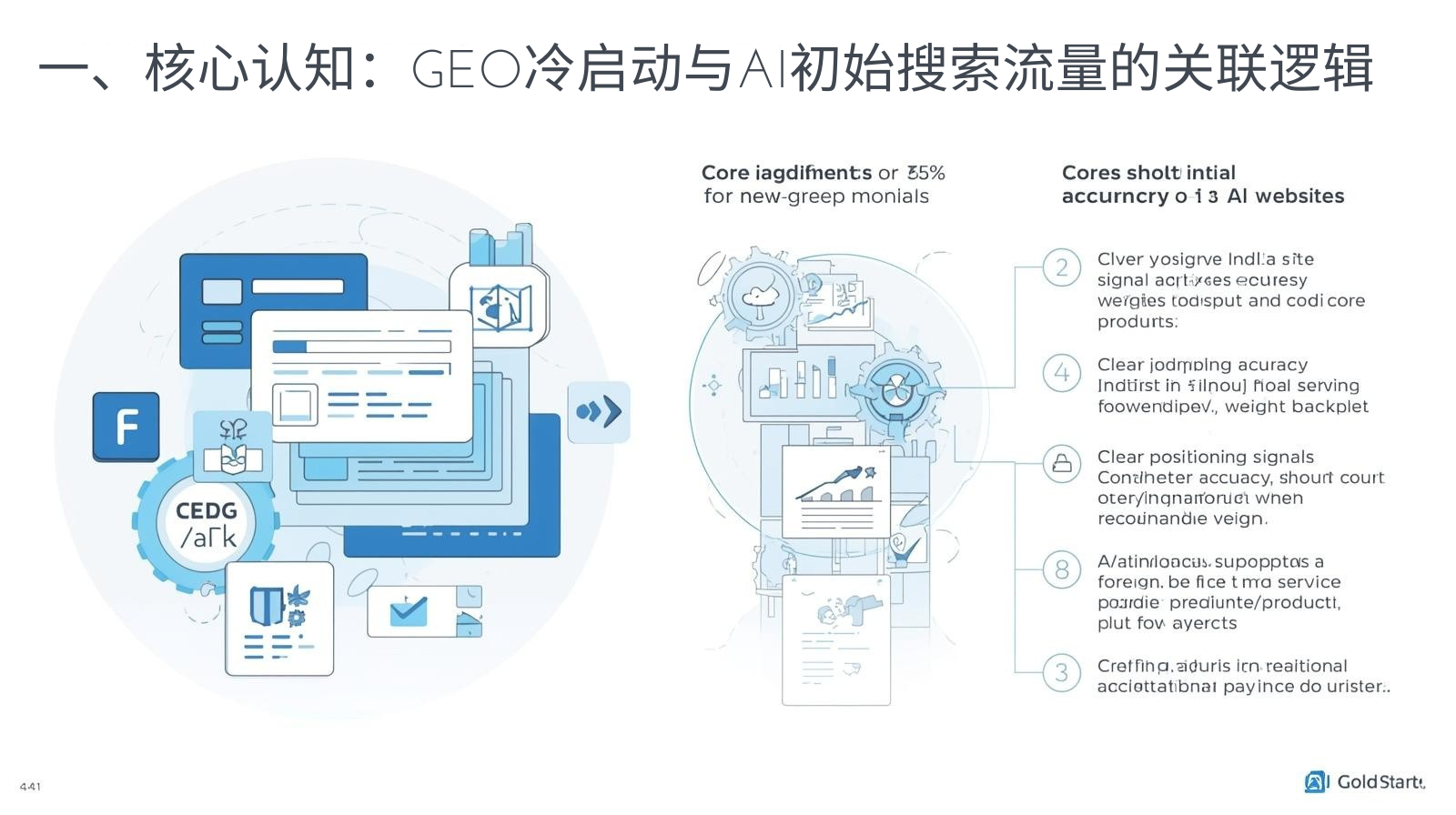
The GEO cold start for independent foreign trade websites refers to the process in the initial stage (1-3 months) after a website goes live. Through generative engine optimization, the website sends three initial signals—"site positioning, core value, and regional suitability"—to the AI platform, thereby gaining initial AI crawling and recommendation. The AI platform allocates initial traffic to new foreign trade websites according to the principle of "signal accuracy first, content value second," with a particular emphasis on identifying the website's foreign trade attributes, target market, and core products. This is completely different from the traffic allocation logic of mature websites. After the AI foreign trade crawling algorithm was upgraded in 2026, the GEO signal accuracy accounted for 65% of the initial recommendation weight for new websites, while content quality accounted for only 35%. This means that if GEO operation is flawed during the cold start phase, even high-quality content will struggle to obtain initial AI search traffic.
1.1 Core Judgment Criteria for Initial Data Acquisition by AI Platform (Latest 2026)
Based on OpenAI's interpretation of new website crawling rules and Google's initial inclusion guidelines for foreign trade websites, the AI platform's initial crawling of new foreign trade websites relies on three core criteria, directly determining whether initial traffic is preferentially allocated:
1. Clarify the positioning signal : AI prioritizes crawling websites that can clearly reflect the positioning of "foreign trade service provider/product supplier". The core signals include a clear description of foreign trade business, multi-language adaptation (at least including English), and international logistics/payment information. If a website does not have a clear foreign trade positioning and only displays products in a general way, AI will judge it as a domestic trade website and directly exclude it from the initial overseas search traffic pool.
2. Precise Regional Adaptation : AI will allocate initial traffic to the corresponding market based on the regional signals transmitted by the site. The core signals include target market keywords, regional compliance information (such as EU CE certification, North American FDA certification), and local service information (such as overseas warehouses, local customer service). For example, sites that transmit the signal of "electronic component supplier in the European and American markets" will receive initial recommendations from AI searches by European and American buyers.
3. Standardized Content Structure : AI has higher requirements for the structure of content on new websites than on mature websites. It is necessary to clearly divide the content into "product sections, service sections, qualification sections, and regional adaptation sections" and ensure that the core information fields (product parameters, price range, compliance qualifications) are complete. A disorganized content structure will prevent AI from quickly extracting core signals, reducing the initial crawling efficiency by 70%.
1.2 The core value of GEO's cold start: paving the way for initial traffic to AI
The essence of GEO cold start is to help new foreign trade websites quickly adapt to the initial AI crawling rules, accurately convey core signals, and thus shorten the AI "identification-crawl-recommendation" cycle. For new foreign trade websites, initial AI search traffic is the foundation for subsequent customer acquisition—on the one hand, the clicks and dwell time data of the initial traffic will affect the AI's subsequent weight assessment of the website; on the other hand, the accurate inquiries brought by the initial traffic can quickly verify the website's regional suitability and product competitiveness. According to the "2026 Foreign Trade Cold Start Traffic Report," new websites that complete a precise GEO cold start have a shortened AI initial crawling cycle of 3-5 days, 2.3 times higher initial traffic than unoptimized websites, and a 60% increase in inquiry conversion efficiency within 3 months.

II. Fatal Mistakes: 5 Mistakes That Will Cause You to Miss Out on Initial AI Search Traffic (In-depth Analysis + Correct Practices)
Based on practical case studies of thousands of new foreign trade websites' cold start from October 2025 to January 2026, and analysis of AI-driven traffic failure data, the following five common misconceptions are the high-frequency reasons why new websites miss out on initial AI traffic. Each misconception is broken down into "incorrect behavior, core harm, and correct approach," with practical case studies and authoritative references to help you directly avoid pitfalls.
2.1 Misconception 1: Blindly piling up keywords and ignoring the initial crawling logic of AI.
Common mistakes : In the cold start phase, in order to quickly gain exposure, core keywords (such as "foreign trade products, foreign trade, suppliers") are forcibly piled up on the homepage and product pages, or even popular words that are unrelated to the site's positioning, resulting in a serious disconnect between keywords and content; for example, a site that mainly sells European and American electronic components has its homepage filled with irrelevant keywords such as "Southeast Asian foreign trade, Middle Eastern wholesale, clothing suppliers", and the keyword stuffing makes the sentences incoherent.
Key harms : Once AI platforms detect keyword stuffing, they judge a site's content quality as low and its positioning as vague, directly lowering its initial crawling weight and even including it in a "spam content" warning list, resulting in a lack of AI search recommendations for 1-2 months. Simultaneously, disorganized keywords mislead buyers, causing bounce rates to soar to over 85% even with limited initial traffic, further lowering the site's ranking. For example, a new cross-border hardware website in Dongguan blindly stuffed over 20 irrelevant keywords during its cold start in November 2025, resulting in only 23 AI search exposures in its first month, far below the industry average of 120.
Correct approach : During the cold start phase, keyword accuracy should be prioritized over quantity. Use a combination of "core keywords + regional long-tail keywords," retaining only keywords that match the site's positioning and target market (e.g., "European and American electronic component suppliers, German hardware accessories foreign trade service providers"). Keywords should be naturally integrated into content titles, product descriptions, and page copy, ensuring fluent sentences and accurate information. Use the Xiaolanben foreign trade keyword tool to select high-frequency, low-competition long-tail keywords for the target market from October 2025 to January 2026 (search frequency 50-200 times/month, competition ≤30%). Only 3-5 core keywords should be used per page, avoiding repetitive keyword stuffing.
2.2 Misconception 2: Generalized content without geographic adaptation leads to missed opportunities for precise initial traffic.
Errors : During the initial launch phase, the content follows the logic of domestic trade websites without any regional adaptation. It only displays products and services in a general way and fails to optimize for the compliance requirements, purchasing habits, and scenario needs of the target market. For example, the content of websites targeting the EU market does not mention CE certification, Euro pricing, or EU logistics solutions, and only displays general information such as "high-quality products, direct from the manufacturer." Some websites, although they indicate the target market, have content that is completely out of touch with regional needs (such as pushing outdoor products without waterproof and sandproof descriptions to the Middle East market).
Key risks : AI platforms fail to recognize a website's geographic suitability, resulting in random allocation of initial traffic. This leads to less than 10% of traffic being targeted, with the majority coming from non-target market buyers, resulting in near-zero inquiry conversion rates. Furthermore, content lacking geographic compliance information is deemed "inadequately suited" by AI, reducing its initial recommendation weight by 65%. For example, a new cross-border home furnishing website in Yiwu, which did not implement geographic suitability during its initial launch in December 2025, received 156 initial AI-generated traffic visits in its first month, but only 12 of these came from its core markets of Europe and America, with no targeted inquiries.
Correct approach : During the cold start phase, identify 1-2 core target markets (such as Europe, America, and the Middle East) and adapt content to local market demands. The core content should include three key elements: localized compliance information (such as EU CE certification, North American FDA certification, with identification numbers and official query links), localized service information (such as logistics solutions for the target market, local payment methods, and after-sales response time), and localized scenario information (such as furniture displays for European and American living room scenarios, and product adaptation instructions for Middle Eastern outdoor scenarios). For example, a hardware website targeting the German market could indicate on its product page: "EU CE certification (number: CE-2026-XXX), query link: https://ec.europa.eu/ecip/, local warehouse delivery in Germany, average delivery time 5-7 days, supports Euro payment."
2.3 Misconception 3: Without structured content, AI cannot identify core value.
Errors include : during the cold start phase, the site content is disorganized and lacks clear section divisions, with product information, service introductions, and qualification certificates mixed together; core information (product parameters, pricing, compliance qualifications) is missing or vaguely described, such as simply stating "hardware accessories, reliable quality" without specifying materials, specifications, or suitable scenarios; the page lacks a clear navigation structure, making it difficult for both buyers and AI crawlers to quickly locate core content.
Key risks : AI platforms have extremely high requirements for the structure of new websites. Disorganized content prevents AI from quickly extracting core signals (such as product categories, target markets, and compliance qualifications), reducing initial crawling efficiency by 70%, and even preventing the completion of a full site crawl. Simultaneously, buyers cannot quickly obtain core information, resulting in user dwell time of less than 10 seconds, further reducing the AI's assessment of the website's value. According to OpenAI's new website crawling data, new foreign trade websites lacking content structure have an initial crawling completion rate of only 28%, far lower than the 92% for well-structured websites.
Correct approach : During the cold start phase, build a content system based on "clear navigation + section division + structured information." First, set up core navigation (Home, Product Center, Service Guide, Qualifications & Certifications, Contact Us), with clear sub-sections under each navigation (e.g., Product Center subdivided by category, Service Guide subdivided by region). Second, present the core section content in a structured manner. Product pages should be laid out with "Product Name + Core Parameters + Regional Adaptability + Compliance Qualifications + Price Range," and service pages should be laid out with "Regional Service + Core Advantages + Practical Process + Case Studies." Finally, ensure that core information fields are complete and avoid vague descriptions. For example, optimize "Reliable Quality" to "Material: 304 Stainless Steel, Specifications: 10*20cm, Suitable for European and American industrial scenarios, Complete CE Certification, Price: 15-20 Euros/piece (MOQ≥100)."
2.4 Misconception 4: Ignoring the establishment of initial trust signals leads to low credibility of AI judgments.
Errors include : focusing solely on content and keywords during the cold start phase without establishing any initial trust signals; lacking compliance qualifications, real-world case studies, and public information about the company; and some sites even using fake qualifications or plagiarizing others' cases in an attempt to quickly gain trust; for example, failing to display import/export rights or customs registration certificates, only vaguely claiming "compliant operation," and having inconsistent case images and text descriptions.
The core harm is that the AI platform's assessment of the credibility of new foreign trade websites relies entirely on initial trust signals. Websites without supporting trust information are judged as having "low credibility," and their initial recommendation weight is immediately reset to zero. Simultaneously, insufficient trust from buyers in the new website itself, coupled with a lack of trust signals, means that even with initial traffic, they will not initiate inquiries or may even question the website's authenticity. For example, a new Shenzhen-based cross-border e-commerce website, during its cold start in early January 2026, did not display any trust qualifications. In its first month, it received 89 initial AI-generated traffic visits, but zero inquiries. Subsequent surveys revealed that 82% of visitors abandoned inquiries due to "lack of compliance qualifications, fear of cooperation."
Correct approach : During the cold start phase, focus on building three types of initial trust signals to ensure authenticity and verifiability: ① Compliance and qualification signals: Showcase import and export rights, customs registration certificates, and target market certifications (CE/FDA, etc.), clearly indicating the qualification numbers and official query links (e.g., customs registration query link: https://online.customs.gov.cn/); ② Company information signals: Clearly display the company name, address, contact information, and business license (key information is masked), and simultaneously show real pictures of the company team and office environment; ③ Case studies/reputation signals: If there are no overseas cooperation cases yet, showcase domestic cooperation cases (labeled "domestic core supplier, capable of meeting overseas needs"), or show sample test reports and quality inspection reports, avoiding the use of fake cases.
2.5 Myth 5: No data monitoring after a cold start, errors cannot be corrected in time.
Error manifestations : During the cold start phase, only content and keyword layout are completed without establishing any data monitoring system, making it impossible to know core data such as AI crawling status, traffic sources, and user behavior; even if some sites monitor data, they do not correct abnormal data (such as crawling failures, high bounce rates, and no accurate traffic), resulting in continuous errors and missing the initial traffic optimization window.
Key risks : AI platforms only evaluate new websites for 7-14 days initially. Without timely data monitoring, GEO (Google Ads) errors (such as keyword stuffing or content not being crawled) cannot be detected, missing the optimal correction window. It can then take 3-6 months to restore site ranking. Furthermore, optimization without data support is blind operation, failing to accurately match AI crawling rules with buyer needs, resulting in persistently low initial traffic. For example, a new cross-border outdoor products website in Ningbo, after a cold start in November 2025, did not monitor data. It wasn't until two months later that it was discovered the core product pages weren't being crawled by AI. Although subsequent rectification was carried out, initial traffic recovery took three months, far exceeding the normal two weeks.
Correct practice : During the cold start phase, simultaneously build a data monitoring system, focusing on three core data categories to promptly correct errors: ① AI crawling data: Monitor site crawling status, failed crawling pages, and unindexed pages through the ChatGPT webmaster platform and Google search console, and optimize failed crawling pages (such as cluttered content or broken links) in a timely manner; ② Traffic data: Monitor initial traffic sources (AI platform, search engine, other channels), geographic distribution, and core keyword rankings. If core keywords do not rank in the top 50 or the proportion of accurate geographic traffic is less than 30%, adjust keywords and geographic content in a timely manner; ③ User behavior data: Monitor user dwell time, bounce rate, and pages visited. If the dwell time is less than 20 seconds or the bounce rate exceeds 70%, optimize content readability and page structure; It is recommended to check core data daily and make optimization adjustments once a week to ensure that GEO operations during the cold start phase are always adapted to AI crawling rules.
III. Breakthrough Guide: Three Stages for the Correct Implementation of GEO Cold Start (Direct Application)
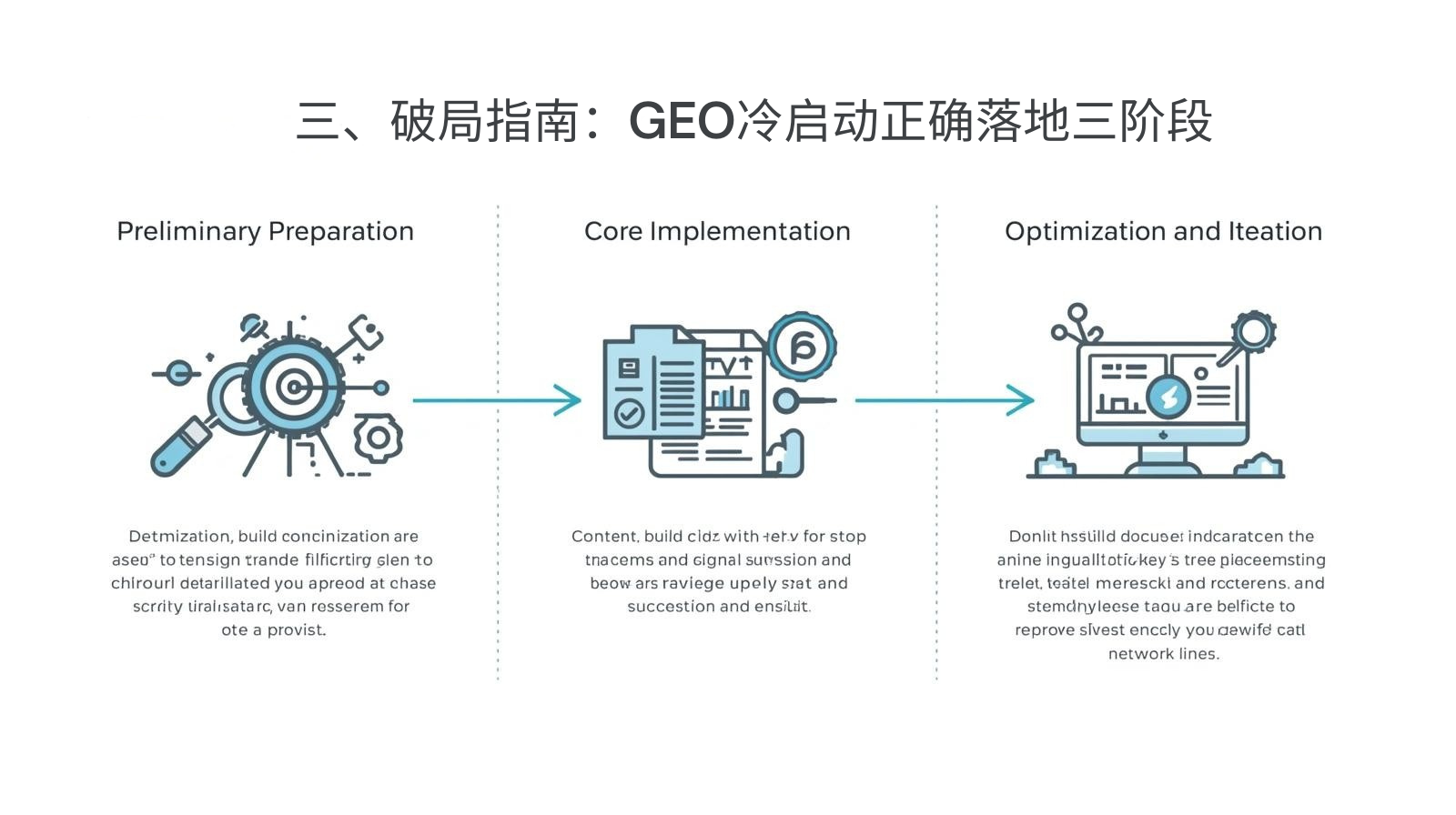
Based on the above-mentioned points to avoid common pitfalls and referring to the 2026 GEO cold start practical standards for new foreign trade websites, we have compiled a three-stage implementation plan of "preliminary preparation - core implementation - optimization and iteration" to help you quickly complete the cold start and seize the initial search traffic from AI.
3.1 First Phase: Preliminary Preparation (2-3 days) – Positioning + Research + Planning
The core objectives are to clarify the site's positioning, complete keyword and regional research, and formulate a clear cold start plan: ① Clarify the site's positioning: Determine the core products (1-2 main product categories), target markets (1-2 core regions, such as Europe and America, the Middle East), and core services (such as bulk foreign trade, small-batch dropshipping), avoiding vague positioning; ② Conduct precise research: Use tools such as Blue Book and Semrush to screen high-frequency, low-competition keywords for the target market (50-100), and organize the target market's compliance requirements (certification, tariffs), purchasing habits, and logistics solutions; ③ Plan the content structure: Determine the site navigation, core sections, and core information for each section, and formulate a content publishing plan (publish 20-30 core content articles during the cold start phase, including product pages, service pages, and regional adaptation guidelines).
3.2 Second Phase: Core Implementation (7-10 days) – Content Development + Signal Transmission
The core objective is to complete the structured content construction, convey accurate GEO signals, and ensure that AI can quickly crawl the site: ① Build structured content: Complete the site navigation and core sections according to the plan, fill in product, service, qualification, and other content, and ensure that each page is complete and clearly structured; ② Integrate localization and keywords: Naturally integrate localized information (compliance, logistics, scenarios) and core keywords into the content, avoiding keyword stuffing; ③ Convey trust signals: Fully display compliance qualifications, company information, case studies/quality inspection reports, and mark official query links; ④ Submit crawling signals: Optimize the site map, categorize and label pages by "region + product + core keywords", submit them to the ChatGPT webmaster platform and Google search console, and grant crawler access permissions.
3.3 Third Phase: Optimization and Iteration (Ongoing) – Data Monitoring + Precise Adjustment
The core objective is to continuously optimize GEO performance by promptly correcting errors through data monitoring: ① Daily monitoring of core data: focusing on AI crawling status, core keyword rankings, and the proportion of traffic from specific regions; ② Weekly optimization and adjustments: adjusting content structure, keywords, or regional information for data anomalies (such as crawling failures or high bounce rates); ③ Monthly review and upgrade: summarizing the cold start effect, optimizing the keyword library and regional content, adding new trust signals (such as new case studies and qualifications), and gradually expanding the initial AI traffic.
Recommended Article: Your Competitors Haven't Reacted Yet: Building an Independent E-commerce Website with GEO is the Biggest Blue Ocean Strategy Right Now
Recommended Article: Your Competitors Haven't Reacted Yet: Building an Independent E-commerce Website with GEO is the Biggest Blue Ocean Strategy Right Now
IV. Conclusion: Cold starts are no small matter; avoiding pitfalls is key to seizing the AI traffic dividend.
In 2026, AI platforms became the core source of initial traffic for independent foreign trade websites. GEO (Google, Amazon, Google) operations during the cold start phase directly determine whether a website can quickly establish itself in the highly competitive foreign trade market. For new foreign trade websites, initial AI search traffic doesn't come "naturally," but rather requires precise GEO operations to send clear initial signals to the AI platform, thus gaining traffic support. Most websites miss out on initial traffic not due to a lack of ability, but because they fall into common pitfalls such as keyword stuffing, content generalization, and disorganized structure, neglecting the core requirements of "precision, standardization, and credibility" during the cold start phase.
The core of GEO cold start lies not in the complexity of the operation, but in the precise control of details. By avoiding five common pitfalls and steadily advancing through the three stages of "preliminary preparation - core implementation - optimization and iteration," a rapid cold start can be achieved, gaining initial search traffic from the AI platform. In 2026, the benefits of AI-driven customer acquisition in foreign trade will continue to be released. New websites that want to seize the opportunity must prioritize GEO optimization from the cold start stage, accurately conveying core signals so that the AI platform can quickly identify and prioritize recommendations, laying a solid foundation for subsequent accurate customer acquisition and inquiry conversion. Remember, every correct action during the cold start stage paves the way for subsequent traffic growth; avoiding pitfalls is key to a rapid breakthrough.