
According to the "White Paper on High-Quality Development of Cross-Border E-commerce" released by the China Research and Development Institute in January 2026, independent foreign trade websites with 3D visualization capabilities saw an average increase of 180% in search exposure on AI platforms, a 2.3-fold increase in user dwell time, and a 65% higher inquiry conversion rate compared to traditional text and image websites. Currently, AI platforms such as ChatGPT support the capture of external 3D models and virtual scene information through the MCP protocol (Model Context Protocol). Overseas buyers prefer to intuitively understand product details and application scenarios through 3D displays. However, only 17% of independent foreign trade websites have completed the collaborative adaptation of digital twin showrooms and GEO optimization. Most websites suffer from a lack of structured descriptions and insufficient regional adaptation of 3D content, resulting in AI's inability to accurately capture information, rendering high-quality visual resources "ineffective displays." A home furnishing export merchant in Yiwu, Zhejiang Province, built a digital twin showroom at the end of 2025 and optimized it with GEO to suit the European, American, and Middle Eastern markets. Within two months, its ChatGPT search ranking improved by 20 places, the amount of 3D display content crawled increased by 210%, and cross-border orders increased by more than 30%. This case illustrates the core logic: the digital twin showroom is the core carrier for realizing 3D visual display, and GEO optimization is the key to making 3D content accurately match regional search needs and be efficiently crawled by AI. The synergy of the two can completely open up the entire link of "AI search - 3D perception - trust conversion".
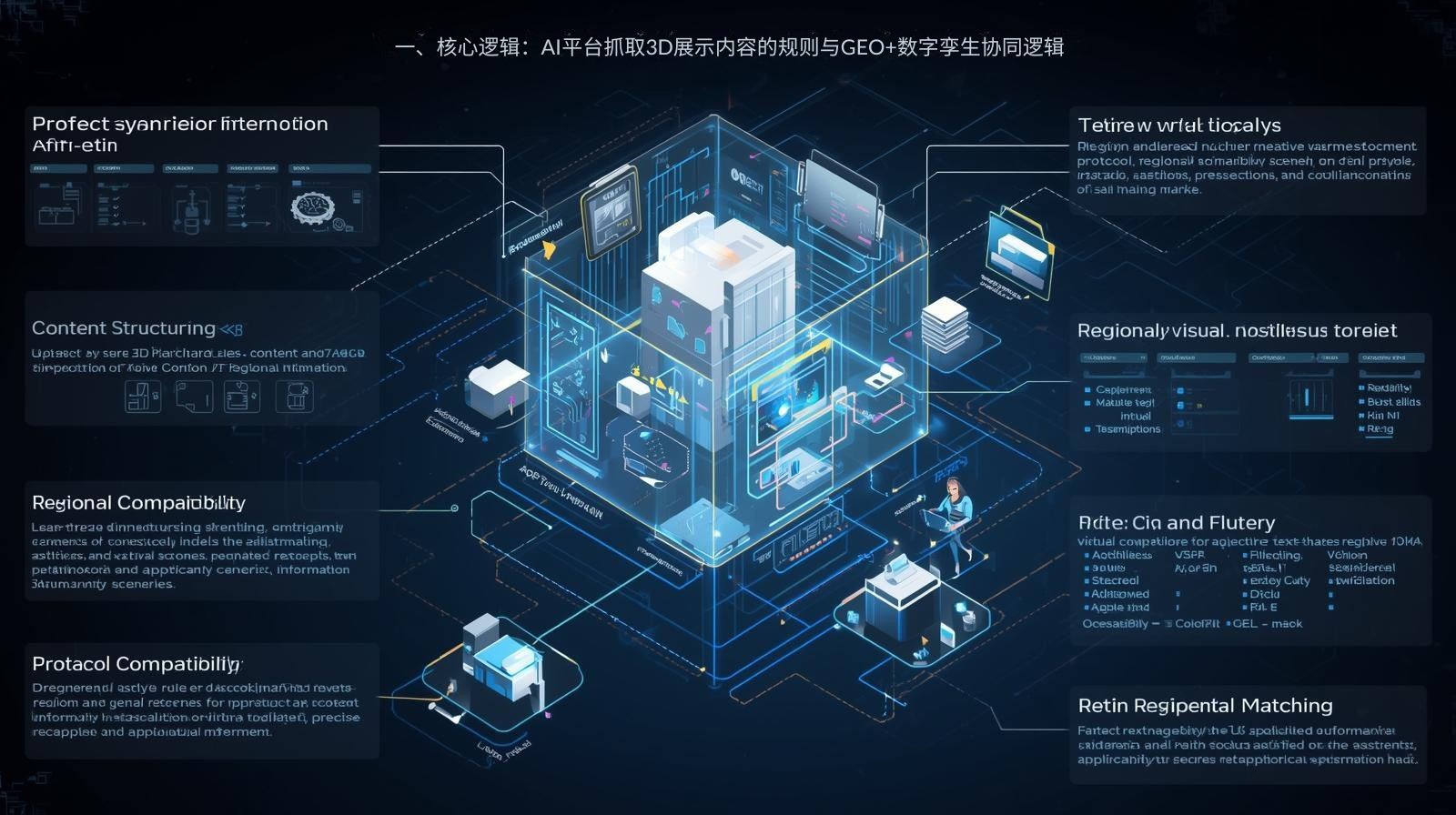
I. Core Logic: Rules for AI Platform to Capture 3D Display Content and the Collaborative Logic of GEO+ Digital Twin
The AI platform's capture of 3D content from digital twin exhibition halls is not simply visual recognition, but rather a three-dimensional screening system based on "content structuring, protocol compatibility, and regional matching." Especially for foreign trade scenarios, it additionally considers the regional contextual adaptability and compliance-related information of the 3D content. The core value of GEO optimization is to transform 3D display content (product models, virtual scenes, application cases) into regionally recognizable signals that can be accurately matched with the purchasing habits, aesthetic preferences, and application scenarios of the target market. This aligns perfectly with the core trend of "upgrading visual competition and AI-driven precise perception" in foreign trade by 2026.
1.1 Three Core Rules for AI Platforms to Capture 3D Display Content (Latest 2026)
Based on the OpenAI MCP protocol specification and the Meta SAM3D model application guide, combined with practical cases of 3D displays in foreign trade, the core rules for AI to prioritize 3D content can be broken down into three points, which directly determine whether the content of the digital twin exhibition hall can be successfully captured and recommended:
1. Content Structuring (Basic Prerequisite) : AI can only efficiently capture structured 3D content with clear text descriptions and field annotations. Core required information includes product 3D model annotations (name, category, core parameters, material details), virtual scene descriptions (application scenarios, regional adaptation attributes, suitable audience), and compliance-related information (corresponding market certifications, material compliance descriptions). For example, 3D content with structured descriptions such as "3D model name: European solid wood sofa, suitable scene: European and American living room (20㎡-30㎡), core parameters: solid wood frame + fabric upholstery, certification: EU CE certification, material: E1 grade environmentally friendly board" is 5.2 times more likely to be captured by AI than a pure model without annotations. 3D models lacking text support will be judged as "invalid information" by AI and directly filtered out.
2. Protocol Compatibility (Core Technology) : AI-driven 3D content capture relies on standardized protocol integration. Core compatibility requirements include support for the MCP protocol or Schema.org 3D content tagging specifications, ensuring that 3D models (glb, gltf formats) and virtual scene data can be automatically detected and accessed by the AI agent. For example, if a digital twin exhibition hall does not configure the access interface and description fields for 3D content according to the MCP protocol, even if the model has high precision, it cannot be captured by AI platforms such as ChatGPT and can only be used as on-site visualization display material.
3. Regional Matching (Core Conversion) : AI prioritizes 3D content that matches the market scenario based on the user's search region. Core matching dimensions include scene regionalization (e.g., European and American living rooms, Middle Eastern bedrooms, Southeast Asian outdoor scenes), aesthetic matching (e.g., European and American minimalist style, Middle Eastern luxury style), and application matching (e.g., Nordic winter heating equipment scene, Southeast Asian rainy season waterproof product scene). For example, when a buyer searches for "Middle Eastern bedroom carpet 3D display" through AI, it will prioritize content in the digital twin showroom that includes "Middle Eastern style bedroom virtual scene + carpet 3D model + material sandproof and waterproof description". 3D content that does not match the regional scenario is unlikely to generate conversions, even if it is captured.
1.2 The Mutual Empowerment Logic of GEO and the Digital Twin Exhibition Hall
The essence of GEO optimization is to "enable 3D display content to accurately reach buyers in the target region and the AI capture system," while the core value of the digital twin exhibition hall is to "reduce buyers' decision-making costs and strengthen trust perception through 3D visualization." The two mutually empower each other, building a core competitive advantage in the visual representation of an independent foreign trade website. The core logic is reflected in three points:
1. GEO infuses 3D content with regional value, enhancing AI's crawling accuracy: 3D content in digital twin showrooms that is not optimized by GEO lacks regional specificity, and even if crawled by AI, it is difficult to match specific market search needs. By integrating regional keywords, scene preferences, and compliance requirements into the 3D content description through GEO, AI can quickly identify the regional suitability attributes of the content. For example, optimizing "3D sofa model" into "European minimalist sofa 3D model adapted to the German market, EU CE certified, suitable for a 25㎡ living room scene, and the material meets the EU E1 environmental standard" not only meets the structured requirements of AI crawling but also accurately matches the search needs of German buyers.
Digital twin showrooms provide high-quality content carriers for GEO optimization, enhancing conversion capabilities: The core of GEO optimization is content value. The 3D product models, virtual application scenarios, and interactive experience functions of digital twin showrooms are high-quality materials for GEO optimization. After being regionally packaged, these visual materials allow buyers to more intuitively perceive product suitability, significantly lowering the trust threshold. For example, GEO content optimized for the Middle Eastern market, paired with "a Middle Eastern-style bedroom virtual scene + 3D product placement effect," allows buyers to view details by rotating and zooming the 3D model, which is more persuasive than pure text descriptions, significantly increasing the willingness to inquire.
The two work together to achieve a "double improvement in crawling efficiency and conversion effect": GEO optimization ensures the regional accuracy and structure of 3D content, and enhances the weight of AI crawling and recommendation; the digital twin exhibition hall enhances the intuitive perception of buyers through 3D visualization and shortens the decision-making path; according to the 2026 cross-border e-commerce visualization trend data, independent websites that achieve GEO + digital twin collaboration have a 2.8 times higher efficiency in AI crawling 3D content and a 65% higher inquiry conversion rate than single-optimized websites.
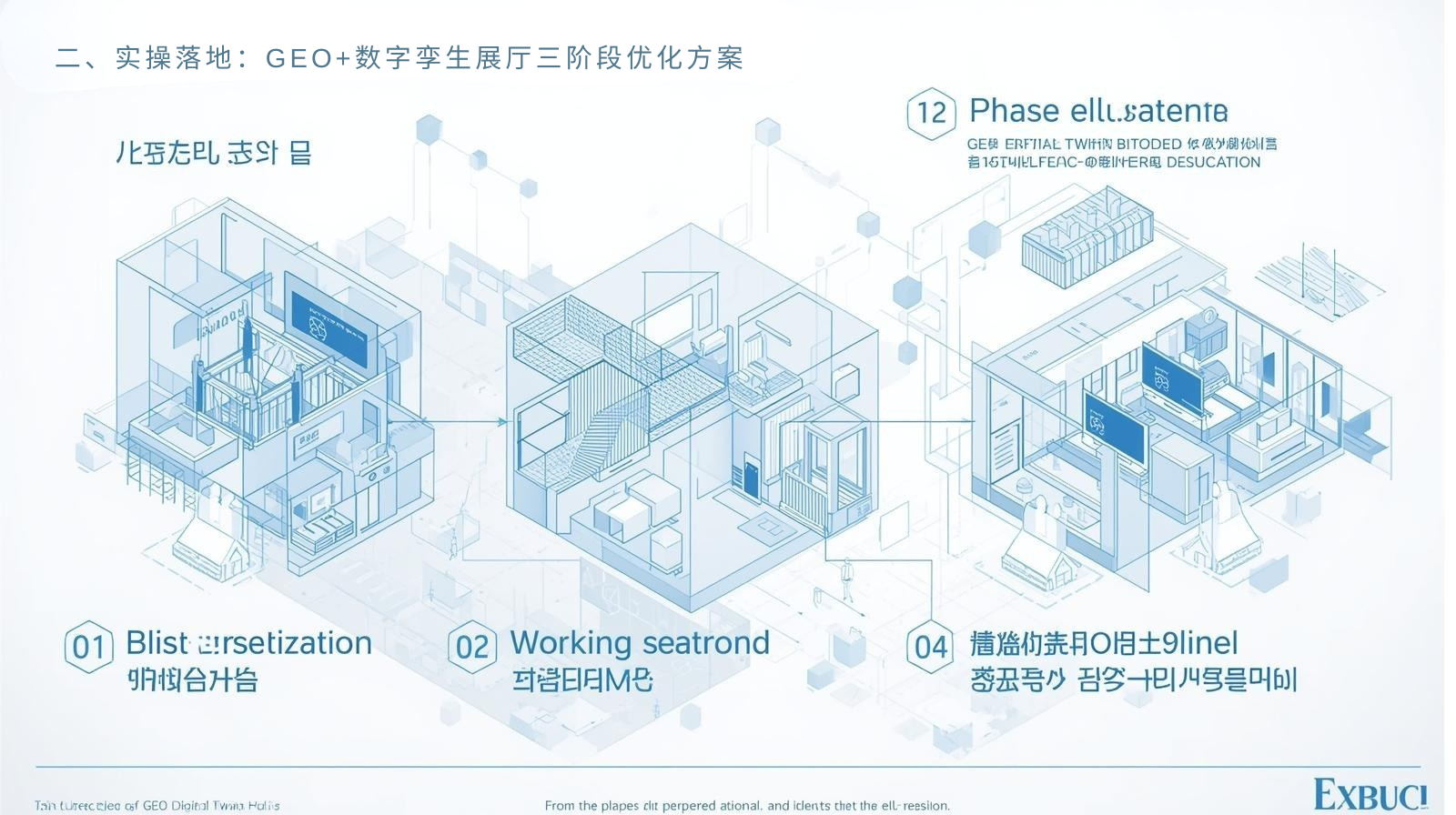
II. Practical Implementation: A Three-Phase Optimization Solution for the GEO+ Digital Twin Exhibition Hall
This solution combines practical cases from Yiwu foreign trade merchants, the application guide for the virtual studio shooting tool from Qunhe Technology, and references the OpenAI MCP protocol interface specifications and Meta SAM3D model adaptation techniques. It completes the "preliminary preparation + core optimization + enhanced adaptation" in three major stages to ensure that the 3D content of the digital twin exhibition hall can be efficiently captured by AI, while accurately adapting to localized search needs.
2.1 First Phase: Preliminary Preparation (3-4 days) – Core Element Analysis + GEO Keyword Development
The core objective is to identify the key elements of the 3D content in the digital twin exhibition hall, build a localized GEO keyword library, and complete basic protocol adaptation preparations to lay the foundation for subsequent optimization. All aspects are tailored to practical foreign trade scenarios.
1. Core Elements of the Digital Twin Exhibition Hall: ① 3D Content Materials: Determine the 3D models of the products to be displayed (prioritize core categories such as furniture, home appliances, and hardware products), and analyze the core parameters, materials, and compliance certifications (CE, FDA, etc.) of each model; plan regionalized virtual scenes (refer to the 5000+ virtual studio scene library of Qunhe Technology, such as European and American living rooms, Middle Eastern bedrooms, Southeast Asian outdoor scenes, etc.), and clarify the suitable regions, application scenarios, and display focus of each scene; ② Protocol Adaptation Preparation: Confirm that the digital twin exhibition hall building platform supports the MCP protocol or Schema.org 3D markup specifications (such as Kujiale, Unity cross-border version), and pre-configure the access interface for 3D content to ensure that the AI agent can automatically detect it; ③ Regionalized Requirements Analysis: Organize the scene preferences (such as Nordic preference for minimalist living rooms, Middle Eastern preference for luxurious bedrooms), aesthetic characteristics, and compliance requirements (such as EU material environmental protection standards, Middle Eastern waterproofing and sandproofing requirements) of the target market (Europe, America, Middle East, Southeast Asia, etc.).
2. Building a Localized GEO Keyword Library: ① Keyword Combination Logic: Combining keywords according to "regional terms + 3D display terms + product terms + scenario terms", with core terms (e.g., "3D product display"), long-tail terms (e.g., "German living room sofa 3D display", "Middle Eastern bedroom carpet 3D model"), and scenario terms (e.g., "EU compliant 3D display", "Southeast Asian outdoor product 3D scenario") accounting for 30%, 50%, and 20% respectively; ② Localized Adaptation: Splitting keywords according to core markets, focusing on keywords related to "minimalist style, CE certification, living room/bedroom scenario" in the European and American markets, and focusing on keywords related to "luxury style, waterproof and sandproof, large apartment scenario" in the Middle Eastern market; ③ Keyword Selection: Using AI keyword tools to query high-frequency search terms in the target market from October 2025 to January 2026, prioritizing keywords with high search frequency and low competition to ensure that keywords match regional search habits and 3D display scenarios.
2.2 Second Phase: Core Optimization (5-6 days) – Content Integration + Exhibition Hall Construction + Page Optimization
The core objective is to complete the construction of a digital twin exhibition hall, deeply integrate GEO keywords with 3D content, optimize the independent website's page structure, and ensure that the 3D content possesses structured attributes that AI can crawl and is regionally adaptable. The core optimization points are as follows:
2.2.1 Construction of Digital Twin Exhibition Hall and Optimization of 3D Content
1. Structured 3D Content Annotation: Clear text descriptions and field annotations are added to each product's 3D model and virtual scene, strictly adhering to the Schema.org 3D content tagging specifications. Core annotation information includes model name, category, core parameters, material, suitable regions, application scenarios, compliance certification number, and query link. For example, for a solid wood sofa 3D model targeting the EU market, the annotation would be: "Name: European minimalist solid wood sofa (3D model), Suitable regions: Germany, France, and other EU countries, Application scenario: 20-30㎡ living room, Material: E1 grade environmentally friendly solid wood, Certification: CE certification (number: CE-2026-XXX), Query link: https://ec.europa.eu/ecip/"; 2. Localized Virtual Scene Construction: Exclusive virtual scenes are built based on target market preferences. For example, minimalist living room and kitchen scenes are built for the European and American markets, while luxurious bedroom and courtyard scenes are built for the Middle Eastern market. These scenes incorporate regionally distinctive elements (such as fireplaces for the European and American markets and carpet patterns for the Middle Eastern markets). Meanwhile, GEO keywords are naturally integrated into the scene descriptions, such as "a virtual bedroom scene in the Middle East style, adapted to markets such as Saudi Arabia and the UAE, showcasing the actual placement effect of products such as carpets and bedding, with materials that support sand and water resistance and meet local usage needs"; 3. Interactive function configuration: Add interactive functions such as 3D model rotation, scaling, and scene switching to the digital twin showroom, and configure multilingual scene descriptions (English, Arabic, Spanish, etc.) to adapt to the usage habits of buyers from different regions, and embed regional GEO keyword tags in the interactive interface.
2.2.2 Deep Integration of GEO with 3D Content
1. **Integrated Page Copywriting:** The copywriting on the homepage, product pages, and showroom entrance page of the independent website seamlessly integrates GEO keywords with 3D display content. The first screen highlights core value, such as "Focusing on European and American/Middle Eastern foreign trade, the 3D digital twin showroom intuitively presents product details. EU CE certified, adaptable to local living room/bedroom scenes, and supports precise AI platform crawling." Product pages include "3D display adaptation instructions," such as "The 3D model of this waterproof outdoor lamp is adapted to Southeast Asian rainy season scenes, supports rotation to view the waterproof structure, meets local outdoor usage needs, and AI search 'Southeast Asian outdoor lamp 3D display' can quickly find this product." 2. **Image and Tag Integration:** ALT tags are added to 3D scene screenshots and model renderings, embedding regional GEO keywords, such as "European living room sofa 3D display, CE certified" and "Middle East bedroom carpet 3D model, sandproof and waterproof." ; Add localized tags to 3D models in the digital twin exhibition hall. Clicking on the tags will display the appropriate region, scene, and compliance information, making it convenient for AI to capture and for buyers to view; 3. Compliance information integration: Deeply bind the compliance certification information of the target market with the 3D content. Clearly mark the certification qualifications and regional compliance requirements in the 3D model details page and virtual scene description, and embed official query links, such as "The home appliances displayed in this 3D model have passed the US FDA certification and are suitable for the North American market. Certification query link: https://www.fda.gov/", to enhance the credibility of the content and the weight of AI capture.
2.2.3 Optimization of Independent Website Page Structure
1. Page Navigation Optimization: A separate navigation entry for the "Digital Twin Exhibition Hall" is set up, displaying virtual scenes categorized by region (e.g., "Europe and America Exhibition Hall," "Middle East Exhibition Hall," "Southeast Asia Exhibition Hall"). Each regional exhibition hall is further subdivided by product category, facilitating quick content location for AI crawlers and buyers. 2. Content Structure Optimization: All pages containing 3D content are laid out as "3D Display Area + Structured Description Area + Regional Adaptation Explanation Area + Compliance Information Area." The structured description area uses bullet points or tables to present product parameters and scene adaptation information, ensuring that AI can quickly extract core content. 3. Loading Speed Optimization: Lightweight processing of 3D models and virtual scenes is performed (e.g., compressing model files and optimizing textures and materials) to avoid slow page loading affecting user experience and AI crawling efficiency. This can be achieved using the automatic optimization functions of the digital twin platform (e.g., Kujiale's model compression tool).
2.3 Phase Three: Enhanced Adaptation (2-3 days) – Test Iteration + Signal Submission + Authoritative Endorsement
The core objective is to improve the accuracy of AI in capturing 3D content through testing and optimization, submit AI capture signals, strengthen authoritative endorsement, and ensure that the 3D content of the digital twin exhibition hall can be stably captured and prioritized by AI.
1. Crawl Testing and Iteration: Simulate search scenarios from buyers in different regions to test the AI's ability to crawl 3D content, such as "search for 3D display of a German living room sofa" or "obtain a 3D model of a Middle Eastern waterproof carpet," checking the accuracy of the crawling results, the display effect of the 3D content, and its regional adaptability; for issues encountered in the test (such as crawling failure, missing description information, and incorrect regional matching), optimize the 3D content labeling and page structure, iterate the protocol configuration, and ensure that the AI crawling accuracy is ≥95%; 2. AI Crawl Signal Submission: Optimize the site map of the independent website, categorize and label the relevant pages of the digital twin exhibition hall according to "region + 3D display + product" (e.g., "Germany-3D-display-sofa"), and submit them to the ChatGPT website management platform and Google search console, while labeling them with core tags such as "3D product display," "AI accessible," and "CE certified" to guide the AI crawler to quickly identify crawlable content; ensure that the independent website's robots.txt protocol allows crawlers such as OpenAI and Google to access the 3D content interface and description pages; 3. Authoritative endorsements and backlink optimization: Authoritative backlinks are naturally embedded in the 3D content description area, such as official compliance certification links, digital twin platform cooperation proof links, and target market industry association certification links; content related to the digital twin exhibition hall (e.g., "Using AI to capture 3D displays, quickly connect with European and American buyers") is published on platforms such as LinkedIn and Global Sources, with links to the independent website exhibition hall, citing data from the China Research & Consulting report and practical case studies; cases of clients placing orders through 3D displays and industry media reports are also showcased to enhance buyers' recognition of the 3D content and brand.

III. Avoidance Guide: 6 Core Misconceptions in GEO+ Digital Twin Showroom Optimization (Key Points to Avoid in 2026)
Based on practical cases of digital twin technology in foreign trade from 2025 to 2026 and experience in AI crawling and optimization, the following six common misconceptions can directly lead to 3D content being unable to be crawled by AI, insufficient regional adaptation, and even damage to brand trust, and must be resolutely avoided:
3.1 Misconception 1: 3D content lacks structured description and is only used for visual display.
Error : The digital twin exhibition hall only builds 3D models and virtual scenes without adding any text descriptions or field annotations, or the annotation information is messy (such as only writing "sofa 3D model"), which cannot meet the structured requirements of AI crawling;
Core harm : AI cannot identify the core information of 3D content, the success rate of crawling is directly reduced to zero, and high-quality 3D resources become "ineffective displays" on the site, unable to gain exposure through AI search;
Correct approach : Add complete structured annotations to each 3D model and scene according to the Schema.org specifications, including core fields such as name, parameters, applicable regions, and compliance information, to ensure that AI can quickly extract content value.
3.2 Misconception 2: GEO content is disconnected from 3D content and lacks regional adaptation.
Error : The 3D scene and keywords are not adapted to the target market. For example, when pushing a minimalist European and American style 3D scene to the Middle East market, the 3D content description does not mention the regional adaptation attribute and only vaguely labels it as "3D display of foreign trade products".
Key harm : AI determines that the content's regional relevance is low, reducing the crawling weight by 70%. After seeing the 3D scene, buyers cannot perceive the product's suitability, resulting in a significant decrease in their willingness to inquire.
Correct approach : Build custom 3D scenes according to the preferences of the target market, and naturally integrate regional keywords and adaptation instructions into the content description to ensure that the 3D content is accurately matched with regional needs.
3.3 Misconception 3: 3D content cannot be accessed due to incompatibility with AI crawling protocol.
Error : The digital twin exhibition hall was not built in accordance with the MCP protocol or Schema.org markup specifications, and the 3D content access interface was not opened, which caused the AI agent to be unable to automatically detect and capture 3D content;
Core harm : Even if the 3D content is of high quality and accurately adapted to the region, it cannot be crawled by AI platforms such as ChatGPT and can only be viewed through in-site access, thus losing the AI search traffic dividend;
Correct approach : Choose a digital twin platform that supports AI capture protocols, configure 3D content interfaces and tags according to specifications, and ensure that the AI agent can detect and call them normally.
3.4 Myth 4: Insufficient lightweight 3D models result in slow page loading.
Error symptoms : The 3D model file is too large and the texture is too complex. It has not been lightweighted, which causes the page to take more than 10 seconds to load. Users frequently jump to other pages. The AI may also give up due to loading timeout.
Core harms : extremely poor user experience, page bounce rate soars to over 80%, AI crawling efficiency decreases by 40%, and even if exposure is gained, conversion is impossible;
Correct approach : Optimize 3D models and scenes to reduce file size and simplify redundant textures, ensuring page load time is ≤3 seconds, balancing display quality and loading efficiency.
3.5 Myth 5: Keyword stuffing affects content readability and crawling performance.
Error : In an attempt to improve GEO optimization, keywords are forcibly stuffed into the 3D content description, such as "German and French sofa 3D display CE certified living room", which results in awkward semantics and cluttered information.
Key harm : AI judges content quality as low, reduces its crawling weight by 50%, prevents buyers from quickly obtaining core information, and results in an extremely poor reading experience;
Correct approach : Integrate GEO keywords naturally into 3D content descriptions and scene descriptions, ensuring smooth sentences and clear information, while balancing optimization effectiveness and readability.
3.6 Myth 6: Neglecting content updates and iterations; poor timeliness of 3D content
Error : The digital twin exhibition hall has not been updated for a long time after its construction. The 3D models, scenes and compliance information still use content from 2024 and earlier, and have not been synchronized with the changes in regional requirements and certification policy adjustments in 2025-2026.
Key risks : AI prioritizes crawling recently updated authoritative content, reducing the probability of crawling outdated 3D content by 75%. If compliance information is outdated, it may mislead buyers and cause compliance risks.
Correct practice : Update the digital twin exhibition hall content monthly, add 3D models of core products, optimize localized scenarios, and synchronize the latest compliance certification information and changes in regional needs to ensure the timeliness and accuracy of the content.
Recommended Article: Your Competitors Haven't Reacted Yet: Building an Independent E-commerce Website with GEO is the Biggest Blue Ocean Strategy Right Now
Recommended Article: Your Competitors Haven't Reacted Yet: Building an Independent E-commerce Website with GEO is the Biggest Blue Ocean Strategy Right Now
IV. Conclusion: Breaking the Mold with Visualization, Using GEO to Seize the New Track of AI Search
In 2026, competition in the foreign trade industry has evolved from "competition based on text and images" to "competition based on visual perception." The 3D display capabilities of digital twin showrooms are becoming a core competitive advantage for independent foreign trade websites. Furthermore, AI platforms' ability to capture and recommend 3D content is opening up entirely new traffic entry points for high-quality visual resources. Data from China Research & Consulting shows that in the next two years, digital twins combined with GEO optimization will become standard for independent foreign trade websites. Companies possessing this capability will gain a first-mover advantage in the competition for AI search traffic.
For independent e-commerce websites to effectively leverage AI platforms to capture 3D content and improve search conversion rates, the key lies not in the precision of the 3D model, but in the structuring of the content, its regional adaptability, and its compliance with protocols. No complex technical support is required. By following the three-stage implementation plan outlined in this article—completing initial preparation, core optimization, and enhanced adaptation, while avoiding common pitfalls—AI can accurately capture the 3D content of the digital twin showroom, allowing overseas buyers to quickly build trust through intuitive 3D perception. In 2026, using the digital twin showroom as the visual carrier and GEO optimization as the precise tool, independent e-commerce websites will undoubtedly achieve a dual breakthrough in AI search exposure and cross-border conversion, standing out in global market competition.