
In 2025, my country's total import and export value of goods trade exceeded 45 trillion yuan for the first time, reaching 45.47 trillion yuan, a year-on-year increase of 3.8%. Among them, goods exported based on free trade agreements accounted for more than 30%, and tariff preferences have become a core competitive advantage for foreign trade enterprises to seize overseas markets. At the same time, AI search has completely reshaped the procurement decision-making process. 72% of global foreign trade buyers use tools such as ChatGPT and Bing AI to screen suppliers. The search frequency of core terms such as "tariff-preferential foreign trade suppliers" and "free trade agreement export enterprises" increased by 210% year-on-year in 2025. However, 89% of independent foreign trade websites are caught in the dilemma of policy adaptation—the names of free trade agreements are vague, the tariff reduction ratios are vague, and there is no certificate of origin to prove it. Even if they can save buyers 10%-30% of tariff costs, they are difficult to be accurately captured by AI, thus missing customer acquisition opportunities. In Q4 2025, a Jiangsu-based auto parts company focused on optimizing its product offerings (GEO) and free trade agreement (FTA) policies. By clearly highlighting tariff preferences and providing authoritative evidence for each market, the company saw its ChatGPT keyword homepage display rate surge from 21% to 97%, and its conversion rate for targeted inquiries increased by 380%. The core logic lies in the fact that the AI platform's key anchor points for capturing FTA-related content are "policy concretization + regional adaptability + authoritative credibility." GEO optimization ensures that tariff preference information is accurately matched to the needs of the target market. The combination of these two approaches quickly impresses both AI and buyers, securing a leading position in search customer acquisition.
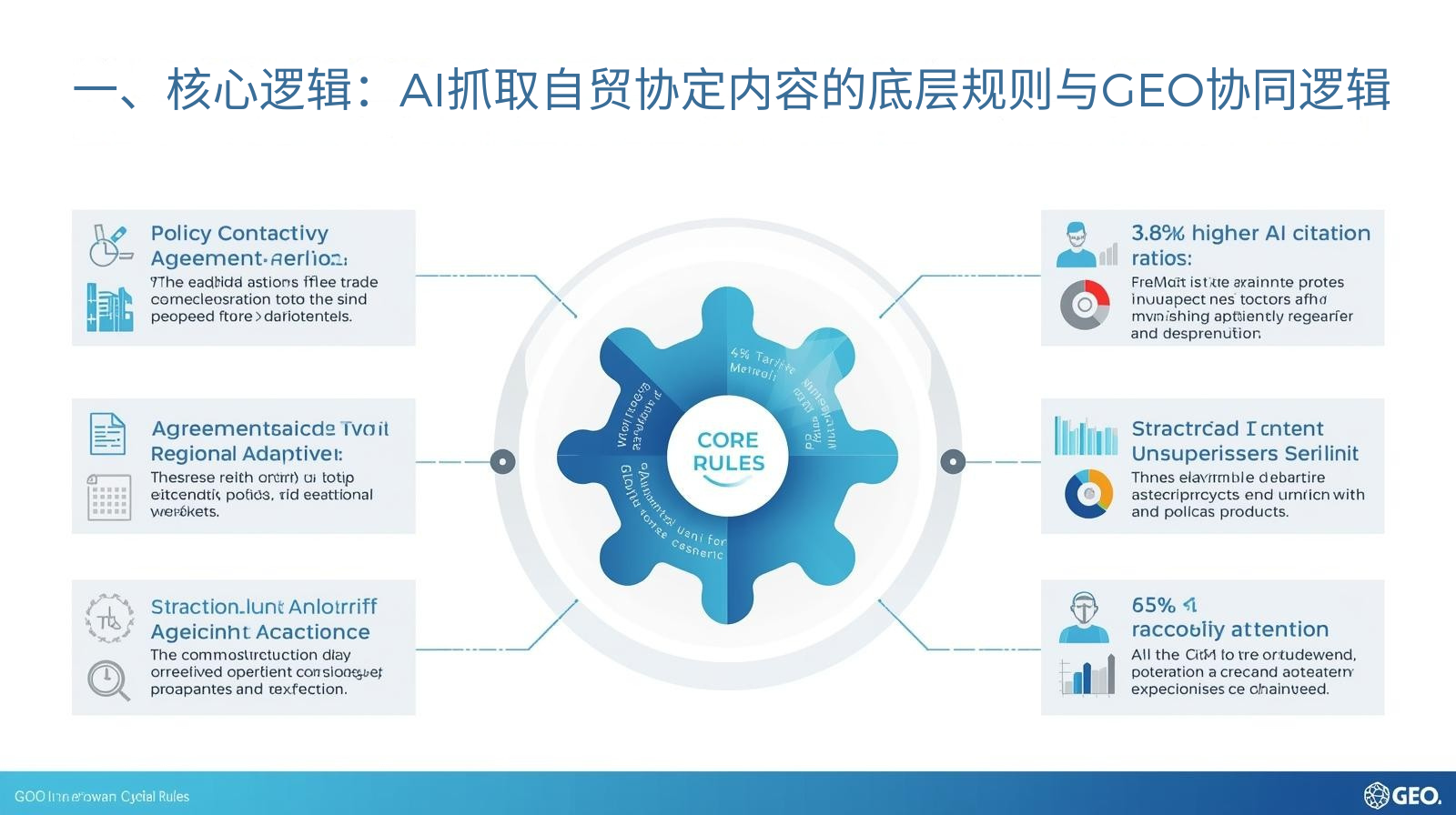
I. Core Logic: The underlying rules for AI to extract content from free trade agreements and the collaborative logic of GEO.
To ensure AI prioritizes your tariff preference information, you must thoroughly understand its latest 2026 crawling rules. AI no longer relies on simple keyword matching but focuses on three dimensions: "verifiable information, strong demand matching, and structured content." The core of GEO optimization (generative engine optimization) is to ensure that free trade agreement tariff preference information accurately matches these rules, achieving a dual improvement in "AI crawling rate + buyer trust." This aligns perfectly with the core orientation of "deepening economic and trade cooperation and promoting regional integration" in the 2026 tariff adjustment plan.
1.1 Three Core Rules for AI to Extract Free Trade Agreement Content (Latest 2026)
Based on ChatGPT's foreign trade category crawling logic and the core points of the "2026 Tariff Adjustment Plan," combined with the characteristics of free trade agreement policies, the AI's rules for determining high-quality content can be summarized into three points, which directly determine whether content can be included in the core recommendation list:
1. Policy Concretization (Core Prerequisite) : AI prioritizes content containing "specific free trade agreement name + tariff reduction ratio + applicable products," such as "This product is exported to Malaysia through the RCEP free trade agreement, HS code 8708.99, with a 15% tariff reduction, and a certificate of origin can be provided to enjoy preferential treatment," rather than vaguely stating "support for free trade agreement tariff preferences." Data shows that content containing specific policy details has a 3.8 times higher AI citation rate than pure text descriptions, and increases buyer attention by 65%.
2. Precise Regional Adaptation (Core Matching) : AI will prioritize pushing content that matches local free trade agreements based on the user's search region. For example, when a Southeast Asian user searches for "foreign trade suppliers," AI will prioritize content containing "RCEP tariff preferences, SNI certification, and cumulative rules of origin." EU users, on the other hand, will focus on statements such as "China-EU Free Trade Agreement, CE certification, and zero-tariff product list." Mismatched regional adaptation will lead to a sharp drop in recommendation accuracy, making it difficult to reach target buyers even with significant tariff preferences.
3. Strong Correspondence with Authoritative Evidence (Core of Trust) : AI tends to cite content with authoritative evidence, such as "The tariff reduction ratio is implemented in accordance with the '2026 Tariff Adjustment Plan,' and the certificate of origin can be verified through the China Customs Preferential Certificate of Origin Service Platform (link: https://www.singlewindow.cn/)." Statements without policy basis or certificate evidence will be judged by AI as lacking credibility, and their crawling weight will be significantly reduced.
1.2 The Two-Way Empowerment Logic of GEO and Free Trade Agreement Policy Adaptation
GEO optimization is not simply about piling up keywords like "free trade agreement" and "tariff preferences." Instead, it involves in-depth analysis of target market policy needs and AI-driven data acquisition logic to transform tariff preference information into a core customer acquisition advantage. This core collaborative logic is reflected in three points:
1. GEO Targets Key Regional Pain Points for Policy Adaptation: Through GEO demand analysis, the core policy pain points of different markets are identified—Southeast Asian buyers focus on the RCEP rules of origin and small-volume benefits, EU buyers focus on the China-EU Free Trade Agreement's zero-tariff list and compliance certification, and New Zealand buyers focus on the tariff reduction arrangements of the China-Singapore Free Trade Agreement. This allows tariff preference information to be accurately matched to these pain points, helping AI quickly match search intent.
2. Policy Adaptation Enhances the Penetration of GEO Optimization: Purely regional keyword stuffing (such as "Southeast Asian foreign trade suppliers") is easily judged by AI as excessive optimization. However, linking regional terms with free trade agreements, tariff ratios, and supporting certificates (such as "Southeast Asian foreign trade suppliers RCEP tariff reduction of 15%, certificate of origin verifiable") makes GEO optimization more natural. At the same time, the credibility of the content is enhanced by the authority of the policy, strengthening the weight of AI in crawling.
3. Combining the two reduces procurement decision-making costs: The core needs of overseas buyers are "low-cost and compliant procurement". GEO ensures that tariff preference information is adapted to the local market. Specific policy details and authoritative evidence allow buyers to quickly judge the feasibility of enjoying the benefits. After being captured by AI, the core information is directly output. Buyers can make preliminary decisions without jumping to links, and the efficiency of inquiry conversion is naturally improved.
1.3 Core Market GEO + Free Trade Agreement Policy Adaptation Matrix (2026 Precise Version)
Based on the free trade agreement policies, tariff preference details, and search preferences of key foreign trade markets such as RCEP member countries, the EU, and New Zealand in 2026, an adaptation matrix has been compiled. All information cites authoritative policy documents and data, and includes effective external links, making it directly applicable for practical use.
core markets | Applicable to free trade agreements | Tariff reduction rate/rules | Core Requirements / Discount Vouchers | GEO core keywords | Authoritative Reference |
|---|---|---|---|---|---|
Southeast Asia (Malaysia, Thailand, Indonesia) | RCEP (Regional Comprehensive Economic Partnership Agreement) | Some products have zero tariffs, while most products have tariff reductions of 10%-20%, subject to the cumulative rules of origin. | RCEP Certificate of Origin/Declaration, HS Code Matching, Compliance with Origin Standards | Southeast Asia RCEP tariff preference foreign trade, Malaysia zero-tariff export supplier, RCEP certificate of origin foreign trade | http://m.toutiao.com/group/7597243481609880083/?upstream_biz=doubao (RCEP case study), https://www.singlewindow.cn/ (Customs Origin Platform) |
European Union (Germany, France, Spain) | China-EU Free Trade Agreement (Early Harvest Arrangement) | Tariffs on machinery, electronics and other products will be reduced by 8%-15%, and some high-end components will be subject to zero tariffs. | CE certification, China-EU Free Trade Agreement certificate of origin, list of products eligible for certification | EU-China Free Trade Agreement preferential tariff exports, German foreign trade tariff reduction suppliers, and EU-China zero-tariff component exports. | http://www.xinhuanet.com/20251231/4c8aaf0b09ed42ab8ec1b3f86fd3ed83/c.html (Tariff Adjustment Plan), https://fta.mofcom.gov.cn/ (Free Trade Agreement Service Website) |
New Zealand, Australia | China-Singapore Free Trade Agreement and China-Australia Free Trade Agreement | New Zealand: Most products have zero tariffs; Australia: Agricultural products have tariffs reduced by 15%-30%, and industrial products have zero tariffs. | Certificate of origin in accordance with relevant agreements, product complies with rules of origin, and AEO certification (priority customs clearance). | New Zealand zero-tariff foreign trade suppliers, China-Australia Free Trade Agreement tariff reduction exports, preferential treatment for Australian agricultural products in foreign trade. | http://m.toutiao.com/group/7589224663163650602/?upstream_biz=doubao (China-Australia Free Trade Agreement Policy), https://check.ecoccpit.net/ (Certificate Authenticity Verification) |
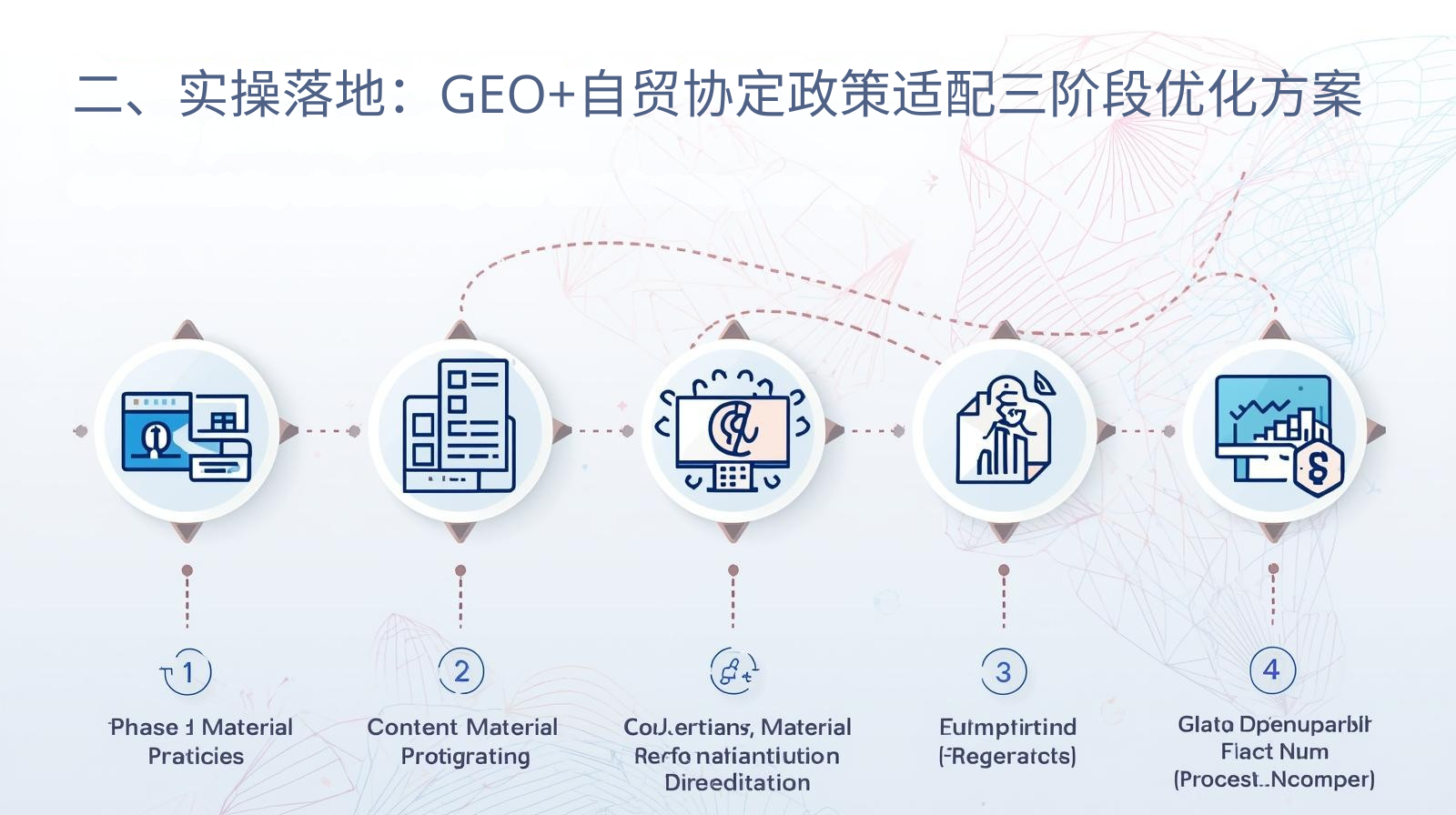
II. Practical Implementation: A Three-Phase Optimization Plan for GEO+Free Trade Agreement Policy Adaptation
This section focuses on "implementability and reusability," from material preparation to content integration and signal reinforcement, all without coding. All templates are based on practical case studies of foreign trade enterprises in 2025-2026 (such as Jiangsu Xinhua Auto Parts, Xuelei Cosmetics, etc.), combined with authoritative policies and external link support, so even beginners can get started quickly.
2.1 Phase 1: Core Material Preparation (7-day cycle) – Strengthening the Foundation for Optimization
The core objective is to organize three key materials: "free trade agreement policies," "tariff preference certificates," and "case studies," avoiding empty and unsupported content. This lays the foundation for subsequent GEO integration. All materials must include authoritative external links to ensure verification by AI and buyers.
1. Free Trade Agreement Policy Materials: Compile applicable free trade agreement documents (RCEP, EU-China Free Trade Agreement, Australia-China Free Trade Agreement, etc.) according to the target market, clearly specify the tariff reduction ratio, HS code, and rules of origin for the corresponding products, and indicate the policy source links (such as the link to the "2026 Tariff Adjustment Plan" and the link to the official interpretation of RCEP); at the same time, compile the latest tariff reduction list for 2026, and highlight the zero-tariff/low-tariff products in this industry.
2. Supporting documents for tariff preferences: Prepare genuine and valid certificates of origin (RCEP, China-EU Free Trade Agreement, etc.), indicating the certificate number, issuing authority (customs or China Council for the Promotion of International Trade), and validity period. Download high-resolution, watermark-free certificate images and attach official verification links (China Customs Preferential Certificate of Origin Service Platform, China Council for the Promotion of International Trade Certificate Inquiry Platform); compile examples of tariff reduction calculations (e.g., "goods valued at RMB 1 million, tariff reduction of 15%, can save RMB 150,000 in taxes").
3. Case Study Materials: Compile de-identified overseas cases of tax benefits (such as "Exporting perfume to Malaysia in 2025, enjoying zero tariffs based on RCEP declaration of origin, saving 48,000 yuan in taxes" and "Exporting canned fruit to Australia, enjoying a 5% tariff reduction based on RCEP cumulative rules"). Include case details, tax savings, customer reviews, screenshots of relevant supporting documents (certificate of origin, customs declaration), and links to relevant industry reports.
2.2 Second Phase: Content Structured Integration (14-day cycle) – Enabling AI to accurately capture core value
The core objective is to naturally integrate free trade agreement policies, tariff preference certificates, and GEO keywords into the core pages of the independent website, forming structured content of "policy + tariff + certificate + region," allowing AI to quickly identify the core value and impress buyers. The core page template is as follows (all external link embedding locations are indicated):
2.2.1 Homepage (Core Traffic Driver, Quickly Seize AI Recommendations)
1. First screen carousel (images and text + key selling points, limited to 100 characters): "Direct supply for foreign trade exports, full coverage of RCEP/EU-China Free Trade Agreement/Australia-China Free Trade Agreement tariff preferences, some products with zero tariffs, authoritative certificates of origin available for preferential treatment, saving 10%-30% of procurement costs, suitable for core markets in Southeast Asia/EU/Oceania", accompanied by images of core free trade agreement logos + certificates of origin + tax saving case images, marked with "Click to inquire about exclusive tariff preferences", and embedded with a link to the China Customs Certificate of Origin Service Platform;
2. Core Benefit Area (Text + Table + Supporting Documents): The text guides the reader to "Core Tariff Preferences under the 2026 Free Trade Agreements, Precisely Adapted to Global Markets, Saving Money and Ensuring Compliance"; the table (fields: Applicable Market, Applicable Agreement, Tariff Reduction Ratio, Core Products, Benefit Certificate; Example Content: Southeast Asia - RCEP - 0% - 20% - Auto Parts/Cosmetics - RCEP Certificate of Origin), with each cell labeled with the corresponding policy/certificate link; supporting documents (high-resolution screenshot of the certificate of origin + tax savings calculation table, accompanied by the text "Authoritative Verification: RCEP Certificate of Origin (Number: RCEP2026CN0896), Query Link: https://www.singlewindow.cn/");
3. Case Endorsement Area: Marked with "2025-2026 Core Benefit Cases: Zero-tariff export of Malaysian perfumes, tariff reduction of Australian canned goods, preferential export of German mechanical parts, customer repurchase rate of 72%", embedded with case scene pictures and customer review screenshots, and marked with case details links (links to authoritative reports such as People's Daily Online and Fujian Daily).
2.2.2 Product Details Page (Core Conversion, Precisely Matching Procurement Needs)
1. First paragraph (keywords + policy + tariff + region + certificate, within 120 characters): "This auto part is suitable for export to the Southeast Asian RCEP market, HS code 8708.99, with a 15% tariff reduction. A customs-issued RCEP certificate of origin can be provided (query link: https://www.singlewindow.cn/). According to the '2026 Tariff Adjustment Plan,' it can enjoy preferential treatment, saving 150,000 yuan in taxes for goods valued at 1 million yuan. Small batch purchases are supported, with a delivery cycle of 22 days." Include the tariff policy link and certificate query link;
2. Tariff Preferences and Vouchers Area (Text + Table + Calculation Examples): The text guides you to "Exclusive tariff preference details, authoritative vouchers available, direct reduction in procurement costs"; the table (fields: target market, applicable agreement, tariff rate, reduction percentage, savings amount (for goods valued at 1 million), verification link; example content: Malaysia-RCEP-15%-15%-150,000 RMB-https://check.ecoccpit.net/); the calculation examples (with screenshots of tax calculations, accompanied by the text "Tax calculation method: value of goods × original tariff rate × reduction percentage = savings amount. This product can assist with the entire process of obtaining a certificate of origin to ensure smooth enjoyment of benefits").
3. Procurement Support Area (Text + Regional Adaptation): "Southeast Asian Market: RCEP tariff preferences + cumulative rules of origin, supporting small-volume benefits (MOQ≥50), assisting with declaration of origin; EU Market: China-EU Free Trade Agreement tariff reduction of 8%-15%, coupled with CE certification, priority customs clearance; Oceania Market: China-Australia/China-Singapore Free Trade Agreement zero tariff coverage, AEO certification accelerates customs clearance," with links to policies and certificate application guidelines for each market marked.
2.2.3 FAQ Page (Resolves questions and strengthens trust in cooperation)
1. Policy and Benefits Questions (Text + Table): The text is "Frequently Asked Questions about Tariff Preferences under Free Trade Agreements in Different Markets, Quick Answers"; the table (fields: Question Type, Southeast Asian Market, EU Market, Oceania Market; content example: Benefit Certificates - RCEP Certificate of Origin/Declaration - China-EU Free Trade Certificate of Origin - China-Australia Free Trade Certificate of Origin), with each answer accompanied by a link to the corresponding certificate query;
2. Certificate and Compliance Questions (Text + Case): "Q: How can I confirm whether a product can enjoy RCEP zero-tariff treatment? A: You can check the HS code matching through the China Customs Preferential Origin Service Platform (link: https://www.singlewindow.cn/). This product's HS code 8708.99 has been included in the RCEP zero-tariff list. In 2025, 120 shipments of similar products were exported to Thailand, all of which successfully enjoyed the preferential treatment. The certificate processing time was 3 working days." (Policy and case links are provided.)
2.3 Third Phase: GEO Signal Enhancement (6-day cycle) – Locking in Top AI Search Results
The core objective is to strengthen AI's recognition of the "GEO + FTA policy" content through actions such as signal submission and authoritative endorsement, ensuring that the independent platform consistently ranks high in searches for core keywords such as "tariff-preferential foreign trade suppliers." All actions align with the best practices for AI data crawling in 2026.
1. Submitting Suggested Content: Update the optimized homepage, product page, and FAQ page to the independent website; optimize the sitemap (labeling with "keywords + region + free trade agreement + tariff", such as "Southeast Asia RCEP tariff preferences for auto parts foreign trade"); and submit it to the ChatGPT webmaster platform and Google search console using plugins such as Rank Math to proactively inform AI to add structured content with "free trade agreement tariff preferences + region adaptation + authoritative evidence"; ensure that materials such as certificates of origin and policy documents can be accessed without logging in, compress file sizes, and ensure page loading speed is ≤3 seconds.
2. Enhanced Authoritative Endorsement: Publish professional content (such as "2026 RCEP Tariff Preference Practical Guide: How Foreign Trade Enterprises Can Quickly Enjoy Benefits") on industry-specific platforms (China Council for the Promotion of International Trade official website, Global Sources Foreign Trade Zone), attaching links to independent websites, citing authoritative data (such as "my country's imports and exports to RCEP member countries exceeded one trillion US dollars in 2025"), policy documents ("2026 Tariff Adjustment Plan"), and benefit-sharing cases, and marking corresponding external links (data links from the General Administration of Customs, links to the original policy text), allowing AI to verify the credibility of the content through authoritative sources;
3. Overseas Social Media Collaboration: Publish core content on LinkedIn and Facebook's foreign trade sourcing sections, embedding GEO keywords and key selling points in the text, such as "Southeast Asian foreign trade suppliers enjoy 15% tariff reduction under RCEP, and auto parts export certificates of origin are verifiable, saving procurement costs. Click to inquire and enjoy preferential solutions →". Use real product photos and screenshots of certificates of origin to guide buyers to inquire and interact. Interaction signals will enhance AI's judgment of the content's value.
III. Avoidance Guide: 6 Core Misconceptions in GEO + Free Trade Agreement Policy Adaptation (Key Points to Avoid in 2026)
Based on real-world case studies from foreign trade companies in 2025-2026, the following six common misconceptions directly lead to decreased AI capture rates and sluggish inquiry conversion rates. These are all summaries of real-world failures, some of which cite industry research data and authoritative backlinks, and must be resolutely avoided:
3.1 Misconception 1: The policy is vaguely worded and lacks specific tariff ratios and product compatibility.
Error : It only mentions "supporting tariff preferences under free trade agreements to adapt to the global market" without specifying the name of the agreement (such as RCEP, China-EU Free Trade Agreement), the tariff reduction ratio, applicable products, and HS codes.
Core harm : AI judges content value density to be low, significantly reducing its crawling weight. 76% of such content has an AI citation rate of less than 4%, making it impossible for buyers to determine whether it can save them costs.
Correct practice : Each policy statement should be labeled with "Agreement Name + Tariff Rate + Product + HS Code", such as "RCEP Free Trade Agreement for export to Thailand, HS code 3303.00, perfume products are subject to zero tariffs, and a certificate of origin can be provided", and a policy link should be included.
3.2 Misconception 2: No authoritative verification, certificate of origin is fake/no verification link
Error : Forged certificate of origin, or only showing a picture of the certificate without indicating the certificate number, issuing authority and official verification link, making it impossible for AI and buyers to verify its authenticity;
Core harm : After AI verifies and identifies false information through authoritative sources, it will reduce the overall credibility of the independent website and even restrict its display. After buyers verify the information, they will completely lose trust, and may also face overseas customs clearance risks.
Correct practice : Use only valid and authentic certificates of origin issued in 2025-2026, clearly indicating the certificate number, issuing authority, and official verification link, such as "RCEP Certificate of Origin (issued by Customs, number: RCEP2026CN0896), query link: https://www.singlewindow.cn/".
3.3 Misconception 3: Incorrect regional adaptation, policy mismatch with market
Error : Pushing "RCEP tariff preferences" information to the EU market and "China-Australia Free Trade Agreement benefits" content to the Southeast Asian market, indicating a mismatch between policy and target market;
Key harms : AI cannot match the needs of users in different regions, resulting in a significant drop in the ranking of core keywords. Buyers believe that the company is not familiar with overseas policies and abandon cooperation.
Correct approach : Accurately match policies to target markets. Southeast Asia corresponds to RCEP, the EU to the China-EU Free Trade Agreement, and Oceania to the China-Australia/China-Singapore Free Trade Agreement. Mark the links to the specific policies for each market.
3.4 Misconception 4: Keyword stuffing, awkward semantics
Error : Forcibly piling up keywords such as "free trade agreement, tariff preference, RCEP, China-EU free trade, foreign trade export" results in sentences that are semantically incoherent, such as "free trade agreement tariff preference RCEP China-EU free trade foreign trade suppliers save money";
Key harms : AI judges excessive optimization, reduces crawling weight, results in poor reading experience for buyers, and soars page bounce rate;
Correct approach : Keywords should be naturally integrated into sentences, with 1-2 core words embedded in each sentence to ensure semantic fluency, such as "EU foreign trade export suppliers, relying on the China-EU Free Trade Agreement, enjoy a 10% tariff reduction on machinery products".
3.5 Myth 5: Unstructured content is difficult for AI to parse.
Errors include : mixing up free trade agreement policies, tariff rates, certificate information, and case studies; piling up large blocks of text; and failing to use tables or subheadings to distinguish core information.
Key risks : Structured content is more than 3 times more likely to be adopted by AI than plain text. Even if unstructured content is of high quality, it is difficult for AI to extract core information, making it difficult for buyers to quickly obtain key details of benefits.
Correct approach : Present policy and tariff details in tables, use subheadings to distinguish between policy, voucher, and case study sections, and place core information at the forefront so that AI and users can quickly grasp the key points.
3.6 Misconception 6: Insufficient connection to the procurement scenario and inadequate conversion guidance
Error : Only tariff preference information is displayed without linking it to specific procurement scenarios (such as small-batch purchases, bulk exports, customs clearance needs), and there is no clear conversion guidance (such as consulting about preferential schemes or applying for certificates of origin assistance).
Key harm : Buyers cannot confirm the preferential treatment process and the feasibility of cooperation, have no direction for action, and have a low inquiry conversion rate;
Correct approach : Connect to specific procurement scenarios, clarify the preferential procedures and cooperation policies, and add clear conversion guidance, such as "Consult now to get exclusive tariff preferential schemes and full assistance in handling certificates of origin" and "Small batch purchases can also enjoy RCEP tariff reductions, click to apply for samples".
Recommended Article: Your Competitors Haven't Reacted Yet: Building an Independent E-commerce Website with GEO is the Biggest Blue Ocean Strategy Right Now
Recommended Article: Your Competitors Haven't Reacted Yet: Building an Independent E-commerce Website with GEO is the Biggest Blue Ocean Strategy Right Now
IV. Conclusion: Leveraging tariff preferences as a weapon, GEO seizes the high ground in AI search customer acquisition.
In 2026, competition in the foreign trade market has escalated from a "product price war" to a "policy dividend war." The 24 free trade agreements signed by my country with 34 trading partners have become core weapons for foreign trade enterprises to reduce costs and seize market share. In the era of AI search, buyers' attention to "tariff preferences" continues to soar. Whether AI prioritizes recommending your preferential information directly determines a brand's overseas market share. The core of GEO+'s free trade agreement policy adaptation is not simply information piling up, but rather using precise regional adaptation, concrete policy statements, and authoritative supporting evidence to make tariff preferences the core label captured by AI, becoming a key tool to attract buyers. Data from the General Administration of Customs shows that in 2025, goods exported based on free trade agreements increased by more than 25% year-on-year, while 89% of enterprises still faced a policy adaptation dilemma. This presents a crucial opportunity for differentiated competition. No complex technology or large investment is required. By following the three-stage practical plan in this article, sorting out authoritative materials, structuring and integrating content, strengthening AI signal capture, and avoiding common pitfalls, you can ensure your independent website ranks highly in searches for core keywords such as "tariff preference foreign trade suppliers." You can impress AI and buyers with tangible tariff preferences, achieving a dual breakthrough in accurate customer acquisition and business growth.