
Today, more and more foreign trade clients are shifting their supplier selection process from "Google keyword search" to "ChatGPT natural language questions," such as directly searching "Which chemical raw material suppliers can provide EU REACH certification by 2025?" or "Which factory supports an MOQ of 50 tents and includes customs clearance services when purchasing outdoor tents from China to the US?" This change means that relying solely on traditional SEO optimization for independent websites to improve search engine rankings is no longer sufficient to reach the new traffic brought by AI search. GEO (Generative Engine Optimization), as an optimization method for generative AI like ChatGPT, can make your independent website brand a "preferred option" in AI responses through "content adaptation + technical integration + signal enhancement." This article will break down the three core steps for implementing GEO on foreign trade independent websites, providing directly replicable operational methods for each step, from basic content optimization to final precise exposure in ChatGPT search, helping you systematically seize the blue ocean of AI procurement traffic.
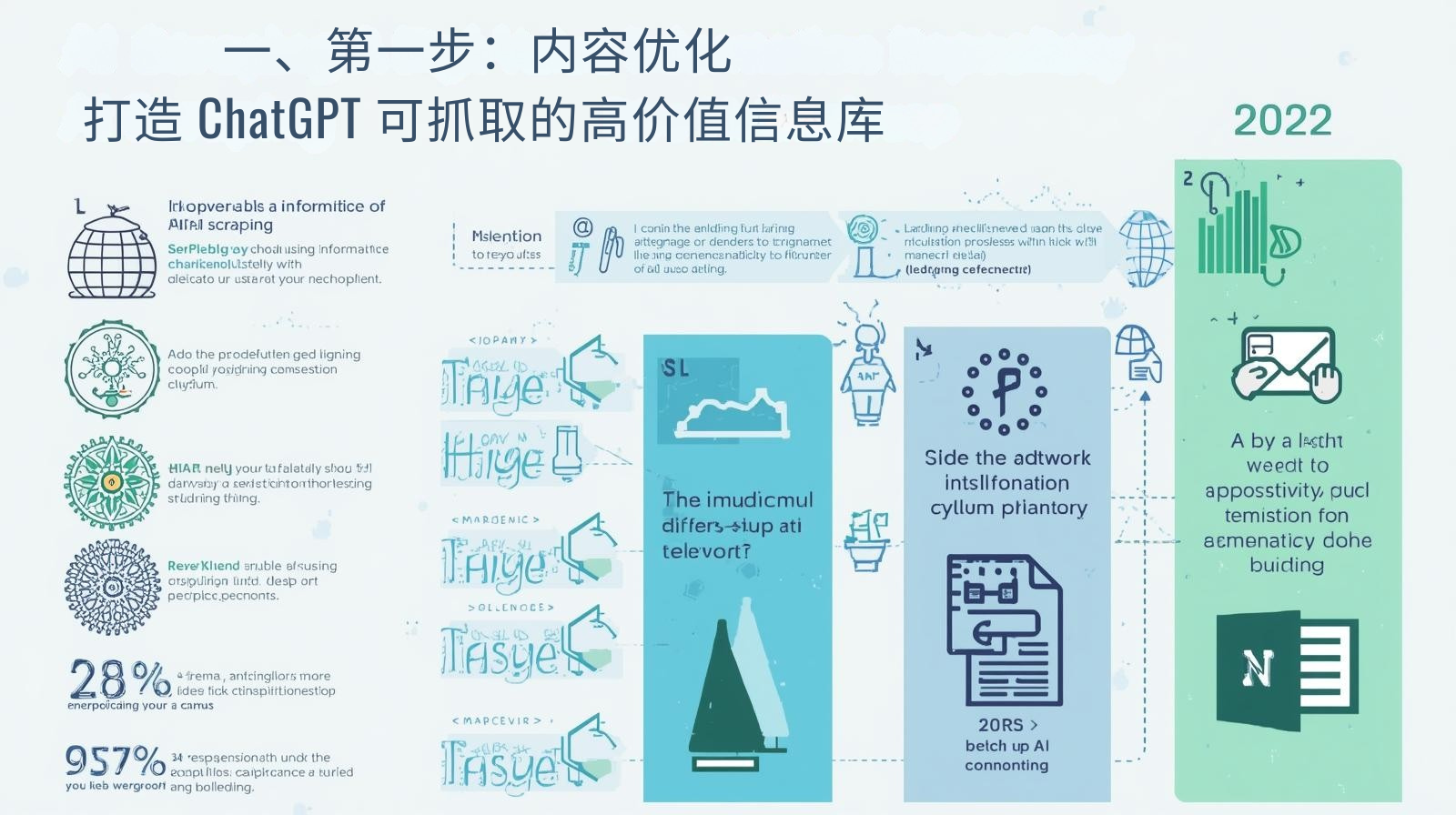
Step 1: Content Optimization – Building a High-Value Information Repository that ChatGPT Can Scrape
Whether ChatGPT will mention your brand in its responses hinges on its ability to extract valuable, logical, and targeted information from your independent website. If the site's content is disorganized, vague, or lacks relevance to the procurement context, even if AI crawls the pages, it won't recommend them as high-quality information sources. Therefore, the first step in implementing GEO (Government Optimization) must be to optimize content around ChatGPT's information extraction preferences and build a high-value information database.
1.1 Restructuring the content structure based on "AI readability" allows ChatGPT to quickly understand the core information.
ChatGPT places far higher demands on content readability than traditional search engines—it prefers to crawl content with a clear structure, core information at the top, and well-defined logical hierarchy, rather than large blocks of unfocused text. For product pages, blog pages, and customer case study pages on independent foreign trade websites, the structure should be restructured according to the following standards:
- Product Page: Core Procurement Information Presented on the First Screen : The page title (H1 tag) must include "Brand + Product + Core Advantages + Target Market Compliance Attributes", such as "XYZ Chemical Raw Materials - EU REACH Certified Food-Grade Thickener (Latest Compliance in 2025)"; The first paragraph directly addresses three core customer questions: "What can we provide (product model/specification)", "What standards do we meet (certification/compliance requirements)", and "Procurement convenience (MOQ/delivery cycle/logistics support)", for example, "XYZ provides food-grade thickener model A100, which complies with the EU REACH regulation's newly added SVHC substance restrictions in 2025, supports minimum order quantities of 200kg, and delivers within 7 days after payment. We can assist with customs clearance at the Port of Hamburg, Germany"; Subsequent content is divided into H2 sections according to "Product Parameters → Compliance Certification → Procurement Process → After-Sales Guarantee". Each section uses coherent text to supplement details, avoiding fragmented lists and ensuring that AI can continuously capture information.
- Blog Page: Centered on "Procurement Issues" : GEO-optimized blogs should not be general industry information, but rather focus on procurement issues frequently asked by clients on ChatGPT, such as "How are import tariffs on US outdoor tents calculated in 2025? Including customs clearance process breakdown" and "What new substance restrictions have been added to European chemical raw material REACH certification in 2025?" The article structure should follow "direct answer to the question → detailed layered explanation → brand solution integration." For example, when answering tariff questions, first clarify that "the most-favored-nation tariff rate for US outdoor tents in 2025 is 8.5%, and tariff deferral can be applied for if shipped through Amazon FBA," then elaborate on "tariff calculation method," "required documents for customs clearance," and "tariff preferential policies," and finally naturally integrate "XYZ can provide a list of US customs clearance cooperation agents to assist clients in completing tariff declarations and reducing the risk of customs clearance delays," allowing AI to strongly link "problem solutions" with "brand" when crawling.
- Customer Case Study Page: Emphasize Concrete Descriptions of "Scenario + Result" : Case study pages should avoid vague statements like "The client is very satisfied with us." Instead, they should be written according to the logic of "Client Background (Industry/Region/Procurement Needs) → Cooperation Challenges (Compliance/Logistics/Cost Issues) → Brand Solution → Final Result." For example, "The client is a campground operator in Munich, Germany. In March 2025, they needed to purchase 150 outdoor tents. The core requirement was compliance with the EU EN 5912 safety standard and an MOQ not exceeding 200 tents. The cooperation challenge was that the client required delivery within 15 days, while the conventional production cycle was 20 days. XYZ adjusted the production line priority, compressed the production cycle to 12 days, and simultaneously assisted in completing the EN 5912 certification document submission. The goods were ultimately delivered to the client's campsite within 18 days, and the client subsequently placed an additional order for 300 tents." Concrete case studies can make ChatGPT believe that the brand has the "ability to solve real procurement problems," increasing the likelihood of citation.
1.2 Embed strong correlation information of "procurement scenario + brand keywords" to match ChatGPT search intent.
When answering user questions, ChatGPT prioritizes content that includes both the user's search scenario and the brand name. For example, if a user searches for "Which supplier supports small-batch customization for outdoor tents for camping in Germany?", the AI will proactively retrieve information containing "German camping + outdoor tents + small-batch customization + [brand name]". Therefore, it's necessary to naturally embed such strongly related combinations within the site's content. The specific steps are as follows:
- We analyze the core procurement scenarios in the target market : breaking down scenarios by "region + industry + procurement needs". For example, in the European market, we analyze "German campsites - small batch tent customization" and "French food factories - compliant chemical raw material procurement", while in the US market, we analyze "California e-commerce - lightweight outdoor furniture wholesale" and "New York food packaging - compostable material customization". This ensures that we cover all the scenario dimensions that customers may mention in ChatGPT.
- Embed scenario-based brand information in key locations : H1 tags, image alt text, and product descriptions on product pages should include scenario-related terms. For example, the alt text of images on outdoor tent product pages should be "XYZ Outdoor Tents - Small Batch Customization for German Campsites (EN 5912 Certification)". Subheadings and paragraph beginnings of blog articles should incorporate the scenario + brand, for example, the subheading of "European Campsite Tent Procurement Guide" should be "Choosing Tents for German Campsites: How XYZ Meets Customization Needs for Orders Starting from 100 Tents". Customer case study pages should directly use "Scenario + Brand + Result" in their titles, such as "Hamburg Campsite in Germany Customizes 120 Tents with XYZ, Delivery and Compliance Acceptance Completed in 15 Days", allowing ChatGPT to quickly associate the brand with specific procurement scenarios.
1.3 Supplementing with "authoritative evidence" enhances content credibility and increases ChatGPT's willingness to cite it.
ChatGPT prefers content with "authoritative supporting evidence" rather than self-praise from a single brand. For independent e-commerce websites, "authoritative supporting evidence" includes industry certifications, third-party testing reports, genuine customer reviews, and industry data citations, which must be clearly presented in the content. Specific methods are as follows:
- Certification and testing reports should be "visualized and verifiable" : In the "Compliance Certification" section of the product page, not only should the certification name be listed (such as REACH, EN 5912, FDA), but a clear image of the certification certificate should also be attached (with the image alt text labeled "XYZ Outdoor Tent EN 5912 Certification Certificate - Updated in 2025"), and a "Certification Query Link" (such as the corresponding page link on the EU CE certification query website) should be added, indicating "You can enter the certificate number XXX to verify its authenticity"; if there is a third-party testing report (such as SGS testing), key pages of the report (such as the test results page) can be converted into images and embedded, while providing a "Full Report Download Link" so that ChatGPT can obtain "verifiable authoritative information".
- Citing industry data and customer testimonials : Blog posts should cite industry reports from the target market, such as, "According to the 2025 European Camping Association (ECS) report, the number of campsites in Germany increased by 12% year-on-year, and 'small-batch customization' accounted for 45% of tent procurement demand. XYZ has launched a customization service for orders of 50 tents or more to address this trend, and has already served 20+ German campsite clients." The data source must be clearly indicated (e.g., "ECS 2025 Q1 Camping Industry Report"). A "Real Customer Reviews" section should be added to the bottom of the product page, citing customer feedback in emails and social media (with customer authorization), such as, "Mr. Schmidt, head of a campsite in Munich, Germany: 'XYZ tents not only meet the EN 5912 standard, but the customized logo printing effect exceeded expectations, and the delivery speed was 30% faster than previous suppliers.'" The customer's name and the duration of the collaboration should be included to enhance credibility.
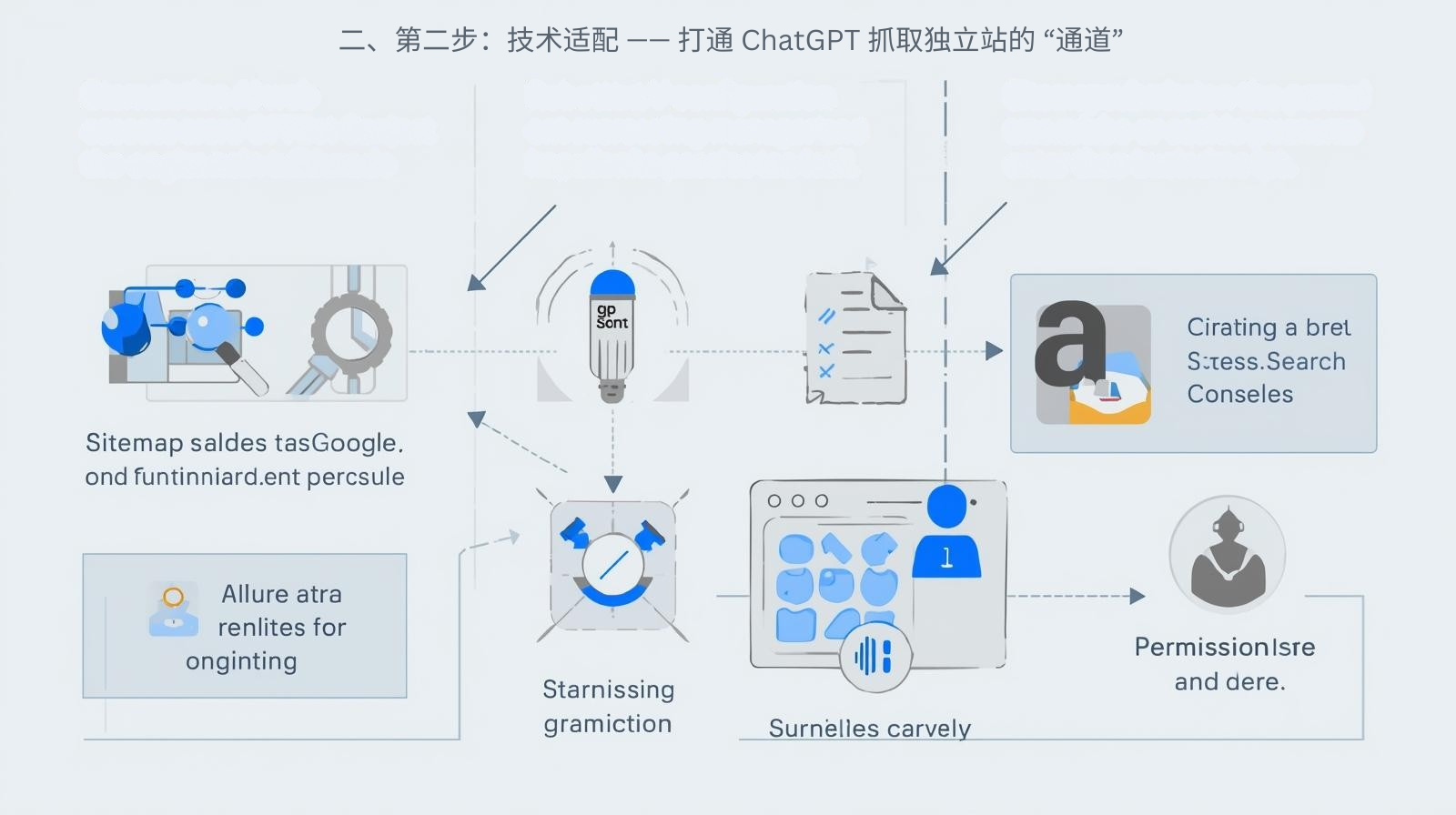
Step Two: Technical Adaptation – Establishing a "channel" for ChatGPT to crawl independent websites.
Even with optimized content, if the independent website faces technical obstacles that prevent ChatGPT from crawling it, the successful implementation of GEO will be a failure. ChatGPT (especially the online version GPT-4) primarily uses web crawlers to extract information from publicly available web pages. Therefore, it is necessary to ensure technical compatibility from three dimensions: "open access," "obstacle removal," and "trust enhancement" to ensure that AI can successfully obtain core information from the website.
2.1 Optimize robots.txt and sitemap, and grant permissions to AI crawlers.
ChatGPT's crawlers have unique identifiers (such as GPTBot), and you need to explicitly allow them to access the site in the robots.txt file of your website. You also need to guide the AI to crawl core pages through a sitemap. The specific steps are as follows:
- Modify the robots.txt file to allow GPTBot access : Log in to the server backend of your independent website (such as cPanel or Alibaba Cloud console), find the "robots.txt" file in the root directory of your site, open it with a text editor, and add "User-agent: GPTBot Allow: /" (meaning that the ChatGPT crawler is allowed to access the entire site); if you need to restrict non-core pages (such as the backend management page or member center), you can add "Disallow: /admin/ Disallow: /member/" to avoid irrelevant information distracting the AI from the core procurement content; after modifying, save the file, and verify whether it has taken effect through a "GPTBot crawler testing tool" (such as Semrush's Site Audit function) to ensure that there are no permission settings errors.
- Submit your sitemap to Google to guide AI crawling : When ChatGPT crawls your independent website, it refers to the list of pages indexed by Google to determine "which pages are valuable." Therefore, you need to ensure that your core pages (product pages, blog pages, case study pages) have been indexed by Google. Log in to Google Search Console and submit your independent website's XML sitemap in "Index → Sitemap" (if using a website building system such as WordPress, you can automatically generate a sitemap through plugins such as Yoast SEO; the link format is usually "https://yourdomain/sitemap_index.xml"). After submission, check the "Sitemap Status" weekly. If any pages are not indexed, check for issues such as "noindex" tags or slow page loading speeds, and optimize them promptly to ensure that 100% of your core sourcing pages are indexed by Google, providing a "trust foundation" for ChatGPT's crawling.
2.2 Eliminating "Scraping Barriers": Handling Member Walls and Dynamic Content
Many independent e-commerce websites, in order to protect core information (such as wholesale prices and purchase contract templates), set up a "visible only to logged-in members" wall or use JavaScript to dynamically load content. These practices prevent ChatGPT from crawling this crucial information. A targeted approach is needed to balance information protection with the requirements of AI crawling.
- To prevent the member wall from obscuring core procurement information, "public information" and "sensitive information" are separated . Information frequently searched by customers on ChatGPT, such as "wholesale price range," "MOQ range," "standard delivery time," and "compliance certifications," are set to "publicly visible." Only "customer-specific quotes," "customized contract templates," and "supplier contact information (e.g., email/phone)" are set to "member-visible." For example, on the product page, it is publicly stated that "XYZ outdoor tent wholesale price range: $120/tent for 50-100 tents, $105/tent for over 100 tents, MOQ 50 tents," while also indicating that "logged-in members can view detailed quotes and customization fees for specific models." This retains the information protection function of the member wall while ensuring that ChatGPT can capture core procurement parameters.
- Optimize dynamic content to ensure AI recognition : If your independent website uses JavaScript to dynamically load product parameters, customer reviews, and other content (e.g., loading subsequent content only when scrolling the page), you need to add "static text backup" to the code (no technical coding knowledge required, can be achieved through website building system plugins, such as WordPress's "Dynamic Content SEO" plugin). For example, for dynamically loaded product parameters, synchronously retain the "static version" of the parameter text in the page source code; or directly change the dynamic content to "server-side rendering" (you can contact your website building service provider for assistance in adjusting this), to ensure that the ChatGPT crawler can read complete product information and procurement details without executing JavaScript, avoiding incomplete information retrieval due to dynamic loading.
2.3 Optimize page loading speed to prevent AI crawlers from "giving up crawling".
ChatGPT's crawler has a threshold requirement for page loading speed; if a page takes more than 3 seconds to load, the crawler may abandon the crawl. Loading speed needs to be improved in three aspects: "image optimization," "code simplification," and "server configuration."
- Image compression and CDN acceleration : Large product images and certification images on an independent website (e.g., single images exceeding 2MB) can severely slow down loading speeds. Use image compression tools (such as TinyPNG and ShortPixel) to compress images to under 500KB while maintaining clear image quality; enable CDN services (such as Cloudflare and Alibaba Cloud CDN) to distribute static resources such as images, CSS, and JavaScript to global nodes, ensuring that page loading speeds are controlled within 2 seconds for overseas customers (such as those in Europe and the United States), while also allowing the ChatGPT crawler to quickly retrieve page content and avoid crawling failures due to loading timeouts.
- Streamline code and disable unnecessary plugins : Log in to the website builder backend and disable unused plugins (such as redundant social sharing plugins and statistics plugins) to reduce code loading. If using a custom theme, delete unused code snippets (such as hidden ad code or invalid JS scripts) or use code optimization tools (such as the Autoptimize plugin) to compress CSS and JavaScript code. Use Google PageSpeed Insights to check page loading speed and address any issues that need optimization (such as enabling browser caching or reducing server response time) to ensure that page loading speed meets the "good" standard (both mobile and desktop scores ≥ 80).
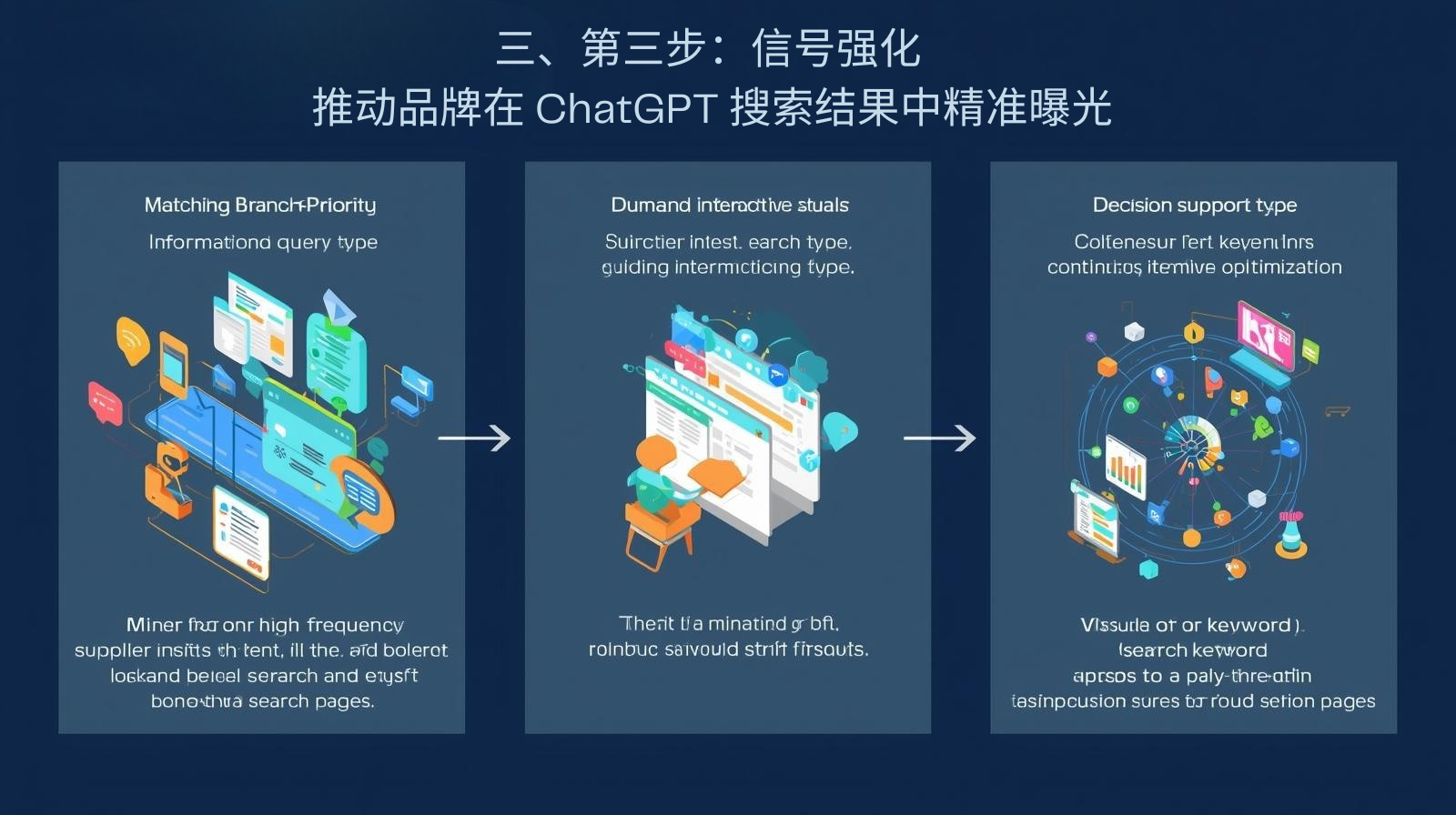
Third step: Signal reinforcement – Driving precise brand exposure in ChatGPT search results.
After completing content optimization and technical adaptation, it's necessary to further "strengthen the brand signal," making ChatGPT believe your independent website is "more recommendable than competitors," thereby achieving precise exposure in search results. The core logic is to improve the brand's priority in the AI recommendation system through "matching search intent," "guiding interaction signals," and "continuous iterative optimization."
3.1 Analyze ChatGPT's high-frequency search intent and optimize keyword placement.
ChatGPT's search intent is more precise than traditional search engines, and can be categorized into "information query" (e.g., "How to apply for EU REACH certification?"), "demand matching" (e.g., "Suppliers of small-batch tents for campsites in Germany"), and "decision support" (e.g., "Which is better, XYZ or ABC outdoor tent suppliers?"). Keyword placement needs to be optimized for different intents to ensure the brand covers various search scenarios.
- Mining high-frequency search intent keywords in ChatGPT : Keywords were collected in three ways: First, by entering "Frequently Asked Questions from European Chemical Raw Material Buyers in 2025" and "Search Keywords for US Outdoor Furniture Suppliers" into ChatGPT to obtain AI-generated high-frequency questions; second, by using the "Question-Based Keywords" function in Semrush and Ahrefs to filter keywords containing "how to choose," "which one is good," "how to apply," and "what is needed," such as "How to choose a European chemical raw material supplier?" and "What documents are needed for customs clearance of US outdoor tents?"; third, by organizing the "core questions" from past customer inquiries, such as "Can the MOQ be reduced?" and "Do you support customized logos?", these questions were converted into keywords.
- Assign keywords to corresponding pages based on search intent : "Information query" keywords (such as "REACH certification application process") are assigned to blog pages, embedding the brand's "certification assistance services" within the articles; "Demand matching" keywords (such as "German small-batch tent supplier") are assigned to product pages, clearly stating the brand's scenario suitability in the title and first paragraph; "Decision support" keywords (such as "How is XYZ tent supplier?") are assigned to customer case study pages or "Brand advantages" pages, addressing customer decision-making questions through case studies and comparative data (such as "XYZ's delivery cycle is 20% faster than the industry average"); ensure that each core keyword has a corresponding "dedicated page," and that the page content is highly matched to the intent, allowing ChatGPT to accurately locate brand information.
3.2 Guide users to use "interaction signals" to enhance AI's recognition of content.
ChatGPT uses user interaction data (such as page dwell time, downloads, and inquiries) to determine the "value" of content—the better the interaction data, the more likely the AI is to recommend it. It's necessary to actively guide user interaction and accumulate positive signals.
- To encourage dwell time and interaction, implement a "High-Value Content Download" feature : Add a "Procurement Toolkit Download" module to the end of blog pages. For example, in the "European REACH Certification Guide" blog, offer a downloadable package of "2025 REACH Certification Required Documents List + EU Customs Clearance Process Form." Users only need to fill in their "Name + Email + Target Market" to download it for free (no login required). Monitor download data through Google Analytics. If download volume is low, optimize the toolkit title (e.g., change it to "Free Download: European REACH Certification Documents List (Latest 2025 Version)") to increase attractiveness. High download volume and user input will make ChatGPT consider the page content "valuable to users," indirectly increasing its recommendation ranking.
- Add "scenario-based consultation guidance" to increase consultation volume : Add "scenario-based consultation buttons" in prominent positions on product and case study pages (such as right-side floating windows or bottom of the page), such as "German campsite procurement consultation" or "US customs clearance assistance consultation." Clicking these buttons will redirect users to a form page. The form fields should be designed to fit the procurement scenario (e.g., "Product to be procured: ______ Target market: ______ Quantity to be procured: ______ Core needs: ______") to lower the barrier for users to fill out the form. Simultaneously, after the form is submitted, an automatic "thank you email" with a link to the "procurement guide" will be sent, guiding users to revisit the site and increasing the page's secondary interaction rate. Consultation volume and secondary visit data will lead ChatGPT to believe that the brand "effectively meets users' procurement needs," further strengthening their willingness to recommend the brand.
3.3 Testing and Iteration: Optimize content direction based on ChatGPT feedback
GEO implementation is not a "one-off operation." It requires regular testing of the brand's exposure on ChatGPT, adjusting and optimizing strategies based on feedback, forming a closed loop of "testing-analysis-optimization."
- Establish a fixed testing cycle and keywords, and record exposure data : Each week, select 15-20 core keywords (covering three intent categories: "information query," "demand matching," and "decision assistance"), search in ChatGPT's online mode, and record three key data points: ① whether your brand is mentioned; ② the source of the mentioned information (whether it is your independent website); ③ the brand's ranking in the answers (first mentioned, second-third mentioned, or not mentioned); compile the data into a "GEO Exposure Monitoring Table," compare weekly changes, and if the mention rate of a certain type of keyword decreases, the reasons need to be analyzed in detail.
- For content optimization regarding "not mentioned" or "information discrepancies" : If the keyword "German small-batch tent supplier" does not mention any brand, first check if the product page corresponding to this keyword has been crawled by ChatGPT (enter "site: your domain German small-batch tents" in ChatGPT to check for results). If not crawled, you need to re-check robots.txt and sitemap. If crawled but not mentioned, you need to optimize the "scenario relevance" of the product page (e.g., add "German campsite customer cases") or "authoritative evidence" (e.g., supplement German customer reviews). If ChatGPT mentions the brand but the information is incorrect (e.g., MOQ error, expired certification), you need to immediately update the corresponding content on the site, and at the same time, provide feedback in ChatGPT such as "This information has been updated, see the latest information at: your page link" to help AI correct its understanding and ensure the accuracy of subsequent answers.
Recommended article: Pintui Technology's Viewpoint: The Best Independent E-commerce Website of the Future Will Be the One That Is "Most Instructive"
End
The core of implementing GEO for independent foreign trade websites is not pursuing complex technical operations, but rather proceeding step by step from three dimensions—"content value," "technical accessibility," and "signal strengthening"—around the "information capture and recommendation logic of ChatGPT." Content optimization is the foundation, ensuring that AI can "understand" your advantages; technical adaptation is the channel, ensuring that AI can "capture" your information; and signal strengthening is the key, ensuring that AI can "prioritize recommending" your brand.
For foreign trade companies, now is the perfect time to implement GEO (Google, Google, and Amazon) – most competitors are still focused on traditional SEO, so the competition for AI search traffic is minimal. Starting today, you can begin with "Content Optimization," restructuring 1-2 core product pages and embedding contextualized brand information; after 1-2 weeks, move on to "Technology Adaptation," granting access to AI crawlers; and then spend another month strengthening interactive signals and iterating through testing to gradually achieve precise brand exposure on ChatGPT.
As more and more foreign trade clients rely on ChatGPT to screen suppliers, companies that implement GEO early will be able to seize the opportunity in the blue ocean of AI procurement traffic, making ChatGPT your "free referral officer" and continuously bringing high-intent procurement inquiries to your independent website.