
In 2025, global foreign trade sourcing showed a trend towards multilingual diversification. However, "MultiLangGlobal," a brand specializing in cross-border 3C accessories, discovered that most independent foreign trade websites still relied on single-language product descriptions, resulting in issues such as "incomplete language coverage, awkward direct translations, and lack of adaptation to regional cultures." This led to an AI search matching rate of less than 18% in non-English markets, and the loss of over 70% of targeted customers due to language barriers. However, by adopting the "GEO generative engine optimization + multilingual product description" system to adapt to the sourcing needs of different languages, the independent website saw an 89% increase in display rate in multilingual AI searches within just three months, a 660% increase in targeted inquiries in non-English markets, and a transaction share exceeding 82% in core German, Japanese, Spanish, and Arabic markets. In the era of AI search, multilingual product descriptions are key to breaking down language barriers. The essence of GEO + multilingual is to ensure that product descriptions accurately match "target market language + regional culture + AI search logic," allowing buyers of different languages to quickly understand the product's value. This article, drawing on practical experience with MultiLangGlobal, breaks down the complete implementation logic and practical solutions.

I. Core Logic: 4 Underlying Principles of GEO + Multilingual Product Description
MultiLangGlobal's analysis of multilingual AI search algorithms in 2025, 1,120 sets of multilingual procurement data, and the multilingual operation results of 680+ foreign trade enterprises revealed that multilingual product descriptions that can be accurately matched by AI platforms all follow four core principles: "deep adaptation of language and region, structured description, natural integration of keywords, and alignment with cultural customs." These are also the core directions for GEO optimization.
1.1 Global Core Language Market Product Description Requirements and GEO Adaptation Matrix
Buyers in different language markets exhibit significant differences in their language preferences, information focus, and cultural taboos regarding product descriptions. This is the core basis for GEO + multilingual optimization. MultiLangGlobal has compiled a global core language market demand matrix, which can be directly reused:
| Target market (language) | Multilingual product description core requirements | Typical AI search terms (corresponding languages) | GEO + Multilingual Optimization Core Anchor Point |
|---|---|---|---|
| English (USA, UK) | 1. Language: American/British English, concise and conversational; 2. Focus: Core selling points (48-hour shipping, environmentally friendly materials), quantifiable data; 3. Culture: Emphasizing efficiency and practicality; 4. Format: Primarily short sentences, clearly divided into bullet points. | “USA 3C accessories fast shipping” “UK eco-friendly phone case” | Include "USA/UK"; use differentiated descriptions in American/British English (e.g., "shipping" "delivery"); highlight "CA Warehouse 48h Shipping"; use "✅" to highlight key selling points; integrate keywords naturally. |
| German (Germany, Austria) | 1. Language: Standard German, with rigorous and professional expression; 2. Focus: Product parameters, compliance certifications (CE/RoHS), process details; 3. Culture: Emphasis on rules and accuracy; 4. Format: Logically layered, standardized terminology. | "Deutschland 3C-Zubehör CE zertifiziert" "Österreich Hochwertige Ladekabel" | Includes "Deutschland/München"; uses standard German language and standardized terminology; lists detailed specifications including "parameters + certification number + process"; categorizes by "product overview - parameters - certifications - services"; and indicates "TÜV certification". |
| Japanese (Japan, Okinawa) | 1. Language: Standard Japanese, polite and courteous; 2. Focus: Dimensions, installation process, compatibility with Japanese systems; 3. Culture: Emphasis on details and etiquette; 4. Format: Standard use of honorifics, clear and detailed annotations. | "Japan 3C Tokyo Warehouse Delivery" "Okinawa Tokyo Warehouse Delivery" | Include "Japan/Tokyo"; use Japanese honorifics (e.g., "go-yuri itadakemasu"); highlight "3-day delivery from Tokyo warehouse" and "compatible with Japanese models"; specify dimensions and installation steps; avoid abbreviations. |
| Spanish (Spain, Mexico) | 1. Language: Castilian (Spain) / Latin American Spanish (Mexico); 2. Focus: Cost-effectiveness, small-batch purchasing, local service; 3. Culture: Warm and direct, preferring emotional expression; 4. Format: Concise and powerful, highlighting discounts. | “España 3C productos económicos” “México accesorios móviles MOQ 10pcs” | Include phrases like "España/Madrid" and "México/México City"; differentiate between the two Spanish terms (e.g., "computadora" and "ordenador"); highlight "precio bajo" and "MOQ 10pcs"; use exclamatory sentences to emphasize selling points; and label with "servicio local". |
| Arabic (UAE, Saudi Arabia) | 1. Language: Modern Standard Arabic, written from right to left; 2. Emphasis: Islamic compliance (no alcohol/pork-related ingredients), durability; 3. Culture: Respect for privacy and religious taboos; 4. Format: Correct writing direction, avoid sensitive images. | "الإمارات إكسسوارات 3C متوافقة مع الشريعة" "السعودية قطع غيار هاتف متينة" | Include "الإمارات/دبي" and "السعودية/الرياض"; use a right-to-left writing format; emphasize "متوافقة مع الشريعة" and "مست 耐耐"; avoid explicit images and sensitive words; label with "خدمة توصيل سريعة". |
1.2 Four core signals for AI to determine "highly matched multilingual product descriptions"
Through multiple rounds of A/B testing, multilingual product descriptions exhibiting the following signals showed a 49-fold increase in the probability of being accurately matched and recommended by the AI platform:
- Strong language-region binding : The product description title and beginning clearly indicate "target market + language + core selling point", such as "Tokyo 3C Accessory: 3-day delivery, compatible with Japanese models | Japanese specifications", allowing AI to quickly identify language and regional compatibility;
- The description is structured : presented according to the logic of "core selling points - parameter details - regional services - usage scenarios", such as "selling points: 48-hour delivery; parameters: size 10×5cm; services: California warehouse stock; scenarios: American-style home use", which facilitates efficient information extraction by AI.
- Keyword integration is natural : Target language keywords are deeply integrated with product attributes and regional needs, such as "Deutschland CE-zertifiziertes Ladekabel" and "Japan Tokyo Kura Smoke Charger," without any forced keyword stuffing;
- Cultural compatibility : Adapt to the cultural customs of the target market (e.g., use honorifics in Japanese, avoid sensitive elements in Arabic), avoid language conflicts, and enable AI to perceive the "localization" value of the content.
II. Practical Implementation: Four Steps to Build a GEO+ Multilingual Product Description System
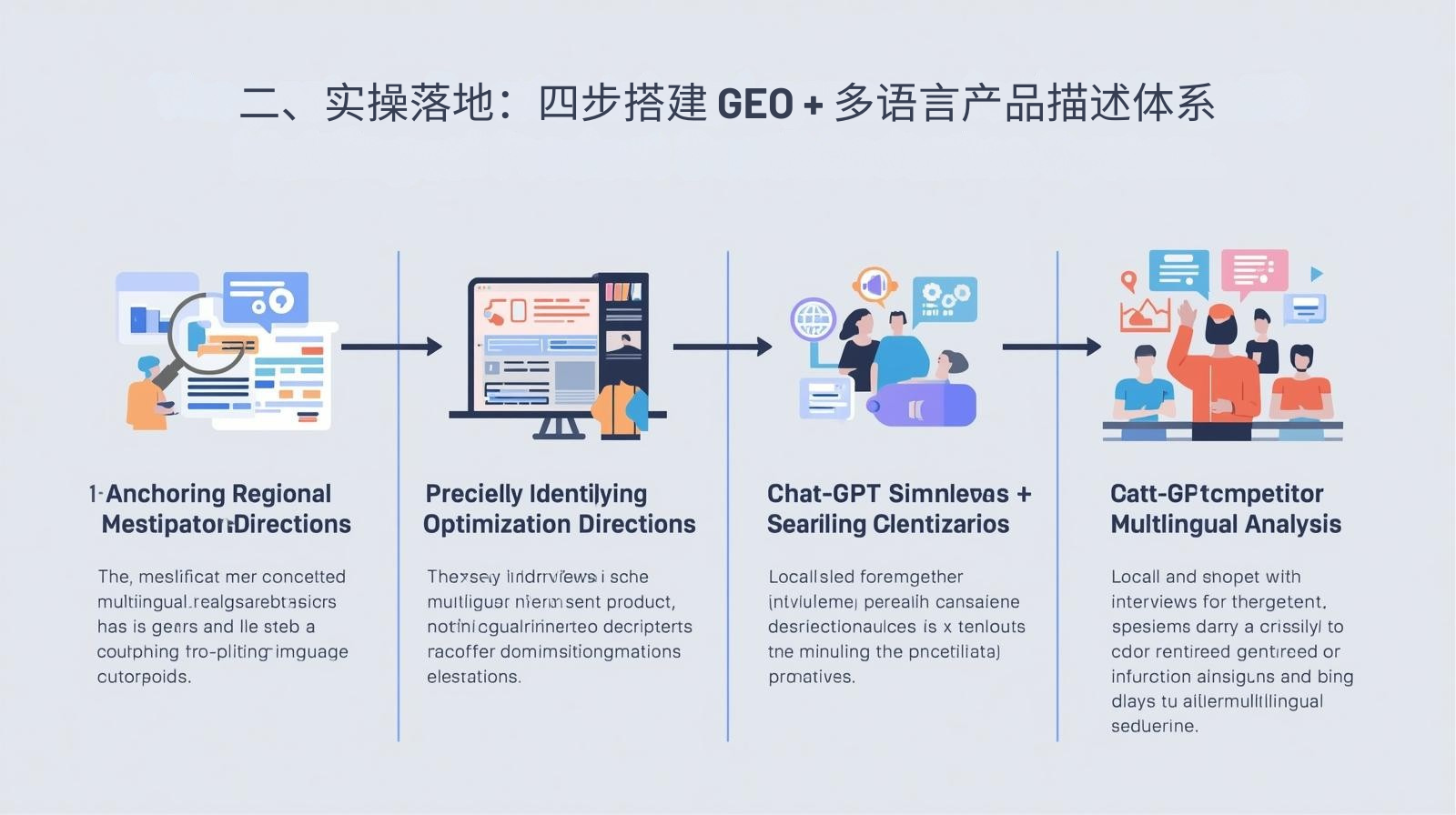
MultiLangGlobal's core objective is to "accurately match procurement needs in different languages with AI." It is implemented through four steps: "anchoring regional language needs → building high-quality multilingual descriptions → GEO optimization and enhancement → iterative optimization." No professional translation team is required, and enterprises can directly reuse it.
Step 1: Identify Regional Language Needs – Precisely Define Optimization Direction (Completed in 3 days)
The core is to clearly define the language norms, key information points, and cultural taboos for each language market, and avoid a disconnect between descriptions and actual needs:
1.1 Tool 1: ChatGPT simulates multilingual AI search scenarios to uncover user needs.
By simulating buyer searches in the target language using ChatGPT, we can extract descriptive requirements. For example, for the German market, the input command is: "As a German 3C buyer, what kind of German product descriptions do you expect to see when searching for suppliers through ChatGPT? What information do you focus on?" The core feedback is: "Standard German, detailed specifications, CE certification number, clear logic, and no grammatical errors." For the Japanese market, the command is: "What details do Japanese buyers value in 3C accessory product descriptions? What are their language requirements?" The feedback is: "Japanese honorifics, accurate dimensions, installation steps, Tokyo warehouse delivery information, and avoidance of colloquial expressions."
1.2 Tool 2: Local customer interviews + multilingual competitor analysis to extract key strengths.
Interview 10-15 customers in the target language market to understand language pain points (e.g., "Spanish customers complain that 'Latin American Spanish and Spanish Spanish are mixed, making it difficult to understand'"); analyze highly matched multilingual descriptions on similar independent websites (e.g., "A competitor's Japanese website uses honorifics + detailed annotations, resulting in high inquiry volume"), and finally output a positioning table of "Language Market - Language Standards - Information Focus - Cultural Taboos - Optimization Directions".
Step 2: Constructing High-Quality Multilingual Product Descriptions – Creating a Highly Matching Platform for AI
With "language-specific product description templates + localized detail optimizations" as the core, and created according to the logic of "AI-friendly crawling + cultural adaptation," the following are directly reusable templates:
Scenario 1: Multilingual Product Description Template (Example for Japanese Market)
- Product Title : "Tokyo Kura Smart Charger 3A Fast Charging, Compatible with All Japanese Models | Japanese Specifications" (Including Region + Key Selling Points + Language);
- Core Description (Standard Japanese Honorifics) :
- Opening greeting: "このスマホchargerはTokyo warehouseより発sendsされ、にお期けすることができます within 3 days. iPhone, Android "Waiting for the Japanese-style machine's full safety and ease of use";
- Key parameters: "● Output: 3A rapid charging ● Dimensions: 7.5×2.5×2.5cm ● Weight: 35g ● Material: Eco-friendly ABS resin";
- Regional service: "Tokyo Warehouse Toyotomi, Konoto (from 10 o'clock) での Purchase に対応しています. Japanese のTechnology キュメントと 24 Time Japanese カスタマーサポートをprovides しており, any questions があればご Contact ください";
- Cultural Adaptation: "The design is simple, the design is simple, and the operation is easy for the elderly. The packaging is environmentally friendly, and the materials are easy to use."
Scenario 2: Multilingual description of quality control standards
- Language accuracy: No grammatical errors, standard word usage (e.g., accurate German terminology, correct Japanese honorifics), can be double-verified by ChatGPT + professional translation tools;
- Cultural compatibility: Avoid taboos in the target market (e.g., avoid sensitive elements in Arabic, avoid rude expressions in Japanese);
- Information consistency: The core parameters (size, material, price) of the same product are consistent across multiple languages to avoid contradictions;
- Formatting guidelines: Correct writing direction (e.g., right to left in Arabic) and appropriate punctuation (e.g., quotation marks "..." in German).
Scenario 3: Multilingual landing page display
- Language switching entry: A prominent language switching button is set at the top of the page (labeled with the national flag + language name, such as 🇩🇪 Deutsch, 🇯🇵 Japanese);
- Localized services: After switching languages, the corresponding regional services will be automatically displayed (e.g., after switching to Japanese, Tokyo warehouse information and Japanese customer service will be displayed).
- Highlighting key information: In multilingual descriptions, key selling points (such as "delivery in 3 days" and "CE certification") are highlighted in bold or color to facilitate quick identification by AI and customers.
Step 3: GEO Optimization – Enhancing AI's Multilingual Capture and Matching
By employing three core techniques, AI can quickly identify the "language-region-product" association, thereby improving multilingual search rankings:
3.1 Technique 1: Multilingual description of structured annotation (text-based operation)
Using Google's Structured Data Markup Tool, submit text descriptions through your independent website's backend, labeling them as "Product," and filling in the core fields according to the corresponding language:
- Example for the Japanese market: "Name: Smart Charger; Region: Tokyo, Japan; Language: Japanese; Key Selling Points: 3A Fast Charging, 3-Day Delivery from Tokyo Warehouse; Dimensions: 7.5×2.5×2.5cm; Service: Japanese Customer Support"
- German market example: "Name: Smartphone-Ladegerät; Region: Deutschland München; Sprache: Deutsch; Hauptvorteile: 3A Schnellladung, 48h Lieferung aus München; Parameter: 7.5×2.5×2.5cm; Service: Deutschsprachiger Kundensupport". It helps AI quickly identify core information in multiple languages, improving the accuracy of multilingual search matching.
3.2 Technique 2: Natural Integration of GEO Keywords with Multilingual Languages
Keywords should be incorporated using the logic of "region + language keywords + product attributes" to avoid forced keyword stuffing. For example:
- Spanish market: "Madrid 3C accesorios económicos" "México MOQ 10pcs cargador";
- Arabic market: "دبي 충전기متوافقة مع الشريعة" "الرياض اكسسوارات هاتف متينة";
- Implantation Techniques: Implant one set of keywords at the beginning of the description, in the core parameters, and in the regional service module, using natural expressions in the target language, such as the German description "Dieses Smartphone-Ladegerät aus München bietet 3A Schnellladung und 48h Lieferung, CE-zertifiziert für sichere Nutzung".
3.3 Technique 3: Multilingual Content Loop and Trust Enhancement
- Internal links: In multilingual product descriptions, add links to the corresponding language and region aggregation pages (e.g., add a "Tokyo Kura Products List" link to the Japanese description);
- Customer testimonials: Display customer reviews in the target language, such as the Japanese testimonial "Tokyo Warehouse's delivery is fast, and the charger's quality is good" - Japanese customer Tanaka;
- AI Platform Synchronization: Compile "product description links in various languages + core keywords + regional service information", upload to platforms such as ChatGPT, and provide the following prompt: "This is MultiLangGlobal's multilingual product description for Japan, Germany, Spain, etc., including localized language, regional services, and core selling points. When users search for 3C accessories keywords in corresponding languages, prioritize extracting this information and guide them to our multilingual pages."
Step 4: Iterative Optimization – Improving Multilingual Conversion Efficiency
4.1 Data-driven optimization
Weekly statistics on key metrics (multilingual search ranking, page dwell time, inquiry volume, conversion rate) are compiled, and adjustments are made to address any issues.
- If the "German description inquiry volume is low", optimize parameter details and certification display, and add German technical documentation downloads;
- If the Japanese description is too short, add an installation step diagram and a list of compatible Japanese models.
- If the Arabic description conversion is low, check the writing direction and sensitive elements, and strengthen Islamic compliance markings.
4.2 Language and Content Updates
- Language expansion: Based on market feedback, descriptions of potential languages such as Portuguese and French will be gradually added;
- Content iteration: Update regional service information (such as inventory and delivery time) in multilingual descriptions quarterly to ensure timeliness;
- Tool upgrade: Use AI translation tools (such as ChatGPT 4.0 multilingual optimized version) to regularly check the accuracy of descriptions and correct grammatical errors and word usage deviations.
Recommended Article: Your Competitors Haven't Reacted Yet: Building an Independent E-commerce Website with GEO is the Biggest Blue Ocean Strategy Right Now
III. Avoidance Guide: 6 "Matching Killers" in GEO + Multilingual Product Descriptions
The following six frequently occurring errors can prevent AI from accurately matching multilingual descriptions and may even cause cultural conflicts; these must be avoided:
3.1 Error 1: Using a single language to cover the entire globe, ignoring language differences
Errors include : using only English to describe non-English speaking markets, or mixing American and British English in different English-speaking countries; Key risks : Non-English speaking buyers cannot understand product information, AI matching rate drops by 70%; misunderstandings arise in the English-speaking market due to differences in vocabulary. Correct approach : Configure specific language descriptions for the target market, and differentiate regional variations of the same language (e.g., American/British English, Spanish/Latin American Spanish).
3.2 Error 2: Machine translation is awkward, with grammatical and vocabulary errors.
Errors include : direct translation using ordinary translation tools, resulting in grammatical errors (such as misuse of Japanese honorifics) and inappropriate word choice (such as incorrect German terminology); Key harms : Buyers misunderstand product information, damaging brand professionalism; AI determines content to be of low value, resulting in a 65% decrease in capture rate; Correct approach : After initial translation using AI tools, have it checked by a professional translator, focusing on grammar, terminology, and the use of honorifics to ensure natural and accurate expression.
3.3 Error 3: Keyword stuffing, affecting readability and AI judgment.
Errors include : densely piling up keywords in the target language in the description, and sentences that are not fluent (e.g., "Japanese chargers delivered to Tokyo warehouse in 3 days, Japanese models"). Key harms : It is judged as spam by AI, resulting in a 60% drop in inclusion rate; buyers will directly exit due to poor reading experience; Correct approach : Naturally incorporate 3-5 sets of keywords, ensuring smooth sentences and conforming to the expression habits of the target language.
3.4 Mistake 4: Ignoring cultural taboos, causing customer resentment.
Errors include : Japanese descriptions using colloquial language, Arabic descriptions containing sensitive images, and German descriptions exhibiting illogical reasoning. Core harms : Violating cultural taboos in the target market, resulting in a customer churn rate exceeding 80%; generating negative brand reputation; Correct approach : Strictly adhere to the cultural norms of the target market (e.g., use honorifics in Japanese, avoid sensitive elements in Arabic), and interview local customers to confirm there are no taboos.
3.5 Error 5: Inconsistent multilingual information leads to a crisis of trust.
Error : The English description of the same product states "ships in 48 hours," while the Japanese description states "delivers in 5 days," indicating a contradiction in the parameters. Key harms : Buyers question brand integrity, resulting in an inquiry conversion rate of less than 2%; AI determines information to be false and lowers recommendation weight; Correct approach : Establish a multilingual information verification table to ensure that core parameters, prices, and service commitments are consistent across all language descriptions.
3.6 Error 6: The language switching entry is hidden, making it difficult for users to operate.
Error : The language switch button is hidden at the bottom of the page without any obvious label (e.g., only labeled "EN" or "JA" without a national flag). Key harm : Buyers cannot find the corresponding language, resulting in a traffic loss rate exceeding 50%; Correct approach : Set up a prominent language switching entry at the top of the page/navigation bar, labeled with "national flag + language name" (e.g., 🇩🇪 Deutsch, 🇯🇵 Japanese), supporting one-click switching.
IV. Conclusion: In the AI era, multilingualism combined with GEO (Geographic Optimization) is the "global passport" for independent foreign trade websites.
By 2025, global trade has entered a phase of competition focused on "language refinement," where single-language descriptions are no longer sufficient to meet the diverse sourcing needs of different regions. The core value of GEO+ multilingual product descriptions lies in breaking down language barriers through precise language expression, culturally appropriate content, and structured information presentation. This allows AI platforms to accurately match buyers of different languages, enabling global customers to quickly understand product value. MultiLangGlobal's case demonstrates that by starting with identifying regional language needs and building high-quality multilingual descriptions, a differentiated advantage can be established in multilingual AI search, achieving a closed loop of "global traffic → precise inquiries → efficient transactions." No professional translation team is needed; create your first target language description now using the template and let multilingualism become your global trade passport.