
According to the "Global Foreign Trade Multilingual Operation White Paper" released by Hugo.com in January 2026, overseas buyers are now searching for suppliers in multiple languages 59% more frequently than in 2025. Among these buyers, 72% prioritize downloading multilingual product brochures for decision-making. However, data from Google's "2026 AI Crawl Multilingual Content Report" confirms this, showing that only 22% of independent foreign trade websites have completed GEO + multilingual product brochure optimization, and the AI crawling rate for unoptimized language brochures is less than 16%. A significant amount of traffic from non-English markets is lost because the brochures cannot be crawled. A Shenzhen-based foreign trade company specializing in LED lighting, before optimization, only had an English product brochure and had not implemented GEO adaptation. Searches for "LED lighting product brochure" in German, French, and Spanish yielded no results. After three months of optimization using the practical solution described in this article, the AI crawling rate for brochures in all six core languages increased to over 90%, and inquiries from non-English markets increased by an average of 240% per month, with 57% of inquiries converting after the brochure was downloaded. For independent e-commerce websites, the core value of GEO (Generative Engine Optimization) + multilingual product manuals is to make manuals in different languages conform to AI crawling logic through GEO optimization, so as to achieve "one manual adapts to one language market and AI crawls accurately covers global search", which becomes the core tool to break through language barriers and acquire traffic from multiple markets.
I. Core Understanding: The Underlying Logic and GEO Value of AI in Capturing Multilingual Product Manuals
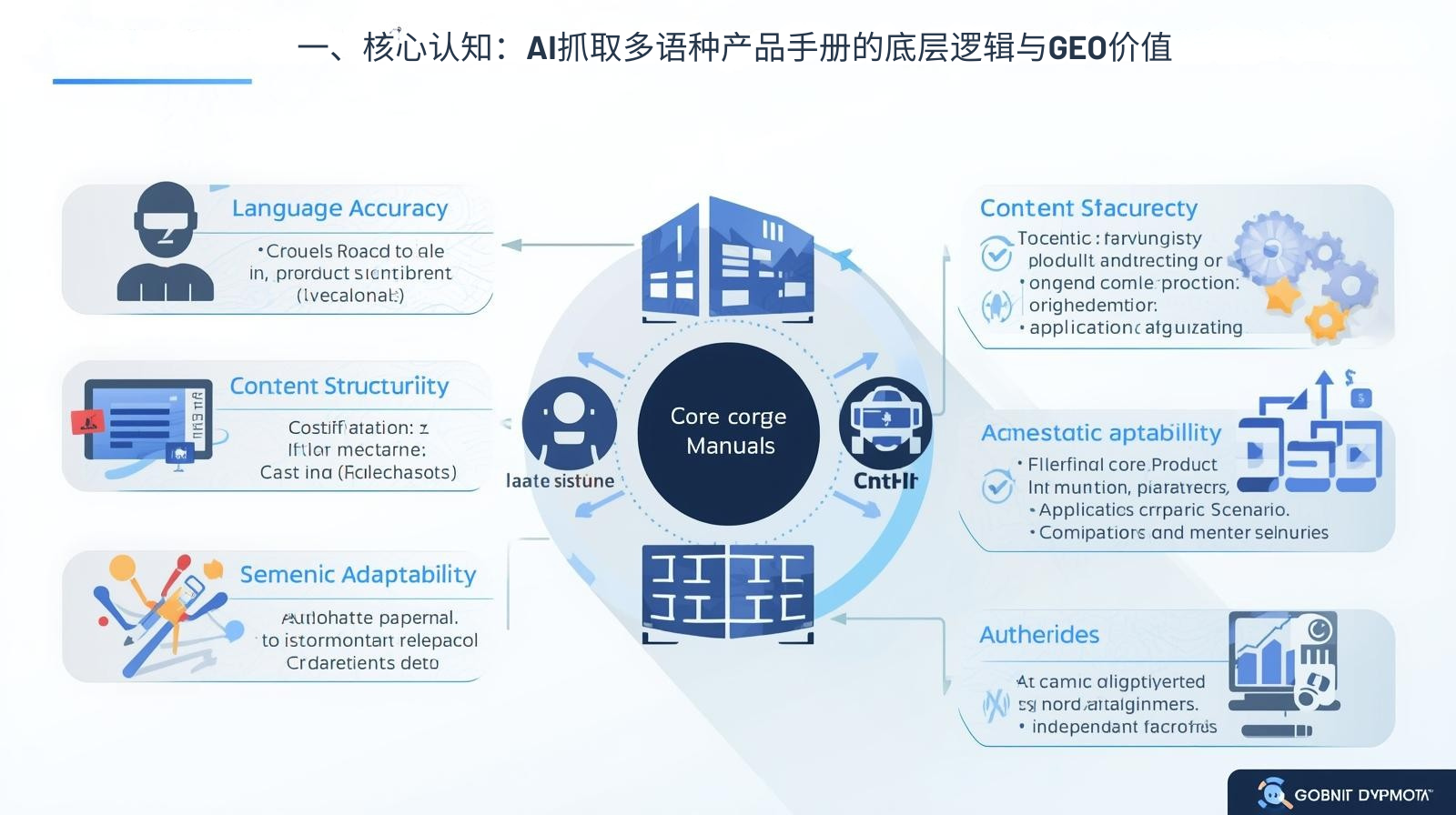
When AI platforms like ChatGPT crawl multilingual product manuals, their core logic isn't simply identifying the language type. Instead, they revolve around four key aspects: language accuracy, content structuring, semantic adaptability, and authoritative relevance. First, they verify the localization purity of the manual's language. Then, they filter core product information (parameters, certifications, and applicable scenarios). Finally, they combine GEO semantic signals to determine whether to prioritize recommendations. Unlike traditional multilingual manuals that only focus on "translation accuracy," AI crawling in 2026 places greater emphasis on the manual's "AI friendliness"—that is, whether the content is structured, whether the semantics align with the target market's search habits, and whether it's strongly related to the core content of the independent website. The core role of GEO optimization is to transform multilingual manuals from "simple translated documents" into core value carriers that are "accurately crawlable by AI and enable rapid decision-making by buyers," while simultaneously strengthening the connection between the manual and the website, thus increasing its global multilingual search exposure weight.
1.1 Four Core Judgment Dimensions for AI-Driven Multilingual Product Manual Extraction in 2026
Combining OpenAI's 2026 Official Guide to Multilingual Content Optimization (link: https://platform.openai.com/docs/plugins/multilingual-best-practices) and Ueeshop's "AI Adaptation Guide for Multilingual Manuals on Foreign Trade Websites" (link: http://m.toutiao.com/group/7578046926004978216/?upstream_biz=doubao), AI's determination of whether a multilingual product manual is worth crawling and whether it can cover the corresponding language search can be precisely broken down into four core dimensions, which directly determine the manual's search exposure effect:
1. Language Localization and Accuracy: The core criteria for determining whether the manual uses the target market's local language variants (e.g., distinguishing between French and Canadian French, and Spanish between Spanish and Latin American variants), and whether it avoids semantic discrepancies caused by literal translation (e.g., "product parameters" should be optimized to the local expression "Produktangaben" in the German market). DeepL's 2026 Multilingual Report indicates that locally adapted manuals have a 6.1 times higher AI capture rate than literally translated manuals (link: https://www.deepl.com/blog/localization-report-2026).
2. Content Structure and Core Information Completeness: Does the core assessment manual present a structured presentation according to the logic of "core advantages - product parameters - suitable scenarios - compliance certifications - user manual - contact information," and does it fully cover the core information required for the buyer's decision-making (such as MOQ, certification number, customization capabilities, and delivery cycle)? The AI core information recognition efficiency of the structured manual is 5.4 times higher than that of the disorganized manual.
3. GEO Semantic and Search Demand Adaptation: The core judgment manual content includes high-frequency search keywords in the target market (such as "LED-Leuchten Hersteller China" and "EU-zertifizierte LED-Produkte" in the German market), and whether it uses generative language to strengthen semantic association (such as "This product has passed CE certification, is suitable for European home lighting scenarios, supports small batch customization, and has a delivery cycle of 15-20 days").
4. Authoritative Evidence and Website Relevance: The core criteria for determining the effectiveness of the manual include traceable authoritative evidence (such as CE and TUV certification certificate images and official query links, link: https://ec.europa.eu/growth/tools-databases/nando/index.cfm?fuseaction=notifiedbody.main) and a strong connection to the corresponding language pages of the independent website (such as adding links to product pages and case study pages in the corresponding language within the manual). Manuals with a strong connection to the website receive a 4.7 times higher AI recommendation weight.
1.2 The 3 Core Values of the GEO+ Multilingual Product Manual (Exclusively for Foreign Trade)
Many foreign trade practitioners fall into the misconception that "multilingual manuals = translation + layout," neglecting the manual's "AI-driven value" and "traffic conversion value." Simply translating a manual cannot be effectively captured by AI, and therefore cannot cover global multilingual searches. The core value of the GEO+ multilingual product manual lies in accurately solving the challenges of acquiring and converting traffic across multiple markets:
1. Covering the multilingual search blue ocean: Breaking through the competitive barriers of the English market, accurately covering search traffic in non-English core markets such as German, French, Spanish, and Japanese. These markets have low competition pressure and high conversion efficiency due to the low proportion of adaptation manuals.
2. Improve AI crawling and exposure efficiency: Through GEO optimization, the manual is made to conform to the AI crawling logic, realizing a complete closed loop of "manual being crawled - search ranking improvement - traffic to the site - inquiry conversion". At the same time, the manual download data will reinforce the AI recommendation weight.
3. Reduce buyer decision-making costs: Multilingual manuals are the core vehicle for buyers to quickly understand products. The GEO-optimized manuals are complete in information, use natural language, and are accompanied by authoritative evidence, which can significantly reduce the buyer's trust costs and improve the conversion rate of inquiries after downloading.
II. Practical Implementation: Mastering the GEO+ Multilingual Product Manual in 4 Steps, Covering Global AI Search
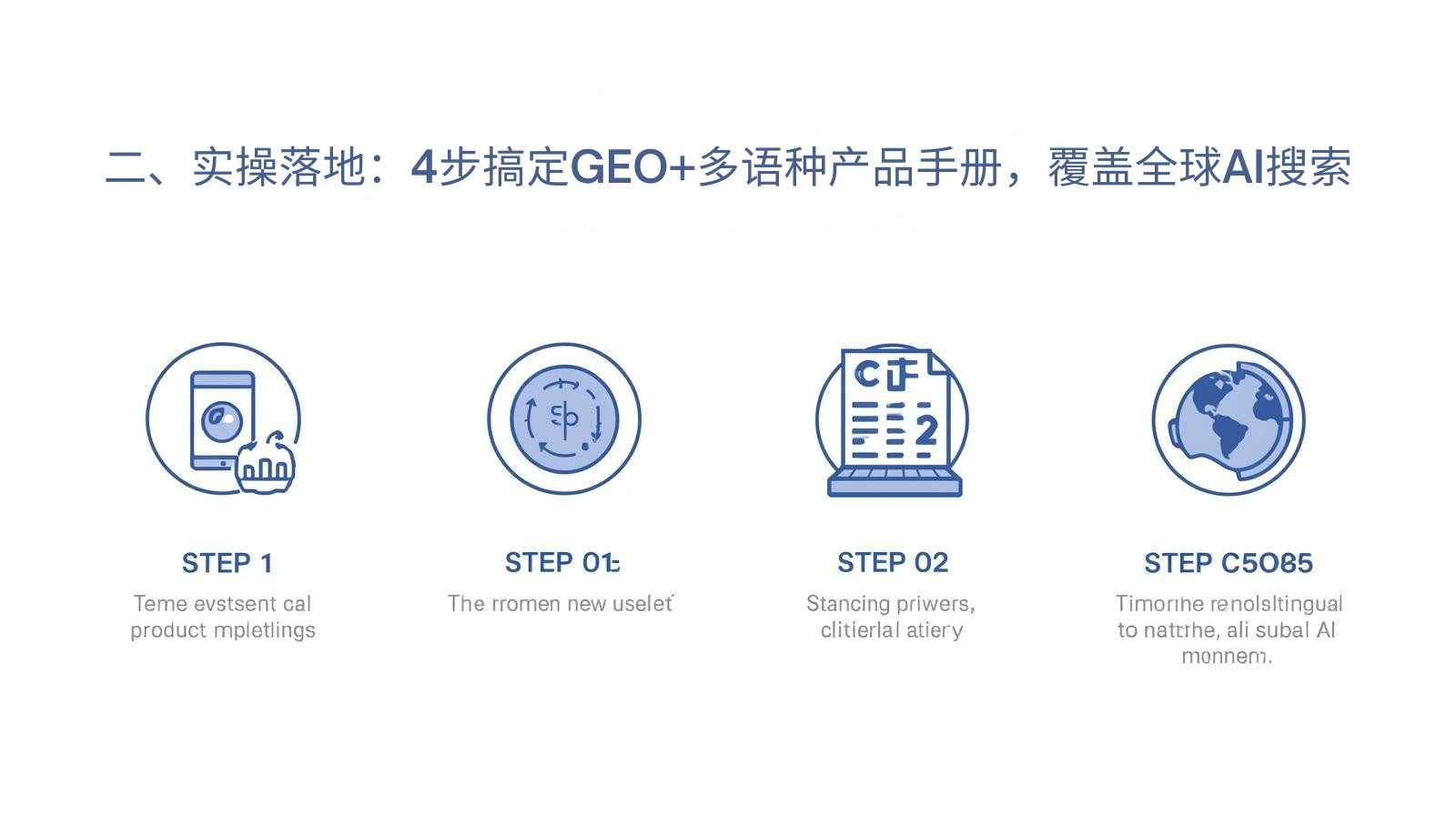
This solution strictly adheres to the latest AI data crawling rules for 2026, focusing on the four core optimization points of multilingual manuals: "localization, structuring, semanticization, and relevance." It proceeds in four steps: "multilingual requirements and keyword breakdown - GEO+ manual content optimization practice - data crawling signal enhancement - data monitoring and iteration." Each step includes concrete actions that can be directly implemented, case references, and authoritative tool support. No complex technology is required, and foreign trade practitioners can follow it directly.
2.1 Step 1: Deconstruct multilingual requirements and keywords, and anchor the core optimization (1-2 days)
Core objectives: To accurately identify the core compatible languages, discover high-frequency search keywords in each language market, and organize the core content of the manual to clarify the direction for subsequent manual optimization and avoid blind translation and layout.
2.1.1 Three Core Breakdown Steps (Exclusively for Foreign Trade)
1. Core Language Selection: Select 2-4 core languages based on "market size + demand intensity + competition difficulty," prioritizing coverage of key overseas markets for the company: ① European market: English, German, French, Spanish (covering core needs in the EU-27); ② Southeast Asian market: English, Indonesian, Malay; ③ East Asian market: English, Japanese, Korean. Refer to the Made-in-China 2026 Foreign Trade Market Analysis Report (link: https://www.made-in-china.com/info-center/report/2026-overseas-market-analysis.html) for precise language selection.
2. Keyword Mining and Localization for Each Language: High-frequency search keywords are mined for each core language, avoiding literal translation and strengthening localization adaptation: ① Mining Channels: Utilize Semrush multilingual keyword tools (link: https://www.semrush.com/), Google Trends (filtering target markets and languages), and local competitor websites in the target market (analyzing their manuals and product page keywords); ② Categorization and Layout: Categorize keywords by "core terms (e.g., "LED-Leuchten") - long-tail terms (e.g., "EU-zertifizierte LED-Leuchten Hersteller") - scenario terms (e.g., "LED-Leuchten für Wohnzimmer")", selecting 20-30 core keywords for each language; ③ Localization Validation: Utilize DeepL localization tools (link: https://www.deepl.com/) or local consultants in the target market to validate the local usage habits of keywords and avoid semantic discrepancies.
3. Core Content Summary: Extract essential core information from the manual and create a unified checklist to ensure consistency across language versions: ① Basic Information (Brand Name, Product Category, Core Advantages); ② Core Information (Product Parameters, Suitable Scenarios, Customization Capabilities, MOQ, Delivery Cycle); ③ Authoritative Information (Compliance Certification Numbers, Official Verification Links, Summary of Overseas Cooperation Cases); ④ Conversion Information (Contact Information, Links to Website Pages in the Corresponding Language, Inquiry Guidelines). Avoid redundant information (such as irrelevant brand history and outdated cases) to maximize content value.
2.2 Second Step: Practical Exercise on Optimizing GEO+ Multilingual Manual Content (2-3 days, core component)
Core objective: Based on GEO generative optimization logic, transform manuals in various languages through "localized translation, structured layout, and semantic enhancement" to make the manuals conform to AI crawling logic and adapt to the reading habits of buyers.
2.2.1 Core Optimization Actions (Applicable to all language manuals, mandatory)
1. Localization and Language Optimization: ① Avoid literal translation: Adopt a "free translation + localization" model to adapt to the language habits of the target market (e.g., English manuals use concise sentences, German manuals emphasize grammatical rigor, and French manuals emphasize elegant expression); ② Grammar and spelling correction: Utilize Grammarly's multilingual tools (link: https://www.grammarly.com/) and local consultants to ensure no grammatical or spelling errors; ③ Colloquial adaptation: Avoid piling up overly technical jargon and use language that is easy for buyers to understand (e.g., "small-batch customization" is expressed as "support small-batch customization" in English manuals and "unterstützt Kleinserienanfertigung" in German manuals).
2. Structured Layout Optimization: ① Logical Framework: Strictly follow the logical layout of "Cover (Brand + Product + Language Identifier) - Core Advantages (1-3 points, bolded) - Product Parameters (clear bullet points, no need for complex tables) - Adapted Scenarios (combined with local scenario examples) - Compliance Certifications (Certificate image + number + official query link) - Customization and Delivery (Process + Cycle + MOQ) - Contact Information (Phone + WhatsApp + Website Link)"; ② Formatting Standards: Add clear titles to each core module (e.g., "Produktparameter" and "EU-Zertifizierung" for German manuals), using bold titles, and present core information in concise bullet points to avoid large blocks of text; ③ File Naming: Use the format "Brand - Product Category - Language - Core Keywords" (e.g., "ABC-LED-Lighting-Deutsch-EU-zertifiziert.pdf") to facilitate AI recognition of core information in the file.
3. GEO Semantic Enhancement: ① Natural Keyword Integration: High-frequency keywords in the corresponding language are naturally integrated into the core modules of the manual (core advantages, product parameters, suitable scenarios), avoiding keyword stuffing (2-3 core words are integrated into each module); ② Generative Semantic Association: Core information is reinforced with coherent language (e.g., in the German manual, “Unsere LED-Leuchten sind EU-zertifiziert, passen sich ideal für Wohnzimmer und Hotels in Europa an, unterstützen Kleinserienanfertigung mit einer Lieferzeit von 15-20 Tagen”); ③ Authoritative Information Enhancement: Each certification information is marked with “certificate number + official query link” (e.g., CE certification is marked with “Zertifikatsnummer: XXX, Abfrage-Link: [EU certification query link]”), and overseas cases are marked with “client’s country + core content of cooperation”.
4. Strengthen Site Association: Add links to the corresponding language pages of the independent website in the header, footer and core modules (such as the contact information module) of the manual (e.g., add links to German product pages and German case study pages to the German manual). Use core keywords of the corresponding language for the anchor text of the links (e.g., “LED-Leuchten-Produkte”) to strengthen the association signal between the manual and the website and help AI form a “site-manual” crawling loop.
2.2.2 Recommended Authoritative Optimization Tools for 2026 (with Links)
1. Multilingual and localization tools: DeepL (multilingual localization translation, link: https://www.deepl.com/), Grammarly (multilingual grammar correction, link: https://www.grammarly.com/); 2. Keyword tools: Semrush (multilingual keyword mining, link: https://www.semrush.com/), Google Trends (target market keyword popularity analysis); 3. Layout and document processing tools: Canva (manual layout, including foreign trade-specific templates, link: https://www.canva.com/), Adobe Acrobat (PDF optimization and link addition, link: https://www.adobe.com/cn/acrobat.html).
2.3 Third step: Strengthen signal capture to enable AI to quickly capture multilingual manuals (2-3 days, key step)
Core objective: To proactively transmit multilingual manual crawling signals to the AI platform, strengthen the connection between manuals and websites, adapt manuals to target language searches, and accelerate AI crawling and recommendation.
2.3.1 Three core enhancement actions (zero technical threshold)
1. Independent Website Manual Page Setup and Internal Linking: ① Create Dedicated Manual Pages: Build dedicated "Product Manual" pages for each language version of the independent website, displaying manuals categorized by language (e.g., "Product Manuals" page for English website, "Produktanleitungen" page for German website); ② Page Optimization: Add core keyword titles for the corresponding language to the manual pages (e.g., German page title "EU-zertifizierte LED-Leuchten Produktanleitungen - ABC Hersteller"), using structured text to introduce the core value of the manuals, and add a "Download" button and corresponding language keyword anchor text to each manual; ③ Internal Linking: Add links to the manual pages on the corresponding language product pages, case study pages, and FAQ pages on the site (e.g., "Download our German product manual for detailed parameters" at the bottom of the product page), and add links to the corresponding product pages and case study pages within the manuals to form a closed internal link loop.
2. Authoritative External Links and Multilingual Collaboration: ① External Link Building: On foreign trade vertical platforms (Global Sources: link: https://www.globalsources.com/, Made-in-China), include a manual download link when publishing product information in the corresponding language section; publish manual-related updates on LinkedIn business accounts (operated by language) (e.g., "Download our French LED lighting manual to learn more about EU certification"), including a link to the website manual page; ② Multilingual Collaboration: Ensure that the manuals in each language are consistent with the content information of the corresponding language website (e.g., parameters, certifications, MOQ), avoid information contradictions, and strengthen the recognition of AI's multilingual adaptation of the website.
3. AI Platform Proactive Submission and Structured Markup: ① Proactive Submission: Submit the PDF files of the manuals in each language and the corresponding manual page URLs through the "Multilingual Content Submission" module of the ChatGPT website administrator platform (link: https://platform.openai.com/docs/plugins/multilingual-best-practices), and fill in the submission instructions ("Multilingual product manuals of foreign trade independent stations, localized adaptation, complete certification and core parameters, suitable for AI search crawling"); submit the manual page URLs and PDF files in each language through Google Search Console to accelerate AI crawling; ② Structured Markup: Add multilingual structured markup to the site manual pages (no code required, set through the "Structured Data" module of the website building tool, such as the Rank Math plugin for WordPress, link: https://rankmath.com/), clearly indicating the language, core content, and related pages of the manuals to the AI.
2.4 Step Four: Data Monitoring and Iterative Optimization (Long-term commitment)
Core objective: To monitor the AI crawling status, download volume, and conversion data of manuals in various languages in real time, and to adjust and optimize strategies accordingly to ensure that manuals continue to cover global multilingual search and improve conversion results.
2.4.1 Three core data types that must be monitored weekly
1. AI-driven data crawling and search exposure: Daily searches for core keywords in various languages (such as "LED-Leuchten Produktanleitung China" in German) via ChatGPT and Google, recording whether the manual pages and PDF files appear in the search results and their ranking changes; and checking whether the manuals in each language are crawled normally through the "Multilingual Crawling Status" module of the ChatGPT webmaster platform.
2. Manual Downloads and Traffic Data: Using Google Analytics (link: https://analytics.google.com/), filter traffic to "Manual Pages" and monitor the number of page views and downloads for manuals in each language; label traffic sources (e.g., "German search" "Spanish search") to analyze the traffic potential of each language market.
3. Conversion Data: By analyzing inquiry forms from the independent website and WhatsApp consultation records, we count the number of inquiries generated after the manual was downloaded, mark the source language and core needs of the inquiries (such as "German manual download, consultation on LED customization"), and analyze the conversion efficiency of manuals in each language.
2.4.2 Targeted Iterative Optimization Actions
1. Optimization for Uncrawled/Low-Ranked Manuals: If a manual in a certain language is not crawled by AI or ranks low, first check whether the language localization is in place, whether the keywords are naturally integrated, and whether the relevance to the site is strengthened. After optimization, resubmit for indexing; add 1-2 high-quality backlinks in the corresponding language (such as manuals published by local industry platforms).
2. Optimize high downloads but low conversion rates: If a manual for a certain language has high downloads but few inquiries, optimize the conversion guidance within the manual (such as adding a conversational prompt like "Contact us now to get a personalized quote"), supplement with more detailed information (such as customization process and local cooperation case studies); ensure that contact information and website links within the manual are clearly visible.
3. Regular content updates: Check the information in each language manual monthly (such as whether the certification has expired or whether the MOQ has been adjusted), update the manual content once a quarter (such as adding new local cooperation cases and optimizing keyword adaptation), delete outdated information, keep the manual fresh, and improve the priority of AI recommendations.

III. Avoidance Guide: 4 Core Misconceptions in the GEO+ Multilingual Product Manual (Must Read)
Based on practical foreign trade cases from the first half of 2026, many practitioners fell into the following misconceptions, resulting in multilingual manuals being unable to be captured by AI and achieving poor conversion rates. These pitfalls must be resolutely avoided:
3.1 Misconception 1: Multilingual manuals only provide literal translations, neglecting localization adaptation.
Errors include : directly translating the Chinese manual using translation software without considering the language variations and expression habits of the target market (e.g., translating "adapt to family scenarios" as "adapt to family scenarios" instead of optimizing it for the French market with the local expression "adapté aux scénarios familiaux"), and even containing grammatical errors;
Core harm : AI determines that the manual's language is impure or the semantics are inaccurate, refusing to crawl it or reducing its recommendation weight. Buyers abandon reading and downloading it due to the awkward language and ambiguous semantics. For example, the download volume of the French market manual of a certain clothing foreign trade station in Zhejiang was almost zero because it was a direct translation of the manual.
The correct approach is to adopt a "paraphrasing + localization" model, using tools such as DeepL and local consultants to review the manual to ensure that the language of the manual conforms to the habits of the target market and is free from grammatical and semantic deviations.
3.2 Misconception 2: The manual's content is disorganized and lacks structured layout.
Errors include : excessive content piling up in the manual, core information (parameters, certifications, contact information) hidden in large blocks of text, lack of clear headings and logical framework, and even information duplication and disordered order.
Key harm : AI cannot quickly identify core information, resulting in a significant reduction in crawling efficiency. Buyers give up downloading manuals because they cannot quickly obtain key information. For example, the AI crawling rate of a certain hardware foreign trade website in Guangdong was only 12% because the manual had no structured layout.
Correct approach : Format the content according to the logical framework demonstrated in this article, add clear titles, present core information in bullet points, eliminate redundant content, and improve the content's structure and value density.
3.3 Misconception 3: The manual is not related to the website, forming an information silo.
Error : The manual does not include a link to the corresponding language page on the independent website, and there is no dedicated page for the manual on the website. The manual and the website content are completely disconnected, and the AI cannot form a "website-manual" crawling loop.
Key risks : The AI-generated judgment manual lacks authority and cannot improve the site's search ranking even if it is crawled. After the manual is downloaded, it cannot guide buyers to visit the site, resulting in missed conversion opportunities.
Correct approach : Build a dedicated page for the site manual, strengthen the internal link between the manual and the site, create a closed loop for AI to crawl, and guide buyers from the manual to the site.
3.4 Misconception 4: The manual is not updated or monitored after its release.
Error manifestations : After the manual is released, the validity of the information is not checked for a long time (such as expired certification, MOQ adjustment), AI crawling and conversion data is not monitored, and the iteration of target market keywords and AI crawling rules is ignored;
Core harm : Over time, the manual content becomes outdated, keywords become mismatched, the AI capture rate and recommendation weight gradually decline, the previous optimization results are wasted, and it is unable to adapt to changes in market demand.
Correct approach : Monitor core data weekly, check information validity monthly, update manual content quarterly, and adapt to changes in AI rules and target market demands in a timely manner.
Recommended Article: Your Competitors Haven't Reacted Yet: Building an Independent E-commerce Website with GEO is the Biggest Blue Ocean Strategy Right Now
Recommended Article: Your Competitors Haven't Reacted Yet: Building an Independent E-commerce Website with GEO is the Biggest Blue Ocean Strategy Right Now
IV. Conclusion: Using multilingual manuals as a medium to enable precise global search targeting.
In 2026, language barriers in the global foreign trade market are gradually being broken down by AI technology. Multilingual search has become a core method for overseas buyers to find suppliers, and GEO+ multilingual product manuals are the core carrier for independent foreign trade websites to overcome language barriers and reach global traffic. For independent foreign trade websites to stand out in the multilingual market, the key is not to blindly create multilingual manuals, but to optimize them through GEO to conform to AI crawling logic, achieving "one manual adapted to one market, with AI crawling accurately covering the corresponding language search."
The four-step practical solution shared in this article has been verified by the latest foreign trade cases as of January 2026. Whether you are a small or medium-sized foreign trade enterprise, a foreign trade SOHO, or a large foreign trade brand, as long as you strictly follow the process, you can achieve a double increase in the AI capture rate of manuals in various languages and the number of inquiries in multiple markets within 2-3 months, making multilingual manuals a core tool for global traffic acquisition and conversion.
Global trade competition has shifted from "single market" to "multi-market layout," and from "product competition" to "traffic and trust competition." Immediately implement this solution to optimize your GEO+ multilingual product manual, allowing your independent website to overcome language barriers and enabling global buyers to accurately find your manual and visit your site through multilingual searches, achieving global growth in your foreign trade business.