
According to Google's "New Global B2B Sourcing Behavior Report" released in January 2026, 61.8% of overseas buyers currently rely on AI platforms such as ChatGPT to complete the entire decision-making process from supplier selection to repeat purchases. Among them, independent foreign trade websites that can achieve "AI-precise matching + full-link demand response" through GEO optimization have a 72% higher customer retention rate and a 58% higher repurchase rate than traditional websites. The decision-making chain of overseas procurement (demand confirmation - supplier selection - price comparison - cooperation fulfillment - repeat purchase and retention) is being reconstructed by AI. ChatGPT has been upgraded from a "search tool" to a "dedicated decision-making assistant" for buyers. However, only 13% of independent foreign trade websites have completed the adaptation and optimization of GEO with the entire procurement chain. Most websites suffer from customer churn rates exceeding 60% during the price inquiry stage due to fragmented information, untimely response, and insufficient regional adaptation. A Shenzhen-based new energy foreign trade company optimized its entire procurement process using GEO in December 2025. This enabled ChatGPT to accurately deliver content tailored to customer needs, resulting in a 45% increase in inquiry conversion rate and a 32% increase in repeat purchases from existing customers within three months. This case demonstrates the core logic: GEO optimization essentially enables AI to understand the needs across the entire procurement process. Through structured, localized, and scenario-based content output, ChatGPT provides comprehensive support for customer decision-making, ultimately achieving continuous conversion from initial inquiries to long-term repeat purchases.
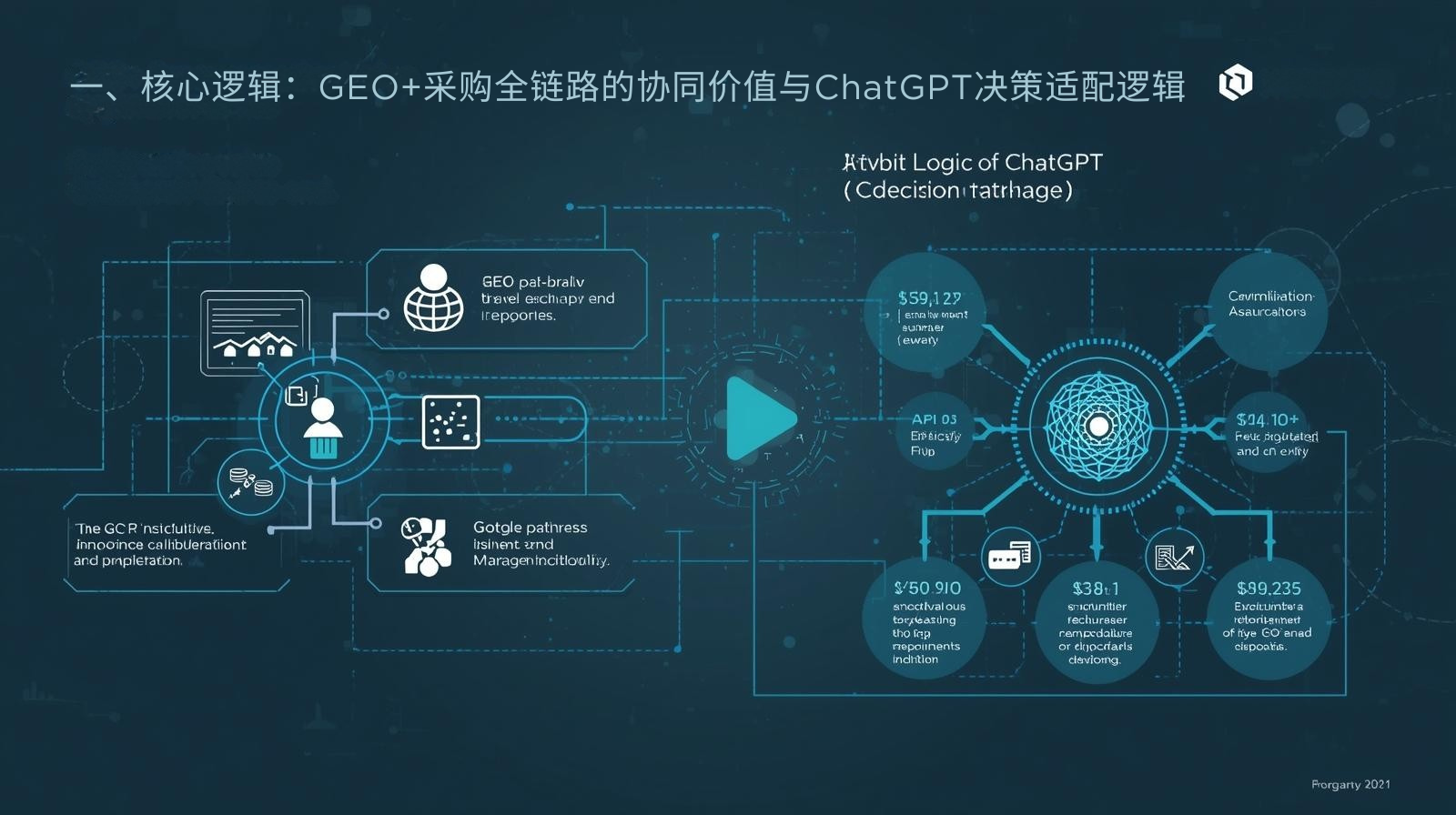
I. Core Logic: The Collaborative Value of GEO+ Procurement End-to-End and the Adaptation Logic of ChatGPT Decision Making
The entire procurement process in foreign trade is characterized by long cycles, detailed needs, and high trust requirements. AI platforms like ChatGPT empower procurement decisions by shortening the decision-making cycle through "deep understanding of needs + accurate information matching + efficient response to inquiries." The core value of GEO optimization lies in transforming product information, service processes, and trust endorsements from independent websites into structured signals that AI can recognize and that buyers can quickly perceive. This precisely adapts to the needs of customers in different regions and at different stages of the decision-making process, aligning perfectly with the core foreign trade trend of "AI-driven procurement efficiency improvement and end-to-end experience determining repeat purchases" in 2026.
1.1 ChatGPT's Three Core Logics for Accompanying the Entire Procurement Process (Latest 2026)
Based on ChatGPT's foreign trade procurement scenario interaction data, OpenAI's enterprise-level search optimization guidelines, and analysis of overseas buyers' decision-making behavior, the core logic of AI-assisted procurement across the entire process can be broken down into three points that directly determine whether a customer can move from inquiry to repeat purchase:
1. In-depth demand breakdown and precise matching : ChatGPT can break down core demands (region: Europe, category: photovoltaic energy storage equipment, procurement mode: small batch, compliance requirements: CE certification) through the natural language description of the buyer (such as "looking for photovoltaic energy storage equipment suitable for the European market, supporting small batch purchases, and having CE certification"), and filter matching independent website content from the entire network; if the independent website has clearly marked structured information such as regional adaptability, procurement mode, and compliance qualifications through GEO optimization, it will become the core target of AI priority recommendation, with a matching accuracy 4.8 times higher than that of non-optimized sites.
2. End-to-End Information Integration and Question Response : Buyers have different questions at each stage of the decision-making process (screening-inquiry-fulfillment-repurchase). ChatGPT will proactively integrate the end-to-end information from the independent website to provide customers with one-stop answers. For example, during the screening stage, compliance qualifications and product advantages are pushed; during the inquiry stage, the price range and cooperation process are pushed; during the fulfillment stage, logistics timeliness and after-sales guarantee are pushed; and during the repurchase stage, new product information and benefits for old customers are pushed. Websites with fragmented information that cannot form a chain will cause AI to be unable to fully respond to customer questions, resulting in a significant increase in customer churn rate.
3. Localized Needs Adaptation and Trust Enhancement : ChatGPT prioritizes pushing supplier information tailored to the local market based on the buyer's geographical attributes. Core adaptation dimensions include regional compliance standards (such as EU CE, US FDA), local services (overseas warehouses, local customer service), and payment and logistics (local payment methods, delivery time). At the same time, AI will prioritize recommending sites with authoritative trust endorsements (certification qualifications, customer cases, third-party evaluations). Customer trust in these sites increases by 82%, and repurchase intention is significantly higher than that of sites without trust endorsements.
1.2 The Two-Way Empowerment Logic of GEO and the Entire Procurement Chain
The core of GEO optimization is "enabling AI and customers to quickly find solutions for end-to-end needs," while the core of the entire procurement chain is "meeting every core customer requirement from selection to repeat purchase." The two mutually empower each other, building the core competitiveness of independent foreign trade websites in the AI era. The core logic is reflected in three points:
1. GEO makes end-to-end information "AI-recognizable and customer-perceptible": Procurement end-to-end information without GEO optimization is mostly fragmented text, making it difficult for AI to quickly extract core needs, and requiring customers to repeatedly browse to find key information. By using GEO to structure end-to-end information according to "decision-making stage + regional needs + core needs," ChatGPT can quickly capture and accurately push information. For example, the generalized message "Welcome to inquire" in the inquiry stage can be optimized to "EU market photovoltaic energy storage equipment inquiry channel, supporting small-batch purchases (MOQ≥50), providing a quotation within 24 hours, with CE certification number (CE-2026-XXX) and official query link: https://ec.europa.eu/ecip/", which is both AI-friendly and can quickly respond to core customer needs.
The entire procurement chain makes GEO optimization "more targeted and effective": The value of GEO optimization ultimately translates into customer conversion. Every link in the procurement chain (screening, inquiry, fulfillment, and repeat purchase) is a high-quality scenario for GEO optimization. Optimizing content around the customer pain points at each link can directly translate GEO results into customer retention and repeat purchases. For example, regarding customers' concerns about logistics timeliness in the fulfillment stage, GEO optimization can push structured content such as "direct shipping from German overseas warehouses, delivery time within the EU in 3-5 days, full logistics visibility, and 24-hour response to abnormal situations," which can significantly reduce customer concerns and increase the willingness to repurchase.
The two work together to maximize customer value throughout the entire lifecycle: GEO optimization ensures that ChatGPT can accurately push the information needed by customers at every stage of the entire procurement process, shortening the decision-making cycle; the high-quality experience throughout the entire process allows customers to build trust from the first inquiry and gradually move towards repeat purchases, realizing the continuous mining of customer value; according to foreign trade AI conversion data in 2026, independent websites that achieve GEO + procurement full-chain collaborative optimization have shortened the customer decision-making cycle by 60% and have a repurchase rate 58% higher than single-optimized websites.
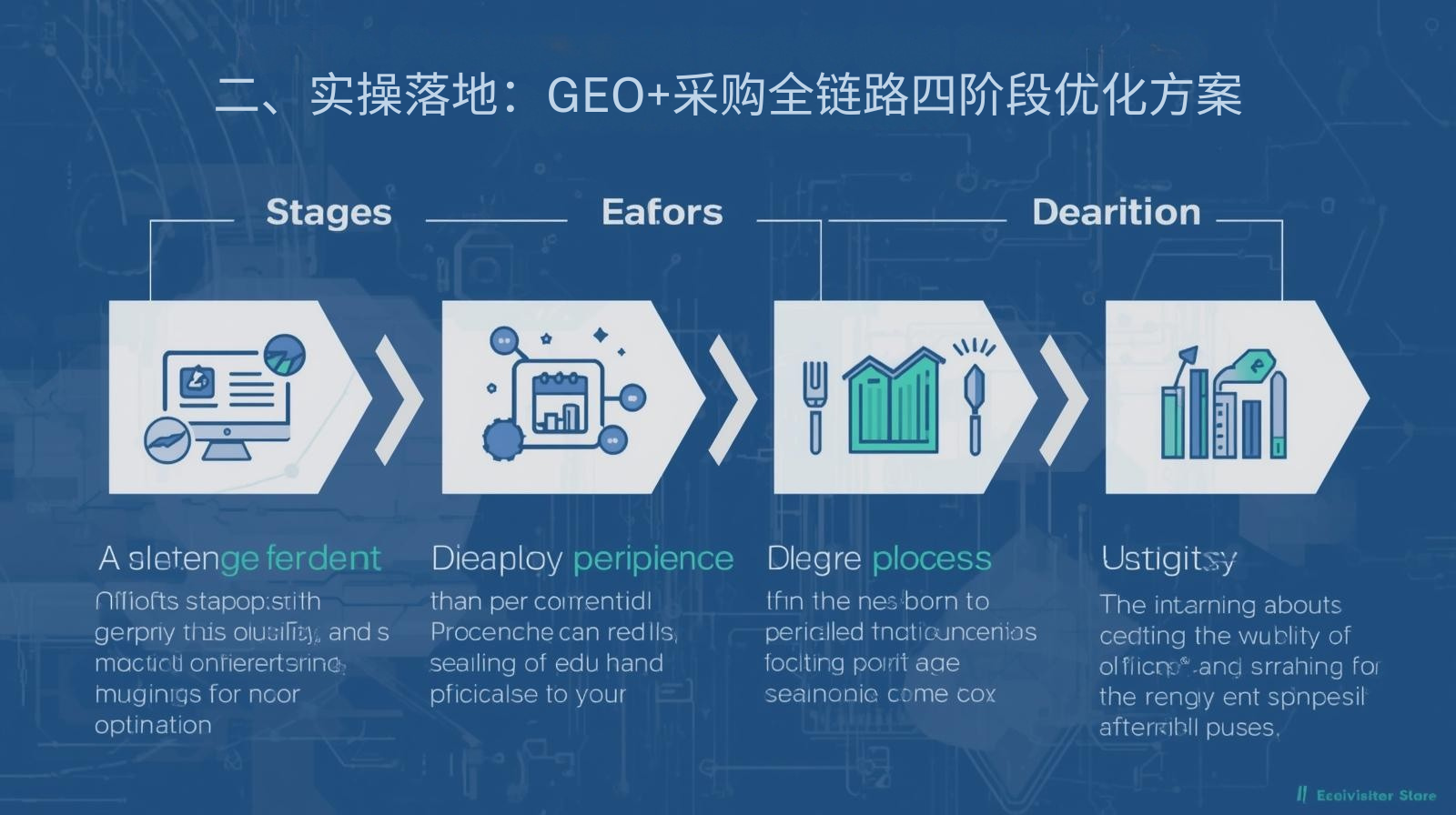
II. Practical Implementation: GEO+ Procurement End-to-End Four-Stage Optimization Solution (Direct Application)
This solution combines practical case studies from Shenzhen's new energy companies with Google's end-to-end procurement optimization guidelines. It also references ChatGPT's structured content capture standards and localization adaptation techniques. Based on the four core stages of procurement decision-making (screening, inquiry, fulfillment, and repurchase), it creates an end-to-end GEO optimization implementation plan to ensure that ChatGPT can accurately push core information at each stage, allowing customers to choose your brand throughout the entire process.
2.1 First Stage: Optimization of the Screening Stage – Let ChatGPT Recommend You First (Core: Precise Matching of Needs)
The screening phase is the first contact between the customer and the brand. The core goal is to get ChatGPT to prioritize your independent website when customers search for suppliers. The key optimization points are as follows:
1. Structured Labeling of Core Screening Information: Following GEO optimization requirements, the core concerns of clients when selecting suppliers (regional suitability, compliance qualifications, core product advantages, and procurement model) are structured and labeled to ensure rapid extraction by ChatGPT. Core labeling information includes: "Suitable Region: XXX (e.g., EU, USA, Middle East), Core Compliance Certifications: XXX (CE/FDA/SASO, label number and official query link), Core Product Advantages: XXX (e.g., photovoltaic energy storage equipment with a battery life ≥10 hours, supports fast charging), Procurement Model: XXX (small batch dropshipping/bulk purchase/MOQ≥XX)". For example, for new energy products suitable for the European market, the label could be: "Suitable Region: Germany, France, Italy, and other EU countries; Core Compliance Certifications: CE certification (number: CE-2026-E001), RoHS 2.0 certification (number: RoHS-2026-058), Query Link: https://www.sgs.com/zh-cn/report-verify Product core advantages: 10kWh photovoltaic energy storage capacity, supports EU standard fast charging, IP67 waterproof rating, procurement mode: supports small batch purchases (MOQ≥50), and enjoys a 30% discount for bulk purchases.
2. Natural Integration of Localized Keywords: Focusing on the core target market, strategically place GEO keywords combining "regional terms + product terms + filter terms" (e.g., "EU photovoltaic energy storage supplier," "US FDA-certified home appliance supplier," "Middle East small-batch furniture supplier"), naturally integrating them into the homepage title, product category pages, and core banner copy of the independent website; avoid keyword stuffing and ensure smooth sentence structure. For example, the homepage title could be set as "Focusing on EU/US new energy foreign trade, core supplier of photovoltaic energy storage equipment, complete CE/FDA certifications, supporting small-batch procurement and customized services."
3. Structured Display of Trust Endorsements: On the homepage of the independent website, authoritative trust endorsements (certifications, client case studies, third-party evaluations) are displayed in a structured manner. For example, "Clients: Fortune 500 companies such as Microsoft and Tesla (with client logos), Third-party evaluation: SGS Annual Excellent Supplier, Industry Honors: 2025 Cross-border New Energy Excellent Supplier"; verifiable information for these trust endorsements is also included, allowing ChatGPT to quickly establish trust with clients and improve recommendation ranking.
2.2 Second Stage: Optimization of the Inquiry Stage – Encouraging Customers to Inquire and Choose You (Core: Reducing Decision-Making Concerns)
The inquiry stage is a critical juncture for customer conversion. The core objective is to enable ChatGPT to accurately push inquiry-related information, reduce customer concerns about inquiries, and guide customers to proactively initiate inquiries. The key optimization points are as follows:
1. Clear and convenient inquiry channels: Establish prominent and consistent inquiry channels (WhatsApp floating button, online inquiry form, email inquiry portal) on the product pages, homepage, and detail pages of the independent website, and use GEO optimization to highlight "24-hour inquiry response, multilingual customer service support (English/German/Arabic, etc.)". Additionally, add the message "Inquire now and receive a detailed product manual + sample quotation" next to the inquiry channel to increase customer willingness to inquire. For example, add the following text to the product page: "Click the WhatsApp button on the right to inquire now, receive a quotation and product manual within 24 hours, and have a dedicated account manager for EU market customers for one-on-one support, with communication throughout in Chinese/English/German."
2. Pre-disclosure of core inquiry information: Through GEO optimization, the information most important to customers during inquiry (price range, MOQ, payment method, sample policy, delivery cycle) is disclosed in a structured manner to prevent customers from abandoning the inquiry due to missing information; for example, the product page is marked with "EU market price range: 150-200 euros/piece (MOQ≥50), payment method: T/T 30% prepayment + 70% balance, sample policy: free samples, freight collect, delivery cycle: 7-10 working days for bulk purchases, direct shipping from EU overseas warehouse"; at the same time, regional adaptation information is embedded, such as "US market supports L/C payment, delivery cycle: direct shipping from US overseas warehouse 3-5 working days".
3. Scenario-based Inquiry Guidance: Addressing common customer inquiries, a dedicated "Inquiry Guide" section is built on the independent website, providing structured answers to core questions such as "How to inquire about prices, how long will it take to get a response after an inquiry, does the quote include shipping and customs fees, and can samples be provided?" Simultaneously, through structured text snippets that can be captured by ChatGPT, customers are guided to provide complete requirements, such as: "For accurate pricing, please inform us of your target market, purchase quantity, and whether you require customized services. We will provide you with a customized pricing plan and fulfillment schedule."
2.3 Third Stage: Optimization of the Performance Stage – Ensuring Customers' Trust and Recognition (Core: Strengthening Full Control)
The fulfillment phase is the core of building long-term trust. The core objective is to enable ChatGPT to push information throughout the entire fulfillment process, allowing customers to keep track of the cooperation progress in real time and strengthen their perception of "full control." The key optimization points are as follows:
1. Structured and Visualized Fulfillment Process: Through GEO optimization, the entire fulfillment process (prepayment confirmation - production and preparation - quality inspection and shipment - logistics and transportation - customs clearance and delivery - after-sales support) is displayed in a structured manner, and the core information of each link (timeliness, responsible person, verifiable method) is marked; for example, it is marked "Full Fulfillment Process Visualization: Production is arranged within 24 hours after prepayment confirmation, the production cycle is 5-7 days, SGS double quality inspection before leaving the factory (with quality inspection report number and query link), logistics is carried out by DHL/FedEx, delivery within the EU is 3-5 days, customs clearance documents are prepared with full assistance, and abnormal situations are proactively notified within 24 hours"; at the same time, a "Fulfillment Progress Inquiry" entry is added to the independent website, and customers can check the progress in real time by order number.
2. Localized Fulfillment Adaptation Optimization: Optimize localized content based on the fulfillment characteristics of different target markets. For example, the EU market emphasizes "CE certification and customs clearance documents, EU VAT assistance, and transit through German/Dutch overseas warehouses"; the US market emphasizes "FDA customs clearance assistance, US domestic logistics and delivery, and detailed tariff estimates"; and the Middle East market emphasizes "SASO certification, heat-resistant and sand-resistant packaging, and direct shipping from Dubai overseas warehouses." Furthermore, by naturally integrating GEO keywords, ChatGPT can accurately push fulfillment information tailored to specific regions.
3. Proactive Contingency Plans: We proactively identify potential contingencies during contract fulfillment (logistics delays, product damage, customs clearance issues) and present structured contingency plans through GEO optimization. Examples include: "Logistics delays: Proactive compensation within 24 hours of delivery exceeding the agreed timeframe, with a maximum compensation of 100% of the shipping cost in the EU market; Product damage: Free replacement within 7 days of receipt upon presentation of photos; Customs clearance issues: Full assistance in preparing supplementary documents, and provision of local customs clearance agent support when necessary." This ensures clients are aware of the contingency measures in advance, significantly increasing client satisfaction and trust in the partnership.
2.4 Fourth Stage: Optimization of Repeat Purchase Stage – Encouraging Customers to Make Repeat Purchases and Rely on You (Core: Uncovering Long-Term Value)
The repeat purchase stage is key to maximizing customer value. The core objective is to ensure that ChatGPT prioritizes pushing your brand information when customers have repeat purchase needs, guiding them to continue making repeat purchases. The key optimization points are as follows:
1. Structured Display of Exclusive Benefits for Existing Customers: Through GEO optimization, a "Dedicated Zone for Existing Customers" is built on the independent website, showcasing repurchase benefits in a structured manner (discounts, priority shipping, dedicated customer service, new product trials). For example, "Existing customers enjoy exclusive discounts on repurchases: 20% discount for cumulative purchases of 1000 items or more; priority shipping: existing customer orders are put on the production queue, reducing shipping time by 30%; dedicated customer service: 1-on-1 dedicated account manager support; new product trials: priority access to new product samples." It also indicates "Repurchase consultation channel: WhatsApp dedicated number XXX, 24-hour priority response."
2. Targeted Push for New Products and Scenario-Based Needs: Focusing on the repeat purchase needs of existing customers, GEO optimizes the push of new product information and scenario-based solutions. For example, for existing customers in the EU market, push messages such as "2026 New EU RoHS 2.0 Certified Photovoltaic Energy Storage Equipment, 20% Increased Range, Suitable for Residential and Commercial Scenarios"; at the same time, regularly update "Industry Solutions" content on the independent website (such as "EU Commercial Photovoltaic Energy Storage System Solutions, US Residential Energy Storage Equipment Adaptation Guide"), so that ChatGPT will prioritize pushing your brand content when customers search for relevant needs.
3. Structured Customer Relationship Maintenance Information: Through GEO optimization, customer relationship maintenance information (holiday greetings, after-sales follow-ups, and usage tips) is integrated into the independent website content and external push notifications. For example, "Exclusive Christmas benefits for EU market customers: enjoy an extra 10% discount on repeat purchases, plus a holiday greeting card; after-sales follow-ups: proactively follow up on usage within 7 days of the transaction and provide a product usage tips manual." At the same time, structured customer care content is regularly pushed through channels such as LinkedIn and WhatsApp, with links to the independent website, to strengthen customer loyalty.
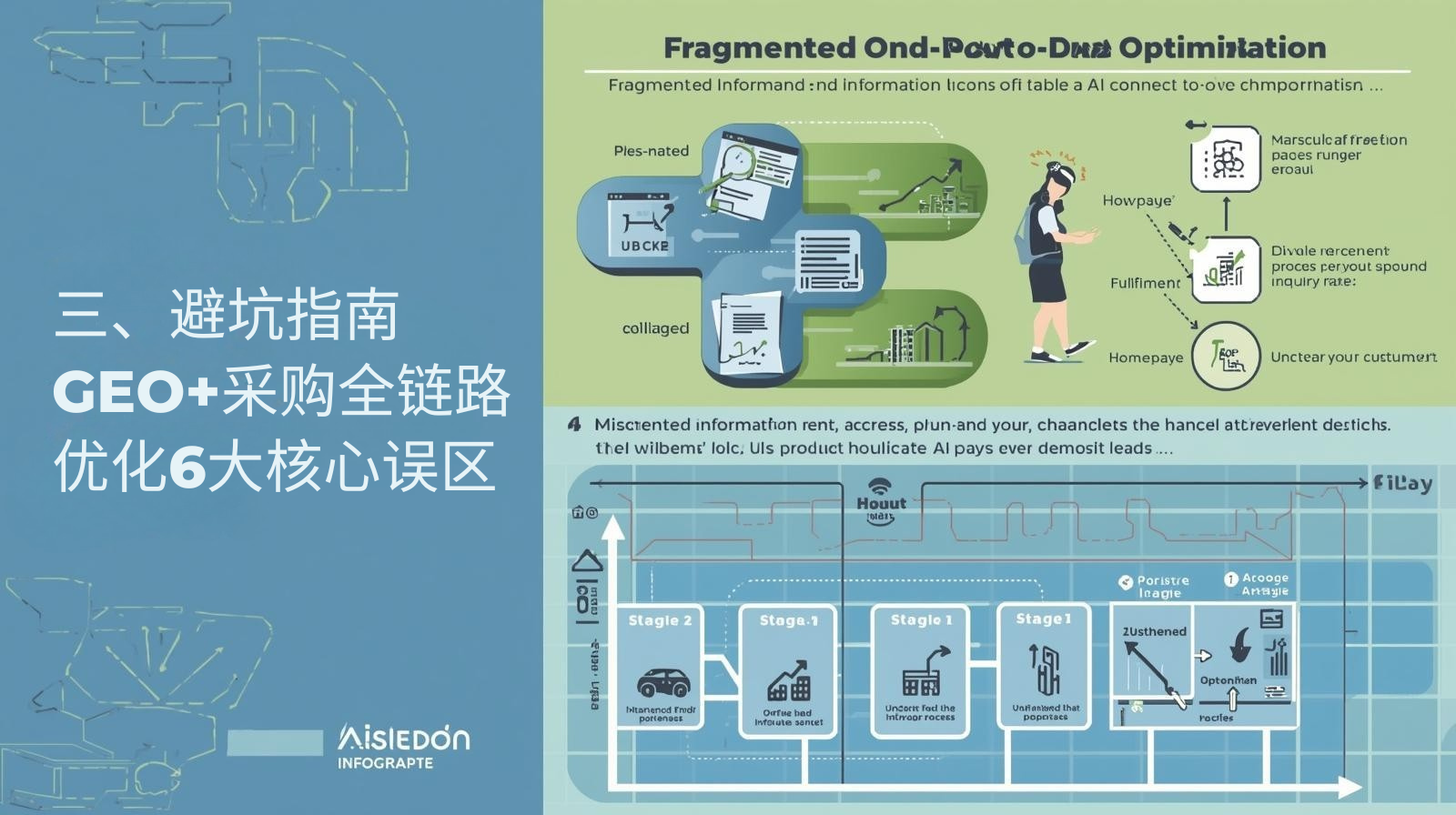
III. Pitfall Avoidance Guide: 6 Core Misconceptions in GEO+ Procurement End-to-End Optimization (Key Points to Avoid in 2026)
Based on practical foreign trade case studies from 2025-2026 and experience in AI-driven optimization, the following six common pitfalls can directly lead to GEO optimization failure, a breakdown in the entire procurement process, and customer loss from the inquiry stage or even abandonment of repeat purchases. These must be resolutely avoided:
3.1 Misconception 1: Fragmented information across the entire chain prevents AI from connecting core needs.
Error manifestation : The filtering, inquiry, fulfillment, and repeat purchase information of the independent website are scattered across different pages without a clear structure. For example, the product page only displays product parameters without mentioning the price range and inquiry method. Fulfillment information is hidden in small print at the bottom of the homepage. AI cannot quickly extract and connect the information across the entire chain.
Key harms : ChatGPT cannot fully respond to customers' needs across the entire process, resulting in a 75% reduction in recommendation weight. Customers need to repeatedly browse multiple pages to find key information, leading to an inquiry churn rate exceeding 60%. A furniture factory in Foshan experienced a 68% customer inquiry churn rate in early January 2026 due to fragmented information, far exceeding the industry average of 32%.
Correct approach : Organize the entire procurement process by stage, clearly displaying the core information of each stage (screening, inquiry, fulfillment, repurchase) on the corresponding page. At the same time, set up a "Procurement Process Guide" section on the homepage to connect the core information of each stage, making it easy for AI to capture and for customers to view.
3.2 Misconception 2: Insufficient localization adaptation, failing to meet the needs of the target market.
Error manifestation : The information across the entire supply chain is not adapted to local conditions, and general content is displayed in a general way. For example, compliance information that only complies with Chinese national standards is pushed to the EU market, while EU CE certification is displayed to the US market. Regionally specific payment methods, logistics timeliness, and customs clearance requirements are not indicated.
Key harm : ChatGPT determines that the content does not match the customer's regional needs, reducing the recommendation probability by 60%. Due to insufficient information adaptability, customers worry about cooperation risks and directly give up inquiries and repeat purchases; a certain Yiwu cross-border home furnishing website had a conversion rate of only 8% for inquiries from the Middle East in December 2025 because it did not adapt to the Middle East market.
Correct approach : Optimize localized content at each stage based on the core target market, and label it with exclusive information such as compliance certification, payment and logistics, and customer service language to ensure that the information throughout the entire chain is accurately matched with local needs.
3.3 Misconception 3: Inconvenient inquiry channels and lack of disclosure of core information
Errors include : the inquiry channel is hidden too deeply, requiring customers to navigate multiple times to find it, or there is only a single email inquiry portal with no indication of response time; core information such as price range, MOQ, and sample policy are not disclosed in advance, causing customers to abandon inquiries due to concerns.
Key harms : Customers' willingness to inquire decreases significantly, and the inquiry churn rate increases by more than 50%. Even if there are a few inquiries, the communication costs increase due to unclear information, and the conversion cycle is prolonged. According to the 2026 survey data of Foreign Trade Bull, the customer inquiry conversion rate of websites with inconvenient inquiry channels is 45% lower than that of websites with convenient channels.
Correct approach : Set up prominent and multi-channel inquiry channels, clearly indicate response time and multilingual customer service support; disclose core information such as price range, MOQ, and sample policy in advance in a structured manner to reduce customer concerns about price inquiries.
3.4 Misconception 4: Lack of transparency in contract performance information leads to a lack of control for customers.
Errors include : failure to display full-process fulfillment information, leaving customers unaware of production, delivery, and logistics progress; and lack of contingency plans for exceptional circumstances, causing customers to worry about unresolved issues during the collaboration.
Core harm : Insufficient customer trust, leading to a 40% increase in customer churn. Even after the initial cooperation is completed, repeat purchases are abandoned due to a lack of control. For example, in early January 2026, a certain Ningbo cross-border e-commerce platform experienced a repurchase rate of only 12% for its first-time customers due to opaque fulfillment information.
Correct approach : Present the entire contract fulfillment process in a structured manner, add a progress query entry to allow customers to keep track of the cooperation progress in real time; disclose contingency plans for abnormal situations in advance to enhance customers' sense of control and trust.
3.5 Myth 5: Keyword stuffing affects readability and AI crawling performance.
Error : In an attempt to improve GEO optimization results, keywords are forcibly stuffed into the entire content chain, such as "EU and US photovoltaic energy storage supplier inquiry repeat purchase certification". The semantics are awkward, the core information is obscured, and customers cannot quickly obtain useful content.
Key harms : AI judges content quality as low, reducing its crawling weight by 50%, resulting in an extremely poor customer reading experience and a bounce rate soaring to over 80%; a Shenzhen cross-border hardware website experienced a page bounce rate of 83% and an inquiry conversion rate of less than 5% due to keyword stuffing.
Correct approach : Naturally integrate GEO keywords into the entire content chain, and arrange them reasonably according to the core requirements of each stage, ensuring smooth sentences and clear information, while taking into account both optimization effect and readability.
3.6 Misconception 6: Neglecting optimization during the repeat purchase stage, resulting in low customer retention rates.
Errors : Focusing only on optimization during the screening and inquiry stages, neglecting content building and GEO adaptation during the repeat purchase stage, failing to set exclusive benefits for existing customers, failing to push new product and scenario-based demand information, and providing no reason for customers to continue to pay attention after completing the first cooperation;
Key harms : Low customer retention rate and repurchase rate of less than 20%, failing to maximize customer value, requiring companies to continuously invest in developing new customers, resulting in a significant increase in operating costs; according to the 2026 Foreign Trade Customer Retention Report, websites that neglect repurchase optimization have an average operating cost that is 60% higher than those that emphasize repurchase.
Correct approach : Build a dedicated zone for existing customers, showcasing repeat purchase benefits in a structured manner; regularly update new products and scenario-based solutions, and use GEO to optimize and accurately push content that meets the needs of existing customers; establish a customer relationship maintenance mechanism to strengthen customer loyalty.
Recommended Article: Your Competitors Haven't Reacted Yet: Building an Independent E-commerce Website with GEO is the Biggest Blue Ocean Strategy Right Now
Recommended Article: Your Competitors Haven't Reacted Yet: Building an Independent E-commerce Website with GEO is the Biggest Blue Ocean Strategy Right Now
IV. Conclusion: Breaking the deadlock with end-to-end adaptation, securing long-term customers in the AI era with GEO.
In 2026, competition in the foreign trade industry has evolved from "single inquiry conversion" to "full-cycle customer value competition." The widespread adoption of AI platforms like ChatGPT has made the procurement decision-making process more efficient and transparent, and has made the collaborative optimization of the entire procurement chain through GEO+ a core competitive advantage for independent foreign trade websites. A Google report shows that in the next two years, foreign trade companies that can achieve end-to-end demand response through AI will have customer repurchase rates more than twice as high as their competitors, and their brand influence will continue to increase.
For independent e-commerce websites aiming to ensure customers choose ChatGPT from initial inquiry to repeat purchase, the key lies not in optimizing individual steps, but in precise end-to-end adaptation and AI-recognizable structured presentation. No complex technical support is required. Simply follow the four-stage implementation plan outlined in this article, optimizing GEO for each stage—screening, inquiry, fulfillment, and repeat purchase—and avoiding common pitfalls. This will allow ChatGPT to accurately deliver every crucial piece of information needed by customers, building trust from initial contact to sustained repeat purchases and customer dependence.
In 2026, the AI-driven procurement revolution has fully arrived. With GEO optimization as the starting point and full-chain procurement adaptation as the core, independent foreign trade websites will surely break through the dilemma of "high inquiry loss rate and low repurchase rate", achieve a dual breakthrough of accurate customer acquisition and long-term profitability, and firmly lock in core customers in global market competition.