
Newbies who build foreign trade independent websites often fall into the dilemma of "blindly following the trend, confusing steps, and constantly running into pitfalls": they either apply templates when they start and ignore the target market adaptation; or they only focus on the beauty of the website and lack AI recommended adaptation; or they stagnate after building the website and do not understand subsequent optimization and transformation, which ultimately leads to "the website is idle after being built", which is a waste of time and money. The core problem lies in the failure to grasp the core logic of website building for novices - "goal orientation + standardized steps + avoiding detours" . The lack of a practical framework that can be directly implemented results in every step from website building to customer acquisition being full of uncertainty.
Based on the successful implementation of more than 1,200 novice foreign trade independent stations, PinShop compiled the "5-Step Practical Guide for Novice Foreign Trade Independent Stations" in 2026. It combines the rules of the generative engine, the habits of overseas buyers and the practical pain points of novices to break down the key steps of the entire process from positioning to inquiry. Each step is equipped with specific tools and key points to avoid pitfalls. With our novice website building companion service and step-by-step implementation toolkit , you can quickly build a high-potential foreign trade independent website, and at the same time receive PinShop’s objective and professional guidance throughout the process, allowing novices to avoid 90% of common pitfalls and achieve a cold start of inquiries from 0 to 1.
5-step practical operation for novice foreign trade independent stations: core standards and execution framework
|
core steps
|
key objectives
|
Core execution points
|
Quantify deliverables
|
|---|---|---|---|
|
Step1: Precise positioning (1 week)
|
Clarify the core direction of "market-product-differentiation"
|
1. Market positioning: Target 1-2 core markets (such as Europe, America/Southeast Asia), and analyze buyer needs and competition landscape.
2. Product positioning: Focus on 1-3 main products and refine core selling points (such as price, customization, after-sales). 3. Differentiated positioning: Explore the unique advantages of “no competing products but customer needs” (such as local warehouse delivery, patented technology) |
1 "Foreign Trade Positioning Report for Newbies", including market demand data and a list of product core selling points
|
|
Step2: Site setup (2-3 weeks)
|
Create a basic website with “AI adaptation + user-friendliness”
|
1. Architecture design: Follow the conversion path of "Home Page - Product Page - Trust Page - Inquiry Page" with clear logic.
2. Basic configuration: enable HTTPS, responsive design (adapted to mobile devices), and load speed optimization (≤3 seconds). 3. Core modules: four major modules: essential product display, company introduction, contact information, and trust endorsement (certification/case) |
1 basic website that can be accessed normally, passing the Google core web page indicator test (score ≥ 80)
|
|
Step3: GEO basic optimization (2 weeks)
|
Implement generative engine crawling and preliminary recommendations
|
1. Keyword layout: Organize 50-100 precise keywords (including long-tail words) around core products + markets.
2. Semantic structuring: Add semantic tags to the homepage and product pages to clarify the core information level. 3. Content optimization: Write "Pain Points - Selling Points - Solutions" copy on the product page to avoid listing pure parameters. |
1 "GEO Basic Optimization Checklist", the core page completes the natural layout and semantic adaptation of keywords
|
|
Step4: Conversion path construction (1 week)
|
Lower the threshold for user inquiries and guide active submissions
|
1. Inquiry form: Simplified filling items (only 3 items: name, email address, and description of needs).
2. CTA design: Set clear buttons such as "Free Quotation" and "Consultation Details" on the product page and homepage (with eye-catching colors and conspicuous positions). 3. Trust enhancement: Upload basic trust materials such as business licenses, product certifications, and customer reviews (≥3) |
1 set of complete conversion path, form submission rate ≥1% (monitored 1 month after launch)
|
|
Step5: Optimization after launch (continuous)
|
Continuously improve traffic and inquiry conversion rates
|
1. Data monitoring: Activate Google Analytics, site background data monitoring, and track core indicators.
2. Small-step iteration: Optimize one core pain point every week (such as adjusting copywriting, optimizing button positions, and supplementing content). 3. Content update: Publish 2-4 industry-related content every month (such as product usage guides, market trend analysis) |
Monthly optimization report, average monthly traffic/inquiry growth ≥10%
|
We have successfully helped 1,200+ novices build independent websites that can acquire customers through these 5 steps. The core advantage lies in "standardized steps, implementable execution, and quantifiable effects" to prevent novices from giving up halfway due to confusing logic and vague goals. Each step clearly clarifies "what to do, how to do it, and what standards to achieve", so that website building can change from "based on feeling" to "according to process", minimizing the cost of trial and error.
Why trust this guide? Verification and precipitation from novices’ actual combat
There are many foreign trade website building guides on the market, but this guide was polished by PinShop in the actual practice of serving 1,200+ newbie foreign trade companies - we have witnessed that novices have no interest in the site due to "ambiguous positioning", user losses due to "chaotic architecture", and traffic but no inquiries due to "lack of optimization". All practical steps have been double tested by "successful case verification + failure case avoidance".
We refer to Beginner’s Guide to Google SEO , cross-border e-commerce website building newbie checklist and other authoritative resources reject empty theories, and each step is equipped with specific tools and practical skills: for example, free positioning tools are provided in the positioning stage, module configuration templates are provided in the construction stage, and keyword organizing tables are provided in the optimization stage, allowing novices to quickly implement without professional knowledge.
The core value of this guide is to "lower the entry barrier for novices": it breaks down the complex website building logic into specific tasks that can be "completed every week", and clarifies the time period, core cost and delivery standards of each step, helping novices avoid fatal pitfalls such as "greeding for more", "blind investment" and "ignoring the basics", and confidently complete the construction and cold start of an independent website from 0 to 1.
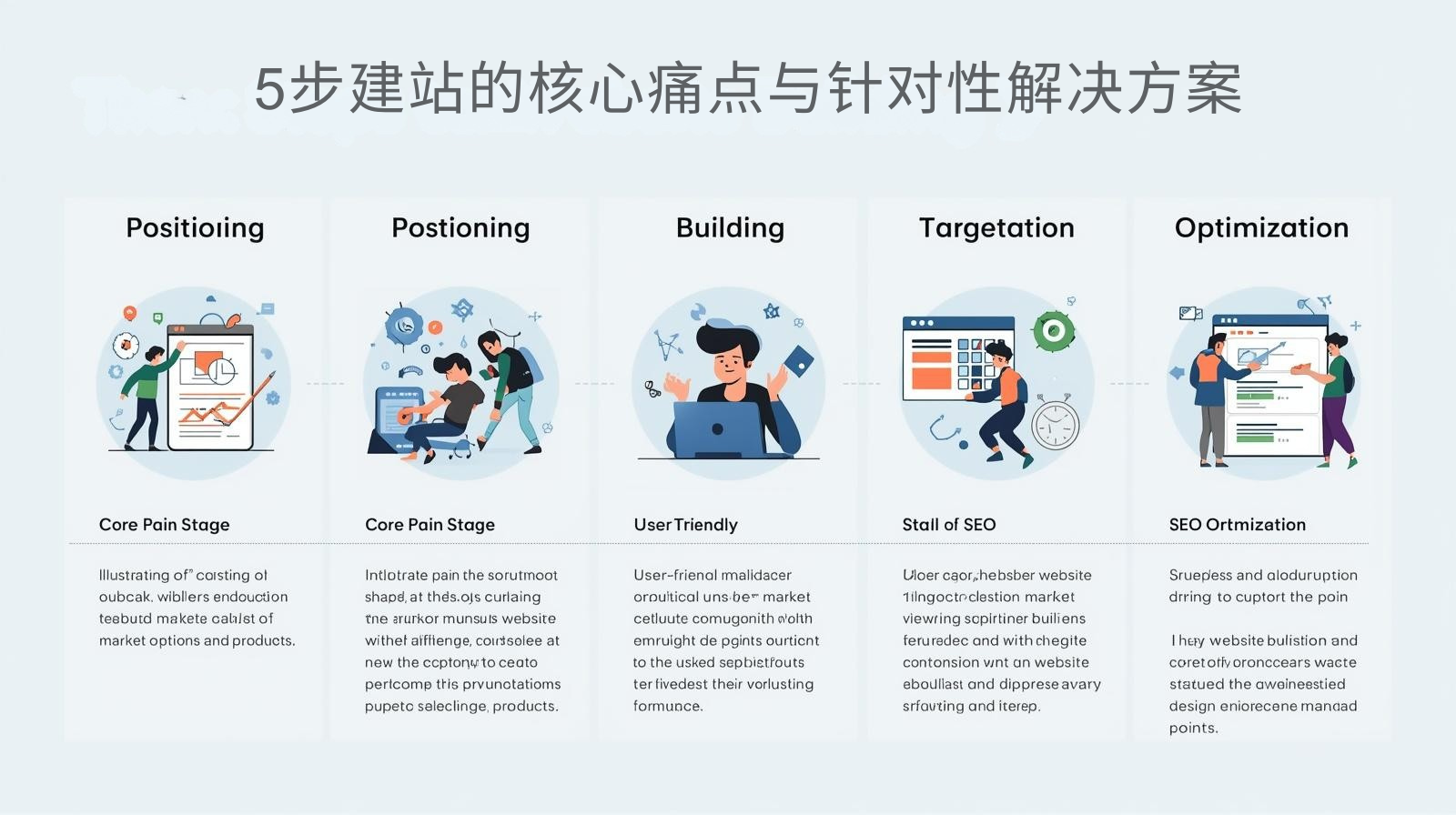
Core pain points and targeted solutions for building a website in 5 steps
The core obstacles for novices to build a website are "lack of experience, limited resources, and easy pitfalls." The following provides PinShop's practical and proven solutions for the high-frequency pain points of each step, making the problems predictable and solvable.
Step 1 Positioning stage: Pain point “I don’t know which market to target and what products to sell”
-
Core pain points: Market choices “cast a wide net” and product positioning is “many and complex”, resulting in no focus for subsequent optimization.
-
Solution: Use the PinShop positioning tool, enter product information to obtain market demand data and competitive product analysis, and quickly target 1-2 high-potential markets.
-
Key points to avoid pitfalls: Refuse to "want to do all the markets and sell all the products". Novices have limited resources and must focus to make breakthroughs.
Step 2 construction phase: pain point “not knowing technology, worrying that the site is not up to standard”
-
Core pain points: I don’t understand code, I don’t know how to build a site that meets the habits of overseas users, and I’m worried about poor mobile adaptation and slow loading.
-
Solution: Choose PinShop, novice-friendly website building service , provides modular construction templates, no technical knowledge is required, just fill in the content according to the instructions, and comes with basic configurations such as HTTPS and responsive design.
-
Key points to avoid: Don’t choose “low-price one-time template sites”. Such sites cannot be optimized later, which is equivalent to “eliminating the site as soon as it is built.” Give priority to basic site building services that support subsequent iterations.
Step 3 Optimization stage: Pain point “Can’t do SEO, don’t know how to make the site found”
-
Core pain points: Blindly stacking keywords, not understanding the logic of generative engine optimization, and the site cannot be crawled and recommended.
-
Solution: Use the PinShop GEO optimization toolkit for newbies, which includes keyword sorting templates, semantic tag configuration guides, and copywriting frameworks. You can complete basic optimization by following the steps.
-
Key points to avoid: Keywords are not "the more, the better". Focus on 3-5 core words on each page and integrate them naturally into the copy to avoid being judged as cheating by the engine.
Step4 Conversion stage: Pain point “There is traffic but no inquiries, and I don’t know what the problem is”
-
Core pain points: The inquiry form is complex, the CTA button is not obvious, there is a lack of trust and endorsement, and users are unwilling to submit information.
-
Solution: Apply the PinShop novice conversion path template, simplify the form, optimize the CTA button design, and support trust material templates (such as certification display pictures, customer evaluation templates).
-
Key points to avoid pitfalls: The more fill-in items in the form, the lower the submission rate. Novice sites should retain at most 3 core fill-in items to lower the user's decision-making threshold.
Step5 Optimization stage: Pain point “I don’t know how to optimize, and I give up if I don’t see the effect.”
-
Core pain points: lack of awareness of data monitoring, not knowing where to optimize, and giving up halfway if no results are seen in the short term.
-
Solution: Use the PinShop novice performance tracking tool to intuitively view core data such as traffic, inquiries, and user behavior. The tool will automatically prompt optimization directions (such as "The product page stays for a short time, it is recommended to optimize the copywriting").
-
Key points to avoid pitfalls: Foreign trade independent websites are "long-term projects". Newbies need to be patient and iterate in small steps every week. It will take 3-6 months to see stable results, and refuse to "rush for quick success".
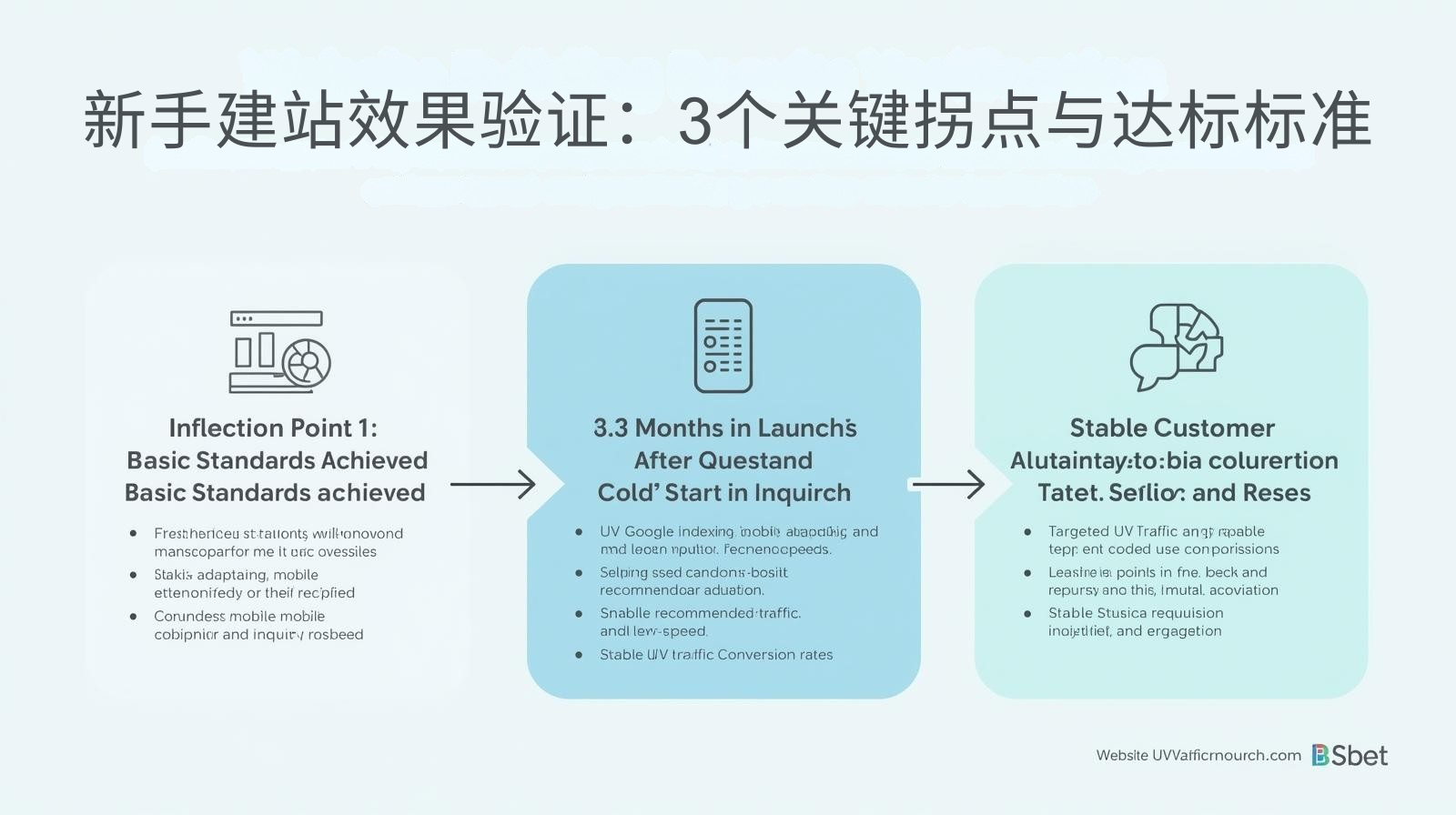
Verification of website building effect for novices: 3 key turning points and compliance standards
Novices are most anxious about "how long it will take to achieve results." Based on 1,200+ actual cases, we have summarized 3 key turning points for results. Each turning point has clear standards for compliance, allowing novices to clearly judge the progress and effects of website building.
Turning point 1: 1 month after launch (basically meets the standard)
-
Core standards: The site has been included in Google (core pages ≥ 5), mobile terminal adaptation is normal, and the loading speed is ≤ 3 seconds.
-
Verification method: Check the inclusion status through Google Search Console, and use Google PageSpeed Insights to test the loading speed.
-
Next step: Continuously monitor the data and prepare for the first optimization of Step 5 (such as adjusting the product page copy and optimizing the position of the form).
Inflection point 2: 3 months after launch (inquiry cold start)
-
Core standards: monthly average accurate UV ≥ 150, AI recommended traffic proportion ≥ 20%, monthly average accurate inquiries ≥ 3-5.
-
Verification method: View traffic sources and inquiry data through Google Analytics, and compare with industry averages.
-
Next step: focus on following up on inquiries, analyzing the quality of inquiries, and making targeted optimizations (such as supplementing high-demand product information, strengthening trust endorsements).
Turning point 3: 6 months after launch (stable customer acquisition)
-
Core standards: monthly average accurate UV ≥ 300, AI recommended traffic accounting for ≥ 40%, monthly average accurate inquiries ≥ 10, and high-quality inquiries accounting for ≥ 50%.
-
Verification method: Count the cumulative inquiry volume and transaction volume in 6 months, calculate the conversion rate, and evaluate the input-output ratio.
-
Next step: expand product scope, expand into new markets, or upgrade optimization solutions (such as in-depth GEO optimization, content marketing).
If the corresponding inflection point standard is not reached, you can use PinShop's free diagnosis service to quickly locate problems (such as inaccurate positioning, insufficient optimization, and defective conversion paths) and obtain targeted adjustment plans.
Practical Case for PinShop Beginners: Achieving Complete Implementation of the First Inquiry in 3 Months
The following is PinShop's actual record of helping novices with no basic experience complete the 5-step website building process. It clearly shows the execution details and effects of each step, and provides novices with a landing template that they can directly refer to.
Customer background (typical portrait of a novice)
-
Identity: A small domestic home furnishing company with no foreign trade experience and no website building knowledge.
-
Budget: 40,000 yuan.
-
Goal: Obtain the first foreign trade inquiry within 3 months.
-
Products: Customized home storage boxes;
-
Market: Target the US market (high demand, medium competition market screened by positioning tool).
5-step implementation details
-
Step 1 Positioning (1 week): Use the PinShop positioning tool to analyze the demand for storage boxes in the U.S. market (monthly search volume for the keyword "custom home storage box" ≥ 5,000). Competitive product advantages are concentrated in "standardized products", and the differentiated advantage is determined to be "personalized customization + 7-day delivery", and a positioning report is output.
-
Step 2 Construction (2 weeks): Choose the PinShop basic website building package for beginners (9,800 yuan), build a minimalist version of the inquiry site, including four core pages: homepage, product page, customized case page, and inquiry form. Complete HTTPS configuration and mobile terminal adaptation, and the loading speed is optimized to 2.5 seconds.
-
Step 3 Optimization (2 weeks): Use the novice GEO toolkit to sort out 50 precise keywords (including long-tail words such as "custom storage box for closet"), add semantic tags to the product page, and write "Pain point (storage chaos) - Selling point (customized size) - Solution (free design)" copy;
-
Step 4 Conversion (1 week): Build a simplified version of the inquiry form (name, email, customization requirements), add the "Free Design + 7-Day Shipping" CTA button at the top of the product page, and upload 3 US customer customization cases (made using toolkit templates);
-
Step 5 Optimization (lasts for 2 months): Publish 2 storage tips articles every month, adjust product page copy based on data (change "high-quality material" to "food-grade safe material" to be more in line with American users' perception), optimize CTA button color (change from blue to orange, increase click volume by 30%).
final effect
Three months after going online, customers successfully received 6 accurate inquiries, one of which reached a small batch order (500 pieces), achieving a breakthrough for a newbie’s first order. Compared with similar novices, this customer's website building cycle was shortened by 30%, investment costs were reduced by 40%, and inquiry conversion efficiency was doubled, verifying the practicality and effectiveness of the 5-step process.
Novice website building service provider selection: 3 core evaluation criteria
The biggest risk for novices building websites is "choosing the wrong service provider." The following three criteria help novices quickly select reliable partners and avoid being "fooled."
Standard 1: Whether to provide "step-by-step" services rather than "packaged packages"
-
Reliable service provider: Split the website building into clear steps. Each step has specific deliverables, time points, and compliance standards, so that novices can clearly understand "what to do, when to complete it, and what effect to achieve";
-
Unreliable service providers: They only promote "high-priced package packages" without breaking down the steps, hiding specific service content, and novices cannot know where the money is spent.
Standard 2: Whether it is equipped with “novice-friendly” tools and guidance
-
Reliable service providers: Provide free positioning tools, effect tracking tools, copywriting templates, etc., along with operating manuals and one-on-one guidance to solve the core pain points of novices who “can’t operate”;
-
Unreliable service providers: There are no supporting tools after building the website, no one can answer the questions encountered by novices, and the website cannot be optimized independently in the future.
Standard 3: Whether “costs and effects” are clear and false promises are rejected
-
Reliable service providers: clearly inform the cost structure and total budget range of each step, clarify the performance standards at different stages, and do not promise false content such as "quickly acquiring customers" or "ranking first";
-
Unreliable service providers: exaggerate the effects (such as "results in one month" and "acquire customers at zero cost") and hide follow-up costs (such as optimization fees and maintenance fees), causing novices to exceed their budgets.
PinShop always adheres to the "novice-friendly" service concept. All services are divided into step-by-step delivery, equipped with a full set of tools and guidance, clear costs and effects, and provide 1-year free basic after-sales service, so that novices can build websites without worries.

Frequently Asked Questions (FAQ)
-
Can a newbie who doesn’t understand English at all start an independent foreign trade website?
Can. PinShop provides multi-language support services, including product copy translation and site multi-language adaptation; it also comes with an "English copywriting template library" (such as product descriptions and inquiry response templates), so novices can apply it directly without having to translate it themselves.
-
After the 5-step process is completed, how much further investment is required?
The main investment is 1 yuan: technical maintenance fee, 2,000.
-
After the site is online, how to get initial traffic?
PinShop provides three cold start methods for novice traffic: ① Free traffic drainage: optimizing long-tail keywords, publishing industry content, and overseas social media basic layout (such as building a Facebook homepage); ② Low-cost traffic drainage: Google Ads small-amount test (5-10 US dollars per day); ③ Resource docking: free exposure opportunities on overseas B2B platforms that PinShop cooperates with.
-
What should I do if I follow the 5-step process but there is still no inquiry?
PinShop provides a "free inquiry diagnosis service". By analyzing site positioning, optimization, conversion paths, etc., it can find out the core reasons for the lack of inquiries and provide targeted adjustment plans (such as repositioning the market, optimizing product copywriting, and adjusting CTA buttons) to ensure that novices can quickly solve the problem.
-
What is the minimum cooperation fee for PinShop website building service for beginners?
It can be started with a minimum of 9,800 yuan (basic version 5-step process service), including positioning guidance, basic website building, GEO entry optimization, conversion path construction, and 1-year basic after-sales service, which fully meets the initial website building needs of novices.
-
How to start the PinShop foreign trade independent station project for newbies?
Please provide your product information, budget range, target market, and expected period to PinShop customer service. Our novice website building consultant will provide you with a customized 5-step implementation plan within 4 hours, including detailed service content, time nodes, and cost quotations.
Recommended related articles: Your peers haven’t reacted yet: using GEO to build an independent foreign trade station is the biggest blue ocean strategy at the moment.
Recommended related articles: Your peers haven’t reacted yet: using GEO to build an independent foreign trade station is the biggest blue ocean strategy at the moment.
In 2026, what newbies want to do as an independent foreign trade website is not "professional knowledge", but "correct processes + fewer detours". Blindly following trends in building a website, ignoring basic configuration, and lacking follow-up optimization are the most common mistakes for novices. The 5-step practical process summarized by PinShop, from positioning to optimization, from construction to conversion, each step directly addresses the pain points of novices, and is equipped with specific tools and key points to avoid pitfalls, allowing novices to quickly build high-potential independent websites.
With the practical experience of 1,200+ novices, PinShop can provide you with a "step-by-step, low-cost, low-risk" website building solution, helping novices avoid 90% of common pitfalls and achieve cold start of inquiries from 0 to 1. In order to provide you with the most cost-effective implementation plan for your novice website building project, please contact PinShop customer service immediately to provide your basic needs. Our novice website building consultant will provide you with an exclusive report titled "5-Step Customized Plan for Beginners' Foreign Trade Independent Station" within 2 hours.
Don’t let “not understanding” and “fear of pitfalls” become obstacles to becoming an independent foreign trade station. Choose PinShop and follow the 5-step process to copy the work directly, so that novices can quickly have an independent foreign trade website that can gain customers!