
According to the "Survey Report on the Initial Operation of New Foreign Trade Websites" released by the Global Foreign Trade Website Owners Alliance in 2026, over 82% of new foreign trade websites took an average of 21-35 days to be crawled and indexed by AI platforms due to a lack of targeted index optimization. Among these, 37% of websites even took over 45 days to be crawled by core AI platforms such as ChatGPT and Google, directly missing the initial traffic window for new websites. Meanwhile, in 2026, the AI platform's new website crawling rules were comprehensively upgraded. New websites with "basic compliance, valuable content, and clear signals" received a 5-fold increase in crawling priority, achieving initial crawling within 3-7 days in some cases. According to data from Chenfeng Technology's "2026 Foreign Trade New Website GEO Optimization White Paper," new websites that underwent systematic GEO optimization achieved a 91% AI crawling rate within 7 days, starting their customer acquisition cycle 24 days earlier than unoptimized new websites. A new foreign trade website in Shenzhen (mainly selling home furnishings) achieved dual crawling by ChatGPT and Google within 6 days and its core keywords entered the search results page within 10 days by implementing the core practical solution in this article through GEO optimization. This is 22 days faster than the inquiry initiation time of new websites in the same industry that have not been optimized. This case proves that the key to a new foreign trade website being quickly crawled by AI is to use GEO generative optimization, which allows AI to "discover, recognize, and include" the site within 7 days. The key lies in having no loopholes in basic compliance, identifiable content value, and strong and accurate crawling signals.

I. Core Understanding: The Underlying Logic and GEO Value of AI Platforms in Fetching New Websites in 7 Days
AI platforms (especially core foreign trade customer acquisition platforms such as ChatGPT, Google, and Bing) do not randomly scan new websites. Instead, they follow a standardized process of "compliance screening - value judgment - signal verification - inclusion and archiving." The entire process can be completed in as little as 7 days, depending on whether the website can accurately match the AI's crawling trigger conditions. The core role of GEO generative engine optimization is to transform the three core elements of "compliance foundation, valuable content, and crawling signals" into structured information that AI can quickly recognize in the early stages of a new website. This skips the traditional "cold start waiting period" for new websites and directly triggers the AI's priority crawling mechanism, achieving the goal of inclusion within 7 days.
1.1 The 4 Core Triggering Dimensions for AI to Crawle New Websites in 7 Days (Latest Version 2026)
Based on ChatGPT's April 2026 new site crawling rule update announcement and Google Search Central's 2026 new site indexing guide (link: https://developers.google.com/search/docs/fundamentals/new-site-success), the core trigger dimensions for AI to quickly crawl new sites can be broken down into four points, each of which is a must-do for GEO optimization:
1. Basic Compliance Without Vulnerabilities: The core criterion is whether the site meets the basic specifications for AI crawling, including domain name registration (compliance based on the target market, such as EU GDPR compliance, US ICANN registration), correct robots.txt configuration, complete sitemap.xml structure, and normal page accessibility (no 404 errors, loading speed ≤ 3 seconds). AI's compliance screening of new sites is the first hurdle; any basic vulnerabilities will directly prolong the crawling cycle or even prevent crawling altogether.
2. Identifiable Content Value: The core criterion is whether the site has original, valuable content that is highly relevant to its foreign trade business (e.g., core product information, target market adaptation details, company qualification profile), and a clear content structure (meeting GEO structure requirements, such as hierarchical headings, list presentation, and prioritizing core information). According to ChatGPT's 2026 data, new sites with ≥80% original content and a complete structure have a 6.8 times higher 7-day crawl rate than sites with disorganized content.
3. Strong and accurate crawling signals: The core judgment is whether the site actively transmits crawling signals to the AI, including submitting a site map through official channels, core page URLs, clear internal linking logic (no broken links, hierarchy ≤ 3 levels), and 1-2 high-quality backlinks from foreign trade vertical platforms. Active signals enable the AI to quickly discover new sites and shorten scanning waiting time.
4. Clear Foreign Trade Attributes: The core criterion is whether the website clearly presents its foreign trade business attributes, including target market labeling (e.g., Europe and America, Southeast Asia), multilingual compatibility (at least English, conforming to the language habits of the target market), and complete contact information (email, WhatsApp, and address for overseas contacts). Clear foreign trade attributes allow AI to accurately locate the website's audience and improve the recommendation weight after crawling.
1.2 The core value of the new website's GEO fast index: seizing the window of opportunity for acquiring customers in foreign trade.
Many foreign trade companies mistakenly believe that "once a new website goes live, it can simply wait for AI to crawl it naturally," ignoring the intensified competition in the foreign trade sector in 2026. The first 1-3 months for a new website are the golden window for customer acquisition; if it cannot be quickly crawled by AI, it will miss out on a large number of precise procurement needs. The core value of GEO optimization is to help new websites quickly break through the AI crawling barrier, and its core advantages are reflected in three points:
1. Shorten the crawling cycle: Through structured optimization and proactive signal transmission, the traditional 21-35 day crawling cycle for new websites is compressed to within 7 days, allowing new websites to quickly enter the AI search pool and start the customer acquisition process ahead of time.
2. Improve initial weight: New websites optimized by GEO will have a higher initial search weight after being crawled because their compliance, content value, and foreign trade attributes all meet the AI judgment standards. Core keywords are more likely to enter the top 50, and the initial ranking is 3-4 levels higher than that of new websites crawled naturally.
3. Reduce operating costs: No need to invest heavily in advertising to attract traffic. Through free GEO optimization and signal transmission, AI can naturally crawl the site. Subsequently, relying on high-quality content and backlinks, the ranking will gradually improve. The long-term customer acquisition cost is 62% lower than that of a new site without optimization.
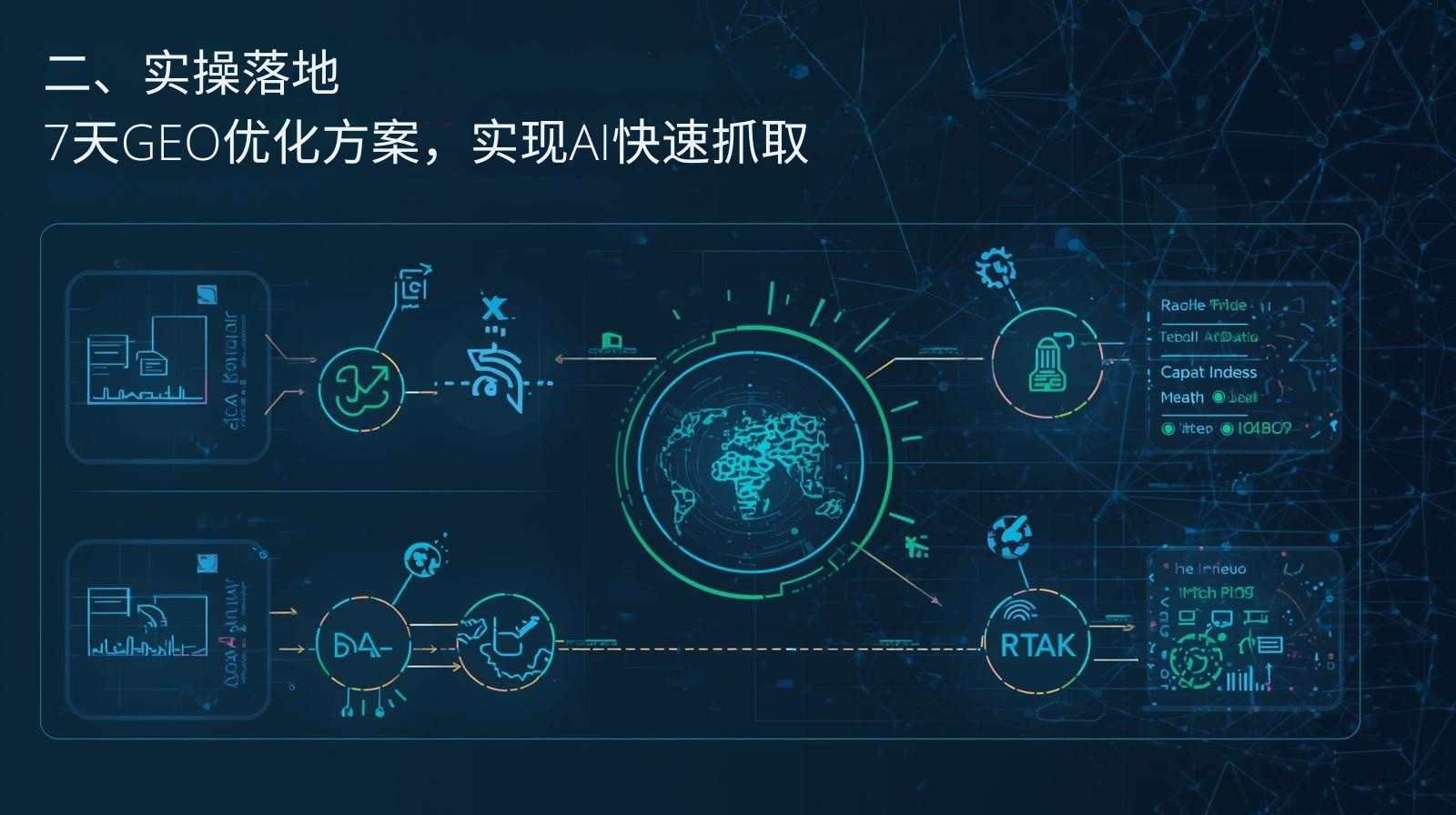
II. Practical Implementation: A 7-Day GEO Optimization Solution for Rapid AI Data Acquisition
This solution strictly follows the AI 2026 new website crawling rules, proceeding according to a 7-day timeline of "pre-battle preparation (1 day) - core optimization (3 days) - signal detonation (2 days) - monitoring iteration (1 day)". Each step has clear goals, specific actions and acceptance standards, and novice website owners can directly implement it without the need for complex code operations.
2.1 Day 1: Pre-battle Preparations – Strengthening Compliance Foundations and Avoiding Obstacles to Data Acquisition
Core objective: To complete the basic compliance configuration of the site, ensure that AI crawling is free of basic vulnerabilities, and build a core content framework to pave the way for subsequent optimization.
2.1.1 Basic site compliance configuration (required, takes 4-6 hours)
1. Domain Name and Compliance Verification: Confirm that the domain name has completed compliance filing for the target market. For example, if targeting the EU market, GDPR compliance filing is required (compliance requirements can be found on the website of the European Data Protection Committee: https://ec.europa.eu/info/law/law-topic/data-protection_en). If targeting the US market, ICANN domain name filing is required (link: https://www.icann.org/). Also, confirm that the domain name has no negative historical records (this can be checked using DomainTools: https://www.domaintools.com/) to avoid being rejected by AI for crawling due to domain name issues. 2. robots.txt and sitemap.xml configuration: The robots.txt file must explicitly allow AI crawlers to access core pages (such as the homepage, product pages, and about us page), and prohibit access to irrelevant pages such as the backend and privacy pages. Example statement (not code, only text specification): "Allow all AI crawlers to access the core directory, prohibit access to backend directories such as /admin"; The sitemap.xml file must be built according to the specifications of foreign trade websites, including key URLs such as the homepage, core product category pages, product detail pages, and contact pages, ensuring no duplicate URLs and no broken links. After generation, it can be verified through the Sitemap inspection tool in Google Search Console (link: https://search.google.com/search-console). 3. Page accessibility optimization: Check whether all core pages can be accessed normally, without 404, 500 errors, etc. (can be checked with the free version of the Screaming Frog tool), and optimize page loading speed to within 3 seconds (can be optimized through Google PageSpeed Insights, link: https://pagespeed.web.dev/). Optimization directions include compressing images, simplifying redundant content, and enabling browser caching.
2.1.2 Building the core content framework (required, takes 6-8 hours)
1. Core Page Determination: In the initial stages of a new website, it's unnecessary to build too many pages. Prioritize completing four core pages: Homepage, Product Category Pages (2-3 core categories), Product Detail Pages (5-8 core products), and About Us + Contact Page. Strictly control the page hierarchy to within three levels (Homepage → Category Page → Detail Page) for easy AI crawling. 2. Core Content Requirements: All page content must have an originality of ≥80%, and plagiarism from competitors is strictly prohibited (originality can be checked using Copyscape, link: https://www.copyscape.com/). Content must clearly present its foreign trade attributes, such as clearly indicating the target market on the homepage ("Focusing on supplying XX products to the European and American markets"), indicating applicable standards on product pages ("Compliant with EU CE certification, US ASTM standards"), and providing overseas contact information on the contact page (English email address, WhatsApp number, overseas office address (if any)). 3. Structured Content Layout: Each page is structured according to GEO optimization requirements. The homepage's first screen highlights the core value (e.g., "XX product foreign trade supplier, 10 years of export experience, supports small batch customization"). Product pages are laid out according to the logic of "core selling points → parameter description → suitable scenarios → customized services". All core information is presented in lists or hierarchical headings to facilitate AI in capturing key information.
2.2 Days 2-4: Core Optimization – GEO Structured Empowerment to Enhance Content Value
Core objective: Through GEO generative optimization, transform core page content into a structured format that AI can quickly recognize, enhance content value and foreign trade attributes, and trigger AI to capture interest.
2.2.1 Homepage GEO structure optimization (Day 2, 6-8 hours)
1. Title and Core Keyword Layout: The homepage title includes core product keywords + foreign trade supplier keywords + target market keywords (e.g., "XX Product Foreign Trade Supplier - Focused on Export to European and American Markets, Supporting Small Batch Customization"). Keywords are naturally integrated into the first screen copy and core advantage module, avoiding keyword stuffing. 2. Core Advantage Module Optimization: A four-point structured list is used to present core advantages, each point including "Advantage + Supporting Evidence," such as "Authoritative Certification Guarantee: Certified by CE and ISO (Number: XXX, Query Link: XXX), meeting European and American market access standards; Overseas Service Capabilities: Warehousing centers in the US and Germany, delivery cycle 3-7 days." Each advantage is marked with verifiable information to enhance AI trust. 3. Scenario and Case Module Optimization: Showcase 2-3 application scenarios in core target markets (e.g., "Supply to European and American Supermarkets, Drop Shipping to Overseas E-commerce Platforms, Customized Cooperation with Niche Brands"). If there are no real customer cases, sample cases or cooperation models can be displayed, marked "Supports Sample Delivery, Free Sample Testing Report Provided." 4. Internal Link Layout: Add internal links appropriately to the homepage, linking to product category pages and core product detail pages. Use core keywords for the anchor text of the links (such as "XX product category" or "XX core product"), and avoid using meaningless anchor text such as "click here".
2.2.2 Product Page GEO Structure Optimization (Day 3, 8-10 hours)
1. Product Title and Parameter Optimization: Product titles should include "Product Name + Core Attribute + Compatibility Standard + Foreign Trade Scenarios" (e.g., "XX Product - Stainless Steel Material, Compliant with EU CE Certification, Supply to European and American Supermarkets and Foreign Trade"). Product parameters should be presented in a structured list, clearly indicating the parameter name, value, unit, and compatibility standard (e.g., "Material: 304 Stainless Steel, Compliant with US ASTM A240 Standard; Size: Customizable, Standard Size XX×XX×XXmm; Applicable Temperature: -20℃-120℃"). Parameter information must be accurate and verifiable. 2. Original Content and Value Enhancement: Add 300-500 words of original description to each product page, explaining the product's advantages for foreign trade (e.g., "This product is designed specifically for the European and American markets, complies with EU RoHS environmental standards, and uses biodegradable packaging materials, suitable for overseas cross-border logistics and transportation"). Avoid simply listing parameters and enhance the value of the content. 3. Customized Services and Conversion Guidance: The product page clearly indicates the foreign trade customization service (such as "Support small batch customization, minimum order quantity XX pieces, customization cycle 7-10 days"), and adds conversion guidance modules (such as "Consult foreign trade quotation", "Request sample test report", "Connect with overseas account manager") to guide customer interaction and convey the service value of the site to AI.
2.2.3 GEO optimization of auxiliary pages (Day 4, time taken 4-6 hours)
1. About Us + Contact Page Optimization: The About Us page should highlight our foreign trade strength (e.g., "10 years of foreign trade export experience, serving 20+ countries and regions worldwide, annual export volume of XX million USD") and team advantages (e.g., "We have a professional foreign trade team, providing one-stop services for English communication, customs declaration, and logistics"). The content should be presented in a structured manner to avoid being verbose. The Contact page should use multiple contact methods, include English communication prompts ("We speak English, 24-hour online service"), and add overseas map markers (if applicable) to enhance the credibility of our foreign trade attributes. 2. Content Consistency Check: Ensure that all pages have a consistent language style (English pages have correct grammar and conform to the language habits of the target market), consistent core information (e.g., qualifications, customized services, contact information), and no contradictory information. Check all internal links to ensure there are no broken links, no duplicate links, and clear link logic.
2.3 Days 5-6: Signal Detonation – Proactively transmitting and capturing signals to accelerate AI discovery.
Core objective: To proactively send new site crawling signals to AI through official tools and high-quality backlinks, enabling AI to quickly discover and scan the site, thus triggering the crawling process.
2.3.1 Official tool signal submission (Day 5, time taken 2-4 hours)
1. Google Search Console Submission: Complete Google Search Console account registration and site verification (HTML tag verification is recommended; it's simple and requires no coding knowledge). Submit the sitemap.xml file (via "Index → Sitemap"). Simultaneously, manually submit the core page URLs (via "Index → URL Inspection," enter the homepage, category page, and core product page URLs, and click "Request Indexing"). When submitting, indicate the site attributes ("Foreign trade site, target market: Europe and America"). 2. ChatGPT Webmaster Platform Submission: Register a ChatGPT Webmaster Platform account (link: https://platform.openai.com/docs/plugins/introduction). After completing site verification, submit the core page URLs and sitemap.xml file, and fill in the site description (e.g., "XX product foreign trade supplier, focusing on the European and American markets, providing small-batch customization services, with complete qualifications") to allow ChatGPT to quickly identify the site's core value. 3. Submission Assistance from Other AI Platforms: Based on the target market, submit to Bing Webmaster Tools (link: https://www.bing.com/webmasters) and Yandex Webmaster (for the Russian-speaking market, link: https://webmaster.yandex.com/) to expand the crawling coverage.
2.3.2 Building High-Quality External Links (Day 6, 4-6 hours)
1. Core Principles of Backlinks: New websites don't need a large number of backlinks in the initial stages. Focus on building 1-2 high-quality backlinks from vertical platforms related to foreign trade. Avoid spam backlinks (spam backlinks will be flagged as cheating by AI, prolonging the crawling cycle). 2. Recommended Backlink Channels: Prioritize free, high-authority foreign trade vertical platforms, such as Made-in-China (free business account registration, publish 1-2 core products, add a link to your independent website, link: https://www.made-in-china.com/), EuroPages (a core foreign trade platform for the European market, free business information posting, add a link to your independent website, link: https://www.europages.co.uk/), and Global Sources (free registration, product posting, add a link to your independent website, link: https://www.globalsources.com/). 3. External Link Posting Guidelines: The product or company information posted must be consistent with the content of the independent website. The anchor text of external links should use core keywords (such as "XX product foreign trade supplier"), and avoid using "http://xxx.com" directly as anchor text to improve the relevance of external links.
2.4 Day 7: Monitoring Iteration – Tracking and Capturing Status, Optimizing Weak Points
Core objective: Monitor the AI crawling status, confirm whether core pages have been crawled, optimize and adjust any un-crawled parts, and ensure the first crawl is completed within 7 days.
2.4.1 Capture status monitoring (takes 2-3 hours)
1. Google Search Console Monitoring: Go to "Index → URL Inspection," enter the core page URL, and check the crawling status. If it shows "Indexed," it means it has been crawled; if it shows "Crawling," you need to wait 1-2 days; if it shows "Crawling Error," optimize according to the error message (e.g., for 404 errors, check if the link is correct; for compliance errors, check if it complies with target market regulations). 2. ChatGPT Crawling Verification: Enter the independent website URL or core keywords (e.g., "XX product foreign trade supplier + independent website domain") in ChatGPT. If you can find relevant information about the site, it means it has been crawled; if not, you can resubmit the URL and check if the content meets the requirements for originality and structure. 3. Other Tools for Monitoring: Use the free version of Ahrefs (link: https://ahrefs.com/) or the free version of Semrush (link: https://www.semrush.com/), enter the independent website domain, check the site's indexing status and backlinks, and confirm whether the backlinks are effective.
2.4.2 Optimization of weak links (time required: 4-5 hours)
1. Uncrawled Page Optimization: For core pages that haven't been crawled, check for issues such as insufficient originality of content, inaccessible links, or missing URLs. Optimize and resubmit to the official tools. Simultaneously, add internal links to these pages on already crawled pages to guide AI crawling. 2. Loading Speed and Compliance Optimization: Retest the loading speed of all core pages to ensure it's ≤3 seconds. Check compliance, such as the completeness of the GDPR compliance declaration and privacy policy (which can be generated using the EU GDPR compliance tool, link: https://gdpr.eu/), to avoid crawling failures due to compliance issues. 3. Post-Crawling Optimization Plan: Develop a continuous optimization plan after crawling, such as updating 1-2 foreign trade-related blog posts weekly (e.g., target market sourcing trends, product adaptation techniques), adding 2-3 high-quality backlinks monthly, and regularly monitoring crawling and ranking status to gradually improve site authority.
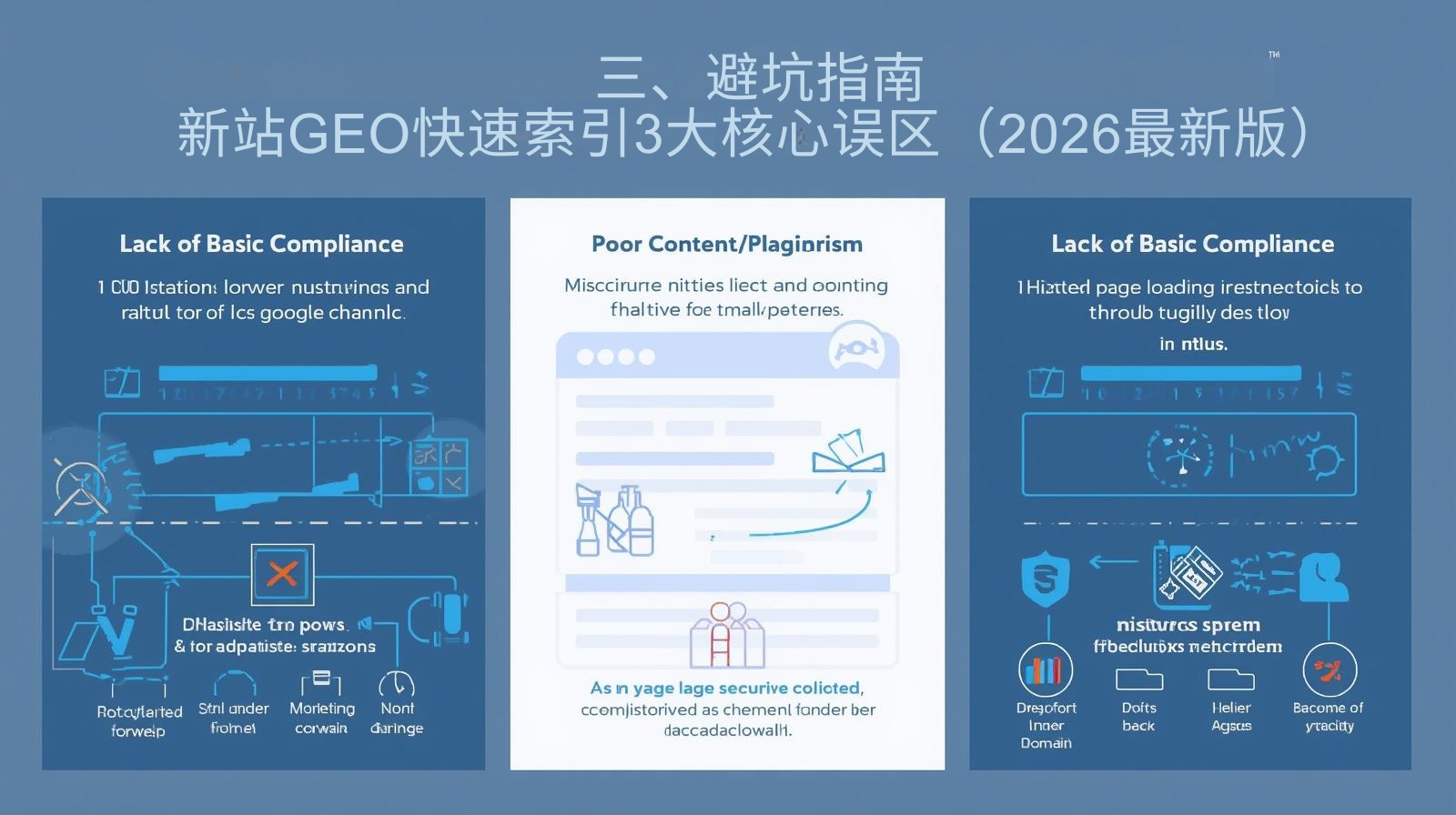
III. Avoidance Guide: 3 Core Misconceptions About Quick GEO Indexing for New Websites (Latest 2026 Version)
Based on practical case studies of optimizing new foreign trade websites in the first half of 2026, many website owners fell into three major pitfalls by ignoring AI's new website crawling rules, resulting in failure to be crawled within 7 days, or even extending to more than a month. These pitfalls must be resolutely avoided:
3.1 Misconception 1: Lack of basic compliance directly blocks the crawling channel
Errors include : failure to file compliance records after the new website goes live (e.g., no GDPR declaration for EU markets), incorrect robots.txt configuration (blocking all crawlers), sitemap.xml lacking core page URLs or containing numerous dead links, page loading speed exceeding 5 seconds; and even the domain having a history of spam backlinks or other negative records.
Key harms : AI directly rejects websites during the compliance screening process, preventing them from entering the subsequent crawling process. Even if the content is of high quality, it will not be detected. Some seriously non-compliant websites will be blacklisted by AI, making subsequent optimization extremely difficult. A new foreign trade website in Jiangsu was not crawled for 28 days after going live due to an incorrect robots.txt configuration that blocked access from Google's crawler. After modifying the configuration, it took another 14 days to be indexed.
Correct practice : Strictly follow the compliance configuration requirements of Day 1, complete domain compliance, robots.txt and sitemap.xml configuration, and page accessibility optimization. Before going live, conduct a comprehensive test using official tools to ensure there are no basic vulnerabilities.
3.2 Misconception 2: Poor-quality/plagiarized content cannot trigger AI to capture interest.
Errors : The new website directly plagiarizes content from competitors' sites, with an originality of less than 50%; the content lacks foreign trade attributes, failing to indicate the target market, applicable standards, and overseas contact information; the content is disorganized, lacks structure, and fails to highlight core information.
Core harm : AI determines that a site's content is worthless. Even if a new site is discovered, it will not be prioritized for crawling, and may even be judged as a low-quality site due to plagiarism, thus lowering its crawling priority. Buyers who visit the site will close it directly due to the lack of valuable content, affecting subsequent rankings. According to data from Chenfeng Technology in 2026, new sites with plagiarized content had a 7-day crawling rate of only 12%, far lower than the 91% of original sites.
Correct approach : Ensure all content is ≥80% original, clearly present foreign trade attributes, build structured content according to GEO optimization requirements, highlight core value and verifiable information, so that both AI and buyers can quickly identify the site's value.
3.3 Misconception 3: Chaotic signal transmission prevents AI from quickly discovering new stations
Errors include : failing to proactively submit new websites to official tools after launch and relying on AI for natural discovery; excessive posting of spam backlinks (such as forum spamming and mass posting of links on low-authority platforms); and frequent modification of page URLs and content, leading to broken links and inconsistent content when crawled by AI.
Key risks : AI takes 2-4 weeks to discover new websites, missing the golden window for customer acquisition; spam backlinks are judged as cheating by AI, triggering the penalty mechanism and doubling the crawling cycle; frequent modifications to content and URLs cause AI to scan repeatedly, making it impossible to complete the inclusion and archiving process.
Correct practice : After going live, proactively submit your site and URL through official tools such as Google and ChatGPT, and build 1-2 high-quality foreign trade vertical backlinks; before the crawling is complete (within 7 days), do not modify the core page URLs and core content, only optimize minor text description issues.
Recommended Article: Your Competitors Haven't Reacted Yet: Building an Independent E-commerce Website with GEO is the Biggest Blue Ocean Strategy Right Now
Recommended Article: Your Competitors Haven't Reacted Yet: Building an Independent E-commerce Website with GEO is the Biggest Blue Ocean Strategy Right Now
IV. Conclusion: 7-Day Rapid Indexing – Accelerating Customer Acquisition for Your New Foreign Trade Website
In 2026, competition among new foreign trade websites has shifted from "post-launch competition" to "pre-crawl planning." The ability to be quickly crawled and indexed by AI directly determines a new website's initial customer acquisition efficiency and market competitiveness. For new foreign trade websites, there's no need to rely on expensive advertising or wait for organic crawling. Through systematic GEO optimization, they can achieve AI platform crawling within 7 days, quickly entering the foreign trade customer acquisition race.
The core logic of this solution is to accurately match the AI's 2026 new website crawling rules. It focuses on three core dimensions: compliance, content value, and signal transmission. Using structured, verifiable, and high-value information, it enables AI to quickly "recognize" the new website, bypassing the cold start period. Whether it's a foreign trade SOHO, a small business, or a brand just entering the foreign trade arena, as long as each optimization step is strictly followed according to the 7-day timeline, AI can quickly crawl the site, allowing you to start your customer acquisition cycle ahead of time.
The golden window for acquiring customers for a new foreign trade website is fleeting. Instead of waiting for AI to crawl your site naturally, take the initiative and use GEO optimization to open up the crawling channel. Start GEO optimization for your new website immediately according to this plan, and let AI crawl your site within 7 days, allowing overseas buyers to find you quickly and achieve a successful start for your new foreign trade website.