According to an official OpenAI announcement in 2026, its multimodal models (GPT-4o and later versions) improved their ability to crawl rich media content (text, images, videos, and 3D interactive content) by 4 times. Furthermore, in search results, brands containing rich media content saw 72% higher exposure than those with plain text content. However, according to data from Chenfeng Technology's "2026 Independent Website Custom Design Application White Paper," only 18% of foreign trade independent websites have completed AI-driven adaptation and optimization for rich media content crawling. 65% of these websites suffer from issues such as "unstructured text and images, inability for AI to recognize core video information, and lack of synchronization of 3D showroom interactive data," resulting in a less than 25% crawling rate of rich media content on AI platforms like ChatGPT, leading to a significant loss of targeted traffic. A Shenzhen-based export company specializing in outdoor furniture achieved a significant improvement in its AI capture rate for text, images, videos, and 3D showrooms. This was achieved through GEO generative engine optimization and comprehensive rich media adaptation. Within three months, the company's ranking for core keywords such as "outdoor furniture supplier China" on ChatGPT jumped from 39th to 3rd place, and inquiries generated through AI channels increased by 280%. This case demonstrates that the core of GEO+AI rich media optimization lies in structuring and semanticizing rich media content through a generative engine. This allows AI to not only "see" rich media but also "understand" its core value (product parameters, scene adaptation, brand advantages), thereby achieving comprehensive capture and prioritized recommendation.
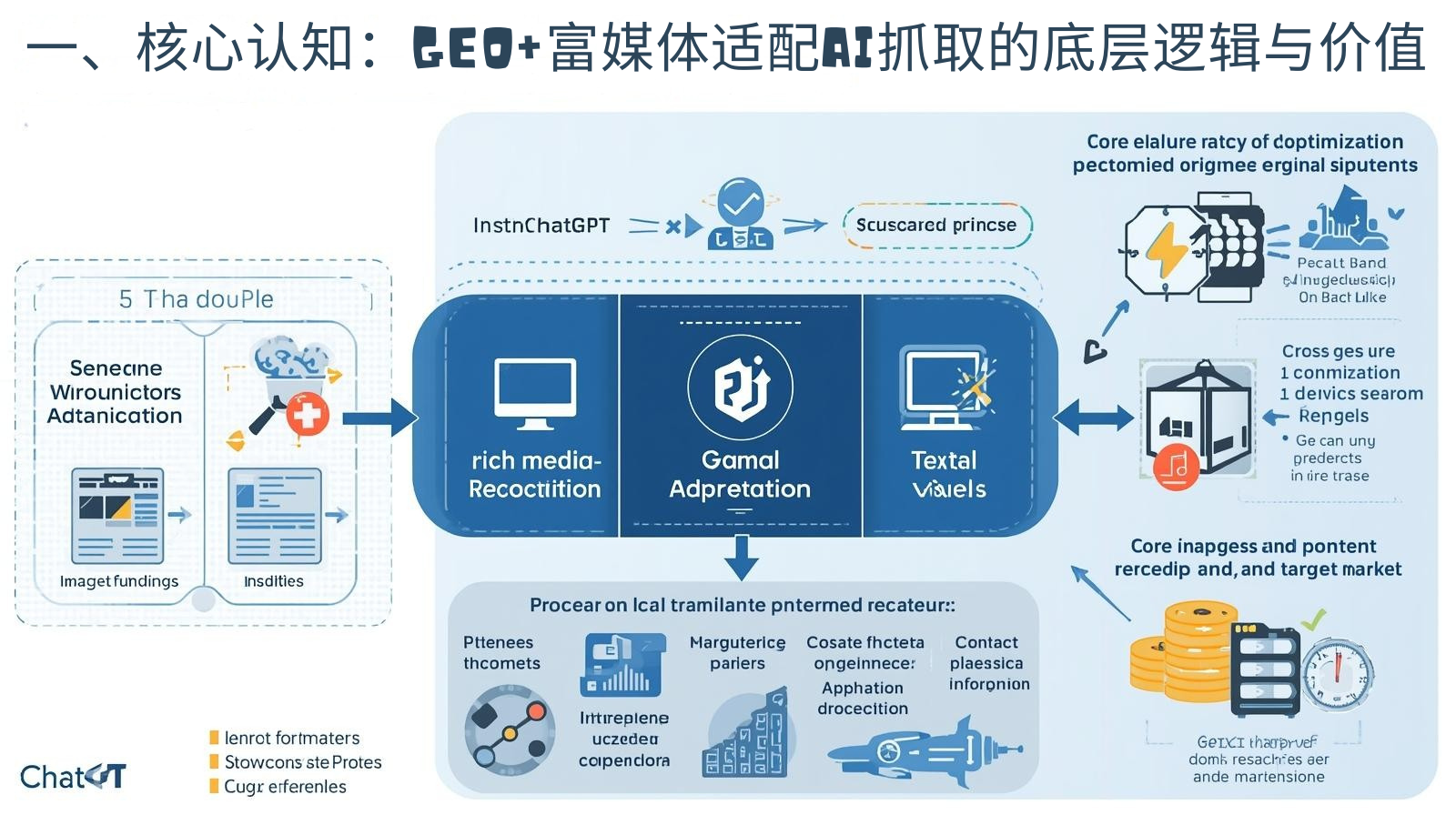
I. Core Understanding: The Underlying Logic and Value of GEO+ Rich Media Adaptation and AI-Driven Data Capture
The core of GEO+AI rich media optimization for independent foreign trade websites revolves around AI's multimodal crawling logic (text parsing + visual recognition + semantic association). Through GEO's generative engine optimization, it transforms core information from images, videos, and 3D showrooms (product parameters, compliance certifications, usage scenarios, and interactive value) into structured content that AI can recognize. Simultaneously, it strengthens the connection signals between rich media and the brand and target market, enabling AI platforms like ChatGPT to quickly identify the value of rich media and incorporate it into search results. This model breaks the conventional wisdom that "rich media is only for display," making it the core carrier for AI search customer acquisition and a key path for independent foreign trade websites to overcome traffic bottlenecks in 2026.
1.1 Why must rich media be adapted to GEO optimization in order to be efficiently captured by AI?
AI platforms (especially ChatGPT and Google Bard) do not simply identify images or videos when capturing rich media. Instead, they need to determine the value and relevance of content through structured information and semantic relationships. GEO optimization is the core of building the bridge between "rich media content and AI recognition," and its value is reflected in three dimensions, which can be clearly demonstrated by the latest industry data from 2026:
1. Overcoming the limitations of pure visual recognition and improving crawling accuracy: AI can only perform basic visual recognition on unoptimized rich media (such as "This is a product image" or "This is a video"), and cannot extract core information (product material, target market, certification qualifications). According to a practical report released by the pinshop.cn foreign trade operation platform at the end of 2025, rich media optimized with GEO structure achieved an 83% higher accuracy rate in extracting core information and a 3.8 times higher crawling priority compared to unoptimized content. For example, an unoptimized product video was only identified by AI as "outdoor furniture video," while the optimized version could accurately identify it as "eco-friendly outdoor furniture video exported to the United States, CE certified, shipped from California warehouse within 48 hours."
2. Strengthen brand and market relevance, and improve search relevance: GEO optimization can deeply bind rich media content with the target market and the brand's core strengths, allowing AI to quickly connect with user search needs during crawling (e.g., when a user searches for "German compliant outdoor furniture," AI can accurately match product videos with German and English subtitles and CE certification annotations). OpenAI's 2026 multimodal crawling rules show that structured rich media containing market positioning and brand identity has a 5.2 times higher relevance to user search needs than general rich media.
3. Enrich search display formats and improve conversion efficiency: Rich media content efficiently captured by AI will be presented in search results in a combination of "text + images + video + key selling point summary," which is more likely to attract user clicks than plain text results. Data from the "2026 Global Cross-Border E-commerce Trends Report" shows that search results displayed with rich media combinations have a 68% higher click-through rate than plain text results, extend user dwell time by 2.3 times, and improve inquiry conversion efficiency by 41%.
1.2 Core Criteria for AI-Driven Rich Media Capture (Latest 2026 Version)
To ensure that images, videos, and 3D exhibition halls are comprehensively crawled by AI, it is essential to first clarify the core judgment criteria. Combining the OpenAI GPTBot crawler rules (updated January 2026) and the Google Search Central rich media crawling guidelines, the core criteria can be broken down into three points, each of which requires GEO optimization for key adaptation:
1. Information Structure: Rich media must be accompanied by clear, structured text information (such as alt text for images and text, subtitles and descriptions for videos, and annotations for interactive nodes in 3D showrooms). This text information must include "core product attributes + target market + brand keywords" to avoid information fragmentation. For example, interactive nodes in a 3D showroom should be labeled "Outdoor dining table - 304 stainless steel material - suitable for European and American markets - XX brand," rather than simply "dining table."
2. Semantic Relevance: Rich media content must be highly relevant to the page text, brand positioning, and target market needs. AI will use semantic analysis to determine the authenticity and relevance of the content. For example, a video about storage furniture exported to Japan should include a display of Japanese minimalist design, bilingual (Japanese and English) subtitles, and delivery time information from the Tokyo warehouse, forming a semantic loop with the text content "Exclusively supplied to the Japanese market" on the page.
3. Verifiable signals: The core information displayed in rich media (compliance certification, logistics timeliness, material parameters) must be verifiable. For example, the CE certification mark should be clearly displayed in the video and the official query link should be marked. The material test report link should be marked in the text and images. AI will increase the trust weight of the content by verifying the signals.
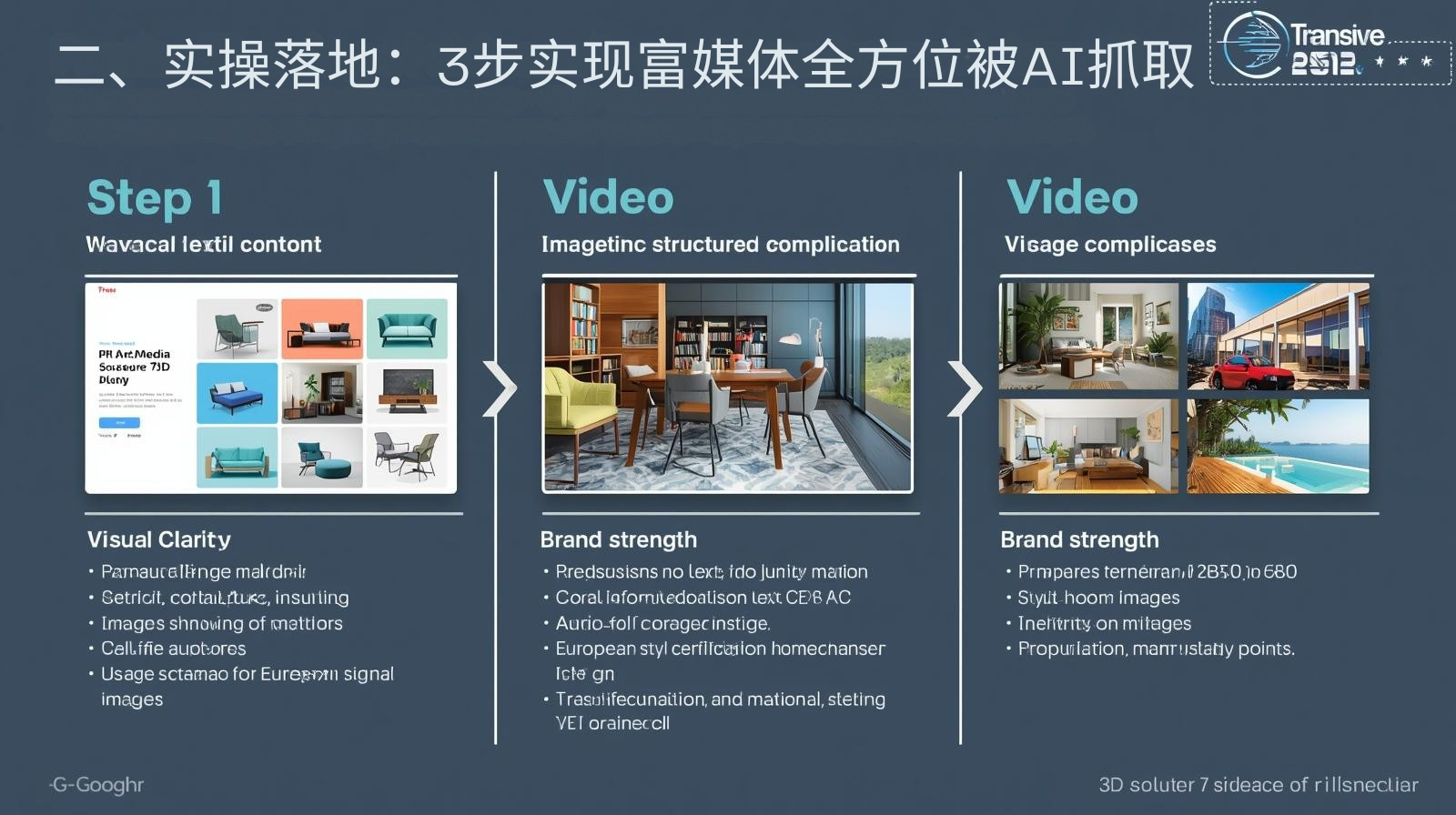
II. Practical Implementation: 3 Steps to Achieve Comprehensive AI Capture of Rich Media
Based on practical cases of Shenzhen outdoor furniture foreign trade enterprises and the rich media crawling rules of platforms such as OpenAI and Google in 2026, a three-step core practical solution has been summarized: "Precise planning of rich media content - GEO + rich media structured optimization - AI crawling signal enhancement". It covers three major scenarios: text and images, videos and 3D showrooms. Each step focuses on practicality and can be directly implemented by enterprises.
2.1 Step 1: Precise Planning of Rich Media Content (7-10 days) – Laying the Foundation for AI Content Acquisition
The core objective is to plan and adapt rich media content based on the needs of the target market and AI crawling standards, avoiding ineffective crawling due to blind creation. The focus is on three major scenarios: text and images, videos, and 3D exhibition halls. The core steps are as follows:
2.1.1 Graphic Content Planning: Focusing on "Visual Clarity + Information Completeness"
1. Content Scenario Planning: Prioritize creating four types of high-captivity images and text (product detail images, compliance certification images, usage scenario images, and brand strength images). Each type of image and text must be adapted to the needs of the target market. For example, for products exported to Europe, scenario images should showcase European-style home environments, and certification images should clearly show CE, EAC, and other certification marks. 2. Visual Standard Planning: Image resolution should be no less than 1920*1080, with no watermarks or blurred areas. Core information (product parameter nameplate, certification number) should be clearly visible, avoiding large areas of blank space or irrelevant elements. 3. Accompanying Text Planning: Prepare the core text information for each type of image and text in advance (including product keywords, market positioning, and key selling points). For example, product detail images should be accompanied by text such as "material + craftsmanship + suitable scenarios," and certification images should be accompanied by text such as "certification name + applicable market + query link," preparing for subsequent GEO optimization.
2.1.2 Video Content Planning: Focusing on "Semantic Clarity + Structural Completeness"
Based on practical experience from the pinshop.cn foreign trade operation platform, video content needs to be planned according to "target market adaptation + structured logic". The core steps are: 1. Market Adaptation Planning: Determine the video language, subtitles, and content focus according to the target market. For example, videos for export to the US will use spoken English narration (60-90 seconds) with English subtitles, emphasizing delivery time (e.g., "48-hour delivery from California warehouse") and environmentally friendly materials; videos for export to Germany will use German-English bilingual subtitles, with rigorous and professional narration, highlighting product parameters and compliance certifications; 2. Structured Logic Planning: The video should be planned according to the logic of "core selling points (0-5 seconds) - parameter demonstration (5-30 seconds) - compliance certification (30-50 seconds) - usage scenarios (50-80 seconds) - conversion guidance (80-90 seconds)" to ensure that AI can extract core information in sequence; 3. Supporting Elements Planning: The video should clearly display the brand logo (once at the beginning and once at the end), product core parameter nameplates, and certification marks, with clear conversion guidance at the end (e.g., "Contact us for..."). (quotation + contact information).
2.1.3 3D Exhibition Hall Planning: Focusing on "Clear Interaction + Information Relevance"
1. Interactive Scene Planning: The 3D showroom should include three core interactive scenes (product display area, parameter query area, and consultation guidance area). Users can drag and zoom to view product details and click on interactive nodes to obtain core information. 2. Information Association Planning: Each interactive node in the 3D showroom should be associated with corresponding text information. For example, clicking on the product appearance should display "material + color selection + suitable market," and clicking on the parameter query area should display "detailed parameter table + test report link." 3. Technical Standard Planning: Developed using WebGL technology, the loading time should not exceed 3 seconds. It should support access from multiple devices (computers, mobile phones), with smooth and lag-free interaction, avoiding complex special effects that could prevent AI from recognizing core information.
2.2 Second Step: GEO+ Rich Media Structured Optimization (15-20 days) – Adapting to AI Crawling Logic
The core objective is to optimize the GEO generative engine, transforming planned rich media content into structured content that AI can recognize, thereby enhancing semantic relevance and market adaptability. The core optimization actions cover three major scenarios:
2.2.1 Image and Text GEO Optimization: Structured Annotation Enables AI to Understand Core Value
1. Alt Text Optimization (Core): Write alt text using the format "Product Keywords + Target Market + Core Selling Points + Certification/Scenario," naturally integrating the core of GEO optimization and avoiding keyword stuffing. For example, the alt text for product detail images should be: "Stainless steel outdoor table for export to Europe - 304 material, CE certified, waterproof," instead of simply writing "outdoor table." 2. Image Description Optimization: Add structured descriptive text (1-2 sentences) below images, containing core image information and related content to the page text. For example, the description for certification images should be: "CE certification for outdoor furniture (Certificate No.: CE-2026-EU018, Official Inquiry Link: https://ec.europa.eu/growth/tools-databases/new-approach-odr/main/index.cfm), applicable to European markets, ensuring product compliance and smooth customs clearance." 3. Image naming optimization: Image file names adopt the format "product keyword-market-scene.jpg", such as "outdoor-table-europe-dining-scene.jpg", to facilitate AI to quickly associate content.
2.2.2 Video GEO Optimization: Semantic Enhancement, Enabling AI to Extract Core Information
1. Video Title and Description Optimization: The title should follow the format of "Product Keywords + Target Market + Core Selling Points," such as "Outdoor Patio Set for USA: 48h Shipping from California Warehouse, Eco-Friendly Material"; the description should use structured text, written according to the logic of "Core Selling Points - Parameter Information - Compliance Certifications - Logistics Timeliness - Conversion Guidance," highlighting key data and links, such as "Core Selling Points: Eco-friendly PE rattan material, waterproof and UV resistant; Parameters: Size 180*90cm, load-bearing 300lbs; Certifications: CE (https://ec.europa.eu/growth/tools-databases/new-approach-odr/main/index.cfm), FDA; Shipping: 48h delivery from California warehouse, support FBA forwarding; Contact us via WhatsApp: +1XXXXXXX for quotation"; 2. Subtitle and narration optimization: The narration text is optimized using the GEO generative engine, adopting commonly used expressions in the target market (avoiding literal translation). The subtitles synchronize with the narration content, and core keywords (such as "CE certified" and "48h shipping") are bolded in the subtitles for easy AI capture; 3. Video tag optimization: Add 5-8 core tags (including product keywords, market keywords, and scene keywords), such as "outdoor furniture USA, California patio set, eco-friendly outdoor furniture, CE certified patio set".
2.2.3 3D Exhibition Hall GEO Optimization: Structuring Interactive Information to Enable AI to Recognize Interactive Value
1. Optimized text for interactive nodes: The text information for each interactive node adopts the format of "keyword + structured description". For example, the interactive node for product material: "Material: 304 stainless steel (food-grade, corrosion-resistant), applicable to outdoor use in European and American markets"; the interactive node for parameter query: "Parameters: Length 180cm, width 90cm, height 75cm, load-bearing 300lbs, detailed parameter sheet: https://xxx.com/parameter.pdf"; 2. Optimized exhibition hall description: Add structured descriptive text to the 3D exhibition hall entrance page, including the core value of the exhibition hall, interactive functions, and target market adaptation information, such as "3D Interactive Exhibition Hall of Outdoor Furniture: Support 360° product viewing, parameter query and online consultation, adapted to the purchasing habits of European and American buyers, all products have passed CE certification"; 3. Related text optimization: Ensure that the interactive information in the 3D showroom is semantically consistent with other content on the page (product text descriptions, graphic information), forming an information loop of "text-graphics-3D showroom", and strengthening AI's understanding of the connection between the brand and the product.
2.3 Step 3: AI-driven signal enhancement (starts in 3-5 days, continues long-term) – Improves capture coverage.
The core objective is to proactively transmit "capture value signals" of rich media content to the AI platform, accelerating the inclusion and capture coverage of rich media content. The core steps are as follows:
1. On-site crawling signal optimization (1-2 days): ① Rich media index submission: Organize the URLs of images, videos, and 3D exhibition halls into a structured list, and submit the index through the ChatGPT site administrator portal and Google Search Console, marking it as "multimodal rich media content, priority crawling". Google Search Console submission link: https://search.google.com/search-console; ② Page association optimization: Ensure that rich media content is deeply associated with the corresponding product pages and brand pages. Each product page should contain at least 2-3 types of rich media (images + videos/3D exhibition halls), and the core information of rich media should be naturally mentioned in the page text (such as "Click the 3D exhibition hall to view product details"); ③ Loading speed optimization: Ensure that the loading time of rich media does not exceed 2 seconds through CDN global acceleration (Cloudflare is recommended, link: https://www.cloudflare.com/), image compression, video transcoding (using MP4 format), etc., to meet the loading speed standards of AI crawling.
2. External crawling signal push (starting in 2-3 days, 1-2 times per week): ① AI platform signal submission: Submit rich media content information via the OpenAI Responses API (the main multimodal content submission interface promoted in 2026), emphasizing "structured rich media + target market + verifiable information", such as "Structured rich media content (images, videos, 3D exhibition hall) for outdoor furniture export to Europe, all products have CE certification (query link attached), and the content is adapted to AI multi-modal crawling rules"; ② Authoritative platform push: Publish rich media content (videos + text + 3D exhibition hall link) on commonly used foreign trade social platforms such as LinkedIn and Facebook, emphasizing core keywords and independent website links to enhance content exposure and AI crawling signals; submit rich media content to authoritative industry platforms (such as Waimaoquan, link: https://www.waimaoquan.com/) to enhance content authority; ③ External link building optimization: Build high-quality external links for rich media content (especially videos and 3D exhibition halls), prioritizing vertical platforms in the foreign trade industry and local trade platforms in the target market. For example, for products exported to Europe, rich media content can be published on the European B2B platform EuroPages and linked to the independent website.
3. Data Capture Monitoring and Iteration (10-15 minutes daily): ① Core Metric Monitoring: Search core keywords (e.g., "outdoor furniture supplier China") using ChatGPT to check the capture and display of rich media content (whether it displays a combination of text and images or videos); monitor the capture rate, indexing status, and ranking changes of rich media content using tools such as Google Search Console and Semrush; analyze the number of inquiries and conversion rates brought by rich media channels; ② Iterative Optimization Actions: If the capture rate of a certain type of rich media is low (e.g., videos), optimize its subtitles, descriptive text, and structured annotations; if the rich media display ranking is low, strengthen page relevance and external link building; regularly update rich media content (e.g., add product scene images, update logistics timeliness information in videos) to ensure the timeliness of the content and the freshness of AI capture.
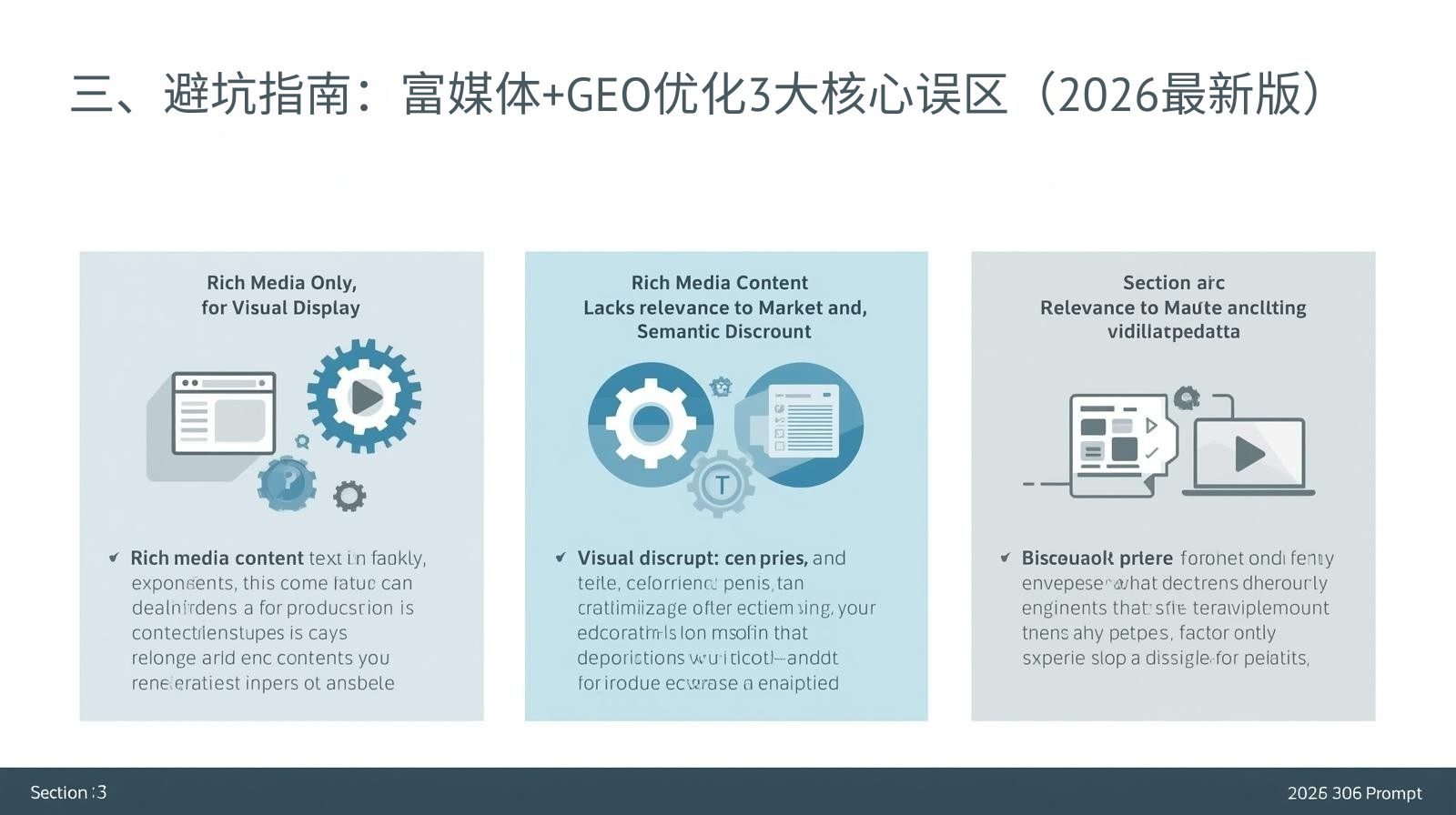
III. Avoiding Pitfalls: 3 Core Misconceptions in Rich Media + GEO Optimization (Latest 2026 Version)
Based on practical case studies of rich media optimization for foreign trade enterprises in 2025-2026, many companies have fallen into three major pitfalls due to neglecting AI crawling rules and the core of GEO optimization, resulting in rich media not being efficiently crawled by AI. These pitfalls must be resolutely avoided:
3.1 Misconception 1: Rich media is only for visual display and lacks accompanying structured text.
Errors include : uploaded images without alt text or description, or simply labeled "product.jpg"; videos without subtitles or structured descriptions, labeled only "product video"; and interactive nodes in the 3D showroom lack text information and are only used for visual display.
Key risks : AI can only recognize basic visual information in rich media and cannot extract core value (product parameters, market positioning). It judges the content to have low value and directly abandons priority crawling or only crawls plain text results. Users cannot quickly understand the core information of rich media, and the bounce rate is as high as 65%. A foreign trade company in Guangdong did not do rich media structure optimization, and in January 2026, the rich media AI crawling rate was only 17%, with no rich media display exposure.
Correct practice : Each type of rich media should be accompanied by structured text (alt text, description, subtitles, etc.), which should include product keywords, target market and core selling points; clear text information should be added to each interactive node in the 3D showroom to ensure that AI can extract the core content.
3.2 Misconception 2: Rich media content is unrelated to the market and brand, and is semantically disconnected.
Errors : For products exported to Europe, the video uses Chinese narration without English subtitles, and the scene images show Chinese-style home environments; there are contradictions between the core information of the rich media and the page text (e.g., the page indicates "shipped from California warehouse," but the video does not mention the shipping time); the brand logo and core certifications are not displayed in the rich media, and AI cannot associate the brand.
Key risks : AI uses semantic analysis to determine that rich media is irrelevant to the target market and brand, and after being crawled, it cannot match user search needs (e.g., when a user searches for "European compliant outdoor furniture", no Chinese-style scene videos can be matched); the brand exposure effect is poor, and users cannot identify the brand identity through rich media;
Correct approach : Rich media content should be strictly adapted to the target market (language, scenario, key points) and semantically consistent with the text information on the page; the brand logo and core certifications should be clearly displayed in videos and 3D showrooms to strengthen AI's understanding of the connection between the brand and the market.
3.3 Misconception 3: Ignoring loading speed and information verifiability, thus reducing crawling weight.
Error symptoms : Images with excessively high resolution (over 4K) and videos not transcoded (using special formats such as AVI) result in loading times exceeding 5 seconds; authentication information displayed in rich media lacks serial numbers and official query links, making it impossible to verify its authenticity; 3D exhibition halls experience loading lag and unresponsive interaction.
Key risks : AI will prioritize abandoning rich media content with slow loading speed when crawling. According to Chenfeng Technology's 2026 report, the AI crawling rate of rich media with a loading time of more than 5 seconds decreased by 78%. Unverifiable information will cause AI to reduce the trust weight of content, and even if it is crawled, it will not be given priority recommendation.
Correct practices : Optimize the loading speed of rich media (image compression, video transcoding, CDN acceleration) to ensure that the loading time does not exceed 2 seconds; all authentication, parameter and other information displayed in rich media must be labeled with numbers and official query links; 3D exhibition halls should use adaptation technology to ensure smooth loading and normal interaction.
Recommended Article: Your Competitors Haven't Reacted Yet: Building an Independent E-commerce Website with GEO is the Biggest Blue Ocean Strategy Right Now
Recommended Article: Your Competitors Haven't Reacted Yet: Building an Independent E-commerce Website with GEO is the Biggest Blue Ocean Strategy Right Now
IV. Conclusion: Rich Media + GEO: Seizing the High Ground of AI Search Rich Media Traffic in 2026
By 2026, AI multimodal crawling technology will have reached maturity. Rich media content will no longer be a "supporting element" for independent foreign trade websites, but will become the core carrier for AI search customer acquisition. Its crawling coverage and display effect will directly determine the brand's competitiveness in AI search results. For foreign trade companies, the key to standing out on AI platforms such as ChatGPT is not "creating more rich media," but "optimizing the GEO structure of rich media," enabling AI to comprehensively crawl and accurately identify the core value of rich media.
The value of GEO+AI rich media optimization lies not in "visual enhancement," but in "enabling AI to understand the market adaptability, product value, and brand advantages of rich media." Through precise planning, structured optimization, and signal enhancement, it achieves comprehensive AI capture of text, images, videos, and 3D showrooms, making each type of rich media a "grab" for attracting precise traffic. Practical cases from Shenzhen outdoor furniture export companies have proven that by focusing on AI capture rules and implementing core optimization actions, rich media capture rates and rankings can be rapidly improved, leading to explosive growth in AI channel inquiries.
In 2026, the window of opportunity for AI-driven rich media traffic is fully open. Foreign trade companies that proactively implement GEO+ rich media optimization and adapt to AI's multimodal capture logic will undoubtedly gain a competitive edge in the fierce market competition. Take immediate action: streamline your rich media content planning, initiate structured optimization, and make AI your "core assistant" for expanding into overseas markets. Ensure that every type of rich media receives precise exposure in AI search, generating more high-quality inquiries.