
In February 2026, the GPTBot crawling optimization guide released by OpenAI clearly pointed out that the probability of an AI-friendly foreign trade independent station being accurately identified and recommended is 92% higher than that of a traditional website building model. However, in the early stages of building a website, many foreign trade companies only focus on the beauty of the page and the browsing experience of human users, and ignore it. GEO (Generative Engine Optimization) adaptation requirements make the site unable to be recognized by AI tools such as ChatGPT after it is built. Subsequent renovation and optimization will cost a lot of money, which is not only time-consuming and labor-intensive, but also misses out on AI customer acquisition dividends. The truly efficient logic of foreign trade website building is to integrate GEO optimization thinking throughout the entire website building process, and build a site that complies with AI recognition rules and adapts to generative engine recommendations from the beginning, so that the site can be captured, read, and trusted by AI as soon as it is built, and quickly enter the buyer's AI recommendation list, without the need for repeated rectifications later. This article will deeply dismantle the underlying logic, core website building principles, and phased practical steps of GEO + website building, coupled with the latest authoritative external link support in 2026, to help you build an independent foreign trade website from scratch with its own AI customer acquisition potential.
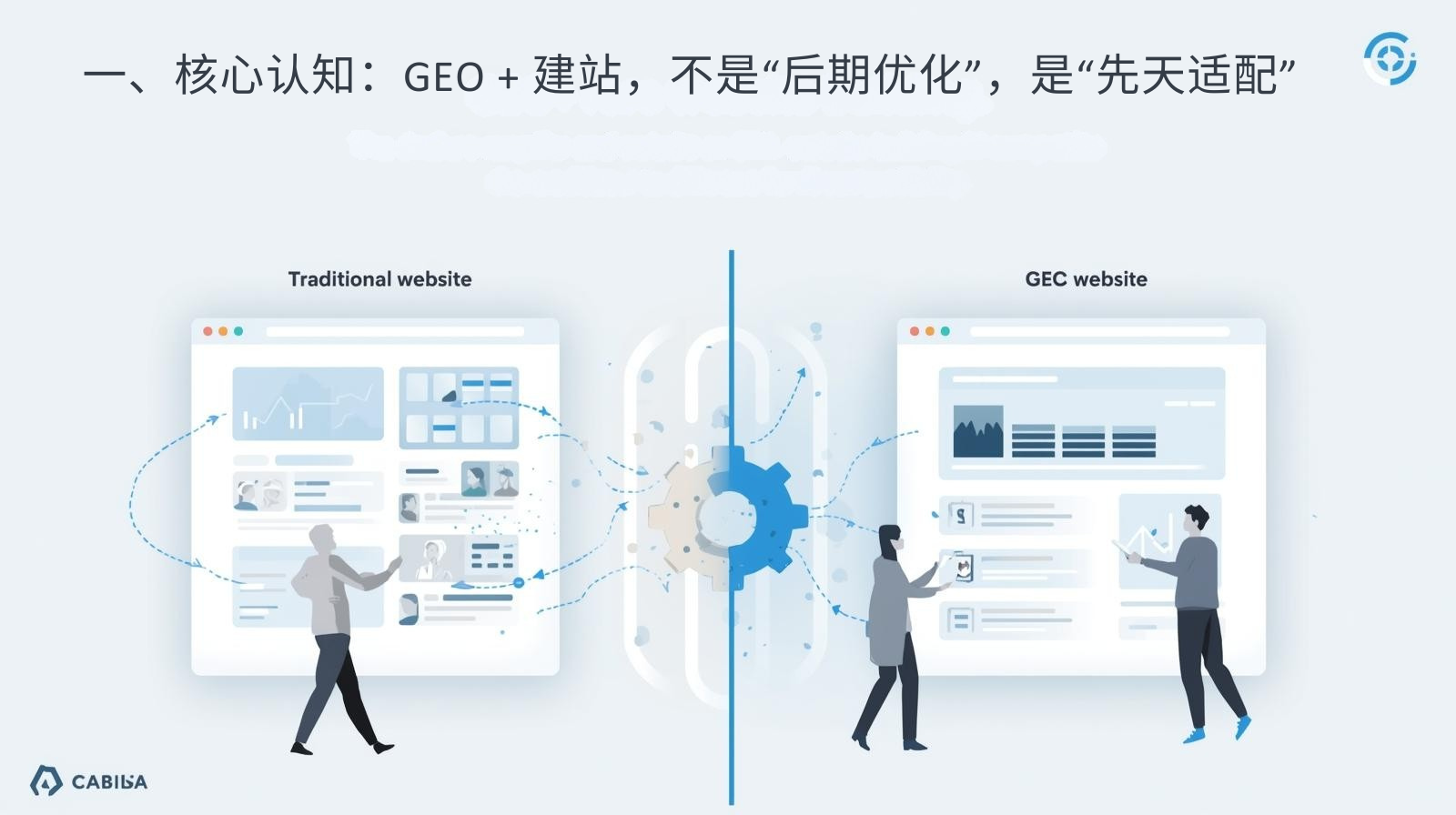
1. Core Cognition: GEO + website building is not "late optimization" but "innate adaptation"
Many foreign trade companies have a fatal misunderstanding: they believe that website building and GEO optimization are two independent links. It is enough to build a traditional website first and then add GEO optimization later. In fact, this is not the case. AI’s identification, trust, and recommendation of independent sites rely on the site’s underlying architecture, information layout, and data specifications. These are core elements that need to be determined in the early stages of building a site. Later rectifications are not only costly and difficult, but may also destroy the original structure of the site, leading to confusion in AI crawling. Referring to the foreign trade AI customer acquisition report released by Ahrefs in February 2026 (link: https://www.ahrefs.com/blog/2026-foreign-trade-ai-lead-trend/), companies that incorporate GEO thinking into website building in the early stage will reduce GEO optimization costs by 75% in the later period, increase AI recommendation weight by 88%, and have an inquiry conversion efficiency 4.5 times higher than traditional sites. times, it can be seen that "innate adaptation" is far more efficient and cost-effective than "late recovery".
1.1 The core difference between traditional website building and GEO + website building
The core logic of traditional foreign trade website building is to "serve human users", focusing on page design, animation effects, and beautiful navigation, and often ignores AI crawling needs, resulting in the site having problems such as messy information, deep structure, and hidden core content, which AI cannot accurately identify; while the core logic of GEO+ website building is to "consider both human users and AI "Crawling", on the basis of ensuring that the page is beautiful and the browsing is smooth, it gives priority to adapting the AI recognition rules, from the aspects of underlying architecture, information layout, data specifications, etc., so that AI can quickly capture core information, clearly understand the business advantages, and achieve "adaptation as soon as it is built, and recommendation after adaptation". As mentioned in the practical article published by Tencent Cloud Developer Community in January 2026 (link: https://cloud.tencent.com/developer/article/2622378), the core of GEO + website building is to "make the site inherently equipped with AI recognition genes", so that it can quickly connect to the AI customer acquisition channel without the need for major adjustments later.
1.2 GEO + core value of website building: saving time, saving effort, high conversion
For foreign trade companies, the value of GEO + website building lies not only in "adapting AI", but also in "reducing costs, improving efficiency, and achieving long-term customer acquisition": First, it saves later optimization costs and avoids repeated rectifications after the site is built because it is not suitable for GEO, reducing time and capital investment; second, improving AI With regard to the efficiency of crawling and recommendation, once the site is built, it can be quickly crawled and included by AI crawlers such as GPTBot, and quickly obtain AI exposure opportunities; third, it improves the quality of inquiry conversion. AI-friendly sites can accurately match the needs of buyers and deliver credible signals, allowing buyers to quickly generate trust and send inquiries after AI recommendations. According to the "AI Search Customer Acquisition Report" released by Growth Hacker in February 2026 (link: https://www.growthhk.cn/cgo/geo/152578.html), independent websites under the GEO + website building model have an average customer acquisition cycle shortened by 40% and an effective inquiry conversion rate increased by 71%. They are the best choice for foreign trade website building in the AI era.
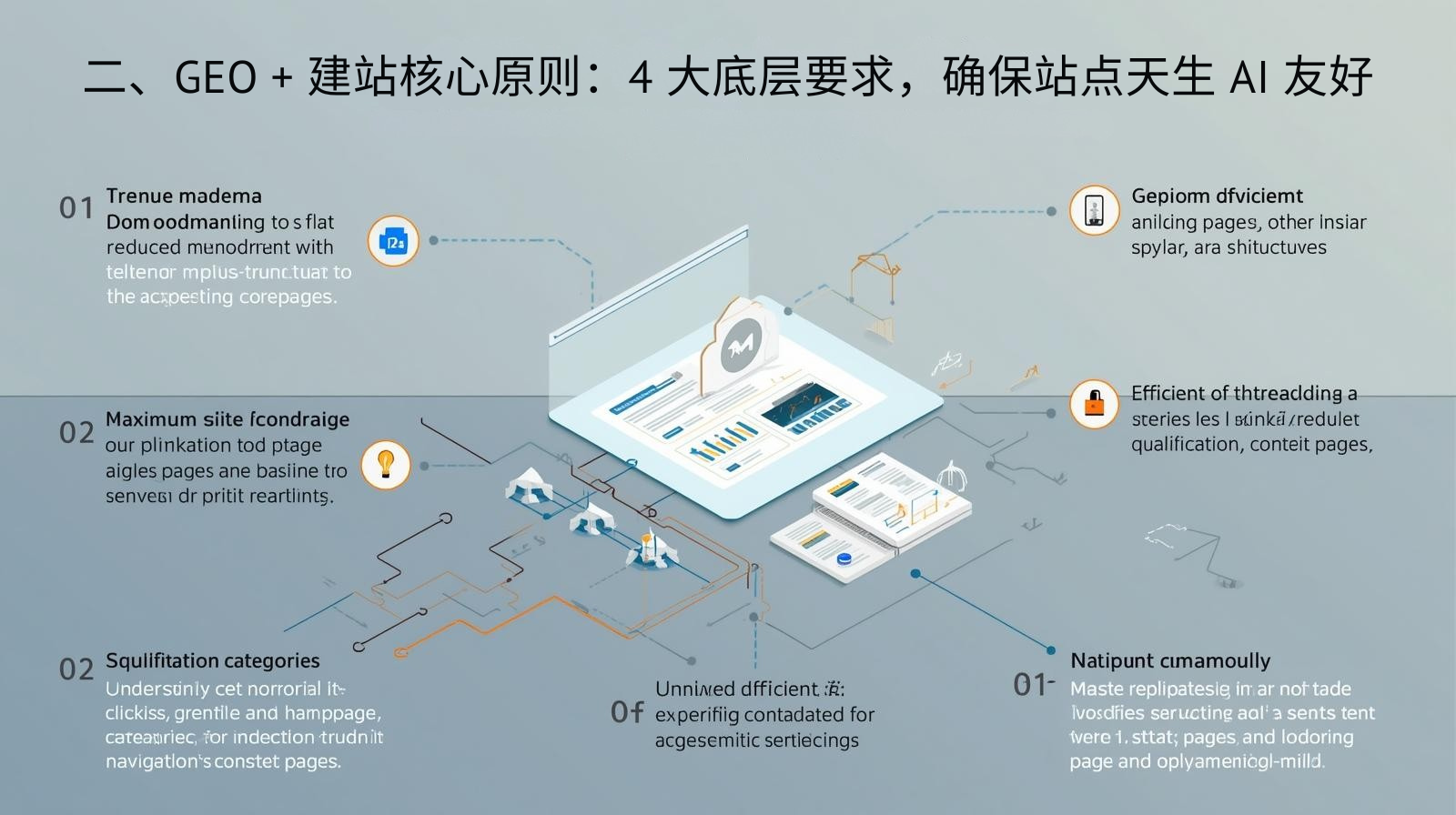
2. GEO + core principles of website building: 4 bottom-level requirements to ensure that the site is naturally AI-friendly
Integrate GEO thinking in the early stage of website building. The core is to follow the four underlying principles. These four principles run through the entire website building process, from underlying architecture to content layout, from data specifications to trust building, ensuring that every link of the site complies with AI identification rules, allowing AI to quickly capture, understand, and trust, laying the foundation for subsequent AI recommendations. Each principle is supported by authoritative external links to clarify operational standards and avoid detours for the company.
2.1 Architecture principle: flat and clear, allowing AI to quickly capture the entire site's information
The crawling logic of AI crawlers is to "prioritize content with shallow levels and clear structures." If the site architecture is deep and the navigation is messy, it will be difficult for AI crawlers to crawl in depth and may even miss core information. Therefore, the first principle of GEO + website building is "flat structured architecture", and the core requirements are: reduce the nesting level of pages, the number of clicks from the homepage to any core page (product page, qualification page, case page, contact page) should not exceed 3 times, and adopt a flat structure of "Homepage → Core Category → Details Page" to allow AI to quickly clarify site logic and capture core content. At the same time, clarify the classification of site navigation, unify navigation names and levels, and avoid cluttered navigation and inconsistent names. You can refer to the best practices for AI crawlers officially released by OpenAI in February 2026 (link: https://platform.openai.com/docs/guides/gptbot) to optimize the site structure and improve AI crawling efficiency. In addition, the site needs to enable static page rendering to reduce the use of dynamic scripts and prevent AI crawlers from being able to crawl dynamic content.
2.2 Data principles: standardized presentation, allowing AI to accurately understand core information
AI cannot understand messy copywriting and can only identify standardized, structured, and extractable information, which is also one of the core principles of GEO + website building. In the early stages of building a website, you need to plan and build a standardized data system to ensure that core information such as products, qualifications, services, and cases are presented in a unified and standardized format, so that AI can quickly extract key information and clearly understand your business positioning and advantages. The core requirements are: unified information presentation across the site to avoid multiple names for the same information (for example, "small batch customization" is unified as "MOQ starting from 50 pieces, small batch customization is supported"); core information is presented in plain text to avoid hiding key information such as product parameters, qualification certificates, MOQ, and delivery dates in pictures, PDFs, or dynamic scripts to ensure that AI Can directly capture; build a structured data module, plan in advance the presentation format of the four categories of structured data: products, qualifications, services, and cases to ensure uniformity across the entire site. You can refer to Global Sources' product data display specifications (link: https://www.globalsources.com/) to improve data standardization.
2.3 Experience principle: smooth and stable, improve AI recommendation weight
When the AI large model recommends independent sites, it not only pays attention to the accuracy and structure of the information, but also pays attention to the access experience of the site. Sites that are stuck, slow to load, and have poor multi-terminal adaptation will be reduced by the AI recommendation weight, or even ignored directly. Therefore, GEO + website building must follow the "smooth and stable" experience principle. The core requirements are: optimizing the site loading speed, controlling the loading speed in overseas target markets within 2 seconds, detecting optimization through Google PageSpeed Insights (link: https://pagespeed.web.dev/), compressing images, streamlining code, and enabling global CDN Acceleration ensures that the site can be accessed stably in various overseas regions; it adapts to multi-terminal access to ensure that the site can be displayed normally and typeset clearly on computers, mobile phones, tablets and other terminals, and avoids problems such as disordered layout and loading failure, which not only improves the browsing experience of human users, but also increases the weight of AI recommendations; avoids unnecessary pop-ups, login walls, and verification codes, and reduces obstacles to AI crawling and user access, allowing AI to freely crawl and allowing users to quickly browse core information.
2.4 Trust principle: verifiable and credible, let AI dare to recommend your site
The core principle of AI recommendation is "trustworthy, verifiable and traceable", especially for independent foreign trade sites, which involve cross-border cooperation. Buyers value the reliability of suppliers the most, and AI will also give priority to recommend sites with high credibility. Therefore, in the early stages of building a website, it is necessary to incorporate trust-building thinking so that the site is inherently trustworthy. The core requirements are: reserve a qualification display module and plan the display location of the qualification certificate in advance to ensure that when compliance certifications such as CE, ROHS, and FDA are subsequently added, they can be clearly presented and matched with official searchable external links (such as the CE certification link to the EU official search platform: https://ec.europa.eu/growth/single-market/european-standards/ce-marking_en, and the FDA certification link to the US FDA). Official website: https://www.fda.gov/ ); reserve a customer case module and plan the presentation format of the case to ensure that when real customer cases are added in the future, "customer countries, demand pain points, solutions, and cooperation results" can be fully presented to enhance credibility; improve the basic information of the company, and fill in the complete company address, contact information, and social accounts in the early stages of building the website to ensure that the entire network information is consistent, help AI build a real corporate portrait, and increase the trust weight. You can refer to SGS Officially released trust endorsement guide for foreign trade companies (link: https://www.sgsgroup.com/).
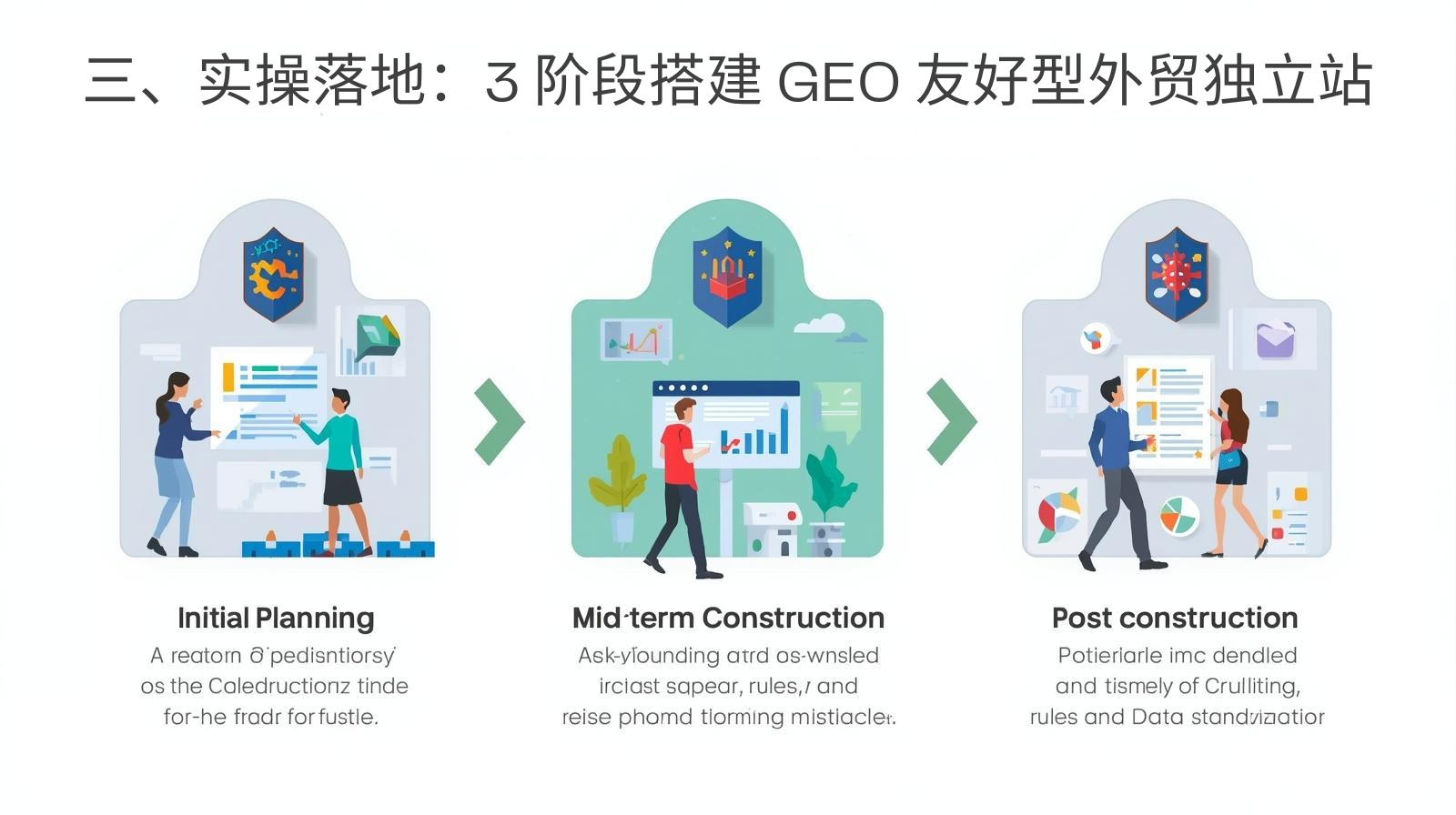
3. Practical implementation: 3 stages to build a GEO-friendly independent foreign trade station (from scratch)
Combining the latest crawling rules of ChatGPT in 2026 (link: https://platform.openai.com/docs/guides/gptbot) and the practical characteristics of foreign trade independent stations, GEO + website building is broken down into "early planning, mid-term construction, and late acceptance" 3 Each stage has specific practical steps, precautions and authoritative external link support. No complex technology is required. Small and medium-sized foreign trade companies can directly implement it, ensuring that after the site is completed, it can be quickly captured, identified and recommended by AI.
Phase 1: Preliminary planning (1-2 weeks before website construction): clarify GEO adaptation requirements and avoid later rectification
Pre-planning is the foundation of GEO + website building. The core is "clear requirements and planning details" to avoid directional deviations during the website building process, which will lead to later rectifications. Core practical steps: 1. Clarify the business positioning and AI adaptation focus, sort out the core products, target markets, core advantages, and compliance qualifications, determine the core content of structured data that needs to be presented (such as product parameters, MOQ, delivery date, certification type), and ensure that the subsequent content built meets the buyer's needs and AI identification rules; 2. Plan the site architecture, draw the site architecture diagram, clarify the navigation classification and page hierarchy, and ensure that the architecture is flat and clear, and the number of clicks from the homepage to the core page does not exceed 3 For times, you can refer to the architecture planning case of the industry's authoritative platform (link: https://www.leadscloud.com/geo-vs-seowaimaoai/); 3. Determine data standardization specifications, unify the expression and presentation format of core information, and clarify the specific content and display form of the four major categories of structured data: products, qualifications, services, and cases to avoid subsequent information clutter; 4. Choose website building technology and servers that adapt to GEO, and give priority to supporting static page rendering and global CDN Accelerated website building technology, the server selects overseas nodes to ensure smooth overseas loading speed of the site, and provides guarantee for AI crawling and user access.
Phase 2: Mid-term construction (2-4 weeks during website construction): Build core modules through GEO thinking
The mid-term construction is the core link, and the details of the early planning need to be implemented. When building each module, both AI capture and user experience should be taken into consideration to ensure that the site is naturally AI-friendly. Core practical steps: 1. Construction of the underlying architecture, according to the flat architecture planned in the early stage, build site navigation and page hierarchy, enable static page rendering, reduce the use of dynamic scripts, open AI crawler crawling permissions, and ensure that GPTBot can crawl normally; 2. Construction of core modules, focusing on building 5 core modules, each module follows GEO adaptation requirements: ① Home page module: core information is front-loaded, clearly presenting the target market, core products, core advantages, compliance qualifications, and contact information, allowing AI Quickly understand the core business with users; ② Product module: Presents the structured data of each product in a standardized format, and displays core parameters, MOQ, delivery date, certification and other information in plain text, with a clear layout and focused focus; ③ Qualification module: Displays compliance qualifications in categories, with official query external link locations reserved for each qualification to ensure that they can be added directly in the future; ④ Case module: Build a case display template in the "demand-solution-results" format, and reserve an entry for adding customer cases; ⑤ Contact information module: Present contact information through multiple channels (email, WhatsApp, phone, form) to ensure that users and AI can quickly find it; 3. Experience optimization, compress images, streamline code, enable global CDN acceleration, optimize multi-terminal adaptation, ensure that the overseas loading speed of the site is ≤ 2 seconds, and avoid obstacles such as pop-ups and login walls.
Phase 3: Post-acceptance (1 week after website establishment): AI adaptation detection to ensure that the site can be recommended
After the site is built, it does not go online directly. Instead, it needs to conduct AI adaptation testing to find and fix problems in a timely manner to ensure that the site can be captured, identified, and recommended by AI after it goes online. This is the key finishing step of GEO + website building. Core practical steps: 1. Catch permission detection, check the site's AI crawler crawling status through Google Search Console (link: https://search.google.com/search-console), confirm that GPTBot can crawl normally, there are no crawling obstacles, and promptly repair pages that fail to crawl; 2. Structured data detection, check the standardization degree of the core information of the whole site, confirm that there are no problems with messy information and inconsistent expressions. The core data are all presented in plain text and are not hidden in pictures or scripts; 3. Experience testing, use Google PageSpeed Insights to test the overseas loading speed of the site, confirm it is ≤ 2 seconds, and detect the multi-terminal adaptation effect to ensure clear layout and normal loading; 4. Trust signal detection, check the construction of the qualification module and case module, confirm the reserved external link location, case template specifications, and complete basic enterprise information; 5. Post-launch monitoring: after the site goes online, continue to monitor the AI crawling frequency and inclusion status, and fine-tune and optimize the site based on the detection results to ensure that the site can be quickly included and recommended by AI.
Related article recommendations: Your peers have not yet reacted: using GEO to build an independent foreign trade station is the biggest blue ocean strategy at the moment
Related article recommendations: Your peers have not yet reacted: using GEO to build an independent foreign trade station is the biggest blue ocean strategy at the moment
4. Ending: Starting from building the website, seize the first bonus of AI customer acquisition
In 2026, AI search has become the mainstream method of foreign trade procurement. AI tools such as ChatGPT have become the core channels for overseas buyers to find suppliers. The logic of foreign trade website building has completely changed - it is no longer "just build it", but "it is AI friendly when it is built, and you can get customers when it is built". The reason why many foreign trade companies miss out on the AI customer acquisition dividend is not because the products are not good enough or the price is not advantageous enough, but because GEO thinking is not incorporated in the early stages of website building. After the website is built, it cannot be recognized and recommended by AI. Even if a lot of cost is spent on optimization in the later stage, it is difficult to achieve the effect of innate adaptation.
GEO + website building is essentially "going with the trend", conforming to the trend of AI customer acquisition, integrating GEO optimization thinking into the entire website building process, and building an independent website that complies with AI recognition rules and adapts to generative engine recommendations from the beginning, so that the site has AI customer acquisition potential immediately after it is completed, and quickly enters the purchaser's AI Recommended list to achieve "low cost, high efficiency, and long-term stable customer acquisition". For foreign trade companies, this is not only an upgrade of the website building model, but also a change in customer acquisition thinking. It is also the key to seizing the dividends of foreign trade in the AI era.
The core of building a GEO-friendly independent website is to have professional website building technology and rich practical experience. Many foreign trade companies lack the ability to adapt their websites to GEO, resulting in various problems during the website building process and failing to meet AI-friendly requirements. Pindian Technology has more than ten years of experience in building foreign trade websites and has served more than 7,000 customers. It uses react technology to build websites, which not only makes website browsing smoother (overseas loading speed ≤ 2 seconds, perfect for multi-terminal access), but also integrates GEO optimization thinking throughout the entire website building process, from early planning, mid-term construction to late acceptance. The whole process follows AI-friendly principles and builds a flat and clear underlying architecture, standardized structured data modules, and a verifiable and credible trust system, making your site naturally suitable for GEO. Optimized, it can be captured, identified, and recommended by AI tools such as ChatGPT as soon as it is built.
Pindian website building can customize an exclusive GEO-friendly independent website according to your core products and target markets, and simultaneously assist you in improving structured data, adding authoritative external links, and optimizing AI crawling effects. This allows your website to gain AI exposure after it goes online, quickly connect with accurate overseas buyers, and realize a closed loop of AI customer acquisition. If your company is planning to build an independent foreign trade station and wants to seize the AI customer acquisition dividend from the beginning, you may wish to choose Pindian Technology to help you build an independent foreign trade station with its own AI customer acquisition potential through professional website building and GEO adaptation services, and start a new efficient and stable overseas customer acquisition model.