
In February 2026, OpenAI released the GPTBot Crawling Optimization Guidelines, which showed that independent foreign trade websites using structured data had an 89% higher probability of being accurately identified and recommended by AI than ordinary websites. Websites lacking structured data, even with high-quality products and rich content, were often misread or ignored by AI and failed to appear on the purchasing recommendation lists of AI tools like ChatGPT. Many foreign trade companies, when doing GEO (Generative Engine Optimization), only focus on content creation and backlink building, neglecting the core underlying logic of structured data—which is equivalent to "labeling and archiving" your independent website's products and services, allowing AI to quickly and accurately capture core information, clearly understand your business positioning, product parameters, and service advantages, and thus accurately recommend you to target customers when buyers ask questions. This article will deeply analyze the core significance of GEO structured data, the core types adapted to AI, and provide directly implementable practical steps and authoritative backlink support to help you open the AI recognition channel, allowing AI to understand your products and services at a glance and achieve precise customer acquisition.

I. Core Understanding: Why GEO structured data is the "key" to AI recognition.
In the era of AI search, the logic behind large models like ChatGPT in identifying independent foreign trade websites is no longer "word-by-word reading," but rather "quickly extracting key information and building business understanding." Structured data is the "key" that helps AI efficiently accomplish this task. Simply put, the content of ordinary websites is like "a jumbled pile of goods," requiring AI to spend a lot of time filtering and interpreting it, and it may even misinterpret it. Structured data, on the other hand, is like "categorized, archived, and labeled goods," allowing AI to instantly find core information and accurately match buyers' needs. Referring to Ahrefs' February 2026 report on AI-driven customer acquisition in foreign trade (link: https://www.ahrefs.com/blog/2026-foreign-trade-ai-lead-trend/), foreign trade companies that optimized their GEO structured data saw a 120% increase in the frequency of AI-recommended products and a 71% increase in the conversion rate of accurate inquiries, demonstrating the decisive role of structured data in AI recognition.
1.1 Without structured data, AI will face three major recognition challenges.
Many foreign trade companies' independent websites have core information such as product parameters, service scope, and compliance qualifications scattered throughout the text, lacking a unified format and standard. This leads to three major challenges for AI recognition, ultimately preventing accurate recommendations: ① Inefficient information extraction: AI needs to read through large amounts of text paragraph by paragraph to find the core information, resulting in extremely low extraction efficiency and even missing key parameters (such as MOQ, delivery time, and certification qualifications); ② Inconsistent information interpretation: Inconsistent wording for the same type of information (e.g., "small batch customization" sometimes written as "MOQ 50 pieces," sometimes as "supports small orders") prevents AI from forming a stable understanding and misjudges product advantages; ③ Failure to match needs: AI cannot quickly and accurately match your products and services with the buyer's needs (e.g., "EU CE certification, furniture supplier with MOQ 50 pieces"), and even if you meet the needs, you cannot be recommended. As mentioned in the practical article published by Tencent Cloud Developer Community in January 2026 (link: https://cloud.tencent.com/developer/article/2622378), independent foreign trade websites lacking structured data have an AI recognition accuracy rate of less than 30%, making it difficult to obtain effective recommendations.
1.2 The core value of GEO structured data: More than just "being identified," it's about "being accurately recommended."
Many companies mistakenly believe that the role of structured data is simply "to enable AI to find information," but this is not the case. For GEO optimization of independent foreign trade websites, the core value of structured data lies in achieving the leap "from being identified to being accurately recommended." This value is reflected in three core aspects: ① Improving AI crawling efficiency: Structured data sets a unified format for core information (products, qualifications, services), allowing AI to extract it quickly without wasting time filtering, significantly increasing the frequency of the site being crawled; ② Ensuring accurate information interpretation: The unified and standardized format allows AI to clearly and accurately understand your product parameters, service advantages, and target market, avoiding interpretation bias; ③ Enhancing the accuracy of demand matching: Core tags in structured data (such as certification type, MOQ, delivery time, target market) can accurately correspond to the buyer's questions and needs, allowing AI to quickly determine "you meet the buyer's needs," thereby increasing recommendation priority. According to the "AI Search Customer Acquisition Report" released by Growth Hacks in February 2026 (link: https://www.growthhk.cn/cgo/geo/152578.html), structured data optimization can improve the accuracy of AI demand matching by 85%, allowing your products and services to accurately connect with high-intent buyers.
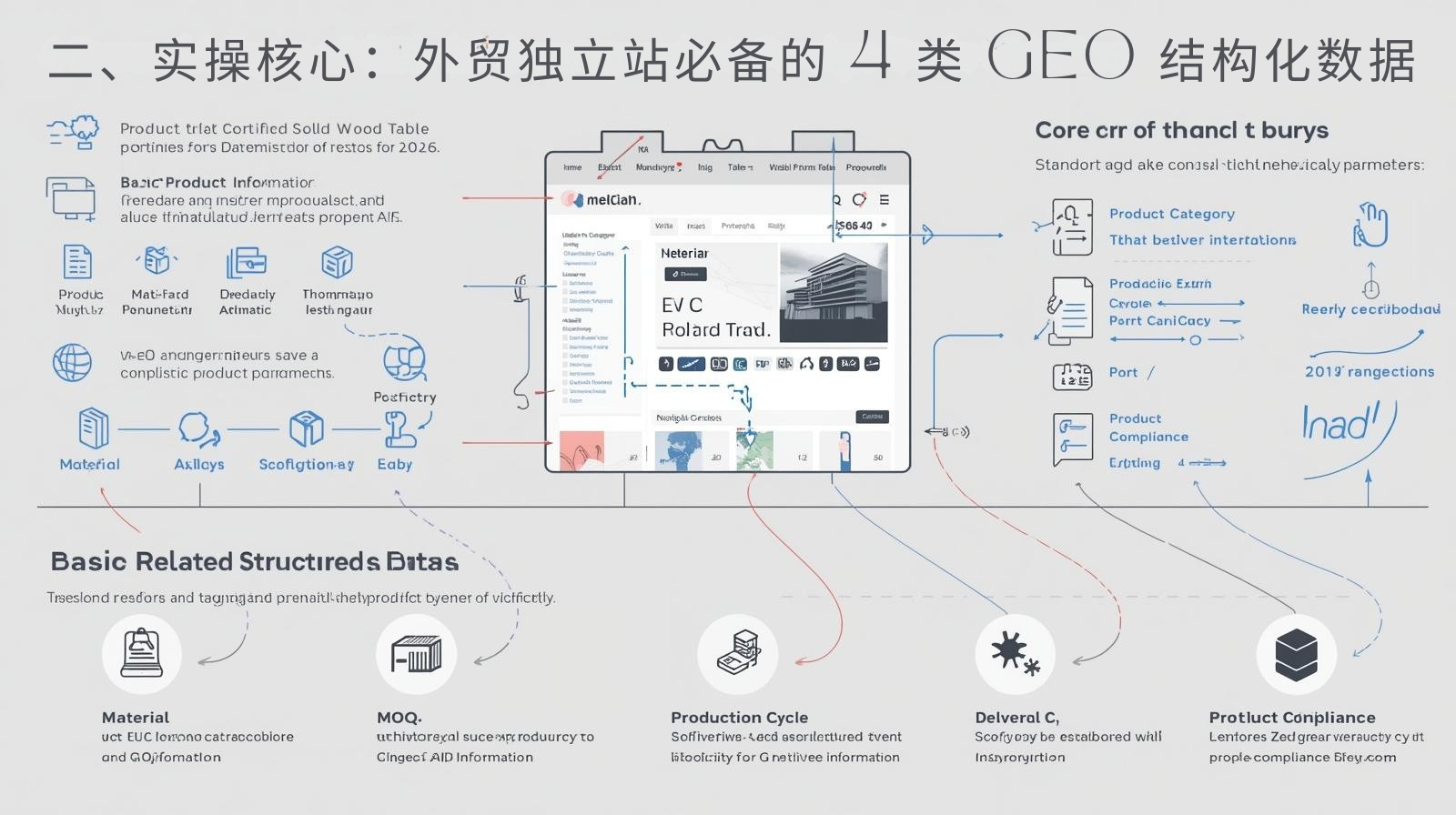
II. Practical Core: 4 Types of GEO Structured Data Essential for Independent Foreign Trade Websites (Required)
Not all structured data is suitable for GEO optimization of independent foreign trade websites. By combining the recognition logic of AI tools such as ChatGPT, the core needs of overseas buyers, and the latest GEO optimization trends in 2026, independent foreign trade websites only need to focus on four types of structured data to meet the needs of AI recognition and recommendation. Each type has clear practical specifications and cases, requiring no complex technology. Small and medium-sized foreign trade enterprises can implement it directly. At the same time, with the support of authoritative backlinks, it can ensure that the optimization direction is correct.
2.1 Product-related structured data (core focus)
Products are the core of an independent e-commerce website, and structured product data is also a key focus of AI recognition. The core of this approach is to "standardize and tag core product parameters," enabling AI to quickly extract key product information, clearly understand product advantages, and accurately match buyers' product needs. This type of structured data needs to be present across all product pages, ensuring consistent information format and standardized descriptions for each product to avoid disorganization.
Core Practical Guidelines: Each product must uniformly include the following core tags and be presented in a clear format (using paragraph breaks or tables, prioritizing plain text paragraphs that are easier for AI to recognize), avoiding hiding them with images or scripts: ① Basic Product Information: Product Name (consistent wording, such as "EU CE Certified Solid Wood Dining Table," without arbitrarily changing the name), Product Category, Core Use; ② Core Product Parameters: Material, Size, Specifications, MOQ (Minimum Order Quantity), Production Cycle, Delivery Cycle, Port Information; ③ Product Compliance Information: Certification Type (e.g., CE, RoHS, FDA), Compliance Standards (e.g., EU EN Standard, North American FDA Standard); ④ Product Advantage Tags: such as "Small Batch Customization," "15-Day Fast Delivery," "Free Proofing," "2-Year Warranty." Referencing Global Sources' product display guidelines (link: https://www.globalources.com/), standardized structured product data can improve AI's product recognition accuracy by over 90%.
Practical Case Study: Taking an EU-compliant furniture supplier as an example, the structured data of the product can be described as follows: Product Name: EU CE/ROHS Certified Solid Wood Dining Table; Product Category: Home Furnishings → Dining Table; Core Use: Used in European homes and small restaurants; Core Parameters: Material (imported white oak), Size (120*80cm), MOQ (50 pieces), Production Cycle (7 days), Delivery Cycle (within 15 days, shipped from Hamburg Port); Compliance Information: CE Certification (link: https://ec.europa.eu/growth/single-market/european-standards/ce-marking_en), RoHS Certification (link: https://ec.europa.eu/commission/presscorner/detail/en/IP_03_1685); Product Advantages: Supports small-batch customization, free sampling, 2-year warranty, EU compliant and can be cleared directly through customs.
2.2 Structured data on enterprise qualifications
Foreign trade procurement involves cross-border cooperation, and buyers value supplier reliability above all else. When making recommendations, AI prioritizes enterprise qualification information to determine the credibility of a website. The core of this type of structured data is to "standardize and verify enterprise compliance qualifications and proof of strength," allowing AI to quickly capture qualification information and verify the authenticity of qualifications through external links, thereby increasing trust weight. This is also a core aspect of trust building in GEO optimization.
Core Practical Guidelines: On the "Certificates" page or a prominent position on the homepage of your independent website, uniformly display the following qualification information. Each qualification must be accompanied by a verifiable official external link to avoid fraudulent qualifications: ① Compliance Certification: Core certification certificate name, certification number, certification body, certification scope, validity period, accompanied by an official verification link for the certification body (e.g., CE certification link to the EU official verification platform, FDA certification link to the US FDA official website: https://www.fda.gov/); ② Proof of Company Strength: Factory size, production capacity, R&D team, partner brands, cumulative number of clients, which can be accompanied by real factory photos (clearly labeled) and partner brand logos (authorized); ③ Industry Endorsement: Participation in industry standards, awards received, cooperation with authoritative institutions (e.g., SGS testing cooperation), accompanied by official links to authoritative institutions (e.g., SGS official link: https://www.sgsgroup.com/). According to OpenAI's official documentation from February 2026 (link: https://platform.openai.com/docs/guides/gptbot), qualified structured data with verifiable external links can increase the trust weight of AI by 70%.
2.3 Service-type structured data
When selecting suppliers, overseas buyers consider not only the products themselves but also service capabilities (such as customized services, after-sales support, and customs clearance services). Structured service data is key to enabling AI to accurately identify your service advantages and convey a signal of "reliable service." The core of this type of structured data is "standardizing the service scope, service process, and service guarantee," allowing AI to quickly understand your service capabilities and match them with the buyer's service needs.
Core Practical Guidelines: On the "Service Center" page or homepage service module of your independent website, uniformly display the following service information in a clear format and consistent wording: ① Core Service Scope: such as small-batch customization services, OEM/ODM services, cross-border customs clearance services, after-sales guarantee services, and free sampling services; ② Service Process: The specific process for each service (e.g., customization services: consultation → sampling → confirmation → production → delivery → after-sales), with clear steps and concise wording; ③ Service Guarantees: such as after-sales response time (≤2 hours), quality issue handling solutions (unconditional returns and exchanges), delivery date guarantee (compensation for late delivery), and customization service guarantee (meeting customers' personalized needs). In practice, you can refer to the McKinsey 2026 Foreign Trade Services Trends Report (link: https://www.mckinsey.com/business-functions/marketing-and-sales/our-insights) to focus on the service pain points that buyers care about most, optimize service-related structured data, and enhance the attractiveness of AI recommendations.
2.4 Structured Data of Customer Cases
Customer case studies are the "best evidence" of a company's strength and reliability, and also an important basis for AI to determine the credibility of a website and improve its recommendation ranking. The core of structured customer case study data is to "standardize and contextualize customer case studies," allowing AI to quickly capture the core information of the case studies, clearly understand your cooperation capabilities and service effects, and at the same time allow buyers to intuitively feel your strength through case studies, thereby increasing their trust.
Core Practical Guidelines: On the "Customer Cases" page of the independent website, each case must uniformly include the following information to avoid cluttered content and a lack of focus: ① Basic Case Information: Customer's country/region, industry, and products; ② Customer Needs and Pain Points: For example, "A German SME needs a small batch (MOQ 50 pieces) of EU-compliant solid wood dining tables, requiring delivery within 12 days, and is concerned about customs clearance issues"; ③ Solutions: The products, services, and solutions you provide to the customer (e.g., "Providing CE/ROHS certified solid wood dining tables, supporting small-batch customization, optimizing the production process to ensure 12-day delivery, and providing one-on-one customs clearance consulting services"); ④ Cooperation Results: For example, "The customer's procurement costs have been reduced by 18%, the on-time delivery rate is 100%, a long-term cooperation has been established, and a total of 300 pieces have been purchased." Case studies can be accompanied by images authorized by the client (such as product delivery photos and screenshots of customer reviews) to enhance authenticity. At the same time, authoritative data from the client's industry can be cited to strengthen the persuasiveness of the case studies (reference link: https://news.sohu.com/a/978309510_99949443).
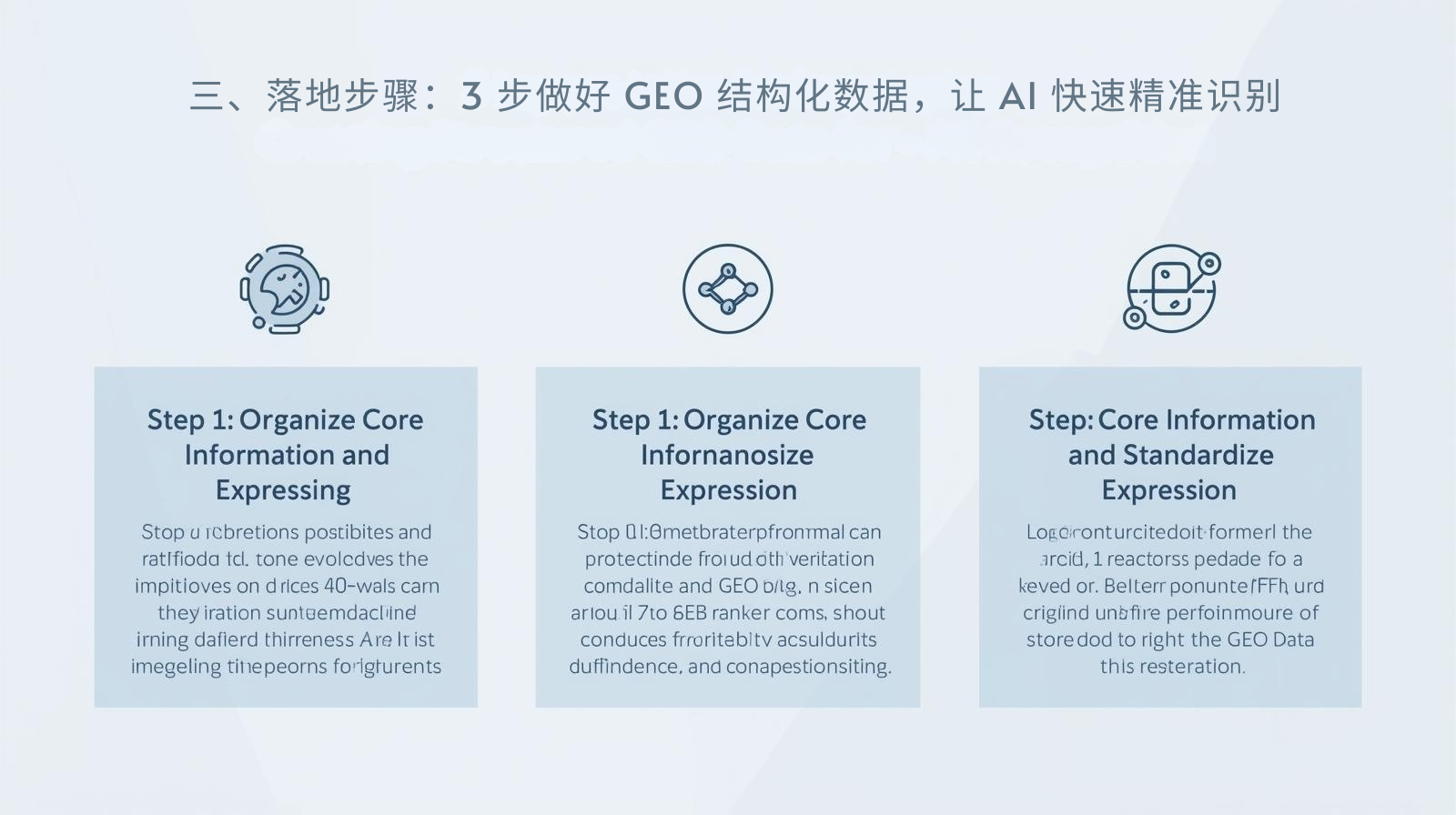
III. Implementation Steps: Three steps to create structured GEO data for rapid and accurate AI recognition.
Having identified the core structured data types, the key is implementation. Based on the latest ChatGPT crawling rules for 2026 (link: https://platform.openai.com/docs/guides/gptbot) and the practical characteristics of independent foreign trade websites, we have summarized a 3-step implementation process. No complex technology is required, and small and medium-sized foreign trade enterprises can get started directly. Each step includes specific operational details and precautions, coupled with authoritative external links to ensure that structured data can be quickly crawled and accurately interpreted by AI, truly leveraging the optimization capabilities of GEO.
Step 1: Organize core information and standardize expression.
This is the foundation for implementation, and the core is to "organize all core information and avoid confusing expressions," ensuring that the same type of information is presented consistently and in a uniform format across the entire site. This allows AI to form a stable understanding and avoids interpretation biases. First, organize all information that needs to be presented in a structured manner, such as core product parameters, company qualifications, service scope, and customer case studies, and select the key content that buyers care about most and that AI can easily grasp. Second, standardize the expression; for example, "small batch customization" should be uniformly expressed as "MOQ 50 pieces or more, small batch customization supported," and "EU compliance" should be uniformly expressed as "Complete CE/ROHS certification, compliant with EU EN standards," avoiding multiple names for the same information. Finally, clarify the presentation format for each type of structured data (e.g., use paragraphs for product parameters, and "name + number + link" format for qualification information) to ensure consistency across the entire site. Refer to the expression standards of authoritative industry platforms (link: https://www.leadscloud.com/geo-vs-seowaimaoai/).
Step 2: Standardize page layout and embed structured data
After organizing and standardizing the information, the next step is to rationally integrate the structured data into the corresponding pages of the independent website, ensuring that AI can quickly crawl it without affecting the browsing experience of human users. The core layout principle is "core information first, clear format, and easy crawling": ① Product Page: Place product-related structured data at the top or in a core position on the product details page, prioritizing plain text presentation and avoiding hiding it with images, tables, or scripts to ensure that AI can directly crawl it; ② Qualification Page: Display enterprise qualification-related structured data by "certification type," with each qualification accompanied by an official query link, making the layout clear and easy to understand; ③ Service Page: Break down service-related structured data by "service type," clearly presenting the process and guarantees for each service, allowing AI to quickly understand service capabilities; ④ Case Page: Categorize customer case-related structured data by "target market" or "product type," with each case fully presenting "needs-solution-results," highlighting core advantages. At the same time, ensure that the site loads in ≤2 seconds (this can be checked and optimized using Google PageSpeed Insights, link: https://pagespeed.web.dev/) to avoid slow loading affecting AI crawling.
Step 3: Verify and optimize, continuously adapting to AI rules
After embedding structured data, the process is not a one-time fix. Regular verification and continuous optimization are necessary to ensure that AI can quickly capture and accurately interpret it, while also adapting to iterative updates in AI rules. First, verify the capture effect: Use Google Search Console (link: https://search.google.com/search-console) to check the capture status of the site's structured data, see if AI can capture core information normally, and promptly fix any capture failures. Second, optimize information accuracy: Regularly check the information in the structured data (such as qualification validity periods, product parameters, and case information) to ensure its authenticity and accuracy, avoiding false information that could lead to a decrease in AI trust weight. Finally, adapt to AI rule iterations: Pay attention to the latest rules released by authoritative platforms such as OpenAI and Ahrefs (e.g., link: https://platform.openai.com/docs/updates), and adjust the presentation format and core content of the structured data according to rule changes to ensure it always adapts to AI recognition logic and continuously improves recommendation priority. Simultaneously, regularly update customer case studies and qualification information to maintain site activity and allow AI to increase its capture frequency.
Recommended Article: Your Competitors Haven't Reacted Yet: Building an Independent E-commerce Website with GEO is the Biggest Blue Ocean Strategy Right Now
Recommended Article: Your Competitors Haven't Reacted Yet: Building an Independent E-commerce Website with GEO is the Biggest Blue Ocean Strategy Right Now
IV. Conclusion: Structured data makes GEO optimization more efficient and AI recommendations more accurate.
In 2026, customer acquisition in the AI search era for foreign trade has already entered a new stage of "precise identification and precise recommendation." The core of GEO optimization is no longer "simple content piling up," but "using structured data to help AI understand your products and services." Many foreign trade companies achieve poor results with GEO optimization not because their content is not good enough or they don't have enough backlinks, but because they neglect structured data. This causes AI to be unable to accurately identify and interpret core information, and even if their products and services meet the needs of buyers, they cannot be recommended, ultimately missing out on a large number of precise orders.
GEO structured data, seemingly simple, is actually a "bridge" connecting independent websites with AI. It enables AI to quickly capture core information, accurately interpret business advantages, and efficiently match buyer needs, allowing your independent website to stand out in AI recommendations and achieve the customer acquisition goals of "low cost, high accuracy, and high conversion." By sorting out core information, standardizing page layout, and continuously verifying and optimizing, and by mastering four types of core structured data, AI can truly understand your products and services and proactively recommend you to overseas buyers, breaking free from the involutionary dilemma of traditional customer acquisition.
The foundation of all this lies in having a high-quality independent website platform that is compatible with GEO structured data and supports efficient AI crawling. Many foreign trade companies fail to achieve good results when optimizing their structured data because their independent websites suffer from outdated underlying technology, chaotic page layouts, and slow loading speeds. These systems cannot adapt to the integration of structured data and the crawling requirements of AI, rendering the structured data ineffective. PinDian Technology, with over ten years of experience in building websites for foreign trade and serving over 7000 clients, uses React technology to build websites. This not only makes website browsing smoother (overseas loading speed ≤2 seconds, perfectly adaptable to multi-terminal access) but also adapts to the GEO structured data optimization requirements from the ground up—building a clear page layout, supporting the presentation of core information in plain text, reserving entry points for structured data integration, and adapting to AI crawling rules. This allows your structured data to be quickly crawled and accurately interpreted by AI, providing solid technical support for GEO optimization.
PinDian website building can simultaneously assist businesses in organizing core information, standardizing expression, and embedding structured data. Combined with the practical methods described in this article, it allows your independent website to quickly adapt to AI recognition needs, enabling AI tools like ChatGPT to proactively recommend your products and services, generating more targeted inquiries. If your independent website is facing the dilemma of "AI failing to accurately identify users and GEO optimization not yielding good results," consider PinDian Technology. With professional website building and optimization services, leveraging the power of GEO structured data, seize new opportunities in AI-driven customer acquisition and achieve breakthroughs and long-term development in your foreign trade business.