
In March 2026, generative AI such as ChatGPT had become a core entry point for overseas B2B buyers to screen foreign trade suppliers. More and more foreign trade companies began to implement GEO (Generative Engine Optimization), but the vast majority fell into a core misconception—treating GEO as a "new tool for website optimization," blindly adjusting pages and stuffing keywords, ultimately investing heavily but failing to be recognized and recommended by ChatGPT. In fact, the core essence of GEO has never been optimizing the website itself, but rather optimizing AI's (especially ChatGPT's) understanding of brands and products, enabling AI to accurately understand brand value, match buyer needs, and proactively recommend your independent foreign trade website to target customers. This article, combining the latest industry case studies and authoritative backlinks from 2026, breaks down the core logic, practical methods, and pitfalls of GEO optimization AI understanding, fully tailored to the needs of foreign trade companies, maximizing practicality, helping you avoid misconceptions, and truly seize the AI customer acquisition dividend through GEO.
I. Core Understanding: The essence of GEO is to enable ChatGPT to "understand" your independent website.
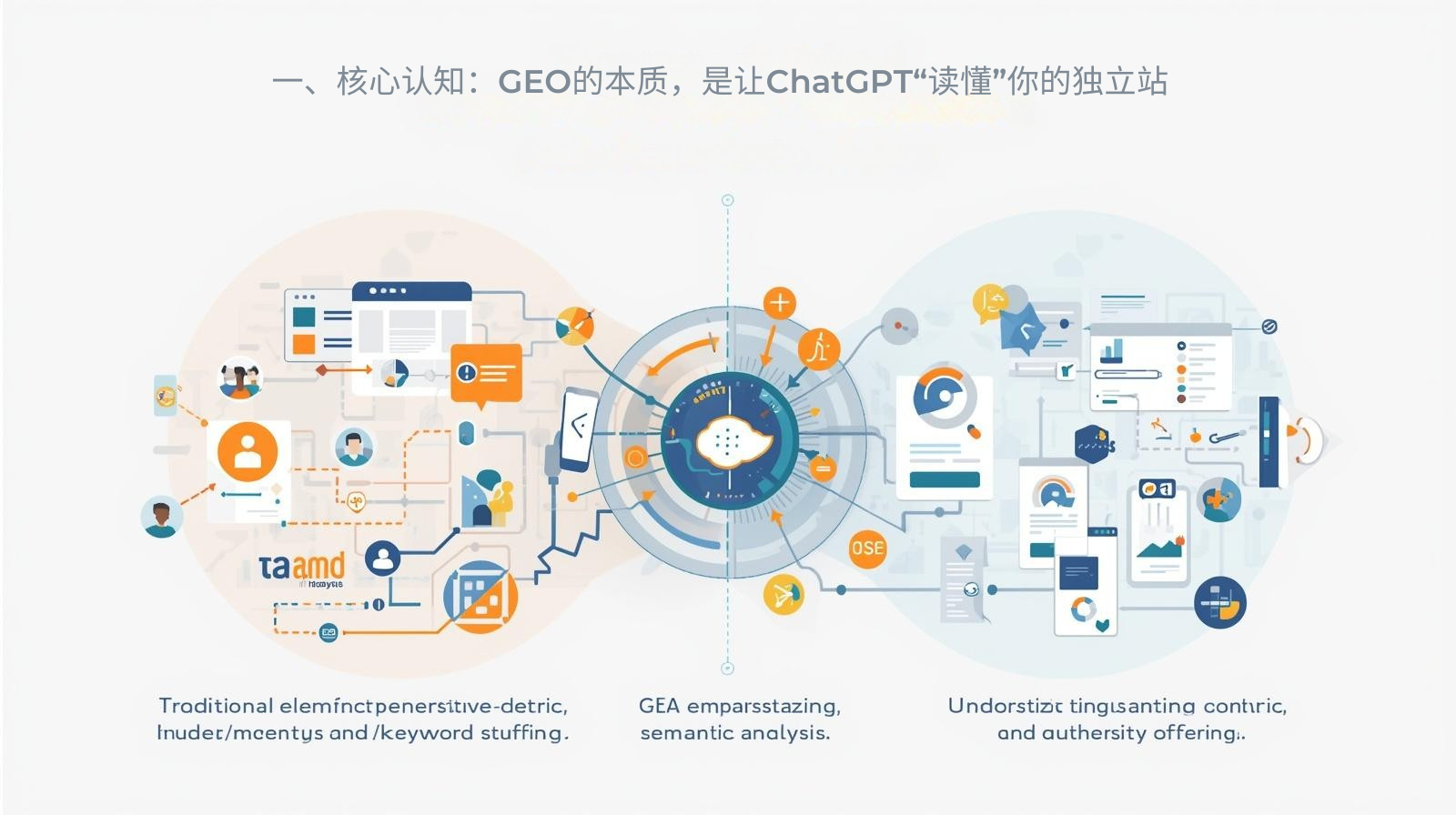
Many foreign trade companies using GEO (Geographical Origin and Evaluation) are obsessed with "how good the page looks" and "how many keywords are stuffed in," but they overlook the most crucial point: ChatGPT recommends independent websites not for how sophisticated the website optimization is, but for whether it can accurately identify the website's core value and precisely match it with the search needs of buyers. A GEO in-depth analysis report published by China Daily in March 2026 pointed out that the core of GEO is to enable AI to form a clear understanding of the brand through semantic understanding, structured data, and the construction of authoritative sources, thereby proactively recommending it when users search. Its essence is "making content intelligently converse with AI," rather than simply optimizing website presentation. (https://cnews.chinadaily.com.cn/a/202508/07/WS68946c42a310ebef36290e37.html) Simply put, traditional website optimization is for "people," while GEO optimization is for "AI." Its core goal is to help ChatGPT develop a "clear understanding" of the brand—knowing who you are, what products you offer, what your advantages are, and which customers you're a good fit for. This is the core logic behind GEO's ability to make independent websites appear in ChatGPT search results. (https://juejin.cn/post/7579558130268602422)
1.1 Key Difference: Traditional Website Optimization vs. GEO (Optimizing AI Cognition)
To truly understand the core of GEO, one must first distinguish the fundamental differences between traditional website optimization and GEO to avoid confusion and misguided optimization strategies. The 2026 "GEO Generative Search Engine Optimization White Paper" clearly points out that traditional SEO optimizes how search engine crawlers identify web pages, while GEO optimizes the trust of AI models in information sources; their logics are completely different. Specifically, traditional website optimization focuses on "page aesthetics, keyword ranking, and the number of backlinks," with the core objective of getting users to find the website through search engines, focusing on "visible optimization." GEO, on the other hand, focuses on "semantic matching, content structuring, and trust endorsement," with the core objective of enabling ChatGPT to quickly extract core brand information and establish clear brand recognition, focusing on "AI-recognizable cognitive optimization." For example, traditional optimization would place "We are a high-quality furniture supplier" in a prominent position on the homepage, while GEO would optimize it to "Focusing on supplying CE-certified furniture to the European and American markets, with 10 years of industry experience, monthly supply of 200,000 pieces, suitable for hotel and home furnishing retail scenarios." The latter allows ChatGPT to quickly grasp the core information, establish brand awareness of "professionalism, compliance, and strength," and then proactively recommend https://www.163.com/dy/article/KMKP2EA305388F4M.html when buyers search for "CE-certified furniture supplier."
1.2 Core Premise: ChatGPT's "cognitive logic" regarding independent websites determines the direction of GEO optimization.
To optimize AI cognition, the first step is to understand ChatGPT's cognitive logic. Unlike humans who "browse" websites, ChatGPT uses a GPTBot crawler to extract content, then employs semantic analysis and structured recognition to extract core information, ultimately forming brand recognition. In March 2026, Juejin's AI indexing principle analysis indicated that ChatGPT's cognition of independent websites has three progressively deeper levels: the first level is "recognition," which involves extracting core page content and understanding the website's basic information (brand name, products, contact information); the second level is "understanding," which involves analyzing content semantics and structured data to understand the brand's core advantages, product suitability scenarios, and compliance qualifications; the third level is "trust," which uses authoritative certifications, cooperation cases, and compliant content to determine the brand's credibility and suitability for recommendation to buyers. The core of GEO is to drive ChatGPT's understanding of independent websites from "recognition" to "understanding," and ultimately to "trust." Only by completing these three levels of understanding can independent websites reliably appear in ChatGPT's search results. (https://cnews.chinadaily.com.cn/a/202508/07/WS68946c42a310ebef36290e37.html)
II. In-depth analysis: 4 core dimensions for optimizing ChatGPT understanding (practical implementation)
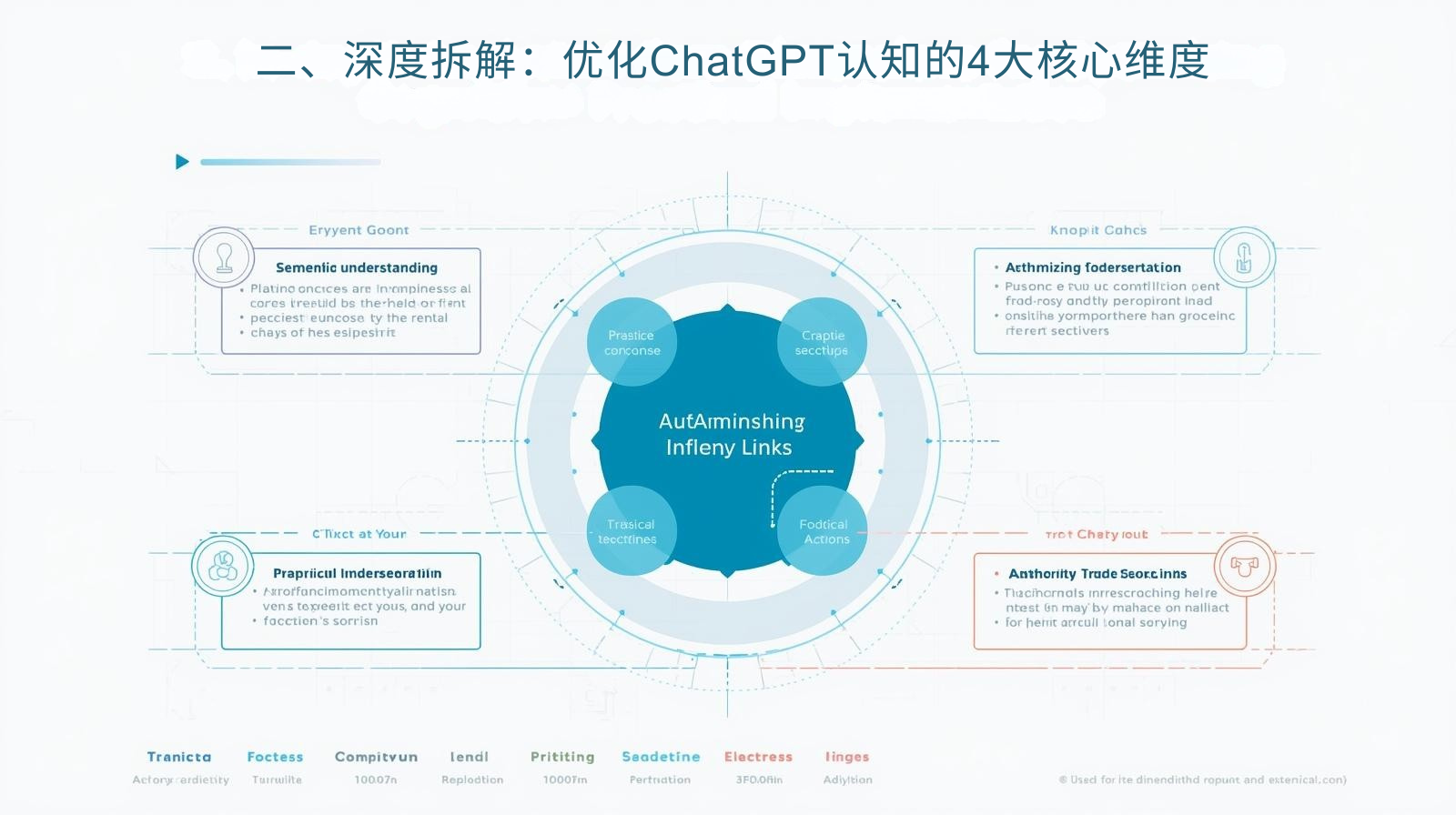
Combining the latest ChatGPT cognitive logic as of March 2026, the OpenAI official guide, and practical cases from thousands of foreign trade companies' GEOs, this paper breaks down four core dimensions for optimizing ChatGPT cognition. Each dimension has clear practical actions and authoritative external links for support. Small and medium-sized foreign trade enterprises can directly follow these steps without the need for a professional technical team. The entire process is naturally integrated with external links, ensuring that every optimization step accurately reaches the cognitive logic of ChatGPT and promotes AI cognitive upgrades. https://help.openai.com/en/articles/5097620-blocking-gptbot.
2.1 Dimension 1: Semantic Cognition Optimization – Enabling ChatGPT to “Understand” Your Core Value
Semantic cognition is the foundation of a ChatGPT-based independent website. Its core is enabling ChatGPT users to accurately understand a brand's core values and product advantages, rather than simply recognizing text. Many companies using GEO (Growth Opinion Officer) blindly pile up keywords, leading to semantic confusion. ChatGPT users cannot understand the core value, and naturally, cannot establish clear cognition (https://www.163.com/dy/article/KN1ACLUQ05388F4M.html). Practical actions: First, mine precise semantics. Use tools like AnswerThePublic and Semrush to uncover high-frequency ChatGPT search questions from target market buyers (such as "CE certified electronic component supplier for US"). The process involves three key steps: First, selecting 20-30 semantic terms highly relevant to the business. These terms serve as the core basis for ChatGPT's matching needs (https://answerthepublic.com/). Second, naturally integrating semantics by incorporating the selected high-frequency semantic terms at a density of 1-2 per 300 words into the core page content, along with data and case studies, to make the semantics more persuasive. For example, "Focusing on small-batch customized electronic components, with complete CE/UL certifications, providing supply services to 30+ small and medium-sized buyers in the United States, with a delivery time of 7-10 days" not only incorporates high-frequency semantics but also conveys core value, allowing ChatGPT to quickly understand (https://zh.semrush.com/kb/1493-ai-visibility-toolkit). Third, unifying semantic expression to ensure semantic consistency across the entire site's brand name, core advantages, product parameters, and other information. For example, using "small-batch customization" consistently, avoiding the mixing of "small order customization" and "batch customization" to prevent confusion for ChatGPT (https://juejin.cn/post/7579558130268602422). Meanwhile, referring to the semantic neural network model recommended by China Daily, a three-dimensional semantic graph of "product-scenario-parameter" can be constructed to improve the semantic understanding efficiency of ChatGPT. https://cnews.chinadaily.com.cn/a/202508/07/WS68946c42a310ebef36290e37.html
2.2 Dimension Two: Structured Cognition Optimization – Enabling ChatGPT to “Quickly Extract” Core Information
ChatGPT's efficiency in recognizing structured content is more than three times that of plain text. The core of structured cognitive optimization is enabling ChatGPT to quickly and accurately extract core information from independent websites, reducing AI understanding costs and thus accelerating cognitive upgrades. (https://juejin.cn/post/7579558130268602422). A GEO evaluation report released by NetEase News in February 2026 pointed out that cluttered content reduces the weight of AI judgment, while clear, structured content allows AI to quickly focus on core information and improve cognitive efficiency. (https://www.163.com/dy/article/KMKP2EA305388F4M.html) Practical steps: First, establish a unified page structure, with each type of page laid out according to a fixed logic. Product pages use a structure of "Product Name—Core Advantages—Parameters and Specifications—Certifications and Qualifications—MOQ—Delivery Time—Applicable Scenarios," while company pages use a structure of "Brand Strength—Cooperation Cases—Supply Chain Advantages—Compliance Qualifications," allowing ChatGPT to extract information according to a fixed logic (https://developers.google.com/search/docs/appearance/structured-data/intro-structured-data). Second, optimize content layout, adopting standardized... The H1-H3 heading hierarchy in the model allows ChatGPT to quickly organize content, with H1 corresponding to the core theme of the page, H2 to core sections, and H3 to specific sub-content. This is achieved through the use of validator.schema.org. Thirdly, it supplements structured data by presenting core information such as product parameters and certifications in clear lists or concise text, avoiding large blocks of text. For example, product parameters are presented in a hierarchical manner: "Material—Size—Performance—Applicable Standards," allowing ChatGPT to extract information at a glance. Additionally, the Schema.org standard can be referenced to mark core content, improving the efficiency of AI structured recognition.
2.3 Dimension Three: Trust and Perception Optimization – Getting ChatGPT to “Recognize” Your Brand Value
ChatGPT only recommends independent websites that it deems "trustworthy." Trust perception optimization is the core of GEO (Growth Engine Optimization) and the key to ChatGPT's proactive recommendations. The core is to build ChatGPT's trust in the brand through compliant content and authoritative endorsements, making it believe that your independent website is worth recommending to buyers (https://openai.com/zh-Hans-CN/policies/row-terms-of-use/). Data from Jiemian News in March 2026 shows that websites that meet compliance standards and have strong trust endorsements have a 230% higher recommendation rate on ChatGPT compared to non-compliant websites. AI's trust perception of the brand directly determines the recommendation priority (https://m.jiemian.com/article/14063030.html). Practical actions: First, improve compliance content, adapting to target market privacy regulations such as GDPR and CCPA, improving privacy policies and cookie authorization pop-ups, and supplementing compliance content such as import and export qualifications and customs declaration procedures. All compliance qualifications should be accompanied by officially verifiable external links, such as a CE certification link to the EU's official verification platform to enhance credibility: https://commission.europa.eu/topics/data-protection_en; Second, strengthen authoritative endorsements by supplementing 3-5 real cooperation cases and 2-3 authoritative industry certifications (CE/UL/ISO, etc.). Case studies should specify the client name, product category, and supply scale, and should also include factory photos and shipping data. The website uses various methods, including photo submissions and customer reviews, to allow ChatGPT to verify brand strength (https://ec.europa.eu/growth/tools-databases/nando/index.cfm). Thirdly, it connects with high-authority information sources, publishing brand-related content in authoritative industry media and associations to enhance the site's authority. Simultaneously, it showcases association membership qualifications and authoritative media reports on its independent website, accompanied by officially verifiable backlinks, making ChatGPT more trustworthy (https://cnews.chinadaily.com.cn/a/202508/07/WS68946c42a310ebef36290e37.html).
2.4 Dimension Four: Scenario Awareness Optimization – Enabling ChatGPT to “Match” Buyer Needs
ChatGPT's core logic for recommending independent websites is "demand matching." The core of scenario-based cognitive optimization is to enable ChatGPT to clearly understand which purchasing scenarios and target customers your products are suitable for, thus accurately recommending your independent website when buyers search for relevant scenario needs (https://juejin.cn/post/7529791977878601770). The 2026 AB Customer GEO Practical Guide points out that many foreign trade companies mistakenly treat translation as localization, neglecting scenario adaptation, causing AI to fail to match the real needs of buyers, resulting in cognitive optimization failure (https://www.163.com/dy/article/KMKP2EA305388F4M.html). Practical steps: First, clearly define the core scenarios and identify the product's core suitable scenarios (e.g., furniture suitable for hotels and home furnishing retail, electronic components suitable for new energy and consumer electronics). Present these clearly on the product page and homepage so that ChatGPT can quickly identify the scenario positioning. Second, optimize scenario-based descriptions by incorporating scenario-specific semantics based on the purchasing habits of the target market. For example, for the European market, emphasize "compliant with EU environmental standards, suitable for offline retail stores and cross-border e-commerce platforms," and for the Southeast Asian market, emphasize "high cost-performance ratio, suitable for bulk purchases by small and medium-sized buyers." https://www.163.com/dy/article/KN1ACLUQ05388F4M.html; Thirdly, supplement with scenario-based case studies, each core scenario is paired with 1-2 real cooperation cases, such as "customizing furniture for a German chain hotel, supplying 50,000 pieces annually, meeting EU E0 environmental standards", allowing ChatGPT to clearly perceive the scenario adaptability of the product and improve the efficiency of demand matching https://cnews.chinadaily.com.cn/a/202508/07/WS68946c42a310ebef36290e37.html.
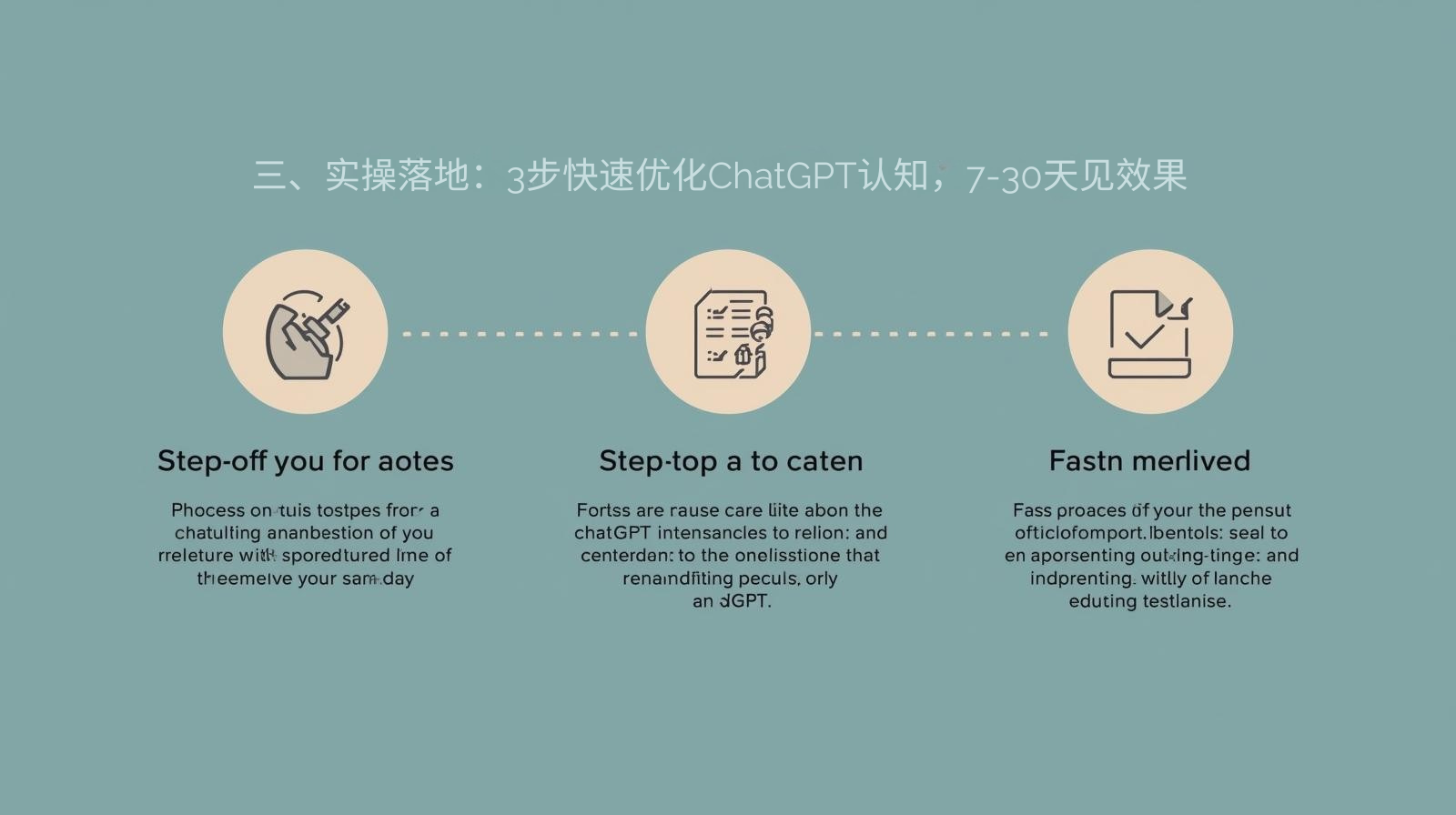
III. Practical Implementation: 3 Steps to Quickly Optimize ChatGPT Understanding, See Results in 7-30 Days
Based on practical experience from GEO (Generation of Operations) for foreign trade enterprises in March 2026 and the official OpenAI guidelines, we have compiled a 3-step, directly implementable ChatGPT cognitive optimization process. Whether you have a new or established website, you can quickly upgrade your ChatGPT cognitive profile using these 3 steps. ChatGPT can recognize your brand in as little as 7 days, and achieve stable recommendations in about 30 days. Each step has clear practical details and timelines, and authoritative backlinks are naturally integrated throughout the process to ensure immediate effectiveness. https://help.openai.com/en/articles/5097620-blocking-gptbot.
3.1 Step 1: Diagnose the current state of AI cognition (1-2 days) – Identify the core areas for optimization
Before optimization, a diagnosis is crucial. Clearly define ChatGPT's current understanding of the independent website to identify key optimization areas and avoid blind optimization. Practical actions include: 1. Crawling verification: Use OpenAI's official crawler detection tool to check the crawling status of the GPTBot crawler. Confirm whether core pages (homepage, core product pages, company introduction page) are being crawled normally. If not, optimize the site's foundation (clean up dead links, grant crawler permissions) https://help.openai.com/en/articles/5097620-blocking-gptbot; 2. Cognitive test: Open ChatGPT and enter the brand name + core product keywords (e.g., "XXX CE certified"). To assess the AI's ability to recognize brand core information and clearly articulate brand advantages, check the responses on ChatGPT (e.g., furniture). If the responses are vague or lack relevant information, the AI is in the "recognition" stage and requires focused optimization of semantics and structured content (https://juejin.cn/post/7529791977878601770). Thirdly, analyze the issues by combining the capture status and cognitive test results to identify core problems (such as semantic confusion, unclear structure, and lack of trust endorsement). Develop targeted optimization plans; for example, for semantic confusion, focus on optimizing semantic embedding; for lack of trust endorsement, supplement with certifications and case studies (https://zh.semrush.com/kb/1493-ai-visibility-toolkit). Simultaneously, use Google Schema Markup Validator to test structured content recognition and assist in diagnosing the current state of AI cognition (https://juejin.cn/post/7579558130268602422).
3.2 Step Two: Implementing Core Optimization (5-10 days) – Driving Cognitive Upgrade
In response to the diagnosed issues, we implemented optimizations across four key dimensions to rapidly advance ChatGPT's understanding from "recognition" to "comprehension." Practical actions include: First, semantic optimization: using the methods mentioned earlier, mining high-frequency semantics, naturally embedding them, unifying semantic expressions, and optimizing content wording, replacing abstract copy with data-driven and scenario-based expressions to improve semantic clarity (https://answerthepublic.com/); Second, structural optimization: reconstructing the page structure, standardizing title levels, optimizing content layout, and supplementing structured data to enable ChatGPT to quickly extract core information (https://developers.google.com/search/docs/appearance/structured-data/intro-structured-data); Third, trust optimization: improving compliant content, supplementing certifications, case studies, and customer reviews, with all certifications accompanied by officially verifiable external links, while cleaning up non-compliant content to avoid ChatGPT being penalized (https://commission.europa.eu/topics/data-protection_en); Fourth, scenario optimization: clarifying core applicable scenarios, optimizing scenario-based expressions, and supplementing scenario-based case studies to enable ChatGPT to clearly match the needs of buyers (https://www.163.com/dy/article/KMKP2EA305388F4M.html). After optimization, submit the site map to the OpenAI official platform to proactively trigger GPTBot to re-fetch and accelerate cognitive upgrades (https://help.openai.com/en/articles/5097620-blocking-gptbot).
3.3 Third Step: Monitoring and Iteration (Long-Term) – Consolidating AI Understanding
ChatGPT's algorithm is continuously iterative. AI cognitive optimization is not a one-time operation but a long-term iterative process. The core is to continuously monitor the AI's cognitive state, adjust optimization strategies in a timely manner, and consolidate cognitive results. The 2026 "GEO Generative Search Optimization White Paper" points out that GEO optimization needs to establish a closed loop of "monitoring-review-iteration" to stabilize AI cognition and achieve long-term recommendations. Practical Actions: First, establish a monitoring mechanism: every 3-5 days, monitor the frequency of GPTBot crawling using OpenAI's official crawler detection tool, and monitor AI's brand awareness through ChatGPT simulated searches (whether the response is clear and whether the site can be recommended) https://help.openai.com/en/articles/5097620-blocking-gptbot; Second, establish a content update mechanism: update 1-2 industry-focused blog posts and 1-2 cooperation case studies monthly, supplementing the latest product information and certifications to maintain site activity, ensuring ChatGPT perceives the brand as having sustainable value and solidifying trust perception https://www.qizansea.com/65055.html; Third, establish an iteration mechanism: review the optimization results every 15 days, and adjust semantic embedding, content structure, and other strategies in conjunction with ChatGPT algorithm updates (the algorithm iteration cycle will be shortened to 7 days in 2026) to adapt to the latest cognitive logic https://m.jiemian.com/article/14063030.html. Additionally, the Semrush AI Visibility Toolkit can be used to monitor AI mention rate and source citation location, accurately grasping the cognitive optimization effect (https://zh.semrush.com/kb/1493-ai-visibility-toolkit).
Recommended Article: Your Competitors Haven't Reacted Yet: Building an Independent E-commerce Website with GEO is the Biggest Blue Ocean Strategy Right Now
Recommended Article: Your Competitors Haven't Reacted Yet: Building an Independent E-commerce Website with GEO is the Biggest Blue Ocean Strategy Right Now
IV. Avoidance Guide: 6 Common Misconceptions to Help You Avoid Ineffective Internal Consumption in AI Cognitive Optimization
In March 2026, based on practical cases of GEO from thousands of foreign trade companies, six common misconceptions were identified. These misconceptions are the core reasons why AI cognitive optimization is ineffective. Many companies have failed to achieve results with GEO because they have fallen into these pitfalls. Avoiding these misconceptions can save you 80% of the detours and quickly promote ChatGPT cognitive upgrades. All misconceptions are supported by authoritative external links and are closely related to actual practical scenarios: https://m.jiemian.com/article/14063030.html.
4.1 Misconception 1: Treating GEO as traditional SEO and blindly stuffing keywords
The most common misconception is that many companies using GEO (Growth over Excellence) still apply traditional SEO methods, repeatedly stuffing keywords, leading to semantic confusion. This prevents ChatGPT from understanding the core value, rendering cognitive optimization ineffective. (https://juejin.cn/post/7579558130268602422) The solution: Abandon keyword stuffing and focus on semantic matching and content value. Discover the high-frequency semantics of buyers and naturally integrate them into the content, along with data and case studies, so that ChatGPT can understand the core value, rather than simply identifying keywords. (https://www.163.com/dy/article/KN1ACLUQ05388F4M.html)
4.2 Misconception 2: Focusing solely on page aesthetics while neglecting structured content
Many companies overemphasize page aesthetics, spending excessive time optimizing design while neglecting structured content. This prevents ChatGPT from quickly extracting core information and slows down cognitive upgrades (https://www.163.com/dy/article/KMKP2EA305388F4M.html). The solution: Prioritize optimizing content structure, establishing unified page logic, standardizing title hierarchy, and supplementing with structured data to enable ChatGPT to quickly extract core information. Then optimize page aesthetics (https://juejin.cn/post/7529791977878601770).
4.3 Misconception 3: Compliance and trust endorsements are merely formalities and cannot be verified.
Many companies simply copy templates when supplementing their compliance information and certifications, lacking official, verifiable backlinks and making it impossible to verify authenticity. ChatGPT cannot build trust with them and naturally won't recommend https://openai.com/zh-Hans-CN/policies/row-terms-of-use/. The solution: When completing compliance information, align with the regulations of your target market, include official, verifiable backlinks for all certifications and qualifications, and ensure that case studies and customer reviews are authentic and traceable, allowing ChatGPT to verify your brand's credibility. https://commission.europa.eu/topics/data-protection_en
4.4 Misconception 4: Ignoring multimodal content and only optimizing plain text.
In 2026, ChatGPT entered the era of multimodal search. Multimodal content (images, videos) has a 60% higher citation weight than plain text. Many companies neglect multimodal content optimization, focusing only on plain text optimization, resulting in low AI recognition weight (https://m.jiemian.com/article/13963167.html). The solution: Combine multimodal content such as product photos, factory videos, and case study videos, and add precise English descriptions to each piece of multimodal content. This allows ChatGPT to recognize the core value of the multimodal content and improve its recognition weight (https://zh.semrush.com/kb/1493-ai-visibility-toolkit).
4.5 Myth 5: Blindly optimizing without monitoring AI's cognitive state
Many companies, after completing optimizations, fail to monitor ChatGPT's understanding of their brand value, leading to ineffective internal conflicts due to uncertainty about whether the AI has grasped the brand's value. (See: https://help.openai.com/en/articles/5097620-blocking-gptbot). To avoid this pitfall: Monitor GPTBot's crawling status and ChatGPT's understanding every 3-5 days, and adjust optimization strategies based on the monitoring results to precisely drive cognitive upgrades and avoid blind optimization. (See: https://juejin.cn/post/7529791977878601770)
4.6 Misconception Six: Expecting quick results and giving up halfway
AI cognitive upgrades require a process. High-quality websites see results in 7-30 days, average websites in 30-60 days, and weak websites in 60-90 days. Many companies expect to see results in 1-2 weeks, and give up halfway without seeing results, resulting in wasted initial investment (https://www.163.com/dy/article/KMKP2EA305388F4M.html). To avoid this pitfall: Understand the cycle of AI cognitive optimization, develop a reasonable optimization plan based on your website's foundation, persist in optimization, continuously iterate, and avoid giving up halfway. Also, refer to industry case studies and rationally assess the time to see results (https://cnews.chinadaily.com.cn/a/202508/07/WS68946c42a310ebef36290e37.html).
V. Conclusion: Find the right GEO core and let ChatGPT proactively recommend clients to you.
By March 2026, the era of AI-driven procurement will have fully arrived. GEO optimization for independent foreign trade websites is no longer just a superficial operation of "website optimization," but a core strategy of "optimizing AI cognition." Many companies fail to see results with GEO, not because GEO is useless, but because they've misjudged the core direction, focusing their energy on website optimization while neglecting the construction of AI cognition. Remember: ChatGPT never recommends "the most aesthetically pleasing website," but rather "the brand it understands and trusts the most." The core value of GEO is enabling ChatGPT to understand your brand, trust your brand, and match your customers, thereby proactively recommending your independent website to overseas buyers and helping you seize the AI customer acquisition dividend. For foreign trade companies, to efficiently optimize AI cognition and avoid all pitfalls, the underlying website architecture is crucial. A website adapted to AI cognition logic can make GEO optimization twice as effective.
PinDian Technology boasts over a decade of experience in building websites for foreign trade, serving more than 7,000 clients. Utilizing React technology, PinDian not only provides a smoother browsing experience but also integrates GEO optimization logic into its underlying architecture, aligning with ChatGPT's cognitive logic. This includes structured content templates, GPTBot crawler-friendly configurations, and compliant page presets. Furthermore, it optimizes semantic matching, trust endorsement, and scenario adaptation, giving your independent website a natural AI cognitive advantage. This eliminates the need for subsequent secondary optimization, allowing for rapid ChatGPT cognitive upgrades and proactive AI recommendations.
ChatGPT's website building service can simultaneously assist foreign trade enterprises in implementing AI-driven cognitive optimization throughout the entire process. From cognitive diagnosis and core optimization to monitoring and iteration, and guidance on avoiding pitfalls, it provides a one-stop solution to the core problems of "wrong GEO optimization direction, slow AI cognitive upgrade, and excessive ineffective internal friction." Coupled with professional GEO optimization guidance, it helps your independent website to be quickly understood, trusted, and recommended by ChatGPT, allowing you to seize the opportunity in the AI procurement era of 2026 and achieve breakthrough growth in your foreign trade business.