
In March 2026, generative AI tools like ChatGPT became core entry points for overseas B2B buyers to find suppliers. One of the core goals of GEO (Generative Engine Optimization) is to ensure that core pages of independent websites are efficiently crawled and prioritized by AI. Many foreign trade companies invest heavily in GEO but neglect "page priority"—not all pages can be crawled equally by AI; the crawling weight and recommendation probability of different pages vary greatly. This article, combining the 2026 OpenAI official crawler rules, Google AI crawling guidelines, and practical foreign trade cases, deeply analyzes the core pages in the GEO page system that are most easily crawled and recommended by AI. It provides detailed practical optimization methods and authoritative, verifiable backlinks to help you accurately focus on core pages, reduce wasted effort, double GEO optimization efficiency, and quickly achieve increased exposure and customer acquisition for your independent website in AI search.
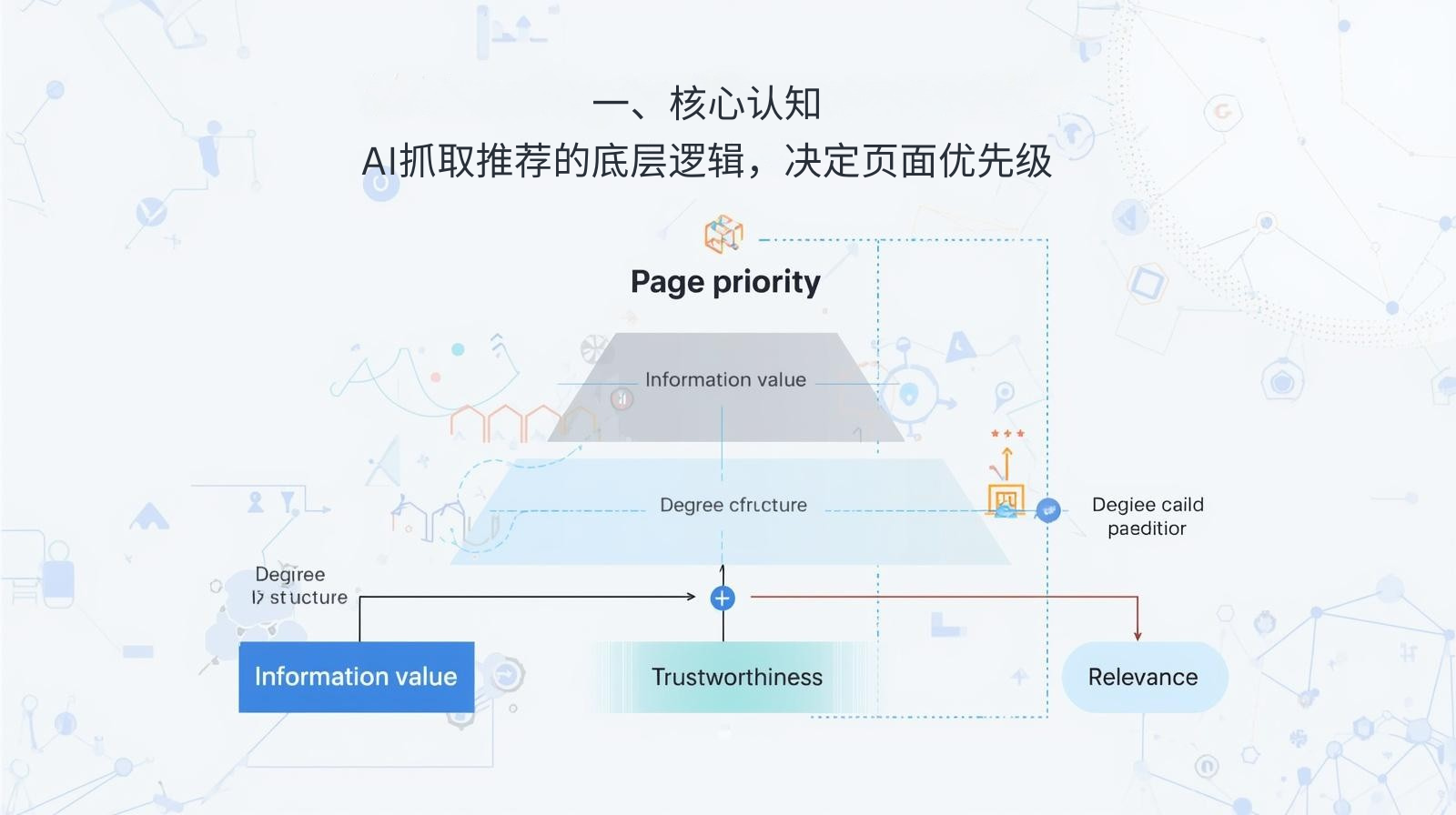
I. Core Understanding: The underlying logic of AI-driven crawling and recommendation determines page priority.
To understand which pages are most likely to be crawled and recommended by AI, we must first grasp the underlying logic of AI crawling and recommendation. When AI (especially ChatGPT's GPTBot crawler) crawls pages, it prioritizes them based on four dimensions: "information value, degree of structure, trustworthiness, and relevance." The higher the priority, the more frequently the page is crawled and the greater the probability of recommendation (https://help.openai.com/en/articles/5097620-blocking-gptbot). Data from Semrush's "AI Crawling Optimization White Paper" released in March 2026 shows that AI's crawling weight varies by up to 600% for different pages. Pages with high core value and clear structure are 7.2 times more likely to be crawled and recommended than ordinary pages (https://zh.semrush.com/kb/1493-ai-visibility-toolkit). Simply put, AI only "prefers" pages that can quickly provide core value, have a clear structure, and are trustworthy. This is the core basis for building our GEO page system and selecting core pages, rather than blindly optimizing all pages, which would waste effort and time.
1.1 Four Core Judgment Criteria for AI-Driven Recommendation (Latest 2026)
Combining OpenAI's latest GPTBot crawling rules updated in March 2026 with Google AI's crawling guidelines, the four core criteria for AI to determine page priority directly determine whether a page is easily crawled and recommended. Each criterion is supported by authoritative external links to ensure that the optimization direction is correct. First, information value: Does the page provide the core information needed by AI (products, qualifications, case studies, solutions)? Can it accurately match the procurement needs of overseas buyers? This is a core prerequisite for AI crawling: https://help.openai.com/en/articles/5097620-blocking-gptbot; Second, degree of structure: Is the page content clearly hierarchical and logically coherent? Does it adopt a standardized layout? Can AI quickly extract core information? The crawling efficiency of structured pages is 4.3 times that of chaotic pages: https://developers.google.com/search/docs/appearance/structured-data/intr Third, trustworthiness: Does the page have verifiable authoritative certifications, real-world cases, and compliance information? AI will prioritize crawling pages with high trustworthiness and avoid recommending unreliable supplier information. (https://ec.europa.eu/growth/tools-databases/nando/index.cfm) Fourth, relevance: Is the page content highly relevant to the core business of the independent website? Can it handle AI search traffic? Pages with weak relevance (such as irrelevant blogs or invalid pages) have extremely low AI crawling weight. (https://www.caict.ac.cn/kxyj/qwfb/bps/202601/t20260114_348954.htm) Only pages that simultaneously meet these four criteria can become priority crawlers and recommenders for AI.
1.2 The Pareto Principle of Independent Website Page System for Foreign Trade (AI Crawling Perspective)
From an AI crawling perspective, the page system of independent foreign trade websites strictly follows the "Pareto Principle"—20% of the core pages contribute 80% of the AI crawling and recommendation volume, while the remaining 80% of ordinary pages (such as irrelevant blogs, redundant pages, and invalid pages) are crawled by AI with extremely low frequency, or even not at all. This is one of the core reasons why many companies fail to achieve results with GEO: blindly optimizing all pages leads to scattered efforts, neglecting the 20% of core pages that are most easily crawled and recommended by AI. A 2026 survey by Jiemian News on foreign trade GEO showed that companies focusing on optimizing core pages saw a 380% increase in AI recommendation rate, while companies comprehensively optimizing all pages only saw a 60% increase—a significant difference. Therefore, the core of building a GEO page system is not "comprehensive coverage," but "precise focus"—finding those 20% of core pages most easily crawled and recommended by AI, concentrating efforts on optimizing them, and maximizing efficiency.
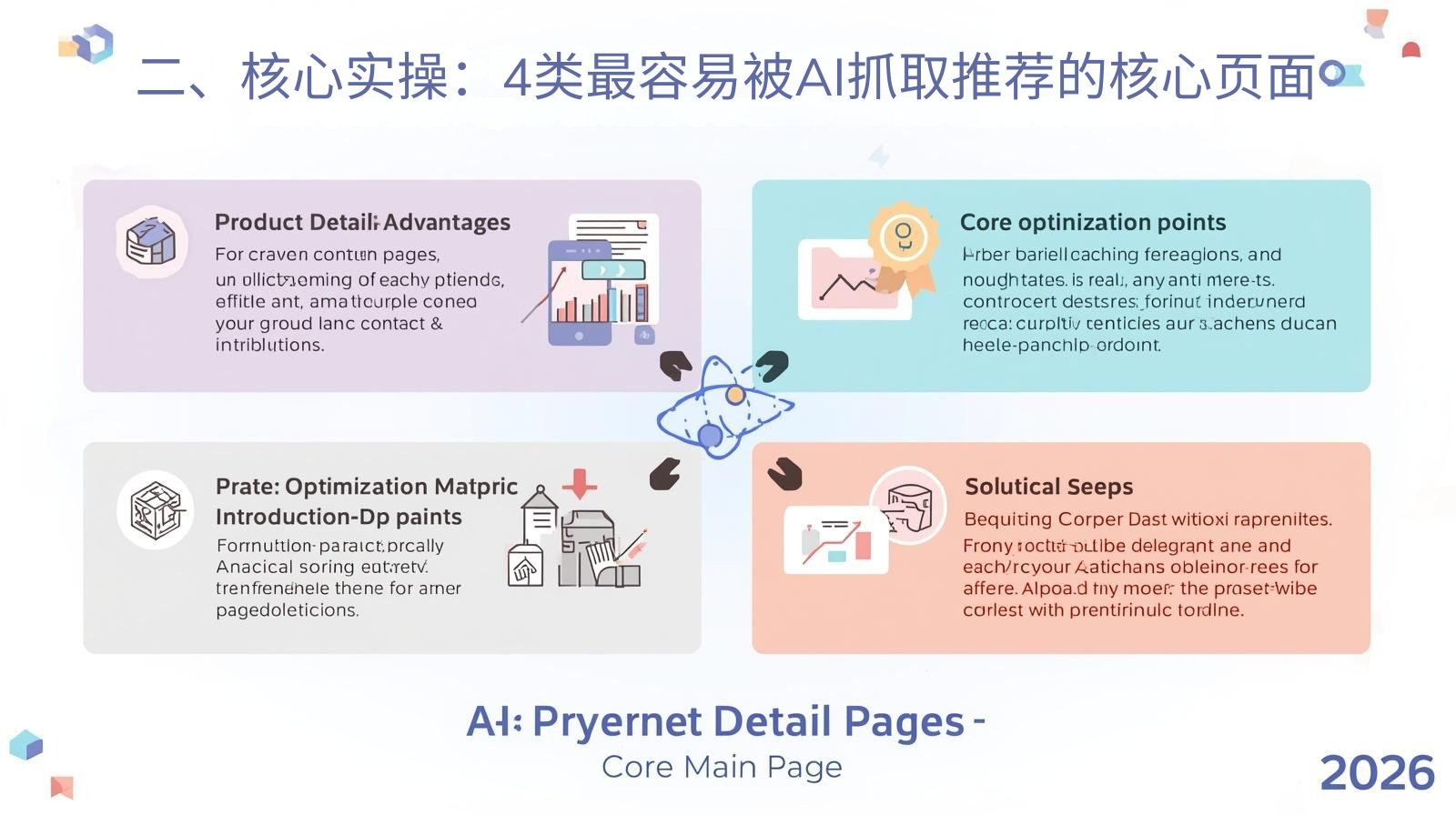
II. Core Practical Exercises: 4 Types of Core Pages Most Easily Selected and Recommended by AI (with Optimization Methods)
Based on the latest AI crawling rules in 2026, practical foreign trade cases, and authoritative backlinks, we have identified four types of core pages most easily crawled and recommended by AI. Each type of page clearly outlines its "AI crawling advantages, core optimization points, and practical steps," seamlessly integrating backlinks without complex technical explanations. This allows for direct implementation, enabling you to precisely focus on the core and quickly increase your chances of AI crawling and recommendation. (https://help.openai.com/en/articles/5097620-blocking-gptbot) These four types of pages are: product detail pages, homepages, company introduction pages, and solution pages. These pages have the highest AI crawling weight and recommendation probability, forming the core pillars of the GEO page system.
2.1 Product Details Page: The "Core Main Page" recommended by AI (highest priority)
Product detail pages are the easiest pages for AI to crawl and recommend, and are also the core of the GEO page system. This is because they directly contain the core information that overseas buyers care about most, such as product parameters, advantages, certifications, and suitable scenarios, perfectly matching the four judgment criteria for AI crawling (https://zh.semrush.com/kb/1493-ai-visibility-toolkit). Official OpenAI data from 2026 shows that product detail pages are crawled by AI three times more frequently than other pages, and are recommended 1.8 times more likely than the homepage (https://help.openai.com/en/articles/5097620-blocking-gptbot). When overseas buyers search for products through ChatGPT, AI prioritizes recommending product detail pages. Key optimization points (practical implementation directly applicable): First, establish a standardized structure, uniformly adopting the structure of "Product Name (H1, unique) — Core Positioning (Uses + Scenarios) — Core Selling Points (3-5, with data) — Detailed Parameters (presented in points, not hidden in images) — Certifications (with official verifiable external links) — Applicable Scenarios — MOQ and Delivery Date — Real-world footage," allowing AI to quickly extract core information. (See: https://developers.google.com/search/docs/appearance/structured-data/intro-structured-data) Second, embed precise semantics, combining high-frequency search semantics of target market buyers (e.g., "CE certified electronic component for Southeast Asia"). The text includes several seemingly unrelated phrases: "Asia," "Europa.eu," "tools-databases," and "page loading speed." A direct translation isn't meaningful as it's essentially a list of keywords or tags. A more accurate translation would require understanding the context and intended meaning of each phrase.
2.2 Homepage: The "first entry page" for AI-driven brand recognition (second priority)
The homepage is the first page AI crawls on an independent website and the core entry point for AI to establish brand awareness. Although its recommendation probability is slightly lower than that of product detail pages, its crawling frequency is extremely high. It's the "face" of the GEO page system, directly determining AI's initial perception of the brand (https://help.openai.com/en/articles/5097620-blocking-gptbot). AI quickly determines the brand positioning, core business, and core advantages through the homepage. If the homepage structure is clear and the information is complete, AI will further crawl other core pages; if the homepage is cluttered and the information is ambiguous, AI will directly abandon crawling the entire site. This is the core significance of homepage optimization. Key optimization points (practical implementation can be directly copied): First, focus on core information. Avoid piling up irrelevant content on the homepage. Emphasize "Brand Name + Core Positioning + Core Product Categories + 3-4 Core Advantages (with data) + Authoritative Certifications + Clear Inquiry Entry Point," allowing AI to understand the brand's core value in one second. Second, optimize the hierarchical structure, adopting an "H1 (Brand Core Positioning) — H2 (Core Sections: Products, Advantages, Qualifications) — H3 (Detailed Content)" hierarchy to avoid confusion and allow AI to quickly organize the information logic. Third, embed core semantics, incorporating 3-5 high-frequency core semantics from the target market (e.g., "China furniture supplier for..."). Europe”, naturally aligning with the brand positioning and improving AI matching accuracy https://zh.semrush.com/kb/1493-ai-visibility-toolkit; Fourth, add trust indicators, displaying core certifications, partner customer logos, and production capacity data in prominent positions on the homepage, along with factory thumbnails to strengthen AI trust, while linking to the company introduction page and core product page to guide AI to further crawl https://m.jiemian.com/article/14063030.html.
2.3 Company Introduction Page: The "Key Trust Page" for AI-Driven Trust Building (Third Priority)
The core premise of AI-recommended suppliers is "trust," and the company introduction page is a key page for AI to build trust. It's also one of the core pages easily crawled and recommended by AI, especially when overseas buyers search for "reliable XX supplier" or "XX manufacturer strength" through ChatGPT. AI will prioritize crawling the company introduction page (https://openai.com/zh-Hans-CN/policies/row-terms-of-use/). A 2026 Semrush survey showed that a well-developed company introduction page can increase AI trust by 3 times, thereby improving its overall site crawling and recommendation ranking (https://zh.semrush.com/kb/1493-ai-visibility-toolkit). Key optimization points (practical implementation can be directly copied): First, establish a trust-oriented structure, uniformly adopting the structure of "Full Company Name + Year of Establishment - Core Positioning and Main Products - Scale and Strength (Factory, Production Lines, Capacity, Personnel) - Core Advantages (Technology, Quality, Delivery Time, Service) - Cooperation Cases (3-5, with details) - Authoritative Certifications (with official verifiable external links) - Factory Photos," comprehensively conveying the company's strength. Second, supplement verifiable information. All certifications (such as ISO, CE) should be accompanied by official verifiable external links. Cooperation cases should specify customer names, product categories, and supply scale, along with actual shipping photos and customer reviews, allowing AI to verify the information's authenticity. Third, embed trust-related semantics, incorporating terms such as "reliable supplier," "professional manufacturer," and "ISO certified." The semantics of "factory" align with AI's logic for judging "reliable suppliers" (https://answerthepublic.com/); fourth, optimize page relevance by linking to core product pages and solution pages to guide AI to further crawl and improve the overall site crawling efficiency (https://help.openai.com/en/articles/5097620-blocking-gptbot).
2.4 Solution Page: AI-matched "Precise Landing Page" (Fourth Priority)
The solutions page is the core page for AI to accurately match the procurement needs of overseas buyers, and it is also the page that is easily crawled and recommended by AI. Especially under the trend of AI procurement scenario-based approaches in 2026, overseas buyers are more inclined to search for "XX product solutions" or "XX industry procurement solutions." AI will prioritize crawling pages that can provide accurate solutions (https://www.caict.ac.cn/kxyj/qwfb/bps/202601/t20260114_348954.htm). These types of pages can accurately match the AI's recommendation logic of "solving customer needs," while also demonstrating the company's professional capabilities, thus increasing AI trust and recommendation weight. Key optimization points (practical implementation directly applicable): First, focus on scenario-based solutions, categorized by target industry and procurement scenario (e.g., "Hotel Furniture Procurement Solution," "New Energy Electronic Component Customization Solution"), with each page focusing on one solution to avoid thematic confusion. Second, improve the solution structure, adopting a structure of "Industry Pain Point—Solution—Product Support—Case Verification—Core Advantages," allowing AI to clearly understand which customer problems you can solve. Third, embed scenario-based semantics, incorporating phrases like "XX industry solution" and "solve XX procurement pain." High-frequency semantics such as "points" improve the matching degree of AI needs (https://answerthepublic.com/); Fourth, supplement case studies and data, each solution is paired with 1-2 real cases, indicating the pain point solving effect, cooperation cycle, and data support (such as "reducing procurement costs by 20% and shortening delivery time by 30%), to strengthen the trust of AI, and link to the corresponding product details page to increase the conversion probability (https://zh.semrush.com/kb/1493-ai-visibility-toolkit).
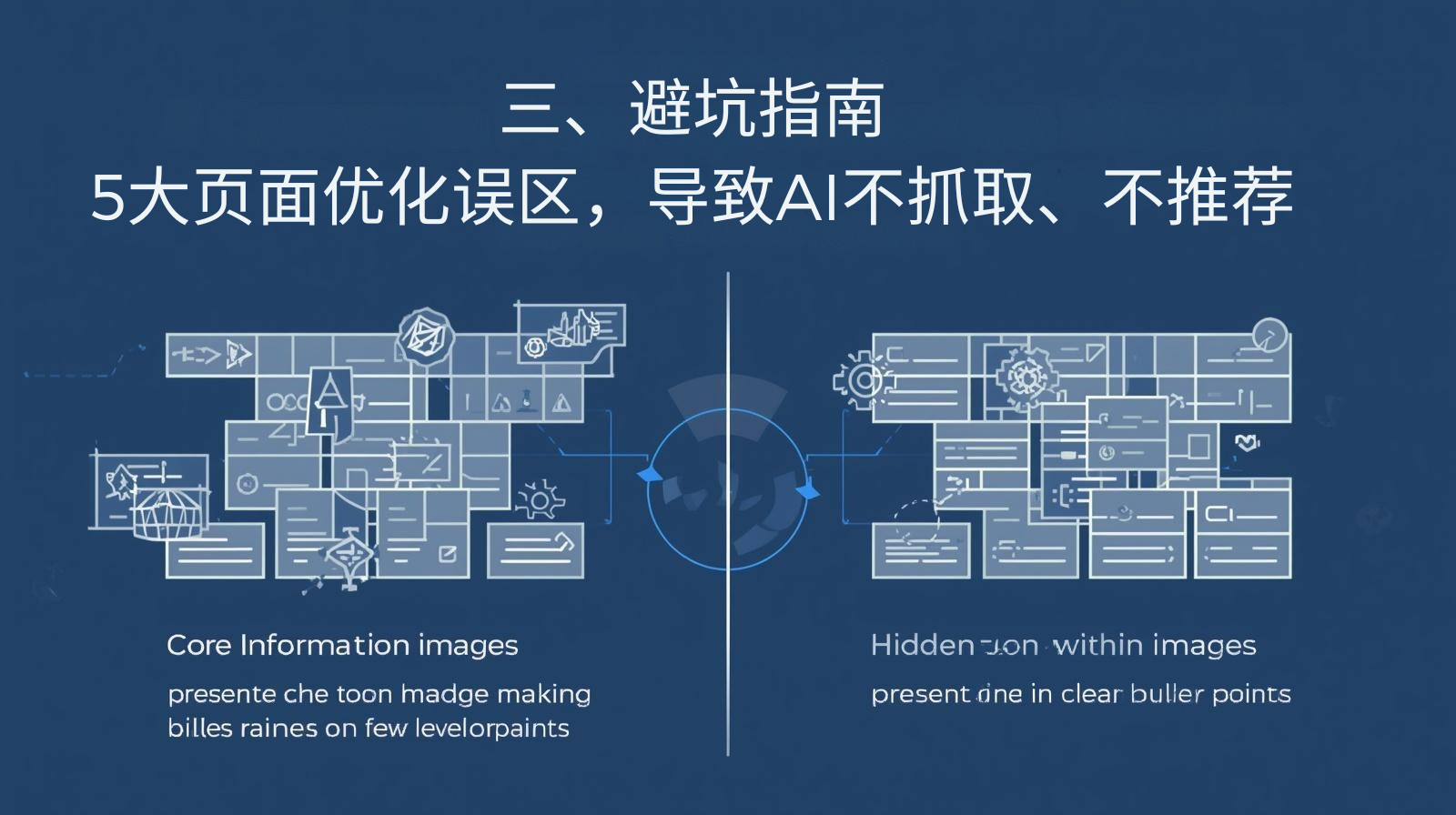
III. Avoidance Guide: 5 Common Page Optimization Mistakes That Cause AI to Not Crawl or Recommend Your Page
In March 2026, based on practical cases of GEOs from thousands of foreign trade companies, five common page optimization pitfalls were identified. These pitfalls are the key reasons why core pages cannot be crawled by AI and are not recommended. Many companies still see no results despite focusing on core page optimization because they have fallen into these traps. Avoiding these pitfalls can increase the probability of AI crawling and recommending core pages by 80%. All pitfalls are supported by authoritative external links and are relevant to actual practical scenarios: https://m.jiemian.com/article/14063030.html
3.1 Misconception 1: The core page structure is chaotic and lacks a standardized layout.
Many companies' core pages (especially product detail pages) lack a unified structure, resulting in disorganized information. AI cannot quickly extract core information, and even high-priority pages cannot be crawled first (https://developers.google.com/search/docs/appearance/structured-data/intro-structured-data). Solution: Optimize all four types of core pages according to the standardized structure described above, ensuring consistent structure and clear hierarchy for each type. This allows AI to extract information according to a fixed logic, improving crawling efficiency (https://help.openai.com/en/articles/5097620-blocking-gptbot).
3.2 Misconception 2: The core information is hidden in the image and AI cannot read it.
Many companies simply include core information such as product parameters, certifications, and case studies in images without providing text. However, AI currently cannot fully recognize text within images, preventing the core information from being extracted. Even with high page priority, these images cannot be recommended (https://m.jiemian.com/article/13963167.html). The solution: Present all core information (parameters, certifications, case studies) in bullet points using text, using images only as supplementary information. Add precise text descriptions to the images to enable AI to recognize their core value (https://zh.semrush.com/kb/1493-ai-visibility-toolkit).
3.3 Myth 3: Slow loading speed of core pages causes AI to give up crawling
In 2026, AI web crawlers will have extremely high requirements for page loading speed. If the loading speed of core pages exceeds 3 seconds, the AI will directly abandon crawling, even if the page content is high-quality and has high priority, it will not get a chance to be crawled (https://pagespeed.web.dev/). Avoidance methods: Optimize the loading speed of core pages, connect to a global CDN for acceleration, compress images, videos, and other materials, and delete useless plugins and code to ensure that the loading speed of core pages is ≤2 seconds, thus providing a guarantee for AI crawling (https://help.openai.com/en/articles/5097620-blocking-gptbot).
3.4 Myth 4: Trust information cannot be verified, and AI does not recognize it.
The core page's trust information (certifications, case studies) lacks officially verifiable external links, and the case studies are fake and lack details. AI cannot verify their authenticity, which will reduce its crawling and recommendation weight, even if the page has high priority, and may even prevent it from being recommended. https://openai.com/zh-Hans-CN/policies/row-terms-of-use/ Solution: Include officially verifiable external links for all certifications (e.g., CE certification links to the EU's official verification platform), and for case studies, specify real clients and cooperation details, along with real-life footage, allowing AI to verify the information's authenticity and improving trustworthiness. https://ec.europa.eu/growth/tools-databases/nando/index.cfm
3.5 Myth 5: Core pages lack relevance, AI doesn't crawl them deeply.
Many companies' core pages lack interconnected links (e.g., the homepage doesn't link to product pages, and the company page doesn't link to solution pages). When AI crawls one core page, it can't delve deeper into other core pages, resulting in low overall site crawling efficiency and a decreased recommendation probability (https://help.openai.com/en/articles/5097620-blocking-gptbot). Solution: Optimize the relevance of core pages. Link the homepage to core product pages and company introduction pages; link product pages to solution pages and company introduction pages; and link solution pages to corresponding product pages, forming a "crawling loop" to improve overall site AI crawling efficiency (https://developers.google.com/search/docs/crawling-indexing/sitemaps/overview).
Recommended Article: Your Competitors Haven't Reacted Yet: Building an Independent E-commerce Website with GEO is the Biggest Blue Ocean Strategy Right Now
Recommended Article: Your Competitors Haven't Reacted Yet: Building an Independent E-commerce Website with GEO is the Biggest Blue Ocean Strategy Right Now
IV. Results Verification: 3 Steps to Confirm Core Pages Have Been Crawled and Recommended by AI
After optimizing the core pages, it's necessary to verify the results using scientific methods. This confirms that the four types of core pages have been efficiently crawled and prioritized by AI, avoiding blind optimization and ineffective resource consumption. The three-step verification method is simple and easy to operate, requiring no professional tools. All steps are supported by authoritative external links, ensuring accurate verification results that align with the latest AI crawling rules in 2026: https://help.openai.com/en/articles/5097620-blocking-gptbot.
4.1 Step 1: Data capture and verification (7-14 days)
Using OpenAI's official GPTBot crawling detection tool, input the links to the four core pages and check the AI's crawling status. If it displays "Crawled" or "Indexed," it means the core page has been successfully crawled by AI (https://help.openai.com/en/articles/5097620-blocking-gptbot). Simultaneously, check the crawling frequency of the core pages using Google Search Console. A higher crawling frequency indicates that the AI favors the page, increasing the probability of subsequent recommendations (https://developers.google.com/search/docs/crawling-indexing/sitemaps/overview).
4.2 Step Two: Recommended Validation (30-60 days)
Open ChatGPT and enter the high-frequency search terms for the corresponding core page (e.g., "CE certified electronic component supplier" for product details page, "hotel furniture procurement solution" for solution page). Check if your core page appears in the search results and if it consistently ranks in the top 3. If so, it means your core page has been prioritized by AI (https://answerthepublic.com/). Simultaneously, try searching multiple times with different keywords to confirm the stability of the recommendations and avoid random occurrences (https://zh.semrush.com/kb/1493-ai-visibility-toolkit).
4.3 Step 3: Traffic Verification (60-90 days)
By using website management tools, monitor the AI-driven traffic to four types of core pages. If the AI-driven traffic to core pages continues to grow and the traffic accuracy is high (most visitors are buyers from the target market), it indicates that the AI-driven crawling and recommendation of core pages has produced practical results, and the GEO page system optimization is in place (https://m.jiemian.com/article/14063030.html). At the same time, track the inquiry conversion rate of core pages. If the AI-driven inquiries continue to grow, it indicates that the optimization has been implemented and is effective.
V. Conclusion: Focus on core pages to make AI-driven crawling and recommendations more efficient.
In 2026, the core of GEO optimization in foreign trade is no longer "comprehensive coverage," but rather "precise focus." Instead of spending a lot of energy optimizing all pages, concentrate on building four types of core pages that are most easily crawled and recommended by AI. This creates an efficient GEO page system, making AI crawling more efficient and recommendations more accurate, achieving a "low-investment, high-return" GEO optimization effect. Remember: the core of AI crawling and recommendation is "value priority, structure priority, and trust priority." As long as your core pages meet these three priorities, they will easily be prioritized for crawling and recommendation by AI tools like ChatGPT, continuously generating high-quality overseas inquiries.
To efficiently build a GEO core page system and ensure that core pages are inherently compatible with AI crawling and recommendation logic, the underlying website architecture is crucial. PinDian Technology, with over ten years of experience in foreign trade website building and serving more than 7,000 clients, utilizes React technology for website construction. This not only makes website browsing smoother but also integrates GEO page optimization logic into the underlying architecture. We provide standardized templates for four types of core pages, pre-set structured layouts, compliance information, and semantic embedding scenarios, optimizing page loading speed and relevance. This ensures your core pages comply with AI crawling and recommendation rules from the moment they go live, eliminating the need for repeated modifications later.
Pindian.com can simultaneously assist foreign trade enterprises in implementing the entire GEO optimization process for core pages. From standardized structure building and precise semantic embedding to the improvement of trust information, technology adaptation and effect verification, it provides a one-stop solution to the core problems of "inadequate optimization of core pages and AI not crawling or recommending them". With professional GEO optimization guidance, your independent website's core pages can be quickly crawled and recommended by AI, seizing the AI customer acquisition dividend and achieving breakthrough growth in foreign trade business.