
Business owners must understand: What are the differences between GEO for independent e-commerce websites and traditional SEO?

  • Independent website industry application
  • Independent website operation strategy
  • Foreign trade stations
  • Foreign trade website
Posted by 广州品店科技有限公司 On Feb 25 2026
In February 2026, an increasing number of overseas B2B buyers stopped sifting through pages of Google search results and instead directly asked ChatGPT: "Recommend Chinese hardware suppliers with European certification and small order quantities." While traditional SEO is still focused on keyword ranking, GEO allows your brand to appear directly in AI responses. Many business owners invest heavily in SEO but receive few inquiries, not because of poor execution, but because the competitive landscape has shifted. This article uses actionable and verifiable comparisons to help you understand the fundamental differences between GEO and SEO, enabling you to seize the customer acquisition opportunities presented by AI.
1. Different optimization goals: SEO focuses on ranking, while GEO focuses on AI recommendation.
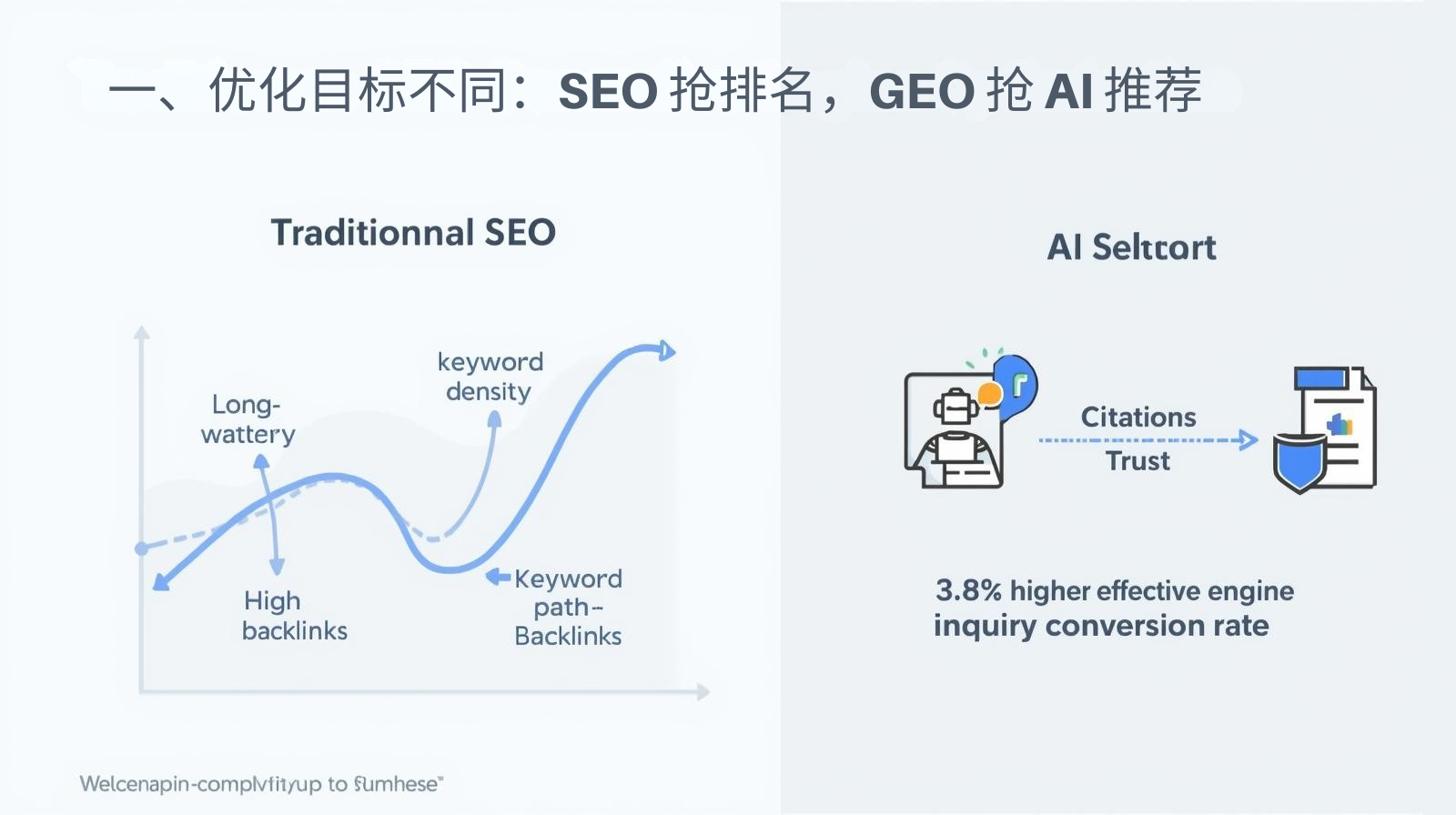
1. Different optimization goals: SEO focuses on ranking, while GEO focuses on AI recommendations.

Traditional SEO aims for a higher ranking on traditional search engines like Google. Its core is "clicks," requiring users to actively search, click links, and enter the site to reach the user. This results in a long traffic path and a high drop-off rate. SEO optimization revolves around ranking factors such as keyword density, number of backlinks, and page speed. Even if a site ranks on the first page, it faces competition from numerous rivals and advertising.
GEO Generative Engine Optimization : The goal is to make generative AI like ChatGPT treat your independent website as a trusted source, directly recommending your brand, products, and advantages in responses. The core is "being cited." Buyers don't need to click through; the AI will prioritize recommending you, resulting in shorter reach, stronger trust, and higher conversion rates. According to the "AI Search Customer Acquisition Report" released by Growth Hacker in February 2026, B2B merchants directly recommended by AI had an effective inquiry conversion rate 3.8 times higher than traditional SEO ( https://www.growthhk.cn/cgo/geo/152578.html ).
In its official documentation in February 2026, OpenAI explicitly stated that GPT recommends prioritizing independent websites with clear structure, authoritative information, and verifiable data sources, rather than simply high-authority pages ( https://platform.openai.com/docs/guides/gptbot ).
II. Different Core Rules: SEO is adapted for web crawlers, while GEO is adapted for AI understanding.
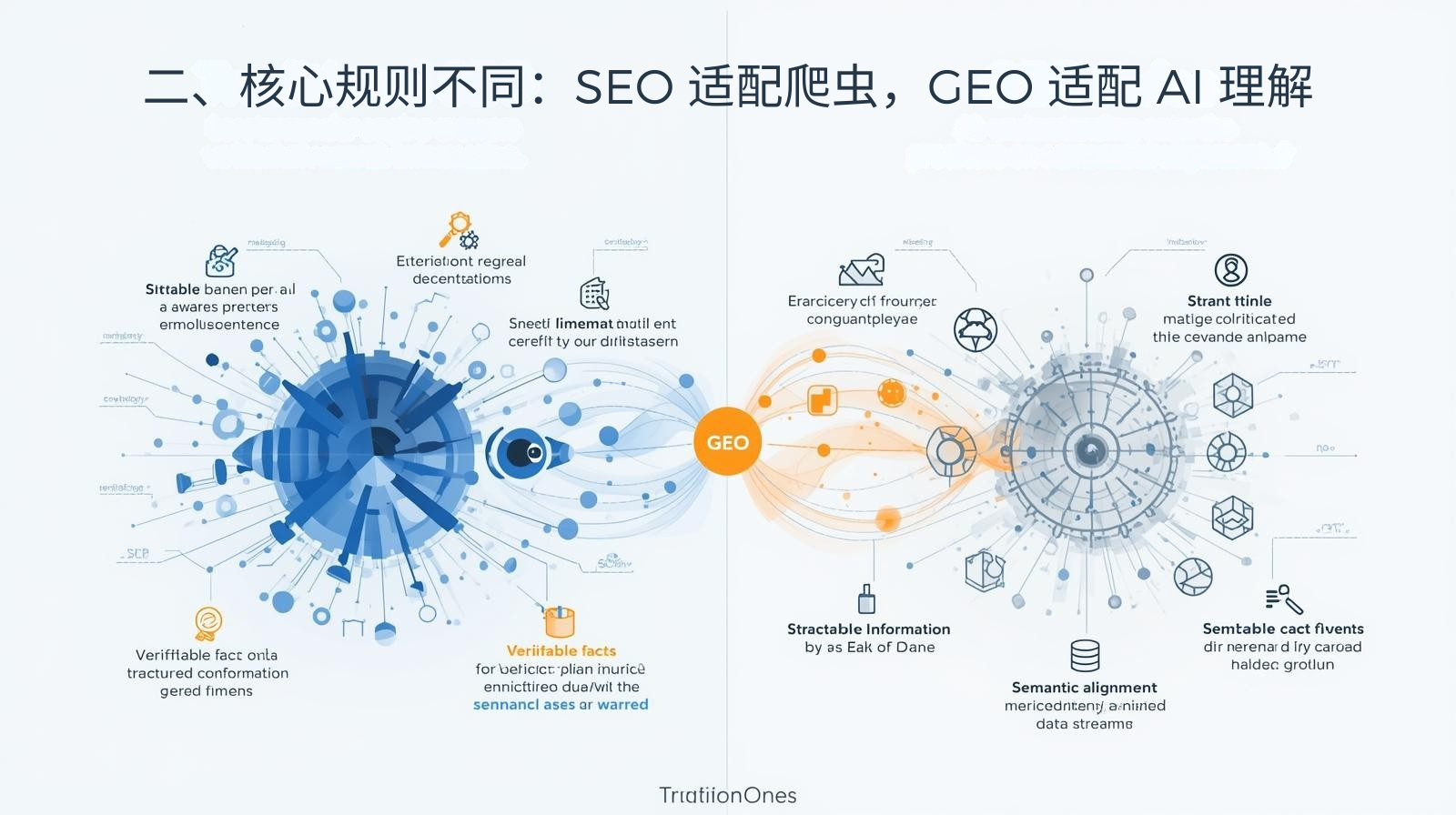
II. Different Core Rules: SEO is adapted for web crawlers, while GEO is adapted for AI.

Traditional SEO rules are designed around search engine crawlers, emphasizing quantifiable metrics such as keyword placement, title tags, link structure, and page load speed. Essentially, it's about "getting the machine to read the keywords." As long as the content conforms to crawler rules, there's a chance of ranking, with relatively lenient requirements on content logic and credibility.
GEO Rules : Designed around the logic of understanding and generating large models, emphasizing information structuring, verifiable facts, semantic integrity, and authoritative endorsement, the essence of which is "to make AI understand you, trust you, and use you".
GEO must meet three underlying AI requirements:
  1. Information is extractable: Key parameters, qualifications, and service capabilities are presented in plain text and structured form, not hidden in images and scripts.
  2. The facts are verifiable: certifications, qualifications, and case studies can be cross-verified through external links, such as the CE certification link to the official EU query portal ( https://ec.europa.eu/growth/single-market/european-standards/ce-marking_en ).
  3. Semantic alignment: Product advantages, service scenarios, and target markets are expressed in a unified way, forming stable knowledge units that AI can recognize.
    According to practical verification by the Tencent Cloud Developer Community in January 2026, websites using standardized structured data tags are 2.3 times more likely to be cited by AI ( https://cloud.tencent.com/developer/article/2622378 ).
Third, the content logic is different: SEO focuses on keyword stuffing, while GEO focuses on building credible knowledge.


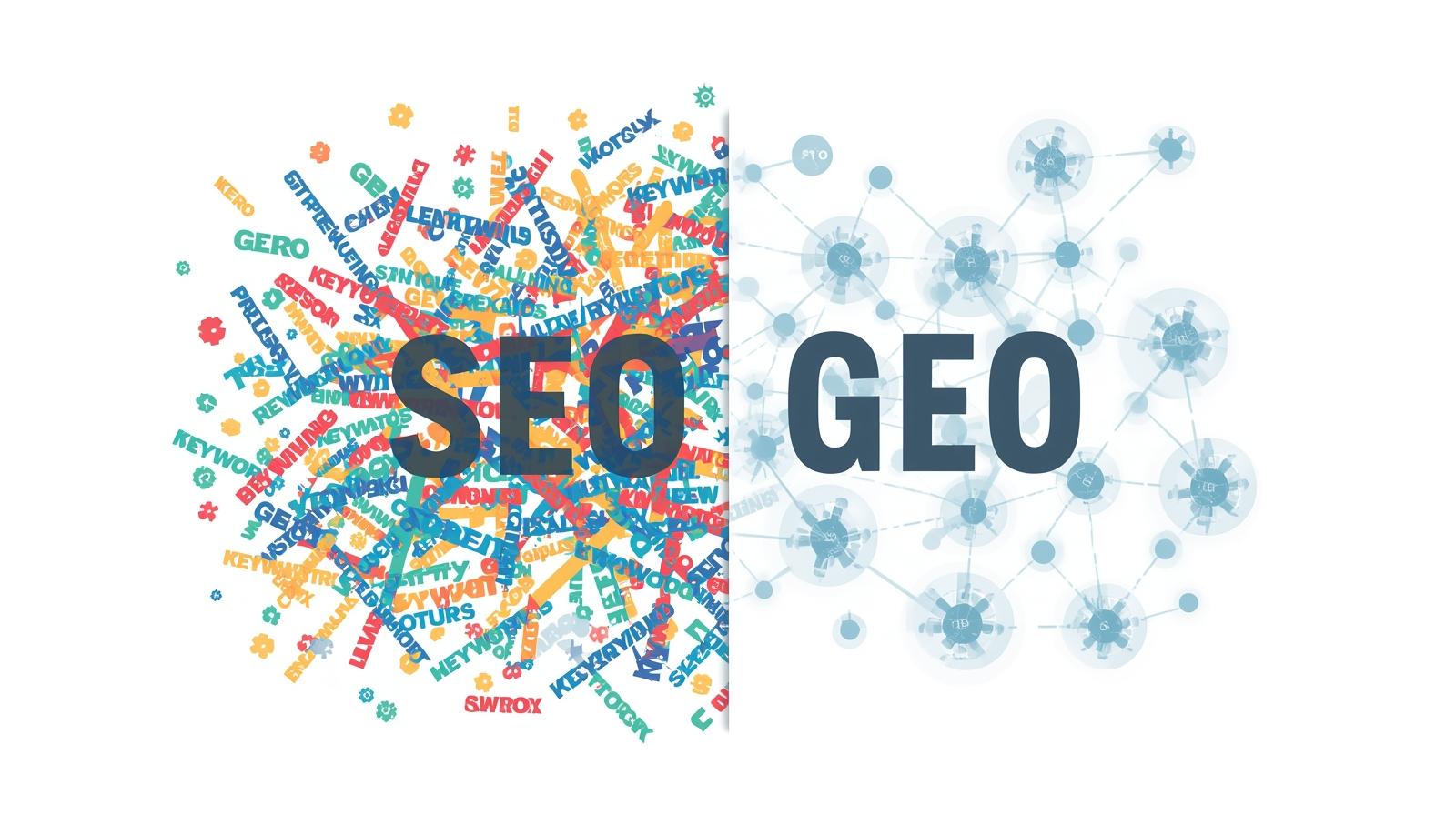
Third, the content logic is different: SEO focuses on keyword stuffing, while GEO focuses on building credible knowledge.

Traditional SEO content focuses on keyword coverage. Common practices include expanding the length of the text, stuffing keywords, and placing long-tail keywords. Readability and usability of the content often give way to ranking requirements, resulting in poor user experience and low value for AI judgment.
GEO Content : Based on the standard of "directly citation by AI", it pursues accuracy, structure, and conclusions upfront, and outputs high-value information in the form of FAQs, parameter tables, solutions, and real-world cases, enabling AI to quickly extract and generate recommendations.
Key practical points for independent e-commerce websites (GEO):
  • The homepage clearly states: target market, core products, certifications, minimum order quantity, and delivery cycle.
  • The product page provides standardized parameters: material, certification, size, MOQ, port, and warranty.
  • Added AI preference module: selection guide, compliance instructions, customization process, customer case data.
  • All key information is in text format to facilitate stable crawling by GPTBot ( https://blog.csdn.net/spider_py/article/details/132200472 ).
    According to Sohu Technology's "Foreign Trade GEO Practical Report" in February 2026, independent websites that adopt structured knowledge output have a 67% higher probability of being recommended by ChatGPT ( https://news.sohu.com/a/978309510_99949443 ).
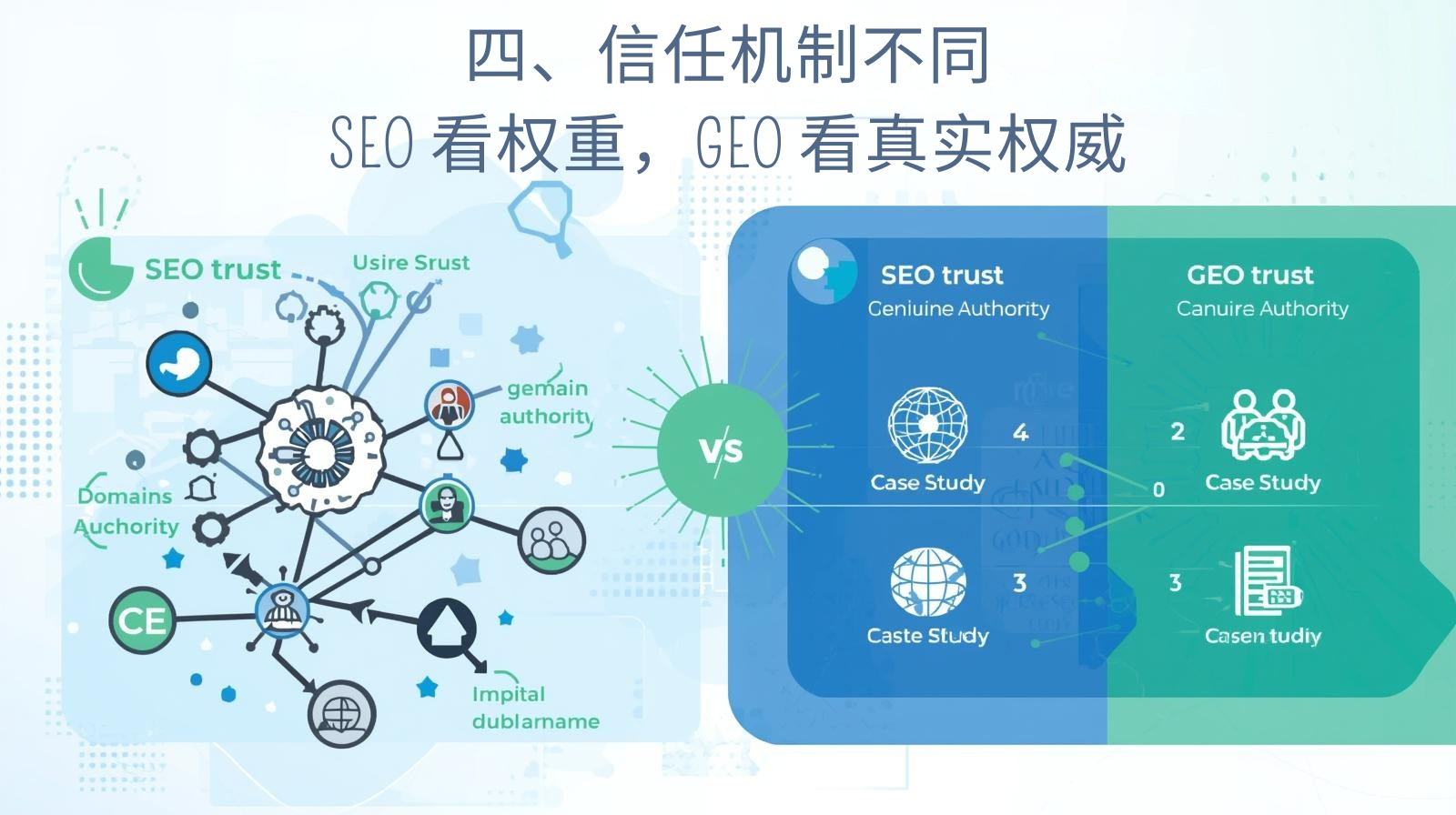
IV. Different Trust Mechanisms: SEO focuses on website authority, while GEO focuses on genuine authority.

Traditional SEO relies on domain authority, the number of backlinks, and submissions to industry platforms. As long as the data meets the standards, the ranking can be improved, making it easily susceptible to manipulation by tools.
GEO Trust : Relies on AI-verifiable, authentic, and authoritative signals, including compliance certifications, real customer case studies, authoritative third-party citations, and consistency of information on the official website. Any false information will be cross-verified and downgraded by AI.
Key steps for building trust with GEO on independent foreign trade websites:
  • The certification page displays certifications such as CE, FDA, and ISO, along with official verification links.
  • The case study page showcases the partner countries, procurement types, pain point solutions, and delivery results.
  • The content cites authoritative reports and industry standards to enhance the credibility of the facts.
  • Enable GPTBot crawling without blocking or adding unnecessary login firewalls (https://blog.csdn.net/Q278068387/article/details/140352153 ).

From "grabbing traffic" to "being chosen," business owners must upgrade their understanding.

Traditional SEO ensures your ranking on search results pages, while GEO (Google AdSense) gives you a foothold in buyers' AI-driven decision-making. In 2026, customer acquisition in foreign trade isn't a matter of choosing one over the other; it's about using SEO as a foundation and GEO for breakthroughs. Focusing solely on SEO will cause you to miss out on the precise traffic of the AI-driven dialogue era; focusing solely on GEO lacks basic search support. The optimal path is to use traditional SEO to guarantee basic search traffic and use GEO to secure top placements on ChatGPT, creating a dual-track customer acquisition strategy.
The prerequisite for GEO optimization is having a well-structured, smoothly loading, standardized information platform that is AI-friendly for web crawling. PinDian Technology boasts over ten years of experience in building websites for foreign trade, serving more than 7,000 clients. Utilizing a React technology architecture, our sites lead in page smoothness, loading speed, and multi-device compatibility. From the ground up, we support structured information display, GPTBot open crawling, and authoritative backlink deployment, ensuring your site naturally aligns with GEO rules and is more quickly recognized and recommended by ChatGPT.
Want your independent website to capture both Google traffic and AI-recommended traffic? Choose PinDian Website Builder, and we'll help you turn your site into a foreign trade customer acquisition platform that AI is willing to recommend, that buyers are willing to trust, and that delivers more efficient conversions.

Add title.png

特色博客

Tag:

  • Independent station
  • SEO optimization for independent websites
  • Independent website traffic acquisition
  • Independent website marketing strategy
  • Independent station conversion and improvement
分享
特色博客
Foreign Trade Independent Website GEO Agency Cooperation Model: AI-optimized service solutions for clients.

Foreign Trade Independent Website GEO Agency Cooperation Model: AI-optimized service solutions for clients.

This article is aimed at foreign trade service agencies and individual practitioners, providing a readily implementable GEO (Generative Engine Optimization) agency cooperation service solution. It covers the entire process of independent foreign trade websites, from AI identification and exposure to inquiry conversion, clearly defining service content, delivery standards, cooperation processes, and profit models. Combining the latest authoritative rules and practical methods from February 2026, it helps agents provide clients with quantifiable and verifiable AI optimization services, enabling them to seize new business opportunities in the AI-driven procurement era of foreign trade services.

Foreign trade independent website GEO + website building: build an AI-friendly independent website from the beginning

Foreign trade independent website GEO + website building: build an AI-friendly independent website from the beginning

This article combines the latest industry reports in February 2026 (OpenAI, Ahrefs, McKinsey, etc.) and checkable external link support to deeply dismantle the core logic of GEO + website building for independent foreign trade websites, break the traditional misunderstanding of "build the website first, optimize later", and clarify that the core of GEO + website building is "innately adapted AI identification rules". Detailed explanation of the four underlying principles of GEO + website building (flat architecture, data standards, smooth experience, verifiable and credible), dismantling the three core practical stages of "preliminary planning → mid-term construction → post-acceptance", with specific steps and authoritative external links to ensure that the method can be implemented directly, helping foreign trade companies to build a friendly independent website with its own AI customer acquisition potential from scratch, so that the site can be captured, identified, and recommended by AI tools such as ChatGPT as soon as it is built, so as to quickly obtain accurate inquiries and seize the opportunity. AI customer acquisition bonus. The article has a clear structure, with chapters and secondary titles clearly separated and presented in bold. Each line of words meets the requirements of a long sentence. External links are naturally integrated into the article. The end of the article naturally promotes product store website building services. It also provides standardized article abstracts, meta descriptions and slugs to help foreign trade companies seize the core opportunities of the AI ​​era in the early stages of website building.

Foreign trade independent station GEO + customer acquisition: a closed loop from AI exposure to effective inquiry

Foreign trade independent station GEO + customer acquisition: a closed loop from AI exposure to effective inquiry

This article focuses on the AI procurement decision-making environment in 2026, and fully explains how independent foreign trade stations can use GEO (Generative Engine Optimization) to achieve a fully closed loop from AI exposure, trust transfer, demand matching to efficient customer acquisition, open up the inquiry conversion link after recommendation by AI tools such as ChatGPT, and use practical methods that can be implemented to truly turn AI exposure into high-quality, high-intent, and high-conversion overseas procurement inquiries.

Foreign Trade Independent Station GEO Old Station Renovation: Let Sleeping Sites Be Recognized by AI

Foreign Trade Independent Station GEO Old Station Renovation: Let Sleeping Sites Be Recognized by AI

This article provides a complete and implementable GEO (Generative Engine Optimization) renovation plan for a large number of old foreign trade websites that have been built but cannot be recognized by large AI models such as ChatGPT. The transformation is carried out from the four dimensions of structural cleaning, structured data reconstruction, content credibility, and crawling channel repair. With the latest authoritative external links and practical steps in February 2026, the originally dormant old website can be read, understood and recommended to overseas buyers by AI again.

GEO Structured Data for Independent Foreign Trade Websites: Enabling AI to Accurately Identify Your Products and Services

GEO Structured Data for Independent Foreign Trade Websites: Enabling AI to Accurately Identify Your Products and Services

This article, drawing on the latest industry reports from February 2026 (OpenAI, Ahrefs, McKinsey, etc.) and verifiable external links, deeply analyzes the core significance of structured data in GEO (Generative Engine Optimization) for independent foreign trade websites. It breaks the misconception of "emphasizing content while neglecting structure," clarifying that structured data is key to AI's accurate product and service identification. Focusing on practical implementation, it details the four essential types of core structured data for independent foreign trade websites (product, company qualifications, services, and customer case studies), providing specific operational guidelines and case studies. It breaks down the three-step implementation process of "information sorting → standardized layout → verification and optimization," ensuring the methods are directly applicable. This helps companies enable AI to quickly and accurately capture core information, clearly understand product and service advantages, and thus stand out in the purchasing recommendations of AI tools like ChatGPT, achieving precise customer acquisition. The article has a clear structure, with chapters and subheadings clearly separated and presented in bold. Each line of text conforms to the requirements of long sentences, and external links are naturally integrated into the text. The end naturally promotes the brand store website building service. At the same time, it provides standardized article summaries, meta descriptions and slugs to help foreign trade enterprises optimize GEO structured data and seize the AI customer acquisition dividend.

GEO Structured Data for Independent Foreign Trade Websites: Enabling AI to Accurately Identify Your Products and Services

GEO Structured Data for Independent Foreign Trade Websites: Enabling AI to Accurately Identify Your Products and Services

This article, drawing on the latest industry reports from February 2026 (OpenAI, Ahrefs, McKinsey, etc.) and verifiable external links, deeply analyzes the core significance of structured data in GEO (Generative Engine Optimization) for independent foreign trade websites. It breaks the misconception of "emphasizing content while neglecting structure," clarifying that structured data is key to AI's accurate product and service identification. Focusing on practical implementation, it details the four essential types of core structured data for independent foreign trade websites (product, company qualifications, services, and customer case studies), providing specific operational guidelines and case studies. It breaks down the three-step implementation process of "information sorting → standardized layout → verification and optimization," ensuring the methods are directly applicable. This helps companies enable AI to quickly and accurately capture core information, clearly understand product and service advantages, and thus stand out in the purchasing recommendations of AI tools like ChatGPT, achieving precise customer acquisition. The article has a clear structure, with chapters and subheadings clearly separated and presented in bold. Each line of text conforms to the requirements of long sentences, and external links are naturally integrated into the text. The end naturally promotes the brand store website building service. At the same time, it provides standardized article summaries, meta descriptions and slugs to help foreign trade enterprises optimize GEO structured data and seize the AI customer acquisition dividend.