
The January 2026 "AI+ Independent Station: 2026 Small and Medium-sized Enterprises Breakthrough in Going Global" report shows that currently 82% of foreign trade entrepreneurship studios face "flat Due to the dilemma of "high commissions, soaring customer acquisition costs, and insufficient manpower", the inquiry cost of traditional platforms has exceeded 200 yuan/item. However, with a small team deploying independent station GEO optimization + AI search traffic, the average inquiry cost can be reduced to 35 yuan/item, and the inquiry conversion rate is 52% higher than the platform model. . A chemical startup studio in Changzhou has a team of only 3 people. After giving up the platform, it focused on GEO optimization of independent stations. In 3 months, the number of precise inquiries obtained through AI platforms such as ChatGPT increased 2.8 times, and it achieved profits with zero commission. For foreign trade startup studios, the core value of GEO (Generative Engine Optimization) is that it does not require a high-paying team or large investments. Through lightweight and precise operation methods, independent stations can be prioritized by the AI platform, efficiently obtain global precise procurement traffic, and break through overseas inbound and outbound operations.

1. Core Cognition: The advantages and underlying logic of a small team doing GEO+AI traffic
Foreign trade entrepreneurship studios (usually 3-5 people) do not have the financial and manpower advantages of large companies. Blindly copying the full-category and heavy-operation model of large teams will inevitably fail. GEO+AI traffic operation fits the core characteristics of "flexibility, focus, and low cost" of small teams. When AI platforms such as ChatGPT and Gemini capture independent websites of small teams, the core logic is not "scale priority" but "accurate value matching" - that is, through the three dimensions of "adaptation to segmented needs, practical value of content, and completeness of trust and endorsement", sites that can accurately solve the pain points of specific procurement scenarios are screened, rather than pursuing large and comprehensive information coverage. The practical cases of Jiyun Technology's three-person team prove that as long as a small team focuses on a certain segmented category or regional market and uses GEO generative optimization to strengthen core values, the AI platform's recommendation weight can even surpass some large enterprise sites.
1.1 The three core advantages of small teams doing GEO+AI traffic
Compared with large enterprises, Foreign Trade Entrepreneurship Studio has a natural advantage in GEO+AI traffic operation, which is also the key to its rapid breakthrough:
1. Outstanding advantages of focus: Small teams tend to focus on a single subcategory (such as a certain type of mechanical accessories, a certain type of chemical raw materials), making it easier to delve into subdivided scenarios. The content can accurately match the segmented needs of buyers, and the AI platform prefers such "small but refined" sites.
2. Flexible and efficient operation: There is no hierarchical process of large enterprises, and it can quickly respond to changes in AI crawling rules and fluctuations in market demand, such as adjusting keyword layout and optimizing content expressions, and it can be implemented on the same day, and the efficiency is much higher than that of large enterprises.
3. Strong cost controllability: There is no need to invest large amounts of advertising costs. GEO optimization can be completed with the help of free AI tools (ChatGPT, DeepL) and low-cost website building solutions (SaaS website building). The initial investment can be controlled within a few thousand yuan, which is suitable for financial constraints in the early stages of entrepreneurship.
1.2 Four core judgment dimensions for AI crawling of small team sites in 2026
Combined with the OpenAI Small and Medium Site Optimization Guide (link: https://platform.openai.com/docs/plugins/small-business-best-practices) and the rare earth Nuggets foreign trade SEO practical summary, the core dimensions of AI's judgment of whether a small team independent station is worthy of priority recommendation can be accurately broken down into four points, which directly determines the traffic acquisition effect. :
1. Matching degree of segmented demand: The core determination is whether the site focuses on a certain segmented category or scenario (such as "Chemical Raw Materials for Infrastructure Construction in Tanzania" and "European and American Outdoor Camping Tent"), and whether the content accurately covers the procurement pain points of the scenario (compliance requirements, selection skills, supply cycle).
2. Practical value of content: The core judgment is whether the content can solve the actual problems of buyers (such as procurement pitfall guides, product usage tutorials), rather than pure brand and product promotion. The AI recommendation rate of practical content is 3 times higher than that of hard advertising content.
3. Trust endorsement integrity: The core judgment is whether there is basic and real trust evidence (such as product certification, small cooperation cases, customer reviews). Small teams do not need well-known cases from large enterprises. Real market segment cases are more likely to be recognized by AI.
4. Lightweight experience: The core determines whether the site loading speed (LCP ≤ 2.5 seconds) and mobile terminal adaptability meet the standards. Small team sites do not need complex functions, and the simple and smooth experience is more in line with the needs of AI and buyers.
1.3 Core principles of small team GEO+AI operation
Many foreign trade entrepreneurial studios fall into the misunderstanding of "blindly chasing traffic and copying the large team model", resulting in investment efforts but no results. Small teams must adhere to three core principles when doing GEO+AI traffic: don't be greedy for too much (focus on a single subcategory/region), don't spend money (use more free/low-cost tools), and don't be complicated (lightweight operations and avoid redundant operations). Only by focusing on the core and implementing it efficiently can you see the results quickly.

2. Practical implementation: 4 steps of efficient gameplay, a small team can quickly handle GEO+AI traffic
This solution is completely in line with the actual situation of small teams with "small manpower, limited budget, and no professional skills". All operations require no code or high-paid talents. A team of 3-5 people can implement it. Every step is supported by clear actions and tools. If you follow these steps, the independent station will be prioritized by the AI platform.
2.1 Step 1: Focus on segmentation and accurately target the core of AI traffic (completed in 0.5 days)
Core goal: avoid full-category competition, lock in subdivided categories/areas that small teams can delve into, explore highly matching keywords for the AI platform, clarify the direction for subsequent optimization, and avoid blind investment.
2.1.1 Core operation actions
1. Segmentation and positioning screening: clarify two core positionings to avoid ambiguity: ① Category positioning: focus on a single subcategory (for example, instead of “chemical raw materials”, only “anti-corrosion chemical raw materials for Tanzania’s infrastructure”; not “outdoor products”, only “European and American single-person camping tents”); ② Regional positioning: lock in 1-2 key areas (such as Southeast Asia, a country in East Africa, a certain market segment in Europe and the United States), and give priority to areas with low competition and stable demand. You can use ChatGPT to assist in analysis and enter "2026 high demand and low competition foreign trade subdivisions + Southeast Asia" to quickly obtain positioning reference.
2. Low-cost keyword mining: Use 3 free tools to screen high-matching keywords on the AI platform, focusing on long-tail words (low competition, high accuracy): ① Google Keyword Planner (link: https://ads.google.com/home/tools/keyword-planner/ ): Free mining of core keywords, screening long-tail keywords with search volume of 100-1000 and low competition (such as "Tanzania anti-corrosion chemical raw materials for infrastructure"); ② AnswerThePublic (link: https://answerthepublic.com/): Capture question-type keywords that buyers frequently search for (such as "How to choose anti-corrosion chemicals for Tanzania railways"); ③ ChatGPT: Enter "I work in XX subcategories, target market XX, help me sort out 20 AI search high-frequency long-tail keywords" to quickly supplement the keyword list.
3. Keyword layout: Allocate the 20-30 core keywords screened according to "product page (core words + long-tail words), blog page (question keywords), home page (core positioning words)", and focus on 2-3 keywords on each page to avoid stacking.
2.2 Step 2: Lightweight content optimization, use GEO to impress AI and buyers (1-2 days to complete)
Core goal: Use AI tools to quickly generate high-quality, differentiated content without the need for professional copywriting talents, so that the content not only conforms to GEO's generative optimization logic, but also accurately solves the buyer's pain points, and is prioritized by AI.
2.2.1 Core operation actions
1. Core page content optimization (home page + product page, key points): ① Home page: Title highlights "Segment Category + Region + Core Advantages" (such as "Tanzania Infrastructure Anti-Corrosion Chemicals Supplier - Fast Delivery & TBS Certified"), the content is concise, and the core advantages (2-3 items are placed at the top, such as "Focus on Tanzania's infrastructure scene, complete TBS certification, 7-day fast delivery"), 2-3 core products + simple cases are placed in the middle, and contact information and certification information are added at the bottom; ② Product page: Use ChatGPT to generate basic copy (enter "product name + core parameters + target market + adaptation scenario to generate a professional foreign trade product description and avoid Chinese English"), and then manually optimize and add differentiated details (such as "This product is specially designed for high-temperature environments in Tanzania. The anti-corrosion effect has been verified by local infrastructure projects and has been supplied to 3 railway tenders"). At the same time, the certification information (such as TBS certification number + official query link: https://tbs.go.tz/ ), using scenario-based language instead of simple parameter listing.
2. Low-cost blog content creation (one article per week, efficient output): Focus on the buyer's pain points and create practical blogs (such as "2026 Tanzania Infrastructure Chemical Raw Materials Procurement Guide to Avoid Pitfalls: 3 Certifications Are Essential" and "How to Choose a European and American Single Camping Tent? 5 Core Indicators"). There is no need for long articles, 800-1000 words are sufficient. Operation process: ChatGPT generates a first draft (enter "blog topic + target market + 3 core pain points to generate a practical guide") → Grammarly optimizes grammar (link: https://www.grammarly.com/) → Copyscape checks (link: https://www.copyscape.com/) to ensure the duplication rate is less than 20%, and finally manually adds 1-2 real service cases of small teams to enhance credibility.
3. Enhanced content differentiation: A small team does not have well-known cases from large companies, so it can highlight differentiated advantages such as "localized services, quick response, and adaptation to segmented scenarios." For example, mentioning in the content "We have local contacts in Dar es Salaam who can quickly respond to order requirements" and "Focus on single-person camping scenarios, the tent weighs only 1.2kg, suitable for European and American hiking enthusiasts." These details are easier for AI and buyers to remember.
2.3 Step 3: Low-cost signal enhancement to allow AI to quickly capture (0.5 days to complete, long-term reuse)
Core goal: without large investment, through free tools and simple operations, deliver "high-quality, accurate, and credible" crawling signals to the AI platform to accelerate the inclusion and recommendation of independent sites.
2.3.1 Core operation actions
1. Free structured markup and site optimization: ① Structured markup: Use the Rank Math free version plug-in (link: https://rankmath.com/ ), without coding, add structured markup (marking product parameters, certification, blog type) to product pages and blog pages with one click, allowing AI to quickly identify the core of the content; ② Site speed-up: use TinyPNG to compress images (link: https://tinypng.com/), delete unused redundant plug-ins in the background of website building, and enable Cloudflare free version CDN (link: https://www.cloudflare.com/ ), ensure that the site loading speed LCP ≤ 2.5 seconds, and the mobile terminal adaptation meets the standards (tested with Google Mobile-Friendly Test, link: https://search.google.com/test/mobile-friendly).
2. Zero-cost external link construction: small teams do not need to invest money to buy external links, focusing on 2 efficient channels: ① Industry resource page external links: Google search "subcategory + resources" (such as "anti-corrosion chemicals for infrastructure resources"), find the industry resource summary page, and contact the webmaster to add independent website links, which are free and have high weight; ② Vertical platforms and social media external links: In the free member areas of Made-in-China, Global Sources and other platforms, publish product information and attach independent website links; on LinkedIn, Quora and other platforms, share practical content (such as procurement pitfall avoidance tips) as an "industry practitioner", and naturally attach independent website blog links at the end of the article.
3. AI platform proactive submission: ① Submit the independent station homepage, core product page, and blog page URL through the ChatGPT webmaster platform (link: https://platform.openai.com/docs/plugins/small-business-best-practices), and fill in the submission instructions ("Small focusing team on XX segmented products for XX market, with practical content and complete certifications, suitable for AI search crawling"); ② Submit sitemaps for free through Google Search Console to accelerate AI and Google crawling.
2.4 Step 4: Efficient data monitoring, iterative optimization for 30 minutes per week (long-term persistence)
Core goal: A small team does not have time to focus on data every day, so it spends 30 minutes every week focusing on core indicators, quickly discovering problems and optimizing, ensuring continuous access to AI traffic, and avoiding blind operations.
2.4.1 Core operation actions
1. Core data monitoring: focus on 4 key indicators and use free tools to quickly view: ① AI crawling and ranking: spend 5 minutes every day to search for core keywords through ChatGPT and Google to record independent station ranking changes; ② Site health: use GTmetrix every week (link: https://gtmetrix.com/ ) Check the loading speed to ensure that the indicators meet the standards; ③ Traffic data: Check the independent site visits, source (AI platform/social media/platform), and stay time (≥2 minutes for high quality) through Google Analytics (link: https://analytics.google.com/); ④ Conversion data: count the amount of inquiries, mark the source of the inquiry (which keyword, which page), and analyze the conversion efficiency.
2. Rapid iterative optimization: Accurately adjust according to data feedback problems, without redundant operations: ① Ranking decline: Prioritize check whether the keyword layout is reasonable and whether the content is duplicated, and resubmit the index after optimization; ② Duration of stay: Optimize the page content and add practical information (such as product use cases, purchasing FAQs); ③ Few inquiries: Add clear consultation guidance (such as "Click to get the exclusive purchasing plan" and "Contact the local contact person") on the core pages (product pages, blog pages), and optimize the display of contact information (WhatsApp and email are highlighted).
3. Weekly review: Spend 10 minutes every week to do a simple review, record effective operations (such as a certain blog that brings a lot of inquiries) and invalid operations, and then focus on effective actions to continuously optimize operational efficiency.
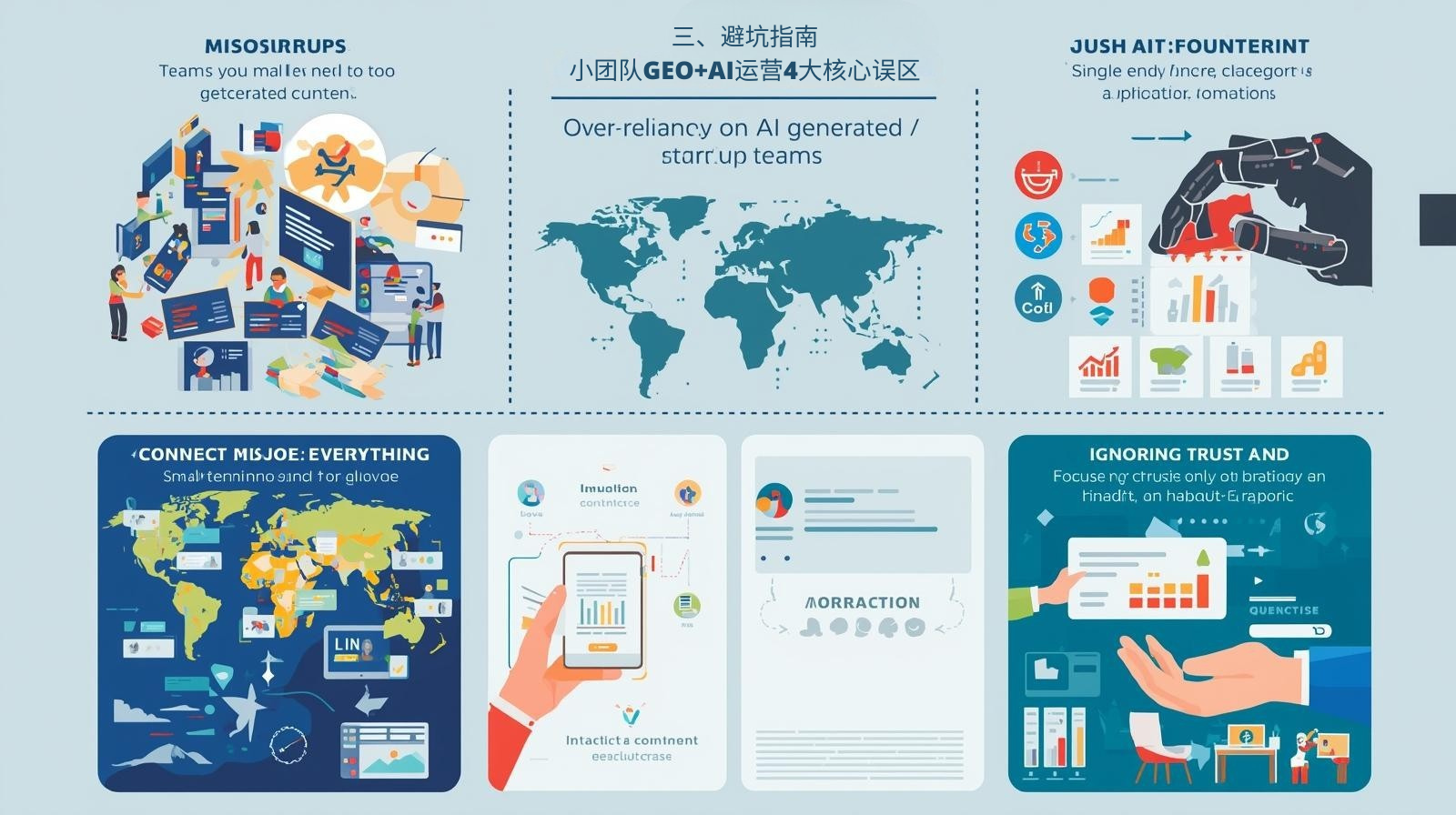
3. Pitfall avoidance guide: 4 core misunderstandings in small team GEO+AI operations (must read)
Based on the practical cases of foreign trade entrepreneurship studios in the first half of 2026, many small teams have fallen into the following misunderstandings, resulting in ineffective GEO optimization and a waste of time and money, which must be resolutely avoided:
3.1 Misunderstanding 1: Be greedy for more and seek completeness, blindly deploy all categories/multiple regions
Error performance: A team of 3-5 people wants to "cover all categories of chemical raw materials" and "cover the global market". The content is general and cannot focus on segmented needs;
Core Hazards: It cannot be recognized by AI as a "precise value site" and is always ranked low. At the same time, it distracts manpower and energy, and it cannot do well in each category/region. A certain foreign trade team of 3 people still has no valid inquiries for 6 months of operation due to greed for more and more;
Correct approach: Stick to a single subdivision category + 1-2 key areas, delve into subdivided scenarios, and allow AI and buyers to quickly identify the core value of the site.
3.2 Misunderstanding 2: Over-reliance on AI-generated content and ignoring manual optimization
Error performance: Directly copy the content generated by ChatGPT without manual optimization, resulting in serious content homogeneity, lack of real details, and even Chinese English;
Core hazard: AI can identify purely generative homogeneous content, directly reducing the weight of recommendations, and buyers will give up consultation because the content is untrue and unprofessional;
Correct approach: After using AI to generate the first draft, manually add real cases of small teams, subdivide scene details, optimize language expression, and check for duplication through Copyscape to ensure that the content is unique and authentic.
3.3 Misunderstanding 3: Ignoring trust and endorsement and only doing product promotion
Error performance: The content only focuses on product parameters and prices, does not display trust evidence such as certification information, cooperation cases, customer reviews, or even false propaganda;
Core hazards: The AI determines that the site is not trustworthy enough, even if it is ranked, it cannot gain the trust of buyers, and the inquiry conversion rate is extremely low;
Correct approach: Display real certification information (with query link), small cooperation cases (no need for well-known customers, market segment cases are enough), and simple customer reviews. The reality of a small team makes it easier to build trust.
3.4 Misunderstanding 4: Leave it alone after optimization, lack of iteration
Error performance: After completing the initial optimization, the content is no longer updated, the data is not monitored, and the strategy is not adjusted, thinking that it is "once and for all";
Core hazard: With the changes in AI crawling rules and peer optimization, the site ranking will gradually decline, and the effect of the initial investment will slowly be lost;
Correct approach: Spend 30 minutes every week monitoring data, iterative optimization, and update 1-2 blog content every month to ensure continuous adaptation to AI rules and market demand.
Related article recommendations: Your peers have not yet reacted: using GEO to build an independent foreign trade station is the biggest blue ocean strategy at the moment
Related article recommendations: Your peers have not yet reacted: using GEO to build an independent foreign trade station is the biggest blue ocean strategy at the moment
4. Ending: The AI traffic dividend of a small team is hidden in efficient GEO operations
Foreign trade overseas in 2026 is no longer an era of "fighting for capital and winning by scale". For foreign trade startup studios, the rise of AI platforms just provides the opportunity to "do big with small" - no need for large investments or high-paying teams. As long as the focus is on segmentation and efficient implementation of GEO optimization, independent stations can be prioritized by AI recommendations and obtain accurate procurement traffic.
The 4-step gameplay shared in this article completely fits the actual operation scenario of a small team. All operations have been verified by actual operations. A team of 3-5 people can quickly implement it without the need for professional skills or large amounts of funds. Remember, when a small team does GEO+AI traffic, the core is not "how much to do" but "to do accurately"; it is not "expensive" but "efficient".
Foreign trade entrepreneurship is not easy. Instead of consuming funds and energy in platform involution, it is better to seize the AI traffic dividend and use lightweight GEO operations to make independent websites the core carrier for accurate customer acquisition. Take action now, focus on segmentation, and implement it efficiently. Your small team can also achieve rapid breakthroughs and profitable growth in AI search traffic.