
In Q4 of 2025, "CampGear Hub", which specializes in outdoor camping equipment, encountered an AI traffic bottleneck: the independent site has single product content such as "California camping tent", "portable sleeping bag" and "moisture-proof mat". Each article is optimized for US regional keywords, but ChatGPT searches for "California camping gear" set" (California camping equipment set), the brand content has always hovered outside the 15th place; similar brands recommended by Perplexity, although the quality of the content of the individual products is similar, but due to the content system of "tents are associated with sleeping bags, sleeping bags are associated with camping scenes", the ranking is firmly in the TOP5. After "GEO+ content relevance" optimization, a breakthrough was achieved within 60 days: a content relevance matrix of "California camping scenes → core equipment → usage techniques" was built, the ChatGPT search ranking for "California camping equipment" rose to TOP2, the number of Perplexity recommendations increased by 320%, and the number of inquiries for equipment sets increased 4 times compared to a single product. The "2025 Foreign Trade AI Content Weight Report" shows that multi-AI platforms tilt the weight of "regionally anchored content correlation clusters" by up to 65%. This type of content can completely cover the user's "search-understanding-decision-making" link, while fragmented content "cannot meet the needs of AI knowledge graph construction", and its weight is only 1/5 of related content. The AI weight competition among foreign trade independent websites has been upgraded from "single content optimization" to "related content system competition" - using GEO to lock in regional scenes and connect content to each other into a network can allow multiple AI platforms to proactively list your brand as a "priority recommendation object".
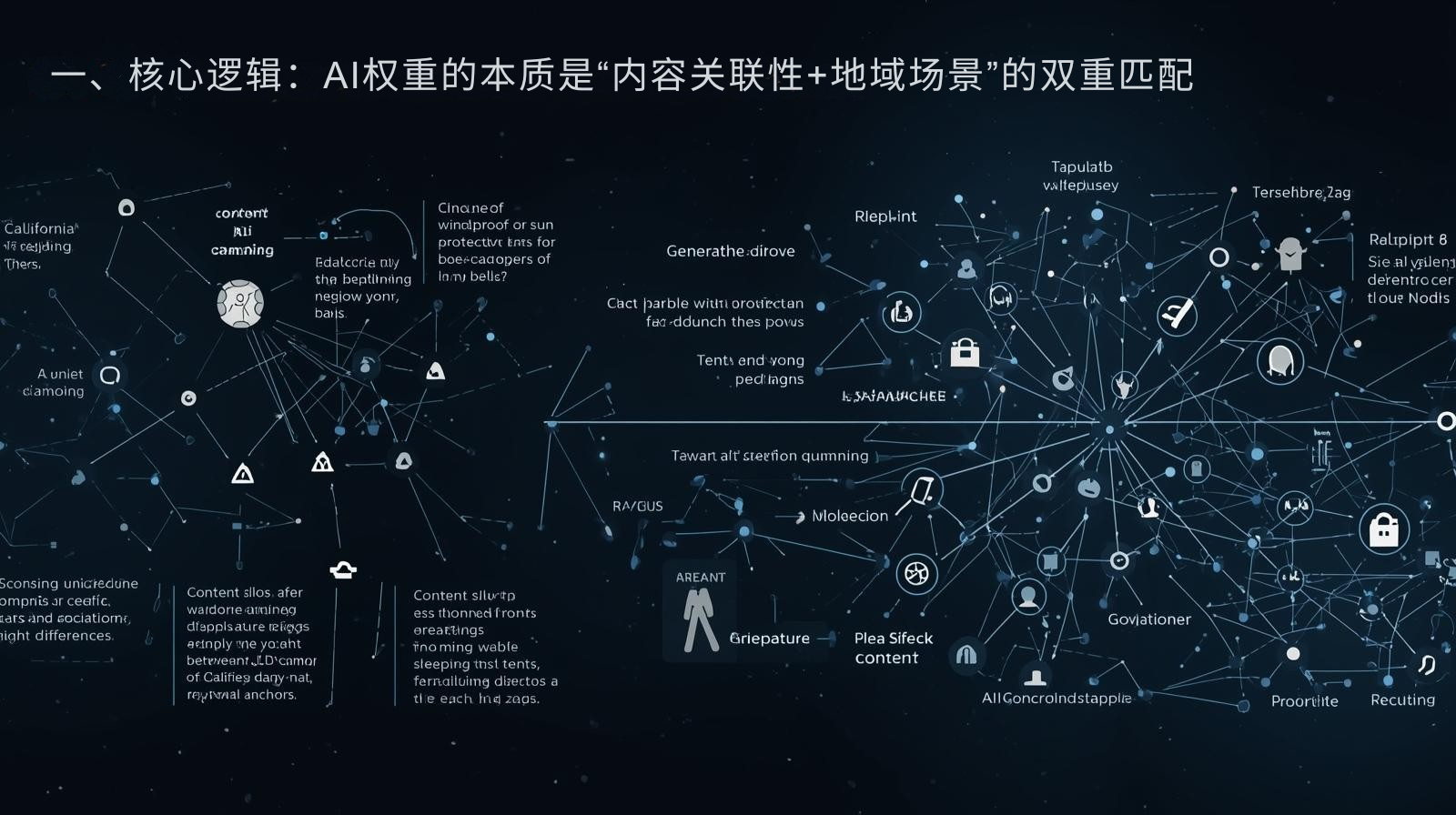
1. Core logic: The essence of AI weight is the double matching of "content relevance + regional scene"
The underlying operating logic of generative AI such as ChatGPT and Perplexity is to "build knowledge associations between user needs and content" - when a user searches for "California When it comes to "camping equipment", AI not only needs the content of single products such as "tents and sleeping bags", but also needs to know related information such as "should you choose a windproof tent or a sunproof tent for camping on the California beach", "how the sleeping bag temperature scale adapts to the temperature difference between day and night in California", "size matching skills for moisture-proof mats and tents", to form a complete "demand solution". The two major weight traps of traditional foreign trade independent websites just violate this logic: First, "islanding of content", each product page and blog exists independently. For example, the "California Camping Tent" page only talks about tent parameters, without mentioning supporting sleeping bags and usage scenarios. AI cannot identify the correlation between the content and can only be judged as a "single information point" ", the weight is naturally low; the second is "association without regional anchor point", associating "camping tent" with "alpine hiking boots" (the scene does not match), or using "global camping skills" to associate "California tent" (region is ambiguous), the AI determines that the "association logic is confusing", which not only does not increase the weight, but may reduce the credibility of the content. The core logic of content relevance + GEO optimization is to "take the regional scene as the core hub to build a network relationship of 'core products → supporting products → scene skills → user pain points'" - for example, around the regional scene of "California camping", let the "windproof and sunproof tent" be related to the "0℃-15℃ temperature "Standard sleeping bag" (ancillary product), "sleeping bag" is associated with "sleeping bag selection tips for the day and night temperature difference in California" (scenario skills), and "technical content" is associated with "common solutions for 'sleeping bags that are too cold' for California campers" (user pain points). At the same time, all content is embedded with regional words such as "California, LA, San Francisco". This correlation system not only allows AI to capture the strong correlation signal of "tent-sleeping bag-scene", but also anchors "California user needs" through regional words. It was eventually judged by AI as "a high-value content cluster that can completely solve the camping equipment needs of California" and was recommended to target users with priority.
2.1 AI perspective: content correlation = "knowledge graph integrity", the weight is naturally high
When AI processes search requests, it will automatically build a "user demand knowledge graph". For example, if a user searches for "California camping tent", the AI's knowledge graph is "tent type (windproof/sunproof) → California climate adaptation (rainy in summer, large temperature difference between day and night) → supporting equipment (sleeping bags, moisture-proof mats) → Usage scene (seaside/forest/mountain) → purchasing tips (material/size/installation).” If your independent station only has "tent type" content, the AI will determine that the "knowledge map is incomplete"; if it can provide related content of "tent + climate adaptation + supporting equipment", the AI will determine that the "knowledge map is complete" and directly increase the overall weight. More importantly, multiple AI platforms will share content correlation signals - the "tent-sleeping bag" correlation identified by ChatGPT will be synchronized to Perplexity's recommendation logic to achieve "one optimization, multiple platforms benefit".
2.2 User perspective: content correlation = "improved decision-making efficiency", retention rate determines weight
The decision-making link of foreign trade users is "Search for single products → Understand the supporting packages → Learn to use → Place an order". If your content allows users to "complete the full-link information acquisition within one site", the residence time and page jump rate will be greatly improved - CampGear Before Hub optimization, after users viewed the tent page, they could not find matching sleeping bag information, resulting in a bounce rate of 68%. After optimization, the tent page added a "California camping recommended sleeping bag" associated link, and the sleeping bag page added a "tent size matching table". The average number of pages viewed by users increased from 1.2 to 4.5, and the dwell time increased from 28 seconds to 156 seconds. AI will regard "high retention and high jumps" as the core signal of "high content value" and further increase the weight - this forms a positive cycle of "content correlation → user retention improvement → AI weight improvement → traffic growth".
2.3 GEO perspective: Regional scenes are the "core anchor of associated content" to avoid association confusion
If the content relationship is divorced from the region, it is easy to fall into the misunderstanding of "loose logic" - for example, "camping tent" is related to "Arctic sleeping bag" (the regional climate is inconsistent), or "California tent" is related to "Alpine camping techniques" (the scene is misplaced). The core role of GEO is to "set the direction" for content association: all related content must revolve around "specific scenes in the target region". For example, the core scene of camping in California is "wind protection at the seaside, sun protection in the forest, and moisture protection in the mountains", then the sleeping bag associated with the tent must be "a temperature scale adapted to the temperature difference of about 10°C in California", and the related skills must be "tent construction methods to cope with California summer showers". This "regional scene-anchored association" allows AI to clearly identify that "the content is tailored for California users" and avoids weight loss caused by confusing association logic.
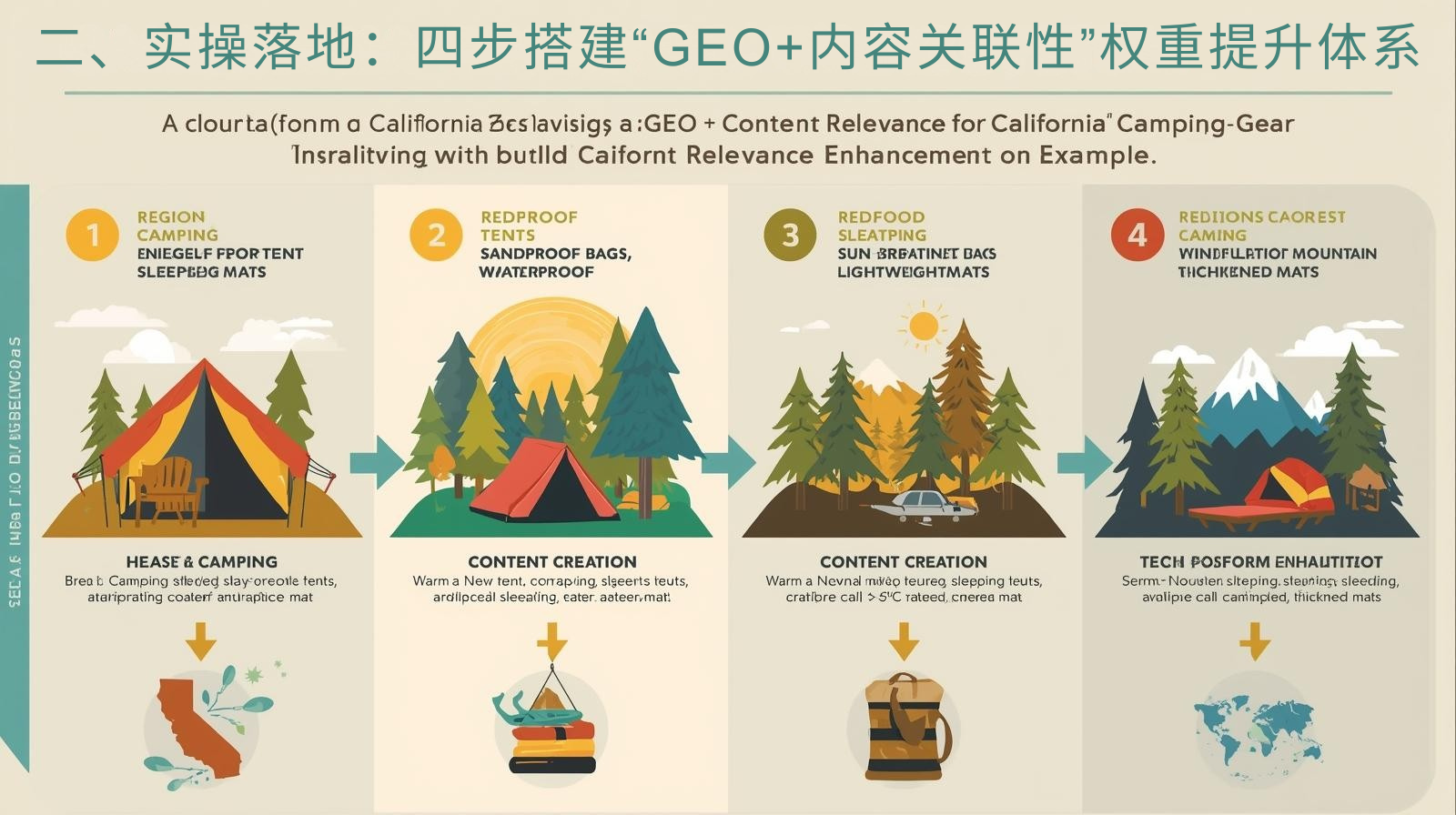
2. Practical implementation: Four steps to build a "GEO + content relevance" weight improvement system (taking camping equipment in California, USA as an example)
CampGear Hub takes "Camping Equipment in California, USA" as the core regional scene, and operates from the four-step process of "associated framework construction → content creation → technology enhancement → multi-platform synchronization" to achieve a jump in the weight of multiple AI platforms within 60 days. The system can be directly reused in multiple foreign trade categories such as home furnishings, 3C, and outdoor.
Step1: Build a "region-product-scene" three-dimensional association framework - first determine the association logic
Core goal: to clarify the related links of "core scenes in the target region → core products → supporting products → related techniques" to avoid confusion in content association. It took 1-2 days and was completed using ChatGPT+ regional scene analysis at a cost of 0 yuan.
1.1 Locking the "California Camping Core Scene" - the associated hub
Use ChatGPT to ask: "What are the mainstream camping scenes in California, USA? What are the equipment and core pain points that campers need most in different scenarios?" Combined with Google Trends verification, the three core scenes and needs in California were determined: ① California seaside camping (requirements: windproof tents, sandproof sleeping bags, waterproof and moisture-proof mats; pain points: tents are overturned by sea breeze, and sleeping bags are filled with sand); ② California redwood forest camping (requirements: sunproof tents, breathable sleeping bags, lightweight moisture-proof mats; pain points: humidity in the shade, and many mosquitoes); ③ Camping in the Sierra Nevada Mountains of California (needs: warm tent, -5℃ temperature-standard sleeping bag, thickened moisture-proof mat; pain points: large temperature difference between day and night, cold at night). These scenes are the "central hub" from which all content is related.
1.2 Construct a "three-dimensional association matrix" - clarify the association links
With the "California Beach Camping" scene as the core, build a "scenario-product-associated content" matrix to ensure that each content has a clear associated object. An example of the CampGear Hub matrix is as follows:
|
Core regional scene
|
Core products (first-level association)
|
Supporting products (secondary association)
|
Association skills content (third-level association)
|
Regional pain point solutions (fourth-level association)
|
|---|---|---|---|---|
|
California seaside camping
|
Windproof and sunproof tent (CampShield S1)
|
Sand-proof sleeping bag (SandBlock S2), waterproof and moisture-proof pad (WaveStop M1)
|
California seaside tent windproof construction techniques, sleeping bag sandproof storage methods
|
Use CampShield S1 ground nail reinforcement system to cope with sea breeze, paired with SandBlock S1 anti-sand chain design
|
|
California Redwood Forest Camping
|
Breathable sunscreen tent (TreeShade T1)
|
Quick-drying sleeping bag (DryFit D3), lightweight moisture-proof pad (LightPro L2)
|
Tips for anti-mosquito layout in sequoia tents and maintenance methods for sleeping bags in humid environments
|
TreeShade T1 mesh breathable design repels mosquitoes, DryFit D3 quick-drying fabric copes with humidity in the shade
|
Step2: Create "strong association + regionalization" content - let AI identify association signals
Core goal: Based on the association matrix, create content with "product page association support, blog association scenarios, and FAQ association pain points". Each content is embedded with "regional words + association guidance" to allow AI to clearly identify links. It takes 3-5 days and the cost can be controlled within 500 yuan (mainly used for local language calibration).
2.1 Product page: "Core product + regional scene + associated recommendation" three-stage template
The product page is the "starting point" of the association system. It needs to highlight the core products while naturally leading to supporting products and scene content. CampGear Hub "California Seaside Windproof Tent" product page optimization example:
Core product and regional scene binding: CampShield S1 California Seaside Windproof Tent - specially designed for the sea breezes along the Pacific coast of California. It is made of 600D Oxford windproof fabric. It has been tested on the beach in Los Angeles and can withstand level 10 gusts. With UPF50+ sunscreen coating, it can cope with the strong sunshine in California's summer without any pressure.
Recommended related products: When camping on the California beach, a tent alone is not enough - pair it with our SandBlock S2 sand-proof sleeping bag (built-in sand-proof sealing ring to prevent the sea wind from bringing sand in) and WaveStop The M1 waterproof and moisture-proof mat (fits the size of the tent and prevents seawater from splashing onto the campsite) forms the "California Beach Camping Gold Set". Order the set now for a 15% discount. It will be shipped from the LA warehouse and will be delivered within 2 days to customers in California. [Click to view package details] [Purchase sleeping bag separately]
Related guidance on scene skills: Many California campers have reported that "seaside tents are easily blown over by the wind." We have specially compiled the "California Seaside Tent Windproof Construction Guide" to teach you to use ground nails + windproof ropes to fix the tent to cope with the windy weather in San Diego and Monterey. [Click to learn building skills]
(Advantages: Use the regional word "California Seaside" throughout the text, establish product associations through words such as "matching" and "suit", use "click to view" to guide AI to identify content links, and at the same time meet users' matching purchase needs)
2.2 Blog: "Regional scene series + multi-product association", covering AI long-tail search
The blog is the "hub" of the related system. It needs to connect multiple products around the regional scene, covering long-tail keywords such as "California camping equipment list" and "California beach camping essentials". CampGear Hub Blog "2025 California Camping Equipment Guide: Seaside, Forest, and Mountain Scenes are Different" Core Structure:
-
Opening chapter: Camping scenes in California are very different - the seaside needs to be protected from wind, the forest needs to be protected from mosquitoes, and the mountains need to be kept warm. Choosing the right combination of equipment can avoid "stepping into pits". This article will help you match the equipment according to the scene.
-
Seaside Camping Chapter: The core equipment is the CampShield S1 windproof tent (to resist Pacific sea breeze), paired with the SandBlock S2 sandproof sleeping bag and WaveStop M1 waterproof pad, and comes with "windproof tips for tent construction" (related product page).
-
Forest Camping Chapter: Highly recommend the TreeShade T1 sun protection tent (which can also remain breathable under the shade of the redwood forest), paired with the DryFit D3 quick-drying sleeping bag (to deal with moisture), and insert the "Mosquito-proof Arrangement Tips" (linked FAQ content).
-
End: Based on the different camping scenes in California, the "Equipment Combination Recommendation Table" is compiled. Each equipment is attached with a purchase link. Customers in LA and San Francisco can enjoy the "free debugging of camping equipment" service after placing an order.
This type of blog can cover multiple long-tail keywords such as "California camping equipment" and "California beach camping sleeping bag". When AI crawls, it will identify the strong association of "tent-sleeping bag-scene" and transfer the blog weight to the associated product page.
2.3 FAQ: "Regional pain points are associated with multiple products" to reduce decision-making costs
FAQ needs to focus on regional pain points and provide solutions related to multiple products to avoid answering questions with a single product. CampGear Hub California camping FAQ example:
-
Question: "I am going to go camping on the beach in Monterey, California for 3 days. What equipment do I need to prepare? I am worried about the strong sea wind and sand getting into the sleeping bag." (Regional pain points + multiple needs)
-
Answer: "The sea breeze on the Monterey coast is frequent and carries sand. It is recommended that you choose the 'windproof and sandproof combination': ① CampShield S1 tent (level 10 windproof, we tested it in Monterey, 40% higher wind resistance than ordinary tents); ② SandBlock S2 sleeping bag (sandproof sealing ring design, a previous San Jose customer reported that "there is no sand in the sleeping bag after camping at the beach"); ③ Paired with WaveStop M1 moisture-proof mat (waterproof material, prevents seawater splashing). The package includes California camping ground nails and windproof ropes. It can be shipped from the LA warehouse and can arrive in Monterey in 2 days. It also comes with the "Monterey Beach Camping Safety Guide" (linked to multiple products + regional cases + solutions).
Step3: Technology enhancement - allowing multiple AI platforms to quickly capture related signals
Core goal: Use technical means to clarify the "content association relationship" and allow AI to identify the association system within 24-48 hours. It takes 2-3 hours to complete with free tools, focusing on strengthening "internal links + structured data".3.1 Internal links: build "associated anchor network" and transfer weight
Internal links are the core signal for AI to identify content associations. They need to follow the principle of "regional scene as the center, product interlinking, and content interlinking". CampGear Hub link layout rules:-
Interlinks between product pages: Core product pages (such as tents) must add a "supporting products" link, and the anchor text contains "California + supporting products" (such as "Recommended sandproof sleeping bags for California beach camping"). Avoid using meaningless anchor text such as "Click here".
-
Product-Blog Interlink: Add a "related scene blog" link to the product page (such as the tent page link "California Beach Camping Guide"), add a "purchase link" to each product recommendation in the blog, and the anchor text includes "product name + regional scene" (such as "CampShield S1 California Windproof Tent").
-
Site-wide associated navigation: Add "California camping scene navigation" at the top of the independent station, which is divided into "seaside camping equipment", "forest camping equipment" and "mountain camping equipment". Under each navigation, there are direct links to the corresponding product portfolio and scene blog, forming a clear link of "navigation-content-products".
3.2 Structured data: mark "association + regional attributes"
Use Google structured data markup tool, select "ItemList" (list) type, mark the relationship of "regional scene-product-related content", replace complex codes, use tables to present core data fields and content, and facilitate AI to directly extract related information:Data fieldContent example (California seaside camping scene)AI recognition valuenameCalifornia Beach Camping Equipment Set - CampGear HubClear the "regional scene + product type + brand" associationitemListElement1. CampShield S1 windproof tent (exclusively for California seaside); 2. SandBlock S2 sandproof sleeping bag; 3. California seaside camping construction skillsClearly mark the association sequence of "product-product-content"geoCalifornia, USA (focus on LA, Monterey, San Diego)Strengthen regional anchors and allow AI to locate target marketsCopy the generated structured data code to the "global code" entrance of the independent station. Google and ChatGPT will prioritize grabbing this related information and quickly identify the content system.3.3 Multi-platform content synchronization: strengthening "associated signal consistency"
Synchronously associate content signals on multiple platforms such as ChatGPT, Perplexity, and Google to ensure consistent AI judgment on content association: ① Upload the "California Camping Equipment Association List" PDF to ChatGPT, and clearly mark the association of "tent-sleeping bag-scene"; ② In the "Content Submission" function of Perplexity, submit the URL of the "California Camping Scene Navigation" page of the independent station, stating that "this page contains a complete California camping equipment related system"; ③ Submit a "Site Map" in Google Search Console and mark "Content is classified by California camping scenes, including internal related links" to speed up Google's identification of the related system.Step4: Monitoring and optimization - let the correlation system continue to increase the weight
Core goal: Use "correlation effect indicators" to monitor changes in AI weight and adjust the correlation logic in a timely manner. It takes 30 minutes a day and costs 0 yuan, focusing on "the jump rate of related content and the amount of AI recommendations".4.1 Core Monitoring Indicators and Tools
Different from single content monitoring, the correlation system needs to pay attention to "link indicators", which can be completed with free tools. CampGear Hub monitoring example:Monitoring toolCore correlation indicatorsMeet the standardOptimization directionGoogle Analytics 4Related content jump rate (the proportion of jumps from the tent page to the sleeping bag page)≥35% (indicating that the user approves the association logic)If the jump rate is low, optimize the related recommendation copy, for example, change "matching sleeping bag" to "a must-have sandproof sleeping bag for California beach camping"ChatGPT+Perplexity"Region + related keywords" search ranking (such as "California tent sleeping bag")Top 10 (explanation of AI recognition correlation system)If the ranking is low, increase the regional word density of related content, such as mentioning "LA, Monterey"Customer Service SystemProportion of related package inquiries≥40% (indicating that related content promotes combined purchasing)If the proportion is low, add "suite exclusive discounts" in the associated recommendations, such as "California customers get 20% off the set"4.2 Optimization and adjustment: solutions to 2 types of common correlation problems
-
Problem 1: The associated jump rate is low, but the ranking of single content is good - The reason is that the associated recommendation does not match the regional scene. For example, the California beach tent page recommends "Alpine Sleeping Bag"; Solution: Return to the association matrix, replace it with supporting products that match the scene, and at the same time optimize the recommendation copy and emphasize "regional adaptability".
-
Problem 2: There is a big difference in the rankings of multiple AI platforms (ChatGPT ranking is high, Perplexity is low) - The reason is that the content correlation signals are not synchronized in Perplexity; Solution: Resubmit the list of related content in Perplexity's "Content Center", clearly mark the "California Camping Equipment Association System", and increase content interaction on the Perplexity platform (such as answering questions about related camping equipment and attaching links).
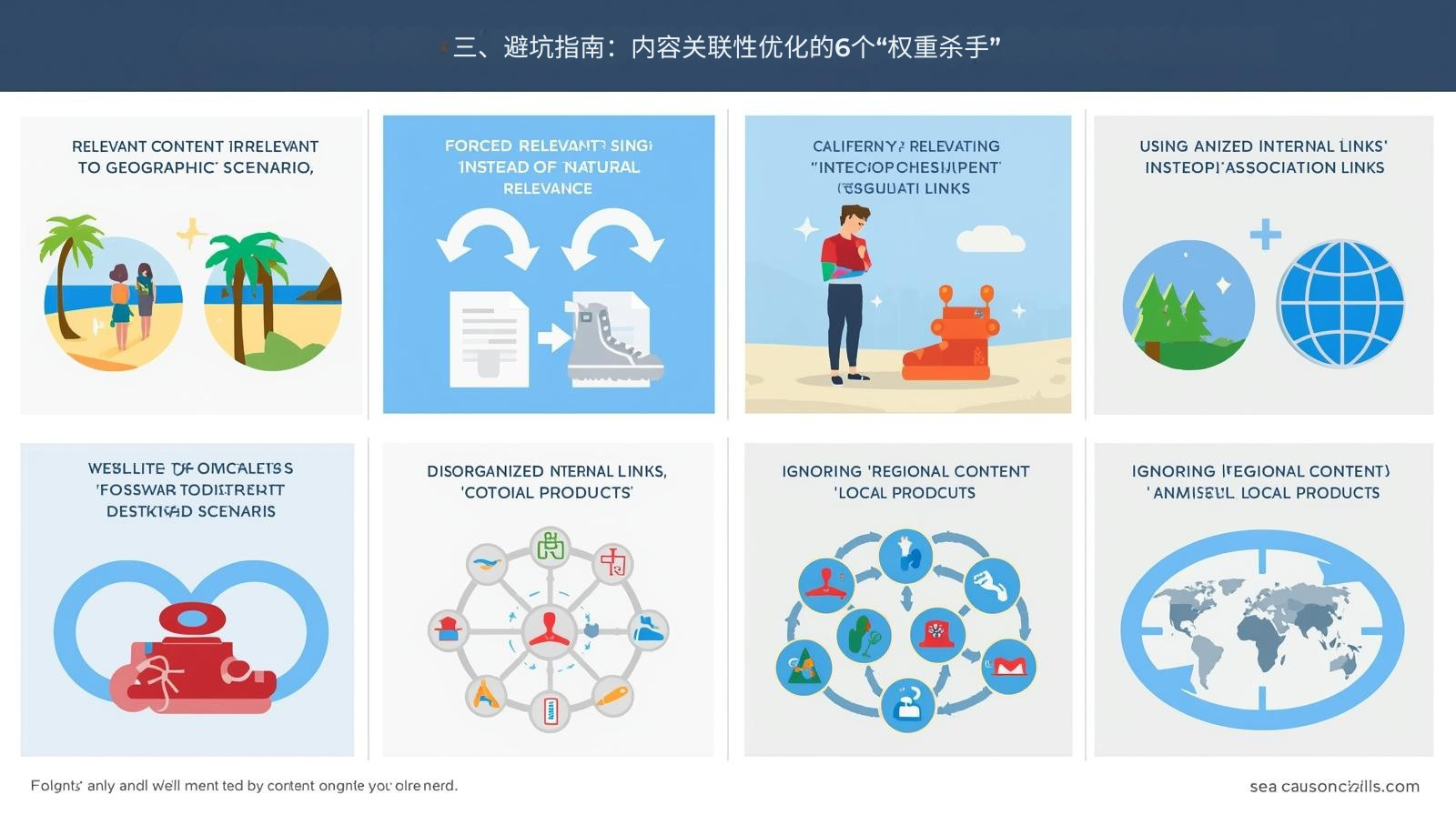
3. Pitfall avoidance guide: 6 "weight killers" for content relevance optimizationContent relevance optimization seems simple, but many sellers will reduce their weight due to "confused relevance logic". The following 6 mistakes are typical "weight killers" and must be avoided:3.1 Error 1: The associated content has nothing to do with the regional scene
3.2 Mistake 2: Forced association, using "keyword stuffing" to replace natural association
Repeatedly stack keywords such as "California sleeping bag, California moisture-proof mat" on the tent page, but there is no actual related content; Harm: AI identifies it as "keyword cheating" and directly reduces the rights; Correct approach: Use "scenario requirements" to naturally associate, such as "When camping on the beach in California, the tent needs to be equipped with a sand-proof sleeping bag because...", so that the association has logical support.3.3 Error 3: Internal links are confusing, "cross-jumping" destroys associated links
The tent page links to the sleeping bag, the sleeping bag page links to the barbecue grill, and the barbecue grill page links to the tent, forming a "loop jump"; Harm: AI cannot identify core related links, and the weight transfer is chaotic; Correct approach: Build "radial links" with the "regional scene" as the center, for example, the seaside scene page links to all seaside equipment, and the equipment page only links to supporting products and techniques for the same scene.3.4 Mistake 4: Ignore regional differences and use "global content" to associate "local products"
Use "Global Camping Techniques" to associate "California Tent", or "European Sleeping Bag Standards" to associate "California Sleeping Bags"; Hazard: AI determines "regional association is inaccurate" and the weight cannot be focused; Correct approach: The associated content must contain "specific information of the target region", such as "California Camping Techniques" and "U.S. Sleeping Bag Temperature Standards".3.5 Mistake 5: The quality of associated content is uneven, which lowers the overall weight
The content of the core product page is high-quality, but the content of the related blogs is rough and has many errors (for example, the California seaside wind speed is wrongly written); Harm: AI will reduce the weight of the entire related system due to "low quality of some content"; Correct approach: Related content must maintain the same quality standard, especially regional information and product parameters, which must be accurate.3.6 Error 6: Multi-platform content is out of sync and associated signal conflicts
The tent page of the independent station is associated with sleeping bag A, but the document uploaded by ChatGPT is associated with sleeping bag B. Harm: AI recognizes "association signal conflict" and cannot determine the core association relationship. Correct approach: multi-platform content is updated simultaneously. When the association relationship changes (such as product upgrades), synchronize the content of the independent station, ChatGPT, and Perplexity as soon as possible.
Related article recommendations: Your peers have not yet reacted: using GEO to build an independent foreign trade station is the biggest blue ocean strategy at the moment.4. Ending: The correlation system is the "weight infrastructure" of the independent foreign trade station in the AI era
In 2025, the weight competition of multiple AI platforms has entered the stage of "systematic competition" - the "single point breakthrough" of a single content has long been ineffective. Only by building a network system of "regional scene anchoring and content correlation" can AI regard your brand as a "solution provider for users in the target region" rather than a "pure product seller". The case of CampGear Hub proves that when "California Beach Tent" is associated with "Sandproof Sleeping Bag", "Sleeping Bag" is associated with "Camping Tips", and "Techniques" are associated with "Regional Pain Points", AI will actively integrate these contents into "California Camping Equipment Complete Plan" and give priority recommendations on multiple platforms. The improvement of AI weight of independent foreign trade stations has never been about “optimizing a certain article”, but “building a content ecosystem recognized by AI”. Starting today, stop worrying about “how to optimize a certain product.” Instead, take a day to sort out the regional scenes of your core market (such as camping in California, Europe, and German home furnishings), build a “scenario-product-content” correlation matrix, and then gradually fill in the content and strengthen the links. After 3 months, you will find that in the search results of ChatGPT and Perplexity, your brand is no longer a “single product” but a “preferred choice for users in the target region.” The foreign trade traffic dividends in the AI era will always belong to the pioneers who "understand the system and the relationship".
-
特色博客
Tag:
分享