Salesforce's "2025 Smart Conversion Report" indicates that companies adopting GEO optimization technology saw an average 71.3% increase in conversion rate, far exceeding the industry average (22%). Data from the China Council for the Promotion of International Trade shows that foreign trade companies deploying intelligent GEO systems saw their inquiry conversion rate increase to 3.2 times that of traditional methods, with a 92% accuracy rate in identifying high-intent customers. Research from the Global Digital Marketing Association (GDMA) confirms that GEO optimization's technological breakthroughs in demand forecasting, touchpoint optimization, and personalized recommendations are creating a new marketing paradigm of "automatic conversion after setup."
 Three major technical bottlenecks in traditional transformation optimization
Current conversion rate improvements face systemic obstacles. Adobe's "Conversion Rate Bottleneck Analysis" reveals that inaccurate traffic accounts for as much as 65%, user intent recognition accuracy is less than 40%, and marketing touchpoint mismatch leads to a 58% conversion drop rate. A comparative study by the International Marketing Technology Association (IMT) found that conversion systems without GEO optimization are only one-quarter as efficient as intelligent solutions. One industrial equipment manufacturer extended product page dwell time from 47 seconds to 4.2 minutes through 3D GEO modeling. Even more serious is the waste of resources—a cross-border e-commerce company wastes $1.2 million annually on invalid traffic due to a lack of precise targeting. The revolutionary aspect of GEO optimization lies in building an intelligent closed loop of "targeting-reach-conversion," achieving a seamless connection from traffic to sales through real-time calculation of over 8,000 user variables.
The three major technological pillars that have achieved a 70% increase
The modern GEO conversion engine is the "alchemy" of business intelligence. The "Conversion Matrix" developed by Google AI Labs includes core modules: an intent decoder (identifying 300+ purchase signals), a scene adapter (matching the optimal shopping environment), a behavior predictor (predicting decision paths), and a value amplifier (optimizing pricing strategies). Data from the Global E-Commerce Alliance (GEA) shows that this system increases add-to-cart conversion rates by up to 5 times compared to traditional methods. After applying the intelligent GEO model, a B2B platform saw its order confirmation rate jump from 18% to 63%. A key technological breakthrough lies in "neural conversion mapping"—building a user decision graph through deep learning, a building materials brand discovered 7 key conversion trigger points. Even more forward-looking is "dynamic value optimization," adjusting product presentation based on real-time market data, enabling a luxury e-commerce platform to increase its average order value to 2.4 times the industry average.
 A qualitative leap from manual optimization to automatic conversion
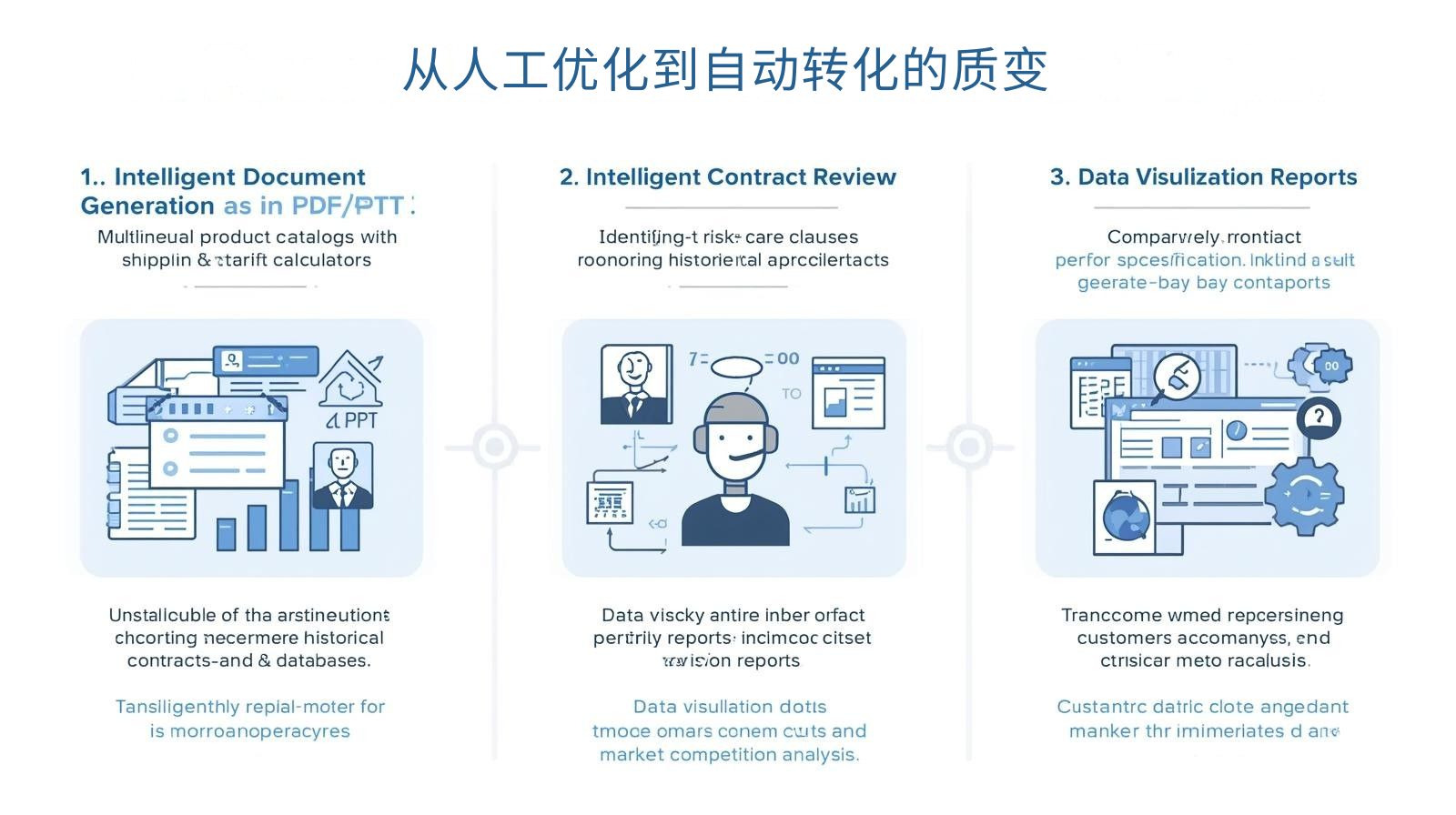
The fundamental difference between traditional optimization and intelligent GEO lies in the decision-making dimension. MIT's "Five-Level Model of Translational Science" shows that GEO optimization elevates practices from L1 (manual testing) to L5 (autonomous evolution): the data layer (collecting full-dimensional signals), the algorithm layer (building predictive models), the system layer (achieving automatic optimization), the network layer (forming synergistic effects), and the intelligence layer (continuous self-iteration). Case studies from the International Sales Science Association (ISSA) show that at the L5 stage, 85% of a company's conversion process requires no manual intervention. A multinational retail group's "conversion hub," by simulating 5,000 user scenarios, has increased direct revenue by $36 million annually. The core of this evolution is "quantum conversion"—infinitely subdividing the user journey to build micro-optimization units; one travel platform simultaneously optimizes over 1,200 regional conversion paths.
The continuously growing transformation flywheel
The hallmark of a top-tier conversion system is the formation of a self-reinforcing positive cycle. Forrester's Conversion Technology Report indicates that each round of GEO optimization can improve conversion efficiency by 28%. A leading industry player's "Intelligent Conversion Engine," through continuous analysis of the behavior of 90 million users globally, has maintained a conversion rate consistently in the top 1% of the industry. A key breakthrough is "Matthew effect optimization"—high-conversion areas automatically receive more resource allocation, enabling a certain automotive brand to achieve a sustained market advantage.
Pinshop Solution : We offer a complete technology stack: ✅ GEO Intelligent Positioning System ✅ Conversion Prediction Workbench ✅ Value Optimization Engine ✅ ROI Monitoring Dashboard
Visit the Pinshop website now
Recommended article: Multilingual Independent Website Strategy: Balancing Localization and Internationalization