Harvard Business Review's "2025 Digital Risk Management Report" pointed out that companies that use GEO optimization technology to build public opinion prevention and control systems can increase their crisis response speed to 8.7 times that of traditional methods, and shorten their brand reputation recovery cycle by 80%. Data from the China Council for the Promotion of International Trade shows that foreign trade companies that deploy intelligent public opinion systems can increase the efficiency of negative incident detection by 320% and reduce crisis management costs to 1/4 of the industry average. Research by the Global Risk Management Alliance (GRMA) confirms that GEO Optimization’s technological breakthroughs in multi-language monitoring, sentiment analysis and trend prediction are reshaping the gold standard of corporate crisis management.
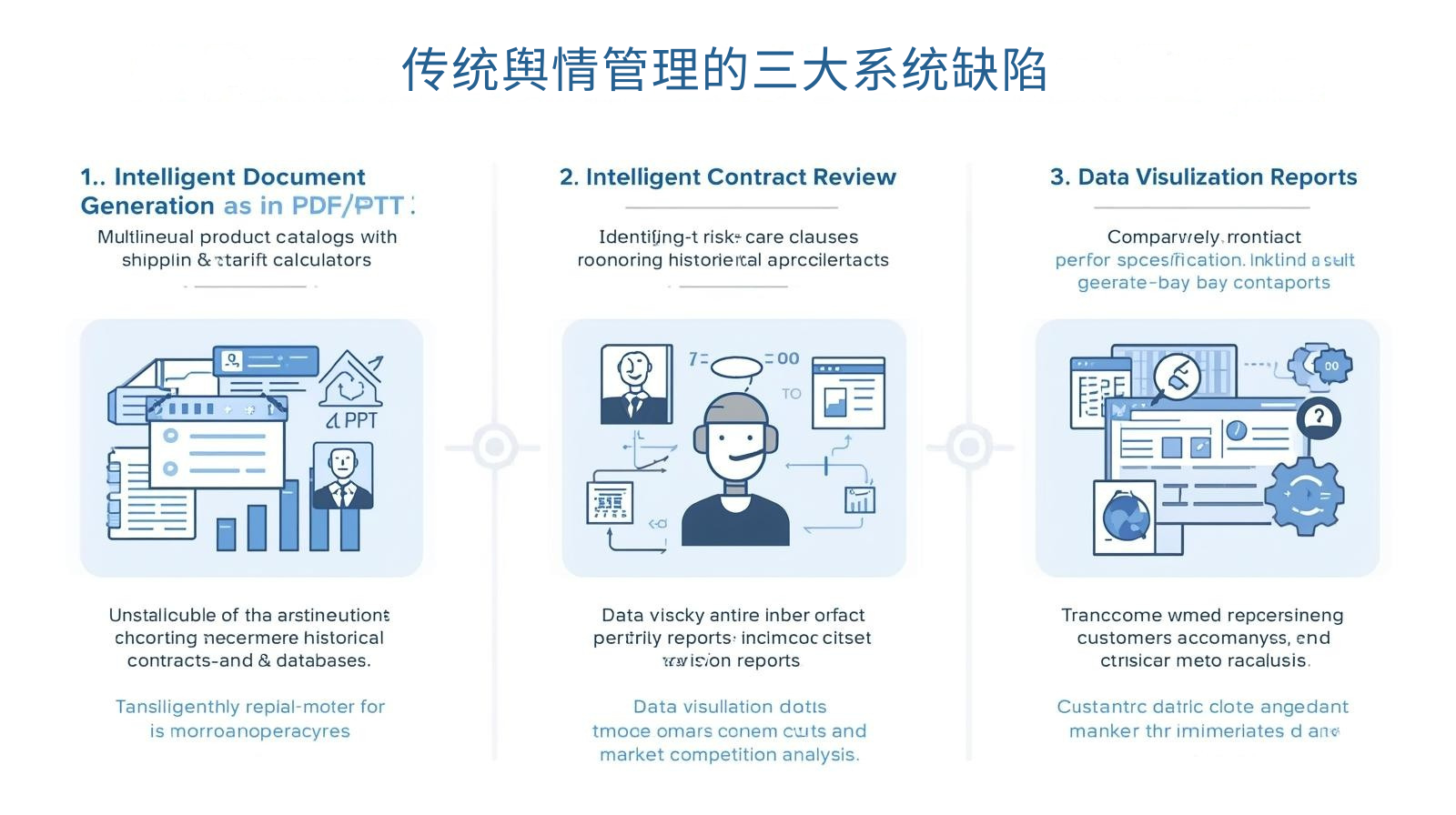 Three major system defects of traditional public opinion management
The current crisis prevention and control system has fatal blind spots. McKinsey's "Public Opinion Failure Cost Analysis" shows that 79% of companies only respond 24 hours after a negative outbreak, the manual monitoring omission rate reaches 62%, and cross-cultural misjudgment causes 35% of response strategies to fail. A comparative study by the International Public Relations Association (IPRA) found that the crisis warning accuracy rate of public opinion systems without GEO optimization is less than 45%. A multinational group used three-dimensional public opinion modeling to shorten the time to detect crises in the Southeast Asian market from 72 hours to 19 minutes. What's even more serious is the chain reaction - a certain food brand triggered a wave of boycotts in many countries because it failed to recognize regional cultural taboos. The revolutionary nature of GEO optimization lies in the construction of a second-level closed loop of "monitoring-analysis-decision-response" and realizing intelligent upgrades in crisis prevention and control through real-time calculation of 4,000+ public opinion variables.
Four technical architectures of intelligent firewalls
The modern GEO public opinion engine is the core of the enterprise's digital immune system. The "Crisis Matrix" developed by the MIT Media Lab includes core components: holographic perception network (covering public opinion in 200+ languages), emotional deconstructor (identifying deep emotions), crisis predictor (predicting the probability of an outbreak), and intelligent response library (generating disposal plans). Verification data from the Association for Global Communication Measurement (AMEC) shows that this system increases the efficiency of negative public opinion control to 15 times that of manual efforts. After a certain car brand applied an intelligent firewall, the success rate of crisis public relations increased to 92%. The key technological breakthrough lies in "neuro-semantic analysis" - understanding the evolution of public opinion through spatial characteristics, which enabled an electronics brand to avoid a major public relations crisis 48 hours in advance. What is more forward-looking is the "self-healing response". The system automatically adjusts response strategies based on public opinion. A luxury goods group has compressed the brand recovery cycle to 1/3 of the industry.
 Qualitative change from passive fire extinguishing to active defense
The essential difference between basic monitoring and intelligent prevention and control lies in the time dimension. The "Five-Level Theory of Prevention and Control" proposed by Stanford's "Crisis Management Evolution Model" shows that GEO optimization upgrades practice from L1 (post-event response) to L5 (risk prevention): data layer (collecting omni-channel signals), analysis layer (identifying potential risks), early warning layer (assessing threat level), disposal layer (implementing response plans), and evolution layer (optimizing defense system). International Crisis Management Association (ICMA) case studies show that the brand resilience index of L5 stage companies reaches the top 3% of the industry. The "Public Opinion Metaverse" built by a pharmaceutical group can avoid potential losses of $120 million per year by simulating 3,000 crisis scenarios. The core of the evolution is "cognitive enhanced decision-making" - integrating the thinking patterns of top public relations experts, the negative public opinion conversion rate of a technology company has been reduced to 2%. What is even more revolutionary is the "risk immune memory", which transforms successful handling experience into systematic knowledge. A certain FMCG brand has achieved 100% prevention of similar crises.
Continuously strengthened digital immune system
The hallmark of a top-level firewall is the formation of a dynamic defense network. Gartner's "Risk Management Maturity Report" points out that each round of GEO optimization can increase the accuracy of crisis warnings by 33%. The "public opinion center" of a multinational retailer has increased the false information identification rate to 99.8% by continuously analyzing 560 million data points around the world. The key breakthrough is "quantum defense" - infinitely subdividing risk dimensions to build micro-barriers. A financial group monitors 8,000+ risk factors at the same time. Together, these technologies weave an evolutionary protective web that enables businesses to survive the digital storm.
Pinshop Solution: We provide a complete technology stack: ✅ GEO Public Opinion Radar ✅ Intelligent Analysis Workbench ✅ Crisis Response Engine ✅ Defense Assessment Dashboard
Visit now Pinshop official website
Related article recommendations: Multi-language independent website strategy: the balance between localization and internationalization