
By March 2026, the way overseas buyers find suppliers has completely changed: they no longer flip through pages of searches, but instead ask questions directly to AI. Whether your independent website can be "understood," "remembered," and "recommended" by AI is the key to success in the next generation of customer acquisition. The core of GEO is not keyword stuffing, but clearly conveying your brand, products, and core advantages in a way that AI can understand.
I. The Era of AI Procurement: The Core of GEO is "Making AI Understand You"
1.1 The buyer's decision-making process has shifted to AI dialogue.
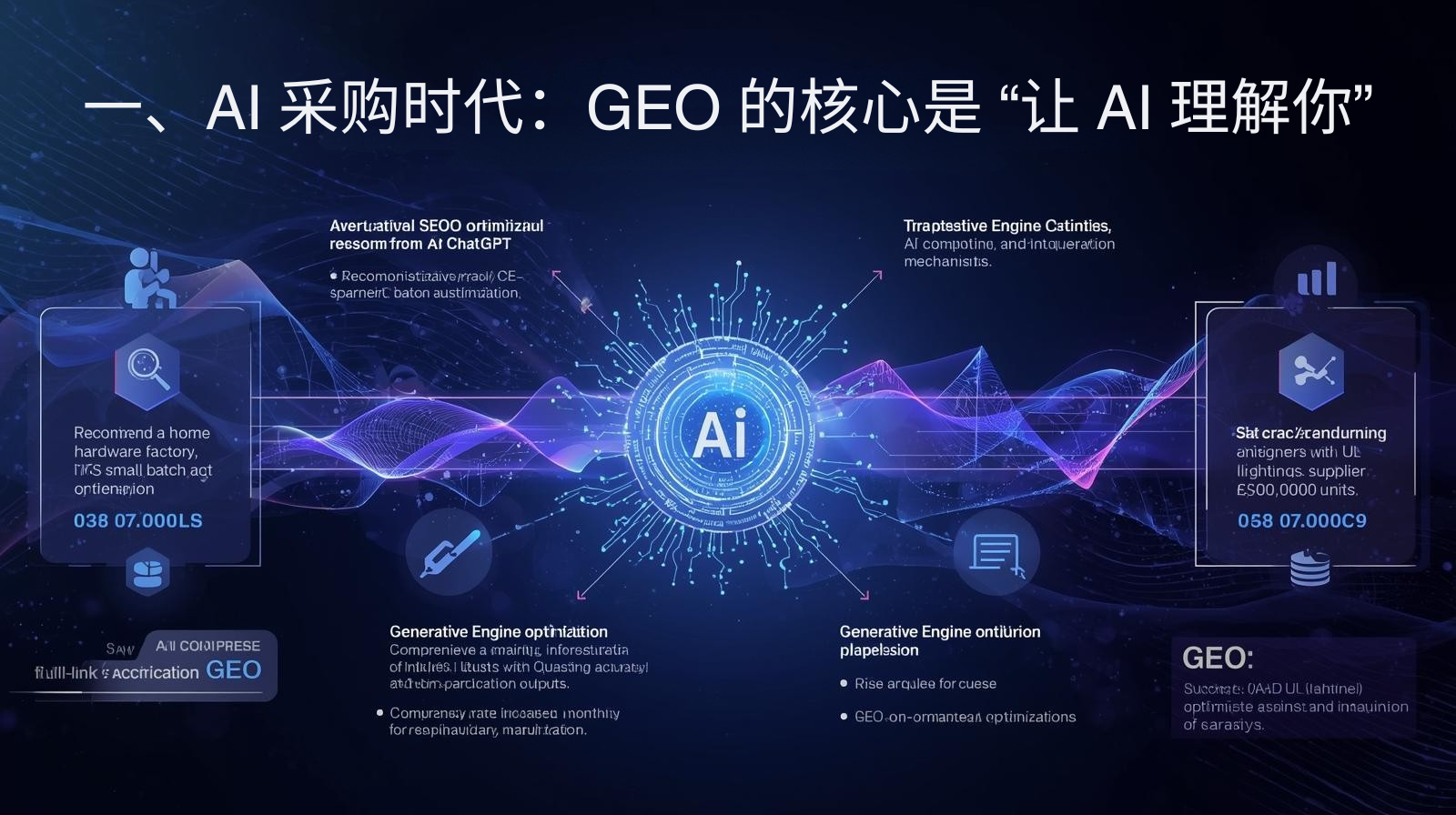
According to Forrester's B2B sourcing report released in January 2026, over 71% of enterprise purchasing decision-makers will first screen suppliers using AI-powered dialogue tools such as ChatGPT, and AI recommendations directly influence over 80% of cooperation intentions (https://www.forrester.com/press-newsroom/forrester-2026-the-state-of-business-buying/ ). Buyers often ask questions in natural language, such as "Recommend a home hardware factory with CE certification and small-batch customization capabilities" or "A UL-certified LED lighting supplier with a monthly production capacity of 500,000 units." The AI will directly output credible and complete candidates; sites that cannot be understood by the AI will directly miss opportunities.
1.2 GEO is not an upgraded version of SEO, but an AI understanding engineering approach.
GEO (Generative Engine Optimization) is a full-link optimization approach encompassing AI crawling, semantic understanding, trust assessment, and recommendation mechanisms. Its goal is to ensure that information on independent websites is correctly extracted, accurately categorized, and reliably cited by AI (https://m.sohu.com/a/992496157_122537503 ). Traditional SEO pursues "ranking," while GEO pursues "being understood and recommended." These are two completely different optimization logics and represent the core capabilities that independent e-commerce websites must adopt by 2026.
1.3 If it cannot be understood by AI, it will automatically exit the AI procurement pool.
Industry testing data from March 2026 shows that for independent e-commerce websites without GEO optimization, the success rate of AI crawling is less than 18%, and the information recognition accuracy is below 30%, making it almost impossible to appear in AI recommendation results. Websites that have completed basic GEO optimization, however, see their AI recognition accuracy increase to over 85%, and AI-driven inquiries increase by an average of 117% over 30 days. Making AI understand you is not an option, but a survival threshold in the AI era.
II. How AI Understands Independent Websites: Three Core Recognition Mechanisms
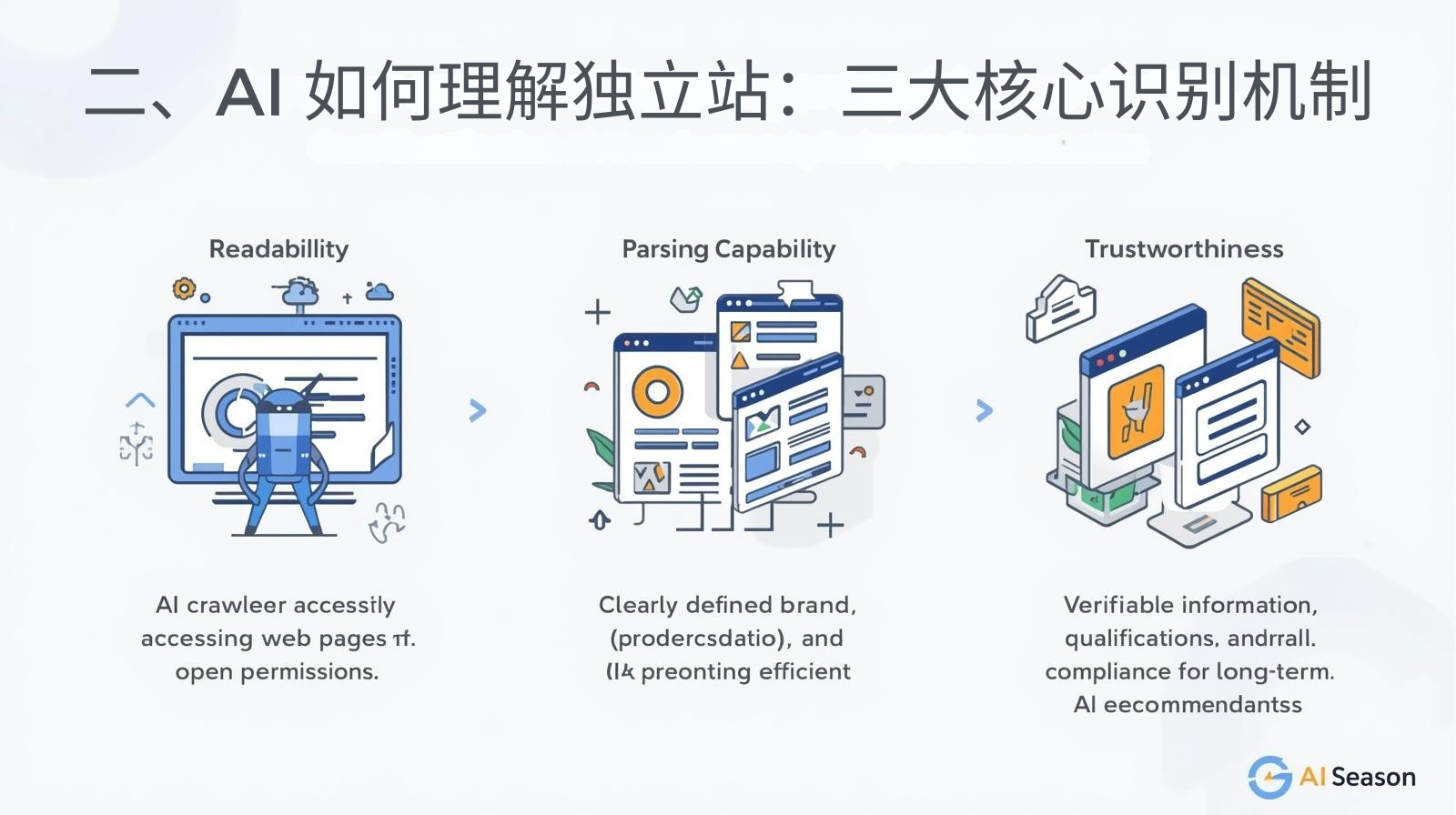
2.1 Read-only: Open permissions allow AI crawlers to access the site smoothly.
AI must first read the content to understand it. OpenAI's official web crawler, GPTBot, reads webpage information according to rules for model training and real-time responses (https://help.openai.com/en/articles/5097620-blocking-gptbot ). Independent websites need to ensure that their homepage, product pages, factory introductions, qualification certificates, and case study pages are accessible to avoid issues such as blocking, loading timeouts, or broken links preventing AI from reading core information.
2.2 Parsable: Structured information reduces the understanding cost for AI.
AI isn't good at guessing; it excels at reading standardized, structured information. Google emphasized in 2026 that structured data is the core basis for AI to understand page content ( https://developers.google.cn/search/docs/appearance/structured-data/intro-structured-data ). The more organized and clearly defined the fields in brand information, product parameters, production capacity, certifications, delivery time, and service scope, the faster AI can extract your advantages and match them with relevant buyers.
2.3 Trustworthiness: Only when information is verifiable will AI make long-term recommendations.
In 2026, AI recommendations will heavily rely on credibility scores. False information, exaggerated descriptions, unverifiable qualifications, and privacy non-compliance will directly lower the recommendation weight (https://openai.com/zh-Hans-CN/policies/row-terms-of-use/ ). EU AI regulations and GDPR compliance also affect AI trust assessments; only sites with truthful information, verifiable qualifications, and stable content will be included in the long-term AI recommendation list.
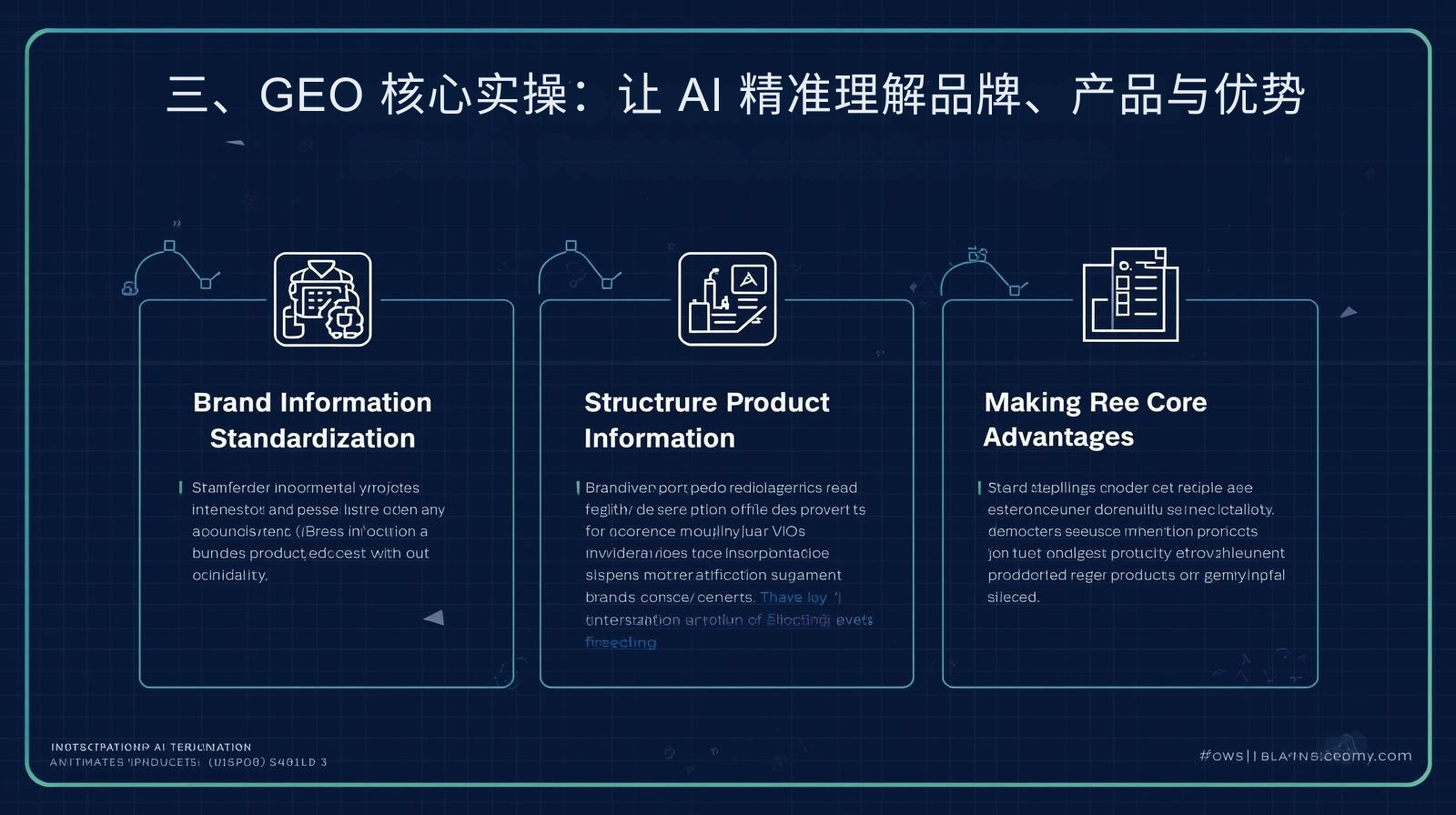
III. GEO Core Practice: Enabling AI to Accurately Understand Brands, Products, and Advantages
3.1 Brand Information Standardization: Enabling AI to Understand Who You Are in a Second
Consistent brand information across the entire website, including the English brand name, full company name, brand positioning, core markets, factory address, contact information, year of establishment, and service philosophy, ensuring consistency across all pages. The brand slogan and core positioning are prominently displayed on the homepage, such as "12 years of focus on the European and American smart home OEM/ODM factory, with complete CE/FCC/UL certifications," allowing AI to quickly establish brand recognition. Additionally, real factory photos, showroom scenes, and patent and certification displays are provided, with all certifications accompanied by an official verification link : https://ec.europa.eu/growth/tools-databases/nando/index.cfm , creating an authoritative brand profile that AI can recognize.
3.2 Product Information Structuring: Enabling AI to Accurately Extract Your Product Capabilities
Each product page is organized into fixed modules, avoiding arbitrary layouts: product name, precise description, core uses, material parameters, size specifications, certifications, minimum order quantity, monthly production capacity, standard delivery time, customization options, packaging solutions, and application cases. Use data-driven descriptions instead of vague text, such as "monthly production capacity 800,000 units," "delivery time 7-12 days," and "supports small batch customization of 100 units." AI is most efficient at understanding and matching numerical and factual information. Follow Google's structured best practices, ensuring product information is prioritized for AI adoption: https://developers.google.cn/search/docs/appearance/structured-data/sd-policies?hl=ja
3.3 Making Core Advantages Explicit: Translating Competitive Advantages into Language AI Can Understand
Extract 3-6 core advantages and present them using fixed modules, such as certification advantages, production capacity advantages, customization advantages, quality control advantages, delivery time advantages, and after-sales advantages. Each advantage should be accompanied by data and supporting documentation, such as "12 years of export experience to Europe and America, 300+ cooperative clients," "5 quality inspection processes, defect rate less than 0.8%," and "24-hour inquiry response, sample solutions provided within 72 hours." Organize content around frequently asked questions about overseas procurement, allowing AI to prioritize your advantages when answering questions like "Which factory has the fastest delivery time?", "Which supports customization?", and "Which has certifications?" (https://answerthepublic.com/ )
3.4 Verifiable Trust System: Enhancing AI Recommendation Weight
Improve your compliance pages, including privacy policies, cookie policies, after-sales terms, and copyright statements, to comply with GDPR and other regional regulations (https://commission.europa.eu/topics/data-protection_en ). Showcase verifiable certifications, patents, and test reports; provide factory photos, production line videos, shipping footage, and customer case studies; and continuously update your industry blog and FAQs to make your site appear professional, active, and trustworthy to AI, thus increasing your chances of being recommended in the long run.
Recommended Article: Your Competitors Haven't Reacted Yet: Building an Independent E-commerce Website with GEO is the Biggest Blue Ocean Strategy Right Now
Recommended Article: Your Competitors Haven't Reacted Yet: Building an Independent E-commerce Website with GEO is the Biggest Blue Ocean Strategy Right Now
IV. Guaranteed Results: AI continuously understands and recommends your independent website.
4.1 Maintain information consistency to avoid cognitive confusion in AI.
All brands, products, production capacity, certifications, and service commitments across the entire website must be consistent. Inconsistent information will lead to a lower trust score from AI. Regularly check the consistency of information on product pages, company profiles, blogs, and category pages, and promptly update any changes in production capacity, certifications, delivery times, etc.
4.2 Continuously produce content that AI prefers
Produce content related to procurement decision-making, such as certification guides, selection manuals, customization processes, quality inspection standards, and industry solutions. This type of content is most likely to be cited as authoritative answers by AI, allowing your brand to naturally appear in conversations. https://www.qizansea.com/65055.html
4.3 Monitoring the AI's crawling and recommendation performance
We monitor AI crawling frequency, page indexing status, and traffic source structure through Google Search Console, OpenAI crawl logs, and site access data. We simulate buyer questions monthly to test AI recommendation results, specifically optimizing weak pages to maintain and improve GEO performance.
In conclusion: Making AI understand you means making buyers find you.
In 2026, foreign trade customer acquisition has entered a new path of "AI understanding → AI recommendation → buyer matching". GEO's core has never been about technical mystique, but rather about using clear, standardized, and reliable methods to enable AI to accurately understand your brand, products, and strengths. When AI can quickly, accurately, and reliably understand you, it will continuously push precise buyers to you.
For more efficient, stable, and hassle-free GEO optimization, the underlying website building system is crucial. PinDian Technology boasts over ten years of experience in building websites for foreign trade, serving more than 7,000 clients. We utilize React technology to build independent websites, resulting in smoother page browsing, faster global loading, and a more standardized structure. From an architectural perspective, our systems are naturally adapted to AI crawling, structured presentation, and GEO optimization requirements. From the very beginning, we help you lay out your brand, products, and advantages according to AI-friendly standards, ensuring your independent website is understood and recommended by ChatGPT from launch, quickly capturing every high-quality inquiry in the AI era.