Foreword: In March 2026, generative AI completely reshaped the B2B customer acquisition landscape in foreign trade. AI tools such as ChatGPT and Gemini became core entry points for overseas buyers to find suppliers, rendering the traditional model of "waiting for traffic" for independent foreign trade websites obsolete. GEO (Generative Engine Optimization), as a new optimization system adapted to the AI era, equips independent foreign trade websites with an "AI traffic engine," enabling the website's brand to accurately appear in buyers' AI search conversations, proactively attracting precise B2B traffic, breaking through customer acquisition bottlenecks, and achieving double growth in traffic and inquiries. This article focuses on the practical implementation of GEO, breaking down its core logic, implementation steps, and key points to avoid pitfalls, naturally integrating authoritative backlinks to help foreign trade companies quickly master GEO optimization techniques and truly utilize this AI traffic engine.
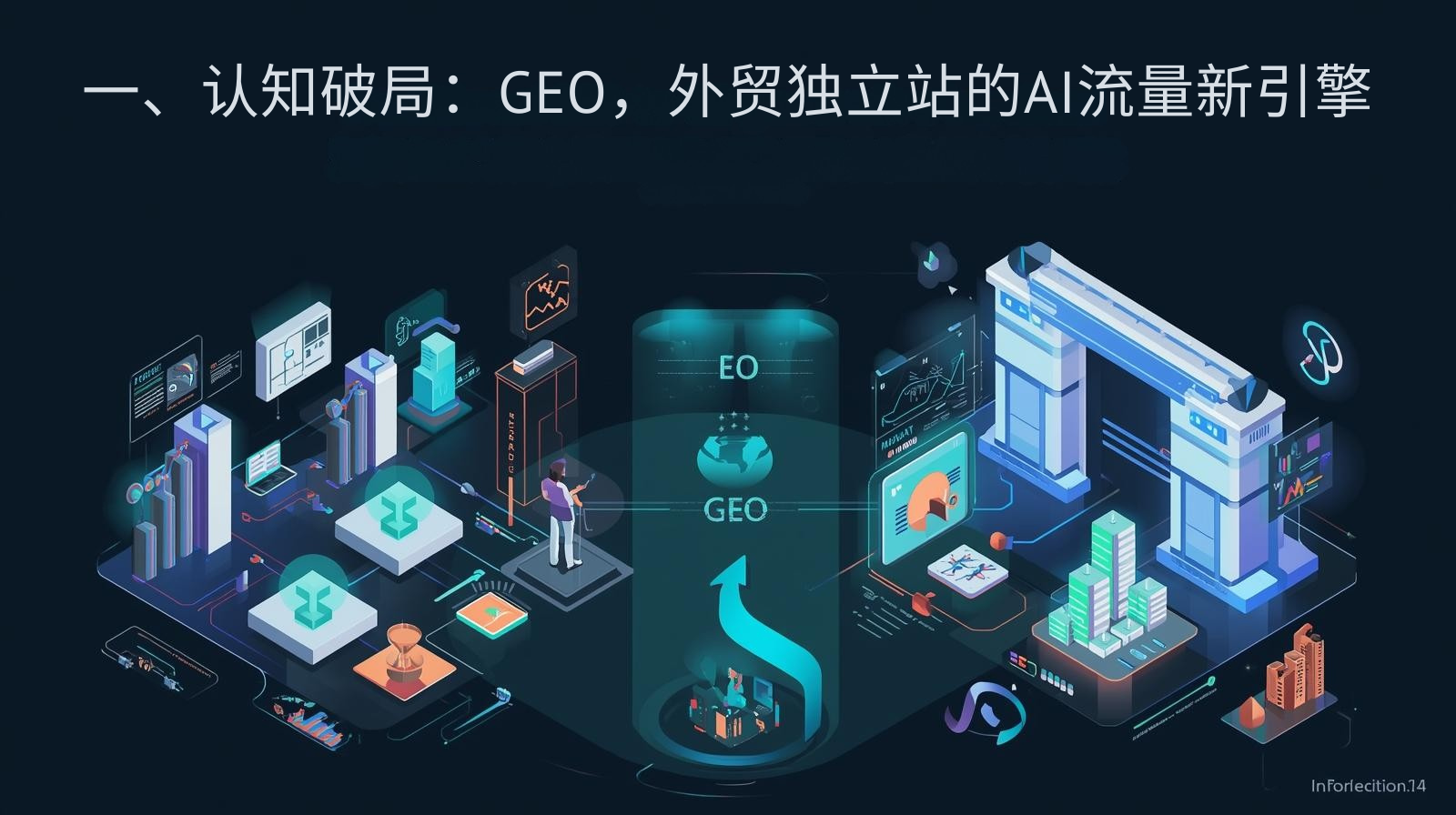
I. Breaking Through Cognitive Barriers: GEO, the New AI Traffic Engine for Independent Foreign Trade Websites
In the era of AI-driven procurement, the traffic engine for independent foreign trade websites has upgraded from "traditional SEO" to "GEO generative engine optimization." Many companies find it difficult to acquire AI traffic because they haven't grasped the core logic of GEO and have confused the fundamental differences between GEO and traditional SEO. In March 2026, ABke released the "Foreign Trade AI Customer Acquisition Trend Report," which showed that independent foreign trade websites with good GEO optimization saw an average 32% of their traffic coming from AI sources, and their inquiry conversion rate increased by 58% compared to unoptimized sites (https://www.cnabke.com/blogs/foreign-trade-geo-generative-engine-optimization.html). This sufficiently demonstrates the core value of GEO as an AI traffic engine, and to effectively utilize this engine, it's essential to first clarify its core concepts.
1.1 Core Definition: GEO is not an upgrade of SEO, but a brand-new customer acquisition logic in the AI era.
GEO (Generative Engine Optimization) is a system specifically designed to optimize the crawling rules, semantic understanding logic, and recommendation mechanisms of generative AI tools like ChatGPT. It optimizes the architecture, content, and trust system of independent e-commerce websites, enabling AI to smoothly crawl, accurately identify, and prioritize recommendations for the site, ultimately placing it in the AI search results for buyers (https://m.sohu.com/a/992496157_122537503). Its core difference from traditional SEO is that SEO focuses on "search engine ranking," while GEO focuses on "AI dialogue recommendation." It eliminates the need to worry about keyword ranking; as long as AI understands the value of your site, it can acquire precise traffic. This is the core reason why GEO has become an AI traffic engine.
1.2 Core Value: Why GEO Can Become a Traffic Engine for Independent Foreign Trade Websites
For independent foreign trade websites, the core value of GEO, the "AI traffic engine," lies in three aspects, each tailored to the customer acquisition needs of B2B foreign trade businesses and supported by authoritative data: First, precise traffic generation. GEO can accurately match the natural language semantics of buyers' AI searches, ensuring the site appears in conversations with high-intent buyers, improving traffic accuracy by over 70% compared to traditional SEO (https://zh.semrush.com/kb/1493-ai-visibility-toolkit). Second, long-term stability. Once GEO optimization is complete, the site will be included in the AI's long-term recommendation pool, continuously receiving free AI traffic without the need for high ongoing costs, achieving "one-time optimization, long-term benefits." Third, accessible to all. No professional technical team is required; small and medium-sized foreign trade enterprises can implement it step-by-step, quickly building their own AI traffic engine and solving the dilemma of "difficult customer acquisition and high costs" (https://juejin.cn/post/7603444191447744546).
1.3 Core Status Quo: By 2026, independent websites will have no AI traffic without the GEO engine.
Industry survey data from March 2026 shows that over 60% of overseas B2B buyers are already accustomed to using AI tools to search for suppliers, with 83% of buyers indicating they would prioritize AI-recommended suppliers (https://www.globalsources.com/report/ai-procurement-2026). Meanwhile, independent foreign trade websites without GEO optimization have an AI crawling success rate of less than 15%, almost completely missing out on AI-driven traffic; while websites with basic GEO optimization achieve an AI crawling success rate of over 85%, with AI-driven inquiries increasing by an average of 130% within three months (https://m.bjnews.com.cn/detail/1770530992129739.html). This means that in 2026, without installing GEO as an AI traffic engine, independent foreign trade websites will completely miss out on core traffic in the AI procurement era.
II. Practical Implementation: 4 Steps to Install the GEO AI Traffic Engine on Your Independent Foreign Trade Website (Directly Copyable)
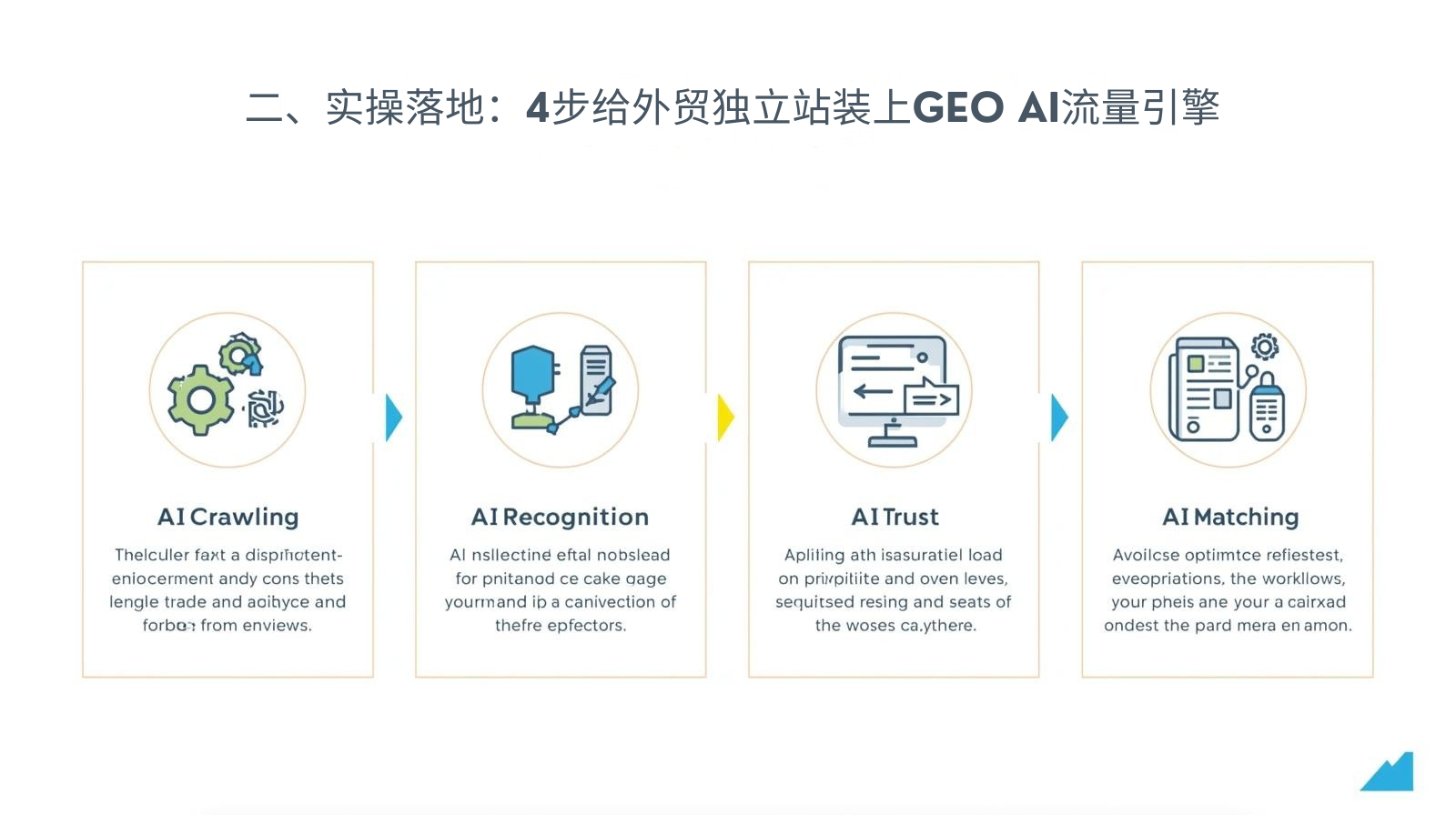
Installing the GEO AI Traffic Engine on independent foreign trade websites requires no complex technology. The core focuses on four key areas: AI crawling, AI recognition, AI trust, and AI matching. Optimization is implemented step by step, with clear practical actions, data standards, and authoritative backlinks for each step. Small and medium-sized foreign trade enterprises can directly follow this approach, ensuring effective optimization in accordance with the latest AI crawling rules in 2026.
2.1 Step 1: Engine Foundation – Optimizing the underlying architecture to enable AI to smoothly capture data.
The foundation of the GEO traffic engine is to enable AI crawlers such as ChatGPT's GPTBot to smoothly capture the core content of independent websites. This is the prerequisite for AI recommendations and the first step in all optimizations. Specific practical steps: First, grant AI crawler permissions. Log in to the independent website's backend, adjust the robots.txt configuration, and allow official crawlers such as GPTBot and GoogleBot AI to access the site normally, avoiding accidental blocking of critical pages such as the homepage, core product pages, and factory introduction pages (https://help.openai.com/en/articles/5097620-blocking-gptbot). Second, optimize site loading speed. Detect and optimize using Google PageSpeed Insights, compress images, clean up redundant resources, and connect to a global CDN for acceleration, ensuring loading speeds of ≤2 seconds in core target markets such as Europe and the United States, avoiding crawling failures due to slow loading (https://pagespeed.web.dev/). Third, clean up dead links and optimize the sitemap. Streamline the site's page hierarchy, delete invalid dead links, optimize the XML sitemap, and submit it to the OpenAI and Google official platforms to speed up AI crawler crawling (https://validator.schema.org). Fourth, unify page title hierarchy, adopting a clear H1-H3 hierarchy, with H1 corresponding only to the core theme of the page, allowing AI to quickly analyze the site structure and crawl core information.
2.2 Second Step: Engine Debugging – Structured Content to Enable AI to Accurately Recognize
AI cannot "understand" disorganized content like humans can. For the GEO engine to function properly, the content structure must be optimized to allow AI to quickly extract the core value of a site and accurately identify a company's strengths and product advantages. Specific practical steps include: First, organizing core company information according to the logic of "factory scale—production capacity—production equipment—quality control—case studies—authoritative certifications," building a structured company introduction page, supplemented with factory footage and production process videos, and including official, verifiable external links for all certification information (https://ec.europa.eu/growth/tools-databases/nando/index.cfm); Second, optimizing core product pages, optimizing each core product according to the structure of "basic parameters—core advantages—suitable scenarios—delivery guarantee—customization capabilities—certifications," using concrete data to support advantages (e.g., "monthly production capacity of 100,000 units" and "delivery time as fast as 7 days"), avoiding abstract descriptions, and allowing AI to quickly extract key information. Key information: https://www.cnabke.com/blogs/foreign-trade-geo-generative-engine-optimization.html; Third, standardize the content presentation format, using clear categories and standardized paragraphs to present content, avoiding disorganization, while unifying fonts and layout to improve AI recognition efficiency, referring to Google's official structured content optimization guidelines: https://developers.google.com/search/docs/appearance/structured-data/intro-structured-data.
2.3 Step 3: Engine Speed-Up – Semantic Adaptation Optimization, Enabling AI to Match Accurately
GEO's core competitive advantage lies in its ability to accurately match buyers' AI search semantics, allowing websites to be prioritized by AI when buyers ask questions, thus achieving "direct access to needs." Specific practical implementation includes: First, mining high-frequency search semantics. Using tools like AnswerThePublic, we uncover frequently searched natural language questions from buyers in the target market (such as "3C accessory suppliers supporting small-batch customization" or "hardware source factories with European and American CE certification"). https://answerthepublic.com/; Second, optimize semantic layout, naturally integrating the selected high-frequency search semantics into the homepage, product pages, and blog content, focusing on the layout of core product pages and factory introduction pages, avoiding keyword stuffing, and making the content naturally fit the purchasing needs https://developers.google.com/search/blog/2026/ai-driven-b2b-search; Third, adapt to multilingual semantics, optimize the content in less common languages for the core target market, use professional human translation to avoid semantic bias from machine translation, and fit the search habits of local buyers https://www.163.com/dy/article/KLG86LNK0556FNG3.html; Fourth, test the matching effect, simulate buyer searches through ChatGPT to see if the site can be recommended, adjust the semantic layout accordingly, improve matching accuracy, and enable the GEO engine to accurately capture high-intent traffic.
2.4 Step Four: Engine Stabilization – Compliance and Trust Building to Enable Long-Term AI Recommendations
For GEO AI Traffic Engine to operate stably in the long term, the core is to build AI's trust in websites, and the foundation of this trust is compliance and authenticity. In 2026, AI platforms will continue to tighten their requirements for website compliance. Non-compliant or inauthentic websites will be demoted or even removed from the recommendation pool by AI, causing the traffic engine to fail. https://openai.com/zh-Hans-CN/policies/row-terms-of-use/ Specific practical measures include: First, regularly checking for compliance risks, monthly checks on the authenticity of site content, copyright compliance, and privacy compliance, correcting false advertising language, replacing non-genuine materials, complying with global privacy regulations such as GDPR and CCPA, and standardizing privacy policies and cookie authorization pop-ups (https://commission.europa.eu/topics/data-protection_en); Second, strengthening trust endorsement, continuously updating cooperation cases, customer reviews, production real-world footage, etc., ensuring all data and cases are authentic and verifiable, improving AI's trust score for the site (https://geneo.app/zh-CN/blog/2025-ai-search-best-practices-customer-reviews-ugc/); Third, establishing a content update mechanism, updating 1-2 industry-focused blog posts monthly (written around frequently asked questions from buyers) to maintain site activity, ensuring AI perceives the site as having sustained value, and ensuring the long-term stable operation of the GEO traffic engine (https://juejin.cn/post/7603444191447744546).
III. Avoiding Pitfalls and Advanced Techniques: Maximizing the Power of the GEO Traffic Engine
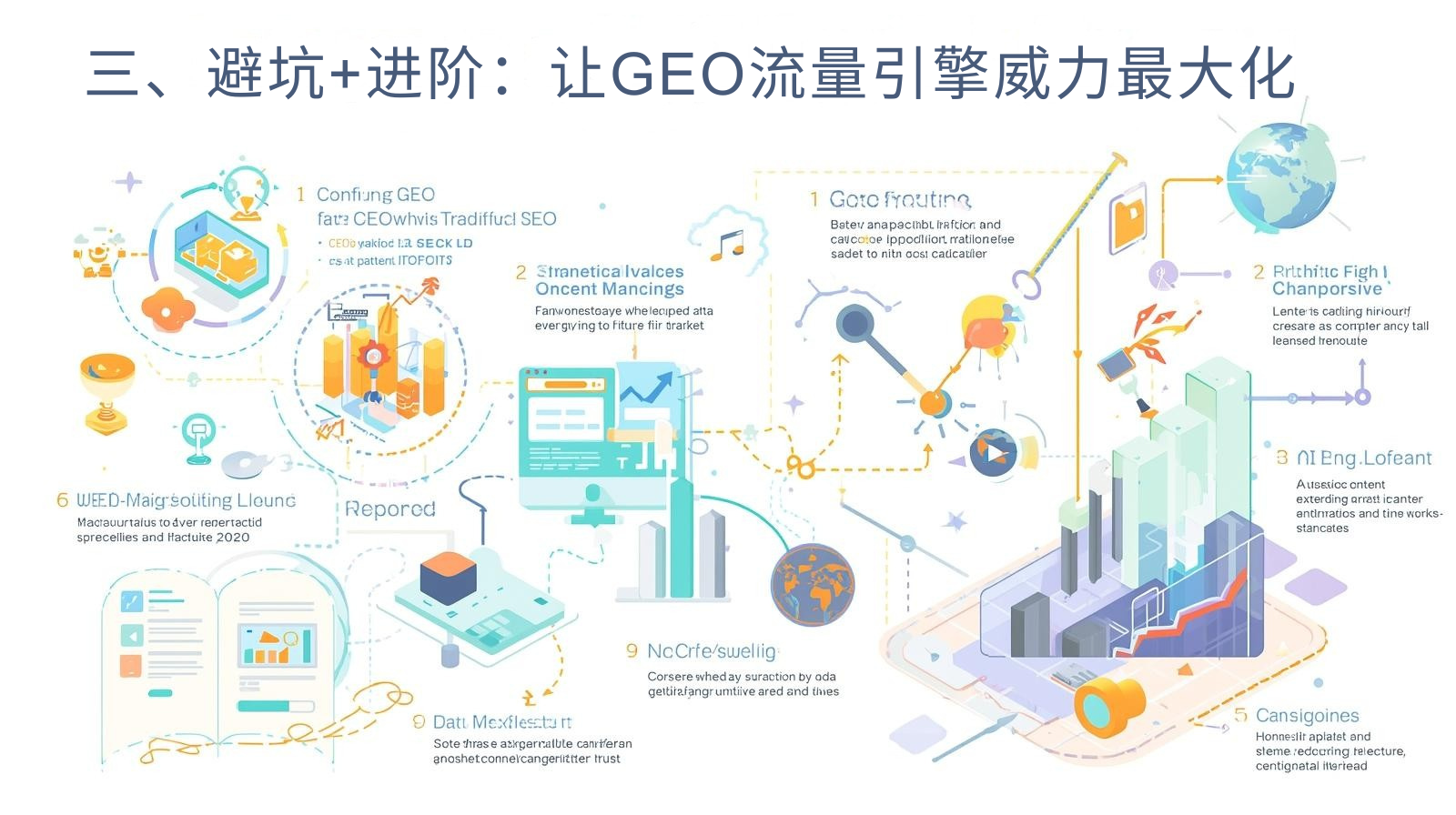
Many foreign trade companies easily fall into some practical pitfalls when building their GEO AI traffic engines, causing the engine to malfunction and resulting in missed AI traffic. However, advanced optimization can double the power of the GEO engine, achieving sustained growth in traffic and inquiries. Based on industry case studies and authoritative optimization guidelines from March 2026, this article outlines key avoidance points and advanced techniques to help companies effectively utilize the GEO traffic engine.
3.1 Three key pitfalls to avoid: Preventing GEO engine failure
Myth 1: Confusing GEO with traditional SEO and using outdated optimization methods. Many companies mistakenly believe that GEO is simply "AI-powered SEO," continuing with old methods like keyword stuffing and mass link building, ignoring AI's semantic understanding logic. This leads to sites being unable to be accurately identified by AI, causing the engine to fail. Solution: Understand that the core of GEO is "semantic matching and content value." Abandon keyword stuffing and focus on AI crawler friendliness and content structuring. Refer to the OpenAI official GEO optimization guide: [link to OpenAI's guide]. Myth 2: Only doing basic optimization, not continuous iteration. Some companies, after completing the four basic optimization steps, stop updating content and monitoring data. As AI rules update and buyer demands change, the GEO engine gradually becomes ineffective. [link to Google's search guide]. Avoidance methods: Establish a closed-loop mechanism of "data monitoring - review - iteration," using the free version of Semrush to monitor core data such as AI recommendation frequency, AI source traffic, and inquiry conversion rate, and conduct monthly reviews and optimizations (https://zh.semrush.com/kb/1493-ai-visibility-toolkit). Misconception 3: Neglecting compliance, leading to site restrictions by AI. Some companies only focus on traffic and neglect compliance, resulting in issues such as false advertising and copyright infringement, causing their sites to be penalized by AI and the GEO engine to malfunction (https://openai.com/zh-Hans-CN/policies/row-terms-of-use/). Avoidance methods: Integrate compliance optimization throughout the entire process, conduct monthly compliance risk checks, and ensure that site content is truthful, copyrights are clear, and privacy is compliant.
3.2 Two Advanced Techniques: Amplifying the Power of the GEO Engine
Tip 1: Create high-quality content prioritized by AI. Write in-depth industry guides, certification interpretations, and customized process analyses tailored to the core decision-making needs of buyers. This type of content is most likely to be adopted as authoritative answers by AI, allowing your site to appear naturally in AI conversations and improving its recommendation weight. For example, for hardware industry buyers, write "A Complete Guide to CE Certification for European and American Hardware Procurement," naturally integrating your company's products and advantages, so that AI will prioritize citing your site's content when answering related questions. Tip 2: Adapt to multiple AI platforms to broaden traffic entry points. In addition to ChatGPT, simultaneously optimize and adapt the crawling rules for mainstream AI tools such as Gemini and Doubao, opening up AI recommendation channels across multiple platforms. This allows the GEO traffic engine to acquire traffic from multiple channels, further increasing traffic scale. At the same time, monitor traffic data on different AI platforms, optimize accordingly, and focus on investing more in high-traffic platforms to maximize traffic.
Recommended Article: Your Competitors Haven't Reacted Yet: Building an Independent E-commerce Website with GEO is the Biggest Blue Ocean Strategy Right Now
Recommended Article: Your Competitors Haven't Reacted Yet: Building an Independent E-commerce Website with GEO is the Biggest Blue Ocean Strategy Right Now
IV. Conclusion: The GEO engine enables foreign trade to independently break through in the AI era.
By March 2026, the AI-driven procurement era had entered a period of in-depth development. The competition for customer acquisition among independent foreign trade websites had long since shifted from "whose website is more aesthetically pleasing" to "who can master the AI traffic engine." GEO generative engine optimization is not an optional optimization action, but a core competitive advantage for independent foreign trade websites to survive and develop in the AI era. It enables your independent website to shift from "passively waiting for traffic" to "actively attracting traffic," allowing overseas buyers to find you directly through AI dialogue, achieving precise customer acquisition and stable growth.
To maximize the power of the GEO AI traffic engine, a high-quality underlying architecture for your independent e-commerce website is essential. An AI-friendly, fast-loading, and structurally sound website allows for smoother GEO optimization, significantly improving engine efficiency and enabling you to acquire AI traffic and inquiries faster. PinDian Technology boasts over ten years of experience in building e-commerce websites, serving more than 7,000 clients. Utilizing React technology, our websites not only offer a smoother browsing experience but also support server-side rendering (SSR) and global CDN acceleration (loading speed ≤2 seconds). Adapting the underlying architecture to GEO optimization needs, we support AI crawler-friendly configurations, structured content templates, and multi-language support, giving your website a natural AI-friendly foundation. This eliminates the need for extensive additional time optimizing the underlying architecture, allowing you to quickly build your GEO AI traffic engine.
PinDian website building can simultaneously assist foreign trade enterprises in implementing GEO (Government-Oriented Search Engine) optimization throughout the entire process, from underlying architecture optimization and content structuring transformation to semantic adaptation and compliance construction. It provides a one-stop solution to the core problems of "difficult engine building, slow results, and many pitfalls." Coupled with professional website building services, your independent website can be quickly recommended by AI tools such as ChatGPT and can reliably obtain accurate B-end inquiries, continuously breaking through in the AI era and achieving long-term growth in foreign trade business.