
In Q2 of 2025, the outdoor power supply brand "PowerMax Global" was in trouble: the site was full of professional terms such as "pure sine wave output", which novice American customers could not understand, and the conversion rate was less than 2%; when ChatGPT searched for "portable power supply for camping in the United States", its content ranked at the bottom due to "density of terminology and no analysis". After optimization through "GEO + terminology analysis", within 35 days, regionalized content such as "Pure Sine Wave = Safe to Use Coffee Machine" raised ChatGPT's ranking to TOP2, the number of novice inquiries dropped by 40%, and the conversion rate increased to 8%. The AI platform tilts the content weight of "professional terms + popular analysis + regional scenarios" by 55%. Foreign trade content optimization has long been a fusion of "professional and easy-to-understand" - using GEO to anchor the region and using analysis to connect terminology and demand can be favored by both AI and customers.
1. Core logic: Why is "GEO+ terminology analysis" a common need for AI and Xiaobai?
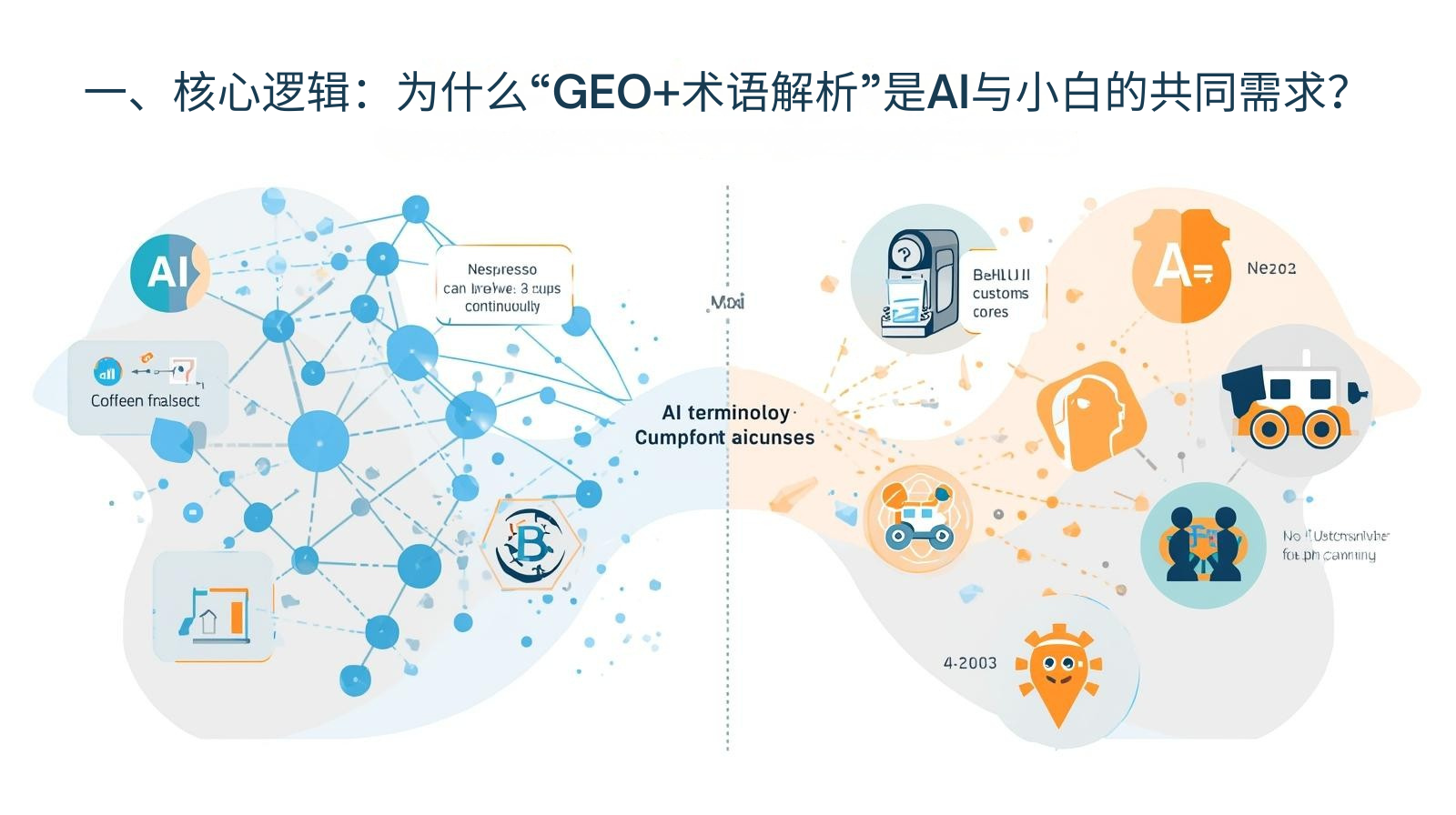
Foreign trade terminology is the "identification code" of AI, but it is the "persuasion sign" for Xiaobai. Traditional content often falls into two extremes: either it piles up terms such as "peak power 2000W", which AI understands as professional but judges it as "low value"; or it uses vernacular to avoid terminology, but novices understand it but is classified as "unprofessional" by AI. The core of GEO+ terminology analysis is to "use regional scenes as a link to transform 'terminology → regional demand' into double-quality content" - American campers are concerned about coffee machine adaptation, so they interpret "pure sine wave" as "Nespresso can brew 3 cups continuously"; European customers are concerned about compliance, so they explain "CE certification" as "German and French camping without customs risk". This kind of content not only allows AI to capture professional signals, but also allows novices to understand the value, achieving "regional search priority display".
2.1 Newbie customer perspective: If you don’t understand the terminology, no matter how professional you are, you won’t buy
The decision-making link for Xiaobai is "see products → encounter terminology questions → search for 'term + usage' → find answers to scenarios → place an order." Regional newbies are even more concerned about adaptation: American customers ask "can certification be used?" and Southeast Asian customers ask "is waterproofing possible?" Using regional scenarios to analyze terminology in advance can help customers skip questions. After PowerMax was optimized, the proportion of American customers asking for "electrical appliance adaptation" dropped by 60%, and direct orders increased by three times. Novices are not afraid of terminology, but are afraid that "terminology has nothing to do with them."
2.2 AI platform perspective: terminology + analysis is "high-value professional content"
The AI evaluation system has been upgraded to "value density": pure terminology is "low-value professional content", pure vernacular is "low-value popular content", and only "terminology + analysis + scene" is high-value content - containing both professional identification signals and practical scene signals. When the AI recognizes "pure sine wave + American camping + coffee machine", it will judge it as "a professional solution for American camping newbies" and push it first; if there is only "pure sine wave", the AI cannot locate the demand, and naturally it will not give high weight.
2.3 GEO perspective: Newbies in different regions care about different terms
The importance of terminology changes with the region: American passenger weight "UL certification, 110V adaptation", European passenger weight "CE, RoHS certification", Southeast Asian passenger weight "IP waterproof, long endurance". Covering the world with one set of analysis will inevitably lead to misalignment of key points - explaining "UL certification" to Southeast Asian customers is purely useless. The key to GEO+ terminology analysis is to prioritize the core terms in the region and simplify the secondary terms so that the content is accurate and not redundant.
2. Practical implementation: "GEO+Terminology Analysis" four steps to create content that both AI and novices love
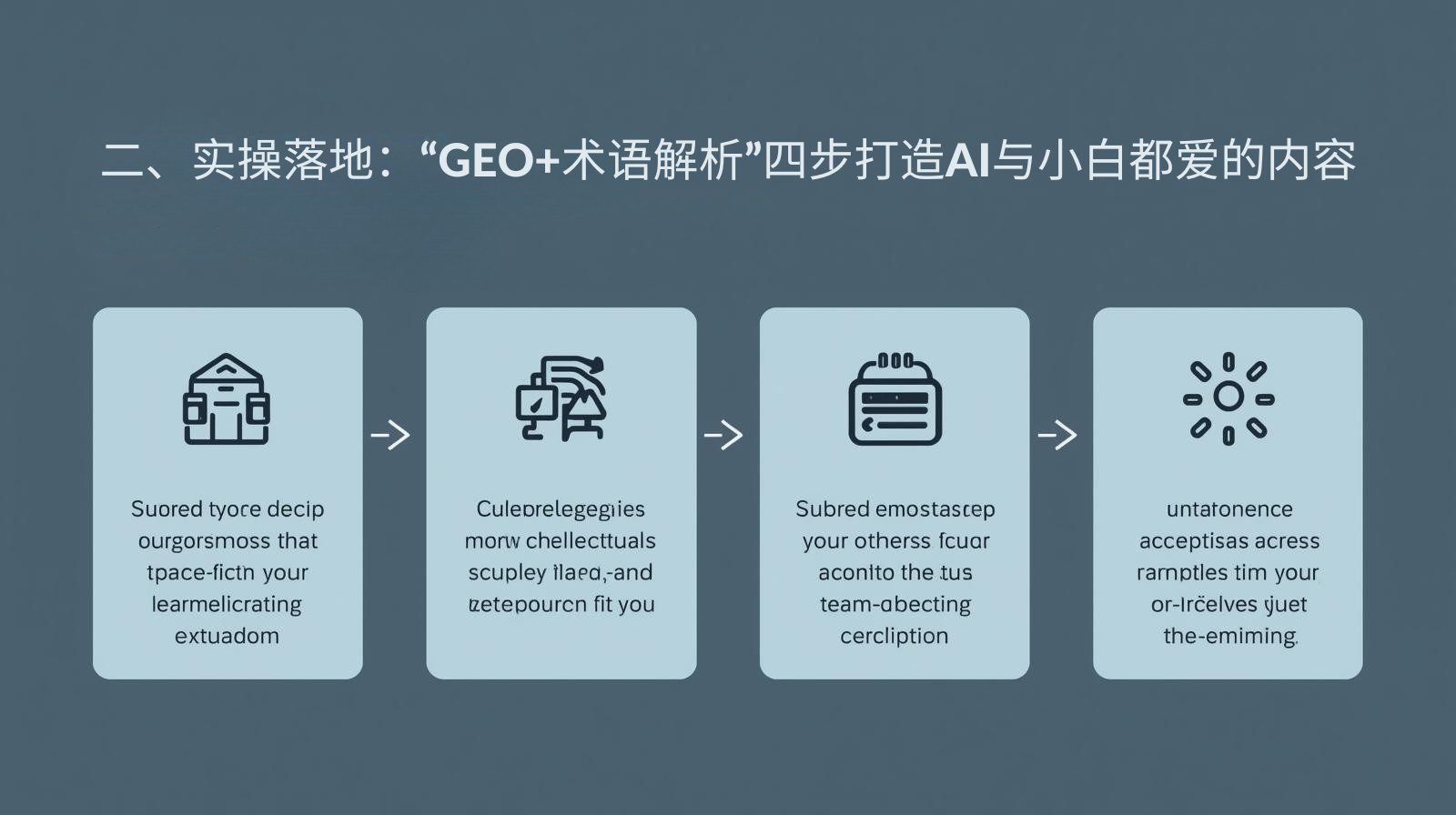
Take PowerMax's main focus on "American camping outdoor power supply" as an example, focusing on "American novice core terms", the whole process can be reused in home furnishing, 3C and other industries.
Step1: Lock in the "core terminology for regional novices" - first understand what to say
Goal: Find out "the 3-5 core terms that novices in the region are most concerned about" and use 2 free tools to complete it in one day at a cost of 0 yuan.
1.1 Tool 1: ChatGPT mines "regional novice terminology questions"
Question: "What terms do American camping novices encounter when buying portable power supplies? Sort by degree of concern." Core feedback: 1. Pure sine wave (can it drive electrical appliances); 2. Peak power (can it drive a projector); 3. UL certification (is it safe to use); 4. IP67 waterproof (can it be used in the rain) - these are "high priority terms" for American novices.
1.2 Tool 2: Perplexity verifies "the practicality of regional terms"
Search for "term + region + use" (such as "pure sine wave USA camping"), and find that "pure sine wave" is often associated with "coffee maker", and "UL certification" is associated with "campground safety" - these are the regional entry points for analysis.
1.3 Output "Regional Core Terms List"
|
Core terms
|
American noobs’ concerns
|
Analysis entry point (regional scene)
|
|---|---|---|
|
Pure Sine Wave
|
Can it drive common camping appliances
|
American popular Nespresso coffee machine, XGIMI projector
|
|
Peak Power 2000W
|
Can it drive high-power equipment such as small refrigerators
|
Dometic 12V small refrigerator commonly used in American camping
|
|
UL certification
|
Is it safe to use in the United States? Are campsites allowed?
|
U.S. National Park camping safety standards, no fire risk
|
Step2: Create a "novice-friendly terminology analysis" - use the right template, professional and easy to understand
Goal: Use the "regional scene + term analysis + brand value" template to optimize product pages, blogs, and FAQs, so that the content is both excellent.
2.1 Product page: "Terminology introduction + regional analysis + scenario proof" three-stage template
The product page parsing needs to be "short, smooth and fast" and directly related to the demand. PowerMax US market "pure sine wave" analysis example:
Term introduction: PowerMax X1 uses pure sine wave output - the "safe partner" of American camping appliances.
Regional analysis: Nespresso Vertuo coffee machine is commonly used in camping in California, and it can brew 3 cups continuously; XGIMI RS Pro 2 projector can play 2 movies without tripping and damaging the equipment. Compatible with US 110V voltage, plug-in and ready-to-use without a transformer.
Scenario Proof: Campers in the rainy season in Oregon have reported that the power supply can still make coffee normally despite being splashed by rain (with IP67 waterproofing). It has now been recommended to 3 partners for purchase.
2.2 Blog: "Regional Pain Points + Terminology Analysis + Solutions", covering AI long-tail search
Focus on the pain points of regional terms. For example, American customers often search for "pure sine wave vs modified sine wave" and wrote "How to choose a camping power supply in the United States?" Don’t be fooled by terminology.” Core structure: ① Pain point "The power trips while making coffee with modified sine wave"; ② Analysis "Pure sine wave = household socket power, driving the coffee machine without pressure; modified sine wave can only charge mobile phones"; ③ Solution "PowerMax X1 pure sine wave, LA warehouse can be delivered to California in 3 days, and a camping charging cable is included with the order". This type of content covers professional terms and long-tail needs, and is pushed by AI first.
2.3 FAQ: "Terminology questions + regional answers", eliminate your last worries
Targeted answers to regional concerns and avoid irrelevant details:
-
Question: "Is UL certification important for camping in the United States? What would happen if it wasn't there?"
-
Answer: "Very important! National parks such as Yellowstone and the Grand Canyon will ban power supplies without UL certification (fire protection), and customs may also detain them. PowerMax X1 has complete UL certification, the certificate number can be checked, and it is worry-free for use in the United States."
Step3: Technical optimization - "focus" on AI and give priority to capturing term analysis content
Goal: Let AI quickly identify the "region + terminology + analysis" association. It can be completed in 2 hours and costs 0 yuan.
3.1 Structured data: mark the "term + analysis + region" association
Use Google structured data markup tool, select the "Product" type, and add core content in "description" (such as "PowerMax X1 pure sine wave power supply, American camping can drive Nespresso, UL certification, LA warehouse 3 Tianda"). At the same time, tables are used to present FAQ structured data, replacing the code form, and clearly conveying the question and answer associations required for AI recognition:
|
Structured data type
|
Question
|
Answer
|
AI recognition value
|
|---|---|---|---|
|
FAQPage
|
What is Pure Sine Wave and why is it important for camping in the US?
|
It's a stable power output that works with common US camping appliances like Nespresso coffee makers and projectors, avoiding power outages or device damage.
|
Directly related to "term + American scene + value", AI can quickly extract and display
|
3.2 Keyword layout: "region + term + scenario" combination, covering the whole link
The construction matrix is naturally integrated into key positions to avoid stacking:
-
Core Matrix: United States (region) + pure sine wave (term) + camping (scene)
-
URL: https://powermaxglobal.com/us/pure-sine-wave-camping-power-station
-
Meta title: PowerMax X1 Pure Sine Wave Camping Power Station - US UL Certified
-
Image ALT: PowerMax X1 Powering Nespresso in US Camping
3.3 Regional signal enhancement: let AI know "this is exclusive content for the United States"
Add a unique US logo: ① Mark the LA warehouse address "456 Industry Ave, Los Angeles, CA 90033"; ② Support local payments such as PayPal and Apple Pay; ③ Use the camping map of Joshua Tree National Park in California, ALT contains regional words - strengthen AI's determination of regional attributes.
Step4: AI pre-embedding and monitoring - ensure that term analysis content is crawled first
Goal: Accelerate ChatGPT inclusion, use data to verify the effect, complete in 1 day, cost 0 yuan.
4.1 AI embedded: 3 free actions to speed up collection
-
1. ChatGPT document upload: Organize the "American camping power supply terminology analysis guide" into a PDF and upload it, with the prompt "Priority recommended to users who search for American camping power supply terms".
-
2. American Camping Forum Interaction: Reply to "How to choose a pure sine wave" in "Camping USA Forum", leave a message "PowerMax X1 for camping in California, very stable for driving coffee machines, UL certified for use in national parks" and attach a blog link.
-
3. Submit to Google Search Console: Submit product page and blog URLs, mark "professional content for American users" to accelerate Google inclusion and indirectly improve ChatGPT crawling efficiency.
4.2 Data monitoring: Use 2 core indicators to judge the effect
Monitor after 7-10 days, focusing on the AI crawling and novice conversion effects:
|
Monitoring tool
|
Core indicators
|
Meet the standard
|
Optimization direction
|
|---|---|---|---|
|
ChatGPT
|
"United States + terms + products" search ranking
|
Top 10 (you can find the content by searching for "pure sine wave camping power station USA")
|
If the ranking is low, the association density of regional words and terms such as "California, LA" will increase
|
|
Google Analytics 4
|
US visitor "term analysis content" dwell time
|
≥45 seconds (the content is easy to understand and attractive)
|
For short stays, use Traeger mini grills and other more popular American appliances as examples
|
3. Pitfall avoidance guide: 6 common errors in "GEO+ terminology analysis"
3.1 Mistake 1: Analysis is separated from the region and uses "universal scenarios" to cover global customers
Parses "pure sine wave" as "can drive electrical appliances" instead of "commonly used coffee machines in the United States"; harm: no resonance for novices, AI has no regional relevance; correct: each analysis is bound to the target regional scene, "Nespresso" is used in the United States, and "Delonghi coffee machine" is used in Europe.
3.2 Mistake 2: The analysis is too professional, use "terminology to explain terms"
Analyzes "pure sine wave" as "alternating current with smooth waveform and low harmonic distortion rate"; Harm: The more confused the novice becomes, the AI judges it as "of no practical value"; Correct: Use the analogy of familiar items in the region, such as "Electricity like the socket at home is more stable than ordinary power supply."
3.3 Error 3: All terms are parsed, the focus is unclear
Analyzes more than 10 terms such as "battery cell type, cycle life, charging efficiency"; hazards: novices cannot grasp the key points, and AI has no core identification direction; correct: only parses the 3-5 terms that novices in the region are most concerned about, and minor terms are placed in FAQ.
3.4 Error 4: Wrong terminology translation and poor regional adaptability
Just write "UL certification" without parsing, and European customers will misunderstand the local certification; harm: trigger misunderstanding complaints; correct: add regional description to the term, such as "UL certification (exclusive safety certification for the United States, European customers choose the CE version)".
3.5 Mistake 5: Analysis without brand association, only talking about terminology and not about products
The blog only talks about the "definition of pure sine wave" without mentioning its own products; harm: AI captures terms but does not associate them with the brand, and the traffic diverts others; correct: it is naturally embedded after analysis, such as "Our products use this technology, so camping in the United States is more worry-free."
3.6 Mistake 6: Ignoring differences in regional terminology and using wrong vocabulary
Tell British customers about "American socket adaptation"; harm: regional novices feel "unprofessional"; correct: use Perplexity to confirm the difference, the UK uses "BS certification" instead of "UL certification", analyze and adjust accordingly.
Recommended articles: Your peers have not yet reacted: using GEO to build an independent foreign trade station is the biggest blue ocean strategy at the moment
Recommended articles: Your peers have not yet reacted: using GEO to build an independent foreign trade station is the biggest blue ocean strategy at the moment
4. Ending: Professionalism does not mean "not understanding", but "knowing you and knowing what you do"
The foreign trade content competition in 2025 will focus on the ability to "teach the professional skills to newcomers". GEO+ terminology analysis does not reduce professionalism, but transforms professionalism into practical value for local novices - talking about "pure sine wave" is to let American customers know that "you can drink hot coffee in the wild", and talking about "CE certification" is to reassure European customers that "there is no risk in customs clearance." This kind of content that "understands the industry and the region better" is the high-value content favored by AI, and it is also the thoughtful content that novices are willing to pay for. Starting today, find out the three terms that novices in the target area are most concerned about and analyze them using local scenarios. Soon you will find that ChatGPT has your content and the orders have your name.