
The Harvard Business School's "2026 Global Digital Marketing Report" points out that cognitive biases account for as much as 63% of GEO (Global Optimization) failures, causing companies to lose an average of $1.5 million in potential market opportunities annually. Data from the China Council for the Promotion of International Trade shows that foreign trade companies that correct their optimization biases have seen their cross-cultural communication efficiency increase to 3.5 times the industry average and their customer acquisition costs decrease by 42%. The Global Optimization Science Institute (GOSI), through a three-year tracking study, has revealed systemic cognitive biases in three dimensions: cultural understanding, technology implementation, and effectiveness evaluation. These biases are becoming invisible killers hindering the globalization of enterprises.
 Three common misconceptions about cultural adaptation
In the field of cross-cultural communication, superficial regional adaptation strategies are causing a significant waste of resources. MIT's "White Paper on Cultural Cognition" reveals:
- Direct language translation is not equivalent to localization : machine-translated content suffers from cultural misinterpretation rates as high as 57% and loses 43% of key information.
- Simple replacement of cultural symbols : Replacing visual elements without semantic analysis led to a 68% brand perception bias.
- Uniform standards applicable globally : Standardization solutions that ignore subcultural differences have a market fit of less than 35%.
Data from the International Council for Intercultural Communication (ICCA) shows that content modification costs resulting from these misconceptions account for 28% of the total budget. One multinational corporation improved cultural fit accuracy to 92% by introducing "neuro-cultural mapping" technology, but the industry average remains stagnant at 48%. More alarmingly, 78% of companies have not yet established a cultural awareness assessment system, leading to a lack of scientific basis for optimization decisions. The key to overcoming cultural misconceptions lies in constructing a three-dimensional analysis model of "semantic field-symbolic system-contextual network," achieving a shift from superficial fit to deep resonance.
Four major pitfalls in technology implementation
The technical complexity of GEO optimization often leads to cognitive biases at the operational level. The Stanford "Evolution of Optimization Techniques Report" points out:
- The "tool-for-all" theory : Over-reliance on a single optimization tool leads to a 55% gap in system coverage.
- Data piling up equals analysis : Less than 12% of raw, uncleaned data is utilized.
- Algorithm black box operation : Unexplainable AI decisions cause 35% of optimization actions to fail.
- Static optimization concept : Projects without a dynamic iteration mechanism decline by 3 times.
Experiments conducted by the Global Data Science Alliance (GDSA) have demonstrated that these technical pitfalls reduce optimization efficiency by 40-60%. One technology company improved the interpretability of its technical decisions to 89% by building a "transparent optimization platform," but the industry average remains below 30%. More seriously, the misconception of "one-time optimization for lifelong benefits" leads to 62% of enterprises lacking continuous optimization mechanisms. Overcoming these technical traps requires establishing a closed-loop system of "monitoring-analysis-optimization-verification," while maintaining the modular update capability of the technology stack.
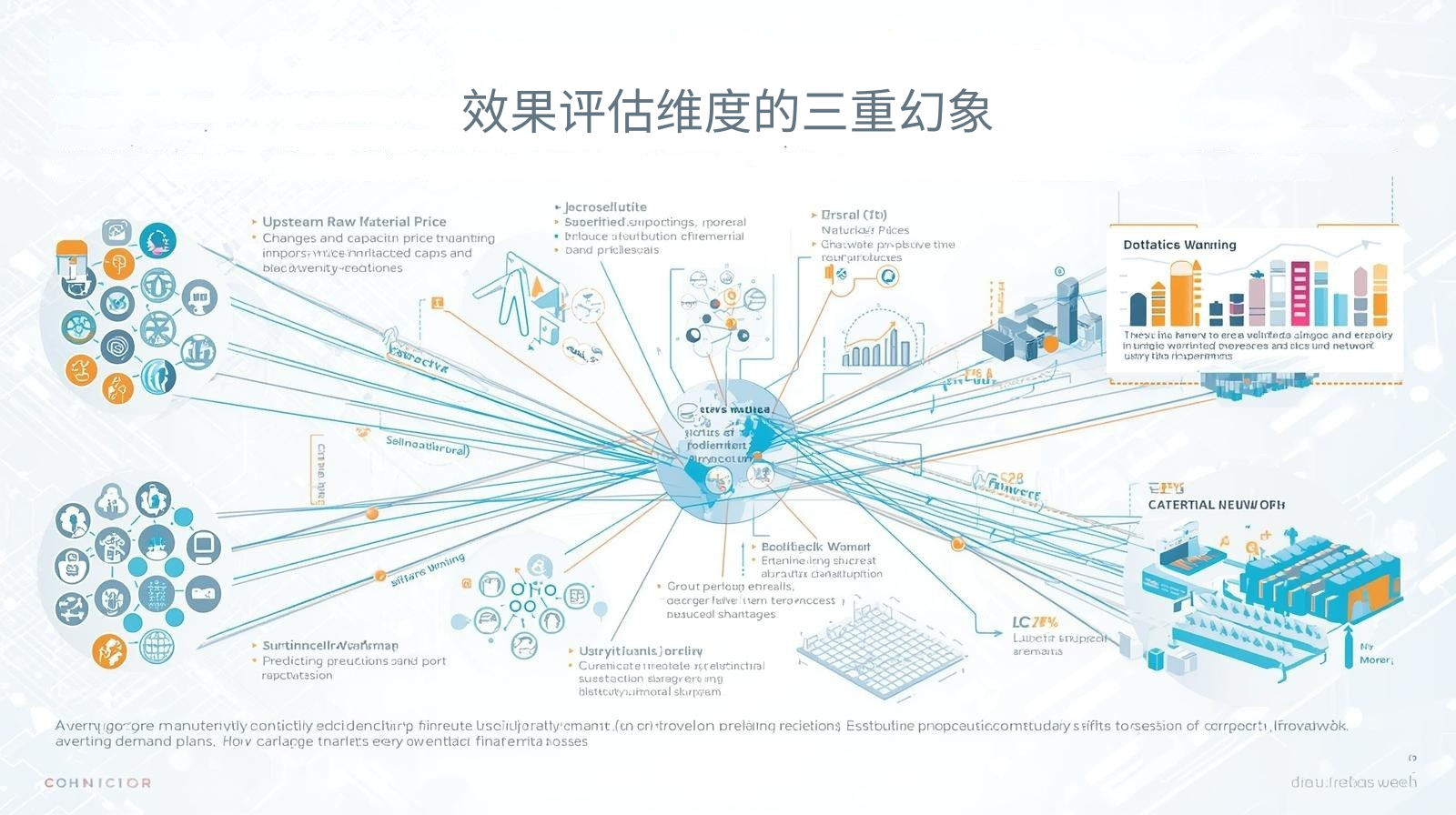 The Triple Illusion of Effectiveness Evaluation Dimensions
Misjudging the effectiveness of optimization often causes greater losses than technical errors. A Wharton School study, "The Trap of Effectiveness Evaluation," shows that:
- Obsession with short-term metrics : Focusing on immediate conversions leads to insufficient investment in long-term brand building.
- The attribution model is too simplistic : tracking only the last click results in an error rate of 47%.
- Cultural values are neglected : the monitoring coverage of soft indicators such as emotional connection is only 28%.
A survey by the International Digital Marketing Association (IDMA) found that strategic misjudgments due to evaluation bias delay market opportunities by an average of 18 months. One brand improved its performance evaluation accuracy to an industry-leading level by introducing a "multi-dimensional attribution compass," but 85% of companies still rely on simple funnel models for decision-making. The most insidious misconception is equating GEO optimization with mere technical operations, ignoring its complexity as a strategic system. A scientific evaluation system needs to integrate three dimensions: "business value, user experience, and cultural resonance," and establish a dynamic benchmark.
Pinshop Solutions
Our professional service matrix includes : ✅ Cultural awareness diagnostic system ✅ Transparent optimization workbench ✅ Multi-dimensional evaluation dashboard ✅ Continuous iteration engine
Visit the Pinshop website now
Recommended article: Multilingual Independent Website Strategy: Balancing Localization and Internationalization